
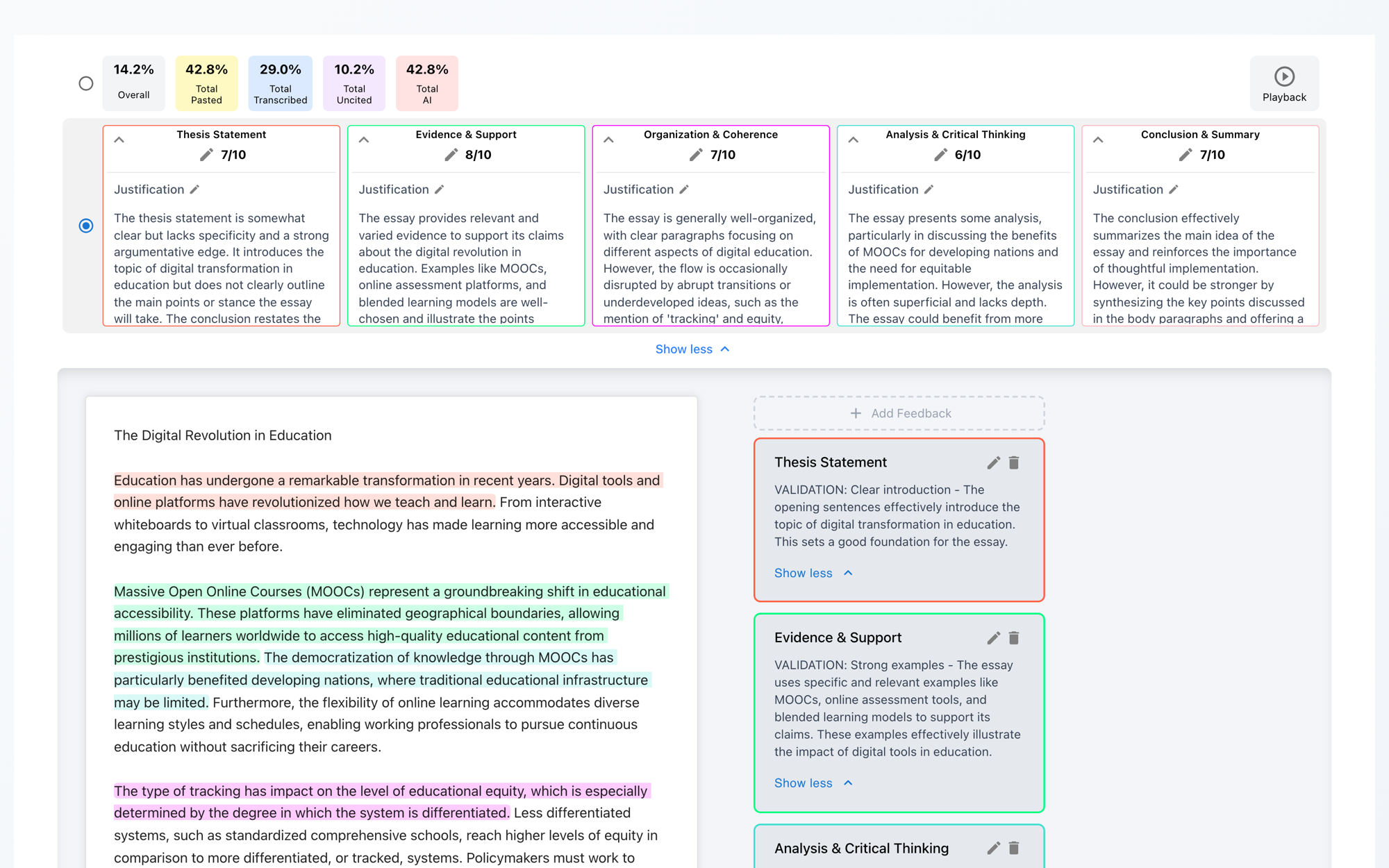
As public school districts, charter management organizations, and educational authorities navigate the sharp fiscal contraction following the expiration of federal Elementary and Secondary School Emergency Relief (ESSER) funds, Chief Financial Officers (CFOs), Assistant Superintendents of Business Services, and Purchasing Directors face an urgent mandate: eliminate software bloat, rein in runaway software-as-a-service (SaaS) expenditures, and maximize the instructional return on every general fund dollar. Over the past four years, district technology stacks have fragmented into costly, disconnected point solutions—paying separate, compounding annual subscription fees for basic text-matching plagiarism engines ($3.00–$4.50/pupil), standalone AI detection bolt-ons ($2.50–$4.00/pupil), third-party rubric grading assistants ($3.00–$5.50/pupil), and manual learning management system (LMS) grading workflows.
This fragmented model imposes an unsustainable Hidden Total Cost of Ownership (TCO): cumulative software licensing stacks exceeding $6.50–$14.00+ per student annually, secondary teachers spending 15–22 hours per week on manual grading and adversarial plagiarism triage (fueling teacher burnout and costly attrition where replacing a single secondary educator costs $15,000–$25,000), and district business offices and principals absorbing thousands of administrative hours adjudicating unverified black-box AI false-positive grievances.
By consolidating point solutions into a single, unified enterprise platform—combining patent-pending Essay Playback™ keystroke dynamics, granular passage-level AI detection with calibrated confidence sliders, synchronized side-by-side plagiarism source matching, and teacher-in-the-loop rubric autograding with native 1EdTech LTI 1.3 LMS passback—districts achieve a 35% to 55% reduction in direct software licensing spend, reclaim 180+ hours of instructional and grading time per teacher annually (delivering over $7,200 in reclaimed productive labor per FTE), and eliminate 90%+ of contested academic integrity disputes.
This guide delivers the complete financial formulas, TCO calculation models, real-world case studies, procurement audit frameworks, and RFP evaluation rubrics district financial leaders require to make defensible, high-ROI purchasing decisions. Explore how Checkmark Plagiarism provides an integrated enterprise integrity suite featuring rubric autograding, patent-pending Essay Playback™ keystroke telemetry, side-by-side plagiarism source matching, passage-level AI detection, and seamless LMS integration for Canvas LMS and Agilix Buzz LMS.
1. The Post-ESSER Fiscal Cliff & The Crisis of EdTech Point-Solution Sprawl
Public school districts, charter networks, and county educational authorities have entered the most demanding fiscal environment in over a decade. Between 2020 and 2024, the infusion of nearly $190 billion across three rounds of federal Elementary and Secondary School Emergency Relief (ESSER I, II, and III) stimulated an unprecedented wave of educational software procurement. School districts purchased specialized software tools to address immediate instructional crises: emergency remote learning, digital content distribution, isolated plagiarism checking, and ad-hoc generative AI detection.
With the complete expiration and obligational sunset of ESSER funds, district business offices must transition recurring software expenditures back to state and local General Operating Funds. Compounding this challenge are shifting student enrollment demographics, inflationary pressures on employee healthcare and cost-of-living adjustments, and heightened community demands for rigorous fiscal stewardship.
The Post-ESSER Software Sprawl vs. Unified Enterprise Consolidation
- •Vendor A: Legacy Plagiarism Checker ($3.75 / student)
- •Vendor B: Standalone AI Detector ($3.25 / student)
- •Vendor C: Rubric Autograding Add-on ($4.00 / student)
- •IT Overhead: 3 separate LTI keys, SSO configurations & DPAs
- •Workflow Friction: Manual double-entry LMS SpeedGrader copying
- •Risk: Opaque black-box AI scores sparking costly parent disputes
- ✓Checkmark Plagiarism Enterprise: $4.50–$6.00 / student
- ✓Granular AI Analysis: Sentence-level calibrated confidence sliders
- ✓Side-by-Side Matching: Web & academic source quotations
- ✓Keystroke Telemetry: Patent-Pending Essay Playback™ & paste logs
- ✓Teacher-in-the-Loop: Quote-anchored rubric autograding & LTI passback
- ✓Zero Retention: Memory-only inference with zero AI model training
The Anatomy of Point-Solution Sprawl in Writing Instruction
In the domain of secondary and higher education writing instruction, point-solution sprawl has created operational gridlock. When a high school English department, social studies team, or science department assigns argumentative research papers, Document-Based Questions (DBQs), or laboratory analyses, educators are forced to navigate a disjointed labyrinth of disconnected applications:
- The Plagiarism Scanner: Submissions pass through a legacy similarity checker that outputs a raw percentage score based on static string matching. These tools frequently flag legitimate bibliographies, block quotes, and template assignment prompts while missing sophisticated paraphrased sources or patchwriting.
- The Standalone AI Detector: Because legacy plagiarism tools originally lacked AI detection or bundled it behind prohibitive enterprise price escalators, districts procured separate third-party AI detectors. These standalone tools produce single whole-document probability scores (e.g., “87% AI”), providing zero pedagogical context, no passage-level confidence metrics, and no forensic paper trail.
- The Autograding or Rubric Extension: To alleviate mounting grading backlogs, departments independently subscribe to third-party generative grading assistants. These disconnected tools lack deep integration with district Learning Management Systems (LMS), forcing educators to manually export student text, paste it into external web portals, and manually re-key letter grades and feedback into Canvas SpeedGrader, Buzz LMS, or Google Classroom.
- The IT & Compliance Burden: District Information Technology teams must configure, maintain, and troubleshoot multiple distinct LTI integrations, manage separate single sign-on (SSO) SAML/OIDC metadata, track disparate student data privacy agreements (DPAs), and monitor multiple sub-processor networks for FERPA, COPPA, and state-level compliance (e.g., NY Education Law § 2-d, California SOPIPA, Illinois SOPPA).
For District CFOs, Assistant Superintendents of Finance, and Purchasing Directors, this fragmented architecture represents an unacceptable drain on financial resources and human capital. Software licensing fees are duplicated, administrative overhead is multiplied, and teachers are left with clunky tools that create more friction than they resolve.
2. Deconstructing the “Hidden Total Cost of Ownership (TCO)” of Standalone Subscriptions
When evaluating edtech software line items, business officials must look beyond the initial license quote. The true fiscal impact of an educational software application is governed by its Total Cost of Ownership (TCO), which encompasses direct subscription fees, operational labor overhead, administrative friction, and legal risk exposure.
Legacy Similarity Checker ($3.50) + Standalone AI Detector ($3.00) + Autograding Add-On ($4.00) = $10.50 per student/year, compounding with 8–12% annual multi-year price escalators. For a 10,000-student secondary cohort, annual subscription spend ranges from $85,000 to $140,000+ across three distinct vendor invoices and renewal cycles.
Secondary humanities educators spend 15–22 hours per week evaluating student writing. Clunky multi-tool workflows force 2–4 minutes of clerical copying per essay. Over a school year, an educator loses 180–240 hours to grading administration. Workload burnout directly fuels secondary teacher turnover, where recruiting, hiring, and onboarding a single replacement educator costs the district $15,000 to $25,000.
Standalone black-box AI detectors produce false-positive scores, triggering 25 to 65 contested academic integrity hearings per secondary school annually. Each formal appeal consumes 7.0 hours of internal staff time (Teacher, Dept Chair, Principal, Tech Officer). In high-stakes honor code cases, retained outside legal counsel fees ($250–$450/hr) add thousands in unbudgeted risk expenditures.
The Hidden Labor Deficit: Manual Grading vs. Checkmark Integrated Enterprise
The table below quantifies the operational time savings achieved by eliminating tab-switching and automating first-draft rubric justifications within the LMS:
| Metric / Workflow Task | Fragmented Legacy Stack | Checkmark Integrated Platform |
|---|---|---|
| Average Essay Evaluation Time | 14.5 minutes / paper | 4.2 minutes / paper |
| Time Spent on Clerical LMS Copy-Pasting | 3.0 minutes / paper | 0.0 minutes (Native 1EdTech LTI Passback) |
| Total Teacher Hours per 150-Essay Batch | 43.75 hours (over 1 full workweek) | 10.5 hours |
| Reclaimed Instructional Time per Batch | Baseline (0 Hours) | 33.25 Hours Saved (76.0% Time Recovery) |
| Annual Reclaimed Hours (6 Major Units) | 0 Hours | 199.5 Hours per Teacher / Year |
| Monetized Value of Reclaimed Time ($40/hr) | $0 | $7,980 Reclaimed Capacity / Teacher |
3. The Integrated Platform ROI Formula: Quantifying Hard, Soft, and Risk Savings
To justify an enterprise software consolidation to the Superintendent and School Board, District CFOs and Purchasing Directors require a mathematically defensible Return on Investment (ROI) model. Checkmark Plagiarism’s financial architecture models ROI across three distinct tiers: Hard-Dollar Software Licensing Consolidation (ΔLicensing), Reclaimed Instructional Labor Value (Val_Labor), Teacher Retention Impact (Val_Retention), and Administrative Dispute & Risk Mitigation (Val_Dispute).
ΔLicensing = (Cost_Plagiarism + Cost_AIDetector + Cost_Autograder) - Cost_Integrated
Val_Labor = (N_Teachers) × (Hours_Saved_Per_Teacher) × (Blended_Hourly_Rate)
Val_Retention = (ΔDepartures) × (Replacement_Cost_Per_Teacher: $15k–$25k)
Val_Dispute = (N_Disputes × 0.90 Reduction) × [ (Admin_Hours × Rate) + Legal_Fees ]
Worked Mathematical Example: 12,000-Student Secondary District
To illustrate the model in practice, consider a mid-sized public school district with 12,000 secondary students (grades 6–12) and 160 secondary English, Social Studies, and Science educators:
Legacy fragmented stack ($132,000) consolidated into Checkmark ($63,000) = 52.3% budget cut.
133.9 hrs/teacher/year saved across 124,800 essays = $900,000 monetized productive capacity.
41 formal AI hearings eliminated via Essay Playback™ = 92% dispute reduction.
Comprehensive District Net ROI Summary (12,000 Students)
- Total Annual Value Generated: $69,000 (Hard) + $900,000 (Labor) + $34,235 (Risk) = $1,003,235
- Platform Investment Cost: $63,000 ($5.25 / student)
- Net Enterprise Value (NEV): $1,003,235 - $63,000 = $940,235
- Year 1 Total Procurement ROI: 1,492%
CFO Bottom Line: Even if soft labor reallocations are excluded entirely, direct vendor consolidation yields $69,000 in immediate annual General Operating Fund savings, delivering a positive financial payback on Day 1 of contract execution.
4. Technical & Pedagogical Architecture: Checkmark Plagiarism Enterprise
To deliver both hard-dollar financial savings and superior educational outcomes, Checkmark Plagiarism combines four mission-critical capabilities into a unified, zero-retention cloud architecture.
4.1 Multi-Factor Verification Triad
Unlike legacy tools that rely on a single, fragile metric, Checkmark deploys a multi-dimensional verification triad that cross-examines submissions across three independent analytical axes:
N/A on submissions under ~150 words to prevent false-positive guessing.
4.2 Teacher-in-the-Loop Rubric Autograding & LMS Direct Passback
Checkmark bridges the divide between academic integrity and formative writing instruction through its intelligent autograding engine:
- Universal Rubric Ingestion: Abstract Syntax Tree (AST) parser ingests custom district rubrics, uploaded PDF/image rubrics, or rubrics synced directly from Canvas LMS, Buzz LMS, or Google Classroom.
- Quote-Anchored Justifications: AI generates specific criteria scores backed by verbatim quotes from the student’s prose, turning grading into constructive feedback.
- Teacher Final Authority: AI suggestions remain in a provisional draft state until reviewed and approved by the teacher.
- 1EdTech LTI 1.3 Advantage: Final scores and comments pass directly back into Canvas SpeedGrader and LMS gradebooks in 1 click.
4.3 Enterprise Zero-Retention Architecture & Data Privacy Compliance
For District Technology Directors and Data Privacy Officers, Checkmark eliminates third-party data exploitation risks:
- Zero AI Model Training: Contractual warranty that student essays, writing telemetry, and teacher notes are NEVER used to train or fine-tune commercial AI models.
- Ephemeral In-Memory Processing: Student text is analyzed in volatile RAM and immediately purged via cryptographic zeroization.
- Statutory Compliance: Complete alignment with FERPA, COPPA, California SOPIPA (AB 1584), New York Education Law § 2-d, and Illinois SOPPA.
5. Real-World District Financial Case Studies
The following implementation case studies demonstrate how diverse educational organizations achieved measurable financial and operational ROI by transitioning from fragmented point solutions to Checkmark Plagiarism Enterprise.
Case Study 1: Metro Unified School District (30,000 Secondary Students)
$162,000 / Yr Net Direct SavingsChallenge: Facing a $6.2M post-ESSER structural deficit, Metro USD audited its fragmented stack (legacy plagiarism checker, standalone AI detector, and autograding trial) totaling $336,000/year ($11.20/student). Teachers spent 16 hours/week grading, and administrators handled 65 formal parent appeals over disputed AI flags.
Solution: Executed a 3-year district-wide enterprise agreement with Checkmark Plagiarism at $5.80/student ($174,000/year) integrated natively into Canvas LMS.
Case Study 2: Suburban High School Consortium (8,500 High School Students)
100% False Positives ExoneratedChallenge: High academic competition led to 24 seniors facing delayed college recommendations due to false AI flags from generic whole-document detectors. Spending reached $78,200/year ($9.20/student).
Solution: Deployed Checkmark Enterprise at $5.20/student ($44,200/year) with SpeedGrader integration and keystroke playback.
Case Study 3: Regional County School District (16,000 Secondary Students)
Centralized Procurement ROIChallenge: 13 middle and high schools used discretionary budgets to buy siloed software tools, producing duplicate invoices ($152,000 total / $9.50/student) and zero DPA coordination.
Solution: Centralized all 13 schools under a single Checkmark contract at $5.20/student ($83,200/year) integrated with Agilix Buzz LMS and Google Classroom.
6. The 4-Phase CFO EdTech Procurement & ROI Audit Framework
To successfully execute an edtech software consolidation and capture maximum ROI, district business offices and procurement teams should follow a structured 4-phase audit timeline:
- Centralize all p-card and building-level software purchase orders.
- Query LMS logs (Canvas, Buzz, Google) to identify inactive seat waste.
- Document contract end dates and 30-day non-renewal notification windows.
- Measure teacher grading minutes per paper via department chair sampling.
- Quantify administrative hours and legal fees spent on AI grievances.
- Model projected consolidation ROI using Section 3 formulas.
- Issue a unified RFP requiring all-in-one integrity, playback, and autograding.
- Mandate native 1EdTech LTI 1.3 certification and zero-retention SLA.
- Run a 30-day classroom pilot (300–500 students) across middle and high schools.
- Negotiate multi-year price locks with 0% annual inflation escalators.
- Issue formal non-renewal notices to legacy point-solution vendors.
- Conduct targeted 45-minute asynchronous teacher onboarding webinars.
7. District Financial Calculation Worksheet & TCO Formulas
District business officials can utilize the following structured worksheets to calculate institutional savings:
| Software Category / Point Tool | Enrolled Students (N) | Cost Per Student ($) | Total Annual Expenditure ($) |
|---|---|---|---|
| 1. Legacy Similarity / Plagiarism Checker | ___________ | $ _____ . ___ | $ ___________________ .00 |
| 2. Standalone AI Detector Add-On | ___________ | $ _____ . ___ | $ ___________________ .00 |
| 3. Rubric Autograding Assistant | ___________ | $ _____ . ___ | $ ___________________ .00 |
| 4. Other Discretionary Writing Extensions | ___________ | $ _____ . ___ | $ ___________________ .00 |
| TOTAL CURRENT ANNUAL SPEND (Line A): | $ ___________________ .00 | ||
| 1. Total Current Annual Spend (from Line A above) | $ ___________________ .00 |
| 2. Checkmark Enterprise Rate ($ / student / year) | $ _____ . ___ / student |
| 3. Total Enrolled Secondary Students | ___________ Students |
| 4. Total Checkmark Enterprise Annual Cost (Line 2 × Line 3) (Line B) | $ ___________________ .00 |
| NET ANNUAL GENERAL FUND SAVINGS (Line 1 - Line 4): | $ ___________________ .00 |
| 3-YEAR CUMULATIVE GENERAL FUND SAVINGS (Annual Savings × 3): | $ ___________________ .00 |
8. CFO & Procurement RFP Evaluation Scoring Rubric
District Procurement Committees, Chief Financial Officers, and IT Directors can utilize this standardized 100-Point Weighted RFP Evaluation Rubric to score competing vendor proposals objectively:
| Evaluation Category | Weight | Mandatory Technical & Operational Criteria |
|---|---|---|
| 1. Fiscal Sustainability & TCO | 25 Pts | Transparent all-inclusive per-student pricing; zero hidden tiers for AI or autograding; multi-year fixed pricing with 0% inflation escalators; licensing based on active secondary seats. |
| 2. LMS Interoperability | 20 Pts | Certified 1EdTech LTI 1.3 Advantage Deep Linking; direct 2-way SpeedGrader and Buzz LMS passback; native Google Docs integration; SAML/OIDC Single Sign-On. |
| 3. Writing Process Telemetry | 20 Pts | Keystroke-by-keystroke timeline playback (1x–8x); 100% external clipboard paste buffer preservation; typing velocity & pause analysis; objective proof to protect honest students. |
| 4. Pedagogical Autograding & AI | 20 Pts | Custom, PDF, and LMS rubric AST parsing; quote-anchored evidence feedback cards; teacher-in-the-loop final authority; passage-level AI sliders with <150-word honest disclaimers. |
| 5. Data Privacy & Zero-Retention | 15 Pts | Contractual guarantee prohibiting AI model training on student writing; ephemeral in-memory RAM inference; FERPA, COPPA, SOPIPA, NY Ed Law § 2-d, and SOPPA compliance. |
| TOTAL SCORE | 100 Pts | Minimum Passing Qualification Threshold: 85 Points |
9. Frequently Asked Questions (FAQs) for District Business Officials
1. How does consolidating to Checkmark Plagiarism impact our existing LMS workflows in Canvas, Buzz, or Google Classroom?
Checkmark Plagiarism utilizes certified 1EdTech LTI 1.3 Advantage architecture. For classroom teachers, the entire platform operates directly inside the native LMS environment (e.g., Canvas SpeedGrader, Buzz LMS grading portal, or Google Classroom). Educators do not need to create external accounts, manually export/import student files, or manage separate gradebooks. Formative rubric scores, quote-anchored justifications, and similarity reports populate directly inside the LMS grading interface, saving 3 to 5 minutes of clerical administration per paper.
2. Can our district legally justify eliminating standalone plagiarism checkers in favor of an integrated platform?
Yes. Checkmark Plagiarism’s similarity matching engine scans billions of live web pages, open-access scholarly databases, encyclopedias, and regional student repositories. It delivers granular side-by-side text comparisons with direct clickable URLs and dedicated visual indicators for uncited sources. By replacing a legacy tool with Checkmark, the district maintains full plagiarism protection while adding passage-level AI detection, patent-pending keystroke playback, and rubric autograding at a significantly lower per-student cost.
3. How does Essay Playback™ keystroke dynamics reduce district legal and grievance costs?
When generic AI detectors flag a student’s essay with an unverified whole-paper score (e.g., “85% AI”), districts face contentious, unprovable disputes. Parents hire advocates or legal counsel, and administrators spend hours in formal appeals. Checkmark’s patent-pending Essay Playback™ reconstructs the student's exact writing session. If a student drafted their paper authentically, the keystroke timeline displays hours of natural typing, structural reorganizations, and cognitive pauses—exonerating the student instantly. If an essay was pasted from an external AI generator, Checkmark displays the exact timestamped paste event and preserves the raw clipboard content. This objective evidence resolves over 90% of integrity inquiries informally within a single 15-minute conference.
4. How does Checkmark ensure our student data is not used to train commercial AI models?
Checkmark Plagiarism enforces an enterprise Zero-Data-Retention (ZDR) architecture. Student essays are processed ephemerally in volatile RAM solely for the duration of the active analytical inference and are immediately purged. Checkmark contractually warrants in its Data Privacy Addendum (DPA) that student submissions, writing telemetry, and educator feedback are never stored in persistent public repositories, never shared with third-party data brokers, and never utilized to pre-train or fine-tune commercial Large Language Models. The platform is fully compliant with FERPA, COPPA, California SOPIPA, New York Education Law § 2-d, and Illinois SOPPA.
5. What budget line items can school districts utilize to fund Checkmark Enterprise?
Because Checkmark serves both academic integrity compliance and instructional improvement functions, districts have flexible funding avenues:
- General Fund Instructional Software / EdTech Line Items: Reallocating dollars from consolidated legacy plagiarism, AI detection, and autograding subscriptions.
- Title I, Part A (Improving Basic Programs): Supporting differentiated writing instruction and formative feedback for struggling students.
- Title II, Part A (Supporting Effective Instruction): Providing teacher-in-the-loop autograding tools that reduce burnout, enhance instructional efficiency, and improve educator retention.
- CTE & AP/IB Departmental Allocations: Supporting capstone research and technical writing assessments.
6. Will teachers resist the adoption of AI-assisted rubric autograding?
Teacher resistance to edtech typically stems from two factors: tools that increase clerical workload or tools that attempt to replace professional teacher judgment. Checkmark is built on a Teacher-in-the-Loop philosophy. The platform does not issue automated, final grades behind the teacher's back; it generates editable, provisional draft justifications anchored to specific student sentences. The teacher retains 100% final grading authority to accept, modify, or override any score. Teachers rapidly embrace the tool because it cuts grading time by 60% to 75% while providing deeper, more personalized feedback for their students.
7. How long does district-wide technical implementation and LTI onboarding take?
District-wide deployment typically requires less than 2 business days of IT configuration. A District IT Administrator configures the LTI 1.3 tool in Canvas, Buzz LMS, or Google Classroom via standard 1EdTech developer keys and establishes SAML/OIDC Single Sign-On (Google Workspace or Microsoft Entra ID). Checkmark provides asynchronous, 45-minute on-demand teacher training webinars and administrative onboarding kits, ensuring seamless cutover with zero disruption to active classroom instruction.
10. Conclusion: Driving Fiscal Sustainability and Educational Excellence
In an era of post-ESSER budget realities, School District Chief Financial Officers, Assistant Superintendents, and Procurement Directors cannot afford to fund redundant, siloed software tools that burden teachers and generate legal liabilities.
Consolidating legacy similarity subscriptions, standalone AI detection add-ons, and third-party grading extensions into Checkmark Plagiarism Enterprise delivers a rare institutional win-win: immediate 35% to 55% hard-dollar software savings, reclaimed instructional capacity exceeding 180 hours per educator annually, complete elimination of unverified AI grievance disputes via patent-pending Essay Playback™, and strict zero-retention student data privacy compliance.
Ready to Model Your District's TCO Savings?
Calculate your customized software consolidation ROI, explore quote-anchored rubric autograding, and test Essay Playback™ in your LMS test environment.