
Over the past decade, institutional academic integrity adjudication across secondary schools, collegiate honor councils, and university judicial affairs offices has drifted into an increasingly adversarial, punitive posture. When academic integrity officers receive misconduct referrals based solely on monolithic, probabilistic artificial intelligence detection scores (e.g., “84% AI Detected”), they are forced into high-stakes, contentious standoffs. This adversarial model inflicts acute emotional distress on students—disproportionately harming English Language Learners (ELLs) and neurodivergent writers—while exposing educational institutions to procedural due process liability under the Fourteenth Amendment (Goss v. Lopez, Board of Curators v. Horowitz) and FERPA inspection disputes (34 CFR Part 99 § 99.10).
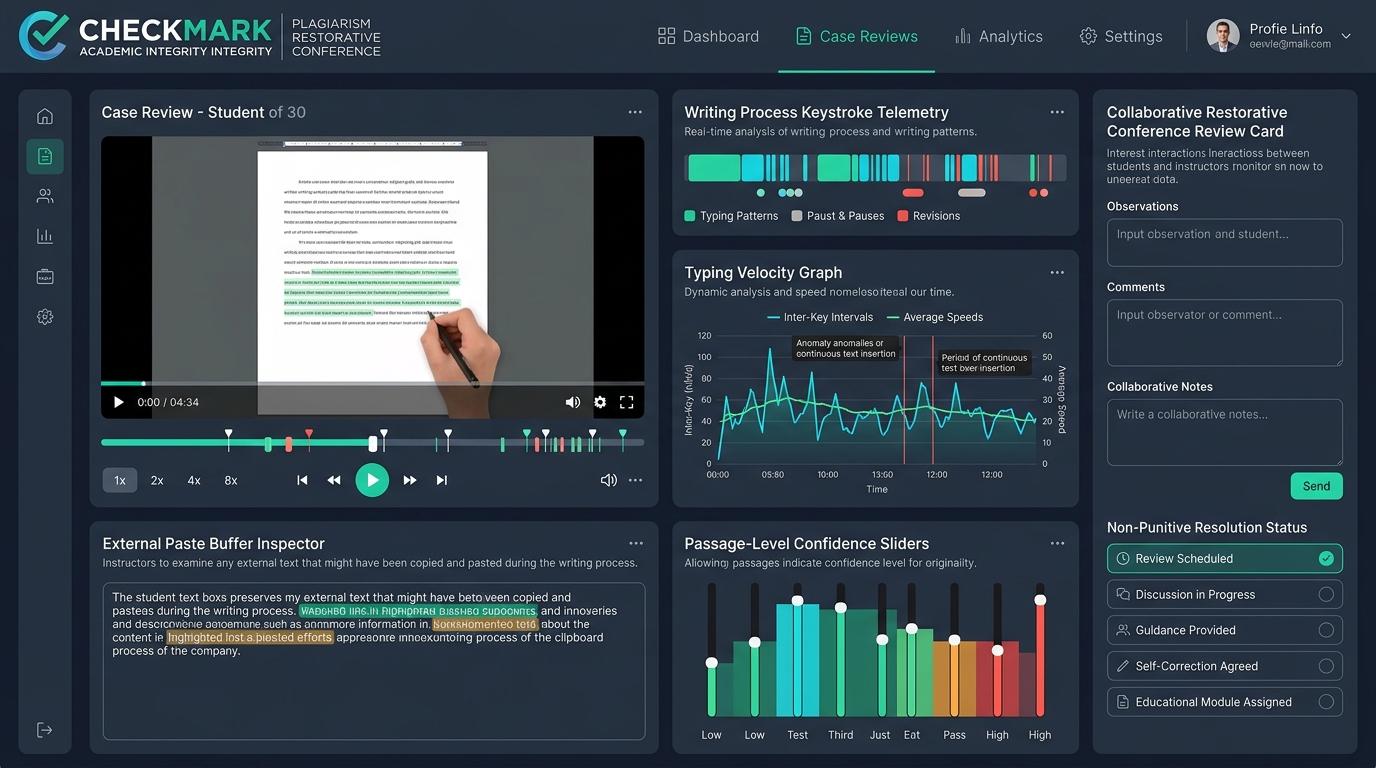
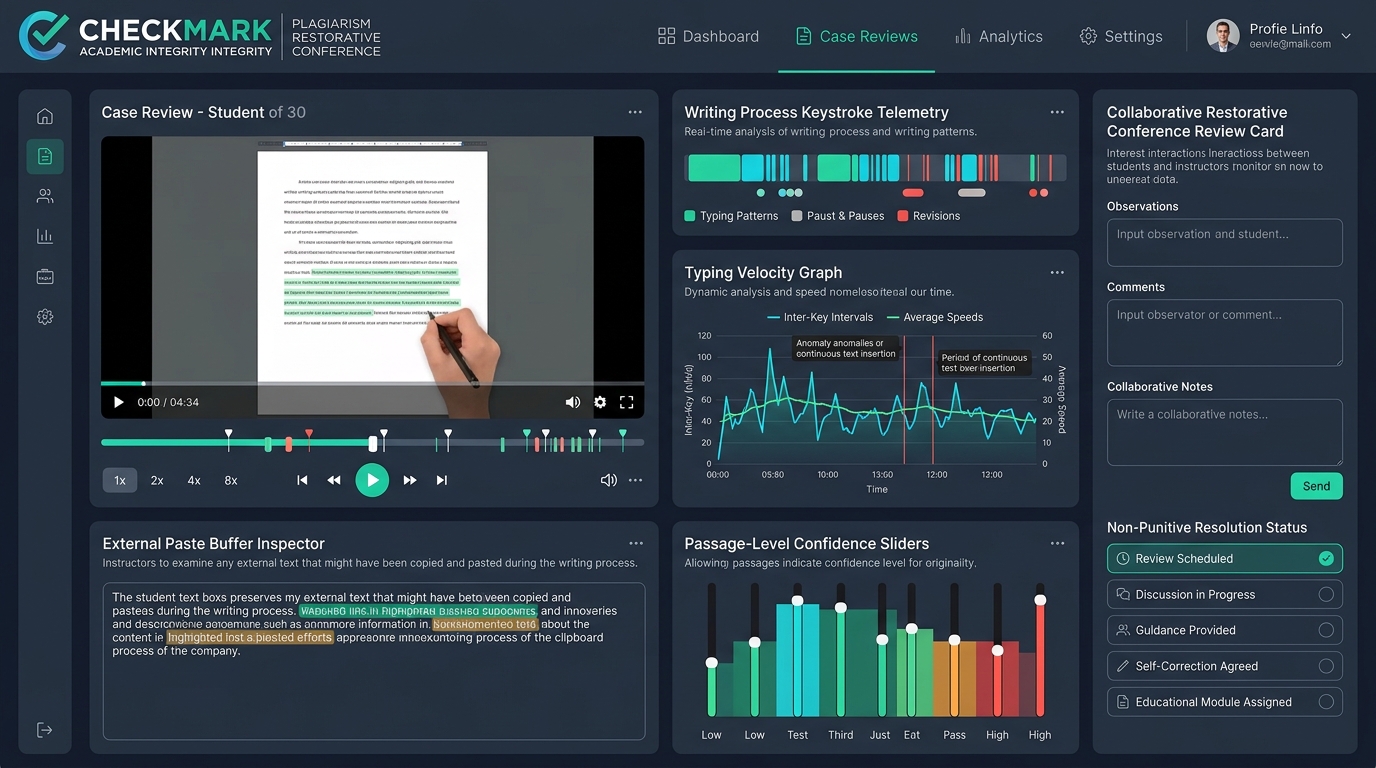
Checkmark Plagiarism resolves this institutional crisis by providing an evidence-based alternative: Restorative Academic Integrity Conferences Grounded in Writing Process Telemetry. Guided by the foundational philosophy of “Stop guessing, start trusting,” integrity officers can sit side-by-side with students in a collaborative, non-punitive co-viewing environment. Leveraging patent-pending Essay Playback™ (1x–8x scrubbable video replay), immutable external paste buffer records with 100% clipboard text preservation, granular passage-level linguistic distributions with calibrated confidence sliders, synchronized side-by-side plagiarism matching, and teacher-in-the-loop rubric grading histories, hearing officers replace speculative accusations with transparent physical “receipts.” This authoritative guide deconstructs the legal, evidentiary, and restorative landscape, details the technical telemetry architecture, presents realistic institutional case studies, provides a 4-Phase Facilitator Protocol with verbatim master scripts, and answers critical administrative FAQs.
Checkmark Plagiarism equips academic integrity officers, honor councils, department chairs, and judicial deans with forensic writing telemetry and enterprise LMS integrations across Canvas LMS, Agilix Buzz, and Google Classroom.
1. The Institutional Crisis: The Breakdown of the Adversarial Disciplinary Model
Across modern secondary schools, collegiate judicial boards, and university student conduct divisions, the traditional model of adjudicating academic misconduct has reached a point of systemic failure.
Historically, academic integrity inquiries operated under a tangible evidentiary standard: an instructor detected uncredited text, cross-referenced it against a physical book or digital database, and presented the matching source directly to the student. The evidence was visible, reproducible, and verifiable by all parties.
Today, however, academic integrity officers, deans of students, and honor councils are overwhelmed by referrals generated by automated, black-box artificial intelligence classifiers. Instructors forward flagged essays accompanied by nothing more than a single screenshot displaying an arbitrary percentage—such as “79% AI Generated”—demanding formal disciplinary sanctions, automatic course failures, or suspensions.
- Presumption of student guilt from outset
- Oppositional interrogation across an oak desk
- Zero primary temporal or behavioral evidence
- Student enters defensive panic and emotional paralysis
- Binary outcome: Punitive zero vs. unguided dismissal
- Hostile parent-school or attorney standoffs
- Severe psychological trauma & student alienation
- Procedural Due Process liability (Goss, Horowitz)
- Inability to fulfill FERPA § 99.10 inspection demands
- Trust between faculty and student body permanently eroded
This legacy adversarial framework suffers from three fatal structural failures that jeopardize institutional integrity, legal compliance, and student welfare:
1.1 The Evidentiary Vacuum of Single-Point Probabilistic Classifiers
Commercial statistical AI detectors operate by evaluating static text for mathematical predictability (perplexity) and syntactic variation (burstiness). They calculate the statistical likelihood that a given sequence of words resembles large language model training distributions.
However, probabilistic neural classifiers are inherently unsuited to serve as sole evidentiary arbiters in formal disciplinary proceedings:
- Model Instability & Non-Reproducibility: Minor formatting adjustments, font changes, or subsequent vendor algorithm updates frequently cause identical text to fluctuate wildly between high and low confidence scores across scans.
- Lack of Forensic Explainability: When a student asks, “Which specific sentences did I not write, and what is the physical proof?”, the hearing officer cannot explain the score. Proprietary neural networks operate as black boxes, preventing institutions from demonstrating how an algorithmic output was derived.
- Binary Guesswork: A single percentage fails to differentiate between authorized assistive technology (e.g., spell-checkers, digital dictionaries, outline organizers), collaborative peer review, uncredited patchwriting, and wholesale generative AI fraud.
1.2 Disproportionate Harm to Vulnerable Student Populations
The adversarial tribunal model inflicts severe collateral damage on honest students, with empirical research demonstrating systematic bias against specific student demographics:
- English Language Learners (ELL) and Multilingual Writers: Seminal research (including Stanford University findings by Liang et al., 2023, published in Patterns) shows that non-native English writers are disproportionately flagged by AI detectors. Because multilingual students frequently use standardized vocabulary, repetitive sentence structures, and predictable transitions, their authentic human prose closely mirrors the low-perplexity patterns typical of generative AI.
- Neurodivergent Writers: Students with Autism Spectrum Disorder (ASD), ADHD, or specific learning disabilities frequently employ hyper-structured, formulaic, or non-linear drafting methodologies that trigger false-positive classifier spikes.
- Psychological Trauma & Alienation: Subjecting a student who spent twenty hours researching and composing a paper to an adversarial tribunal where they must “prove their innocence” against an opaque machine algorithm creates lasting academic demoralization, imposter syndrome, and deep cynicism toward educational institutions.
1.3 Legal and Procedural Due Process Liabilities
Academic misconduct findings carry severe, permanent consequences, including transcript notations, loss of academic scholarships, expulsion, and revocation of degree conferrals. As a result, reliance on uncorroborated black-box detection exposes schools and universities to substantial legal risks:
- Fourteenth Amendment Procedural Due Process (Goss v. Lopez, Board of Curators v. Horowitz): Under established constitutional jurisprudence, students at public secondary schools possess protected property and liberty interests in their education and reputation (Goss v. Lopez, 419 U.S. 565), and the Supreme Court has assumed that public university students hold comparable interests (Board of Curators of the University of Missouri v. Horowitz, 435 U.S. 78). In Goss, the Court held that even short disciplinary suspensions require meaningful procedural protections, including notice of the charges, an explanation of the evidence, and an opportunity for the student to present their side; Horowitz separated academic evaluations, which need less formal process, from disciplinary charges based on alleged conduct. Relying on an unexplainable probabilistic score without primary supporting evidence violates the fundamental requirement of non-arbitrary adjudication.
- Contractual Fair Hearing Mandates in Private Institutions: Private universities and independent secondary schools are legally bound by their published student handbooks, honor codes, and disciplinary procedures under contract law doctrines. When an institution promises students a “fair, impartial review” and the right “to examine all evidence,” presenting an opaque vendor score while withholding primary forensic proof constitutes a breach of contract.
- FERPA (34 CFR Part 99 § 99.10) Student Records Inspection Rights: Under the Family Educational Rights and Privacy Act (FERPA), parents (and eligible students, meaning students who are 18 or older or attend a postsecondary institution) have a federal right to inspect and review education records, which are records directly related to a student and maintained by the school or by a party acting for it. Vendor reports and logs that a school keeps about a student's work can fall within that definition. When an AI vendor withholds the basis for a score behind proprietary trade-secret claims, the institution may be unable to show the student what a record rests on, risking inspection disputes, federal compliance investigations, and funding sanctions.
To resolve these legal vulnerabilities and pedagogical failures, academic integrity officers must transition from punitive, adversarial tribunals to Restorative Integrity Conferences grounded in Writing Process Telemetry.
2. The Restorative Justice Paradigm in Writing: “Stop Guessing, Start Trusting”
The institutional philosophy of Checkmark Plagiarism is encapsulated in a single principle: “Stop guessing, start trusting.”
Restorative academic integrity fundamentally reframes integrity inquiries. Rather than treating suspected misconduct as a quasi-criminal violation requiring an adversarial trial and automated punishment, the restorative model views academic integrity breakdowns as fractures in the learning process, classroom expectations, and community trust that must be repaired through transparency, dialogue, and guided accountability.
Adversarial Tribunal vs. Restorative Integrity Conference
- Presumption: Presumption of student guilt; burden on student to disprove algorithm.
- Focus: Interrogation, finding culpability, and demanding confession.
- Evidence: Opaque, unexplainable black-box percentage score (e.g., “85% AI”).
- Spatial Dynamic: Confrontational; officer sitting across an oak desk from student.
- Role of Officer: Disciplinary judge, interrogator, and prosecutor.
- Role of Student: Accused defendant forced into defensive posture.
- Emotional Climate: Fear, hostility, panic, and lasting alienation.
- Disciplinary Outcome: Binary punitive sanction (automatic zero, transcript mark, suspension).
- Long-Term Impact: Teaches students detection evasion and erodes institutional trust.
- Presumption: Presumption of goodwill, growth, and developmental learning capacity.
- Focus: Process diagnosis, metacognition, and skill repair.
- Evidence: Patent-pending Essay Playback™ writing telemetry and preserved paste buffer logs.
- Spatial Dynamic: Side-by-side co-viewing at a shared screen displaying drafting replay.
- Role of Officer: Facilitator, process coach, and objective truth-seeker.
- Role of Student: Active co-investigator walking through their own composition journey.
- Emotional Climate: Psychological safety, transparency, self-reflection, and dignity.
- Restorative Outcome: Guided revision, writing center coaching, and repaired trust.
- Long-Term Impact: Builds metacognitive writing stamina, citation ethics, and academic resilience.
2.1 The Non-Punitive Co-Viewing Environment
The core operational innovation of the restorative integrity conference is the collaborative co-viewing session.
Instead of an integrity officer sitting behind a desk and reading formal charges to a terrified student, the officer and student sit side-by-side in front of a shared monitor displaying the student's chronological writing timeline in Checkmark Plagiarism.
The framing of the conversation shifts completely:
- The Adversarial Question: “Turnitin says your essay is 85% AI-generated. Why did you cheat, and what do you have to say for yourself?”
- The Restorative Question: “Let’s open your drafting timeline together. I want to walk through your writing journey from your first outline to your final submission so we can understand how your ideas evolved, celebrate where your thinking developed, and examine any moments where you hit a roadblock.”
By removing the accusatory posture, the student's defensive barrier lowers. The conversation is anchored not in abstract accusations, but in observable, objective drafting milestones.
2.2 Diagnosing the Root Causes of Writing Breakdowns
When students engage in unauthorized source copying, patchwriting, or unapproved AI generation, they rarely act out of malicious dishonesty. In the vast majority of institutional referrals, academic integrity breakdowns stem from four developmental root causes:
Panic & Time-Management Crisis
- 2:00 AM deadline crunch and paralyzing cognitive fatigue
- Overwhelmed by competing exams, athletic obligations, or family duties
- Pasting external summaries in a moment of acute desperation
- Restorative Remedy: Time management coaching and structured draft milestones
Cognitive Overload & Patchwriting
- Struggling to synthesize dense, peer-reviewed academic literature
- Intense fear of academic inadequacy leading to sentence-structure mimicking
- Retaining original source grammar while substituting occasional synonyms
- Restorative Remedy: Writing Center triage on synthesis and APA/MLA paraphrasing
Authorized Tool Confusion
- Vague syllabus policy permitting “AI brainstorming” vs. “AI drafting”
- Confusion between digital grammar assistants (Grammarly) and generative LLMs
- Blurring boundaries between assistive outlining and unauthorized generation
- Restorative Remedy: Clear institutional tool boundaries and disclosure protocols
Deliberate Authorship Fraud
- Commercial contract cheating or essay mill purchasing
- Secondary-screen optical transcription of external AI text
- Wholesale submission of uncredited peer manuscripts
- Restorative Remedy: Direct behavioral receipts, guided accountability, and supervised rewrites
Writing process telemetry provides the exact forensic resolution necessary to differentiate these scenarios, allowing academic integrity officers to apply targeted, constructive interventions rather than blanket punitive sanctions.
3. The 5-Pillar Writing Process Telemetry Architecture: Objective “Receipts” for Adjudication
To facilitate a legally defensible and restorative conference, academic integrity committees require verifiable, multi-dimensional forensic evidence (“receipts”). Checkmark Plagiarism replaces opaque percentages with the 5-Pillar Writing Process Telemetry Architecture, delivering transparent, time-series telemetry directly within the administrative dashboard:
384 words inserted from external source. 100% clipboard text preserved at insertion timestamp.
3.1 Pillar 1: Patent-Pending Essay Playback™ (1x–8x Scrubbable Video Replay)
The cornerstone of Checkmark's restorative suite is patent-pending Essay Playback™, which reconstructs the complete physical composition session keystroke-by-keystroke.
Integrity officers, instructors, and students can scrub through the entire writing timeline like a video at variable playback speeds (1x, 2x, 4x, 8x), observing:
- Chronological Thought Evolution: How the introduction was drafted, how supporting arguments were formulated, and how concluding ideas developed over time.
- Inter-Key Interval (IKI) Topography: The microsecond timing between individual keystrokes. Natural human drafting exhibits variable IKI distributions (e.g., 120ms during rapid word execution, expanding to 800ms–2,500ms between lexical choices).
- Production Bursts (P-Bursts): The contiguous clusters of characters typed between cognitive planning hesitations.
- Revision Bursts (R-Bursts): The frequency of backspaces, character deletions, cursor navigation, and sentence restructurings. Authentic human writing typically includes a steady rhythm of backspacing, deletion, and revision.
- Cognitive Pause Topography: Time-stamped planning pauses (3,000ms to 20,000ms) occurring at major syntactic boundaries (commas, semi-colons, paragraph transitions) where the writer deliberates over rhetorical structure.
3.2 Pillar 2: Immutable External Paste Buffer Inspector
When text is pasted into an essay from an external application, Checkmark immediately logs a permanent, immutable milestone in the timeline.
Crucially, Checkmark’s External Paste Buffer Inspector captures and permanently preserves 100% of the original clipboard text at the exact millisecond of insertion—even if the student subsequently rewrites, edits, paraphrases, or deletes every single word across multiple editing sessions.
This capability resolves one of the most contentious debates in academic adjudication: proving whether an external paste was a student’s legitimate pre-writing (such as bulleted class notes or a personal outline) or an unapproved dump from an external generative AI tool or essay mill.
3.3 Pillar 3: Optical Transcription & Mechanical Retype Detection
When students attempt to bypass paste tracking by placing a smartphone, secondary monitor, or paper printout next to their keyboard and manually typing out AI-generated or copied text, they produce a distinctive biomechanical signature:
- Monotonic, Flat Typing Cadence: Typing velocity remains virtually flat (e.g., 65–75 WPM) across simple words, complex multisyllabic terminology, and abstract syntax alike.
- Near-Zero Backspace Ratio (< 1.5%): Because the student is merely copying finalized text rather than composing original thoughts, self-correcting backspaces and syntactic hesitations drop to near zero.
- Absence of Cognitive Pauses: The timeline shows an absence of natural 5-to-15-second planning pauses at paragraph transitions.
Checkmark detects and visualizes this transcription signature, providing integrity officers with unassailable behavioral proof of secondary-screen retyping.
3.4 Pillar 4: Granular Passage-Level AI & Plagiarism Matching
Rather than generating an opaque, monolithic whole-document score, Checkmark utilizes Passage-Level Granularity:
- Calibrated Confidence Sliders: Specific passages are underlined directly within the essay, linked two-way to interactive evidence cards in the sidebar displaying calibrated confidence sliders (Typical Human Writing Style vs. Typical AI Pattern).
- Honest Guardrails (<150 Words): For short submissions or fragmented passages under 150 words, Checkmark displays
N/Arather than guessing on statistically insufficient sample sizes. - Side-by-Side Live Plagiarism Quotes: Matched text is displayed alongside original web sources, digital encyclopedias, and academic databases with live, clickable URLs.
- Uncited Source Differentiation: Checkmark assigns dedicated visual styling to uncredited source matches, allowing officers to separate innocent citation formatting errors from intentional academic deception.
- Educator-Only Flag Statuses: Flag statuses (Flagged, Resolved, Not Flagged) remain strictly private to authorized educators to prevent premature accusations or student stigmatization.
3.5 Pillar 5: Teacher-in-the-Loop Rubric Autograding & LMS Synchronization
Checkmark integrates directly with institutional learning management systems (Canvas LMS SpeedGrader, Buzz LMS, Google Classroom, Moodle) via LTI 1.3:
- Formative and Summative Rubric Scoring: Generates first-draft rubric score suggestions tied directly to custom school rubrics.
- Quote-Anchored Justifications: Feedback cards cite specific lines of student prose, justifying rubric evaluations and highlighting strengths and areas for revision.
- Teacher Final Authority: All AI-suggested grades remain non-binding drafts until reviewed, edited, and approved by the educator. Final grades and feedback pass back seamlessly into LMS gradebooks.
4. Illustrative Institutional Case Studies: Restorative Resolution in Practice
The following institutional case studies illustrate how academic integrity officers, high school administrators, and college honor councils utilize writing process timelines to replace adversarial penalties with restorative resolutions. They are illustrative composite scenarios, not reports of specific institutions or students, and the figures in them are examples.
| Case Scenario | Legacy Adversarial Outcome | Restorative Process Outcome |
|---|---|---|
| Case 1: University First-Year Capstone Essay (88% AI Flag) | Automatic zero assigned; formal misconduct record; parent-retained legal counsel threatens due process lawsuit. | Essay Playback™ reveals 9.5 hours of recursive typing & 1,420 backspaces; student completely exonerated. |
| Case 2: Suburban High School AP Literature (Pasted Block) | Immediate zero; removal from National Honor Society; student suffers acute panic and academic alienation. | Paste buffer inspector proves paste was student's own lecture notes; guided 48-hour revision awarded. |
| Case 3: Community College ESL Nursing Research Paper | Course failure for plagiarism; academic probation; student drops out of nursing degree program. | Timeline shows dictionary pauses; patchwriting diagnosed as summary anxiety; Writing Center triage assigned. |
Case Study 1: University Dean of Students Resolves Contested First-Year Capstone Referral
The Incident: A first-year undergraduate student submitted a 3,200-word capstone research paper in a mandatory composition course. The course instructor submitted the paper to a legacy AI detector, which returned an 88% AI-Generated score. The instructor filed a formal academic dishonesty charge, seeking an “F” in the course and an official honor code transcript notation. The student passionately denied the charge, and their family retained legal counsel alleging constitutional due process violations.
The Restorative Investigation: The Academic Integrity Dean scheduled a restorative conference and opened the student’s Checkmark Essay Playback™ timeline.
Root-Cause Diagnosis: The student had been taught a highly formulaic five-paragraph persuasive writing structure in high school. The resulting low lexical perplexity and uniform sentence lengths triggered the generic detector’s false-positive flag.
Restorative Resolution: The Integrity Dean dismissed the academic misconduct charge entirely. The dean held a joint conference with the instructor to review the keystroke telemetry, restoring institutional trust. The student was offered advanced writing center coaching on syntactic variation, and no disciplinary mark was placed on their record.
Case Study 2: Suburban High School Restorative Conference Replaces Automatic Zero with Guided Revision
The Incident: An AP Literature student submitted a 1,500-word literary analysis of Hamlet. The teacher noticed a sudden insertion of a 400-word block of highly sophisticated text in the body paragraphs. Under district policy, the teacher prepared to assign an automatic zero and remove the student from the National Honor Society.
The Restorative Investigation: The Assistant Principal for Curriculum convened a restorative conference with the student and teacher, co-viewing the Checkmark writing timeline.
Root-Cause Diagnosis: The student had drafted preliminary notes in Google Keep during classroom lectures and pasted them into the primary LMS document to organize their thoughts, violating the teacher's rule against outside drafting but with zero deceptive intent.
Restorative Resolution: The Assistant Principal facilitated an open dialogue regarding proper drafting workflows and classroom expectations. Instead of a zero or disciplinary referral, the student was granted 48 hours to complete a guided revision incorporating proper in-text citations. The student remained in good standing in the National Honor Society.
Case Study 3: Community College Multilingual Student Exoneration & Citation Triage
The Incident: A first-generation, English-as-a-Second-Language (ESL) nursing student submitted a research paper on pediatric clinical protocols. The paper was flagged for a 34% similarity index and high passage-level AI probability in the literature review section.
The Restorative Investigation: The Department Chair invited the student to a restorative writing conference.
Root-Cause Diagnosis: The student understood the medical concepts but suffered from intense linguistic anxiety regarding American academic conventions. Fearing their English was inadequate, the student relied on the exact sentence structures of published medical abstracts, genuinely believing that minor word adjustments constituted proper academic paraphrasing.
Restorative Resolution: The Department Chair recognized the issue as a developmental writing challenge rather than willful cheating. The chair paired the student with an ESL writing specialist at the campus Academic Support Center for three structured citation coaching sessions. The student resubmitted the literature review with properly formatted APA block quotations and original synthesis, receiving a “B+” on the assignment.
5. The 4-Phase Restorative Integrity Conference Protocol for Academic Integrity Officers
To implement restorative writing conferences systematically across academic departments and administrative hearing panels, institutions should adopt the following 4-Phase Restorative Integrity Conference Protocol:
Phase 1: Pre-Conference Audit
- Scrub Essay Playback™: Review total active typing time, composition velocity, and backspace counts.
- Inspect Paste Buffers: Examine preserved clipboard content for external AI dumps or notes.
- Cross-Examine Cards: Review passage-level confidence sliders and side-by-side URL matches.
- Verify LMS Guidelines: Confirm assignment instructions and permitted tools in Canvas or Buzz.
Phase 2: Collaborative Co-Viewing
- Establish Psychological Safety: Clarify the developmental, non-punitive focus of the meeting.
- Elicit Student Narrative: Invite the student to share their research journey before showing flags.
- Synchronized Replay: Scrub through the timeline together at 2x/4x speed, pausing at key milestones.
- Observe Pauses & Bursts: Validate authentic cognitive hesitation and recursive revisions.
Phase 3: Root-Cause Diagnosis
- Examine Roadblocks Neutrally: Pause at paste events or rapid bursts without accusatory tone.
- Isolate Underlying Driver: Differentiate panic crunch, citation anxiety, or tool confusion.
- Facilitate Reflection: Discuss how uncredited source use fractures community academic trust.
- Acknowledge Skill Gaps: Separate developmental writing challenges from intentional deception.
Phase 4: Restorative Action Plan
- Guided Revision Window: Grant a 48–72 hour organic revision period for proper paraphrasing.
- Support Center Referral: Connect student with Writing Center tutors for citation coaching.
- LMS Grade Passback: Direct instructor to evaluate revised submission in SpeedGrader.
- Case Closure: Resolve referral without punitive disciplinary transcript notations.
6. Restorative Dialogue Master Scripts: Verbatim Verbal Frameworks for Facilitators
Facilitating a restorative conference requires precise, empathetic, and de-escalating language. The following master scripts provide academic integrity officers, deans, and department chairs with exact verbal frameworks for every stage of the conference:
“Thank you for coming in today, Alex. I know that receiving an email from the Academic Integrity Office can feel stressful and intimidating, so I want to start by clarifying why we are here. Our goal today is not to interrogate you, accuse you, or issue an automatic punishment. Our goal is to look at your writing journey together. We use a system called Checkmark that maps the drafting timeline of your essay. Today, you and I are going to sit side-by-side and look at that timeline so you can walk me through how your ideas developed. Does that sound fair?”
“Let’s look at your screen together. What you’re seeing here is the Checkmark Essay Playback™ timeline. It shows the active time you spent drafting this paper in Canvas. I’m going to press play at 2x speed. As we watch your essay come together, I’d love for you to tell me about how you chose this thesis statement and how you organized your first main argument.”
“I see that right around minute 38 of your second writing session, a 300-word block of text was pasted into your document. Checkmark keeps a record of all clipboard insertions. Let’s look at the original text that was pasted here. Can you tell me the story behind this passage? Where were you working before this paste, and how did this text make its way into your draft?”
“Alex, as we watch the timeline for this section of your literature review, notice how the typing speed stays at a constant 75 words per minute with zero backspaces or hesitations, which is very different from the recursive drafting we saw in your opening paragraphs. Typically, this pattern happens when someone is retyping text from a secondary screen, phone, or generative AI tool. We all experience moments of panic when deadlines loom. I want to give you the space to be completely honest with me about what happened during this session so we can figure out the best way to move forward.”
“Alex, I want to thank you for walking me through your timeline. Looking at the detailed keystroke dynamics, your 1,420 backspaces, and the active composing pauses across your ten hours of work, it is 100% clear that this is your authentic, original writing. The generic AI detector flagged your paper because of its structured academic phrasing, but the process evidence proves complete authorship. I am dismissing this referral immediately, and I will personally contact your professor to explain the evidence and ensure your essay is graded fully and fairly on its merits. Thank you for your patience with this process.”
“Now that we understand that you were struggling with how to integrate and cite these three medical research articles under time pressure, let’s focus on repairing this. We are not going to place a disciplinary mark on your permanent record. Instead, we have a restorative agreement: you will meet with an academic writing tutor tomorrow to review APA paraphrasing, and you will resubmit a revised draft by Friday afternoon. When your revised draft is submitted, your professor will grade it directly in Canvas. How do you feel about this plan?”
7. Enterprise Security, Privacy, and FERPA Zero-Training Architecture
When deploying writing process telemetry and AI evaluation tools across school districts and higher education institutions, data privacy, student confidentiality, and statutory compliance are non-negotiable requirements.
Zero Model Training Architecture
Student submissions, writing telemetry, and keystroke logs are never used to train, fine-tune, or calibrate public or proprietary large language models. Student intellectual property remains protected under strict institutional domain control.
FERPA & COPPA Full Compliance
Checkmark strictly adheres to the Family Educational Rights and Privacy Act (FERPA) and the Children's Online Privacy Protection Act (COPPA). All student data is encrypted using AES-256 at rest and TLS 1.3 in transit.
34 CFR Part 99 § 99.10 Records Inspection
Because Checkmark provides raw, human-interpretable telemetry (keystroke timelines, paste logs, side-by-side source quotes) rather than proprietary black-box calculations, institutions can instantly export unredacted, comprehensive multi-evidence dossiers during formal student record inspection requests.
Educator-Only Flag Privacy
Flagged passages and integrity statuses remain private to verified faculty and integrity officers. Students are not exposed to unverified flags, preventing unwarranted anxiety before an educator reviews the evidence.
8. Frequently Asked Questions (FAQs) for Academic Integrity Officers & Deans
1. How does a restorative integrity conference differ from a traditional academic misconduct hearing?
A traditional academic misconduct hearing operates on an adversarial, quasi-judicial model where an accused student defends themselves against charges, often resulting in binary punitive outcomes (e.g., an automatic zero, suspension, or formal transcript sanction). A Restorative Integrity Conference operates on a developmental, educational model. Using Checkmark’s patent-pending Essay Playback™ telemetry, the officer and student co-view the drafting timeline to identify the root causes of writing breakdowns (such as time panic, citation confusion, or unapproved tool use) and agree upon constructive restorative actions (guided revisions, writing center tutoring) that preserve student engagement and uphold institutional standards without unnecessary punitive escalation.
2. What if a student claims they drafted their paper offline in Microsoft Word or Google Docs before pasting it into the LMS?
Checkmark captures writing telemetry directly across connected environments, including Google Docs, Microsoft Word via Checkmark editor tooling, and native LMS embedded editors (Canvas LMS, Buzz LMS, Google Classroom). If a student legitimately drafted offline in an authorized desktop environment, the integrity officer can review the external paste buffer logs in Checkmark alongside the student’s external version history. If authentic drafting occurred offline, the student will have detailed time-stamped revision histories in their primary editor matching the pasted content.
3. How does writing process telemetry protect institutions from procedural due process lawsuits?
Under the Fourteenth Amendment (Goss v. Lopez, Board of Curators v. Horowitz) and contractual fair hearing doctrines, institutions that impose discipline are expected to give students notice, an explanation of the evidence, and a chance to respond, and private institutions are expected to follow their own published procedures. Arbitrary, unexplainable algorithmic scores make that difficult. Because legacy AI detectors provide only an opaque probability percentage, penalizing a student without primary evidence creates severe legal liability. Checkmark provides objective, verifiable primary evidence, including time-stamped keystrokes, Inter-Key Interval distributions, 100% preserved paste buffer records, and side-by-side web source matches, giving institutions an unassailable evidentiary record (“receipts”) that withstands judicial scrutiny.
4. Can Essay Playback™ distinguish between speech-to-text assistive dictation and unauthorized AI transcription?
Yes. Speech-to-text dictation software (frequently used by students with dysgraphia, visual impairments, or IEP/504 accommodations) generates text in phrase-level burst clusters separated by natural acoustic pauses, followed by character-by-character editing to fix transcription errors. In contrast, mechanical transcription of AI text from a secondary screen produces a continuous, flat typing cadence (e.g., constant 70 WPM) with virtually zero backspaces (<1.5%) and no natural drafting hesitations. Checkmark visualizes these distinct telemetry signatures clearly.
5. What should an integrity officer do if an instructor demands a punitive zero despite telemetry proving authentic student effort?
The academic integrity officer should convene a brief tripartite conference with the instructor and department chair to review the Checkmark Multi-Evidence Dossier. By walking the instructor through the scrubbable Essay Playback™ replay, displaying the student's 1,000+ backspaces, active composing pauses, and authentic drafting velocity, the officer can demonstrate conclusively that the generic detector score was an algorithmic false alarm. Providing physical process proof depersonalizes the disagreement and helps faculty transition confidently from punitive reactions to objective grading.
6. How does Checkmark help institutions respond to FERPA § 99.10 student records inspection requests?
Under FERPA (34 CFR Part 99 § 99.10), parents and eligible students have the right to inspect and review education records, which can include evidence used in disciplinary proceedings. Legacy black-box detectors make such requests hard to answer because vendors withhold neural network feature activations as proprietary trade secrets. Checkmark helps by allowing integrity officers to export a complete, human-readable Multi-Evidence Dossier containing the exact chronological timeline, paste buffer snapshots, passage-level confidence breakdowns, and side-by-side plagiarism matches, so the institution has readable records to share when it responds to an inspection request.
7. How long does a typical restorative conference take, and how does it scale across large institutions?
A standard restorative integrity conference lasts between 20 and 30 minutes. Because Checkmark’s pre-conference telemetry audit allows officers to identify anomalies (such as external pastes or transcription spikes) in under three minutes, officers enter meetings with full clarity. For large institutions handling hundreds of referrals per semester, the restorative model dramatically reduces administrative overhead by resolving many cases at the informal conference stage, eliminating weeks of protracted formal hearings, administrative appeals, and legal disputes.