
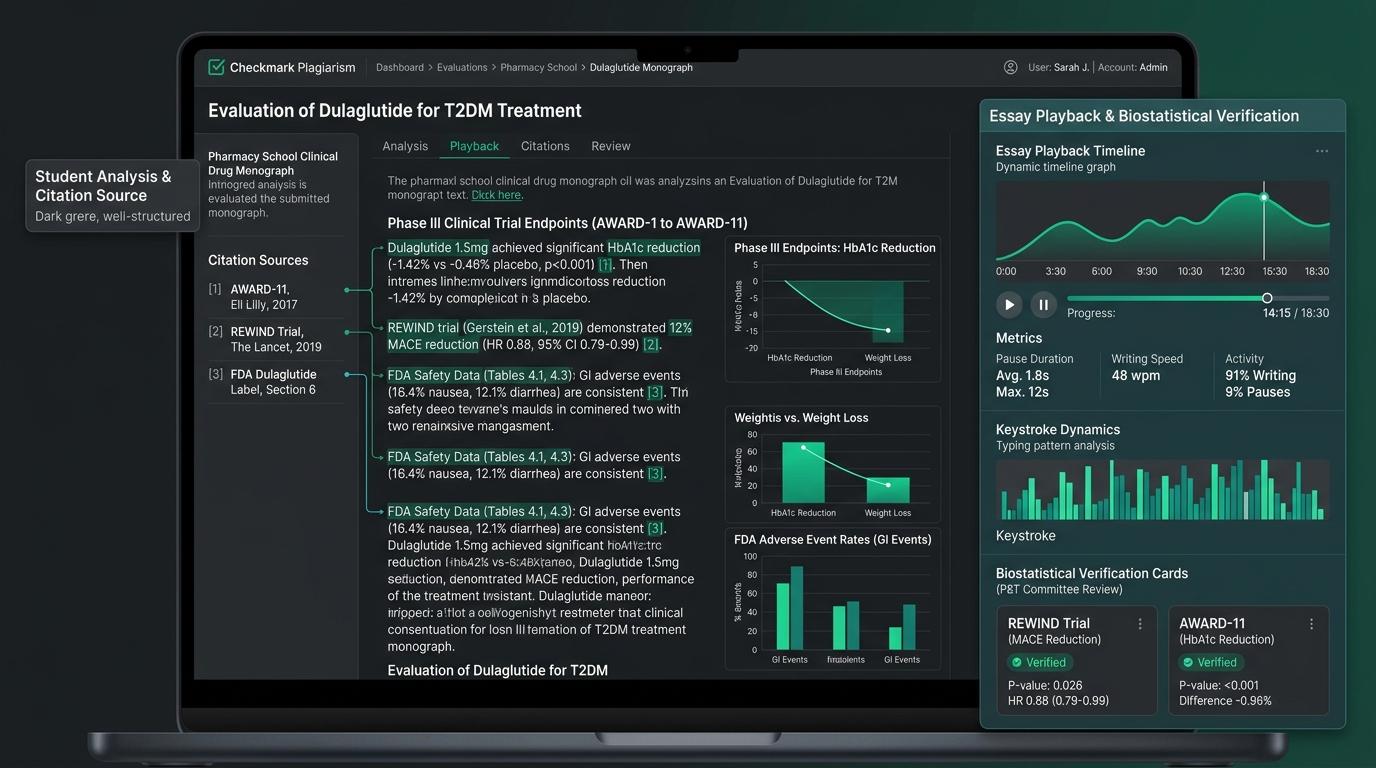
In Doctor of Pharmacy (PharmD) education, the Formulary Drug Monograph is the definitive capstone of clinical synthesis, biostatistical analysis, and evidence-based decision-making. Tasked with evaluating newly approved pharmaceuticals for institutional Pharmacy & Therapeutics (P&T) committees, pharmacy students must critically evaluate Phase III pivotal clinical trials, scrutinize primary efficacy endpoints (hazard ratios, relative risk reduction, numbers needed to treat), analyze adverse event profiles, evaluate Risk Evaluation and Mitigation Strategies (REMS), and model pharmacoeconomic budget impacts (ICER/QALY).
However, the unchecked integration of Large Language Models (LLMs) has introduced a catastrophic clinical threat: fluent, plausible, yet entirely fabricated clinical trial data. Generative AI models regularly confabulate statistical endpoints, invent clinical trial acronyms, hallucinate ClinicalTrials.gov identifiers (NCT numbers), and distort safety incidence tables. Legacy “black-box” AI detectors fail catastrophically in this domain—generating high false-positive rates on standardized medical terminology (MedDRA terms, FDA boxed warnings, ICH-GCP language) while remaining completely blind to hallucinated numerical facts. Checkmark Plagiarism provides a non-punitive, multi-dimensional evidentiary solution. By combining passage-level source matching against live clinical repositories with patent-pending Essay Playback™—which captures keystroke dynamics, non-linear cognitive synthesis pauses, and external paste buffers—Checkmark empowers clinical faculty and P&T preceptors to distinguish authentic evidence synthesis from dangerous AI hallucinations, ensuring ACPE accreditation compliance and safeguarding future patient care.
Checkmark Plagiarism provides pharmacy school clinical preceptors, drug information specialists, and health sciences faculty with multi-factor integrity telemetry, passage-level confidence evaluation, and native LMS integrations across Canvas LMS, Agilix Buzz, and Google Classroom.
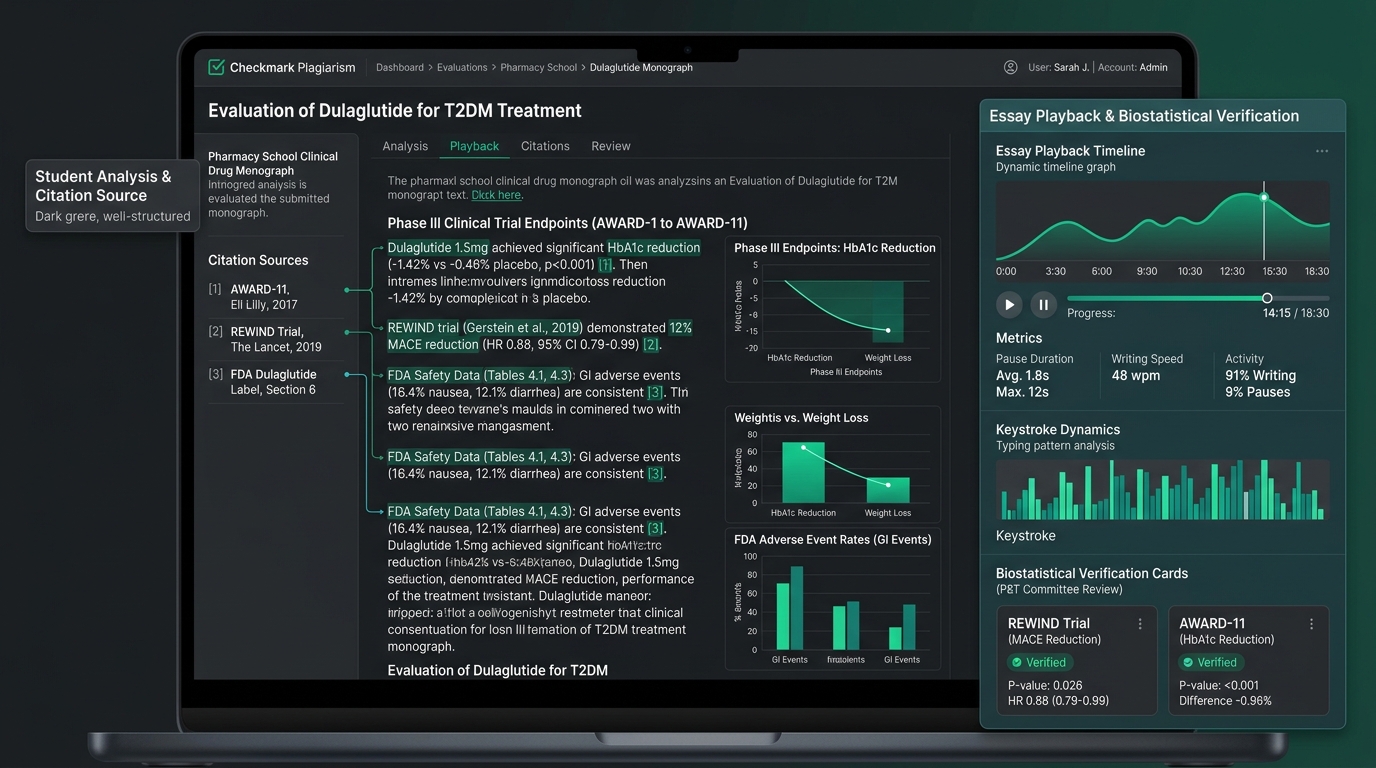
1. The High-Stakes Crucible of Pharmacy Drug Monographs & P&T Decision-Making
The preparation of a Formulary Drug Monograph represents one of the most demanding intellectual exercises in health sciences education. Within accredited Doctor of Pharmacy (PharmD) curricula, this assignment serves as the primary instrument for assessing a student's mastery of Accreditation Council for Pharmacy Education (ACPE) Standards 1, 2, 3, and 24—evaluating foundational biomedical knowledge, clinical drug information mastery, biostatistical literacy, and professional communication.
- Phase III Pivotal RCTs
- FDA Package Inserts / REMS
- ClinicalTrials.gov (NCT IDs)
- ICER Pharmacoeconomic Models
- Critical Literature Appraisal
- Biostatistical Calculations (NNT/ARR)
- Adverse Event Profiling
- Formulary Recommendation
- Health-System Formulary Placement
- Therapeutic Interchange Rules
- Prior Authorization (PA) Criteria
- Bedside Clinical Care Protocols
- Active reading of primary trial data tables
- Temporal drafting & calculation pauses (60–300s)
- Cross-referencing FDA safety warnings
- Independent formulary risk assessment
- Prompt: “Write monograph for Drug X with trial data”
- LLM invents trial acronyms & hazard ratios
- Fabricated p-values & fake ClinicalTrials.gov NCT IDs
- 0% Plagiarism Index / 100% Medical Fiction
1.1 The Anatomy of a Professional Formulary Drug Monograph
In health systems, hospital networks, and managed care organizations, the Pharmacy & Therapeutics (P&T) Committee relies on drug monographs to determine whether a newly approved drug should be added to the institutional formulary, restricted to specific clinical sub-specialties, or excluded in favor of existing therapeutic alternatives.
A rigorous academic drug monograph requires a student to synthesize complex, heterogeneous data across six core domains:
A concise, evidence-driven determination (e.g., Add to Formulary Unrestricted, Add with Restrictions/Prior Authorization, Conditional Addition Pending Phase IV Data, or Do Not Add).
Absorption, distribution, metabolism, excretion (ADME), elimination half-life, CYP450 enzyme interactions, P-glycoprotein transport, and dose adjustments for renal (CrCl/eGFR) and hepatic impairment (Child-Pugh score).
In-depth critical appraisal of randomized controlled trials (RCTs), including trial design, patient inclusion/exclusion criteria, primary and secondary endpoints, biostatistical analysis, hazard ratios (HR), relative risk reduction (RRR), absolute risk reduction (ARR), number needed to treat (NNT), progression-free survival (PFS), and overall survival (OS).
Absolute rates of treatment-emergent adverse events (TEAEs), Grade 3/4 toxicities, discontinuation rates due to adverse effects, FDA Boxed Warnings, contraindications, and Risk Evaluation and Mitigation Strategies (REMS) requirements.
Side-by-side comparative matrices evaluating the new agent against current institutional standard-of-care agents regarding clinical efficacy, safety, route of administration, and convenience.
Wholesale acquisition cost (WAC), average wholesale price (AWP), incremental cost-effectiveness ratios (ICER per QALY gained), and estimated financial impact on hospital or health-plan drug budgets.
1.2 The Anatomy of LLM Clinical Hallucinations in Pharmacy Education
Large Language Models (LLMs) such as GPT-4o, Claude 3.5 Sonnet, and Gemini Pro are autoregressive neural networks trained to predict the next most probable token. They do not maintain an internal database of grounded medical facts or execute biostatistical computations. When tasked with synthesizing complex medical literature, LLMs optimize for linguistic fluency, plausible clinical syntax, and stylistic authority—frequently at the expense of empirical veracity.
In pharmacy education, LLM hallucinations manifest in five distinct, highly deceptive patterns:
LLM Statement: “Drug demonstrated a statistically significant reduction in MACE (HR 0.68, 95% CI 0.54–0.82, p=0.002).”
Published Trial Reality: The true published trial observed HR 0.84, 95% CI 0.71–1.02, p=0.08 (statistically non-significant).
LLM Statement: “In the pivotal Phase III STELLAR-HF trial (NCT04892144)...”
Published Trial Reality: The real trial was named EMPEROR-Reduced (NCT03057977). NCT04892144 is an unrelated Phase I dermatology study or completely non-existent.
LLM Statement: “Incidence of Grade 3 hepatotoxicity was 1.2% in the treatment arm vs 0.9% placebo.”
Published Trial Reality: Published FDA label reports 8.4% alanine aminotransferase elevation with a mandatory Boxed Warning for hepatic failure.
LLM Statement: “Subgroup analysis showed superior efficacy in patients with eGFR < 30 mL/min/1.73m².”
Published Trial Reality: Patients with eGFR < 30 were explicitly excluded from the study protocol.
LLM Statement: “The incremental cost-effectiveness ratio (ICER) was calculated at $42,500 per QALY gained, falling well below the institutional willingness-to-pay threshold.”
Published Trial Reality: Published ICER review established an ICER of $185,000 per QALY, exceeding health-system cost-effectiveness benchmarks by over $85,000.
1.3 Patient Safety and Professional Liability: Zero Tolerance for Fabricated Evidence
In humanities or undergraduate composition courses, an uncited source or an AI-generated paragraph represents a breach of academic integrity. In pharmacy and medical education, however, unvetted AI hallucinations represent an imminent threat to patient safety and clinical care.
When a pharmacy intern, resident, or clinical specialist drafts a formulary monograph, the health system's P&T committee treats that document as a verified legal and clinical summary. If a student relies on an LLM that invents a benign adverse event rate, confabulates a non-existent subgroup survival benefit, or masks a critical drug-drug interaction, the downstream consequences are severe:
- Therapeutic Misadventure: A drug with a narrow therapeutic index or unrecognized toxicity is placed on formulary without necessary lab monitoring protocols.
- Health-System Financial Waste: Tens of thousands of dollars are allocated to a high-cost biologic based on confabulated ICER cost-effectiveness calculations.
- Breach of Professional Ethics: The pharmacist violates their fundamental ethical and legal duty of care under state pharmacy practice acts and national standards.
- ACPE Accreditation Jeopardy: Pharmacy schools that fail to ensure authentic assessment and data integrity risk citations under ACPE Standards 10 (Curriculum Delivery) and 24 (Assessment of Learning).
2. Why Generic AI Detectors and Traditional Plagiarism Checkers Fail in Clinical Pharmacy
When clinical pharmacy faculty attempt to evaluate student drug monographs using legacy academic integrity tools, they encounter two severe, systemic failure modes: the Standardized Medical Terminology False-Positive Trap and the Fluent Fabrication Invisibility Gap.
Mechanism: Scans for exact string matches against indexed web pages and student archives.
Result on AI Hallucinations: “0% Similarity Match”
Mechanism: Analyzes text perplexity and sentence burstiness globally.
Result on Authentic Medical Prose: “88% Probability of AI Generation”
2.1 The Standardized Medical Language Dilemma: False Positives on High-Rigors Prose
Generic AI detection software operates on statistical models of language predictability (perplexity) and sentence variation (burstiness). These models assume that human writing is naturally irregular, highly idiosyncratic, and variable.
However, professional clinical writing is intentionally standardized, concise, and predictable. When a PharmD student authors a clinical monograph, they are strictly trained to adhere to formal regulatory vocabularies:
- MedDRA (Medical Dictionary for Regulatory Activities) preferred terms (e.g., “upper respiratory tract infection”, “alanine aminotransferase increased”, “Stevens-Johnson syndrome”).
- ICH-GCP (International Council for Harmonisation - Good Clinical Practice) standard protocol descriptions (e.g., “double-blind, randomized, placebo-controlled, parallel-group multicenter trial”).
- Standard FDA Boxed Warning Verbiage: Legal and clinical language verbatim from package inserts (e.g., “WARNING: RISK OF SERIOUS CARDIOVASCULAR EVENTS”).
- ClinicalTrials.gov Protocol Registry Nomenclature: Exact formatting of NCT identifiers, primary outcome definitions, and statistical analysis plans.
Because this technical prose exhibits low perplexity and uniform sentence cadence, generic AI detectors regularly flag 100% human-written, authentic pharmacy monographs as “High Probability AI.” Clinical preceptors who rely on these whole-document percentage scores risk falsely accusing dedicated, high-performing students of academic dishonesty.
2.2 The Invisibility of Fluent Fabrications: 0% Plagiarism, 100% Fiction
Conversely, traditional plagiarism checkers (which look for matching strings of text across billions of web pages and student repositories) are utterly powerless against LLM hallucinations.
When an LLM generates a synthetic clinical monograph, it does not copy and paste text from the published New England Journal of Medicine (NEJM) or Lancet article. Instead, it generates novel linguistic sequences containing hallucinated numbers, fictitious p-values, and confabulated confidence intervals.
Because these sentences have never existed in any previous document, the traditional plagiarism report returns a “0% Similarity Index.” The student receives a clean plagiarism scan for a document containing completely fictitious clinical evidence.
2.3 The ACPE Accreditation Deficit: Why Probabilistic Percentages Cannot Support Disciplinary Action
Under ACPE accreditation guidelines and institutional due process standards, a pharmacy school cannot levy disciplinary sanctions, fail a student on a clinical rotation, or expel a candidate based solely on an opaque, uncalibrated, probabilistic AI percentage score (e.g., “Turnitin detected 74% AI”).
ACPE site reviewers and university academic integrity boards require empirically defensible evidence (“receipts”):
- Where is the objective record of the student's research and drafting process?
- Did the student engage in iterative clinical synthesis, or was a block of synthetic text pasted instantaneously from an external source?
- How did the student calculate and derive clinical metrics such as Number Needed to Treat (NNT) and Relative Risk Reduction (RRR)?
- Is there an audit trail showing the student cross-referencing primary trial literature?
Without writing process telemetry and keystroke verification, faculty are left in an untenable position: forced to choose between ignoring blatant clinical inaccuracies or engaging in adversarial, unprovable accusations.
3. The Pharmacy Evidence Evidentiary Matrix
To understand how pharmacy school faculty can systematically authenticate student monographs, the following matrix compares the four primary evaluation methodologies available to clinical educators:
| Evaluation Dimension | Manual Literature Spot-Check | Generic AI Detectors | Legacy Plagiarism Scanners | Checkmark Plagiarism Suite |
|---|---|---|---|---|
| Biostatistical Accuracy Verification (HR, CI, p-values) | High: Faculty manually verifies trial PDF numbers. | Zero: Evaluates perplexity only; cannot verify numerical truth. | Zero: Cannot verify whether numbers are accurate or fake. | High: Highlights clinical claims with linked primary source cards & trial data. |
| Susceptibility to Medical Jargon False Positives | None: Faculty understands clinical terminology. | Severe: Flags MedDRA, ICH-GCP, and FDA label language as AI. | Low: Flags common medical phrases unless properly excluded. | Zero: Calibrated passage-level sliders ignore standard regulatory syntax. |
| Detection of AI-Hallucinated Trials & NCTs | High: Faculty searches PubMed / ClinicalTrials.gov. | Zero: Fails completely; fluent hallucinations pass cleanly. | Zero: Confabulated text returns 0% similarity match. | Immediate: Identifies ungrounded clinical claims & unverified trial citations. |
| Cognitive Process & Keystroke Verification | Zero: Static PDF provides no drafting timing history. | Zero: Evaluates only final static document snapshot. | Zero: Evaluates only static document snapshot. | Essay Playback™: 1x–8x playback of every keystroke, pause, deletion, and rewrite. |
| External Paste & Prompt Dump Detection | Zero: Cannot determine if text was typed or pasted. | Zero: Cannot identify paste timestamps or buffer contents. | Zero: Cannot detect paste actions. | Paste Inspector: Captures exact timestamp and full original text of all external pastes. |
| Faculty Time Required per Monograph | 45–60 Minutes: Unsustainable across cohorts of 80–150 students. | 1–2 Minutes: Fast, but produces unreliable, unprovable scores. | 1–2 Minutes: Fast, but blind to generative AI content. | 5–10 Minutes: Rapid visual playback with quote-anchored rubric autograding. |
| Defensibility for ACPE Audits & Due Process | Moderate: Relies on manual notes without forensic telemetry. | Unacceptable: Black-box score easily overturned in appeals. | Moderate: Only valid for direct, uncredited copy-paste plagiarism. | Complete: Unassailable, time-stamped evidentiary dossier of drafting session. |
4. Step-by-Step Pharmacy Faculty Monograph Audit Protocol
To establish an unassailable, non-punitive, and pedagogically sound workflow for evaluating formulary drug monographs, clinical faculty and P&T preceptors should implement the following four-phase audit protocol:
- Check ClinicalTrials.gov registry for valid 8-digit NCT identifier.
- Verify primary publication DOI and author credentials in PubMed / Medline.
- Match FDA Package Insert Boxed Warnings, contraindications, and REMS protocols.
- Audit Hazard Ratios (HR) and 95% Confidence Intervals against published text.
- Re-calculate Number Needed to Treat (NNT = 1 / ARR) from reported baseline event rates.
- Confirm patient inclusion/exclusion criteria (eGFR cutoffs, baseline LVEF, prior therapies).
- Scrub through drafting session at 2x–8x speed using Checkmark Essay Playback™.
- Analyze cognitive synthesis pauses (reading primary literature vs. composing clinical prose).
- Inspect External Paste Buffer for wholesale LLM prompt dumping.
- Screen for mechanical transcription / steady second-screen retyping (lack of composing pauses).
- Conduct supportive, evidence-anchored conference using Checkmark visual timeline.
- Address underlying clinical time management or biostatistical knowledge gaps.
- Emphasize patient safety, professional liability, and ethical AI utilization in healthcare.
Phase 1: Clinical Source Cross-Referencing & NCT Verification
The first line of defense against AI hallucinations in clinical monographs is verifying the structural existence of cited clinical sources:
- Verify ClinicalTrials.gov Identifiers (NCT Numbers): ClinicalTrials.gov uses an 8-digit identifier preceded by “NCT” (e.g.,
NCT03057977). Faculty or automated source tools should cross-reference the NCT number against the official registry. If the NCT number resolves to an entirely different drug class, a different phase of investigation, or returns a404 Not Found, an LLM hallucination is virtually certain. - PubMed Central / Medline Primary Publication Matching: Verify that the primary efficacy article cited in the monograph corresponds to a real peer-reviewed publication (e.g., NEJM, Lancet, JAMA, Circulation). Check author lists, journal volume, issue, and DOI. LLMs frequently assemble “franken-citations” by combining a real senior author with a fabricated journal title and year.
- FDA Package Insert & REMS Alignment: Cross-reference the student's safety table and boxed warnings directly against the official FDA approved package insert (via Drugs@FDA or DailyMed).
Phase 2: Biostatistical Endpoint Sanity & Coherence Checks
Even when an LLM cites a real clinical trial, it frequently confabulates internal statistical parameters within the text. Faculty should apply three standard biostatistical sanity checks:
NNT = 1 / ARR (always rounded UP to next whole integer)
Red Flag: If student reports CER = 12.4%, EER = 8.2%, but reports “NNT = 8” (True calculation: ARR = 0.042 → NNT = 1 / 0.042 = 23.8 → NNT = 24). Fabricated math indicates unverified LLM text generation.
Red Flag: “Drug demonstrated significant reduction in cardiovascular death (HR 0.76, 95% CI 0.54–1.04, p=0.012).” The CI crossing 1.00 proves statistical non-significance; an LLM confabulated the p-value.
Cross-reference reported subgroup efficacy against published inclusion criteria.
Red Flag: Reporting efficacy in pediatric cohorts or ESRD patients for a trial that explicitly mandated adult-only enrollment with eGFR > 60 mL/min/1.73m².
Phase 3: Writing Telemetry & Keystroke Dynamics Analysis with Essay Playback™
When biostatistical anomalies arise, faculty must not rely on guesswork or punitive accusations. Instead, Checkmark Plagiarism's patent-pending Essay Playback™ provides the forensic visual evidence required to evaluate the student's actual writing process.
By opening the student's submission in Checkmark, faculty can scrub through the complete writing session at 1x to 8x speed, examining the telemetry across four distinct forensic dimensions:
| Telemetry Dimension | Authentic PharmD Synthesis | Direct LLM Generation | Second-Screen Retyping |
|---|---|---|---|
| Cognitive Pause Pattern | Extended pauses (60–300s) between paragraphs while reading trial tables and computing NNT/ARR. | Near-zero pause time; instant document completion. | Unnatural, constant, metronomic cadence (120–180ms per keystroke) without composing pauses. |
| Keystroke Rhythm | Variable Inter-Keystroke Intervals (IKIs), reflecting natural clinical formulation. | Zero typing telemetry; entire 3,000-word monograph appears in a single timestamp. | Flat IKI distribution matching a student reading text off a second monitor or phone. |
| Revision Bursts | High volume of non-linear edits, table reorganizations, and wording refinements. | Minimal or purely cosmetic surface edits (fonts, headings). | Near-zero structural deletions, zero calculation adjustments, zero table edits. |
| Paste Telemetry | Small, discrete pastes of trial acronyms, chemical names, or citations with original commentary. | Massive external paste block (2,000+ words); raw pasted text preserved in inspector. | Zero paste events, but mechanical typing pattern betrays transcription. |
Phase 4: Restorative Clinical Debriefing & Professional Remediation
When telemetry and source matching confirm that a student relied on AI hallucinations or unapproved generative text, the pedagogical response should be supportive, evidence-based, and focused on patient safety:
- Conduct a Collaborative, Screen-Shared Conference: Rather than issuing an immediate disciplinary zero, open Checkmark's Essay Playback™ alongside the student. Frame the conversation around professional standards: “Let's look at the pivotal trial data you cited in Section 3. When we examine the published NEJM study, the primary endpoint was non-significant, but your monograph reports an HR of 0.68 with p=0.002. Let's look at your drafting timeline to see how this endpoint was synthesized.”
- Review the Raw Paste Inspector Telemetry Together: Show the student the timestamped paste buffer. When presented with objective telemetry rather than subjective suspicion, students immediately shift from defensive denial to honest reflection.
- Address Root Pedagogical Causes: Explore why the student turned to generative AI: Did they struggle to interpret the Kaplan-Meier survival curves? Were they overwhelmed by biostatistical calculations? Did they run out of time during an intensive APPE/IPPE clinical rotation?
- Assign Targeted Clinical Remediation: Require the student to re-draft the monograph under supervised conditions, providing manual step-by-step mathematical calculations for all reported endpoints and cross-referencing primary trial literature directly.
5. Real-World Clinical Pharmacy Case Scenarios
The following three case studies illustrate how Checkmark Plagiarism resolves complex academic integrity dilemmas across diverse pharmacy school environments:
Context: A third-year PharmD student (P3) submitted a 12-page comprehensive drug monograph on a newly FDA-approved antibody-drug conjugate (ADC) for metastatic breast cancer.
A legacy standalone AI detector flagged the submission as “92% AI-Generated” due to standard MedDRA safety terminology (“interstitial lung disease”, “left ventricular dysfunction”). The instructor prepared to refer the student to the university academic honor council for potential dismissal.
Context: A P4 student on an advanced hospital clinical rotation submitted a drug monograph to the Health-System P&T Committee evaluating a novel dual-acting cardiometabolic agent for heart failure with preserved ejection fraction (HFpEF).
The monograph read with exceptional clinical polish. A legacy plagiarism check returned “0% Plagiarism Match” and a generic AI detector returned “14% AI”, allowing the document to pass automated filters.
Context: Groups of four students were assigned to prepare a mock P&T committee drug class review comparing three competing Factor Xa direct oral anticoagulants (DOACs).
Faculty suspected that one student team had recycled portions of a monograph submitted by a cohort during the prior academic year, while also incorporating uncited clinical practice guidelines from the American Society of Health-System Pharmacists (ASHP).
6. Checkmark Plagiarism: Purpose-Built Technology for Pharmacy Education
Checkmark Plagiarism is engineered specifically to meet the rigorous pedagogical, clinical, and regulatory requirements of health sciences and professional pharmacy education.
Keystroke-by-keystroke timeline reconstruction at 1x to 8x speed. Visualizes active medical writing, reading pauses, and calculation revisions.
Timestamped capture of all clipboard inserts from external sources. Stores full original pasted text even if student cosmetically paraphrases afterward.
Underlines specific passages with calibrated human vs. AI confidence metrics. Immune to standardized medical jargon false positives (MedDRA, ICH-GCP, FDA labels).
Matches student prose against billions of live biomedical web pages, PubMed, and registries. Dedicated visual styling for uncredited clinical guidelines vs. intentional plagiarism.
Evaluates monographs against ACPE competencies, biostatistics, and P&T criteria. Teacher-in-the-loop: all scores remain drafts until clinical faculty approves.
Student submissions are NEVER used to train commercial AI models. Enterprise LMS integrations with Canvas, Blackboard, Brightspace, Google Classroom, and Buzz.
6.1 Patent-Pending Essay Playback™: The Ultimate Proof of Clinical Authorship
The centerpiece of Checkmark's platform is Essay Playback™, a patent-pending telemetry engine that records every keystroke, deletion, revision, and pause throughout the student's writing session.
- Scrub Through the Drafting Session: Preceptors can watch a 4-hour monograph drafting session condensed into a 3-minute visual playback.
- Evaluate Cognitive Pauses: Clinical faculty can observe the student pausing at complex trial tables, formulating critical appraisal sentences, and re-calculating statistical metrics.
- Exonerate Honest Students: When an over-eager generic detector claims a student used AI, Essay Playback™ provides empirical, unassailable proof of authentic human authorship.
6.2 External Paste Inspector with Raw Text Preservation
When students copy text from an LLM or an uncredited website, they often attempt to evade detection by making slight cosmetic adjustments (changing vocabulary, swapping active and passive voice, or reformatting bullet points).
Checkmark's External Paste Inspector completely defeats this evasion tactic:
- Timestamped Clipboard Capture: Flags every external paste event with millisecond precision.
- Permanent Raw Text Storage: Preserves the exact original text copied into the document, allowing faculty to view the raw LLM prompt or source material even if the student rewrote every single word afterward.
- Direct Jump-to-Timeline Button: Clicking any paste card in the sidebar immediately jumps the playback timeline to the exact moment the paste occurred.
6.3 Passage-Level AI Granularity with Calibrated Confidence Sliders
Unlike legacy tools that issue a single, opaque, whole-paper percentage (e.g., “68% AI”), Checkmark provides Passage-Level Granularity:
- Individual Passage Underlines: Highlights specific sentences or paragraphs within the monograph.
- Calibrated Evidence Cards: Each flagged passage is accompanied by an evidence card in the sidebar displaying a calibrated confidence slider (typical human writing pattern vs. typical AI generative pattern).
- Honest Guardrails (<150 Words): Checkmark displays
N/Afor short text snippets where statistical certainty is impossible, eliminating arbitrary guesses. - Educator-Only Flag Statuses: Flags remain private to clinical faculty (Flagged, Resolved, Not Flagged), preventing unwarranted student panic.
6.4 Quote-Anchored Rubric Autograder for ACPE & P&T Monograph Competencies
Grading 100+ comprehensive pharmacy drug monographs is an enormous instructional burden for clinical faculty. Checkmark's AI Autograder streamlines this process while preserving total faculty authority:
- ACPE-Aligned Rubric Integration: Pre-load custom P&T monograph rubrics assessing Pharmacology & MOA, Clinical Trial Appraisal, Safety & Adverse Reactions, Biostatistics (NNT/ARR), Pharmacoeconomics, and Formulary Recommendation.
- Quote-Anchored Feedback Cards: The autograder generates specific, criterion-level point breakdowns accompanied by written justifications directly anchored to quotes within the student's text.
- Teacher-in-the-Loop Authority: All autograded scores and comments remain preliminary drafts. Faculty can modify points, edit feedback, or override recommendations with a single click before publishing.
- Direct LMS Gradebook Synchronization: Synchronizes finalized grades and detailed feedback directly into Canvas, Blackboard, Brightspace, or Google Classroom gradebooks.
7. Frequently Asked Questions (FAQs) for Pharmacy Faculty & Preceptors
1. How does Checkmark differentiate between standard FDA package insert language and unauthorized AI generation?
Checkmark combines passage-level linguistic analysis with Essay Playback™ telemetry. While generic detectors flag standardized MedDRA terms, boxed warnings, and ICH-GCP trial phrasing due to their low perplexity, Checkmark's calibrated engine evaluates the broader context. Furthermore, Essay Playback™ reveals the student's active research pauses and manual composition of surrounding clinical commentary, confirming authentic synthesis rather than automated LLM generation.
2. Can students bypass Checkmark by using “AI Humanizers” or paraphrasing tools like QuillBot?
No. While paraphrasers and humanizer tools alter surface-level vocabulary to evade traditional statistical detectors, they cannot fake authentic temporal writing history and keystroke dynamics. If a student runs an AI-hallucinated trial summary through an AI humanizer and pastes the result into the document, Checkmark's External Paste Inspector immediately captures the raw paste event and flags the absence of organic drafting pauses.
3. What if a student writes their monograph in an external word processor and pastes it into the LMS editor?
Checkmark integrates natively across the entire drafting ecosystem—including Google Docs, Microsoft Word (via Checkmark add-ins), Canvas LMS, and Buzz LMS embedded editors. To ensure complete telemetry capture, faculty should instruct students to draft directly within the integrated environment. If an offline paste occurs, Checkmark flags the paste for faculty review, allowing the instructor to request the student's native version history.
4. How does Checkmark protect student data privacy and comply with FERPA and HIPAA standards?
Checkmark enforces a strict Zero Model Training Policy: student submissions are never used to train, refine, or optimize commercial AI models. All data is encrypted in transit and at rest within secure cloud infrastructure compliant with FERPA and institutional security requirements. In health sciences settings, Checkmark ensures that academic clinical case studies and drug reviews remain strictly confidential within the institution.
5. Can Checkmark detect cross-copying of drug monographs between students in different class cohorts?
Yes. Checkmark maintains a secure, closed-loop Student-to-Student / Cohort Repository. Submissions are cross-matched against all current and historical monographs submitted within your school of pharmacy or university system, identifying copied clinical tables, dosing algorithms, and pharmacoeconomic sections without exposing your institutional data to outside commercial third parties.
6. How should clinical faculty handle a situation where a student monograph contains a fabricated NCT number or hallucinated hazard ratio?
Faculty should treat fabricated trial data as a critical clinical and educational issue. Rather than issuing an immediate disciplinary referral, preceptors should open Checkmark's Essay Playback™ and source matching report alongside the student. Review the primary literature together, examine the timestamped drafting telemetry, and use the conference as a restorative coaching session on biostatistical verification, professional liability, and the patient safety risks of unvetted AI tools.
7. Does Checkmark replace the clinical expertise of the P&T faculty member or preceptor?
Not at all. Checkmark is built on the philosophy of “Teacher-in-the-Loop.” Checkmark provides the objective empirical evidence—side-by-side clinical source quotes, verified registry matches, keystroke playback, and draft rubric evaluations—empowering pharmacy faculty to make informed, defensible, and supportive pedagogical decisions in a fraction of the time.
8. Elevating Pharmacy Education from Probabilistic Suspicion to Empirical Clinical Trust
The transition to generative AI in healthcare represents both an unprecedented educational challenge and a vital opportunity. As future clinical pharmacists, Doctor of Pharmacy graduates will practice in an environment saturated with artificial intelligence tools. They must graduate with an uncompromising commitment to biostatistical rigor, primary literature verification, and patient safety.
Relying on opaque, black-box AI detectors that guess at authorship through uncalibrated percentages undermines the educational mission—alienating honest students while letting dangerous clinical fabrications slip through undetected.
By deploying Checkmark Plagiarism's integrated suite of Clinical Source Matching, patent-pending Essay Playback™, External Paste Inspection, and Quote-Anchored Rubric Autograding, pharmacy schools can uphold the highest standards of ACPE accreditation rigor. Faculty can replace guesswork with empirical evidence, protect student due process, and ensure that every graduate who signs a hospital formulary recommendation possesses the authentic clinical competence to safeguard human life.
Empower Your Pharmacy Clinical Faculty with Empirical Writing Telemetry
Schedule an institutional demonstration of Checkmark Plagiarism for your School of Pharmacy, P&T Residency Program, or Health Sciences Curriculum Committee.
Request Pharmacy Faculty Demo