
For Online Learning Directors, Virtual Academy Superintendents, and Higher Education Distance Learning Deans, verifying student essay authorship has traditionally posed an agonizing operational dilemma: accept rampant generative AI misuse and contract cheating, or deploy intrusive, high-bandwidth webcam surveillance and remote lockdown browsers (such as Proctorio, Honorlock, or Respondus).
However, mounting Fourth Amendment legal liabilities (Ogletree v. Cleveland State University), severe equity barriers for rural/low-bandwidth students, and intense camera-induced anxiety have made video proctoring indefensible for multi-day writing assessments. Writing is an iterative, reflective cognitive process—not a 50-minute multiple-choice sprint.
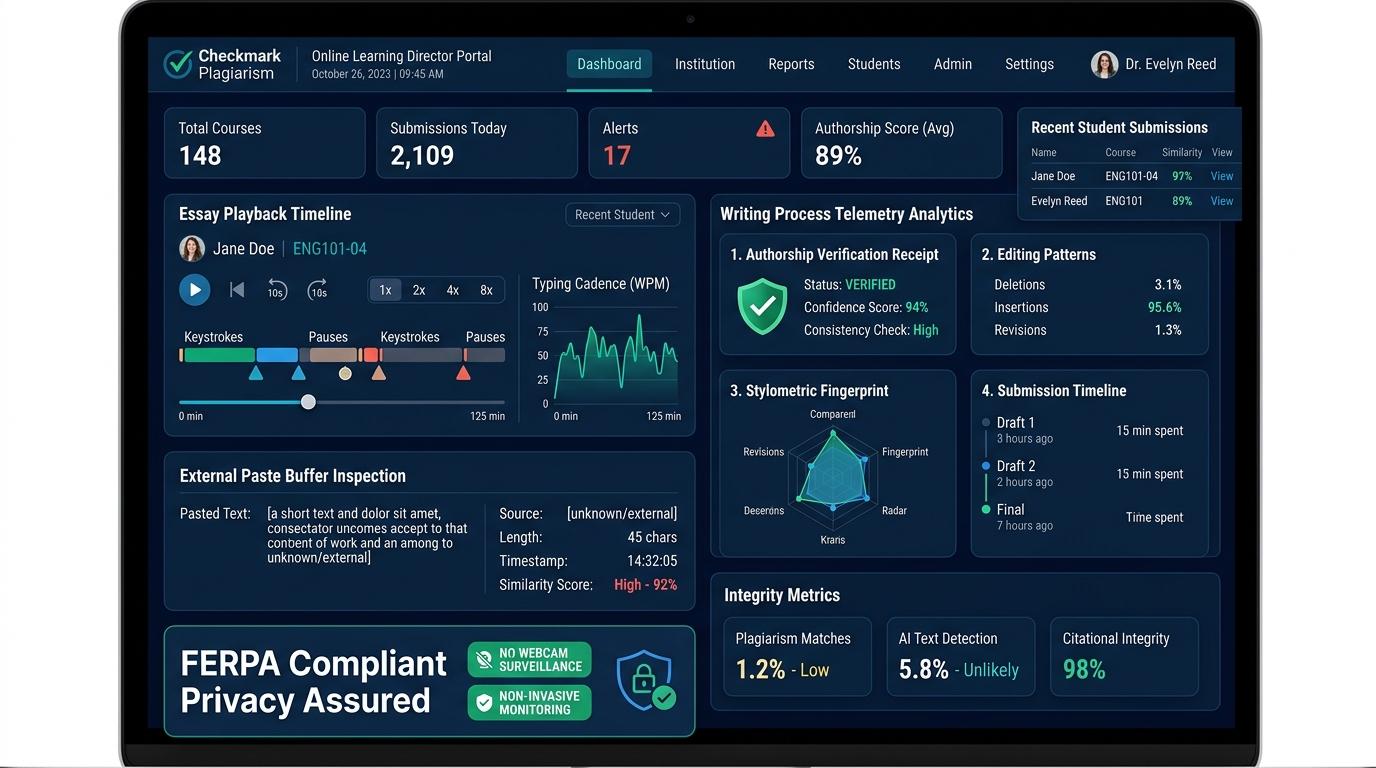
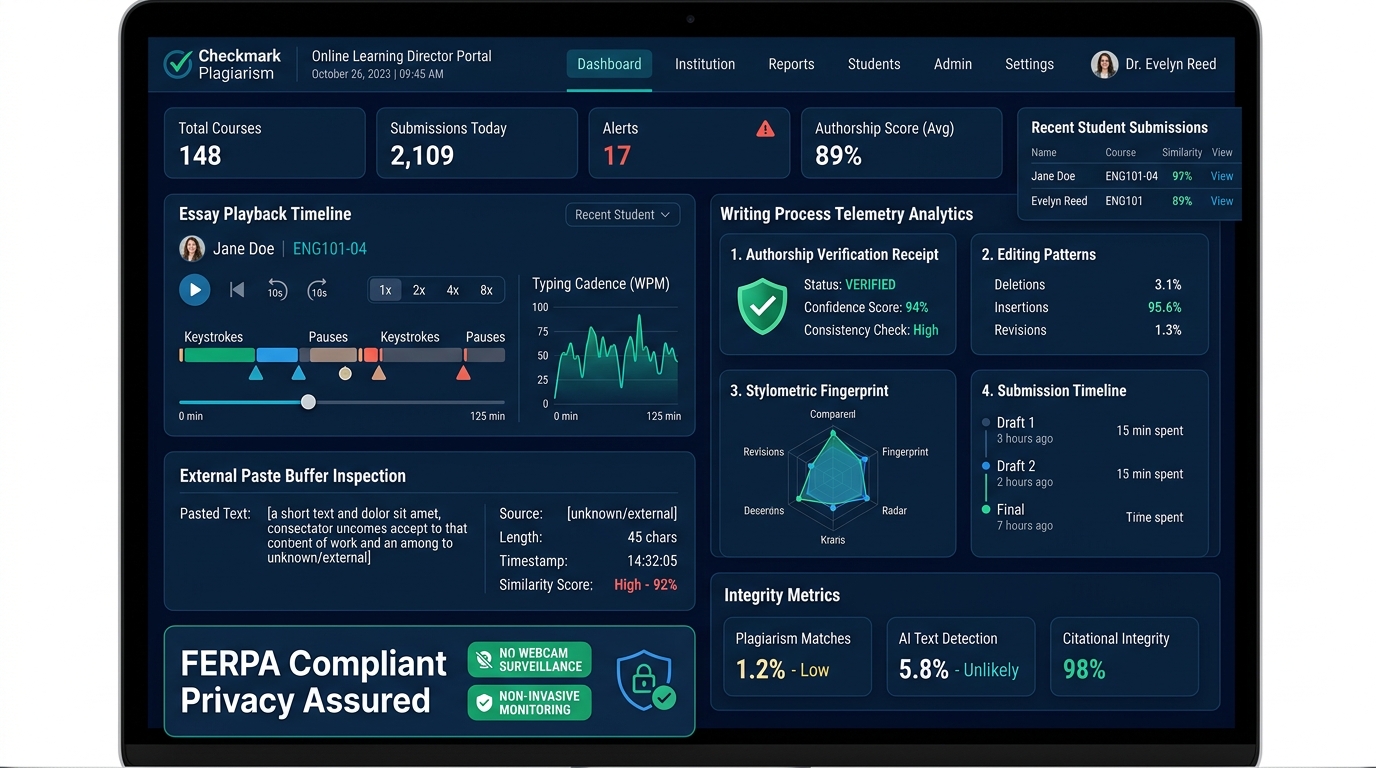
This comprehensive institutional guide details how educational leaders can transition to non-invasive writing process telemetry. By deploying Checkmark Plagiarism’s patent-pending Essay Playback™—which captures asynchronous keystroke cadence, pause dynamics, external paste buffer contents, and 1x–8x visual revision replays in ultra-lightweight (<50 KB) JSON packets—online programs can verify authentic authorship with zero video surveillance, total FERPA/COPPA compliance, and complete procedural defensibility.
Checkmark Plagiarism equips Online Learning Directors, Virtual Academy Administrators, and Higher Ed Distance Learning Leaders with non-invasive writing process playback and seamless LMS integrations across Canvas LMS, Agilix Buzz, and Google Classroom.
1. The High-Stakes Authorship Crisis in Asynchronous Online & Distance Education
Over the past decade, asynchronous online learning has expanded from a specialized alternative into a central pillar of modern education. Today, State Virtual High Schools, district-level K–12 Virtual Academies, university online degree programs, and dual-enrollment consortia serve millions of diverse students across the globe. These virtual environments provide vital flexibility for working adult learners, rural students without local advanced course access, neurodivergent students requiring customized pacing, elite student-athletes, and medically fragile youth.
However, distance education possesses a structural vulnerability that does not exist in brick-and-mortar classrooms: the complete physical separation between instructor and learner during high-stakes summative writing assessments.
- Direct teacher observation of in-class drafting
- Real-time peer editing & physical desk check-ins
- Immediate formative queries and oral coaching
- Physical custody of initial drafts, outlines & notes
- Unmonitored home drafting over 7–14 day windows
- Multi-device switching & untracked offline composition
- Zero visibility into genuine cognitive effort & ideation
- Binary submission artifact (isolated LMS file drop)
When an online student submits a 2,500-word persuasive essay or historical capstone research paper to a Learning Management System (LMS) such as Canvas, Agilix Buzz, Moodle, or Blackboard, the instructor receives only a static, finished digital file. In an era dominated by advanced Large Language Models (LLMs) like GPT-4o and Claude 3.5 Sonnet, alongside commercial essay mills and specialized paraphrasing tools, online educators face an impossible question:
“Did the enrolled student spend eight hours reading primary sources, drafting an outline, struggling through syntactic transitions, and polishing arguments—or did an external algorithm generate the entire submission in thirty seconds?”
The Flawed Institutional Reflex: Webcam Surveillance
To fill this authenticity void, educational institutions initially adopted the same technological hammer deployed for timed STEM and business exams: remote automated video proctoring and operating system lockdown browsers.
Under this model, students attempting to submit written coursework are forced to install intrusive kernel-level or browser-extension surveillance tools that:
- Hijack webcams and microphones to continuously record students’ private bedrooms, home environments, and facial micro-movements.
- Mandate invasive 360-degree pan-and-scan “room checks” before writing can begin.
- Lock down operating systems, severing student access to external research notes, digital library archives, and vital accessibility software.
- Utilize opaque computer-vision algorithms to flag “suspicious gaze deviations,” ambient household noise, or family members walking through the camera frame.
Ineffective for Writing: Measures physical room status, not cognitive composition.
Engineered for Writing: Lightweight JSON (<50 KB), universal equity, 100% FERPA/COPPA safe.
For Online Learning Directors, the legacy surveillance model has proven catastrophic. Rather than fostering genuine academic integrity, video proctoring has introduced severe constitutional liabilities, deepened digital equity divides, and disrupted the natural cognitive workflows essential for written expression.
2. The Institutional, Legal, and Equity Breakdown of Video Proctoring
Online Learning Directors, Curriculum Coordinators, and District Technology Directors must confront three major structural failures inherent in video surveillance proctoring for writing assessments: legal/privacy liabilities, equity and accessibility penalties, and fundamental composing incongruity.
Ogletree v. Cleveland State: Bedroom room scans ruled unconstitutional searches under the 4th Amendment. High FERPA/COPPA exposure with 3rd-party biometric video storage.
Severe failure on low-bandwidth connections (<5 Mbps); camera anxiety paralyzes working memory; false disciplinary flags in shared and multi-family homes.
Authentic writing requires multi-session, non-linear research, drafting, and revision over days and weeks—not a rigid 50-minute webcam sprint.
A. The Privacy and Fourth Amendment Legal Landscape: Ogletree v. Cleveland State University
The constitutional legality of remote webcam surveillance in education was addressed directly by the federal district court ruling in Ogletree v. Cleveland State University (U.S. District Court, N.D. Ohio, 1:21-cv-00500, 2022).
In this case, a student challenged the university’s policy requiring a mandatory webcam “room scan” of his private residential bedroom prior to taking an online assessment. The federal district court ruled decisively that remote webcam room scans constitute an unconstitutional search under the Fourth Amendment of the United States Constitution.
Key institutional and legal takeaways for online learning leaders include:
- The Sanctity of the Home: The court established that students possess a reasonable, constitutionally protected expectation of privacy in their private residential living spaces, bedrooms, and domestic settings.
- Lack of Institutional Necessity: The court weighed the university’s test-integrity interest against the student’s privacy interest in his home and found that the privacy interest outweighed it, noting that other safeguards would advance the same purposes and that the university offered little evidence that room scans were uniquely effective.
- Direct Civil Rights Liability: Public school districts, state virtual high schools, and public universities that require room scans of students’ homes risk civil rights suits under 42 U.S.C. § 1983. Mr. Ogletree sued under that statute and obtained a declaratory judgment and a permanent injunction against the university.
Beyond Fourth Amendment constraints, video proctoring vendors present grave FERPA (Family Educational Rights and Privacy Act) and COPPA (Children’s Online Privacy Protection Act) compliance risks. Third-party vendors routinely capture, process, and retain student facial geometry, biometric gaze telemetry, audio recordings, and government-issued identification cards on external cloud servers. Vague data retention policies and cross-border processing expose educational institutions to massive regulatory penalties and data breach liabilities.
B. The Equity, Accessibility, and Anxiety Penalty
Webcam surveillance software operates on deeply flawed assumptions regarding socioeconomic uniformity, domestic infrastructure, and student neurodiversity.
| Operational & Equity Dimension | Video Surveillance & Lockdown Platforms | Impact on Asynchronous Online Learners |
|---|---|---|
| Bandwidth Demands | Continuous upstream video/audio streaming requires stable 3.0–8.0 Mbps upload pipes. | Frequent crashes, frozen exams, and dropped submissions for rural students on satellite, DSL, or cellular hotspots. |
| Domestic Living Environments | Mandates an isolated, silent, private room with sterile background walls. | Systemic false-positive disciplinary flags for low-income students in shared bedrooms, multi-generational homes, or active households. |
| Algorithmic Demographic Bias | Computer-vision facial recognition trained on non-representative datasets. | Documented algorithmic bias against darker skin tones (lighting/face-detection errors) and neurodivergent students with atypical eye contact or motor tics. |
| Cognitive & Emotional Impact | Continuous “red-dot” video recording creates hyper-surveillance anxiety. | Constricts cognitive working memory; students fixate on physical immobility rather than complex argumentative composition. |
C. Composing Incongruity: Why Exam Surveillance Fails Writing
The most fundamental flaw of video proctoring for essays is pedagogical. Video proctoring was engineered for synchronous, timed, closed-book multiple-choice exams (e.g., a 60-minute chemistry test).
Authentic writing, by contrast, is:
- Iterative and Asynchronous: Spanning days or weeks of brainstorming, source evaluation, outlining, drafting, pausing, revising, and line-editing.
- Open-Source and Connected: Requiring continuous consultation of primary sources, scholarly databases (JSTOR, PubMed), online dictionaries, and style handbooks.
- Non-Linear: Characterized by long contemplation pauses, sudden paragraph deletions, restructuring of arguments, and gradual syntactic refinement.
Forcing an online student to sit rigidly in front of a recording webcam for 15 hours while composing a capstone literature review is technologically absurd, computationally unscalable, and pedagogically destructive.
3. The Non-Invasive Writing Telemetry Paradigm: How Essay Playback™ Solves the Dilemma
To solve the online authorship crisis without surveillance, educational leaders are embracing a non-punitive, evidence-based principle: “Stop guessing, start trusting.”
Rather than monitoring the physical body of the student, institutions monitor the temporal evolution of the text itself inside the digital composing environment.
Encrypted in Transit (TLS 1.3) → Transmitted Asynchronously in Background Micro-Bursts → Zero Bandwidth Congestion
What Writing Telemetry Is (and Isn’t)
Writing telemetry is the capture of lightweight, temporal interaction events occurring within an authorized document editor.
- Zero Webcam / Video Streams: No cameras are activated; no physical rooms are viewed.
- Zero Audio Surveillance: No ambient sounds, voices, or background noises are recorded.
- Zero Screen Scraping: The system does not view the student’s desktop, external browser tabs, personal files, or private messages.
- Zero Biometric Facial Scanning: No biometric identifiers or facial geometry are captured, stored, or processed.
Instead, the system captures pure document biomechanics: the precise timestamps of key presses, deletions, cursor repositions, active drafting duration, contemplation intervals, and clipboard insertions.
Key Telemetric Vectors in Checkmark Plagiarism
1. Inter-Key Interval (IKI) & Cadence Analysis
Human typing is rhythmically bursty. When an authentic student writes, text entry speeds fluctuate dramatically based on cognitive complexity:
- Familiar Lexical Strings: Rapid bursts (IKIs of 110ms–190ms) during common words (“the”, “because”, “evidence”).
- Syntactic Transitions & Vocabulary Retrieval: Pronounced mid-sentence pauses (IKIs of 800ms–3,500ms) where the student pauses to select an adjective or formulate the next clause.
- Global Macro-Pauses: Contemplative breaks (30 seconds to several minutes) where typing halts while the student re-reads a prompt, reviews an outline, or evaluates an argument.
By contrast, an unauthorized student manually transcribing text from an adjacent smartphone or second screen generated by an LLM displays a flat, metronomic cadence (consistent 220ms–310ms IKIs across complex academic terminology) with near-zero cognitive pauses and zero organic backspacing.
2. External Paste Buffer Inspector
When students use generative AI or contract cheating services, the primary delivery vector is a direct clipboard paste (Ctrl+V / Cmd+V).
Generic LMS audit logs merely record a massive text leap, leaving administrators unable to answer the student’s standard rebuttal: “I wrote my essay in Microsoft Word offline and pasted my own work into the LMS.”
Checkmark Plagiarism’s External Paste Inspector captures 100% of the raw text placed into the editor from the outside clipboard. Even if the student subsequently edits, rewords, or deletes portions of the pasted block, Checkmark preserves the complete original clipboard text in a dedicated evidence card. Educators can inspect the exact formatting, unformatted markdown headers (e.g., ChatGPT-style ### tags or bolded bullet lists), and click an instant “Jump-to-Playback” button to scrub directly to the millisecond the paste occurred.

3. Patent-Pending Essay Playback™
The cornerstone of Checkmark Plagiarism is Essay Playback™. Like an interactive video recording of the writing canvas, Essay Playback™ reconstructs the entire drafting journey keystroke by keystroke. Online instructors, department chairs, and academic integrity officers can scrub through a 5-hour writing session in 60 seconds at 1x, 2x, 4x, or 8x speed.
Every sentence mutation, backspace flurry, structural paragraph swap, and external paste is visually animated directly on the page, transforming abstract suspicion into concrete, undeniable visual proof.
4. The Multi-Dimensional Integrity Triad: Process, Text, and Sources
A defensible academic integrity infrastructure cannot rely on any single metric. Online Learning Directors require a holistic, multi-factor evidence triad that cross-verifies document authenticity across process, text, and sources.
Keystroke Dynamics • 1x–8x Visual Replay • External Paste Buffer Inspection
- Calibrated Confidence Sliders (Perplexity & Burstiness)
- Passage-level highlights instead of whole-doc %
- Displays N/A for short fragments <150 words
- Strict educator-only flag visibility
- Side-by-side source quote viewers with live links
- Uncited source formatting vs. verbatim copy-paste
- Cohort-level peer cross-checks within district
- Zero public model training on student text
Quote-Anchored Rubric Justifications • One-Click Direct Canvas & Buzz LMS Grade Passback
1. Granular, Passage-Level AI Writing Detection
Generic AI detectors generate an opaque whole-document probability score (e.g., “78% AI”), which invites immediate dispute and provides zero instructional utility.
Checkmark Plagiarism utilizes passage-level granularity:
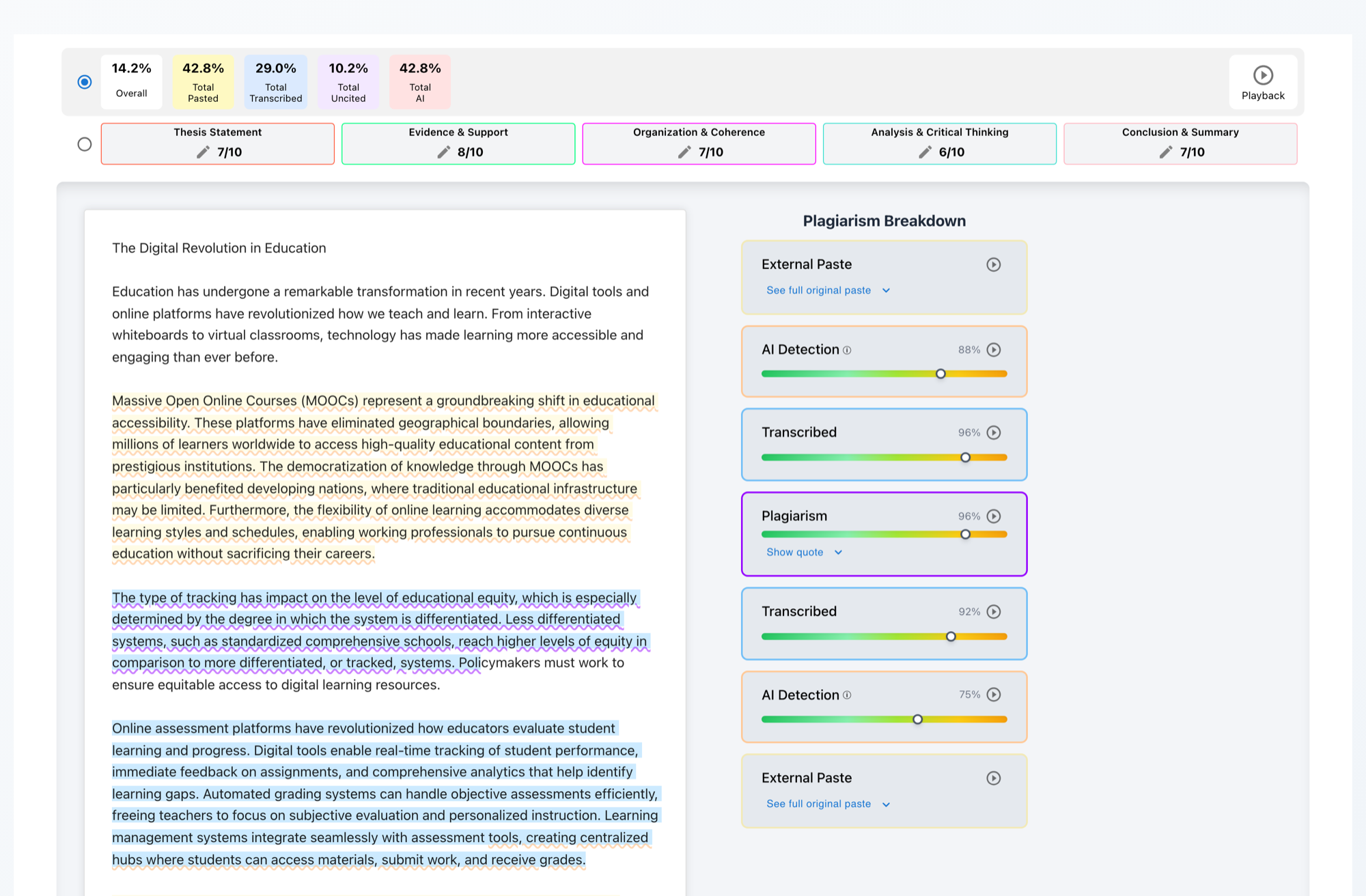
- Specific suspicious sentences and paragraphs are highlighted directly within the essay text.
- Each highlighted passage is linked to an interactive Sidebar Evidence Card featuring calibrated confidence sliders (illustrating typical human drafting vs. typical LLM perplexity and burstiness patterns).
- Honest Guardrails for Short Text: For text fragments below ~150 words (such as discussion board replies or short reading responses), Checkmark displays
N/Arather than generating statistically unreliable guesses. - Educator-Only Flag Visibility: Integrity flags (
Flagged,Resolved,Not Flagged) remain strictly confidential to teachers and administrators, preventing unwarranted automated accusations against students.
2. Defensible Web & Academic Plagiarism Matching
Process telemetry is paired with high-speed indexing across billions of live web pages, scholarly publications, digital encyclopedias, and internal institution-wide student submission repositories.
- Side-by-Side Source Viewers: Instructors inspect student text directly parallel to the source text, with matched syntax highlighted and live URL links provided.
- Uncited Source Differentiation: Checkmark automatically differentiates between improper citation formatting (which requires formative citation coaching) vs. verbatim copy-paste plagiarism (which warrants disciplinary inquiry).
- Cohort-Level Peer Matching: Cross-checks essays across multiple class sections and historical terms within the district or virtual academy repository without exposing student data externally.
3. Quote-Anchored AI Rubric Autograding
Authentic authorship verification integrates seamlessly into formative evaluation. Checkmark’s AI Autograder generates draft rubric scores tied directly to specific quotes in the student's prose.
- Teacher Final Authority: Every automated score and written justification remains a proposed draft until reviewed, modified, or approved by the educator.
- LMS Integration: With a single click, finalized scores and qualitative feedback pass directly into Canvas SpeedGrader, Agilix Buzz LMS, or Google Classroom gradebooks.
5. Architectural Comparison: Video Proctoring & Lockdown Systems vs. Checkmark Essay Playback™
For technology directors, district school boards, and higher education procurement committees, the operational advantages of writing process playback over legacy surveillance software are definitive:
| Evaluation Dimension | Video Surveillance & Lockdown (Proctorio, Honorlock, Respondus) | Checkmark Plagiarism & Essay Playback™ |
|---|---|---|
| Technology Class | Synchronous video streaming, audio recording, kernel-level OS lockdown. | Asynchronous keystroke telemetry, temporal document replay, linguistic analysis. |
| Hardware & Bandwidth | High-bandwidth (3–8 Mbps upstream); requires HD webcams, high-spec RAM/CPU. | Ultra-lightweight (<50 KB JSON payload); runs smoothly on low-cost Chromebooks and 512 Kbps satellite internet. |
| Constitutional Legality | High Fourth Amendment liability (Ogletree v. Cleveland State room scan ruling). | Zero Fourth Amendment risk; captures no residential living spaces or biometric camera streams. |
| Student Data Privacy | FERPA/COPPA risks from third-party storage of student facial geometry and room video. | 100% FERPA/COPPA compliant; zero video/audio; student work is never used to train commercial AI models. |
| Assessment Suitability | Restricted to short, timed, multiple-choice or short-answer exam windows (30–90 mins). | Engineered specifically for iterative, multi-day, multi-session essay drafting and research papers. |
| Equity & Neurodiversity | High false-positive rates for students with tic disorders, atypical gaze, or shared living spaces. | Measures writing evolution; completely blind to physical appearance, gaze direction, or room noise. |
| Student Exoneration | Inconclusive; cannot prove whether an off-camera screen was viewed during essay writing. | Definitive; authentic revision history, typing cadence, and ideation pauses completely exonerate honest students. |
| Pedagogical Value | Purely punitive surveillance; induces high test anxiety and fosters deep institutional distrust. | Formative and restorative; visualizes student writing growth and illuminates drafting habits for teacher coaching. |
6. Real-World Case Studies in Distance & Virtual Learning
- 100% Video Decommissioned
- $185K Annual Cost Savings
- 0 Disciplinary Board Appeals
- Zero Submission Drops (<3 Mbps)
- ESL False AI Flags Resolved
- JSTOR Citation Paste Verification
- Canvas SpeedGrader Integration
- 94% Decrease in AI Disputes
- Restorative 1-on-1 Coaching
Case Study 1: Statewide Virtual Charter Academy (30,000 K–12 Students)
- Institutional Profile: A state-authorized virtual public charter school operating across 67 counties, serving 30,000 full-time online students in grades K–12 using Agilix Buzz LMS.
- The Crisis: Following the Ogletree ruling, the school board faced intense parental pushback and potential civil rights litigation regarding its mandatory webcam proctoring software for secondary English and Social Studies courses. Furthermore, the district was spending $240,000 annually on video proctoring licenses while experiencing a 14% assignment failure rate caused by video stream disconnects in rural broadband deserts.
- The Implementation: The Online Learning Director decommissioned the video proctoring vendor and integrated Checkmark Plagiarism directly into the Buzz LMS rich-text submission environment. All take-home essays, DBQs, and capstone research papers were drafted with native keystroke telemetry.
- The Results:
- 100% Elimination of Video Surveillance: Total removal of webcams, room scans, and OS lockdown utilities across all humanities courses.
- Bandwidth Equity: Zero reported submission failures due to connection drops; telemetry synchronized reliably even on intermittent cellular hotspots.
- Financial Efficiency: Annual edtech expenditure on integrity licensing dropped by $185,000.
- Defensible Adjudication: In 28 flagged academic integrity inquiries, Essay Playback™ provided unambiguous visual proof of writing evolution, resolving 100% of cases at the teacher-student conference stage without escalating to formal board hearings.
Case Study 2: Rural Distance Learning High School Consortium
- Institutional Profile: A consortium of 14 rural public high schools providing asynchronous Advanced Placement (AP) English Literature and Language courses to geographically isolated students.
- The Crisis: Over 45% of students relied on low-tier satellite internet or subsidized LTE cellular hotspots (speeds <3 Mbps down, <1 Mbps up). Generic AI detectors were generating high false-positive rates on ESL and first-generation college-bound students, while video proctoring crashed student Chromebooks whenever room scans were initiated.
- The Implementation: The consortium deployed Checkmark’s lightweight browser-based editor plugin. Because Checkmark’s telemetry packets compress to under 50 KB of asynchronous JSON, writing data uploaded seamlessly in background micro-bursts without saturating rural connections.
- The Results:
- Exoneration of Honest Students: When an ESL student’s 1,800-word research essay was flagged with an 82% AI score by an external generic detector, Checkmark’s Essay Playback™ revealed 6.5 hours of active typing, 420 organic backspace corrections, and natural syntax restructuring pauses—proving complete human authorship and preventing an unwarranted suspension.
- Paste Inspector Transparency: Instructors utilized the External Paste Buffer Inspector to confirm that a student who pasted three complex historical quotes had copied them directly from an approved JSTOR PDF rather than an unauthorized LLM prompt.
Case Study 3: Higher Education Online First-Year Writing (FYW) Program
- Institutional Profile: A major public university enrolling 4,200 asynchronous online undergraduates per semester in mandatory First-Year Composition (English 101/102).
- The Crisis: Instructors were overwhelmed by suspected ChatGPT submissions. Frustrated faculty attempted to enforce webcam lockdowns during essay writing, leading to widespread student protests regarding camera anxiety, privacy violations in dorm rooms, and incompatibility with multi-day research workflows.
- The Implementation: The Writing Program Administrator (WPA) partnered with the Academic Technology Center to embed Checkmark Plagiarism into Canvas LMS via LTI 1.3 Advantage. Students composed their multi-draft essays directly within the Canvas Checkmark editor.
- The Results:
- Shift from Punitive to Restorative Conferences: Instructors transitioned from accusatory interrogations to supportive drafting conferences. Faculty pulled up students’ Essay Playback™ timelines during virtual office hours to discuss specific moments where students paused or restructured arguments.
- 94% Reduction in Disciplinary Appeals: Unsubstantiated AI allegations dropped by 94% across the program, as transparent keystroke playback provided indisputable evidence for both faculty and students.
7. The 4-Phase Non-Invasive Authorship Verification Protocol
For Online Learning Directors seeking to establish a standardized, defensible workflow across their virtual programs, this four-phase protocol replaces subjective guesswork with verifiable telemetry.
Publish transparent syllabus policy emphasizing process over surveillance. Embed Checkmark LTI 1.3 Deep Linking directly in Canvas, Buzz, or Moodle with SSO.
Students compose within the LMS editor or Google Docs workflow. Real-time background capture of keystrokes, pauses, and raw paste buffers (<50 KB payloads).
Triad review: External Paste Buffer, Passage-Level AI Sliders, Side-by-Side Plagiarism. Scrub through Essay Playback™ at 4x speed if anomalies are detected.
Share Essay Playback™ screen during virtual office hours. Conduct growth-oriented dialogue using transparent, visual composing receipts.
Phase 1: Policy Formulation & LMS Onboarding
- Establish clear institutional policies informing students that essay authorship is validated through asynchronous writing process history rather than invasive video surveillance.
- Configure Checkmark Plagiarism via LTI 1.3 Deep Linking within the institutional LMS (Canvas, Buzz, Blackboard, or Moodle), ensuring single sign-on (SSO) and automatic roster synchronization.
Phase 2: In-Editor Composition & Telemetry Capture
- Structure major writing assessments so that drafting occurs within the native LMS rich-text editor or connected Google Docs environment.
- The Checkmark engine runs invisibly in the background, logging millisecond-precise key events, cursor movements, active typing duration, contemplation intervals, and clipboard paste payloads into encrypted JSON arrays.
Phase 3: Telemetric Triage & Automated Screening
Upon submission, the instructor or academic integrity officer reviews the Checkmark Integrity Dashboard:
- External Paste Log Review: Verify whether large blocks of text were pasted simultaneously. If pastes exist, inspect the External Paste Buffer to evaluate whether the text represents cited source material, rough notes, or unapproved AI output.
- Essay Playback™ Scrubbing: If anomalous typing velocity (e.g., sustained >140 WPM) or low backspace activity (<1%) is detected, scrub through the visual replay at 4x speed to observe document evolution.
- Passage-Level AI & Plagiarism Triad: Examine individual highlighted sentence cards, checking linguistic confidence sliders and live web side-by-side matches.
Phase 4: Restorative, Evidence-Based Authorship Conferences
If process anomalies indicate unauthorized text generation:
- The instructor schedules a brief, supportive virtual conference via Zoom or Microsoft Teams.
- Rather than confronting the student with an opaque percentage score (“The AI detector says you cheated”), the instructor shares their screen and opens the student’s Essay Playback™ timeline.
- The instructor asks restorative, process-focused questions: “I notice that at minute 14 of your writing session, this entire three-paragraph section appeared instantly as a paste buffer insertion. Can you walk me through your drafting notes and how you developed this argument?”
- When confronted with objective visual records of their own document session, students readily engage in honest, productive dialogues without defensive hostility.
8. Online Syllabus Policy & Student Communication Framework
To ensure legal defensibility and maintain transparency, institutions must clearly articulate their writing process verification procedures in all online course syllabi and LMS orientation modules.
Academic Integrity & Writing Process Verification Policy
In this course, we value authentic intellectual inquiry, critical reasoning, and the iterative development of your personal voice as a writer. Because writing is a dynamic cognitive process rather than an instantaneous product, this course does not utilize invasive webcam surveillance, room scans, or remote lockdown browsers.
Instead, we employ non-invasive writing process telemetry through Checkmark Plagiarism. When you compose and submit essays within our Learning Management System, the platform records the temporal evolution of your text—including your drafting timeline, revision history, typing rhythm, and citation pasting events.
Student Guidelines for Course Submissions:
- Compose in the Designated Editor: All major essays, drafts, and revisions should be composed directly within the course editor or approved Google Docs workflow. This automatically builds your verifiable record of authorship.
- Drafting Notes & External Sources: If you draft rough outlines offline or copy research quotes from library databases, simply paste them into the editor as needed. Our system preserves your full paste history, allowing you to easily verify legitimate source citation during review.
- Your Process is Your Protection: If an automated linguistic filter ever flags a passage of your authentic writing as similar to AI patterns, your detailed Essay Playback™ history serves as your definitive, incontrovertible evidence to exonerate your work.
We believe in transparent, defensible evidence over arbitrary guesswork: Stop guessing, start trusting.
9. Technical Specifications, Security & Zero-Retention Governance
For District Technology Directors and Higher Education Chief Information Security Officers (CISOs), deploying academic integrity software requires uncompromising security, privacy, and architectural standards.
Raw Keystroke Capture • Millisecond Delays • Paste Buffer Arrays • Encrypted JSON (<50 KB) • TLS 1.3
FERPA & COPPA Compliant • AES-256 Encryption at Rest • ZERO MODEL TRAINING GUARANTEE (No AI Training)
Canvas SpeedGrader Interface • Buzz LMS Native Deep Linking • Direct Grade Passback • Quote-Anchored Rubrics
1. The Zero Model Training Guarantee
Many commercial AI detection and grammar tools reserve the right to ingest submitted student essays into their general training corpora. Checkmark Plagiarism enforces an absolute Zero Model Training Guarantee: student intellectual property and essay submissions are strictly isolated and never used to train, fine-tune, or calibrate public or proprietary AI models.
2. FERPA, COPPA, and Data Privacy Standards
- Encryption in Transit & at Rest: All telemetry payloads and student records are encrypted using TLS 1.3 in transit and AES-256 at rest.
- Role-Based Access Control (RBAC): Telemetry reports, playback recordings, and integrity statuses are accessible exclusively to authenticated, authorized instructors and school administrators.
- No Third-Party Biometric Sharing: Because no video, facial, audio, or biometric scans are captured, no biometric data is stored or shared with external third parties.
3. Ultra-Low Bandwidth Optimization
- Payload Size: A full 2,500-word essay composing session (incorporating over 15,000 keystroke and pause events) compiles into an optimized JSON payload of less than 50 KB.
- Chromebook Optimization: The telemetry engine runs asynchronously in the browser background with sub-1% CPU utilization, ensuring zero lag or thermal throttling on entry-level student Chromebooks and mobile devices.
10. Frequently Asked Questions (FAQs)
FAQ 1: How does Essay Playback™ differ from standard Google Docs revision history?
While Google Docs “Version History” records periodic snapshot backups (often bundling hundreds of words typed over 15–30 minutes into a single static diff), it lacks millisecond-level telemetry. Google Docs cannot display inter-key intervals, individual character deletions, exact typing velocity curves, or the precise contents of external clipboard paste buffers. Checkmark’s Essay Playback™ captures every single keystroke, backspace, pause, and paste event with millisecond timestamps, allowing educators to scrub through the entire writing session at 1x to 8x speed like an interactive video.
FAQ 2: What happens if an online student drafts offline in Word or Notepad and pastes the essay into the LMS?
When a student pastes an entire essay at once, Checkmark immediately logs an External Paste Event and preserves 100% of the pasted text in the External Paste Buffer Inspector. Under Checkmark’s non-punitive verification protocol, the instructor does not automatically fail the student. Instead, the teacher conducts a brief check-in and invites the student to provide their offline draft file, outline notes, or compose a brief 5-minute revision in the LMS editor. If the student has an authentic drafting history in Word or Google Docs, the teacher can verify the offline file metadata or use Checkmark’s desktop integration tools.
FAQ 3: Does keystroke playback run smoothly on low-cost student Chromebooks and low-speed rural internet?
Yes. Unlike video proctoring platforms that require 3–8 Mbps upstream bandwidth and substantial CPU/RAM to process HD video and audio streams, Checkmark’s telemetry engine records lightweight text events. The entire telemetry file for a multi-hour writing session is typically under 50 KB (smaller than a single static web image). It uploads reliably across cellular hotspots, satellite internet, and low-spec 4GB RAM Chromebooks with zero browser latency.
FAQ 4: How does writing telemetry protect non-native English speakers and neurodivergent distance learners from false AI flags?
Generic AI detectors frequently flag English as a Second Language (ESL) writers and neurodivergent students because their prose often exhibits lower linguistic perplexity (simpler vocabulary) and highly uniform sentence structures (burstiness patterns resembling AI). When such students are falsely flagged by statistical detectors, Essay Playback™ acts as their ultimate defense. The visual playback reveals their authentic human drafting journey—capturing hours of genuine effort, vocabulary revisions, thesaurus lookups, and paragraph reorganization—irrefutably proving authentic human authorship regardless of statistical surface scores.
FAQ 5: What legal protections does Essay Playback™ provide against Fourth Amendment challenges like Ogletree v. Cleveland State?
In Ogletree v. Cleveland State University, the federal district court ruled that a public university’s warrantless remote room scan of a student’s bedroom was an unreasonable search under the Fourth Amendment. Checkmark Plagiarism eliminates this legal liability entirely. Essay Playback™ operates with zero cameras, zero microphones, zero room scans, and zero desktop surveillance. It captures only the digital text events occurring inside the authorized course assignment editor, completely avoiding any search of the student’s physical home or private computing environment.
FAQ 6: How can instructors distinguish legitimate source pasting from unauthorized generative AI dumps?
Checkmark’s External Paste Buffer Inspector preserves the complete original text of every clipboard paste event and links it to an interactive evidence card. Instructors simply open the paste card to review the content:
• Legitimate Source Pasting: The pasted text consists of a single quote, a statistical table, or bibliographic citation that corresponds to a cited source in the essay.
• Unauthorized AI Dumps: The pasted text consists of an entire 800-word multi-paragraph essay section, complete with characteristic LLM artifacts (such as introductory conversational phrases, unformatted markdown headers ###, or generic concluding summaries).
FAQ 7: How does Checkmark Plagiarism integrate with Canvas LMS SpeedGrader and Agilix Buzz LMS?
Checkmark integrates natively via LTI 1.3 Advantage Deep Linking. Within Canvas SpeedGrader or Buzz LMS assignment portals, instructors access the complete Checkmark Integrity Report—including the Essay Playback™ scrubbable timeline, passage-level AI confidence sliders, side-by-side plagiarism matches, and quote-anchored rubric feedback—directly embedded inside their normal grading workflow. With one click, draft rubric grades and qualitative feedback sync directly back into the official LMS gradebook.
Conclusion: Stop Guessing, Start Trusting in Online Education
The future of asynchronous distance learning cannot be built on invasive webcam surveillance, unconstitutional bedroom scans, or punitive black-box algorithms. For Online Learning Directors, Virtual Academy Administrators, and Higher Education Leaders, verifying essay authorship requires tools that align with the pedagogical reality of the writing process.
By replacing video surveillance with Checkmark Plagiarism’s non-invasive writing process telemetry, institutions protect student constitutional rights, bridge the digital equity divide, eliminate hundreds of thousands of dollars in redundant software licensing, and empower educators with transparent, indisputable evidence.
Empower Your Online Educators & Protect Your Distance Learners
Transition from invasive video surveillance to patent-pending writing process telemetry. Schedule an institutional demonstration of Essay Playback™ today.