
For District Assessment Coordinators, Chief Technology Officers (CTOs), Directors of Curriculum & Instruction, and State Testing Administrators, validating the authenticity of student writing on remote, hybrid, and take-home benchmark assessments has reached a critical inflection point. Traditional remote integrity methods have collapsed under legal, ethical, and technical realities: a federal court has held that an invasive webcam room scan violated a student’s Fourth Amendment rights (Ogletree v. Cleveland State University), and webcam proctoring more broadly disproportionately penalizes low-income and neurodivergent learners, while opaque “black-box” AI detectors generate unprovable whole-essay probability scores that trigger false accusations and fail to catch students transcribing AI text from secondary devices.
To safeguard the validity of district-wide writing benchmarks—including quarterly English Language Arts (ELA) writing prompts, Advanced Placement (AP) mock exams, Career and Technical Education (CTE) capstone performance tasks, and credit-recovery exams—districts are transitioning to non-invasive writing process telemetry. Powered by Checkmark Plagiarism’s patent-pending Essay Playback™, this methodology passively captures granular keystroke dynamics, pause topography, inter-key intervals (IKIs), and external clipboard paste contents in ultra-lightweight (<50 KB) payloads on standard student Chromebooks under the founding principle: “Stop guessing, start trusting.”
Checkmark Plagiarism provides the pedagogical and forensic foundation for district benchmark validity by combining patent-pending Essay Playback™ with passage-level AI detection, side-by-side plagiarism checking, quote-anchored rubric autograding, and direct LMS integrations for Canvas LMS, Google Classroom, and Buzz LMS.
1. The Remote Benchmark Assessment Crisis: Why Traditional Integrity Methods Collapsed
Across K–12 school districts, regional educational service agencies (RESAs), and state virtual academies, standardized interim and benchmark writing assessments serve as critical navigational instruments. District leaders, curriculum specialists, and school boards rely on these assessments to:
- Measure Longitudinal Skill Growth: Track cohort-level mastery of state academic standards (e.g., Common Core, TEKS, BEST) in argumentative, informative, and narrative writing.
- Predict High-Stakes Exam Outcomes: Evaluate student readiness for Advanced Placement (AP) English Language/Literature, International Baccalaureate (IB) Extended Essays, and state-mandated graduation competency tests.
- Validate Credit-Recovery Competencies: Ensure that students completing asynchronous or remote credit-recovery modules have genuinely mastered core compositional competencies before conferring high school course credit.
- Direct Remediation & Title I Resource Allocation: Allocate district instructional coaches, reading specialists, and federal intervention funds based on reliable, standardized diagnostic writing data.
- Fall Baseline Writing Prompts
- Reading Response Quick-Writes
- Weekly Reflective Journals
Focus: Low-stakes baseline diagnosis & formative growth coaching.
- Quarterly District Writing Tests
- AP / IB Mock Essay Exams
- CTE Capstone Portfolios
Focus: District-wide standardization, calibration & growth tracking.
- State Graduation Competency Tests
- Credit Recovery Course Conferrals
- Dual Enrollment Transfer Submissions
Focus: Legal accountability, course credits & diploma validation.
However, the widespread expansion of 1:1 student device programs (predominantly Google Chromebooks), hybrid learning models, independent study academies, and take-home diagnostic assessments has severed the traditional physical chain of custody in writing evaluation.
When thousands of students complete district writing benchmarks outside the direct physical supervision of a proctored classroom, assessment coordinators confront an acute operational trilemma:
2. Deconstructing the Flawed Integrity Paradigms: Video Surveillance vs. Black-Box AI Detectors
When generative AI models (such as GPT-4o, Claude 3.5 Sonnet, and Gemini) proliferated, educational institutions initially responded with two reactive approaches: invasive video surveillance lockdown software and probabilistic AI detection classifiers. Both technologies have proven structurally defective for high-stakes district writing assessments.
- Fourth Amendment Exposure: A federal court held a public university’s room scan of a student’s home an unreasonable search in Ogletree v. Cleveland State University.
- Severe Bandwidth Bottlenecks: Crashes low-income and rural Chromebooks requiring 3–8 Mbps continuous upstream video feeds.
- Algorithmic Gaze Bias: Eye-tracking computer vision penalizes neurodivergent and ESL students looking away to think.
- Cognitive Composing Paralysis: Staring at a red recording dot paralyzes iterative drafting and creative synthesis.
- Opaque Whole-Paper Scores: “78% AI” gives zero granular proof, zero timestamps, and zero passage location.
- Non-Native Speaker False Positives: Punishes formulaic or non-native English writing styles far more often than native writing.
- The “Second-Screen” Blindspot: Zero detection when students hand-type AI output from a smartphone or tablet.
- Legally Indefensible: Probabilistic scores collapse instantly during formal parent hearings and school board appeals.
A. The Proctoring & Lockdown Browser Backlash
Remote video proctoring platforms—which mandate continuous webcam monitoring, audio recording, 360-degree room scans, and operating system locks—were engineered for synchronous multiple-choice testing. When applied to multi-paragraph writing assessments, they introduce profound legal, technical, and psychological liabilities.
1. The Fourth Amendment Ruling: Ogletree v. Cleveland State University
In the federal ruling Ogletree v. Cleveland State University (U.S. District Court, N.D. Ohio, No. 1:21-cv-00500, August 2022), the court held that a public university’s webcam room scan of a student’s bedroom before a remote exam was an unreasonable search under the Fourth Amendment.
The court found that the student had a reasonable expectation of privacy in his bedroom. The ruling involved an adult student at a public university and does not directly decide the question for K–12 students, but public institutions that require webcam room scans should expect Fourth Amendment challenges, which can be brought under 42 U.S.C. § 1983.
2. The Socioeconomic & Infrastructure Barrier
Video proctoring mandates continuous high-bandwidth video uplinks (3.0 to 8.0 Mbps per student). In large public school districts with substantial rural or Title I populations, thousands of students operate on cellular mobile hotspots, shared multi-generational Wi-Fi, or low-tier broadband.
During district-wide benchmark testing windows, video proctoring engines frequently disconnect, freeze Chromebook screens, discard unsaved essay text, and trigger false “disconnection anomaly” flags—effectively penalizing students for their socioeconomic status rather than their academic ability.
3. Algorithmic Demographic Bias & Neurodivergent Panic
Automated computer-vision proctoring algorithms rely on facial recognition and eye-tracking models that exhibit documented demographic disparities:
- Facial Detection Failures: In one study of widely used proctoring software, students with darker skin tones were significantly more likely to be flagged for instructor review (Yoder-Himes et al., 2022).
- Neurodivergent Misclassifications: Students with ADHD, autism spectrum disorder, or physical tics who look away from the screen to formulate thoughts, stim, or vocalize ideas are systematically tagged with “high-risk cheating anomalies.”
- Surveillance-Induced Cognitive Paralysis: The psychological pressure of a persistent “red recording dot” restricts working memory, inducing anxiety that degrades writing quality and invalidates diagnostic benchmark metrics.
B. The Black-Box AI Detector Trap
Frustrated by video proctoring, many district assessment coordinators turned to automated statistical AI detectors. These platforms ingest a finished text submission and output an aggregate probability score (e.g., “This essay is 72% AI-generated”). For district leadership, relying on whole-paper probabilistic AI scores creates severe procedural and legal vulnerabilities:
| Failure Dimension | Operational Reality | Impact on District Benchmark |
|---|---|---|
| Whole-Paper Aggregate Score | Generates an opaque percentage without isolating specific claims, quotes, or paragraphs. | Fails to identify whether a single outline sentence or the whole essay was AI-assisted. |
| Non-Native Speaker Bias | High perplexity classifiers flag uniform syntax and standard transitions as machine-generated. | English Language Learners (ELL) are falsely flagged far more often than native speakers: Stanford researchers found that popular detectors consistently misclassified non-native English writing as AI-generated (Liang et al., 2023). |
| The “Second-Screen” Blindspot | If an LLM generates text on a phone and the student manually types it in, detectors have zero context. | Text passes through static AI detectors with zero process flags despite being 100% generated. |
| Procedural Indefensibility | Probabilistic predictions do not constitute legal evidence in school board or parent appeals. | Districts cannot defend score cancellations or disciplinary actions during formal hearings. |
When an assessment coordinator attempts to invalidate a student’s benchmark writing score based solely on a commercial AI detector’s “85% AI” score, the district cannot answer basic evidentiary questions: Where are the specific uncredited sources? Did the student brainstorm an outline or have an algorithm write the final argument? How can the district prove the student didn’t spend three hours typing every sentence by hand?
| Evaluation Criteria | Remote Webcam Video Proctoring | Black-Box Statistical AI Detectors | Checkmark Keystroke Telemetry & Essay Playback™ |
|---|---|---|---|
| Constitutional Legality | × Room scans held an unreasonable search in Ogletree | ¡ High liability if used as sole basis | ✓ 100% compliant; zero home surveillance |
| Hardware & Bandwidth Demand | × Heavy (3–8 Mbps video); crashes Chromebooks | ✓ Low (single text payload post-submission) | ✓ Ultra-lightweight (<50 KB JSON); runs on 2G/hotspots |
| Cognitive Composing Freedom | × Paralyzing; forces students to stare at webcam | ✓ Unaffected (analyzes finished text after) | ✓ Natural; students draft, pause, and revise freely |
| Equity & Neurodiversity Safety | × Disproportionately flags ADHD & shared homes | × Disproportionately flags ELL & formulaic styles | ✓ Captures non-linear drafting, pauses & true effort |
| Second-Screen Phone Retyping | ¡ Partial (only if camera catches screen) | × Zero detection (static text lacks velocity) | ✓ Definite (detects isochronous cadence & zero pauses) |
| Clipboard Paste Verification | × Cannot inspect clipboard buffer contents | × Zero visibility into paste events | ✓ 100% paste capture with pre/post-paste text diffs |
| Procedural Defensibility for Appeals | ¡ Highly disputed; subjective human video review | × Defenseless; probabilistic black-box output | ✓ Complete; scrubbable 1x–8x visual session replay |
3. The Non-Invasive Writing Telemetry Standard: Architecture & Mechanics
To resolve the integrity crisis, modern school districts are shifting from physical surveillance to digital writing telemetry. Rather than watching the student’s physical body, writing telemetry captures the temporal and structural evolution of the text document itself as it is composed inside the district’s authorized writing environment (Google Docs, Canvas LMS Rich Content Editor, Agilix Buzz LMS, or Checkmark’s native assessment editor).
Low-memory JavaScript hook in Google Docs or Canvas LMS captures microsecond-accurate keystrokes, inter-key intervals (142ms), cursor hops, backspace mutations, cognitive pauses, and clipboard pastes in local cache.
Reconstructs the time-series mutation tree, analyzes burst topography against cognitive writing models, inspects external clipboard buffers against prompt sources, and executes passage-level AI detection.
Delivers scrubbable 1x–8x Essay Playback™, generates cohort-wide anomaly heatmaps for coordinators, and empowers teachers with quote-anchored rubric autograding and LMS grade passback.
The Biometrics of Authentic Human Composition
Authentic human writing leaves a distinct, irreproducible cognitive and mechanical fingerprint. When a human student drafts an essay under exam conditions, their composition exhibits three distinct biometric dimensions:
1. Pause Topography and Cognitive Burst Theory
In cognitive psychology, the Flower-Hayes Cognitive Process Theory of Writing (Flower & Hayes, 1981) describes composition as a recursive mix of planning, translating, and reviewing rather than a straight line, and research on writing fluency (Chenoweth & Hayes, 2001) describes text production as bursts of words separated by pauses and revisions. A student plans a thought, pauses to retrieve vocabulary and construct syntax, types a burst of words, pauses to evaluate what was typed, and edits or continues.
- Inter-Key Intervals (IKIs): The microsecond latency between consecutive keypresses (typically 120ms to 280ms for proficient student typists).
- Within-Word IKIs vs. Cross-Word IKIs: Natural typists execute keys within a known word rapidly (e.g., typing
t-h-ein 110ms increments) but exhibit natural micro-pauses (350ms to 700ms) at word and clause boundaries. - Macro-Pauses (Cognitive Formulations): Pauses exceeding 3.0 to 15.0 seconds that occur at the beginning of new paragraphs, after thesis statements, or when consulting reference texts.
2. Revision Topography & Mutation Density
Authentic drafting is messy. Natural student essays exhibit continuous structural mutations: real-time backspacing to fix typographical errors, highlight-and-replace actions to refine vocabulary, sentence reordering, paragraph restructuring, and upward cursor navigation where the student scrolls back up to adjust an earlier premise.
A completed 1,000-word authentic essay typically requires 3,500 to 7,000 individual keystroke and mutation events.
3. Keystroke Velocity & Isochronous Cadence
When a student is not formulating original thoughts, but is instead mechanically copying text (such as transcribing an essay displayed on a smartphone or second monitor), the cognitive pause topography vanishes:
- Isochronous Keystroke Cadence: Characters are entered at an unnaturally uniform, metronomic cadence (e.g., 180ms ± 15ms between every character, without sentence-boundary pauses).
- Zero Cognitive Macro-Pauses: The typing stream flows steadily from the first character to the final period without pauses for reflection or argument construction.
- Low Mutation Ratio: Near-zero structural revisions, zero sentence reordering, and only occasional typographical backspacing.
4. Checkmark Plagiarism’s Assessment Telemetry & Forensic Suite
To equip District Assessment Coordinators, CTOs, and instructional leaders with actionable, defensible writing insights, Checkmark Plagiarism provides a comprehensive, multi-dimensional assessment forensics suite. Rather than delivering a single black-box score, Checkmark synthesizes keystroke dynamics, paste inspection, web/peer plagiarism matching, and passage-level AI detection into an integrated, transparent evidence dossier.
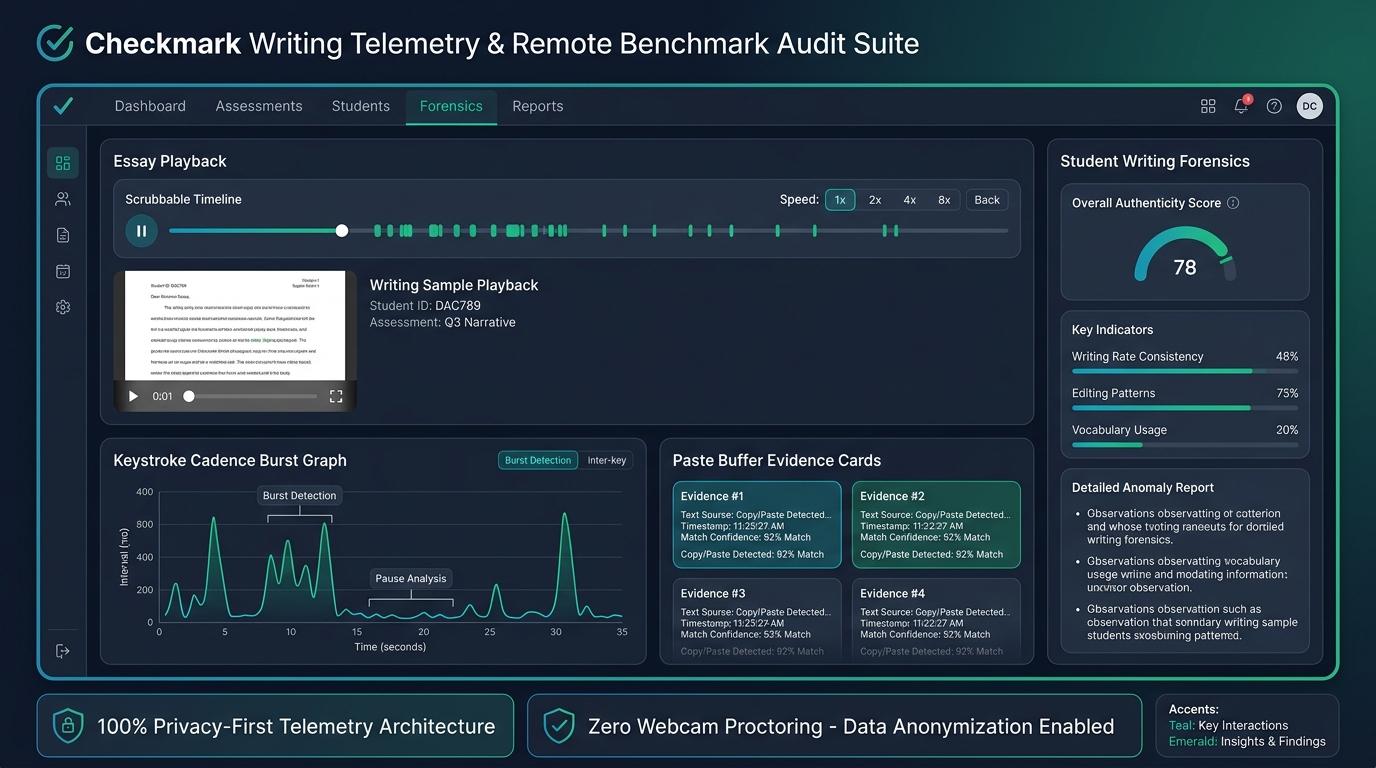
1x–8x scrubbable video replay reconstructing every keystroke, pause, deletion, and rewrite in real time.
Captures 100% of clipboard text, timestamp, character volume, and original pasted content prior to student edits.
Algorithms flag metronomic, pause-free character entry indicative of manual smartphone or second-screen copying.
Calibrated confidence sliders, side-by-side web quotes, and honest short-text guardrails (<150w N/A).
Quote-anchored feedback cards with seamless grade synchronization to Canvas SpeedGrader, Agilix Buzz, and Google Classroom.
Pillar 1: Patent-Pending Essay Playback™ (1x–8x Scrubbable Replay)
The centerpiece of Checkmark’s writing forensics is Essay Playback™. Essay Playback converts the stream of recorded keystroke telemetry into a scrubbable, video-like visual replay of the student’s entire writing session.
“The socio-economic implications of the Industrial Revolution were fundamentally shaped by rapid urban migration. [PAUSE 4.2s] In particular, textile workers in Manchester faced [backspaced 'poor'] inserted 'deplorable' working conditions...”
- Dynamic Timeline Scrubbing: Assessment coordinators and department chairs can drag the playhead to any moment in the testing session to observe how an idea developed.
- Typing Cadence Graphs: Color-coded timeline tracks highlight periods of rapid composition (green), extended cognitive reflection pauses (blue), heavy revision/deletion clusters (orange), and external paste events (red).
- Instant Exoneration: When an over-zealous statistical tool falsely accuses an honors student of using AI, opening Essay Playback immediately shows 75 minutes of authentic human drafting, agonizing pauses, and extensive structural revisions—providing indisputable proof of human authorship.
Pillar 2: External Paste Buffer Inspector
In remote testing, unauthorized text entry almost always involves the system clipboard (Ctrl+V or Cmd+V). Traditional LMS essay boxes record only the final submitted string; if a student pastes a 500-word ChatGPT essay into the box and then spends ten minutes tweaking minor words, legacy systems register the entire text as “typed.”
Checkmark’s External Paste Buffer Inspector transforms clipboard auditing:
- 100% Clipboard Capture: The exact string of text placed into the document during a paste event is preserved in an isolated forensic log.
- Pre- and Post-Paste Text Preservation: Checkmark maintains the original pasted block even if the student subsequently rewrites, paraphrases, or deletes every single word in an attempt to obscure the paste.
- Jump-to-Playback Integration: Every paste card in the forensic sidebar includes a “Jump to Timestamp” button that instantly seeks the Essay Playback video to the exact second the paste occurred.
- Legitimate Reference Differentiation: If the district permits students to paste from an approved digital source sheet or pre-writing graphic organizer, coordinators can view the paste card, verify that the text matches the approved prompt materials, and mark the event as “Resolved / Authorized.”
“Furthermore, the geopolitical ramifications of the Treaty of Versailles established a fragile balance of power that inadvertently accelerated economic collapse across Weimar Germany...”
Student made 14 minor lexical substitutions over next 8 minutes (e.g., replaced ‘ramifications’ with ‘impacts’). Checkmark preserved 100% of original clipboard string prior to edits.
Pillar 3: Second-Screen / Transcription Cadence Detection
One of the most elusive cheating vectors in remote testing is manual transcription: a student generates their benchmark essay on an unmonitored smartphone or second monitor, and then manually retypes the text character-by-character into the LMS to avoid triggering paste alerts.
Checkmark’s Transcription Cadence Engine detects this behavior through statistical signal processing of the keystroke stream:
- Variable Velocity: Fluctuates between 20 WPM and 75 WPM depending on cognitive complexity.
- Deep Pause Topography: 4–15 second formulation stops at clause and sentence boundaries.
- High Deletion Density: Constant backspacing, typo corrections, word swaps (1.5x–2.5x keystroke ratio).
- Non-Linear Cursor Navigation: Navigates backward to re-read and alter earlier paragraphs.
- Metronomic Entry Velocity: Steady, continuous 45–55 WPM without cognitive deceleration.
- Zero Structural Pauses: Inter-key intervals remain identical across major sentence boundaries.
- Near-Zero Mutation Density: Backspaces only occur for minor slips (<1% of total events).
- Purely Linear Progression: Types strictly from char 0 to char 3,000 without upward navigation.
When an essay exhibits a statistically flat cadence profile with zero formulation pauses, Checkmark generates an automated “Suspected Transcription Event” flag, prompting the coordinator to review the session replay.
Pillar 4: Passage-Level Multi-Factor AI & Plagiarism Detection
When analyzing text semantics, Checkmark rejects the flawed whole-paper percentage model. Instead, it provides Passage-Level Granularity:
- Underlined In-Text Highlights: Specific phrases and paragraphs are highlighted directly within the essay.
- Calibrated Confidence Sliders: Individual evidence cards in the sidebar display a continuous slider showing whether the passage exhibits patterns typical of human writing or typical of AI models (analyzing perplexity, burstiness, syntax uniformity, and transition predictability).
- Honest Guardrails (<150 Words): If an analyzed passage or short response is under ~150 words, Checkmark displays
N/Arather than guessing on statistically insufficient sample sizes. - Side-by-Side Plagiarism Comparisons: Web and peer matches display the student’s text side-by-side with original crawled sources, complete with clickable URLs and dedicated visual styling for uncredited source usage versus formatted quotations.
“The implementation of renewable energy infrastructure requires a multifaceted policy framework that simultaneously addresses grid modernization, capital subsidies, and regulatory harmonization...”
Pillar 5: Teacher-in-the-Loop Rubric Autograder & LMS Grade Passback
Assessment coordinators know that evaluating benchmark essays at scale across 20,000 students places an immense grading burden on ELA departments. Checkmark integrates Teacher-in-the-Loop AI Rubric Autograding:
- Criterion-by-Criterion Justifications: Evaluates student writing against district-standard rubrics (e.g., 6-trait writing, AP 6-point rubrics), generating written justifications tied directly to quotes in the student’s prose.
- Teacher Final Authority: All AI-generated scores remain provisional drafts until reviewed, adjusted, and approved by the certified educator.
- Direct LMS Passback: Finalized rubric scores and quote-anchored formative feedback push directly into Canvas SpeedGrader, Agilix Buzz LMS, or Google Classroom with one click, eliminating manual grade-entry overhead.
5. Real-World District Assessment Case Studies
The following case studies illustrate how diverse educational organizations have deployed keystroke telemetry and Essay Playback to audit benchmark writing exams.
The Challenge: A large urban/suburban district administered quarterly argumentative benchmarks to 18,000 secondary students. Mandating a commercial webcam proctoring browser resulted in 1,400+ hotspot disconnections, intense parent pushback regarding home bedroom video scans, and over 2,200 “suspicious gaze” false alarms—predominantly triggered by neurodivergent learners.
Telemetry Implementation: The district replaced video proctoring with Checkmark’s passive telemetry embedded in Canvas LMS. Bandwidth dropouts dropped from 1,420 to 0 (<50 KB payload), false flags dropped by 94% (down to 112 verified paste/transcription events), and software licensing costs dropped from $138,000 to $18,000 annually (87% savings) with zero privacy complaints.
The Challenge: A statewide virtual academy serving homebound students administered end-of-course capstone essays online. Generic whole-paper AI detection tools triggered endless disputes where instructors had zero physical evidence to defend findings.
Telemetry Implementation: Across 12,000 submissions, Checkmark automatically verified 11,814 clean drafting streams. Of 186 flagged submissions, 44 were verified as approved pre-writing organizers in the Paste Inspector, 88 were unauthorized AI pastes (full ChatGPT text captured), and 54 were second-screen transcriptions. When shown their own composing replays on Zoom, 100% of students acknowledged unauthorized help without prolonged appeals.
The Challenge: An 11th-grade honors student submitted a sophisticated comparative analysis of King Lear and Things Fall Apart. A legacy AI detector flagged the essay at 84% AI-Generated, and the student faced academic probation.
Telemetry Resolution: The Assessment Coordinator opened Essay Playback™, revealing 2 hours 48 minutes of active typing, 6,420 keystrokes, 34 cognitive formulation pauses, zero paste events, and extensive thesis restructuring. The student was fully exonerated: the high AI score had been triggered solely by her advanced vocabulary and formal syntactic structure.
6. The 4-Phase District Assessment Writing Telemetry Protocol
To standardize writing assessment integrity across multiple school sites, District Assessment Coordinators should implement the following four-phase operational protocol.
- Embed Checkmark LTI 1.3 telemetry hook into LMS writing prompts.
- Publish clear student guidelines defining authorized vs. unauthorized tools.
- Whitelist approved pre-writing organizers and source archives.
- Execute test window with passive background telemetry capture.
- Transmit lightweight (<50 KB) encrypted JSON streams to cloud vault.
- Maintain zero-interruption environment (no cameras, no crashes).
- Review centralized Anomaly Heatmap to isolate flagged outliers.
- Inspect Paste Buffer cards to distinguish organizers from AI dumps.
- Scrub through 1x–8x Essay Playback™ to confirm writing timeline.
- Conduct non-punitive student conferences sharing visual playback evidence.
- Enable teacher rubric autograding and push scores to LMS gradebook.
- Archive verified benchmark data for longitudinal state reporting.
7. The 10-Point Assessment Coordinator Audit Checklist
Use this 10-point checklist when evaluating anomalous benchmark writing submissions before initiating any academic integrity proceeding:
| # | Audit Dimension | Evaluator Forensic Criteria |
|---|---|---|
| 1 | Session Duration vs. Word Count | Does active typing time correlate logically with essay length (e.g., >35 mins for a 750-word analytical benchmark)? |
| 2 | Gross Keystrokes vs. Final Characters | Does gross keystroke count exceed final character count by at least 1.5x, demonstrating natural drafting mutations and revisions? |
| 3 | Pause Topography & Cognitive Bursts | Are there visible formulation pauses (3–15 seconds) at paragraph boundaries, or is the typing stream unnaturally continuous? |
| 4 | External Paste Buffer Inspection | Were paste events >100 characters logged? Does the captured clipboard text reveal full pre-drafted essays or authorized quotes? |
| 5 | Approved Source Whitelist Correlation | Does pasted text match an approved prompt excerpt, pre-writing graphic organizer, or primary source citation? |
| 6 | Transcription Cadence Analysis | Does typing velocity exhibit natural human fluctuations (20–70 WPM) or a flat, metronomic cadence characteristic of second-screen copying? |
| 7 | Post-Paste Mutation Density | If text was pasted, did the student make superficial word-swaps (paraphrasing an AI dump), or integrate it into authentic drafting? |
| 8 | Passage-Level AI Confidence Sliders | Do highlighted AI sections correspond directly to unexplained paste events or flat cadences on the Playback timeline? |
| 9 | Short-Text Guardrail Verification | Verify that no short responses (<150 words) are flagged based on statistical linguistic classifiers alone. |
| 10 | Visual Essay Playback™ Review | Has an educator or coordinator watched the 1x–8x session replay before scheduling any student or parent integrity conference? |
8. Enterprise Data Privacy & Compliance: Zero-Retention Architecture
For District Technology Directors (CTOs), Chief Information Security Officers (CISOs), and School Board Legal Counsel, deploying educational technology requires strict adherence to federal and state privacy statutes. Checkmark Plagiarism is engineered with a Zero-Model-Training, Ephemeral Processing Architecture that guarantees full compliance across all regulatory frameworks:
| Statute / Framework | Checkmark Architectural Safeguard | Compliance Status |
|---|---|---|
| FERPA (34 CFR Part 99) |
Complete district data custody; no secondary sharing; ephemeral in-memory processing. | 100% Compliant (§ 99.31 School Official) |
| COPPA (15 U.S.C. §§ 6501–6506) |
Zero behavioral tracking, profiling, or commercial data mining for K–12 students. | 100% Compliant (Under 13 Safe) |
| State Privacy Laws (NY Ed Law 2-d, SOPPA, SOPIPA) |
Strict alignment with NY 2-d, Illinois SOPPA, and California SOPIPA standards. | Exceeds State Baselines with Standard DPA |
| Zero Model Training Guarantee | Student writing and keystrokes are NEVER used to train or tune AI models. | Contractually Guaranteed in Enterprise SLA |
| Data Encryption & Vaults | AES-256 encryption at rest; TLS 1.3 in transit. | District-Isolated Tenant Cryptography |
9. Frequently Asked Questions (FAQs) for District Assessment Leadership
Traditional “keyloggers” are invasive operating-system-level surveillance tools that record global keystrokes across all applications—capturing private passwords, personal chat messages, and web browsing history. In sharp contrast, Checkmark’s writing telemetry is strictly sandboxed to the active assignment canvas within the LMS. It operates as an ephemeral DOM event listener that measures the temporal evolution of the essay text itself. It cannot monitor other browser tabs, desktop applications, or personal device data, ensuring total student privacy.
Checkmark’s client-side telemetry engine is built with an offline-resilient local cache. If a student experiences a Wi-Fi dropout on a rural cellular hotspot, the telemetry events continue to queue securely in the browser's encrypted local runtime. Once connectivity is restored, the compressed JSON telemetry packet (<50 KB) synchronizes automatically with the district server with zero data loss.
No. When students deliberately insert artificial pauses while copying from a second device, their cadence remains fundamentally distinct from authentic drafting. Artificial delays produce erratic, unnatural inter-key distributions and lack the corresponding structural mutation events (backspacing, sentence restructuring, word substitutions) that naturally accompany genuine cognitive composition. Essay Playback makes these artificial patterns immediately obvious to an auditor.
ELL students and neurodivergent writers are disproportionately harmed by static AI detectors, which often flag their formulaic sentence structures or repetitive vocabulary as “AI-generated.” Essay Playback serves as the ultimate exoneration tool: it proves that the student spent 45 minutes actively drafting, pausing to consult bilingual dictionaries, re-typing sentences, and working through grammar revisions by hand. Visual process proof guarantees that students are judged by their real effort rather than an opaque statistical score.
Yes. Checkmark’s telemetry listener is engineered in ultra-lightweight, memory-optimized JavaScript. It executes with near-zero CPU overhead, consuming less than 15 MB of RAM. It runs flawlessly on low-spec student Chromebooks without causing browser lag, keyboard latency, or battery drain.
Yes. When a student pastes an excerpt from an authorized graphic organizer, reading passage, or primary source document, Checkmark's External Paste Buffer Inspector captures the exact pasted string. The assessment coordinator can cross-reference the pasted text against the approved exam source sheet with one click. If it matches, the coordinator marks the event as “Resolved / Approved Source,” clearing the flag instantly.
Checkmark is a certified 1EdTech LTI 1.3 Advantage tool. It embeds directly inside Canvas SpeedGrader, Agilix Buzz LMS, and Google Classroom. Educators can review telemetry playback, examine paste cards, adjust AI rubric autograding suggestions, and push finalized scores and written feedback directly into the LMS gradebook with a single click—eliminating manual data entry.
10. Conclusion: Moving from Suspicion to Growth in District Assessment
The integrity of district writing assessments cannot be preserved through punitive webcam surveillance or unprovable black-box AI scores. High-stakes writing benchmarks require an assessment architecture that respects student constitutional rights, bridges digital equity gaps, and provides transparent, defensible evidence of authentic effort.
By adopting Checkmark Plagiarism’s keystroke telemetry, External Paste Buffer Inspector, and patent-pending Essay Playback™, school districts establish an assessment environment rooted in educational clarity and procedural fairness. Assessment coordinators gain the verifiable forensic data needed to audit remote exams with total confidence, while classroom teachers receive the rubric autograding tools needed to accelerate meaningful student growth.
Stop guessing. Start trusting.
Equip your district assessment team with the modern, non-invasive standard for writing authenticity on remote, hybrid, and in-person benchmark exams.