
For Online Instructional Designers, Virtual High School Principals, State Cyber Charter Administrators, and Asynchronous Distance Learning Directors, verifying student essay authorship without sacrificing student dignity, privacy, and equity has become one of the most contentious challenges in K–12 education. Historically, virtual programs turned to automated webcam surveillance and lockdown browsers (e.g., Honorlock, Proctorio, Respondus Monitor) to police remote assessments.
However, escalating Fourth Amendment legal liabilities (Ogletree v. Cleveland State University), severe equity barriers for low-income and rural students, neurodivergent trauma from gaze-tracking algorithms, and the fundamental pedagogical mismatch of using 60-minute video lockouts for multi-day writing tasks have rendered camera-based proctoring untenable.
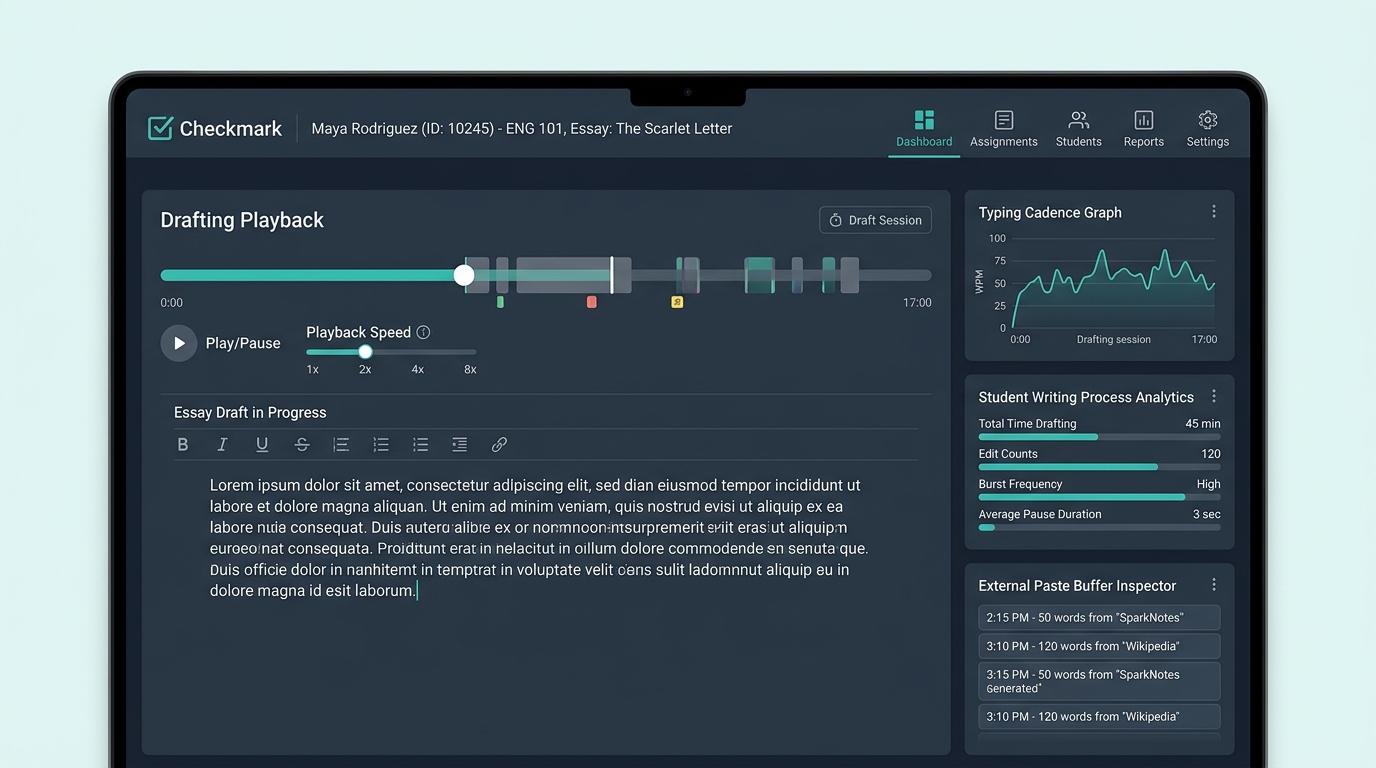
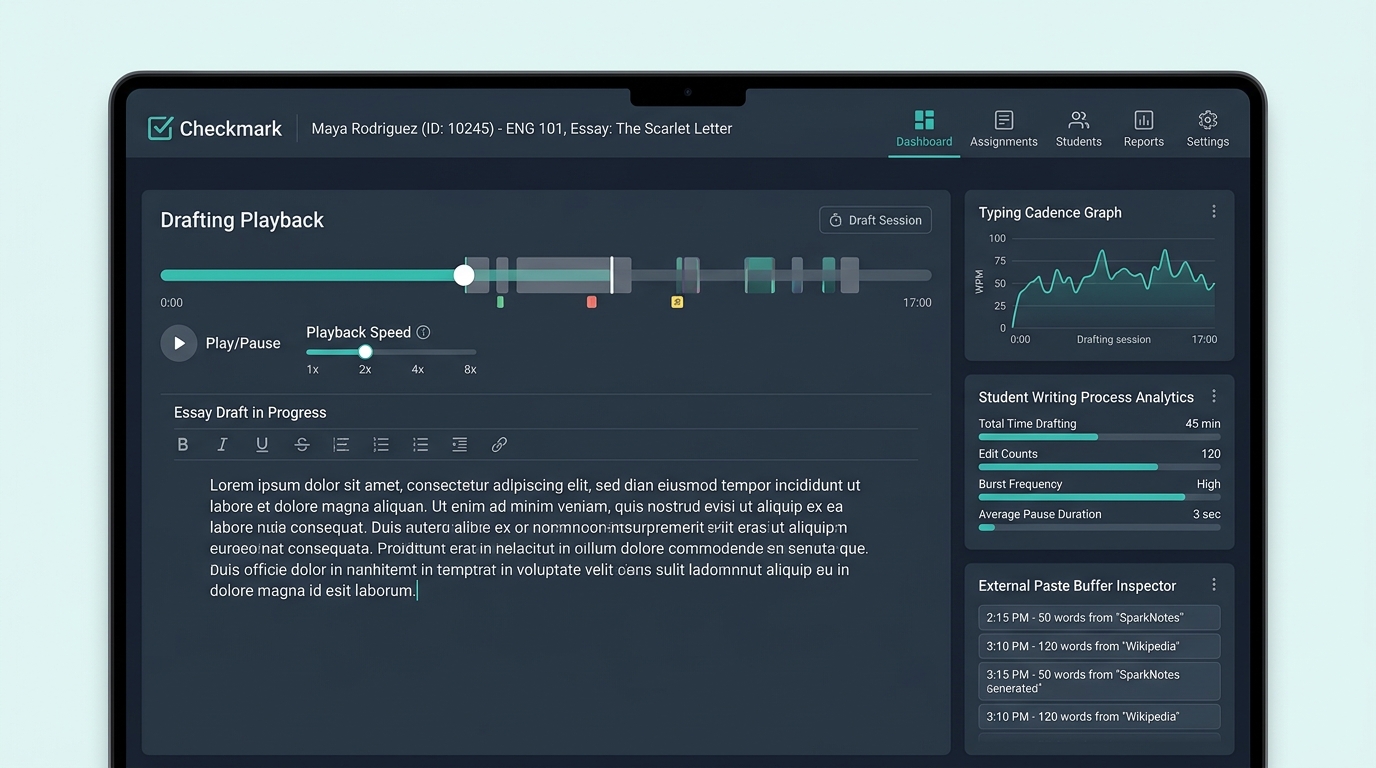
This comprehensive institutional guide details how virtual course designers can embed non-invasive keystroke telemetry and Checkmark Plagiarism’s patent-pending Essay Playback™ directly into LMS course blueprints. By capturing lightweight (<50 KB) temporal drafting dynamics, 1x–8x scrubbable visual revision replays, full-text external paste preservation, and transcription detection, virtual schools can guarantee transparent, defensible academic integrity while eliminating webcam surveillance entirely.
Checkmark Plagiarism empowers virtual academies, statewide cyber charters, and online course design teams to eliminate invasive webcam surveillance with non-invasive keystroke playback, deep LMS integrations across Canvas LMS, Agilix Buzz LMS, and Google Classroom, alongside AI writing detection, plagiarism matching, and teacher-in-the-loop rubric autograding.
1. The Virtual High School Integrity Crisis: Why Webcam Surveillance Fails Asynchronous Writing
The rapid expansion of statewide cyber charters, district virtual academies, and asynchronous high school diploma programs has democratized access to rigorous secondary education. Today, virtual high schools serve an extraordinarily diverse population: rural learners seeking advanced coursework unavailable in their local districts, students balancing competitive athletics or performing arts, medically fragile adolescents, working teens supporting their families, and neurodivergent learners who thrive outside the sensory overwhelm of brick-and-mortar classrooms.
Yet, this physical separation introduces a structural vulnerability during high-stakes summative assessments: the asynchronous authorship verification void.
- In-person teacher observation of drafting
- Physical desks, paper outlines & verbal queries
- Longitudinal familiarity with student handwriting & voice
- Formative desk conferences during writing blocks
- Fully remote, unmonitored home drafting across 24h
- Multi-device switching & offline writing
- Asynchronous submissions spanning days & weeks
- Binary submission artifact (isolated LMS file drop)
When a virtual high school student submits a 1,500-word persuasive essay, a Document-Based Question (DBQ) essay, or an AP Capstone literature review to a Learning Management System (LMS) such as Canvas LMS, Agilix Buzz, Moodle, or Google Classroom, the teacher receives only a static final document (.docx, PDF, or text submission).
In an educational landscape transformed by ubiquitous Large Language Models (LLMs) such as GPT-4o, Claude 3.5 Sonnet, and Gemini, alongside commercial essay mills and AI paraphrasers (e.g., QuillBot, Undetectable AI), virtual educators face an agonizing dilemma:
“Did the enrolled high school student spend four days reading primary sources, testing syntactic structures, reorganizing topic sentences, and refining their voice—or did an external algorithm generate the entire essay in twelve seconds?”
The Historical Misstep: Transplanting STEM Surveillance to Humanities Writing
To solve this authenticity dilemma, virtual school administrators and instructional designers historically reached for the same software tools deployed by university computer science and STEM departments: third-party remote webcam proctoring software and lockdown browser extensions.
Fatal Flaw: Built for 60-minute multiple-choice exams; paralyzes authentic multi-day writing.
Advantage: Encodes complete cognitive revision process in <50 KB JSON payload with 0 video.
Under this surveillance model, high school teenagers working from home were required to install invasive browser extensions or native applications that:
- Commandeered computer webcams and microphones to continuously record student bedrooms and home environments.
- Demanded intrusive 360-degree room scans, forcing students to show their desks, floors, beds, and personal living spaces.
- Locked down the operating system, severing access to legitimate digital research libraries, electronic note cards, and assistive technologies.
- Deployed opaque computer-vision algorithms to flag “anomalous eye movements,” looking away from the monitor, ambient household voices, or lighting shifts as suspected academic dishonesty.
While perhaps defensible for a 50-minute synchronous trigonometry exam, video surveillance is fundamentally broken for authentic writing instruction. Writing is an iterative, non-linear, multi-session cognitive process. Forcing a student into a single video-monitored sitting to compose an extended essay corrupts the writing process, breeds deep student resentment, introduces severe legal liabilities, and erects profound equity barriers.
2. Deconstructing the Legal, Privacy, Equity, and UX Failures of Webcam Proctoring in Virtual K-12
Virtual High School Principals, Online Instructional Designers, and School District Technology Directors are increasingly dismantling webcam proctoring systems due to three insurmountable structural failures: legal and constitutional liability, socioeconomic and neurodiversity penalties, and pedagogical incompatibility.
- Ogletree v. Cleveland State: Room scans ruled unconstitutional 4th Amendment searches.
- Biometric Privacy Laws: IL BIPA & TX CUBI statutory liability ($1k–$5k per violation).
- COPPA / FERPA Risks: Minor bedroom video files held on vendor cloud servers.
- Rural Bandwidth Collapse: 1.5–3.0 Mbps video streams fail on satellite & hot spots.
- Housing Insecurity: Shared bedroom shaming & false flags from family movement.
- Neurodivergent Flags: Gaze algorithms penalize Autism, ADHD & Tourette Syndrome.
- Writing Is Not a Sprint: Multi-day incubation, outlining, and structural revision destroyed.
- Research Blockades: Lockdown browsers sever access to library databases & notes.
- Cognitive Panic: Working memory consumed by behavioral self-policing.
A. The Legal and Privacy Liability: Ogletree v. Cleveland State University and Biometric Bans
The legal foundation of remote webcam surveillance in public education collapsed with the landmark federal court ruling in Ogletree v. Cleveland State University (N.D. Ohio, 2022). In this historic case, the federal district court held that mandatory webcam room scans conducted prior to remote exams constitute an unconstitutional search under the Fourth Amendment of the United States Constitution.
The court established that students possess a reasonable, constitutionally protected expectation of privacy inside their homes and private bedrooms. For public virtual charter schools, state-funded online consortia, and public school districts, mandating room scans or webcam surveillance creates immediate civil rights exposure under 42 U.S.C. § 1983.
| Legal / Regulatory Dimension | Webcam Surveillance Software | Checkmark Keystroke Replay |
|---|---|---|
| Fourth Amendment Search & Seizure | High Liability (Ogletree Ruling: Unconstitutional bedroom scans) | Zero Risk (No video, no audio, no residential capture) |
| Biometric Privacy (IL BIPA, TX CUBI) | High Risk (Facial/gaze geometry captures without explicit opt-in consent) | Zero Biometrics Collected (Measures keystroke timestamps only) |
| FERPA (Student Educational Records) | Third-party video server leaks and unauthorized commercial storage | Encrypted JSON text history with zero third-party disclosure |
| COPPA (<13 Minor Protections) | Invasive minor video capture and long-term cloud biometric custody | Full COPPA compliance; zero biometric or environmental capture |
| District Retention & Breach Exposure | Giant biometric video repositories vulnerable to subpoenas & leaks | Zero model training guarantee; automated scheduled telemetry purge |
Furthermore, state-level biometric privacy statutes present extreme financial risks for school districts:
- Illinois Biometric Information Privacy Act (BIPA, 740 ILCS 14/): Prohibits the collection, capture, or storage of biometric identifiers (including facial geometry, eye tracking, and voiceprints) without written informed consent. Violations carry statutory damages of $1,000 to $5,000 per occurrence.
- Texas Capture or Use of Biometric Identifier Act (CUBI): Restricts commercial capture of biometric data without strict notice and immediate destruction protocols.
- COPPA & FERPA Video Custody: High-resolution video streams of minors in their bedrooms stored on commercial cloud servers create severe data breach vulnerabilities and subpoena risks that district legal teams cannot defend.
B. Socioeconomic, Bandwidth, and Neurodiversity Barriers
Webcam surveillance enforces a discriminatory standard that disproportionately penalizes marginalized students:
- The Rural Bandwidth Barrier: Continuous high-definition video streaming requires a stable upstream bandwidth of at least 1.5 to 3.0 Mbps per student. In rural virtual academies where students rely on satellite internet (Starlink, HughesNet) or cellular hotspots, video streams constantly drop frames, freeze, or terminate sessions. Students are penalized with automatic exam lockouts, failed submissions, and administrative zero grades through no fault of their own.
- Housing Insecurity & Socioeconomic Disparities: Mandatory camera feeds force students to broadcast their socio-economic circumstances to remote vendors and school staff. Students living in shared bedrooms, multi-generational households, shelters, or temporary housing face intense humiliation and frequent false flags when siblings, parents, or pets inevitably cross the camera frame.
- Neurodivergent Bias (Autism, ADHD, Tourette Syndrome): Automated proctoring systems rely on computer vision algorithms trained on neurotypical gaze patterns. An autistic student who avoids direct eye contact, a student with ADHD who looks away to process thoughts, or a student with vocal or physical tics is systematically flagged with “high suspicion scores.” This creates severe affective trauma, triggering intense anxiety that destroys executive functioning during writing tasks.
C. Pedagogical Incongruity: Why Writing Cannot Be Locked Down
High-quality writing instruction is fundamentally incompatible with the constraints of lockdown browsers and single-sitting video surveillance:
- Iterative Drafting Over Time: Rigorous secondary writing requires students to draft over multiple days—incubating ideas, reviewing teacher feedback, performing substantive structural revisions, and polishing prose across multiple discrete sessions.
- Authentic Research Synthesis: Authentic research papers require students to consult digital library databases (e.g., JSTOR, EBSCO, Gale), digital encyclopedias, primary source archives, and course notes. Lockdown browsers block access to these essential scholarly tools, reducing writing to an artificial memory test.
- Cognitive Working Memory Overload: When students are monitored by a glowing red webcam indicator and warned that glancing away will trigger a cheating flag, their working memory is consumed by behavioral self-policing rather than syntactic variety, rhetorical persuasion, and textual evidence synthesis.
3. The Non-Invasive Keystroke Telemetry Architecture: How Checkmark Works Under the Hood
To resolve this crisis, online course designers are embedding Checkmark Plagiarism’s non-invasive writing telemetry architecture into their asynchronous course designs. Rather than monitoring the student’s physical environment, Checkmark records the digital topography of the writing process itself directly within the LMS essay editor or connected writing environments (Google Docs, Microsoft Word, Canvas LMS, Buzz LMS).
Defensible Process Receipts + 1-Click Rubric Grade Passback directly into Canvas SpeedGrader or Buzz LMS Gradebook.
A. Patent-Pending Essay Playback™ & Lightweight JSON Telemetry
At the core of Checkmark’s architecture is Essay Playback™, a patent-pending system that captures the temporal construction of an essay keystroke by keystroke. Every typing burst, pause, backspace, deletion, rearrangement, and formatting adjustment is recorded with microsecond timestamps.
Ultra-Lightweight Network Footprint (<50 KB JSON Payload)
Unlike video streaming, which consumes gigabytes of data and collapses rural connections, an entire 2,000-word essay’s complete keystroke telemetry is encoded in a lightweight JSON array that typically weighs between 25 KB and 50 KB. A student on a 56 kbps dial-up or weak cellular hotspot can transmit complete telemetry seamlessly without packet loss.
{
  "submission_id": "vhs-ela11-draft-89421",
  "student_anonymized_id": "usr_9942a7c8",
  "document_metrics": {
    "total_active_writing_ms": 14280000,
    "total_sessions": 4,
    "final_word_count": 1482,
    "net_keystrokes": 9840,
    "backspaces_and_deletions": 1842,
    "paste_event_count": 3
  },
  "telemetry_events": [
    {
      "event_type": "type_burst",
      "timestamp_offset_ms": 1240,
      "chars_added": 34,
      "mean_iki_ms": 142.5,
      "iki_std_dev": 28.4,
      "text_segment": "In The Great Gatsby, Fitzgerald explores "
    },
    {
      "event_type": "cognitive_pause",
      "timestamp_offset_ms": 6070,
      "pause_duration_ms": 4830,
      "cursor_position": 41,
      "context": "sentence_predicate_formulation"
    },
    {
      "event_type": "deletion_burst",
      "timestamp_offset_ms": 10900,
      "chars_deleted": 8,
      "deleted_text": "explores",
      "replacement_text": "critiques the hollow nature of"
    }
  ]
}
The 1x–8x Visual Replay Interface
When an educator opens the submission in Canvas SpeedGrader, Agilix Buzz, or the Checkmark dashboard, they are presented with a scrubbable video-like timeline. The teacher can watch the student compose the entire paper at 1x, 2x, 4x, or 8x speed:
- Natural Organic Composing: The teacher sees the student formulate an introduction, pause for 45 seconds to reflect, type a supporting paragraph, backspace to refine a clumsy metaphor, reorder two sentences in paragraph three, and paste a block quote from the course textbook.
- Zero Video Intrusion: Not a single frame of the student’s bedroom, face, or physical environment was ever recorded, preserving total privacy while providing 100% process verification.
B. The External Paste Buffer Inspector (100% Text Preservation)
The most common point of failure for legacy integrity tools is the copy-paste event. When a student pastes text into a document, generic tools simply see a block of text appear instantly.
Checkmark’s External Paste Buffer Inspector intercepts all clipboard operations and creates an immutable, timestamped record of the exact text pasted into the document:
- Student pastes 180 words from Canvas module notes or primary source reading.
- Paste inspector captures raw text with exact millisecond timestamp.
- Playback shows student wrapping text in MLA quotation marks & citation.
- Linked evidence card confirms legitimate academic synthesis.
- Student pastes 1,200 words of full essay generated by external LLM in one click.
- Paste inspector captures complete raw text before any modifications.
- Student spends 20 minutes rewording sentences to fool standard AI detectors.
- Checkmark preserves original 1,200 words with instant “Jump to Playback” proof!
Immunity to AI Paraphrasers & “Humanizers”
A pervasive tactic among students attempting to evade AI detectors is running generated text through tools like QuillBot, Undetectable AI, or HideMyAI. These tools scramble perplexity and burstiness metrics.
However, they are powerless against Checkmark’s Paste Buffer Inspector. If a student pastes an AI-generated essay and then manually rewires words over the next thirty minutes, Checkmark stores the complete original pasted text alongside a direct “Jump to Playback” button. The educator can view the raw external text that entered the document prior to the surface edits.

C. Second-Screen and Manual Transcription Detection
When students realize that large paste drops are captured, some attempt a more labor-intensive bypass: opening ChatGPT or Claude on a smartphone, tablet, or secondary monitor and manually typing the text into the essay editor character by character.
To a standard word processor, this appears as typed text. But to Checkmark’s Transcription Detection Engine, it presents an unmistakable mathematical signature:
Mathematical Telemetry Indicators of Transcription:
- Inter-Keystroke Interval (IKI) Uniformity: In genuine drafting, the pause before starting a new clause or complex word is 300% to 800% longer than within-word typing intervals. In transcription, IKIs remain uniformly flat across all linguistic boundaries.
- Backspacing & Deletion Deficit: Authentic human drafting exhibits a 12% to 25% revision/deletion ratio (deleting characters, rewriting clauses). Transcription from a second screen typically shows a deletion ratio below 1.5%.
- Linear Monotonic Growth: The document grows in an unbroken linear fashion from word 1 to word 1,500 with zero structural reorganizations or paragraph-level movements.
D. Multi-Factor AI Detection & Teacher-in-the-Loop Rubric Autograding
Checkmark does not rely solely on keystroke dynamics; it integrates telemetry with multidimensional text analysis:
Highlights exact sentences with calibrated style-vs-AI sliders. Honest short-text guardrail displays N/A for <150 words.
Live web & student repository matching with direct quote links. Separates citation errors from deliberate copying.
Keystroke replay (1x–8x), session timestamps, and original raw clipboard content preservation.
Formative criteria scoring with draft quotes. Teacher retains 100% final grading authority before LMS sync.
- Passage-Level AI Confidence Sliders: Rather than assigning a single, punitive whole-document percentage (e.g., “78% AI”), Checkmark highlights specific passages and presents interactive sidebar evidence cards showing where human style diverges from typical AI predictability patterns.
- Short-Text Honest Guardrails: For answers under 150 words (such as short reading checks or discussion posts), Checkmark displays
N/Arather than guessing on insufficient sample sizes. - Teacher-in-the-Loop Autograder: Checkmark evaluates essays against custom school rubrics (e.g., Claim, Evidence, Reasoning, Organization, Mechanics), drafting formative comments tied directly to quoted passages. The AI score remains a draft until the virtual teacher reviews, edits, and approves it, pushing finalized grades into Canvas SpeedGrader or Buzz LMS with one click.
4. Comprehensive Architectural Comparison: Video Surveillance vs. Embedded Keystroke Telemetry
The following matrix compares legacy webcam proctoring suites against Checkmark’s embedded keystroke telemetry across the ten essential operational dimensions in virtual education:
| Specification Dimension | Legacy Webcam Surveillance (Honorlock, Proctorio, Respondus) | Checkmark Embedded Keystroke Telemetry (Essay Playback™) |
|---|---|---|
| 1. Network Bandwidth Requirement | High: Requires 1.5–3.0 Mbps upload. Constantly crashes on rural & cellular hot spots. | Ultra-Low: <50 KB JSON payload total. Works flawlessly on 56 kbps & degraded cellular. |
| 2. Hardware & Peripheral Demands | Mandates high-res webcam, microphone, and modern CPU/RAM for real-time video encoding. | Zero special hardware. Operates smoothly on any low-cost Chromebook, laptop, or tablet. |
| 3. Student Privacy & 4th Amendment | High Liability: Records minor bedrooms, living spaces, and facial micro-movements. | Total Privacy: 0 video, 0 audio, 0 biometrics. Captures only LMS text editor interactions. |
| 4. Legal & Regulatory Defensibility | Major legal exposure under Ogletree, IL BIPA, TX CUBI, and minor video retention risks. | 100% Compliant: FERPA, COPPA, CSPC zero-retention architecture. |
| 5. Asynchronous Writing Pedagogy Fit | Broken: Forces 1-sitting artificial sprints; locks down digital research libraries. | Native: Supports multi-day, multi-session, non-linear drafting across weeks. |
| 6. Neurodivergent & IEP Accessibility | Discriminatory: Flags autism gaze, ADHD movement, and tic disorders as cheating. | Neuro-Inclusive: Validates non-linear drafting, speech-to-text, and personalized pacing. |
| 7. Evidentiary Granularity (“Receipts”) | Ambiguous: “Suspicious eye movement” timestamp (cannot prove cheating). | Deterministic: 1x–8x keystroke replay, raw paste text dumps, and pause heatmaps. |
| 8. Paste & AI Humanizer Immunity | Blind: Cannot detect pasted text that was rewritten or run through QuillBot. | Complete: Preserves 100% clipboard text; detects manual second-screen transcription. |
| 9. Server Storage Costs & Footprint | Massive: 500 MB – 2 GB video files per student submission. | Negligible: <50 KB JSON files per paper; 10,000x more efficient storage profile. |
| 10. LMS & SpeedGrader Integration | Clunky external portal; separate logins; detached grade sync. | Seamless LTI 1.3 Advantage; native sidebar in Canvas SpeedGrader, Buzz, and Moodle. |
5. Real-World Case Studies: Virtual High Schools Eliminating Webcams
- Problem: 1,400+ annual proctoring appeals; high parental outrage over bedroom camera scans.
- Action: Decommissioned webcams across 48 ELA & Social Studies courses in Canvas.
- Outcome: 89% drop in integrity disputes; $140,000 annual software license cost savings.
- Problem: 14.2% submission failure rate due to video bandwidth crashes on satellite & cellular.
- Action: Embedded Checkmark telemetry inside Agilix Buzz LMS writing assignments.
- Outcome: Submission failures dropped to 0.08%; zero rural disconnects; 400+ faculty hours saved.
- Problem: Surveillance anxiety stifled deep revision; students wrote shallow 1-draft essays.
- Action: Adopted “Open Kitchen” writing culture with 4x Essay Playback™ peer reflection.
- Outcome: Revision cycles jumped 310%; AP exam qualifying score rate rose by 14.6%.
Case Study 1: Statewide 25,000-Student Cyber Charter School Replaces Webcam Surveillance Across All High School English Courses
- Institution: A major statewide public cyber charter school serving 25,000 students in grades 9–12 across 67 counties.
- Challenge: The charter school mandated webcam proctoring for all midterm and final essays. The policy generated fierce parent backlash, formal complaints citing Ogletree, and over 1,400 formal academic misconduct appeals annually triggered by false-positive gaze flags. Furthermore, the district spent $140,000 annually on proctoring licensing fees and video storage.
- Implementation: The Instructional Design department integrated Checkmark Plagiarism across 48 English Language Arts and Social Studies courses in Canvas LMS. Webcams were entirely decommissioned for writing tasks.
- Results:
- 89% Reduction in Integrity Appeals: Misconduct inquiries were resolved in minutes by reviewing the 1x–8x Essay Playback™ timeline with parents and students, eliminating speculative arguments over eye movements.
- $140,000 Annual Budget Savings: Eliminating per-seat video proctoring licenses freed up significant curriculum funding for virtual tutoring.
- 94% Student Satisfaction Recovery: Student end-of-course surveys indicated a 94% positive response regarding reduced assessment anxiety and increased trust in the evaluation process.
Case Study 2: Mountain West Rural Virtual Academy Solves Bandwidth Disconnections and Satellite Latency
- Institution: A regional virtual academy serving 3,200 secondary students across geographically isolated mountainous ranching and tribal communities.
- Challenge: Over 60% of enrolled students relied on high-latency satellite connections (Starlink, HughesNet) or shared cellular hot spots. During quarterly writing assessments, video streaming software repeatedly severed connections. The school recorded a 14.2% incomplete submission rate, forcing teachers to administer stressful oral makeup exams over the phone.
- Implementation: The curriculum director embedded Checkmark’s ultra-lightweight telemetry into Agilix Buzz LMS. Students composed essays directly in the Buzz LMS rich editor with offline local caching.
- Results:
- Submission Failures Dropped from 14.2% to 0.08%: The <50 KB telemetry payload transmitted seamlessly even over degraded 2G/3G cellular hot spots.
- Elimination of Time-Zone Makeup Burdens: Teachers gained full process verification without requiring synchronous proctored appointments, saving over 400 faculty hours per semester.
Case Study 3: Online AP Literature & Composition Consortium Restores Student Trust and Iterative Revision
- Institution: An online Advanced Placement consortium serving 850 high-achieving virtual learners across 14 school districts.
- Challenge: AP Literature requires sophisticated rhetorical analysis, thesis refinement, and primary source synthesis. Under lockdown video surveillance, students reported feeling paralyzed, resulting in simplistic, safe, unrevised essays composed in rushed single sittings.
- Implementation: The course design team reframed writing integrity from “policing” to an “Open Kitchen” pedagogical philosophy. Students were shown their own Essay Playback™ replays and encouraged to review their revision topography during one-on-one virtual conferences.
- Results:
- 310% Increase in Structural Revisions: With the fear of video proctoring flags removed, students spent an average of 4.2 sessions revising each essay, restructuring paragraphs and polishing rhetorical strategies.
- 14.6% Increase in AP Exam Qualifying Scores (Score 3+): Students developed authentic, resilient writing habits, leading to a substantial gain in national AP exam performance.
6. The 4-Phase Instructional Design Implementation Protocol for Virtual High Schools
To successfully transition a virtual high school or cyber charter from webcam surveillance to keystroke telemetry, instructional designers and academic administrators should execute the following four-phase implementation blueprint:
Course Blueprinting & LTI 1.3
- Configure LTI 1.3 Advantage in Canvas / Buzz / Moodle / Google Classroom.
- Embed Checkmark telemetry editor in master course templates.
- Enable 1-click SpeedGrader rubric feedback and grade passback.
Student Onboarding & “Open Kitchen”
- Deploy Module 0 orientation introducing Essay Playback™ to students & parents.
- Establish clear boundaries: Allowed AI brainstorming vs. Unauthorized generation.
- Demystify telemetry: Show students how authentic typing protects against false flags.
Asynchronous Scaffolding
- Structure writing assignments into multi-day asynchronous milestones (Outline → Draft → Rev).
- Configure Paste Buffer Inspector to track approved course note transfers.
- Enable student self-playback for metacognitive revision analysis.
Restorative Triage & Grading
- Establish teacher review protocols: Check Playback before making inquiries.
- Use side-by-side plagiarism cards and paste inspector receipts during conferences.
- Review AI-drafted rubric suggestions; approve final grades for LMS gradebook sync.
Phase 1: Course Blueprinting and LMS LTI 1.3 Embedding
- LTI 1.3 Advantage Deployment: Install Checkmark Plagiarism across the district LMS instance (Canvas, Buzz, Moodle, Blackboard) via 1-Click LTI 1.3 Advantage, ensuring automatic assignment creation, student roster syncing, and grade passback.
- Master Course Template Configuration: In LMS master shells, replace all external “lockdown exam” assignment types with standard Checkmark-enabled writing assignments.
- Bandwidth Optimization: Ensure client-side telemetry caching is enabled, permitting students to continue typing even during brief internet drops without data loss.
Phase 2: Transparent Student Onboarding and the “Open Kitchen” Culture
- Module 0 Demonstration Video: Include a 3-minute orientation video in introductory course modules demonstrating Essay Playback™ in action. Show students exactly what teachers see: typing rhythm, pauses, and revisions—with zero video or audio access.
- The “Open Kitchen” Metaphor: Frame telemetry like a restaurant with an open kitchen: when diners can see the chef chopping vegetables, simmering sauce, and plating the dish, there is no need to question the food's authenticity. Authentic typing history serves as the student's personal defense against false accusations.
- Explicit Boundary Setting: Clearly distinguish between authorized digital tools (e.g., LMS spelling checkers, course-provided glossary notes) and unauthorized tools (e.g., LLM generation prompts, contract cheating mills).
Phase 3: Asynchronous Drafting Scaffolding & Milestones
- Multi-Session Architecture: Design major writing tasks with recommended multi-day intervals (e.g., Day 1: Thesis & Outline; Day 3: Evidence Integration & Draft; Day 5: Substantive Polish).
- Source Note Integration: Teach students to utilize the course digital notepad. When students copy quotes from the LMS digital textbook and paste them into their essay, Checkmark's Paste Buffer Inspector verifies the source immediately, preventing false plagiarism flags.
- Metacognitive Self-Playback: Allow students to rewatch their own drafting playback at 4x speed before final submission to identify repetitive phrasing or dropped transitions.
Phase 4: Restorative Integrity Triage & LMS SpeedGrader Workflow
- SpeedGrader Review Protocol: When grading in Canvas SpeedGrader or Buzz LMS, teachers glance at the Checkmark sidebar. A green status with 4+ active sessions and natural pause topography confirms authentic authorship instantly.
- Restorative Dialogue Protocols: If a submission exhibits anomalous signals (e.g., a single 1,500-word paste drop or metronomic transcription), the teacher initiates a supportive, non-punitive conference: “Let's open your Essay Playback™ timeline together and walk through how you developed the arguments in section two.”
- Teacher Authority over Autograding: Teachers review the AI-suggested rubric justifications, adjust point allocations as needed to reflect unique student accommodations, and push finalized feedback to the official gradebook.
7. Model Course Syllabus Boilerplate Clauses & District Policy Language
Online instructional designers and virtual school leaders can adopt the following standardized policy language to codify non-invasive writing telemetry across their programs:
“In this course, we believe that writing is a creative, iterative process that reflects your unique voice and critical thinking. To protect your privacy while ensuring authentic scholarship, our virtual school utilizes Checkmark Plagiarism and patent-pending Essay Playback™ technology.”
- 1. No Webcam Surveillance: You will NEVER be asked to turn on a webcam, record your bedroom, perform room scans, or install intrusive video surveillance software for writing assignments.
- 2. Process Telemetry: As you write within our LMS editor, the platform records your typing cadence, drafting pauses, revisions, and pasted text in an ultra-lightweight, secure text format.
- 3. Your Authentic Protection: This writing process history serves as your personal verification receipt. If an automated AI detector ever questions your essay, your Essay Playback™ timeline provides undeniable, step-by-step proof of your human authorship.
- 4. Authorized Tools: You are encouraged to use course readings, digital library databases, and standard grammar tools. Generating full text using external AI tools (ChatGPT, Claude) or manual transcription from external devices without teacher authorization violates our integrity code.
Policy 4120.3 – Assessment Authenticity and Student Data Privacy in Distance Learning:
“The School District is committed to safeguarding student constitutional privacy rights under the Fourth Amendment (Ogletree v. Cleveland State University) and state biometric privacy laws. The use of remote automated webcam proctoring, room scans, and continuous facial video surveillance is strictly prohibited for asynchronous writing assessments. All virtual and distance learning courses shall verify authentic authorship exclusively through non-invasive writing process telemetry, keystroke dynamics, and LMS-embedded revision history. Student data collected for authorship verification shall be strictly zero-retention, encrypted, FERPA/COPPA compliant, and never utilized to train commercial machine learning models.”
8. Frequently Asked Questions (7 In-Depth FAQs for Virtual School Leaders)
Q1: How does keystroke telemetry respect student privacy under FERPA and state student data privacy acts?
Answer: Keystroke telemetry operates on a strict Zero-Biometric, Zero-Surveillance architecture. Unlike video proctoring tools that record audio, ambient home environments, and facial geometry, Checkmark captures only discrete, text-editor-level interaction events (character timestamps, pauses, deletions, and paste contents). All telemetry is transmitted over encrypted TLS 1.3 channels, stored in FERPA- and COPPA-compliant cloud environments, and strictly classified as student educational records. Furthermore, Checkmark maintains an absolute zero-training guarantee: student submissions and keystroke data are never utilized to train or fine-tune public or commercial Large Language Models.
Q2: What happens if a virtual student loses internet connectivity while drafting an essay?
Answer: Checkmark’s embedded editor includes a resilient, client-side Offline Telemetry Buffer. As the student writes, keystroke dynamics and temporal timestamps are continuously recorded and stored in the browser’s local encrypted cache. If the student’s satellite connection drops or their cellular hotspot disconnects, the student can continue drafting without interruption. The moment internet connectivity is restored, the local buffer automatically syncs the compressed (<50 KB) JSON telemetry package back to the LMS without losing a single keystroke or timestamp.
Q3: Can tech-savvy students bypass keystroke telemetry using AI paraphrasers or “humanizer” tools?
Answer: No. While AI paraphrasing tools (e.g., QuillBot, Undetectable AI) alter surface-level vocabulary and sentence structures to manipulate text-only AI detectors, they cannot alter temporal physics. When a student copies text from an AI humanizer and pastes it into their document, Checkmark’s External Paste Buffer Inspector captures 100% of the raw pasted text immediately. If the student attempts to manually retype the paraphrased text character-by-character, Checkmark’s Transcription Detection Engine flags the unnatural, metronomic typing cadence (uniform IKIs and absence of cognitive formulation pauses).
Q4: How does writing telemetry support neurodivergent students and official IEP/504 accommodations?
Answer: Keystroke telemetry is inherently neuro-inclusive and fully supports diverse learning styles:
- Speech-to-Text Dictation: Dictated text appears as burst blocks accompanied by voice-to-text input tags, allowing teachers to differentiate approved assistive accommodations from unapproved copy-pasting.
- Extended Time & Pacing: Students who require extended processing time can compose over dozens of discrete sessions across several weeks without being constrained by artificial 60-minute video exam clocks.
- Non-Linear Composing: Neurodivergent writers who compose non-linearly (e.g., drafting conclusions first or jumping between body paragraphs) have their authentic struggle and reorganization validated visually in Essay Playback™.
Q5: What specific evidence does an educator see if a student manually retypes an essay from a smartphone?
Answer: If a student places a phone next to their laptop and manually transcribes an AI-generated essay, the teacher’s Checkmark report displays a Transcription Alert accompanied by three distinct forensic indicators:
- Metronomic Typing Cadence: A flat, unnatural speed graph (e.g., 210 characters per minute with near-zero standard deviation across the entire essay).
- Missing Boundary Pauses: The total absence of natural 2-to-10-second pauses before complex syntactic clauses, topic sentences, or transition words.
- Near-Zero Deletion Rate: A backspace/deletion ratio below 1.5% (compared to 12%–25% for genuine human drafting), proving the student was merely copying pre-existing text rather than generating thought.
Q6: How does Checkmark integrate directly with virtual school LMS platforms like Canvas, Buzz LMS, and Google Classroom?
Answer: Checkmark integrates seamlessly via certified LTI 1.3 Advantage protocols. For Canvas LMS, Checkmark embeds directly within the native Canvas SpeedGrader interface, allowing instructors to view the 1x–8x Essay Playback™ timeline, paste inspector data, and rubric suggestions alongside the student’s submission without leaving Canvas. For Agilix Buzz LMS, Google Classroom, and Moodle, Checkmark provides native assignment embedding, automatic roster synchronization, and 1-click grade passback directly into the master gradebook.
Q7: How does eliminating webcam proctoring affect state cyber charter accreditation and NCAA eligibility audits?
Answer: Eliminating webcam proctoring in favor of keystroke telemetry strengthens accreditation and NCAA compliance. Accrediting bodies (such as Cognia) and the NCAA Eligibility Center require virtual programs to demonstrate verified student identity and authentic coursework completion. Video proctoring only proves a student was sitting in front of a screen—it cannot prove who generated the digital text. Checkmark’s Essay Playback™ provides undeniable, timestamped forensic proof of the cognitive writing process, providing an airtight evidentiary audit trail for NCAA eligibility reviews, state department of education audits, and district charter renewals.
9. Conclusion: Moving From Invasive Surveillance to Pedagogical Trust
For the past decade, virtual high schools and distance learning programs were trapped in a false choice: surrender academic integrity to unchecked digital cheating, or subject minor students to invasive, high-stress webcam surveillance that violates privacy and deepens educational inequality.
Checkmark Plagiarism eliminates this false dilemma.
By embedding non-invasive keystroke telemetry and patent-pending Essay Playback™ into virtual course design, educational leaders can:
- Protect Student Civil Rights: Eliminate the legal, Fourth Amendment, and biometric liabilities of bedroom webcam recording.
- Ensure Digital Equity: Deliver rock-solid authorship verification on ultra-lightweight (<50 KB) payloads that thrive on rural satellite connections and Chromebooks.
- Restore Pedagogical Integrity: Support authentic, multi-day writing, research synthesis, and formative revision.
- Empower Teachers and Students: Replace opaque, punitive black-box AI scores with transparent, defensible writing process receipts.
As virtual education matures into a permanent, vital pillar of global learning, the guiding principle of academic integrity must evolve. It is time for virtual course designers and school leaders to embrace the Checkmark philosophy: Stop guessing, start trusting.
Ready to Transition Your Virtual High School to Non-Invasive Keystroke Telemetry?
Discover how Checkmark Plagiarism and Essay Playback™ protect student privacy, eliminate webcam liabilities under Ogletree, and deliver seamless LTI 1.3 integration across Canvas, Buzz, and Google Classroom.