
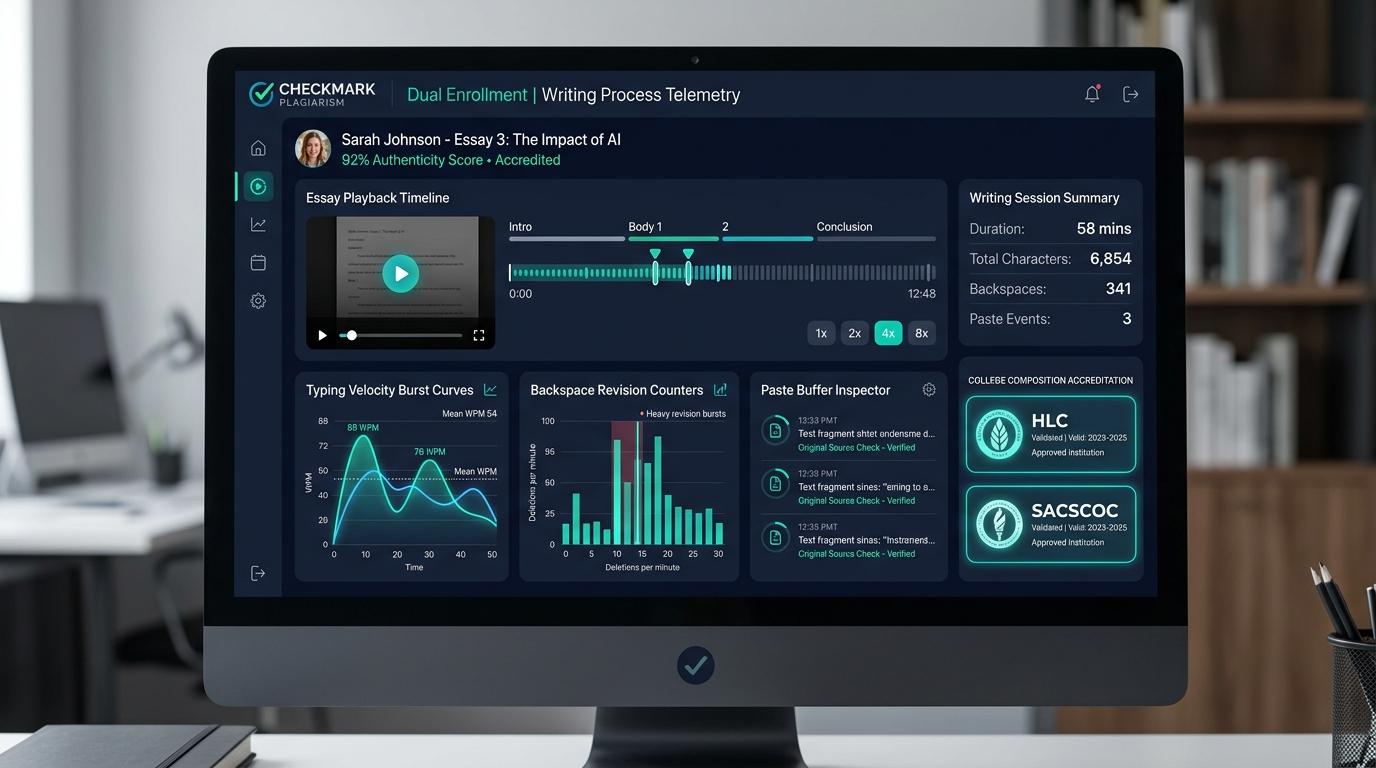
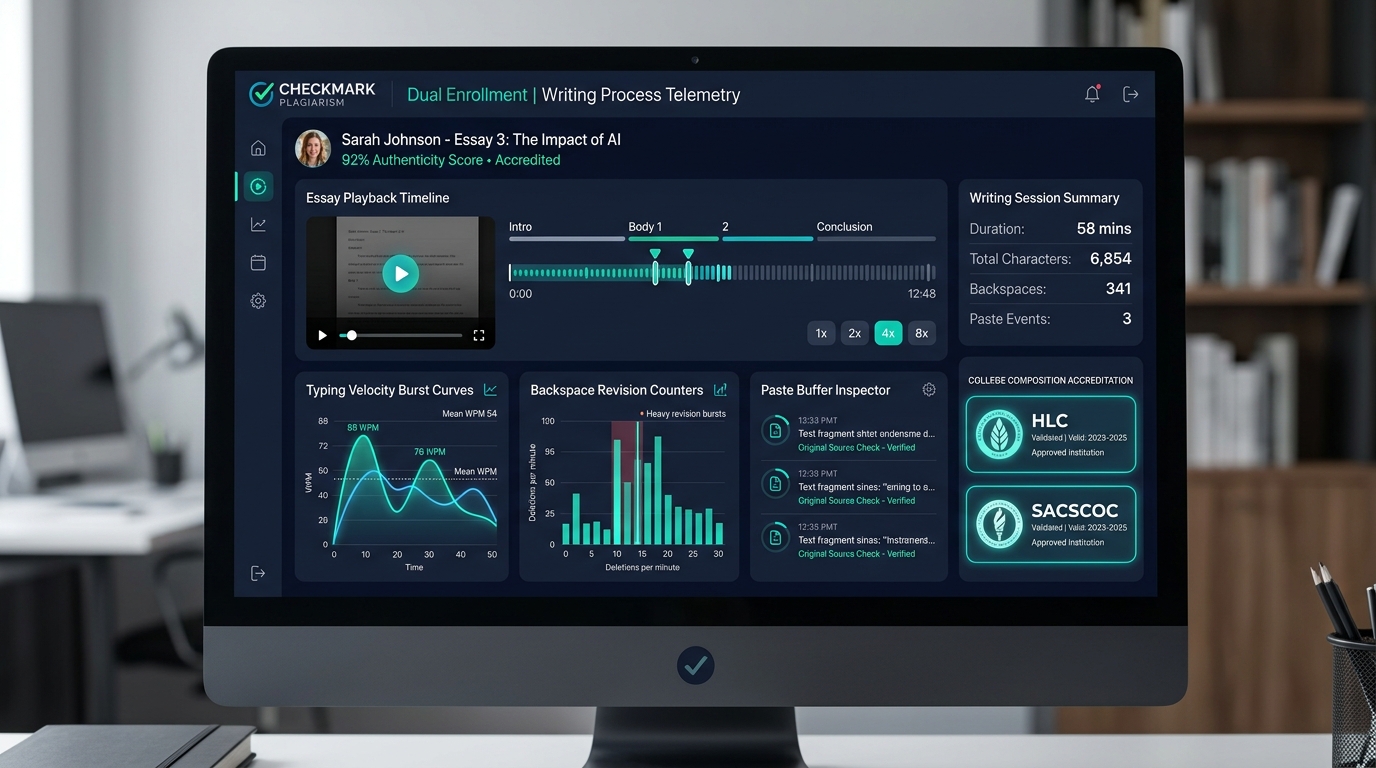
Dual Enrollment (DE) and Concurrent Enrollment programs have expanded dramatically, offering high school students the opportunity to earn transferable college credit in gateway courses like English 101 and 102. However, asynchronous online delivery creates an acute institutional vulnerability: college faculty and high school adjuncts must certify collegiate-level writing rigor and original student authorship for remote submissions (1,500 to 3,500 words) without in-person observation or intrusive webcam surveillance. This tension places institutions at risk during regional accreditation reviews (such as HLC, SACSCOC, NECHE, and WSCUC), which expect institutions to verify student identity in distance education and to keep course rigor and quality consistent across delivery modes, including dual enrollment arrangements. Generic black-box AI detectors fail catastrophically in this environment, generating frequent false-positive flags on developmental high school prose while remaining blind to polished LLM humanizers or third-party ghostwriting. Checkmark Plagiarism resolves this crisis through Writing Process Telemetry. By leveraging patent-pending Essay Playback™ (1x–8x scrubbable video replay of drafting sessions), 100% external clipboard paste buffer preservation, calibrated passage-level AI confidence sliders with honest short-text (<150w) guardrails, and teacher-in-the-loop AAC&U VALUE rubric autograding, dual enrollment instructors gain objective, non-invasive, and legally defensible proof of student authorship. This multi-dimensional evidence base supports institutions' efforts to meet accreditation expectations, bridges the high school–college LMS divide, and fosters transparent, restorative writing conferences.
Checkmark Plagiarism equips college composition chairs, high school concurrent faculty, and distance education deans with modern writing governance by integrating patent-pending Essay Playback™ writing telemetry, side-by-side source verification, passage-level AI confidence scoring, and AAC&U VALUE rubric autograding into seamless Canvas LMS and Agilix Buzz LMS workflows.
1. The Dual Enrollment Asynchronous Writing Dilemma
Dual enrollment programs represent one of the fastest-growing sectors in American secondary and postsecondary education. By allowing high school juniors and seniors to complete First-Year Composition (FYC) requirements before matriculating into college, institutions lower tuition costs, shorten time-to-degree, and widen postsecondary access.
Yet behind this success lies a severe structural and pedagogical crisis centered on asynchronous college writing authenticity:
- HLC, SACSCOC, NECHE, WSCUC distance mandates
- Substantive equivalence to on-campus First-Year Composition
- Verifiable student identity & authentic authorship
- Defensible academic integrity documentation for audits
- High school students compose remotely from home/study halls
- Submissions routed through fragmented high school/college LMS
- Zero synchronous classroom observation or proctoring
- Pervasive access to generative LLMs, humanizers & tutors
Invasive webcams spark student-privacy and parental pushback • Generic AI detectors generate severe false positives on developing high school writers • High school vs. College faculty disputes over unsubstantiated allegations
Keystroke timeline replay (1x–8x) • 100% External paste buffer logging • Passage-level AI sliders • Quote-anchored AAC&U VALUE rubric autograding
The Ghostwriting & Generative AI Crisis in Distance Education
When an on-campus undergraduate writes an in-class diagnostic essay, the instructor observes the physical act of composition: the hesitation between paragraphs, the scratching out of sentences, the consulting of printed texts. In asynchronous dual credit courses, this physical visibility drops to zero.
High school students compose 1,500- to 3,500-word argumentative essays, rhetorical analyses, and capstone research papers on personal laptops, district Chromebooks, or library workstations. In this isolated environment, students face immense pressure:
High-Stakes Dual GPA Impact
A single poor grade damages both the student's high school class rank and their permanent college transcript, driving panic-induced shortcutting.
Ubiquitous Generative AI
Frontier LLMs (ChatGPT, Claude, Gemini) produce synthetically sophisticated collegiate arguments in seconds without leaving textual trace fingerprints.
Polished AI Humanizers
Paraphrasing tools (QuillBot, Undetectable AI) scramble surface token distributions to intentionally evade crude whole-document AI filters.
Third-Party Ghostwriting
Well-meaning parents, private college admissions advisors, and peer tutors rewrite student drafts, obscuring true student developmental capability.
Regional Higher Education Accreditation Standards: HLC, SACSCOC, NECHE, and WSCUC
Higher education regional accreditors have placed dual credit and distance education programs under unprecedented scrutiny. Under the federal rules that govern accreditors (34 CFR § 602.17(g)) and regional commission standards, colleges cannot award postsecondary credit on faith:
Higher Learning Commission (HLC) — Criterion 3 & Core Component 2.E (Criteria effective Sept. 1, 2025)
Midwest RegionUnder the revised Criteria for Accreditation, the rigor and quality of each educational program must be consistent regardless of modality, location or other differentiating factors (Criterion 3), and the institution must adhere to policies and procedures that ensure responsible acquisition, discovery and application of knowledge (Core Component 2.E). In practice, institutions need documented assessment evidence of authentic student performance.
SACSCOC (now The Commission on Colleges and Universities) — Standard 10.6 (Distance and Correspondence Education)
Southern RegionRequires institutions to ensure that the student who registers in a distance or correspondence education course or program is the same student who participates in and completes it and receives the credit. Institutions typically document their identity verification processes as evidence of compliance.
NECHE — Standard Two (The Academic Program, 2026 Standards)
New England RegionRequires the institution to retain, even with contractual, dual enrollment, or other arrangements, responsibility for the design, content, quality and delivery of its courses (2.13). NECHE evaluates institutions at least every ten years, with a fifth-year interim report, so dual enrollment programs should be ready to document how course quality and academic integrity are assured.
WSCUC & NWCCU — Distance Education Identity Verification
Western & Northwest RegionsNWCCU Standard 2.G.7 requires an effective identity verification process for students, including those enrolled in distance education, to establish that the enrolled student is the same person whose achievements are evaluated and credentialed. WSCUC, as a federally recognized accreditor, is subject to the same federal requirement that institutions have processes establishing that the student who registers in a distance course is the same student who academically engages in it.
When accreditation review teams audit a community college or university's dual credit English department, they do not accept unverified assertions of integrity. They expect an audit trail documenting how course quality is assured and how student identity is verified in remote courses.
The Inter-Institutional Void: High School Portals vs. Higher Ed LMS
Dual enrollment programs operate across a complex technological divide:
- Some high school students submit assignments directly into the college's LMS instance (Canvas, Blackboard, Brightspace, or D2L).
- Other cohorts work entirely within a high school LMS (Google Classroom, Buzz LMS, Canvas K-12), with secondary instructors manually transferring grades to the college registrar.
- Hybrid programs require students to toggle between high school Google Docs environments and college submission portals.
In this inter-institutional void, college English department chairs have zero insight into drafting workflows, while high school adjuncts lack the forensic tooling necessary to defend student work against skeptical college evaluators.
2. Why Invasive Webcams and Black-Box AI Detectors Fail
To combat distance learning fraud, many institutions initially turned to two deeply flawed technologies: invasive webcam proctoring and probabilistic black-box AI detectors. In the context of secondary-to-higher-education dual enrollment, both have proven disastrous.
Many dual credit students are minors (15–17 years old) protected by FERPA and state student privacy laws. Recording home bedrooms and high school study spaces creates severe legal liability for public school districts.
Continuous eye-tracking and facial monitoring paralyzes authentic brainstorming. Students spend mental bandwidth avoiding “suspicious head movements” rather than engaging in deep rhetorical problem-solving.
Heavy surveillance extensions crash low-memory district Chromebooks. Continuous high-definition video streaming is inaccessible to students in rural or low-bandwidth households, exacerbating educational inequity.
A video recording only proves a student sat at a keyboard; it cannot verify if the text on screen was generated by an off-screen smartphone LLM, whispered by a tutor, or pasted from an unverified source.
The Inadequacy of Probabilistic Black-Box AI Detectors
Standard AI detection software relies on static text-classification models that output a single opaque percentage (e.g., “88% AI-Generated”). In dual enrollment college composition, black-box detectors fail due to three core deficiencies:
- Severe False-Positive Bias on Developmental Prose: High school students learning academic discourse frequently rely on formulaic five-paragraph transitions (“Furthermore,” “In conclusion,” “It is essential to consider”). Standard AI detectors flag these low-entropy, formulaic structures as machine-generated text, wrongfully accusing earnest young writers.
- Vulnerability to Synthetic Text Evasion: Modern LLMs prompted with stylistic instructions (“Write with varied sentence lengths and occasional colloquial rhythm”) or run through paraphrasing engines easily circumvent text-matching filters.
- Unusable in Academic Grievance Hearings: A single probabilistic score is legally and procedurally indefensible. When a student or parent appeals a course failure, an academic integrity committee cannot uphold a sanction based on a black-box algorithm that provides no auditable receipts.
3. Writing Process Telemetry: The Modern Higher Ed Standard
The solution to the dual enrollment dilemma is Writing Process Telemetry—capturing the granular temporal, mechanical, and cognitive dynamics of how a text is constructed over time.
Instead of treating the final essay as an isolated static artifact, telemetry treats writing as an observable longitudinal human behavior.
6 discrete writing sessions across 8 calendar days (Total: 4 hours, 42 minutes) • Natural drafting velocity curves (25–45 words per minute during generative bursts).
1,248 total backspaces and inline word substitutions • Paragraph restructuring at minute 38 (Thesis reframed after drafting body paragraph 2) • 45–90 second mid-sentence pauses indicating reflective idea formulation.
3 external pastes detected (all verified as primary source quotations from JSTOR) • 0 bulk essay injections or foreign LLM clipboard transfers.
Calibrated AI confidence slider across all individual sections • AAC&U VALUE Written Communication rubric scored with quote-anchored citations.
Comparing Integrity Verification Modalities
| Dimension | Invasive Webcam Surveillance | Generic Black-Box AI Detector | Checkmark Writing Process Telemetry |
|---|---|---|---|
| Primary Data Source | Video feeds, facial tracking, room scans | Static submitted text tokens | Keystroke events, pause times, clipboard buffer, revision logs |
| Student Privacy | 🔴 Severe Risk | 🟡 Moderate | 🟢 100% Protected |
| False Positive Risk | 🔴 High (Eye tracking) | 🔴 Severe (Formulaic prose) | 🟢 Near-Zero (Playback proof) |
| Chromebook Compatibility | 🔴 Poor (Crashes hardware) | 🟢 High (Browser-based) | 🟢 High (Lightweight LTI hook) |
| Accreditation Audit Defense | 🔴 Weak (Presence, not writing) | 🔴 Unacceptable (Speculative) | 🟢 Ironclad (Full timeline audit) |
| Pedagogical Value | 🔴 Zero (Punitive) | 🔴 Zero (Adversarial) | 🟢 High (Formative drafting insights) |
| LMS Interoperability | 🟡 Standalone lockouts | 🟡 Basic iframe | 🟢 1EdTech LTI 1.3 dual passback |
4. Checkmark Plagiarism's Dual Enrollment Authenticity Suite
Checkmark Plagiarism provides a purpose-built, educator-first platform designed specifically to resolve the dual enrollment and distance composition verification challenge.
Patent-Pending Essay Playback™
- 1x–8x scrubbable video replay of the full composition lifecycle
- Frame-by-frame keystroke and pause inspection
- Typing velocity curves distinguishing organic bursts from transcription
- Visual markers for thesis deletions and structural reorganizations
External Paste Buffer Inspector
- 100% clipboard payload preservation (even if rewritten or deleted)
- Instant “Jump-to-Playback” synchronization button
- Differentiates authorized research quotes from external LLM injections
- Pre-writing and research note verification archive
Passage-Level AI Sliders & Guardrails
- Sentence-by-sentence linguistic perplexity and burstiness evaluation
- Honest short-text (<150 words) suppression guardrails
- Eliminates false positives on developmental transitional prose
- Educator-only confidential review status prior to student release
Teacher-in-the-Loop AAC&U Autograder
- AST parsing aligned with AAC&U VALUE Written Communication criteria
- Quote-anchored feedback citing specific evidence and claims
- Instructor maintains final grading authority with one-click adjustments
- Automatic score passback to Canvas SpeedGrader, Buzz, and Google Classroom
1. Patent-Pending Essay Playback™ (1x–8x Scrubbable Replay)
At the heart of Checkmark is Essay Playback™, a patent-pending timeline engine that reconstructs the entire composition lifecycle of an essay keystroke by keystroke.
Instructors can scrub through a student's drafting session just like a video recording:
- Variable Speed Scrubbing (1x, 2x, 4x, 8x): An instructor can review a 3-hour composition session in under two minutes, observing how the student outlined their thesis, developed topic sentences, wrestled with complex quotes, and executed macro-revisions.
- Typing Velocity Curves: Visualizes words-per-minute (WPM) fluctuations. Authentic human writing displays natural generative bursts (30–60 WPM) interspersed with cognitive pauses (10–120 seconds) while thinking, reading, or revising.
- Transcription & Mechanical Retyping Detection: When a student copies text off a second monitor, smartphone, or generated printout, their typing cadence is unnaturally steady—lacking drafting pauses, structural reorganizations, or authentic backspaces. Essay Playback highlights this mechanical rhythm instantly.
“The socio-economic stratification of Victorian London is mirrored in the architectur- [Backspace x12] structural geography of Dickens's Bleak House. Specifically, the juxtaposition of Chesney Wold and Tom-all-Alone's demonstrates... [Pause: 42 seconds]...”
2. External Paste Buffer Inspector with 100% Text Preservation
Uncontrolled pasting from external applications is the primary mechanism for generative AI cheating and cut-and-paste plagiarism. However, not all pastes are dishonest: students frequently paste legitimate primary source quotes, rough outline bullet points, or assignment prompts.
Checkmark's External Paste Buffer Inspector logs every clipboard insertion event and preserves the full text payload:
- 100% Clipboard Text Capture: The inspector stores the complete pasted text string even if the student subsequently edits, rewrites, or deletes every individual word.
- Jump-to-Playback Integration: Clicking any paste alert in the sidebar instantly jumps the Essay Playback video to the exact millisecond the text entered the document.
- Pre-Writing vs. Synthetic Generation Verification: Dual enrollment instructors can compare the pasted text against the student's pre-writing notes or primary sources to verify whether the injection was an authorized research quote or an illicit LLM response.

3. Calibrated Passage-Level AI Confidence Sliders
Rather than issuing a single speculative whole-paper score (e.g., “This paper is 74% AI”), Checkmark provides granular passage-level analysis:
- Interactive Evidence Cards: Highlighted sentences and paragraphs are linked to dedicated evidence cards in the sidebar displaying calibrated confidence sliders (typical human writing pattern vs. typical AI pattern).
- Perplexity & Burstiness Evaluation: Measures local token predictability and sentence variety within specific structural contexts.
- Honest Short-Text (<150 Words) Guardrails: Checkmark automatically suppresses AI confidence scoring on short answer blocks, abstract intros, and isolated fragments below 150 words—displaying
N/A - Insufficient sample size for reliable AI pattern analysis. This prevents false accusations on concise thesis statements or bibliography entries. - Educator-Only Flag Status: Integrity flags remain private to the instructor until reviewed, preventing unwarranted accusations.
4. Teacher-in-the-Loop Rubric Autograding (AAC&U VALUE Alignment)
Evaluating hundreds of collegiate research papers while conducting integrity audits is an unsustainable workload for dual enrollment faculty. Checkmark integrates an Abstract Syntax Tree (AST) Rubric Autograder:
- AAC&U VALUE Written Communication Standards: Parses core collegiate writing dimensions including Context of and Purpose for Writing, Content Development, Genre and Disciplinary Conventions, Sources and Evidence, and Control of Syntax and Mechanics.
- Quote-Anchored Justifications: Checkmark anchors every rubric score to verbatim quotes from the student's essay, showing exactly where claims are supported or warrants are missing.
- Teacher as Final Authority: All rubric scores remain drafts until approved or modified by the college instructor.
- Multi-LMS Passback: Publishes finalized scores and formative comments seamlessly back into Canvas SpeedGrader, Buzz LMS, or Google Classroom.

5. Technical Architecture & Inter-Institutional Data Flow
To support dual enrollment programs across disparate school district and university environments, Checkmark operates on an enterprise-grade, privacy-first infrastructure.
• High School Google Classroom / Buzz LMS
• District-Issued 1:1 Chromebooks
• LTI 1.3 Ingestion Hook (Zero install needed)
• College Canvas LMS / Brightspace / D2L
• English Dept Chair & Dual Credit Dean Review
• Official Registrar Gradebook Sync
Review 1x–8x Playback • Inspect Clipboard Pastes • Validate Quote-Anchored Rubric Feedback • Synchronize Canvas SpeedGrader & High School Gradebook
FERPA and COPPA Compliance Across Secondary and Higher Ed Boundaries
When high school minors take college courses, institutional data sharing must comply simultaneously with K-12 and higher education privacy mandates:
- Privacy Protection for Students Under 18: Checkmark collects no biometric data, video feeds, or unnecessary personal identifiers. Writing telemetry is strictly limited to document-level keystroke events and timestamps.
- FERPA Protection & Zero-Model Training: Checkmark guarantees that student submissions and writing process telemetry are never indexed into public repositories or used to train commercial generative AI models. Student data remains the exclusive property of the institution.
- Dual-Role Authorization: Permissions can be configured so that high school adjunct instructors, college lead faculty, and academic integrity officers have role-specific visibility into playback dossiers without exposing sensitive student records across unauthorized district boundaries.
6. The 4-Phase Dual Enrollment Writing Telemetry Protocol
To standardize authenticity verification across asynchronous college writing sections, dual enrollment coordinators should implement this four-phase operational protocol:
• LTI 1.3 Course Setup
• Transparent Syllabus Policy
• Scaffolded Milestones
• Granular Keystroke Capture
• Paste Buffer Logging
• Multi-Session Partitioning
• 4x Essay Playback Scrub
• Paste Source Inspection
• Passage AI & Rubric Review
• Non-Adversarial Conference
• Rubric Validation
• Dual LMS Grade Passback
Phase 1: Pre-Submission Calibration & Transparent Policy Disclosure
Prior to the start of the semester, dual enrollment leadership embeds telemetry-enabled composition tools directly into the course LMS (Canvas, Blackboard, Brightspace, or Buzz).
- Syllabus Policy Disclosure: The course syllabus clearly articulates that asynchronous writing will be completed within telemetry-enabled drafting environments to verify authenticity without webcam surveillance:
“In accordance with college distance education accreditation standards, all major composition essays must be drafted within our integrated writing environment. Keystroke telemetry and Essay Playback verify your authentic drafting process, protecting your original work against false AI accusations and eliminating the need for invasive webcam proctoring.”
- Scaffolded Milestone Configuration: High-stakes essays (1,500–3,500 words) are structured across distinct drafting phases:
- Milestone 1: Topic Proposal & Annotated Working Bibliography.
- Milestone 2: Thesis Formulation & Structured Outline.
- Milestone 3: First Full Rough Draft (minimum 60 minutes active composing logged).
- Milestone 4: Macro-Revision & Final Polished Submission.
Phase 2: Asynchronous Draft Telemetry Ingestion & Real-Time Logging
As students compose remotely from high school computer labs, public libraries, or home study spaces:
- The telemetry engine captures every keystroke insertion, backspace, deletion, and timestamped pause.
- External paste events trigger automatic capture of the clipboard payload into the Paste Buffer Inspector.
- Session boundaries are automatically partitioned, logging total active drafting duration, typing velocity, and multi-day drafting distribution.
Phase 3: Multi-Dimensional Evaluation & Accreditation Audit Review
Upon submission, the dual enrollment instructor or college composition lead evaluates the essay using Checkmark's unified evidence dashboard:
- Telemetry Review: The instructor checks session overview metrics: total composition time (e.g., 3 hours 45 minutes across 4 sessions), typing velocity curves (natural 25–50 WPM bursts vs. flat-line mechanical typing), and paste count.
- Essay Playback Scrubbing: For submissions requiring detailed review, the instructor spends 60–90 seconds scrubbing through the timeline at 4x speed to observe thesis restructuring and drafting evolution.
- Passage-Level AI Slider Review: If isolated paragraphs exhibit high AI stylistic probability, the instructor compares those specific sentences against the student's playback and paste buffer to confirm whether they were typed organically or injected externally.
- Rubric Autograde Validation: The instructor reviews the AST-generated AAC&U VALUE rubric evaluations, adjusts criterion points as needed, and verifies quote-anchored feedback cards.
Phase 4: Restorative Validation Conferencing & Dual-LMS Synchronization
If anomalies emerge (such as an unexplained 1,200-word paste from an unregistered source), the instructor initiates a supportive, evidence-based restorative conference:
- The instructor shares the Essay Playback timeline with the student over a shared screen or in-person conference.
- Rather than making an adversarial accusation (“You used ChatGPT”), the instructor asks the student to explain the writing choices visible on the timeline: “Let's look at minute 24 where this 800-word block was pasted. Can you walk me through your pre-writing notes for that section?”
- Once resolved, finalized grades and quote-anchored feedback are synced directly back to the college Canvas SpeedGrader and high school student portal via 1EdTech LTI 1.3.
7. Illustrative Dual Enrollment Scenarios
The scenarios below are illustrative composites written for this guide, not reports on specific institutions or students. They show how an institution could use Checkmark's writing process telemetry to resolve integrity challenges, prepare for accreditation audits, and protect students.
Scope: Statewide network of 14 high schools (1,800 dual enrollment English 101/102 students).
Challenge: HLC distance education audit demanding proof of authentic student authorship.
Outcome: Full compliance achieved via Essay Playback audit dossiers with zero webcam surveillance.
Scope: Asynchronous Dual Credit English 101 Research Paper (2,200 words).
Challenge: High school senior flagged with “88% AI Probability” by generic detector.
Outcome: Essay Playback proved 4.2 hours of drafting, 843 deletions, and pre-writing paste match.
Scope: Interdisciplinary Humanities Capstone Thesis (3,500 words).
Challenge: Differentiating legitimate peer-tutor coaching from external ghostwriting.
Outcome: Keystroke timeline confirmed authentic iterative revisions across 6 discrete sessions.
Case Study 1: Statewide 14-High School Community College Consortium
- Setting: A midwestern community college administering asynchronous dual enrollment English 101/102 across 14 rural and suburban partner high schools (1,800 total students).
- The Challenge: During a comprehensive Higher Learning Commission (HLC) regional accreditation review, evaluators raised concerns regarding distance learning student identity authentication and writing rigor in concurrent high school cohorts. High school administrators had previously refused third-party webcam proctoring due to parental privacy protests and district Chromebook hardware limitations.
- The Implementation: The consortium integrated Checkmark Plagiarism via LTI 1.3 across both the college's Canvas LMS and partner high schools' Google Classroom environments. All major argumentative and research papers were composed within Checkmark's telemetry-enabled editor.
- The Outcome: During the subsequent accreditation audit, the community college provided anonymized telemetry dossiers for 120 randomly sampled student portfolios. The dossiers included complete Essay Playback timelines, paste buffer logs, and AAC&U VALUE rubric evaluations demonstrating authentic, multi-session drafting.
Case Study 2: Asynchronous Dual Credit English 101 Resolving Contested AI Allegations
- Setting: An asynchronous dual-credit English 101 course taught by a university adjunct instructor to high school seniors.
- The Challenge: A student submitted a 2,200-word persuasive essay on renewable energy policy. The university's legacy plagiarism detection tool flagged the submission with an “88% AI-Generated” probability score, prompting the instructor to initiate an academic integrity violation report that threatened the student's college admission status.
- The Investigation: The student's high school guidance counselor requested an evidence review using Checkmark's Writing Process Telemetry:
- Essay Playback Timeline: Revealed that the student spent 4 hours and 14 minutes actively typing across three separate evening sessions.
- Cognitive Struggle Telemetry: The replay recorded 843 individual backspaces, sentence-level restructuring in the introduction, and 14 distinct pause intervals ranging between 30 and 95 seconds while reviewing primary sources.
- Paste Buffer Inspection: Two pastes were detected: one 45-word block quotation from a Congressional Research Service report, and a 120-word personal outline created during the student's brainstorm session.
- The Result: The evidence conclusively proved that the student's formal, highly structured syntax had triggered a false positive in the generic detector. The allegation was dismissed immediately, the student's grade was restored, and the integrity file was expunged.
Case Study 3: High School Senior Concurrent Enrollment Portfolio Audit
- Setting: A suburban high school offering concurrent enrollment English 102 in partnership with a state university.
- The Challenge: A student submitted a 3,500-word capstone research paper comparing modern urban design to renaissance architectural theory. The prose was exceptionally sophisticated, leading the college composition committee to suspect uncredited parental ghostwriting or paid commercial editing.
- The Investigation: The lead college instructor audited the student's Checkmark writing dossier:
- Multi-Session History: The student logged 6 discrete drafting sessions over a 12-day period, totaling 6 hours and 38 minutes of active composition.
- Evolution of Thesis: At minute 42 of Session 2, the playback captured the student deleting their initial thesis statement and composing a more nuanced argument following a 3-minute reflection pause.
- Syntax Velocity: The student's typing velocity averaged a steady 38 words per minute during generative bursts, with constant micro-revisions of disciplinary vocabulary.
- The Result: The writing process telemetry definitively validated original student authorship, confirming that the sophisticated vocabulary reflected authentic student revision rather than external ghostwriting.
8. Accreditation Audit Dossier Checklists & Rubric Framework
To prepare for regional accreditation audits (HLC, SACSCOC, NECHE, WSCUC) and internal institutional quality assurance reviews, dual enrollment administrators can utilize the following standardized checklists:
- [✔] Verified LTI 1.3 authenticated student login from enrolled high school cohort.
- [✔] Multi-session writing telemetry log confirming composition over distributed calendar window.
- [✔] 100% complete keystroke timeline archive accessible via Essay Playback™ replay console.
- [✔] Zero unverified external clipboard pastes in final submitted text.
- [✔] Assignment aligned with AAC&U VALUE Written Communication institutional learning outcomes.
- [✔] Passage-level AI linguistic analysis completed with short-text (<150w) guardrails enforced.
- [✔] Quote-anchored formative feedback generated and validated by certified college faculty.
- [✔] Two-way gradebook passback synchronized with official college registrar records.
- [✔] FERPA compliance verified: Zero student text used for commercial LLM training.
- [✔] COPPA compliance verified: No invasive webcam recording, biometric, or eye-tracking data.
- [✔] Institutional data retention policy compliant with state secondary/postsecondary statutes.
Dual Credit Writing Telemetry Instructor Verification Rubric
| Verification Dimension | Green Light (Authentic Work) | Yellow Flag (Formative Review) | Red Flag (Restorative Conference) |
|---|---|---|---|
| Drafting Duration & Velocity | Active composition aligns with length (~1.5–3+ hrs per 1,000 words); natural 25–50 WPM bursts. | Active composition unusually fast (e.g., 2,000 words in 20 min); steady >70 WPM typing with zero pauses. | Entire essay submitted with <5 minutes active drafting; 100% typed in a single continuous blast with 0 backspaces. |
| Keystroke Revisions & Pauses | Frequent backspaces (>300 events), inline word swaps, structural reorganizations, natural 15–90s pauses. | Minimal backspaces (<30 events); essay typed strictly linearly from start to finish without pausing. | Zero backspaces; mechanical retyping cadence indicative of manual transcription off a second screen/phone. |
| External Clipboard Pastes | All detected pastes match annotated sources, works cited entries, or student outline pre-writing notes. | Isolated uncredited paste of 100–250 words without clear source attribution in bibliography. | Bulk paste of >500 words of fully formed argumentative prose directly from an unverified external source. |
| Passage-Level AI Patterns | Low or isolated AI confidence markers consistent with standard academic phrasing; developmental guardrails pass. | Clustered AI confidence flags across 2+ paragraphs without corresponding organic drafting history. | Essay combines 100% external paste injection with high AI confidence markers across all core argumentative sections. |
9. Restorative Student Conferencing Scripts
When reviewing writing telemetry with dual enrollment students, instructors must maintain a supportive, growth-oriented, and pedagogical posture. The goal is to build trust, demystify academic expectations, and foster scholarly confidence.
Context: A student's essay received a high statistical AI score from a generic filter, but Checkmark's Essay Playback confirms authentic, hard-fought composition.
“Hello Alex. I wanted to meet with you today to review your Draft 2 submission for our rhetoric unit. When we ran our initial text screening, an automated filter flagged a few of your paragraphs because your formal transition words looked very structured. But because we use Checkmark's Essay Playback, I was able to open your actual drafting timeline.
I watched your session from Tuesday night, and I was so impressed by how you worked through the thesis. I saw you pause for nearly two minutes at paragraph three, delete your original argument, and re-craft it around the primary source quote from the historical archives. That is exactly what collegiate-level writing looks like.
I want you to know that your original work is 100% verified, your integrity file is completely clear, and you should be proud of how you wrestled with that argument. Let's look at the quote-anchored feedback on your counterargument to see how we can make Draft 3 even stronger.”
Context: An essay contains an unverified 800-word paste from an external application, with no prior drafting history in the timeline.
“Hi Jordan. Thank you for meeting with me. As you know, in English 101, our goal is to help you develop your own authentic analytical voice for college. When I reviewed your submission dashboard, our system recorded that on Sunday at 9:15 PM, an 800-word section for body paragraphs two and three entered the document as a single external paste.
Because we don't have drafting keystrokes or revision history for that block, I can't currently verify how those ideas were composed. Can you open your pre-writing files or research notes and walk me through how you developed those two arguments?
If you drafted those paragraphs in a separate document or used an AI tool to help summarize a source, I want you to be completely transparent with me. Our focus today is not on assigning punitive zeroes—it's on understanding your research process and making sure your final portfolio reflects your true collegiate ability. If we need to reset that section and give you 48 hours to rewrite it authentically in the editor, we can set up that revision contract right now.”
10. Frequently Asked Questions (FAQ)
1. How does Essay Playback verify writing authenticity without violating student privacy?
Unlike invasive proctoring tools that record student bedrooms, track eye movements, or require biometric verification, Checkmark's Essay Playback operates entirely within the document editor environment. It records only textual keystroke events, timestamps, backspaces, and clipboard paste events. No video feeds, audio recordings, or desktop surveillance software are ever installed or captured, making it 100% compliant with COPPA, FERPA, and secondary school privacy mandates.
2. Can students bypass Essay Playback by manually retyping text generated by AI on a second screen or phone?
No. When a student manually transcribes text off a secondary device, their typing mechanics exhibit a distinct mechanical transcription signature: a flat, unnaturally steady typing velocity (e.g., 65–85 WPM continuously), an absence of cognitive formulating pauses, and near-zero backspaces or structural reorganizations. Checkmark's telemetry highlights these mechanical typing patterns instantly, alerting instructors to investigate.
3. What happens if a student legitimately drafts their essay offline or in a personal document?
Checkmark's External Paste Buffer Inspector captures the entire text payload whenever content is pasted into the editor. If a student pastes a pre-drafted section, the instructor can review the paste text, compare it against the student's submitted research notes, or request the revision history of the offline document during a quick restorative conference. To prevent paste issues, instructors should encourage students to compose directly within the integrated LMS editor.
4. How does writing telemetry satisfy higher education regional accreditation standards (e.g., HLC, SACSCOC)?
Regional accreditors mandate that institutions verify student identity and original authorship in distance learning and concurrent enrollment programs. Checkmark provides a complete, exportable Accreditation Audit Dossier containing timestamped keystroke logs, session distribution metrics, paste buffer verifications, and quote-anchored rubric assessments. This empirical evidence provides higher education deans with an auditable, legally defensible record of student work.
5. Why do standard AI detectors generate high false-positive rates on high school dual enrollment essays?
Standard AI detectors evaluate static text using probabilistic perplexity and burstiness models. High school students learning formal collegiate discourse often use formulaic transitions (“Moreover,” “It is crucial to note”) and simple declarative sentences that statistically resemble machine-generated text. Checkmark eliminates this false-positive vulnerability by pairing passage-level linguistic analysis with authentic temporal keystroke telemetry and short-text (<150w) guardrails.
6. How does Checkmark integrate with mixed high school and college LMS environments?
Checkmark utilizes 1EdTech LTI 1.3 Advantage protocols to seamlessly bridge institutional boundaries. It integrates directly into college instances of Canvas LMS, Blackboard, and D2L Brightspace, as well as secondary platforms including Google Classroom, Buzz LMS, and Canvas K-12. Grades, rubric criteria scores, and quote-anchored feedback pass back automatically between platforms without manual instructor data entry.
7. Does Checkmark use student submissions to train external or commercial AI models?
No, absolutely never. Checkmark operates under a strict Zero-Model-Training Architecture. Student essays and writing telemetry are never sold, monetized, indexed into public search repositories, or used to train commercial Large Language Models. All institutional data remains the confidential property of the subscribing school district or college.
11. Strategic Roadmap for Academic Deans & Department Chairs
To establish an unassailable academic integrity foundation for dual enrollment college composition, academic leaders should follow this implementation roadmap:
• Deploy Checkmark LTI 1.3 integration across College Canvas and Partner High School LMS instances.
• Standardize syllabus distance education integrity statements and accreditation audit disclosures.
• Train high school adjuncts and college lead faculty on scrubbing Essay Playback™ timelines.
• Calibrate AAC&U VALUE Written Communication rubrics in the AST Autograder console.
• Conduct restorative student conferencing workshops using standardized evidence dialogues.
• Monitor multi-session drafting milestones on high-stakes argumentative and research essays.
• Utilize Paste Buffer Inspector to resolve uncredited source injections formatively.
• Conduct random telemetry audits across partner high school cohorts to ensure uniform rigor.
• Export comprehensive writing telemetry dossiers for HLC / SACSCOC institutional compliance files.
• Sync finalized rubric evaluations and letter grades directly to college registrar portals.
By transitioning from invasive webcam surveillance and unreliable black-box detectors to Checkmark Plagiarism's Writing Process Telemetry, dual enrollment programs protect student privacy, uphold collegiate rigor, and establish an airtight standard for distance education accreditation compliance.
To discover how Checkmark Plagiarism can transform your institution's dual enrollment, concurrent credit, and distance writing integrity, explore our Writing Process Telemetry Engine or schedule a dedicated higher education consultation.