
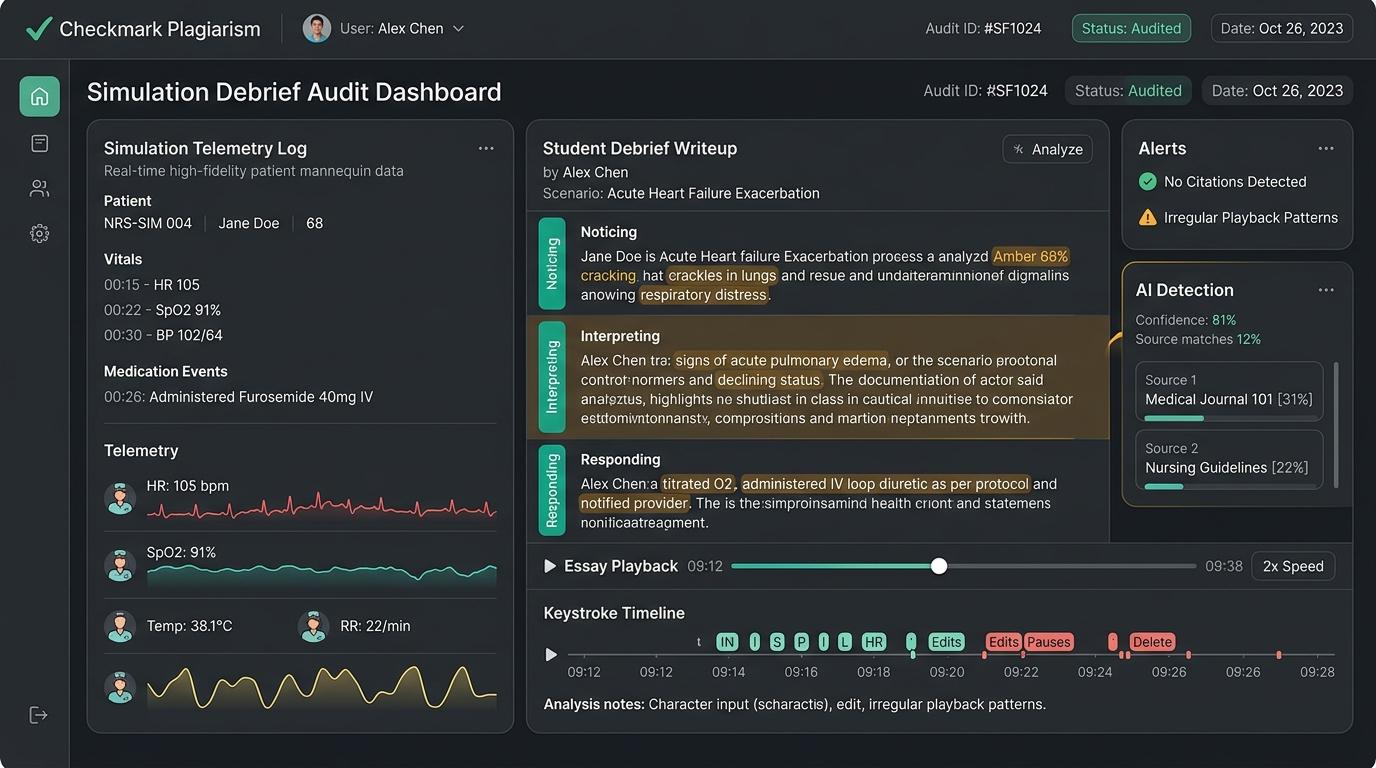
In modern collegiate nursing education (BSN, MSN, DNP), post-simulation debrief writeups and reflective clinical logs represent the primary cognitive crucible where student nurses develop, consolidate, and demonstrate clinical judgment before stepping into high-acuity patient care environments. Guided by Tanner's Clinical Judgment Model and the NCSBN Next Generation NCLEX (NGN) Clinical Judgment Measurement Model, these written reflections capture a learner's authentic capacity to notice subtle clinical cues, interpret evolving physiological trajectories, prioritize emergent interventions, and engage in honest self-evaluation following clinical errors.
However, the widespread availability of commercial Large Language Models (LLMs) has sparked an urgent patient safety and academic integrity dilemma: AI-fabricated patient reflections. When nursing students use generative AI to ghostwrite their post-simulation debriefs, LLMs produce polished, textbook-perfect narratives characterized by generic empathy clichés, idealized hindsight rationalizations, and fabricated clinical dialogue that completely detach from the actual simulation telemetry—such as high-fidelity mannequin logs, vital sign trends, and medication administration timestamps. Generic AI detectors exacerbate the crisis by triggering false-positive flags on standardized medical syntax, SBAR handoff templates, and formatted nursing care plans—disproportionately penalizing English-as-a-Second-Language (ESL) and international nursing candidates.
To preserve clinical competency verification and comply with AACN Essentials, CCNE, and ACEN accreditation mandates, nursing programs are implementing a 5-Phase Clinical Telemetry Audit Protocol. By pairing scenario telemetry concordance with Checkmark's zero-retention Writing Process Telemetry, patent-pending Essay Playback™ (1x–8x timeline replay), External Paste Buffer Inspection, and quote-anchored rubric evaluations, nursing faculty can verify genuine diagnostic reflection, protect honest students from false accusations, and foster restorative clinical learning without punitive black-box scores.
Checkmark Plagiarism provides collegiate nursing faculties, simulation center directors, and clinical coordinators with forensic writing telemetry, passage-level confidence evaluation, and native LMS integrations across Canvas LMS, Agilix Buzz, and Google Classroom.
1. The High-Stakes Role of Reflective Debriefing in Nursing Clinical Judgment
In Bachelor of Science in Nursing (BSN), Master of Science in Nursing (MSN), and Doctor of Nursing Practice (DNP) programs, the healthcare simulation laboratory is not merely a venue for psychomotor skills training. It is an experiential cognitive incubator where future nurses learn to navigate chaotic, rapidly deteriorating clinical scenarios without compromising human patient safety.
Whether navigating a high-fidelity pediatric anaphylaxis scenario, managing acute postpartum hemorrhage on a maternal simulator, or coordinating an interprofessional resuscitation during sudden cardiac arrest, the learning does not occur solely during the active physical run. Educational research in healthcare simulation consistently demonstrates that the vast majority of clinical learning and cognitive schema development occurs during the debriefing phase—specifically through structured, post-scenario reflective writing.
Noticing
Perceptual grasp of clinical reality:
- Recognize clinical cues
- Filter monitor noise
- Assess vital instability
- Identify baseline variance
Interpreting
Analytical & intuitive reasoning:
- Analyze cue clusters
- Formulate differentials
- Prioritize hypotheses
- Generate solutions
Responding
Executing decisive nursing action:
- Administer IV push meds
- Titrate supplemental O2
- Perform SBAR handoff
- Execute crisis algorithms
Reflecting
Metacognitive synthesis:
- Evaluate patient outcomes
- Reflect-in-Action (bedside)
- Reflect-on-Action (debrief)
- Identify cognitive fixations
The Cognitive Foundations of Clinical Judgment
To understand why debrief writeups are irreplaceable, nursing faculty ground clinical evaluation in two foundational pedagogical frameworks:
-
Tanner's Clinical Judgment Model (2006):
- Noticing: Perceptual grasp of the clinical situation based on the nurse's theoretical knowledge, clinical experience, and acute observation.
- Interpreting: The reasoning processes (analytic, narrative, and intuitive) used to make sense of the collected clinical data.
- Responding: Deciding upon and executing an appropriate course of nursing action.
- Reflecting: Split into Reflecting-in-Action (adjusting interventions in real time at the bedside) and Reflecting-on-Action (retrospective contemplation of what occurred, what knowledge was lacking, and how clinical practice must evolve).
-
NCSBN Next Generation NCLEX (NGN) Clinical Judgment Measurement Model (NCJMM):
Layer 3 Cognitive Operations: Recognize Cues → Analyze Cues → Prioritize Hypotheses → Generate Solutions → Take Action → Evaluate Outcomes.
Post-simulation written debriefs serve as the tangible, auditable artifact of Reflecting-on-Action and Evaluating Outcomes. When students write an authentic debrief, they are forced to confront their diagnostic hesitations, acknowledge fixation errors (e.g., spending five critical minutes troubleshooting an IV pump while the patient's airway deteriorated), and articulate the physiological rationale behind their clinical successes or missteps.
The Generative AI Shortcut: Bypassing the Cognitive Crucible
When a nursing student inputs a simulation scenario prompt into a commercial LLM (such as ChatGPT, Claude, or Gemini) to generate their debrief writeup, they do not merely commit an academic honor code infraction. They fundamentally sever the reflective feedback loop that builds safe bedside instincts.
- Direct Vulnerability & Error Acknowledgment: Student admits missed cues or delayed vitals; identifies cognitive fixation, sensory overload, and emotional stress.
- Scenario-Specific Telemetry Anchoring: Accurately details mannequin SpO2 drops, actual medication administration delays, and telemetry discordances.
- Formative Metacognitive Growth: Faculty coaches specific diagnostic struggles; clinical reasoning matures before human patient care.
- Outsourced Prompt Engineering: Student pastes case prompt into an LLM; AI outputs sanitized, clinical-sounding text with zero self-assessment.
- Telemetry Disconnect & Idealized Hindsight: Generates textbook answers disconnected from actual scenario timestamps, event logs, and patient alarms.
- Illusory Competency & Masked Clinical Gaps: Student bypasses self-assessment completely; uncorrected errors carry over to real hospital patients.
By substituting an LLM's probabilistic text generation for authentic metacognition, the student presents an illusion of clinical mastery. Unrecognized knowledge deficits, pharmacological misunderstandings, and poor communication habits remain uncorrected—posing direct, catastrophic hazards to human patients once the student enters licensed clinical practice.
2. Anatomy of AI-Fabricated Nursing Reflections: Telltale Signs & Failure Modes
Because commercial LLMs operate by predicting the most statistically probable sequence of tokens based on vast pre-training corpora, their outputs in clinical nursing reflection exhibit recognizable structural, linguistic, and contextual anomalies. Nursing faculty, simulation center coordinators, and clinical instructors can identify AI-fabricated writeups by recognizing four primary failure modes:
Generic Empathy Clichés
Formulaic, superficial statements about therapeutic communication and holistic care lacking situational nuance or actual patient dialogue.
Idealized Hindsight Bias
Omniscient, flawless reasoning that erases human hesitation, sensory overload, team miscommunication, and actual simulation errors.
Telemetry Discordance
Reflective claims directly contradict mannequin vitals logs, medication dispensing stamps, and simulation scenario event timers.
Hallucinated Dialogue
Invented bedside conversations with non-verbal mannequins, phantom attending physicians, or fictitious family members not present in lab.
1. Generic Empathy Clichés and Formulaic Therapeutic Phrasing
Large language models trained on generic nursing literature rely heavily on standardized, moralistic clichés regarding holistic care and therapeutic communication. While authentic student reflections describe concrete, often awkward interpersonal moments (“I didn't know how to interrupt the angry family member without escalating the room, so I froze for a minute before remembering to use a calm, low tone”), AI-generated reflections default to smooth, vacuous platitudes:
- “Throughout the simulation, I maintained profound empathy, actively listening to the patient's concerns and establishing an unshakeable therapeutic rapport.”
- “I holistically addressed both the physiological and psychosocial dimensions of the patient, ensuring their emotional comfort was prioritized alongside hemodynamic stability.”
- “Recognizing the profound vulnerability inherent in the patient's condition, I deployed evidence-based therapeutic touch and active validation techniques.”
These passages sound superficially sophisticated to non-clinical readers, but experienced nurse educators immediately recognize their complete lack of situational grounding, specific dialogue, or authentic emotional reflection.
2. Idealized Hindsight Bias and Omniscient Rationalization
In a genuine high-fidelity simulation, novice nursing students frequently make errors: they miscalculate drip rates, forget to check allergy bands before administering IV push medications, misinterpret early signs of septic shock as simple post-operative pain, or experience task saturation.
Commercial LLMs, by contrast, possess idealized hindsight bias. When prompted with a scenario summary, the LLM constructs an omniscient narrative in which every action taken was premeditated, perfectly sequenced, and theoretically optimal:
“When the monitor started alarming for SVT at HR 180, my heart stopped. I immediately wanted to push Adenosine, but my partner reminded me we didn't have a physician order or IV access in the antecubital fossa. I felt overwhelmed by the alarm noise and realized I hadn't checked the blood pressure first to see if he was stable.”
“Upon noting the sudden onset of supraventricular tachycardia with a heart rate of 182 bpm, I systematically executed advanced cardiac nursing protocols. I immediately recognized the loss of atrial kick and calmly initiated vagal maneuvers while directing my team with clear, closed-loop communication to prepare adenosine 6mg IV push.”
The AI narrative completely erases the visceral stress, cognitive disorientation, and messy reality of real-time clinical decision-making, replacing it with a sanitized, textbook-perfect performance that contradicts the faculty's actual observation from the simulation control booth.
3. Telemetry Disconnect and Chronological Discordance
The most definitive clinical indicator of AI fabrication is the discordance between the student's written claims and the objective, timestamped telemetry recorded by the simulation software (such as Laerdal LLEAP, Gaumard UNI, or CAE Maestro) and electronic health record (EHR) audit logs.
- The “Instantaneous Response” Myth: The student writeup claims: “I immediately administered 0.5 mg Epinephrine IM within 60 seconds of noticing biphasic wheezing.” The simulation event log shows the student did not locate or administer Epinephrine until minute 8 of the scenario, after the mannequin's blood pressure had plummeted to 68/38 mmHg.
- Vital Sign Inaccuracies: The debrief asserts: “The patient remained normotensive throughout the fluid bolus.” The mannequin telemetry log demonstrates persistent hypotension (MAP < 55 mmHg) for over twelve minutes.
- Medication Administration Sequence: The writeup describes administering IV push Morphine prior to placing the patient on continuous pulse oximetry and supplemental oxygen, reversing the actual clinical sequence executed during the simulation.
4. Hallucinated Bedside Dialogue and Fictitious Interactions
Generative AI models frequently “hallucinate” interactions, embellishing the scenario with events, personnel, or patient responses that never occurred in the physical simulation suite:
- Interactions with Non-Verbal Mannequins: Describing detailed verbal comfort exchanges with a standardized patient or mannequin programmed to be comatose, intubated, or non-verbal.
- Phantom Providers and Family Members: Referencing detailed SBAR handoffs with an attending physician, respiratory therapist, or concerned spouse when no confederate or standardized actor filled that role during the specific run.
- Fabricated Clinical Tools: Detailing the use of bedside point-of-care ultrasound (POCUS), arterial lines, or specific monitoring equipment that were not physically present in the simulation lab.
3. The Patient Safety, Accreditation, and Detector Dilemma
The integrity of clinical simulation debriefs is directly tied to program accreditation, legal licensure standards, and public health safety. When nursing programs fail to audit and maintain the authenticity of clinical debriefs, they expose themselves to severe institutional and regulatory vulnerabilities.
| Accreditation / Regulatory Body | Core Mandate | Impact of AI-Fabricated Debrief |
|---|---|---|
|
AACN Essentials (2021) American Association of Colleges of Nursing |
Domain 1: Knowledge for Practice Domain 2: Person-Centered Care Domain 10: Personal & Leadership Development (Self-Reflection) |
• Bypasses clinical judgment and metacognitive evaluation. • Compromises professional role formation and accountability. |
|
CCNE & ACEN Standards Commission on Collegiate Nursing Education / ACEN |
Systematic assessment of student clinical competencies; verifiable clinical judgment progression across coursework. |
• Invalidates clinical hours replacement ratios (up to 50% simulation equivalency). • Creates severe audit liabilities during accreditation site visits. |
|
State Boards of Nursing (BON) & NCSBN National Simulation Study Guidelines |
High-fidelity simulation debrief standards requiring documented evidence of structured student reflective integration. |
• Fraudulent documentation of required reflective debrief competency benchmarks. • Fosters masked clinical errors entering direct hospital licensure. |
The NCSBN Simulation Hour Replacement Vulnerability
Following the landmark NCSBN National Simulation Study (2014), state boards of nursing across the United States permit nursing programs to substitute up to 50% of traditional clinical hospital hours with high-fidelity healthcare simulation, provided that simulations adhere to the INACSL (International Nursing Association for Clinical Simulation and Learning) Healthcare Simulation Standards of Best Practice™.
A foundational cornerstone of the INACSL standards is Criterion 4: The Debriefing Process, which mandates that learners engage in structured, reflective integration of knowledge, skills, and attitudes. If nursing students routinely submit AI-generated debrief writeups, the educational validity of those simulated clinical hours is compromised. Department chairs and curriculum committees risk non-compliance during CCNE or ACEN accreditation site visits if they cannot demonstrate defensible mechanisms for verifying the authenticity of student reflective clinical portfolios.
The Catastrophic Failure of Generic AI Detectors in Nursing
Faced with the threat of generative AI, many nursing departments have attempted to deploy generic, whole-document AI percentage scanners. In nursing education, this approach has proven catastrophic.
Standardized SBAR & SOAP Phrasing Trap
Clinical communication mandates uniform, low-perplexity templates (“Patient placed in semi-Fowler's position; 2 L/min O2 applied via NC”). Generic AI detectors rely on statistical perplexity and burstiness, systematically misclassifying honest nursing students who write with clinical precision as AI bots.
Severe ESL & International Student Bias
Collegiate nursing programs educate highly diverse cohorts. Non-native English nursing students naturally utilize formal, predictable sentence structures. Commercial AI percentage detectors falsely flag ESL writing at rates exceeding 40%, creating severe emotional distress and administrative appeals.
Contextual Blindness to Telemetry
Whole-paper text scanners only evaluate static prose; they cannot compare student claims against mannequin logs, medication dispensing records, or vital sign trends. A student who pastes a completely fabricated clinical narrative can easily score “10% AI” while describing events that never happened.
AI Humanizers & Paraphraser Bypasses
Dishonest students frequently run AI-generated debriefs through text humanizers (such as QuillBot or Undetectable AI) to artificially introduce sentence variance. These tools bypass generic detectors while preserving the student's underlying clinical fabrication.
Privacy, FERPA, and Simulated EHR Data Governance
Uploading student debrief writeups containing complex simulation vignettes to commercial AI checkers that ingest and store data to train public models introduces serious compliance risks under FERPA (Family Educational Rights and Privacy Act). Nursing programs require an enterprise Zero-Data Retention (ZDR) architecture that processes submissions ephemerally without indexing or caching student records.
4. The Nursing Clinical Telemetry Matrix
To eliminate the hazards of unverified AI percentages and replace subjective guesswork with transparent clinical evidence, nursing programs must adopt a multidimensional verification approach.
| Integrity & Verification Modality | Standalone Generic AI Detectors | Legacy Plagiarism Scanners | Checkmark Plagiarism & Telemetry Suite |
|---|---|---|---|
| Primary Evaluation Mechanism | Opaque global statistical percentage | 1-to-1 static database string matching | Multi-factor: writing telemetry, keystrokes, source links & rubrics |
| Passage-Level Granularity | ❌ Whole-paper score only (e.g., “82% AI”) | ⚠️ Highlights text matches without context | ✅ Direct inline highlights with calibrated confidence sliders |
| Short-Text Guardrail (<150 words) | ❌ Guesses wildly on brief clinical notes | ❌ Flags standard medical abbreviations | ✅ Automatic N/A guardrail prevents false flags |
| Keystroke-by-Keystroke Playback | ❌ No temporal or keystroke data | ❌ No temporal data | ✅ Patent-Pending Essay Playback™ (1x–8x replay) |
| External Paste Buffer Inspection | ❌ Blind to clipboard activity | ❌ Only checks final submitted text | ✅ Permanent capture of raw pasted text & timestamps |
| Transcription Detection (2nd Screen) | ❌ Cannot detect manual retyping | ❌ Cannot detect manual retyping | ✅ Identifies steady typing rhythms lacking reflection pauses |
| Telemetry Concordance Cross-Ref | ❌ Blind to simulation logs | ❌ Blind to simulation logs | ✅ Facilitates direct alignment with mannequin event logs |
| Uncited Source vs. Plagiarism Split | ❌ N/A | ❌ Treats all text overlap identically | ✅ Dedicated visual styling for citation coaching |
| Teacher-in-the-Loop Rubric Grading | ❌ None | ❌ None | ✅ Quote-anchored feedback mapped to NGN & AACN rubrics |
| Zero-Data Retention & FERPA Safety | ⚠️ Many retain text for model training | ❌ Stores submissions in global repository | ✅ 100% Zero Retention; FERPA & HIPAA compliant |
| Direct LMS Gradebook Passback | ❌ Standalone external portal | ⚠️ Basic LTI score passback | ✅ Native integration with Canvas SpeedGrader & Buzz LMS |
Writing Telemetry Forensics: Authentic Reflection vs. AI-Fabricated Output
When evaluating a debrief writeup in Checkmark, nursing faculty can examine the underlying writing process telemetry to immediately distinguish authentic clinical self-reflection from outsourced AI generation:
| Telemetry Metric | Authentic Nursing Reflection | AI-Fabricated Writeup |
|---|---|---|
|
1. Drafting Velocity & Cadence (Chars / Keystrokes Per Min) |
Dynamic, bursty velocity: • 18–35 WPM during deep synthesis • Long reflective pauses (>90s) • Frequent backspacing & rewrites |
Static, invariant velocity: • Instantaneous 150+ WPM paste OR • Steady 70 WPM typing without a single pause across complex theory. |
|
2. Clinical Pause Distribution (Temporal Cognitive Lulls) |
Concentrated at decision nodes: • Pauses before articulating pharmacological rationales or explaining missed cues. |
Uniform or absent pauses: • No hesitation before complex pathophysiological rationale; continuous linear entry. |
|
3. External Paste Buffer Logs (Clipboard Forensics) |
Fragmented, contextual pastes: • Copies of specific lab values, vital signs, or scenario prompt headers. • Subsequent inline text edits. |
Monolithic prompt dumps: • 400–1,200 word blocks containing complete SBAR debriefs and empathy essays. |
|
4. Revision & Deletion Dynamics (Backspaces & Reorganizations) |
Iterative self-correction: • Rewriting drug mechanisms • Restructuring SBAR priority • Refining clinical impressions. |
Minimal, cosmetic edits: • Fixing minor spelling typos; running a paraphrasing tool to alter surface synonyms. |
5. The 5-Phase Nursing Faculty Audit Protocol
To establish a standardized, transparent, and restorative academic integrity workflow, nursing programs and healthcare simulation centers should implement the following 5-Phase Nursing Faculty Audit Protocol:
Phase 1: Ephemeral Multi-Factor Screening & Guardrails
- Passage-Level Analysis: Open the debrief writeup in Checkmark's integrated review portal. Focus on the core clinical synthesis sections: Evaluation of Clinical Judgment, Prioritization of Interventions, and Reflective Growth Plan.
- Review Calibrated Confidence Cards: Examine individual passage cards in the sidebar. Check whether flagged text exhibits statistical synthetic hallmarks (invariant sentence length, robotic transitions) or represents normal clinical precision.
- Verify Short-Text Guardrails: Confirm that short clinical entries (such as individual vital sign summaries or brief handoff notes under 150 words) display
N/A, preventing false-positive flags on standard medical terminology.
Phase 2: Clinical Telemetry Concordance Audit
- Retrieve Simulation Event Logs: Pull the timestamped event log from the simulation control software (e.g., Laerdal LLEAP, Gaumard UNI, or CAE Maestro).
- Cross-Reference Critical Clinical Milestones:
- Oxygenation / Airway Intervention: Did the student's reflection claim they recognized hypoxia at minute 2, while the telemetry log shows oxygen was applied at minute 7 after SpO2 dropped below 82%?
- Medication Timing: Does the writeup claim immediate IV push administration, whereas the Pyxis/Omnicell dispensing record indicates a 10-minute delay?
- Vital Sign Trends: Does the student describe managing a stable patient when the simulator recorded severe refractory tachycardia and hypotension?
- Verify Scenario Specifics: Check whether the reflection references clinical confederates, patient dialogue, or diagnostic tools that were not part of the assigned scenario.
Phase 3: Writing Telemetry & Essay Playback™ Forensics
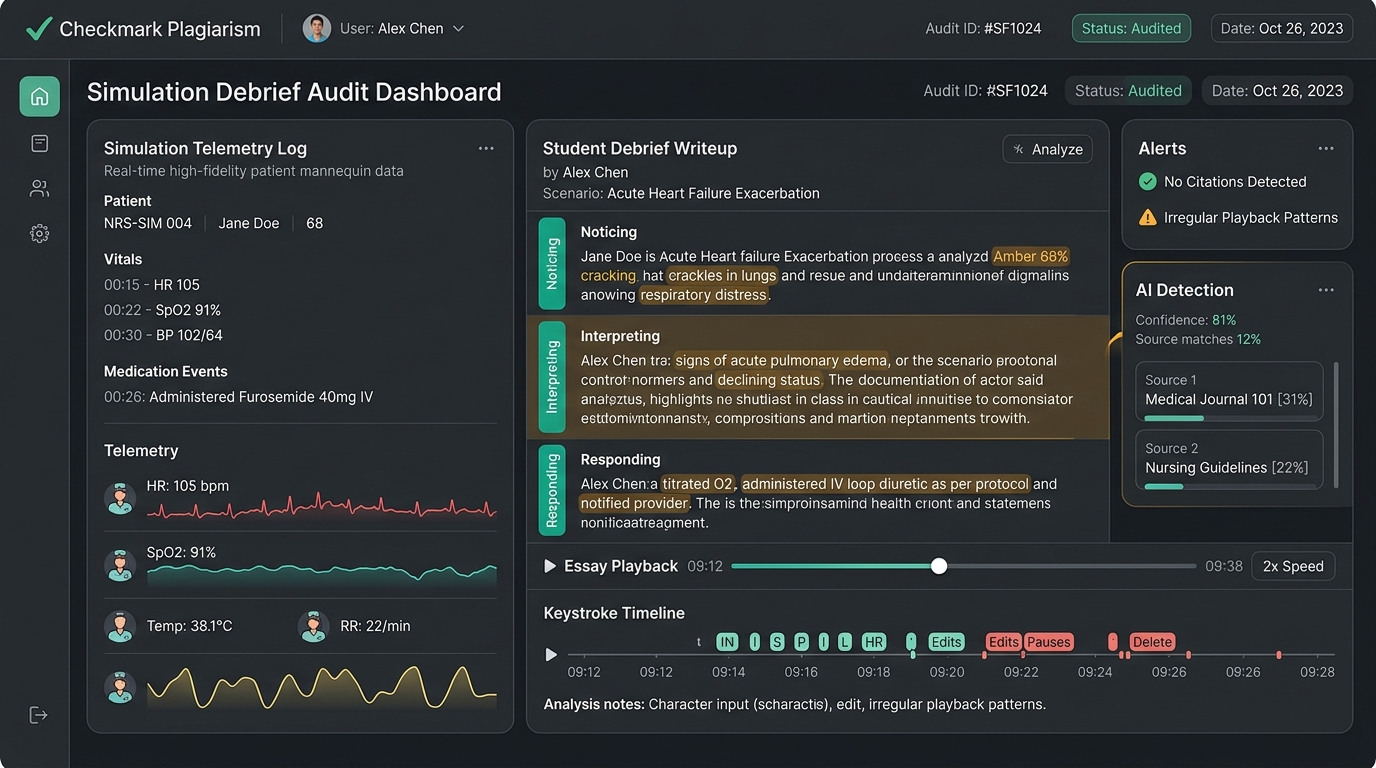
- Launch Essay Playback™: Open Checkmark's timeline scrubber and replay the student's writing session at 2x or 4x speed.
- Evaluate Cognitive Pause Distribution:
- Authentic Reflection: The student pauses for 60–180 seconds before drafting complex clinical evaluations, demonstrating active recall and clinical judgment processing.
- AI-Generated Text: The student inserts massive paragraphs instantaneously or types without hesitation across complex pathophysiological concepts.
- Detect Secondary-Screen Transcription Dynamics: If the student typed continuously at 65–80 WPM with zero composing pauses, no backspaces, and zero structural reorganization over a 20-minute span, inspect for secondary device transcription (typing while looking at an LLM response on a smartphone or second monitor).
Phase 4: External Clipboard & Prompt Artifact Inspection
- Open the External Paste Inspector: Audit all timestamped paste events captured during the drafting session.
- Inspect Preserved Clipboard Content: Checkmark preserves the raw, original pasted text even if the student subsequently retyped, paraphrased, or edited every word.
- Identify LLM Prompt Engineering Artifacts:
- Conversational intro text (“Here is a reflective debrief for a nursing student who managed a simulated post-operative pulmonary embolism scenario...”).
- Unprompted formatting tags (Markdown bolding
**Assessment**, bulleted lists, or artificial numbered headers). - Generic ethical disclaimers (“As a nurse, it is essential to always follow hospital policy and physician orders...”).
Phase 5: Supportive Restorative Clinical Judgment Conferences
- The “Stop Guessing, Start Trusting” Philosophy: The goal of nursing clinical education is not punitive expulsion, but ensuring bedside safety, clinical competence, and professional accountability.
- Collaborative Playback Review: In a private, supportive conference, open the Checkmark Essay Playback™ timeline alongside the student.
- Conduct an Oral Clinical Defense: Ask the student to articulate their real-time clinical judgment from the simulation:
- “Walk me through what you were observing at minute 4 when the patient's blood pressure began dropping.”
- “In your writeup, you mentioned considering cardiogenic shock. What specific telemetry cues from the simulator led you to prioritize that over hypovolemia?”
- “Can you explain the pharmacological mechanism of the medication you chose to administer first?”
- Targeted Remediation: If the student outsourced the reflection due to time pressure, burnout, or clinical anxiety, establish a restorative remediation contract: supervised simulation lab practice, structured clinical reasoning worksheets, and guided debrief drafting.
6. Real-World Clinical Simulation Case Scenarios
The following realistic scenarios illustrate how nursing faculty utilize clinical telemetry concordance and Checkmark Writing Process Telemetry to resolve debrief anomalies:
The Anaphylaxis Shock Simulation & Telemetry Disconnect
Scenario Vignette:
Acute IV antibiotic-induced anaphylactic shock with progressive stridor, facial angioedema, and severe hypotension in a 28-year-old post-surgical patient.
Submission Anomalies:
The student submitted a 1,400-word debrief writeup praising their rapid recognition: “I immediately identified early laryngeal edema, promptly discontinued the IV Vancomycin infusion within 45 seconds, administered 0.3 mg Epinephrine 1:1,000 IM in the anterolateral thigh, and elevated the head of the bed.”
Audit Execution & Telemetry Proof:
- Step 1 (Telemetry Log): The Laerdal LLEAP event log revealed the student did not stop the IV infusion until minute 6, and Epinephrine was never administered during the 12-minute run—the simulation ended with PEA arrest.
- Step 2 (Checkmark Paste Inspector): At timestamp
21:14:02, the student pasted a 1,350-word text block. Checkmark's preserved buffer displayed the student's raw prompt: “Write an A-grade nursing reflection for a student who successfully managed an anaphylaxis simulation with prompt epinephrine and perfect SBAR.”
The ESL Graduate Nursing Student Falsely Flagged
Scenario Vignette:
Post-operative surgical unit simulation managing sudden hypovolemic shock following an abdominal aortic aneurysm (AAA) repair.
Submission Anomalies:
A standalone commercial AI detector flagged the student's reflection at 92% AI Generated. The clinical coordinator initiated an academic integrity inquiry against a top-performing bilingual candidate with English as an additional language.
Audit Execution & Telemetry Proof:
- Step 1 (Passage Cards): Checkmark revealed the flag was triggered by standard SBAR formatting and structured clinical transitions (“In evaluating the post-operative trajectory, hemodynamic instability was evidenced by...”).
- Step 2 (Essay Playback™): Replay demonstrated 4 hours and 14 minutes of authentic, non-linear composition.
- Step 3 (Keystroke Forensics): Recorded 294 backspaces, 14 major paragraph reorganizations, and multiple 120+ second pauses reviewing hospital transfusion protocols.
- Step 4 (Clipboard Audit): Confirmed zero external bulk pastes.
The Behavioral Health De-escalation Writeup with Mechanical Transcription
Scenario Vignette:
Managing an escalating standardized patient experiencing acute persecutory delusions and auditory hallucinations in an inpatient psychiatric setting.
Submission Anomalies:
The student submitted an exceptionally detailed reflection describing complex therapeutic communication strategies, citing Peplau's Theory of Interpersonal Relations and detailed verbal de-escalation scripts.
Audit Execution & Telemetry Proof:
- Step 1 (Video Review): Simulation room footage showed the student had appeared visibly anxious, stood rigidly against the door, and spoke fewer than 20 total words before calling security.
- Step 2 (Passage AI Detection): Checkmark flagged the therapeutic communication section with high synthetic pattern predictability.
- Step 3 (Essay Playback™ Dynamics): Telemetry revealed secondary-device transcription dynamics: over 24 minutes, the student typed 1,650 words at an invariant 74 WPM with zero pauses, zero backspaces, and zero sentence restructuring.
7. How Checkmark Plagiarism Empowers Collegiate Nursing Programs
Checkmark Plagiarism provides a comprehensive, educator-first academic integrity and clinical evaluation ecosystem designed specifically for health sciences, collegiate nursing departments, and simulation centers.
1. Granular Passage-Level AI Detection with Confidence Sliders
- No Blanket Percentages: Checkmark eliminates opaque whole-paper scores, highlighting specific sentences and passages with calibrated confidence cards (typical human variability vs. typical AI predictability).
- Educator-Controlled Flag Statuses: Flags (
Flagged,Resolved,Not Flagged) remain private to faculty, enabling instructors to investigate quietly without creating premature panic. - Automatic Short-Text Guardrails: Any submission or response under 150 words displays
N/A, preventing false alarms on brief clinical notes or SBAR blurbs.
2. Patent-Pending Essay Playback™ (1x–8x Timeline Replay)
- Keystroke-by-Keystroke Video Replay: Faculty can scrub through an entire 3-hour debrief drafting session in 60 seconds, observing genuine cognitive pauses, real-time revisions, and clinical self-corrections.
- Transcription Rhythm Analysis: Automatically identifies robotic, steady typing lacking natural brainstorming intervals.
- Exoneration Proof: Provides objective, verifiable telemetry to protect honest students falsely flagged by generic scanners.
3. External Paste Buffer Inspector
- Permanent Raw Text Preservation: Captures every character pasted from external sources, preserving the original clipboard content even if the student completely rewrites or deletes the text later.
- Jump-to-Playback Sync: Clicking any paste event in the sidebar instantly transports the playback timeline to the exact millisecond the text entered the editor.
4. Synchronized Dual-Pane Clinical Source Verification
- Clickable Evidence Cards: Clicking any highlighted citation in the student's paper instantly opens the corresponding live medical journal article, PubMed record, or clinical practice guideline in a split-screen viewer.
- Uncited Source Differentiation: Visual indicators separate proper citation omissions from deliberate plagiarism, facilitating targeted citation coaching.
- Cohort-Wide Match Detection: Detects unauthorized assignment sharing across clinical sections and LMS cohorts without storing student work in public databases.
5. Teacher-in-the-Loop Rubric Autograding & LMS Integration
- Quote-Anchored Clinical Feedback: Generates draft rubric evaluations anchored directly in quotes from the student's debrief, mapped directly to Tanner's Clinical Judgment Model and AACN Essentials.
- Teacher Final Authority: All automated scores remain drafts until reviewed, edited, and approved by nursing faculty.
- Direct LMS Passback: Seamless one-click grade and feedback passback into Canvas LMS SpeedGrader, Buzz LMS, Google Classroom, and Blackboard.
8. Frequently Asked Questions (FAQ)
1. How does Checkmark Plagiarism protect simulated patient data and student privacy under FERPA and HIPAA?
Checkmark operates under a strict Zero-Data Retention (ZDR) architecture. All student debriefs, clinical logs, and case analyses are processed ephemerally in secure, volatile server memory and are never used to train commercial large language models, stored in public databases, or shared with third parties. This guarantees full compliance with FERPA regulations and institutional clinical research security standards.
2. Why do generic AI detectors frequently flag honest nursing students writing SBAR debriefs?
SBAR handoffs and clinical reflections are intentionally structured to follow formulaic, standardized phrasing and concise medical grammar. Generic AI detectors rely on statistical perplexity (word choice unpredictability) and burstiness (sentence length variation). Because clinical documentation is inherently predictable and uniform, generic detectors mistakenly classify high-quality human clinical writing as machine-generated text. Checkmark eliminates this flaw by combining passage-level analysis with keystroke writing process verification (Essay Playback™).
3. Can Essay Playback™ prove a student transcribed an AI debrief from a smartphone or tablet?
Yes. When a student transcribes text from a secondary device, they exhibit a distinct keystroke telemetry profile: a steady, mechanical typing cadence (e.g., 60–80 WPM) with near-zero composing pauses, virtually no backspacing, and no structural reorganization of clinical arguments. In contrast, authentic clinical reasoning produces highly variable speeds, frequent backspaces to adjust medical terminology, and significant cognitive pauses while recalling simulation events.
4. How can nursing faculty use simulation telemetry to cross-reference debrief writeups?
Faculty can cross-reference specific claims in the student's debrief writeup against the high-fidelity simulator's timestamped event log (e.g., Laerdal LLEAP, Gaumard UNI), medication dispensing records (Pyxis/Omnicell), and debrief audiovisual recordings. Discrepancies between written claims (e.g., claiming early intervention) and actual simulation telemetry (e.g., delayed medication administration or prolonged hypoxia) provide clear, objective indicators of AI fabrication or clinical recall errors.
5. How does Checkmark support CCNE and ACEN accreditation standards for clinical simulation?
Accreditation bodies (CCNE, ACEN) and state boards of nursing mandate verifiable assessment of student clinical competencies when substituting simulation for direct patient care hours. Checkmark provides an auditable, transparent record of authentic student clinical reflection and diagnostic reasoning through Writing Process Telemetry, ensuring that programs maintain the pedagogical integrity of their simulation curricula.
6. How should nursing instructors conduct supportive, restorative debrief conferences?
Guided by Checkmark's philosophy “Stop guessing, start trusting,” instructors should avoid confrontational or punitive accusations based solely on AI percentages. Instead, faculty should review the Essay Playback™ timeline collaboratively with the student and conduct an oral clinical defense. Asking the student to articulate their diagnostic reasoning and physiological rationales helps instructors diagnose underlying clinical misconceptions and assign targeted simulation lab remediation.
7. Does Checkmark integrate directly with Canvas SpeedGrader and Buzz LMS?
Yes. Checkmark provides seamless LTI 1.3 integration with Canvas LMS, Buzz LMS, Blackboard, and Google Classroom. Nursing faculty can view passage-level AI detection, keystroke playback, and rubric evaluations directly within the native LMS interface, with single-click grade and comment passback to the institutional gradebook.
8. How does Checkmark distinguish between legitimate medical abbreviations and plagiarized text?
Checkmark's dual-pane source viewer distinguishes between standard medical terminology/clinical acronyms and actual source plagiarism. Standard clinical phrases are recognized through domain-specific filtering, while uncredited verbatim source matches are highlighted with dedicated visual styling to facilitate targeted citation coaching rather than punitive discipline.