
Executive Summary & Music Theory Forensic Mandate
The rapid integration of multimodal large language models (LLMs) into undergraduate music theory, conservatory counterpoint seminars, and AP Music Theory courses has created a profound academic integrity challenge: the Score-to-Prose Discrepancy. Generative AI models can ingest score images, MusicXML files, or figured bass prompts to output sophisticated, musicologically polished analytical essays laden with advanced harmonic terminology—yet these texts frequently contain subtle, confident hallucinations. From inventing phantom pivot chords and misattributing Neapolitan or German augmented sixth resolutions to fabricating rule compliance in species counterpoint while ignoring glaring parallel fifths in the student's actual score notation, AI-generated musical analysis mimics expert scholarship while divorcing itself from acoustic reality.
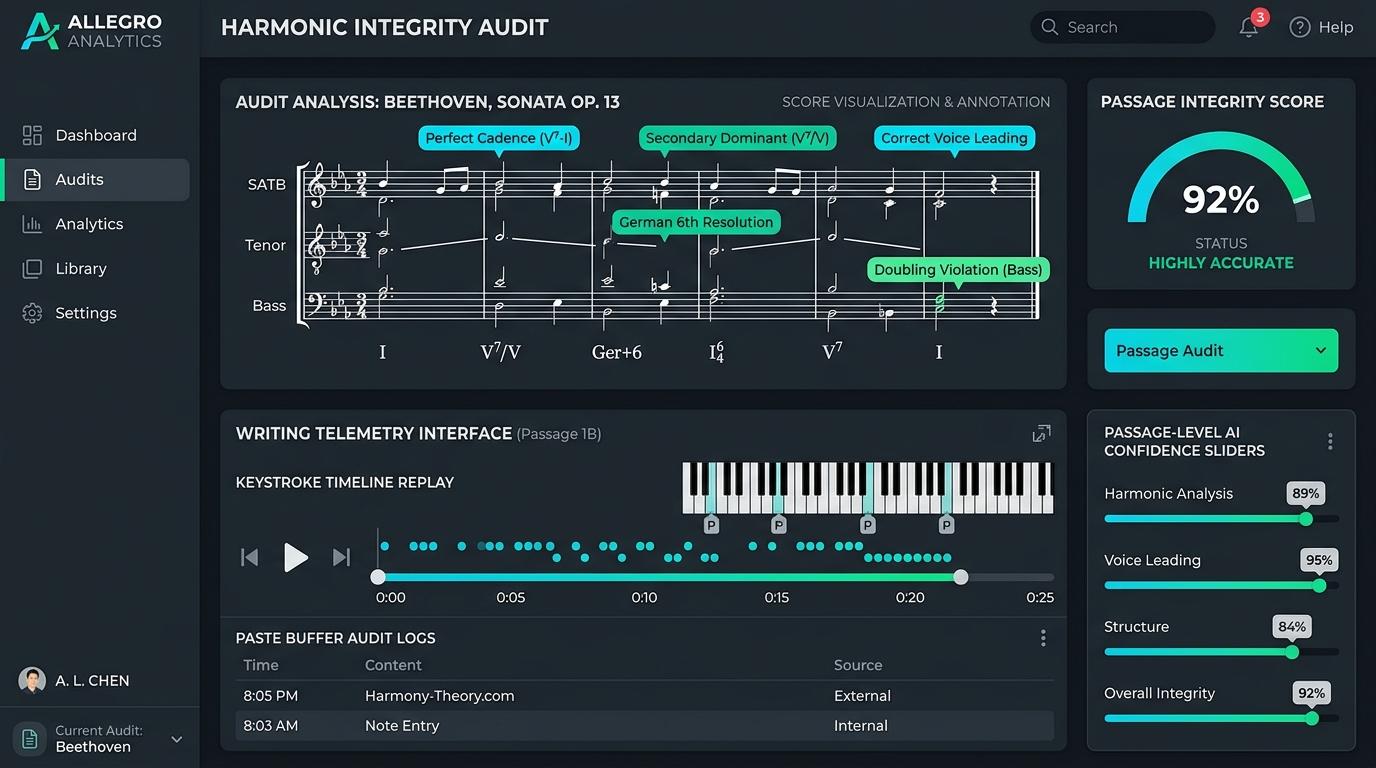
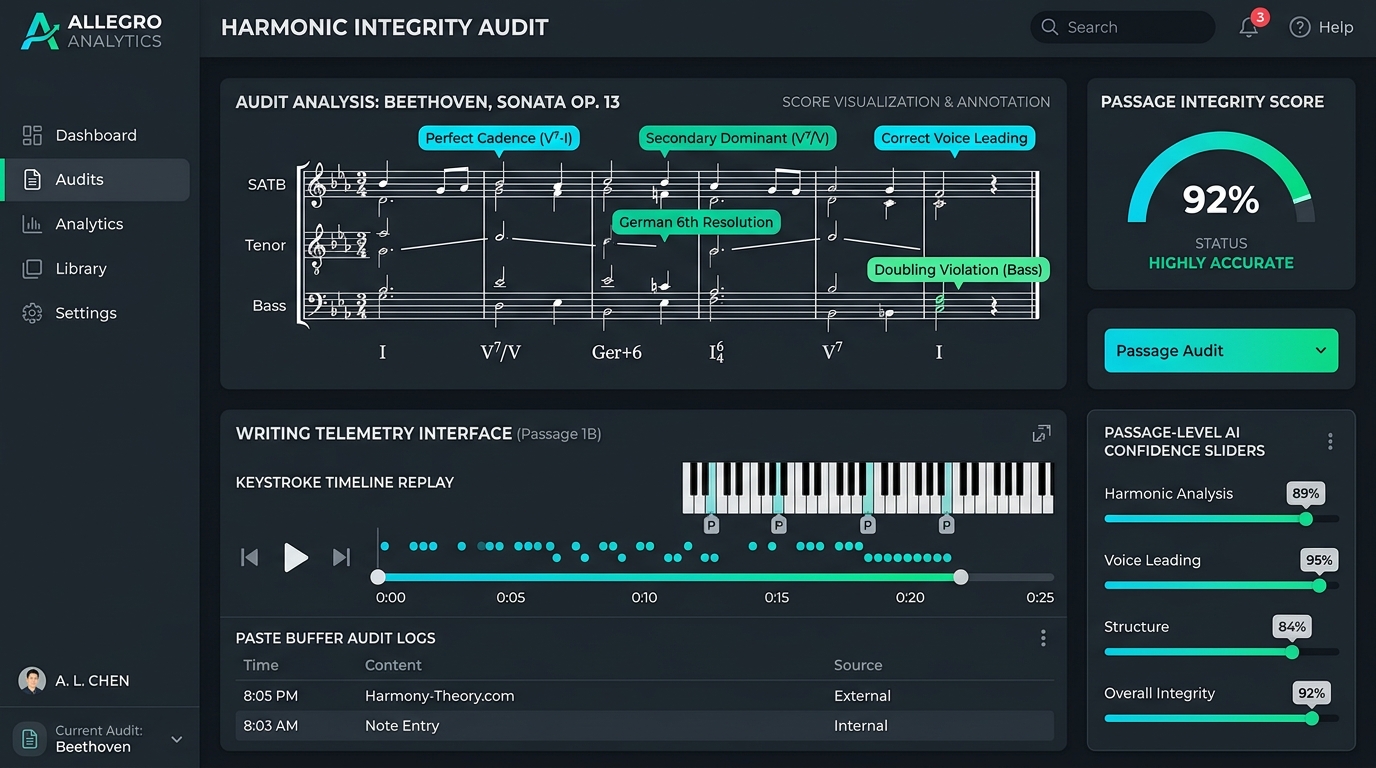
Traditional text-matching plagiarism engines fail entirely because standard analytical vocabulary (“cadential six-four resolving to dominant seventh,” “contrary motion to imperfect consonance”) triggers false similarity, while generic black-box AI detectors produce unreliable whole-document scores on short-form measure annotations. Checkmark Plagiarism resolves this disciplinary dilemma through its Music Portfolio Integrity Suite. By coupling Score-to-Prose Concordance Auditing with patent-pending Essay Playback™ (1x–8x scrubbable keystroke video replay), an External Paste Buffer Inspector, Passage-Level AI Confidence Sliders with honest short-text guardrails (<150w N/A), and Teacher-in-the-Loop Rubric Autograding with Canvas, Buzz, and Google Classroom Passback, music faculty can distinguish authentic, keyboard-tested student analysis from outsourced AI rhetoric—fostering transparent, restorative dialogue at the piano rather than punitive guesswork.
Score-to-Prose Concordance
- Roman Numeral Validation: Checks written roots vs. notated pitch classes.
- Voice-Leading Incongruity: Detects unmentioned parallel 5ths/8ves.
- Species Rule Verification: Verifies cantus firmus & ligature compliance.
- Chromatic Matrix Check: Confirms augmented 6th and Neapolitan spellings.
Writing Telemetry & Replay
- Essay Playback™ (1x–8x): Scrubbable keystroke video replay.
- Piano-Pause Dynamics: Captures 30–120s cognitive keyboard pauses.
- Paste Buffer Inspector: Preserves raw clipboard text & prompts.
- Passage AI Sliders: Granular sentence-level confidence cards.
Restorative Piano Conference
- Non-Punitive Keyboard Check: Student plays voice lines live.
- Harmonic Defense: Student explains pivot chord decisions at piano.
- Transparent Timeline: Student & teacher review replay together.
- Restorative Growth: Partial credit re-drafting preserves trust.
“Stop guessing, start trusting.” Checkmark replaces opaque, black-box AI detection percentages with verifiable, multi-layered process and score evidence, ensuring fair due process for students and high musical standards for faculty.
1. The Disciplinary Dilemma: Generative AI in the Music Theory Classroom
For centuries, music theory pedagogy has relied on a foundational pedagogical contract: the student analyzes a musical score, grapples with pitch relationships and formal syntax at the keyboard or through internal audiation, and writes a detailed textual defense justifying their analytical decisions. Whether constructing a four-voice Bach chorale realization in undergraduate Theory II, drafting strict species counterpoint in a conservatory Renaissance seminar, or annotating a Brahms intermezzo for an AP Music Theory portfolio, written prose has served as the window into a student's cognitive and aural comprehension.
The advent of frontier multimodal large language models (such as GPT-4o, Claude 3.5 Sonnet, and Gemini 1.5 Pro) has fundamentally fractured this evaluative window.
Today, a student can upload a high-resolution smartphone photo of a hand-annotated score, an exported PDF from Sibelius, Dorico, or MuseScore, or a raw MusicXML text file into an LLM and generate a multi-page, scholarly analytical paper in under fifteen seconds. The resulting prose is syntactically flawless, effortlessly deploying Italian, German, and French musical terminology, quoting Schenkerian linear concepts, citing formal-prall conventions, and weaving historical context into measure-by-measure commentary.
“In mm. 14–16, the bass descends through an Italian augmented sixth chord (A♭–C–F♯), resolving outward by contrary motion to the dominant octave on G, which resolves the tension created by the earlier chromatic passing tones in the tenor voice.”
Rhetorical Impression: Sounds like senior musicological commentary; deploys advanced harmonic jargon with absolute confidence.
Pitch Check: The pitch F♯ does NOT appear anywhere in the measure.
Voice Leading: Tenor contains a static pedal point, not chromatic passing tones.
Forensic Reality: Complete discordance between score pitches and prose claims. The AI hallucinated the entire chromatic progression.
2. Deep Dive: Anatomy of AI Hallucinations in Music Theory & Counterpoint
To detect AI-generated analysis without resorting to punitive guesswork, music theory faculty must understand the precise failure modes of neural language models when interpreting musical syntax. Unlike human musicians who synthesize visual notation, tactile keyboard geography, and inner hearing (audiation), LLMs operate through statistical token prediction.
This architectural reality leads to five distinct, highly predictable categories of musical hallucinations.
Roman Numeral & Pivots
Inverting chord roots, confusing cadential 6/4 embellishments with stable tonic triads, and hallucinating non-existent pivot chords in distant modulations.
Species Rule Fabrications
Claiming strict Fuxian ligature and suspension compliance while the student's actual score notation contains raw parallel fifths, octaves, and illegal unisons.
Chromatic Harmony Errors
Mislabelling Italian, French, and German augmented sixths; inventing phantom Neapolitan roots; confabulating “Mozart fifth” resolution excuses.
Voice-Leading Apologies
Inventing elaborate historical justifications (stylus fantasticus, rhetorical devices) to excuse basic voice crossings and leading-tone doubling blunders.
Post-Tonal & Set Theory
Calculating incorrect prime forms, invalid interval class vectors (ICV), and miscalculating twelve-tone retrograde-inversion (RI) matrix transformations.
Checkmark Solution
Scores are verified against prose using Score-to-Prose Concordance and validated through Essay Playback™ writing process telemetry.
2.1 Roman Numeral Analysis & Pivot Chord Confabulations
When tasked with providing a Roman numeral analysis (RNA) of a modulating passage—such as a transition in a Classical sonata-allegro exposition from tonic (I) to dominant (V), or a Romantic modulation to a chromatic mediant (♭VI or ♯III)—LLMs frequently generate logically structured but musically fictional pivot chord explanations.
1. Phantom Diatonic Overlaps
The model asserts that a specific measure functions as a dual-identity pivot chord (e.g., vi in E♭ Major = iv in G minor) when the pitch collection in that measure contains accidentals that make the chord diatonic in neither key.
2. Inverted Root Logic
The model confuses figured bass inversions with root-position chords, describing a cadential I64 chord as an independent tonic triad in second inversion exercising tonic stability, rather than recognizing its dominant syntactic function (V6-54-3).
3. Secondary Dominant Misidentifications
LLMs routinely label any chord containing an accidental as a secondary dominant (V7/V or V7/iv), even when the chord represents modal mixture (borrowed chord), an applied diminished seventh (vii°7), or a purely linear chromatic passing sonority.
2.2 Species Counterpoint Rule Violations Masked by Eloquent Rhetoric
In strict Fuxian species counterpoint (First through Fifth Species), students are evaluated on rigorous, centuries-old contrapuntal rules: prohibition of parallel fifths and octaves, avoidance of direct (hidden) fifths/octaves, restriction of harmonic dissonances to specific metric placements (passing tones on weak beats in Second Species, accented suspensions in Fourth Species), and maintenance of a single, well-defined melodic climax in the cantus firmus.
“In Fourth Species, the counterpoint in mm. 6–8 maintains strict adherence to Fuxian principles by preparing the 7–6 suspension on the weak half-note of measure 6, tying it over the barline as an accented dissonance on beat 1 of measure 7, and resolving it downward by step to a consonant major sixth on beat 2.”
CF: D4 | CP: D5
Octave (8)
CF: C4 | CP: C5
Octave (8)
CF: B3 | CP: G4
Sixth (6)
2.3 Chromatic Harmony: Augmented Sixth and Neapolitan Confabulations
Advanced tonal harmony portfolios require students to identify and rationalize chromatic pre-dominant sonorities: Neapolitan sixth chords (N6 or ♭II6) and the three national variants of augmented sixth chords:
- Italian Sixth (
It+6):♭6̂ - 1̂ - ♯4̂(three pitch classes; tonic doubled). - French Sixth (
Fr+6):♭6̂ - 1̂ - 2̂ - ♯4̂(contains the whole-tone scale degree2̂). - German Sixth (
Ger+6):♭6̂ - 1̂ - ♭3̂ - ♯4̂(enharmonically equivalent to a dominant seventh chord).
LLMs struggle notoriously with the enharmonic spelling and voice-leading mechanics of these chords. Common AI confabulations include confusing the characteristic augmented sixth interval with a minor seventh, mislabeling a German sixth as a secondary dominant, and fabricating the “Mozart fifth” avoidance explanation even when the score has raw consecutive fifths.
2.4 Fabricated Voice-Leading Rationales & Post-Tonal Errors
When students make fundamental part-writing errors in SATB voice leading—such as voice crossing (tenor singing higher than alto) or doubling the leading tone (7̂)—generative AI models frequently manufacture high-sounding apologies:
“The temporary doubling of the leading tone in measure 11 is utilized deliberately as an expressive rhetorical device (pathopeia) to heighten the affective tension of the text, evoking 17th-century stylus fantasticus practices rather than strict Common Practice part-writing conventions.”
In an undergraduate Theory I or II four-part voice-leading assignment where the rubric strictly mandates common-practice doubling rules, this high-sounding prose masks a simple student blunder. Similarly, in post-tonal set theory, LLMs regularly calculate incorrect prime forms (confusing Forte 4-Z15 [0,1,3,7] with 4-19 [0,1,4,8]) and invalid interval class vectors.
3. The Failure of Legacy Plagiarism Scanners & Generic AI Detectors in Music
Why can't music faculty simply run analytical portfolios through legacy plagiarism checkers or generic AI detectors like Turnitin, GPTZero, or CopyLeaks? The answer lies in the unique disciplinary and linguistic characteristics of music theory discourse.
Standardized Terminology False Positives
Music analysis relies on formulaic phrases (“cadential 6-4 resolving to dominant 7th,” “modulation via common-chord pivot in m. 18”). Legacy text matchers flag standard theoretical formulas as plagiarized from textbooks, while generic AI detectors assign high AI probabilities due to low perplexity.
The Short-Annotation Guesswork Crisis
Music portfolios consist of modular, measure-by-measure callouts (30–120 words). Generic AI detectors require 250–500+ continuous words; on short snippets, they output erratic 0% or 100% false-positive spikes, violating institutional due process.
The Notational Blind Spot
Generic detectors evaluate prose in complete isolation from Sibelius/Dorico score notation or handwritten manuscripts. They cannot detect the fatal contradiction between a pristine analytical essay and an incorrect musical score.
Punitive Black-Box Alienation
Presenting a conservatory student with a single “78% AI Detected” score destroys psychological safety, sparks acrimonious grade appeals, and fails to provide defensible evidence. Music education requires transparent, growth-oriented forensics.
4. The Music Theory Evidentiary Matrix
To establish fair, transparent, and legally defensible academic integrity standards in music departments, institutions must compare their investigative methods across all evaluative dimensions.
| Evaluative Dimension | Traditional Grading (No Tools) | Legacy Plagiarism (Turnitin) | Standalone AI Detectors | Checkmark Music Suite |
|---|---|---|---|---|
| Score-to-Prose Concordance | Manual cross-checking (time-intensive) | Completely blind to scores | Completely blind to scores | Integrated Audit Protocol: Directly highlights notation vs. text discrepancies |
| Writing Process Telemetry | Invisible; faculty only sees final draft | Non-existent; flat scan | Non-existent; flat score | Essay Playback™: 1x–8x scrubbable video replay of actual drafting sessions |
| Pacing & Keyboard Pauses | Inferred during live office hours | None | None | Piano-Pause Dynamics: Tracks realistic typing pauses while testing chords |
| Clipboard / Paste Tracking | None | None | None | Paste Buffer Inspector: Preserves 100% of clipboard text, timestamps & origin |
| Short-Text Guardrails (<150w) | Human discretion | Flags common terms | Extreme false positives on <150w | Honest Guardrails: Displays N/A on snippets <150w to eliminate false flags |
| Disciplinary Terminology | Faculty understands context | Flags formulas as copied | Flags low-perplexity terms as AI | Passage-Level Sliders: Calibrated cards distinguishing style from AI generation |
| Source & Score Matching | Manual Google search | Generic web matching (flags IMSLP) | None | Two-Way Linked Matching: Verifies public domain treatises & cohort sharing |
| LMS Rubric Integration | Manual paper grading | Static attachment | External web portal | Direct Passback: Syncs teacher-approved rubric scores to Canvas, Buzz & Classroom |
| Appeal Defensibility | Subjective word against word | Weak; easily challenged | Unusable in formal hearings | Defensible Forensic Dossier: Exportable timeline, paste logs & replay proofs |
5. Step-by-Step Music Faculty Audit Protocol
When evaluating semester portfolios, capstone analysis papers, or counterpoint submissions, music theory faculty and academic integrity committees should follow this structured, five-stage audit protocol.
Stage 1: The Score-to-Prose Concordance Audit
Cross-reference written measure numbers, pitch-classes, key signatures, and Roman numerals directly against the submitted engraved or handwritten score. Check whether described accidentals (F♯, B♭) or chord members actually exist on the musical staff.
Stage 2: Voice-Leading & Rule Contradiction Spot-Checks
Inspect written claims of rule compliance (e.g., “contrary motion,” “7–6 suspension,” “single climax in cantus firmus”) against actual notated voices.
Leading tone claimed resolving by step leaps by a 4th.
Prose praises 4th species ligature; score has raw 1st species.
Invoking stylus fantasticus for 100-level voice crossing.
Stage 3: Writing Process & Analytical Pacing with Essay Playback™
Launch Checkmark Essay Playback™ to observe drafting cadence: look for authentic, non-linear measure-by-measure composition with natural keyboard pauses vs. linear, uniform generation.
Stage 4: External Paste Buffer & Clipboard Inspection
Review Checkmark Paste Inspector for large external clipboard insertions, chatbot prompts, or text dumps copied from external LLM interfaces. The inspector preserves 100% of clipboard text, exact timestamps, and origin metadata even if the student later edited or deleted words.
Stage 5: The Restorative Piano/Score Conversation
“Stop guessing, start trusting.” Meet with the student at an acoustic piano or keyboard desk. Invite the student to play voice lines, explain their analytical logic, and review the timeline together. Allow restorative resubmission for partial credit, turning a potential disciplinary crisis into a lasting musical breakthrough.
6. Real Classroom Case Studies
The following four case studies illustrate how music theory professors, conservatory instructors, and AP Music Theory teachers encounter and resolve AI-generated analysis using Checkmark’s multi-evidence suite.
The Bach Chorale Voice-Leading Hallucination
Assignment: Harmonize a 16-measure Bach chorale (“O Haupt voll Blut und Wunden”) in four SATB voices and provide a 500-word harmonic justification.
The Fourth Species “Ghost Suspension”
Assignment: Compose 14 measures of Fourth Species counterpoint above a Dorian cantus firmus on D, with a contrapuntal rationale detailing each suspension.
The Exonerated AP Music Theory Student
Assignment: Formal and harmonic analysis of Brahms' Intermezzo in A Major, Op. 118, No. 2 (mm. 1–48).
The Chromatic Transposition Key Mismatch
Assignment: Analyze Hugo Wolf's Mörike-Lieder excerpt focusing on Neapolitan and augmented sixth modulatory pivots in a customized transposed edition in E♭ minor.
7. How Checkmark Plagiarism Empowers Music Educators & Fine Arts Programs
Checkmark Plagiarism is engineered specifically to address the complex, multimodal, and process-driven nature of fine arts and humanities education. Rather than reducing student scholarship to an arbitrary, punitive percentage, Checkmark provides music faculty with a comprehensive suite of defensible, educator-controlled tools.

External Paste Buffer Inspector
Logs exact character count, source snippet, and insertion timestamp. Allows educators to instantly verify allowable dictionary lookups vs. unauthorized LLM text dumps.

Multi-Factor Integrity Dossier
Pairs writing telemetry waveforms with side-by-side plagiarism matches and music theory rubric criteria, giving educators complete transparency without black-box guessing.
Passage-Level Granularity
Specific sentences are evaluated individually with calibrated confidence cards, replacing monolithic document percentages.
Essay Playback™ (1x–8x)
Reconstructs entire drafting history keystroke-by-keystroke to observe piano pauses, score cross-checks, and self-repairs.
Honest <150w Guardrails
Displays N/A on short measure blurbs under 150 words to prevent statistical false-positive flags on concise callouts.
Two-Way Linked Matching
Scans billions of web sources, IMSLP scores, and cohort submissions with side-by-side dual-pane comparisons and clickable URLs.
LMS Rubric Passback
Syncs teacher-approved rubric scores and quote-anchored feedback straight to Canvas SpeedGrader, Buzz LMS, and Google Classroom.
FERPA Zero-Retention
Student musical scores, essays, and analyses are strictly encrypted and never used to train commercial AI models.
8. Frequently Asked Questions (FAQ)
1. How can music faculty tell if a student used AI to generate their Roman numeral analysis?
Look for Score-to-Prose Incongruity. Multimodal LLMs routinely hallucinate chord roots, mislabel figured bass inversions, invent phantom pivot chords in distant modulations, and confuse chromatic mediants with diatonic submediants. When the written commentary describes accidentals, chord tones, or voice resolutions that do not exist in the submitted score notation, the analysis was likely generated by an AI model.
2. Why do generic AI detectors flag authentic music theory essays as AI-generated?
Music theory relies heavily on formulaic, highly standardized terminology (“cadential six-four resolving to dominant seventh,” “contrary motion to an imperfect consonance”). Generic AI detectors evaluate text based on perplexity (word unpredictability). Because standard musical analysis uses highly predictable academic phrasing, generic detectors mistake authentic student writing for machine generation, producing rampant false positives.
3. How does Checkmark’s Essay Playback™ verify authentic music theory drafting?
Essay Playback™ reconstructs the entire writing session keystroke by keystroke. In an authentic music analysis session, students exhibit characteristic piano-testing pauses (30–120 seconds of typing inactivity while testing chords on a keyboard or checking a score), non-linear revisions (deleting and correcting Roman numerals), and measure-by-measure pacing. Conversely, AI use appears as instantaneous bulk pastes or rapid, uninterrupted transcription without pauses or edits.
4. What if a student claims they drafted their harmonic analysis offline or in a physical notebook?
If a student drafted their analysis on paper and typed it into the document in one sitting, their keystroke dynamics will show a continuous typing stream. However, unlike AI generation, authentic typing from handwritten notes still contains natural human typos, spontaneous word substitutions, and formatting adjustments. Furthermore, faculty can conduct a brief, restorative 5-minute conference at the piano, where an authentic student can easily explain and play their harmonic reasoning.
5. Can AI accurately analyze complex polyphonic music, such as a 5-voice fugue or late-Romantic chromaticism?
No. Current frontier LLMs struggle significantly with polyphonic voice-tracking, spatial score navigation, and complex chromatic syntax (such as Wagnerian Tristan chords, omnibus progressions, or post-tonal pitch-class sets). While the AI will produce fluent, scholarly prose, the detailed voice-leading claims will almost always contain acoustic and notational hallucinations.
6. How does Checkmark handle short measure annotations under 150 words?
Checkmark features Honest Short-Text Guardrails. For text passages under approximately 150 words, Checkmark displays an N/A disclaimer rather than generating an unreliable probability score. This prevents false positive flags on concise measure-by-measure portfolio callouts.
7. How does Checkmark integrate with music school LMS platforms like Canvas or Buzz?
Checkmark integrates seamlessly via LTI 1.3 standards with Canvas LMS, Buzz LMS, Google Classroom, and Moodle. Faculty can launch Checkmark directly within their standard grading workflow, review keystroke telemetry, edit rubric-based feedback, and pass finalized grades straight back to the institutional gradebook with a single click.
8. Does Checkmark store or train AI models on student music compositions or essays?
Never. Checkmark enforces a strict Zero Model Training guarantee. Student submissions are processed securely in FERPA- and COPPA-compliant cloud environments and are never indexed into public AI training datasets or used to train commercial foundation models.
9. Conclusion: Restoring Academic Trust in Music Education
The emergence of generative AI does not spell the end of written music theory analysis or counterpoint portfolios. Instead, it demands that music educators move past two flawed extremes: the naive belief that text alone reflects understanding, and the punitive reliance on opaque black-box AI detectors.
By combining rigorous Score-to-Prose Concordance Auditing with Checkmark Plagiarism’s writing process telemetry, Essay Playback™, and restorative piano debriefs, music departments can protect academic standards while nurturing authentic musical musicianship.
Stop guessing. Start trusting. Equip your music faculty with the transparent evidentiary tools needed to foster genuine theoretical mastery and creative growth.
To schedule a departmental demonstration of Checkmark Plagiarism's Music Portfolio Integrity Suite, visit checkmarkplagiarism.com or explore our institutional plans.