
Auditing collaborative group research papers (3–6 students, 3,000–8,000 words) presents one of the most fraught evaluation dilemmas in modern higher education and advanced secondary programs. When an aggregate plagiarism or AI detector flags a collaborative submission with a monolithic score (e.g., “42% Similarity” or “68% AI Detected”), instructors are trapped between two unacceptable outcomes: inflicting collective punishment on honest, hardworking students or granting blanket impunity to rogue contributors who copied external text or outsourced their sections to generative AI. Standard document revision logs (like Google Docs or Microsoft Word version history) cannot solve this dilemma because they merely record high-level account timestamps without preserving raw clipboard payloads, distinguishing authentic offline drafting from illicit chatbot pastes, or tracking mechanical transcription.
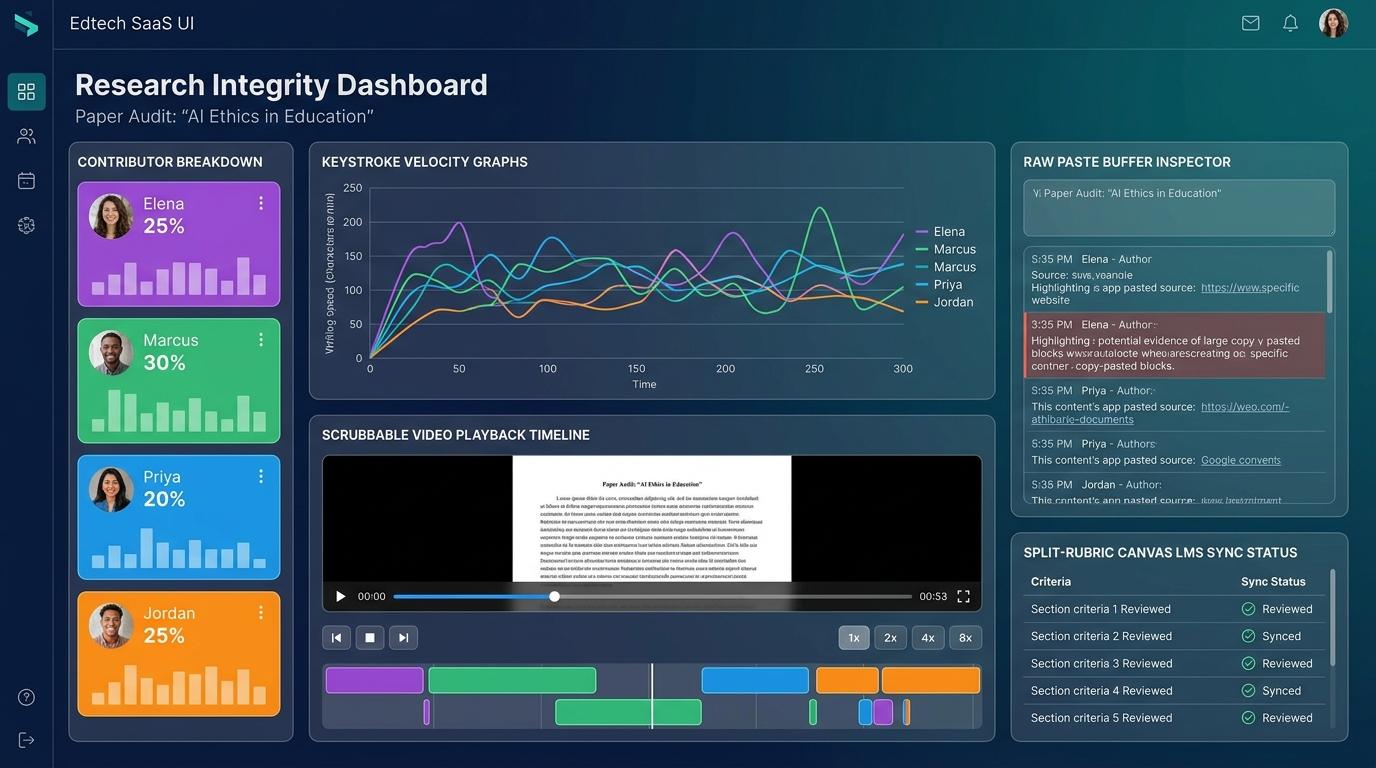
Checkmark Plagiarism resolves this crisis through its Multi-Author Research Audit Suite. By integrating Multi-Contributor Color-Coded Attribution, patent-pending Multi-Author Essay Playback™ (1x–8x scrubbable chronological video replay), an External Paste Buffer Inspector with Contributor Metadata, Passage-Level AI Confidence Sliders with honest short-text guardrails (<150w N/A), Synchronized Dual-Pane Source Matching, and Teacher-in-the-Loop AI Autograding with Split-Rubric LMS Passback (Canvas SpeedGrader, Buzz LMS, and Google Classroom), faculty can isolate individual contributions with courtroom-level evidentiary precision while preserving the collaborative spirit of group research.
Checkmark Plagiarism equips university faculty, department chairs, and capstone coordinators with comprehensive writing process forensics—seamlessly integrating writing telemetry replay, passage-level AI analysis, multidimensional plagiarism verification, and split-rubric autograding across higher education and secondary learning environments.
1. The Multi-Author Research Dilemma: Navigating Group Synthesis, Individual Accountability, and the Collective Punishment Fallacy
Collaborative research is foundational to 21st-century academic and professional training. Across undergraduate engineering capstones, MBA strategy projects, senior humanities theses, AP Capstone seminars (such as the AP Seminar Team Multimedia Project and Individual Research Report), and health sciences literature reviews, multi-author assignments mirror the interdisciplinary team dynamics of real-world research laboratories, corporate task forces, and clinical trial groups.
Working in teams of 3 to 6 students on long-form papers spanning 3,000 to 8,000+ words, students learn to negotiate conceptual frameworks, divide complex analytical workloads, synthesize divergent perspectives, and unify multiple distinct voices into an authoritative, cohesive manuscript.
- Assigns group-wide zero or blanket grade dock.
- Traumatizes diligent, honest researchers who wrote authentic sections.
- Destroys psychological safety, cohort morale, and institutional trust.
- Violates constitutional due process (Goss v. Lopez) and grade appeal standards.
- Faculty ignores flag due to lack of individual proof.
- Rogue student's academic fraud succeeds without consequence.
- Diligent peers become cynical and deeply resentful of free-riding.
- Institutional academic rigor and professional accreditation degrade.
However, the collaborative nature of these projects introduces an acute evaluation and integrity vulnerability. When multiple authors draft asynchronously across shared cloud documents, the boundary between collective synthesis and individual accountability blurs. Faculty are routinely confronted with submissions containing suspicious passages, uncredited source text, or generative AI markers, without any obvious mechanism to determine which student bears responsibility.
The Collective Punishment Fallacy in Academic Integrity
When a collaborative research paper returns an alarming similarity match or high AI probability, faculty and academic integrity committees frequently succumb to the Collective Punishment Fallacy—the assumption that because the final manuscript is submitted as a joint product, all co-authors bear equal moral, academic, and disciplinary liability for any integrity violation embedded within it.
This approach fails on multiple pedagogical, ethical, and legal grounds:
1. Destruction of Psychological Safety and Collaborative Trust
When honest students who invested dozens of hours conducting primary literature searches, drafting rigorous methodology sections, and refining prose are penalized because a peer took an illicit shortcut at 2:00 AM on deadline day, their trust in the educational institution is shattered. Rather than learning the value of collaboration, students learn that group projects are dangerous traps where their academic standing is held hostage to the lowest ethical denominator of their peers.
2. Constitutional Due Process and Legal Vulnerabilities (Goss v. Lopez)
In public higher education institutions and K-12 school districts across the United States, students possess constitutionally protected property and liberty interests in their education, academic standing, and disciplinary records under the Fourteenth Amendment. Under the landmark U.S. Supreme Court precedent Goss v. Lopez (419 U.S. 565), educational institutions are legally required to provide procedural due process before imposing serious disciplinary sanctions or academic penalties.
Issuing a group-wide zero, suspension, or transcript notation for plagiarism without establishing individual culpability through defensible, verifiable evidence constitutes arbitrary and capricious administrative action, exposing departments and universities to successful grade grievances, ombudsman appeals, and administrative litigation.
3. Institutional Policy and Private University Grievance Standards
Even in private colleges and universities where constitutional due process does not directly apply in the same statutory manner, standard academic grievance policies, faculty handbooks, and accreditation standards require that disciplinary findings be supported by a “preponderance of the evidence” or “clear and convincing evidence.” A monolithic 40% similarity report on an 8,000-word group document fails to satisfy even the lowest evidentiary standard against an individual student unless the specific offending text can be forensically attributed to that student's individual actions.
The Camouflage Vulnerability: Free-Riders and Rogue Contributors
The inverse failure mode is equally catastrophic: Unchecked Impunity. Because conscientious faculty are understandably loath to punish innocent students without definitive proof, they frequently feel forced to dismiss aggregate integrity flags altogether, assigning a passing grade to the entire group.
This creates the classic Camouflage Vulnerability:
- The Rogue Contributor: An unmotivated or overwhelmed student realizes that a collaborative document provides the ultimate camouflage. By dropping 1,500 words of unedited ChatGPT output or uncredited text copied from a gated journal into Section 4 (Data Analysis), the rogue contributor assumes that the diligent work of their teammates will dilute the overall similarity percentage or that faculty will be unable to untangle the authorship.
- The Free-Rider (“Academic Parasitism”): A group member contributes almost zero original prose, adding only a few cosmetic commas or formatting tweaks, yet claims an equal share of the co-authored manuscript's high grade.
- The Disillusioned Team: Diligent group members, aware that their peer contributed plagiarized material or contributed virtually nothing, feel powerless to speak out for fear of derailing their own grades or inviting social retaliation within their cohort.
Comprehensive Matrix: Traditional Evaluation vs. Legacy Plagiarism Tools vs. Checkmark Telemetry Audit
| Evaluative Dimension | Traditional Group Grading (No Tools) | Legacy Plagiarism Engines (Monolithic Scans) | Standard Google Docs Revision History | Checkmark Multi-Author Telemetry Suite |
|---|---|---|---|---|
| Individual Text Attribution | Completely invisible; relies on student self-reporting | Non-existent; treats entire 8,000w document as a single author | Coarse character counts per account; easily manipulated | 100% Character-Level Tagging: Every word, phrase, and citation mapped to verified student LTI ID |
| Temporal Drafting Process | Invisible; only final draft is assessed | Invisible; flat static post-submission scan | Snapshot-based; skips micro-revisions and editing dynamics | Patent-Pending Essay Playback™: 1x–8x scrubbable video replay of collaborative drafting |
| External Clipboard Tracking | None | None; only scans static resulting text | Shows text insertion but cannot prove external source or clipboard origin | Paste Buffer Inspector: Preserves 100% of clipboard text, timestamp, and author metadata |
| AI Generation Analysis | Subjective teacher intuition | Monolithic document percentage (e.g., “65% AI”) with high false positive risk | None | Passage-Level Sliders: Calibrated confidence per author span with <150w honest N/A guardrails |
| Source Matching & Citation Audit | Manual Google search verification | Side-by-side matches but unattributed to specific group contributor | None | Dual-Pane Contributor Matching: Live web/journal matches linked directly to author evidence cards |
| Grading & LMS Passback | Manual spreadsheet calculations | Static PDF report attached to submission | Manual LMS rubric entry | Split-Rubric Autograding: Direct sync of group & individual sub-scores to Canvas/Buzz/Google Classroom |
| Evidentiary Due Process | Indefensible under appeal | Highly vulnerable; penalizes innocent co-authors | Ambiguous; vulnerable to “offline drafting” claims | Defensible Forensic Dossier: Exportable timeline, paste logs, and keystroke replay proofs |
2. The Failure of Legacy Plagiarism Tools & Monolithic Similarity Reports in Collaborative Writing
To understand why collaborative research requires a paradigm shift in academic integrity technology, faculty must deconstruct the four fundamental structural failures of legacy plagiarism checkers and black-box AI detection tools when applied to multi-author documents.
[ Section 1: Intro ] [ Section 2: Lit Review ] [ Section 3: Methods ] [ Section 4: Results ]
↓ Ingests as Flat Continuous String ↓
OVERALL SIMILARITY SCORE: 34% (Matches across 14 sources)
Author A: 38% • Author B: 34% • Author C: 26% • Author D: 2%
Chronological keystroke replay filtered per contributor
Timestamp, student user ID, source URL, full copied string
Author-mapped linguistic metrics with <150w honest guardrails
Failure 1: Aggregate Ambiguity and the Absence of Contributor Lineage
Legacy plagiarism detection systems (e.g., traditional Turnitin similarity engines, Unicheck, or generic web scanners) were engineered during the late 1990s and early 2000s for a single-author, single-document paradigm. When an 8,000-word multi-author manuscript is uploaded, the legacy engine flattens the entire document into a single continuous text string, comparing n-gram sequences against web repositories and academic databases.
The resulting output is an aggregate score—for example, “34% Similarity”. The report highlights matching strings throughout the paper, but offers zero metadata regarding:
- Who typed or pasted the specific matching phrase.
- When in the drafting lifecycle the text was introduced (e.g., early exploratory literature gathering vs. desperate final-hour drafting).
- How the text entered the document (e.g., manual typing from an open notebook, direct block-paste from a browser, or speech-to-text dictation).
Without contributor lineage, faculty cannot determine whether Author A committed 34% plagiarism while Authors B, C, and D maintained impeccable source integrity, or whether all four authors committed minor citation formatting errors distributed evenly across the text.
Failure 2: Citation Camouflage and Patchwriting Masking
In multi-author research papers, individual contributors exhibit radically different research hygiene, citation fluency, and disciplinary writing maturity.
A high-performing undergraduate researcher (Author A) may construct an exhaustive, perfectly formatted APA/IEEE bibliography with 45 peer-reviewed citations, integrating rigorous block quotes and analytical synthesis. Simultaneously, a struggling team member (Author C) assigned to write the background section may engage in heavy patchwriting—copying paragraphs from secondary reviews, swapping three or four synonyms per sentence using an online thesaurus or QuillBot, and omitting quotation marks.
In a legacy report, Author A's extensive and legitimate citations artificially inflate the document's baseline similarity score, while Author C's patchwritten text blends seamlessly into the overall background noise. Faculty reviewing an aggregate report are unable to differentiate between Author A's legitimate direct quotations and Author C's unauthorized textual appropriation.
Failure 3: The Forensic Deficit of Standard Google Docs / Word Revision Histories
When faculty suspect misconduct in a collaborative document, their first instinct is typically to open the Google Docs Version History or Microsoft Word Track Changes. While helpful for general project management, native word processor revision histories are fundamentally unsuited for forensic integrity audits:
- Snapshot Coarseness: Native version histories do not capture real-time drafting. Instead, they bundle hundreds of edits made over several minutes or hours into arbitrary, coarse snapshots. If Student B types three sentences and Student C simultaneously pastes 500 words during the same 15-minute window, Google Docs often lumps both actions into a single aggregated version entry.
- Account Borrowing & Delegation Ambiguity: If Student A pastes text while logged into Student B's laptop during a group library session, Google Docs tags the edit to Student B's account. Without keystroke velocity, continuous typing cadence analysis, and session telemetry, faculty cannot verify physical authorship.
- No Clipboard Text Preservation: If a student pastes 1,000 words from ChatGPT or a gated PDF into a Google Doc, realizes 10 minutes later that the paste looks suspicious, and systematically rewrites every third word to disguise the source, Google Docs only displays the current state of the text in the latest version. The original, raw clipboard content that entered the document is lost forever.
Failure 4: The Co-Editing Synthesis Conundrum
Authentic collaborative writing is not merely a collection of isolated silos stitched together at the end. In high-functioning student teams, authors actively co-edit one another's work: Author A drafts the introduction, Author B reorganizes the paragraphs to improve logical flow, and Author C polishes the prose for conciseness and academic tone.
Legacy plagiarism and AI detection tools completely misinterpret this collaborative synthesis:
- If Author B heavily edits Author C's poorly structured draft, a legacy tool might flag Author B as the author of the entire passage, falsely attributing any plagiarism or AI artifacts within that section to Author B.
- If Author C runs Author A's authentic draft through an AI paraphraser (e.g., Undetectable AI or QuillBot) to “improve the flow,” a legacy detector flags the whole section as AI-generated, leaving faculty unable to determine who originally wrote the ideas versus who introduced the generative AI transformation.
3. Per-Author Telemetry & Attribution Architecture: Checkmark's Multi-Author Research Audit Suite
Checkmark Plagiarism solves the collaborative group writing dilemma by moving beyond static document analysis to capture continuous, granular Writing Process Telemetry. By recording and analyzing the complete temporal mechanics of how a multi-author document is constructed from the first blank page to final submission, Checkmark provides faculty with indisputable, author-isolated evidence.
1. Multi-Contributor Color-Coded Attribution Engine
Checkmark's attribution engine maps every character, word, sentence, and paragraph in a collaborative document directly to the authenticated student user ID who entered it.
Dynamic Contributor Metrics Dashboard
When faculty open a multi-author submission in Checkmark, the sidebar immediately presents a Contributor Breakdown Matrix:
- Volume Contribution: Absolute word count and percentage of total document volume per author.
- Active Drafting Time: Total active composition time (excluding idle background time) spent typing, revising, and organizing within the document.
- Typing Cadence (Net WPM): Natural typing speed calculated during active composition bursts.
- Revision Intensity: Total deletions, backspaces, and structural reorganizations executed by each author.
- Paste Frequency & Volume: Total number of external clipboard paste events and cumulative pasted word count per contributor.
| Student Name | Net Words | % Total | Active Time | Avg WPM | Backspaces | Paste Events | Pasted Wds |
|---|---|---|---|---|---|---|---|
| ● Elena Rostova (Author A) | 2,450 w | 38.2% | 8h 42m | 38 WPM | 1,842 | 4 (Citations) | 112 w |
| ● Marcus Vance (Author B) | 2,180 w | 34.0% | 7h 15m | 42 WPM | 1,420 | 6 (Quotes) | 185 w |
| ● Priya Sharma (Author C) | 1,680 w | 26.2% | 6h 10m | 35 WPM | 980 | 3 (Data tables) | 94 w |
| ● Jordan Hayes (Author D) | 105 w | 1.6% | 0h 14m | 110 WPM | 12 | 2 (Bulk text) | 1,240 w |
| TOTAL / GROUP SUMMARY | 6,415 w | 100.0% | 22h 21m | 39 WPM | 4,254 | 15 Events | 1,631 w |
2. Patent-Pending Essay Playback™ (1x–8x Scrubbable Chronological Video Replay)
Checkmark's flagship innovation is Essay Playback™, a patent-pending technology that reconstructs the entire collaborative writing process as an interactive, scrubbable video timeline.
Ctrl+V Injected 1,104 words in 0.00s.02:18:22 AM: Jordan makes 6 minor synonym swaps over 4 minutes, then closes session. Total active time: 14m.
- Global Group Timeline: Faculty can scrub through the complete multi-week evolution of the research paper at 1x, 2x, 4x, or 8x speed, watching how the group's thesis evolved, how sections were assembled, and how co-authors edited alongside one another.
- Author-Isolated Replay Filter: Faculty can click on any individual group member (e.g., “Filter by Jordan Hayes”) to isolate only that student's contributions. The playback timeline dims all other authors' edits and replays Jordan's specific writing sessions in chronological order.
- Visualizing Cognitive Composing Dynamics: Essay Playback makes authentic student thought visible. Faculty can see natural drafting pauses (where a student pauses for 15 seconds to formulate an argument), progressive sentence structuring, vocabulary experimentation, and iterative paragraph refinement. Conversely, illicit shortcuts (such as pasting large blocks of text or mechanical transcription) appear instantly as unnatural spikes in the drafting timeline.
3. External Paste Buffer Inspector with Author Metadata
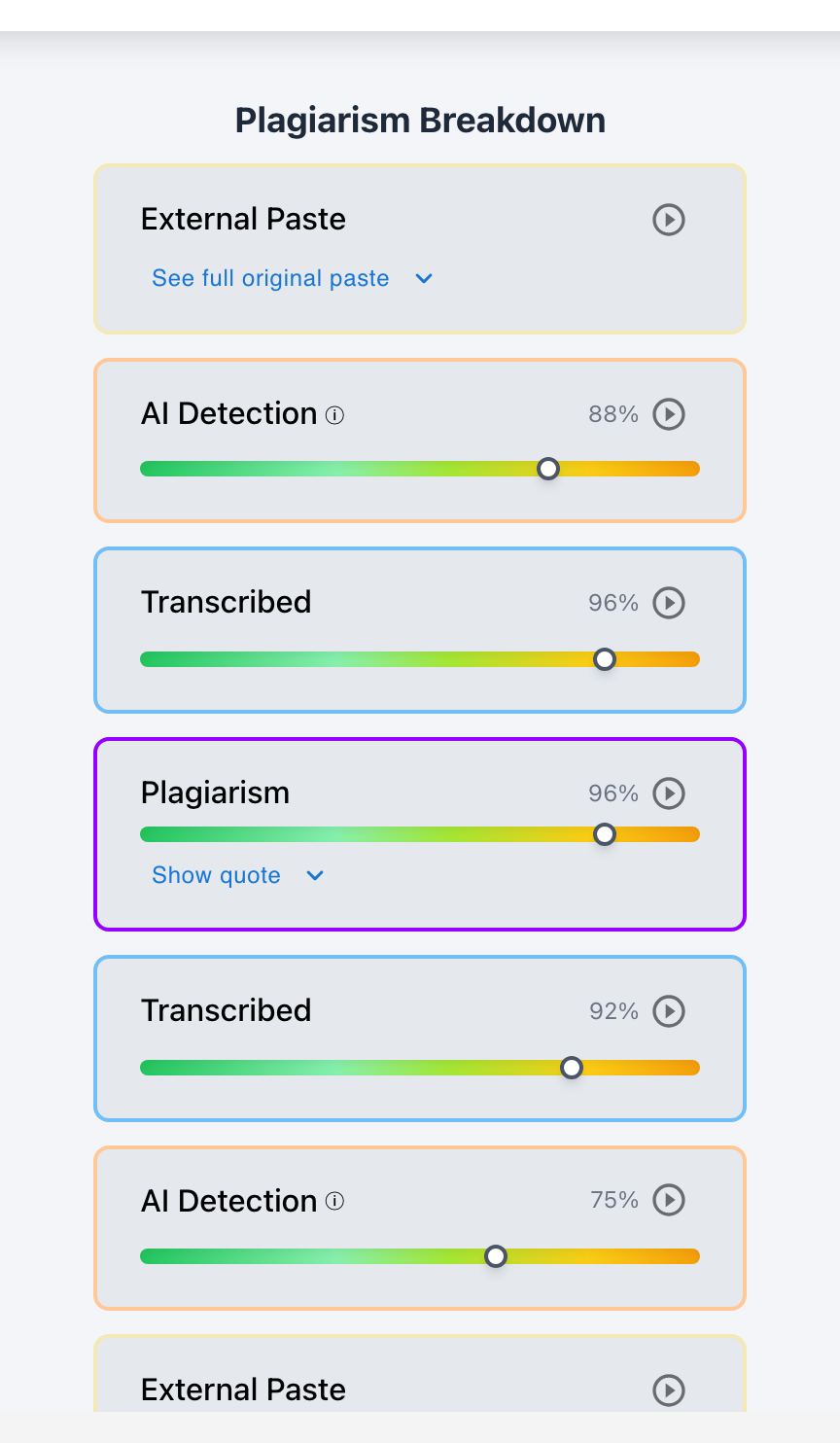
When a student copies text from an external application (a web browser, PDF reader, ChatGPT session, or local Word document) and pastes it into the Checkmark collaborative editor, the External Paste Buffer Inspector immediately captures and permanently archives the raw clipboard payload.

- Permanent Raw Payload Preservation: Checkmark archives 100% of the original pasted text, even if the student subsequently edits, paraphrases, or deletes words over the following days to conceal the paste.
- Contributor Metadata Tagging: Every paste event is permanently linked to the student's authenticated user ID, exact timestamp, cursor document position, and character count.
- One-Click “Jump to Playback”: Each paste entry in the sidebar features a direct anchor button. Clicking “Jump to Playback” scrubs the Essay Playback video directly to the exact millisecond of the paste event, allowing faculty to witness the surrounding document context.
4. Author-Mapped Passage-Level AI Confidence Sliders
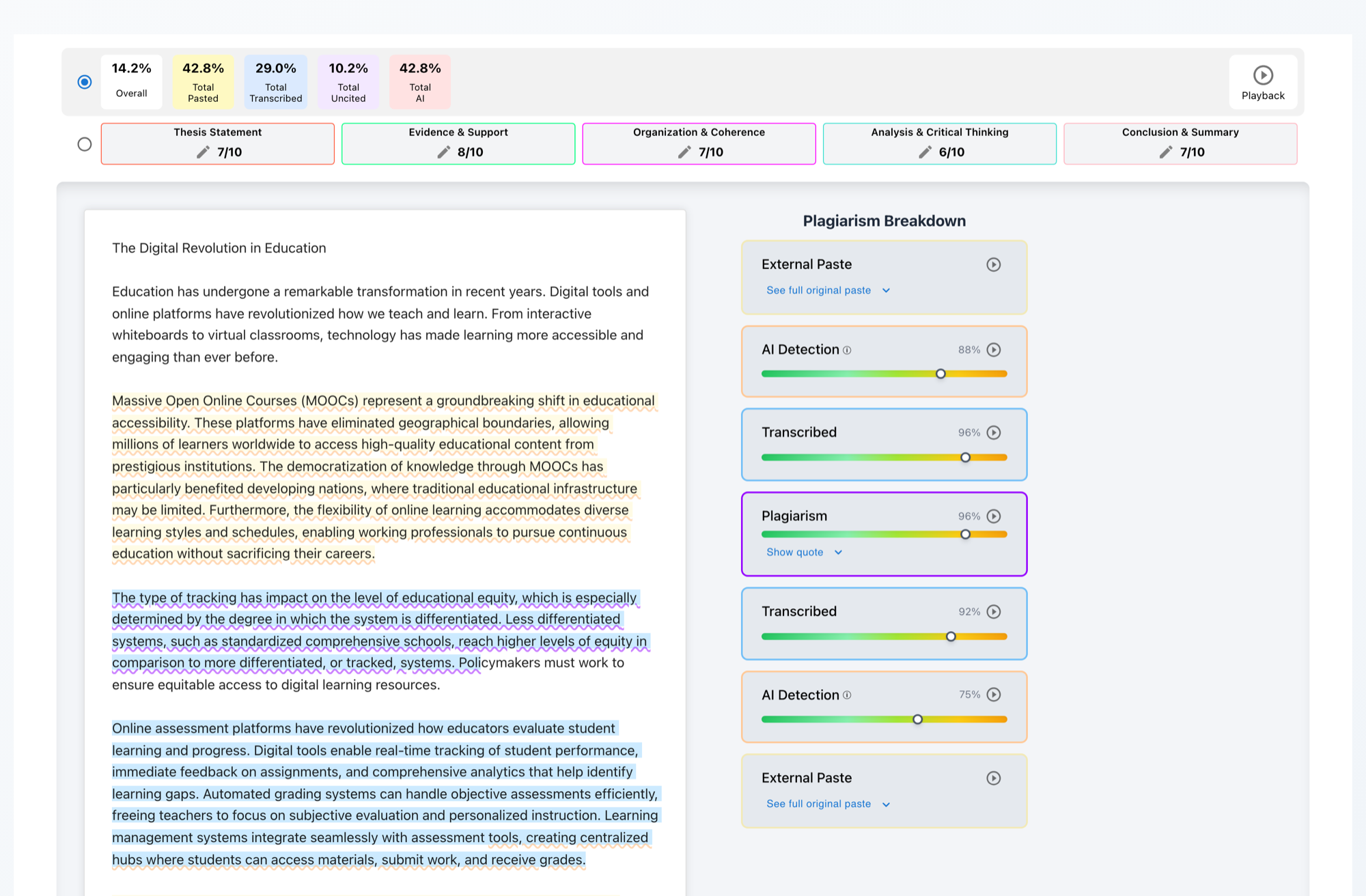
Unlike black-box AI detectors that generate a single, unhelpful whole-paper percentage, Checkmark analyzes text at the passage level, mapping linguistic predictability (perplexity) and sentence structure diversity (burstiness) directly to individual author spans.
- Calibrated Passage Sliders: Underlines specific suspicious sentences or paragraphs within the manuscript, displaying an evidence card in the sidebar with a calibrated confidence slider (Typical Human Writing Style vs. Typical AI Pattern).
- Short-Text Honest Guardrails: For passages under ~150 words (such as brief transition sentences, section subheadings, or short captions), Checkmark displays
N/Arather than guessing. This eliminates the false positives that plague legacy tools when analyzing short, structured academic phrases. - Immunity to AI Humanizers: While commercial “humanizer” tools (e.g., Undetectable AI, HideMyAI) alter surface vocabulary to evade static linguistic scanners, they cannot fake authentic temporal writing history. If a humanized passage was dumped into the document in a single 2-second paste without drafting keystrokes, Checkmark's telemetry exposes the shortcut immediately.
5. Synchronized Dual-Pane Source Matching
When Checkmark detects text matching billions of live web pages, open-access academic publications, or institutional student repositories, it presents the finding in a Synchronized Dual-Pane Viewer:
- Left Pane: The student's submitted research manuscript, highlighted and color-coded by the specific author who entered the matching text.
- Right Pane: The original source text with direct, clickable URLs, publication metadata, and exact matching phrases highlighted.
- Uncited vs. Formatted Citation Styling: Checkmark uses distinct visual styling to differentiate between uncredited source text (potential plagiarism requiring investigation) and properly formatted citations with minor punctuation flaws (formative citation coaching).

6. Teacher-in-the-Loop AI Autograder with Split Rubric Passback
Evaluating multi-author research papers requires grading both group-level collaborative outcomes (overall thesis coherence, inter-section synthesis, executive summary clarity) and individual-level mastery (methodological rigor, literature review depth, individual voice and prose quality).
Checkmark's Teacher-in-the-Loop AI Autograder streamlines this complex workflow:
- Custom & Synced Rubric Support: Instructors can import existing rubrics from Canvas LMS, Buzz LMS, or Google Classroom, or create multi-tier rubrics in Checkmark.
- Split-Criterion Drafting: Checkmark drafts initial point recommendations and quote-anchored written justifications for group criteria and individual author criteria simultaneously.
- Faculty Final Authority: All AI-suggested grades remain provisional drafts. Faculty can adjust scores, edit feedback comments, or override recommendations with complete pedagogical autonomy.
- Direct LMS Grade Passback: With a single click, Checkmark pushes individualized scores, group grades, and detailed rubric feedback straight into Canvas SpeedGrader, Buzz LMS, or Google Classroom.

4. Real-World Institutional Case Studies
The following three case studies illustrate how Checkmark's Multi-Author Research Audit Suite enables faculty, department chairs, and capstone coordinators to resolve complex collaborative integrity challenges across diverse academic disciplines.
Legacy scan flagged 28% similarity. Paste Buffer Inspector isolated a 1,104w IEEE block paste by Student C at 2:14 AM. Students A, B & D exonerated and granted a 72-hour grace period to re-author.
Legacy tool flagged “54% AI Generated.” Keystroke telemetry proved Student 3 mechanically retyped ChatGPT text from a phone (0 deletions, 78 WPM flat). Restorative rewrite completed.
Uncited paywalled whitepaper + hallucinated AI citations in Financials. Telemetry proved Author B pasted whitepaper; Author E disengaged (140w). Canvas SpeedGrader split-rubric passback applied.
Case Study 1: Undergraduate Engineering Capstone — The Rogue Algorithm Paste
Institutional Context
At a major public research university, four senior Mechanical and Aerospace Engineering students (Liam, Sophia, Tariq, and David) submitted their 6,500-word Senior Capstone Design Report: “Autonomous Obstacle Avoidance and Sensor Fusion in GPS-Denied Urban Environments.” The project represented 40% of their final course grade and was a prerequisite for ABET-accredited graduation.
The Integrity Incident
Upon final PDF submission through the university's LMS, the institution's legacy similarity tool returned a 28% Overall Similarity Index. Highlighting concentrated heavily in Section 3.2 (Extended Kalman Filter Optimization for LiDAR-Inertial Odometry), matching an IEEE Robotics and Automation Letters conference preprint published four months earlier.
Under the engineering department's legacy policy, a similarity score exceeding 20% on a capstone project triggered an automatic group-wide referral to the Academic Misconduct Committee, which would have delayed graduation for all four seniors.
The Forensic Telemetry Audit
The capstone course coordinator opened the submission in Checkmark Plagiarism and initiated a Multi-Author Research Audit:
- Contributor Breakdown Analysis: The dashboard revealed that Liam (33%), Sophia (30%), and David (17%) had spent a combined 27 hours of active drafting in the shared editor, recording over 3,400 backspaces and revisions. In stark contrast, Tariq (20% volume) recorded only 22 minutes of total active drafting time.
- External Paste Buffer Inspection: The coordinator opened the Paste Buffer Inspector filtered by Tariq's user ID. At 2:14 AM on May 2 (six hours before the morning deadline), Tariq executed a single block paste of 1,104 words directly into Section 3.2. Checkmark's raw buffer log preserved the entire unedited text, matching the IEEE preprint verbatim.
- Essay Playback™ Verification: Scrubbing through Tariq's isolated playback timeline at 4x speed, the coordinator observed that after pasting the 1,104-word block, Tariq spent four minutes making six minor cosmetic edits (changing “utilizes” to “employs” and adjusting two variable names) before closing the document.
- Exoneration of Co-Authors: Reviewing the playback sessions for Liam, Sophia, and David proved that none of the other three students touched Section 3.2 during or after Tariq's paste event. Their respective sections (Chassis Design, Hardware-in-the-Loop Simulation, and Battery Management) exhibited authentic, organic drafting dynamics.
Pedagogical and Institutional Resolution
- Individualized Due Process: The department initiated a formal academic integrity hearing exclusively for Tariq. Confronted with the timestamped paste buffer logs and the Essay Playback recording during an initial conference, Tariq admitted that he had fallen behind due to job interview travel and panicked.
- Protection of Innocent Co-Authors: Liam, Sophia, and David were fully exonerated. Rather than failing the capstone, the group was granted a 72-hour grace window to remove Tariq's plagiarized section and collaboratively re-author Section 3.2 from scratch.
- Grade Passback: Following successful re-authoring, the instructor used Checkmark's AI Autograder to evaluate the final technical report, passing split individual grades (A for Liam, Sophia, and David; Incomplete/Disciplinary Pending for Tariq) directly into Canvas SpeedGrader.
Case Study 2: AP Seminar Team Multimedia Project & Research Report (IRR/TMP)
Institutional Context
In a suburban public high school, a team of three 11th-grade AP Seminar students (Chloe, Ethan, and Noah) submitted their 4,200-word collaborative Team Research Report (TRR) investigating the socioeconomic impacts of municipal urban heat island mitigation strategies. The TRR, alongside their Team Multimedia Presentation (TMP), forms a crucial component of their AP Capstone portfolio scored under College Board rubrics.
The Integrity Incident
When the AP Seminar instructor ran the group's draft through the district's newly mandated commercial AI detection tool, the software flagged the entire manuscript with a monolithic “54% AI Generated” warning banner.
The instructor was deeply conflicted. Under College Board AP Capstone policy, submitting uncredited AI-generated prose on a Performance Task results in a score of zero for the entire task. However, Chloe and Ethan were known to be exceptionally dedicated students who had spent weeks in the school library analyzing municipal climate data.
The Forensic Telemetry Audit
- Author-Mapped Passage-Level AI Sliders: Checkmark's passage-level analysis revealed that Chloe's section (Urban Canopy Deficits in Low-Income Neighborhoods, 1,750 words) and Ethan's section (Public Health Outcomes and Heat Mortality, 1,550 words) registered negligible AI probabilities (4% and 7% confidence, both firmly in the “Typical Human Writing Style” range). However, Noah's 900-word section (Economic Cost-Benefit Analysis of Cool Roof Mandates) was flagged at 96% AI Confidence, exhibiting extreme syntactic uniformity and low perplexity.
- Keystroke Velocity and Transcription Analysis: When the teacher filtered Essay Playback by Noah's user ID, an alarming telemetry pattern emerged:
- Noah typed all 900 words in a single 18-minute sitting.
- His typing speed remained completely constant at exactly 78 WPM with almost zero standard deviation between keystrokes.
- Over the entire 900-word passage, Noah registered zero backspaces, zero deletions, and zero cognitive pauses exceeding 1,500 milliseconds.
- Forensic Diagnosis: This distinct keystroke pattern is the mathematical signature of Manual Transcription—where a student places a secondary device (such as a smartphone running ChatGPT) next to their keyboard and mechanically retypes the AI-generated text character-by-character to avoid triggering basic paste detection.
Pedagogical and Restorative Resolution
- Non-Confrontational Restorative Conference: The teacher scheduled an individual conference with Noah. Rather than making an accusatory statement, the teacher opened Essay Playback and shared the screen: “Noah, let's look at how your section was typed. Notice how Chloe and Ethan have hundreds of revisions and pauses where they wrestled with the ideas, while your section was typed steadily in 18 minutes with zero backspaces. Can you walk me through your composing process here?”
- Student Accountability: Seeing his own writing telemetry laid out objectively, Noah admitted that he had felt overwhelmed by the economic data and had used ChatGPT on his phone to draft the section, copying it down word-for-word.
- Remediation & Team Protection: The teacher guided Noah through an after-school research workshop where he learned to locate primary economic studies from the municipal comptroller's office. Noah re-authored his section authentically over three days under teacher supervision. The team's collective AP Capstone submission was preserved, safeguarding Chloe and Ethan from an unfair group penalty.
Case Study 3: College MBA Marketing Strategy Plan — Distinguishing Free-Riding from Rogue Outsourcing
Institutional Context
In a top-ranked Master of Business Administration (MBA) program, five graduate candidates (Amanda, Brian, Carlos, Danielle, and Evan) collaborated on an 8,000-word comprehensive Market Entry Plan for an electric vehicle charging infrastructure startup. The project required integrating market analysis, supply chain logistics, regulatory compliance, and a detailed 5-year pro-forma financial forecast.
The Integrity Incident
The marketing professor reviewed the final submission. While the overall Turnitin similarity index appeared manageable at 19%, a manual inspection of Section 4 (Financial Projections & Sensitivity Modeling) revealed two major integrity red flags:
- Three paragraphs of market sizing narrative matched an uncredited, proprietary Goldman Sachs CleanTech Equity Research report published behind a paywall.
- The footnotes contained four citations to academic financial journals that did not exist—classic generative AI hallucinations.
During an initial informal inquiry, team members pointed fingers at one another. Evan claimed he was responsible for financial modeling, while Brian claimed he had assisted with the narrative text.
The Forensic Telemetry Audit
- Deconstructing Section 4 Authorship: Filtering by character-level attribution, Checkmark proved that Brian (Author B) had authored 92% of the text in Section 4. Evan (Author E), who claimed to be the lead financial analyst, had authored exactly 140 words consisting entirely of table headers and two bullet points.
- Paste Buffer Inspector Receipts: Checkmark's paste logs captured Brian pasting 950 words of the Goldman Sachs whitepaper at 11:45 PM. Two hours later, Brian pasted three successive blocks of text from Claude 3.5 Sonnet containing the hallucinated journal citations.
- Exonerating the Core Team: Amanda, Carlos, and Danielle were completely cleared of any wrongdoing. Their telemetry showed rigorous, multi-session composition spanning 27 combined hours with detailed primary source citations from government regulatory filings and industry databases.
Pedagogical and Administrative Resolution
- Differentiated Accountability via Split Rubric: The professor avoided the collective punishment trap by utilizing Checkmark's split-rubric autograding system:
- Group-Wide Score (40% weight): The team received 38/40 points for overall strategic cohesion, executive summary clarity, and market viability.
- Individual Section Scores (60% weight):
- Amanda, Carlos, and Danielle received 58/60 points for exceptional section mastery, earning final course grades of 96% (A).
- Brian was referred to the Graduate Honor Board for uncredited source appropriation and AI fabrication, receiving 0/60 on his individual component.
- Evan was penalized for severe academic non-contribution and free-riding, receiving 12/60 on individual effort, resulting in a failing grade for the assignment with mandatory remediation.
- Canvas LMS Passback: The professor pushed all five individualized score sets directly into the Canvas Gradebook with attached forensic evidence cards, providing complete institutional defense against potential grade disputes.
5. The 4-Phase Multi-Author Audit & Calibration Protocol for Faculty
To implement a transparent, defensible, and pedagogically sound collaborative writing audit process, faculty, department chairs, and academic integrity officers should follow this standardized 4-Phase Multi-Author Audit & Calibration Protocol.
Distribute the Collaborative Research Attribution Matrix & Group Charter. Establish explicit syllabus boundaries for authorized vs. prohibited AI use. Mandate that all drafting occurs inside the Checkmark-enabled collaborative LMS editor.
Review dynamic Contributor Breakdown Dashboard (volume, active time, paste counts). Scan author-mapped passage AI confidence sliders and dual-pane plagiarism matches. Identify anomalous contributor profiles (e.g., high volume + low active time + zero revisions).
Filter Essay Playback™ by flagged contributor user ID. Inspect External Paste Buffer logs to examine raw clipboard payloads and timestamps. Cross-reference suspicious typing velocity spikes against mechanical transcription baselines.
Conduct private, evidence-based student conference using Playback screen share. Apply split-rubric grading (protect honest co-authors; isolate penalties for rogue contributor). Execute 1-click grade and feedback passback to Canvas SpeedGrader, Buzz LMS, or Google Classroom.
Phase 1: Pre-Submission Framework & Attribution Contracting
Proactive pedagogical structuring prevents the majority of collaborative integrity breakdowns before the first sentence is typed:
- Mandate the Collaborative Attribution Matrix: Require student groups to submit an initial Attribution Matrix & Project Charter during Week 1 of the assignment. This matrix explicitly defines which team member is primary lead for each section, who is responsible for literature synthesis, and who serves as peer review editor.
- Define Clear AI Boundary Policies: Establish explicit, written guidelines in the syllabus detailing authorized vs. unauthorized AI use:
- Authorized: Using generative AI for initial brainstorming of broad research questions or generating search strings for library databases (must be disclosed in an appendix).
- Unauthorized: Using generative AI to draft sentences, synthesize source articles, paraphrase text, or generate bibliography entries.
- Enforce Single-Ecosystem Drafting Hygiene: Mandate that all brainstorming, outline development, drafting, and revisions occur inside the Checkmark-enabled collaborative environment (such as Checkmark embedded in Canvas, Buzz LMS, or Google Docs). Forbid external “offline drafting” where members email raw Word files back and forth, as this destroys real-time keystroke telemetry.
Phase 2: Post-Submission Automated Telemetry Triage
Upon final manuscript submission, faculty should conduct an initial 3-minute telemetry triage:
- Inspect the Contributor Metrics Matrix: Check for extreme imbalances in volume and active drafting time. Red flags include:
- A student contributing >25% of total document volume in <30 minutes of active time.
- A student contributing <5% of total volume on an equal-weight group assignment (free-riding).
- Average typing velocity exceeding 85 WPM with zero recorded backspaces.
- Review Passage-Level AI & Plagiarism Flags: Scan the sidebar for highlighted passages. Note whether flags are concentrated within a single author's color-coded section or distributed across multiple contributors.
- Verify Short-Text Guardrails: Ensure that any flagged passages meet the minimum length threshold (~150 words). If Checkmark displays
N/A, disregard brief technical phrases as standard disciplinary vocabulary.
Phase 3: Forensic Isolation & Deep Playback Inspection
If Phase 2 reveals significant anomalies in a specific section, faculty initiate a targeted forensic review:
- Apply Author-Isolated Replay Filters: In Checkmark Essay Playback, select the specific flagged contributor. Scrub the timeline at 4x speed to observe their drafting behavior:
- Authentic Drafting Indicators: Uneven typing bursts, frequent cursor repositioning, regular backspaces/deletions, composing pauses >2,000ms at sentence and paragraph boundaries.
- Illicit Shortcut Indicators: Instant block paste dumps, or mechanical, unbroken typing with flat inter-key latency and zero deletions.
- Examine the External Paste Buffer Log: Open the Paste Buffer Inspector. Review the full text of all clipboard insertions attributed to the flagged author. Determine whether pasted text consists of:
- Legitimate direct quotes, raw data points, or bibliographic citations.
- Uncited source text copied directly from web pages or academic PDFs.
- Pre-generated AI text dumped from an external browser session.
- Cross-Reference Dual-Pane Source Proof: For uncredited source text, click the match to open the Dual-Pane Viewer. Review side-by-side matching phrases, publication dates, and source URLs to verify whether the student committed deliberate plagiarism or careless citation formatting.
Phase 4: Restorative Adjudication, Split Rubric Scoring & LMS Passback
The final phase ensures that academic integrity standards are enforced with procedural fairness and restorative pedagogical goals:
- Conduct a Supportive, Evidence-Based Student Conference: Never accuse the student outright or email punitive notices without a meeting. Invite the flagged student to a private conference (in person or via Zoom). Open Checkmark Essay Playback, share the screen, and ask open-ended, non-confrontational questions anchored in the objective telemetry.
- Isolate Penalties & Exonerate Honest Co-Authors: Under no circumstances should faculty apply a collective grade reduction across the entire team. Honest group members must receive full credit for their authentically authored sections. If the rogue contributor's actions left a critical section incomplete or compromised, grant the honest team members a structured 48- to 72-hour grace period to re-author the missing section.
- Execute Split-Rubric Scoring & Grade Passback: Using Checkmark's AI Autograder, adjust rubric points to reflect group-level vs. individual performance. Click “Publish to LMS” to instantly sync finalized scores, individual rubric breakdowns, and evidence-anchored feedback into Canvas SpeedGrader, Buzz LMS, or Google Classroom.
6. Institutional Policy, Pedagogical Frameworks & Implementation Artifacts
To assist higher education faculty, high school department chairs, and academic integrity officers in deploying these workflows, the following four institutional artifacts provide ready-to-use policy templates, audit worksheets, dialogue scripts, and compliance specifications.
Artifact 1: Collaborative Research Attribution Matrix & Group Writing Contract Template
ENGR-490 / CAPSTONEFall 2026October 4, 2026| Student Name | Student LTI ID | Primary Section Responsibility | Secondary Review Lead |
|---|---|---|---|
| Author 1: Elena Rostova | #90142 | Section 1 (Intro) & Section 2 (Literature Review) | Section 3 (Methods Review) |
| Author 2: Marcus Vance | #90188 | Section 3 (Chassis Design & Sensor Architecture) | Section 4 (Data Review) |
| Author 3: Priya Sharma | #90215 | Section 4 (Hardware-in-the-Loop Simulation) | Section 1 (Intro Review) |
| Author 4: Jordan Hayes | #90412 | Section 3.2 (Sensor Fusion & EKF Algorithms) | Section 2 (Lit Review) |
- Single Platform Composition: All brainstorming, outlining, drafting, and revisions must be conducted directly within the designated Checkmark-enabled collaborative LMS editor. No external offline drafting or unmonitored file sharing is permitted.
- Individual Authorship Accountability: Each student is personally responsible for the academic integrity, source citations, and original prose of their assigned sections.
- Generative AI Policy Compliance: Generative AI tools (ChatGPT, Claude, Gemini, etc.) may NOT be used to draft, rewrite, or paraphrase text. Any authorized AI use (e.g., literature search keywords) must be fully documented in Appendix A.
- Clipboard & Citation Transparency: Any text pasted from external sources must represent a legitimate direct quotation enclosed in quotation marks with an immediate in-text citation.
Artifact 2: Faculty Multi-Author Integrity Audit Worksheet
Artifact 3: Restorative Contributor Remediation Dialogue Scripts
“Thank you for meeting with me today, [Student Name]. I'm reviewing your group's capstone paper, and I want to look closely at Section 3.2 on sensor fusion. Checkmark gives us a complete Essay Playback view of how the paper was assembled over time. When we look at this timeline, we can see that on Tuesday at 2:14 AM, this 1,100-word block entered the document in a single paste event from an IEEE conference paper. Can you walk me through what was happening during your research session that evening?”
Pedagogical Goal: Anchors the conversation in indisputable, objective telemetry without using inflammatory language like “caught” or “cheated.” The student is invited to explain their decision-making, leading almost universally to an admission of deadline panic or poor note-taking hygiene.
“Hi [Student Name]. I was reviewing the drafting timeline for your AP Seminar Team Research Report. When I watch the Essay Playback for your section on economic incentives, I noticed something interesting. Your teammates Chloe and Ethan have hundreds of backspaces and long thinking pauses where they restructured sentences. In your section, you typed 900 words at a perfectly steady 78 words per minute without a single backspace, deletion, or pause over 18 minutes. That specific keystroke pattern usually occurs when someone is retyping text from a second screen or phone. Help me understand how you composed this draft.”
Pedagogical Goal: Focuses on the physical impossibility of composing complex analytical prose without cognitive friction or revisions, removing any room for denial while maintaining a supportive, coaching tone.
“Hello [Student Name]. As part of our collaborative project evaluation, I review the Contributor Breakdown telemetry for all project groups. On this 8,000-word business plan, the data shows that your teammates contributed between 1,900 and 2,400 words each across 8 to 10 hours of active drafting, while your total contributions over the 4-week project amounted to 140 words and 28 minutes of active time. Our course project charter requires an equitable division of labor. How would you describe your contribution to the final research synthesis?”
Pedagogical Goal: Establishes clear, quantitative accountability for non-contributing students, protecting honest peers from carrying unearned credit.
Artifact 4: FERPA, COPPA, and Zero-Data Retention Compliance Architecture
- Student research papers and keystroke telemetry are NEVER ingested to train public AI models.
- Strict contractual guarantees compliant with FERPA (34 CFR Part 99) and COPPA regulations.
- Student intellectual property remains 100% owned by the student and institution.
- All drafting telemetry, paste buffer strings, and playback logs encrypted at rest (AES-256).
- In-transit cryptographic protection via TLS 1.3 across all LMS LTI integrations.
- Role-Based Access Control (RBAC): Telemetry visible ONLY to authorized course instructors.
- Configurable institutional retention schedules (e.g., auto-purge 90 days after term end).
- Compliant with state student data privacy laws (NY Ed Law 2-D, CA AB 1584, IL SOPPA).
- Immediate data deletion upon verified institutional administrator request.
7. Frequently Asked Questions (7 Targeted FAQs)
1. What if two students legitimately co-edit the same paragraph or sentence? How does Checkmark attribute co-authored text?
Checkmark's telemetry engine tracks document composition at the granular character and millisecond level. If Student A drafts a 100-word paragraph and Student B subsequently reorganizes the syntax, replaces six words, and adds a concluding sentence, Checkmark accurately records the dual authorship. In the Contributor Attribution view, Student A is credited for the original 85 retained words, while Student B is credited for the 15 added words and the editorial revisions. When viewing Essay Playback, faculty can watch the chronological interaction: Student A typing the initial draft on Tuesday, followed by Student B editing the text on Thursday. This provides complete visibility into authentic peer synthesis without falsely penalizing the secondary editor.
2. How does Essay Playback handle students who draft in external offline programs (like Microsoft Word or Notepad) and paste their own original work into the shared doc?
When a student pastes a large block of text drafted externally, Checkmark's Paste Buffer Inspector captures the paste event and flags it for review. However, because Checkmark pairs paste buffer logs with Essay Playback and linguistic analysis, faculty can quickly verify authenticity:
- If the student legitimately drafted the text offline, they can easily provide their local Word document's native file creation timestamps, iterative save history, or personal notes during an informal conference.
- In the shared document, authentic pasted notes are typically followed by active in-document editing, formatting, citation integration, and sentence restructuring.
- In contrast, illicit AI paste events typically feature zero subsequent editing, high AI passage confidence, and hallucinated citations. To completely avoid paste inquiries, faculty should mandate that all drafting occur directly within the Checkmark collaborative environment from the project outset.
3. Can a student claim that a group member logged into their account or shared credentials to frame them for plagiarism?
Checkmark's telemetry captures deep behavioral keystroke dynamics, typing cadence, and session metadata. Every typing session logs IP addresses, browser session tokens, device user agents, and individual typing speed profiles (net WPM and inter-key latency variance). If a student claims their account was compromised:
- The telemetry will reveal whether the suspicious section was typed from the student's standard device/IP address or an anomalous foreign session.
- Furthermore, the typing cadence (e.g., a student who consistently types at 40 WPM suddenly exhibiting a 90 WPM burst) provides objective behavioral evidence to evaluate the claim. In practice, false framing claims are extraordinarily rare and easily disproven through session logs.
4. How does the Multi-Author Audit Suite integrate with Canvas SpeedGrader and Buzz LMS when group assignments require both a group grade and individual sub-scores?
Checkmark features deep LTI 1.3 integration engineered specifically for split-rubric group grading. When an instructor configures a group assignment in Canvas LMS or Buzz LMS:
- Checkmark syncs the course roster and group membership directly from the LMS.
- The AI Autograder allows instructors to assign group-level scores (applied uniformly to all team members) alongside individual-level criterion scores (derived from each student's specific section performance and drafting telemetry).
- With one click on “Publish to Gradebook,” Checkmark pushes the distinct individual composite grades, tailored rubric feedback comments, and attached evidence cards directly into each student's Canvas SpeedGrader or Buzz LMS gradebook record.
5. How does Checkmark differentiate between legitimate collaborative AI brainstorming (e.g., using AI for outlining) and illicit AI text generation in group papers?
Checkmark distinguishes between conceptual assistance and authorship fraud through its temporal telemetry and passage-level analysis:
- Legitimate Brainstorming: If a student uses an LLM to brainstorm broad topic ideas or outline structural headings, the student subsequently types their own original prose into the document. Essay Playback reveals natural keystroke dynamics, composing pauses, revisions, and high linguistic burstiness.
- Illicit AI Generation: If a student prompts an LLM to write an analytical section, the resulting text is either pasted directly in bulk (captured by the Paste Buffer Inspector) or mechanically transcribed (captured by continuous velocity telemetry with zero backspaces), while passage-level sliders register extreme syntactic uniformity and low perplexity.
6. What legal due process protections does keystroke telemetry provide faculty during formal grade appeals or academic integrity hearings?
Keystroke telemetry transforms disputed academic misconduct proceedings from subjective “he-said-she-said” debates into objective, evidence-based evaluations. Under Goss v. Lopez and university due process policies, students have the right to inspect the evidence against them. A Checkmark forensic dossier provides:
- Timestamped, millisecond-accurate video playback of the drafting session.
- Complete raw clipboard text preservation for all paste events.
- Quantitative typing velocity and backspace metrics.
- Side-by-side matching source proofs.
This immutable, transparent evidence satisfies the highest administrative legal standards (“preponderance of the evidence” and “clear and convincing evidence”), successfully protecting faculty and institutions during formal ombudsman reviews, grade grievance appeals, and litigation.
7. How does Checkmark ensure student privacy under FERPA when multiple students' drafting histories are audited simultaneously?
Checkmark complies strictly with the Family Educational Rights and Privacy Act (FERPA, 34 CFR Part 99) and state student privacy legislation. When faculty audit a collaborative document:
- Drafting telemetry and individual author logs are restricted strictly to authorized course instructors and institutional administrators via Role-Based Access Control (RBAC).
- Students within a group can see co-authored text in the shared editor, but private integrity flags, AI confidence sliders, and instructor grading notes remain educator-only views.
- Checkmark enforces a strict Zero Model Training Policy: student research manuscripts, telemetry data, and institutional records are never sold, shared with third parties, or ingested to train public artificial intelligence models.
Conclusion: Stop Guessing, Start Trusting Collaborative Research
Collaborative research papers are among the most powerful learning experiences in higher education and secondary capstone programs. They prepare students to solve complex, interdisciplinary problems in an increasingly connected world. However, maintaining the integrity and pedagogical value of group writing requires moving beyond blunt, punitive, black-box detection tools that penalize entire teams for the actions of a single contributor.
By pairing Multi-Contributor Color-Coded Attribution, patent-pending Essay Playback™, the External Paste Buffer Inspector, Author-Mapped Passage Sliders, and Split-Rubric LMS Passback, Checkmark Plagiarism provides faculty with the transparent, defensible evidence needed to uphold academic rigor, protect innocent students, and foster authentic collaboration.
Equip Your Faculty with Multi-Author Writing Telemetry
Eliminate the collective punishment dilemma in collaborative group research. Protect diligent students, isolate individual contributions, and sync split-rubric scores directly to Canvas SpeedGrader and Buzz LMS.