
Executive Summary
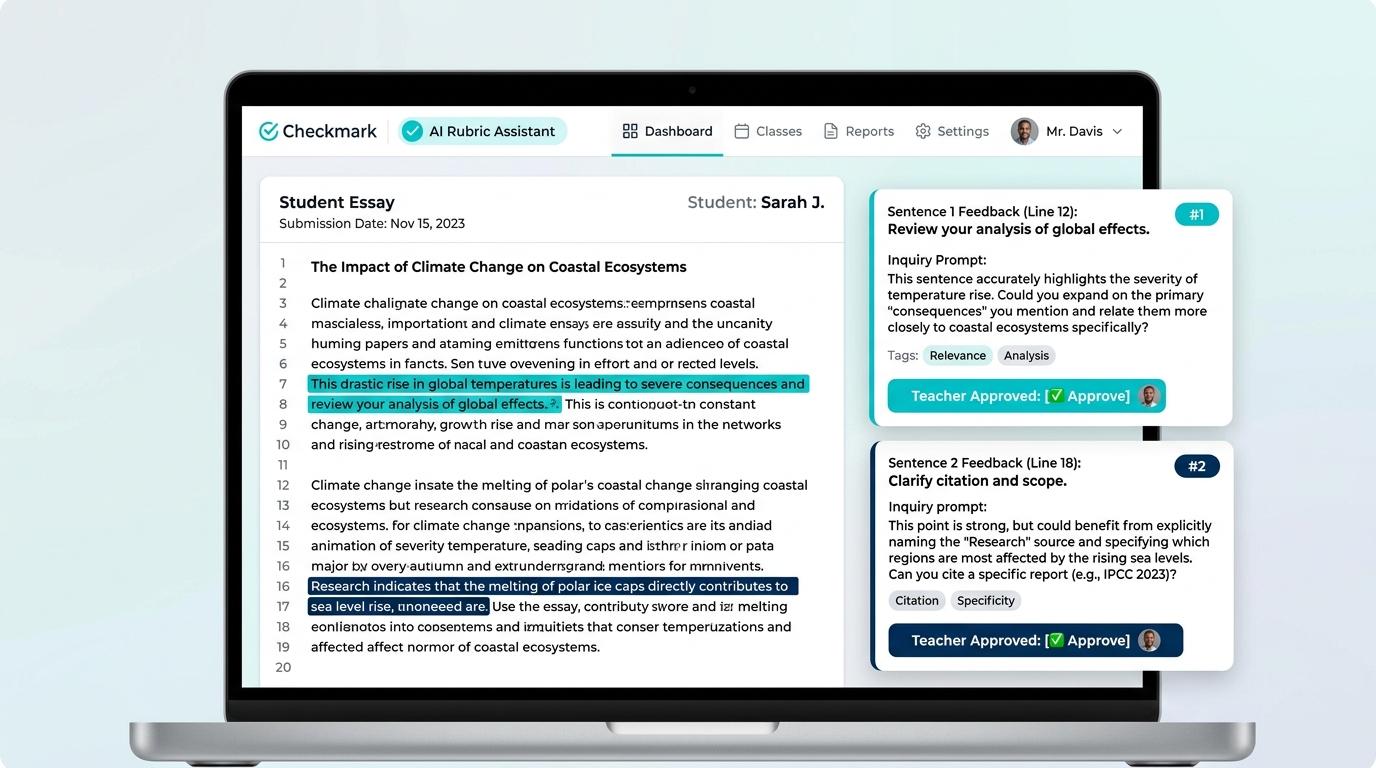
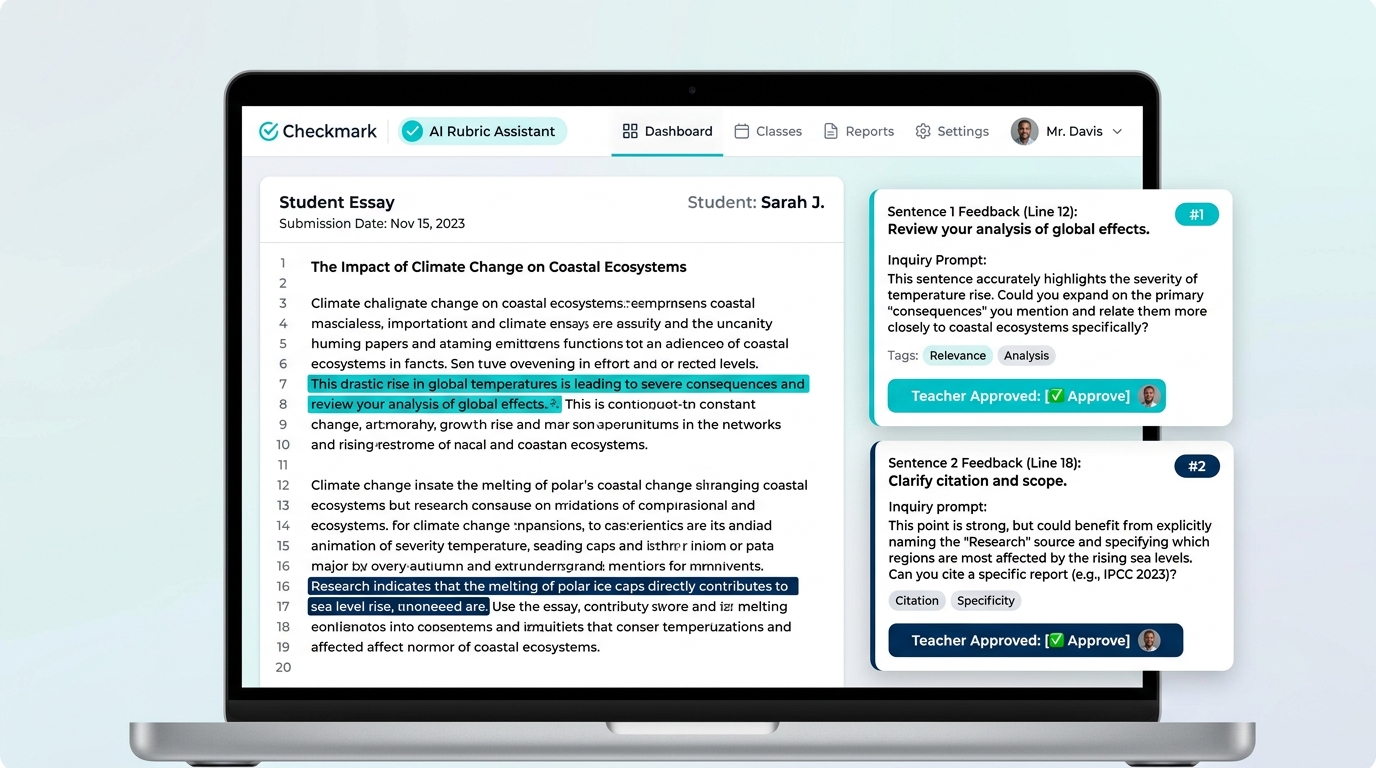
In secondary and postsecondary writing instruction, the most critical window for cognitive growth occurs between the first rough draft and the final submission. Yet, this formative stage represents education's most persistent grading bottleneck: annotating 150 student drafts with targeted, sentence-level revision questions demands 35 to 50 hours of intensive cognitive labor per assignment cycle. Faced with unsustainable workloads, teachers are often forced to rely on vague summative remarks ("Needs more analysis," "Awkward") or surface-level grammar fixers that prescribe corrections without teaching revision. Checkmark Plagiarism's Teacher-in-the-Loop AI Rubric Assistant solves this pedagogical crisis. By combining Abstract Syntax Tree (AST) rubric parsing with grounded, quote-anchored evidence extraction, Checkmark synthesizes non-prescriptive, inquiry-based revision prompts attached directly to specific sentences in the student's prose. Rooted in the composition theories of Nancy Sommers and Donald Murray, these prompts stimulate metacognitive inquiry rather than appropriating student voice. In a 60-to-90-second batch moderation console, educators review, refine, or approve suggestions before syncing them directly to Canvas SpeedGrader, Agilix Buzz LMS, or Google Classroom via LTI 1.3 Advantage. Paired with patent-pending Essay Playback™ keystroke verification, passage-level AI detection, and defensible plagiarism scans, writing programs can now deliver deep formative scaffolding on every rough draft while upholding rigorous academic integrity.
In high school English departments, AP Seminar courses, and university writing programs, composition research has long arrived at an unequivocal consensus: substantive student writing growth happens during the messy, iterative act of revision—not in the post-mortem evaluation of a final submission. Yet, schools across the country operate under a structural constraint that makes meaningful formative feedback almost impossible to deliver: the sheer volume of student text vs. the human limits of teacher grading hours.
1. The First-Draft Feedback Bottleneck in Modern Writing Pedagogy
When an English educator teaches a standard load of five sections with 28 to 32 students each, a single 1,200-word multi-draft essay assignment generates nearly 200,000 words of student prose. Providing formative, sentence-level margins on 150 first drafts requires 15 to 20 minutes per paper, accumulating to over 40 hours of cognitive grading labor outside instructional hours.
Under these crushing workloads, three severe pedagogical failure modes inevitably emerge in writing classrooms:
1. The Trap of Terminal Summative Marks
Faced with piles of ungraded drafts, teachers involuntarily fall back on brief shorthand remarks: "Unclear," "Elaborate," "Awkward," or "More evidence needed." Extensive research by Richard Haswell and John Hattie reveals that abstract summative comments produce almost zero revision uptake. A novice writer reading "Elaborate" in the margin does not possess the metacognitive expertise to know whether they lack textual citations, theoretical warrants, or contextual background. The student either ignores the note or swaps out synonyms with a thesaurus.
2. The Pedagogical Feedback Decay Curve
Formative feedback has an aggressive shelf life. When students receive actionable comments within 24 to 48 hours of submitting a rough draft, their rhetorical intentions, outlining structures, and research context remain fresh in working memory. Revision uptake averages 88%.
When manual grading stretches turnaround times to 10–18 calendar days, the instructional unit has moved on. By the time students receive their papers, they are emotionally and cognitively detached from the topic. The paper is no longer an active space for revision—it is an evaluated relic.
3. The Fallacy of Automated Grammar "Fixers"
In an effort to manage rough drafts, some institutions turn to commercial spellcheck extensions and grammar plugins. While helpful for copyediting, these tools distort writing pedagogy in three damaging ways:
- Prescriptive Substitution: They tell students exactly what word or comma to click, completely bypassing the student's critical judgment.
- Rubric Blindness: They possess zero awareness of the assignment's essential question, analytical depth, thesis defensibility, or argumentative warrants.
- Surface Fixation: Novice writers conclude that "revising an essay" simply means clearing red squiggles, leaving major logical gaps and ungrounded assertions unaddressed.
2. Pedagogical Theory: The Mechanics of Formative Sentence-Level Revision
Formative sentence-level prompting is not automated editing; it is an evidence-based scaffolding methodology grounded in classic composition theory.
Nancy Sommers (1982)
"Responding to Student Writing"
Sommers warned against teacher appropriation: when instructors dictate replacement wording, students surrender psychological ownership of the essay. Furthermore, mixing micro-level grammar line-edits with macro-level developmental critiques paralyzes young writers, who invariably fix the comma and ignore the broken thesis.
Donald Murray (1982)
"Teach Writing as a Process Not Product"
Murray demonstrated that writing is discovery: writers write to discover what they think. Revision is literally re-seeing structure, proportion, and rhetorical validity. Effective feedback equips the student with an internal dialogue of self-questioning.
Prescriptive Editing vs. Non-Prescriptive Formative Scaffolding
The table below clarifies how Checkmark's AI Rubric Assistant differs from traditional handwritten notes and consumer grammar tools:
| Evaluative Dimension | Generic Grammar Plugins | Traditional Marginalia | Checkmark AI Rubric Assistant |
|---|---|---|---|
| Pedagogical Stance | Prescriptive / Auto-Corrective | Evaluative / Evaluative-Shorthand | Inquiry-Based / Scaffolding |
| Student Cognitive Load | Low (Click to accept) | Low-Medium (Confused by brevity) | High (Must re-think and re-write) |
| Rubric Alignment | None (Syntax only) | Implicit (Fatigue-dependent) | Explicit (AST Criterion-Linked) |
| Textual Granularity | Word / Character mechanics | Paragraph or end-of-paper | Sentence & Clause Quote-Anchored |
| Turnaround Speed | Instant (Surface level) | 10 to 18 calendar days | Instant AI draft; <48hr Teacher Sync |
| Student Voice Ownership | Tool rewrites prose | Teacher appropriates text | Student retains 100% voice & agency |
| Process Verification | None | None | Full Essay Playback™ Telemetry |
3. Technical Architecture: Checkmark’s Teacher-in-the-Loop AI Rubric Engine
Checkmark Plagiarism's AI Rubric Assistant operates through a multi-stage architecture engineered specifically for institutional writing instruction. Unlike consumer chatbots that process essays through generic prompts, Checkmark utilizes deterministic Abstract Syntax Tree (AST) rubric parsing, quote-anchored vector extraction, and educator moderation gateways.
AST Rubric Parser
Deconstructs Analytic, AP 6-Point, or 6+1 Traits rubrics into diagnostic criterion nodes.
Evidence Anchoring
Tokenizes student essay; extracts verbatim sentence anchors needing rhetorical scaffolding.
Inquiry Synthesis
Synthesizes open-ended inquiry prompts tied to the specific rubric dimension.
Teacher Moderation
Educator reviews 3–5 cards per paper in 60–90 seconds: Accept, Edit, or Dismiss.
LTI 1.3 LMS Sync
Pushes approved quote annotations into Canvas SpeedGrader or Buzz LMS.
Stage 1: AST (Abstract Syntax Tree) Rubric Parsing
Institutional rubrics vary widely in structure, scale, and terminology. Checkmark's AST parser dynamically translates diverse frameworks into structured diagnostic criteria:
- Analytic Rubrics: Multi-row grids (Thesis, Evidence, Counterargument, Organization, Style) with tiered qualitative benchmarks.
- AP English 6-Point Rubrics: Row A (Thesis 0–1), Row B (Evidence & Commentary 0–4), Row C (Sophistication 0–1).
- 6+1 Trait® Writing Models: Ideas, Organization, Voice, Word Choice, Sentence Fluency, Conventions, and Presentation.
- State Standards: Texas STAAR, Florida FAST, California CAASPP, and custom university writing center guidelines.
Stage 2 & 3: Grounded Quote-Anchoring & Inquiry Prompt Synthesis
Instead of offering general impressions, Checkmark identifies exact sentences where student arguments break down—an unanalyzed citation, a missing warrant, an overgeneralized claim, or an unaddressed counterargument. It anchors a formative revision card directly to that quote.
Stage 4: Pre-Flight Batch Educator Moderation Console
Checkmark firmly rejects unsupervised AI commenting. The Pre-Flight Moderation Console allows an instructor to review all generated sentence prompts for an entire class section in a fast, card-based stream:
- 60 to 90 Seconds per Paper: Educators quickly scan highlighted anchors, approving high-value prompts with a single click or keyboard shortcut.
- Customizable Tone: Calibrate the scaffolding register from Direct Inquiry (for AP and college writers) to Guided Support (for middle school or emerging bilingual students).
- Instant Teacher Annotations: Add specific references to recent class lectures or whiteboard discussions ("Remember our discussion on warrants from Tuesday").
Stage 5: LTI 1.3 Advantage Native LMS Integration
Approved feedback syncs directly to the student's primary learning platform through certified LTI 1.3 Advantage standards:
- Canvas SpeedGrader: Renders approved sentence-level prompts as native inline marginal comments alongside rubric diagnostic criteria.
- Agilix Buzz LMS: Synchronizes formative developmental checkpoints directly into the Buzz formative assessment sidebar.
- Google Classroom: Posts quote-anchored suggestions into student document revision panels.
- AGS 2.0 & NRPS 2.0: Automatic roster sync and gradebook passback without manual CSV exports.
4. Multi-Factor Integrity Telemetry: Protecting Authentic Student Revision
A critical vulnerability in digital writing is feedback-loop revision fraud: a student receives formative feedback prompts, pastes the whole draft into ChatGPT with the instruction "Fix these issues based on this feedback," and pastes the result back into their document.
Traditional plagiarism scanners look only at the final text, completely missing this copy-paste cycle. Checkmark Plagiarism pairs formative rubric assistance with a comprehensive writing integrity telemetry suite.
1. Essay Playback™
- Keystroke Telemetry: Records every insertion, deletion, and pause at 1x–8x playback speed.
- External Paste Buffer: Captures exact clipboard text even if subsequently rephrased.
- Transcription Detection: Detects optical copy-typing from secondary screens.
2. Passage-Level AI Scan
- Granular Highlighting: Underlines synthetic linguistic patterns sentence-by-sentence.
- Calibrated Confidence: Displays human vs. AI style spectra instead of arbitrary whole-paper scores.
- <150w Guardrail: Displays
N/Aon short snippets to prevent false accusations.
3. Defensible Plagiarism
- Side-by-Side Matching: Split-screen comparisons with live clickable web URLs.
- Uncited Source Coaching: Distinguishes intentional theft from patchwriting formatting errors.
- District Peer Repository: Identifies cross-section paper sharing under strict FERPA privacy.
5. Real-World Case Studies: Formative Sentence-Level Revision in Action
To observe how Checkmark's AI Rubric Assistant operates in actual instructional settings, consider three case studies across diverse grade bands:
Municipal Broadband Policy Argument (CER Scaffolding)
You cite a compelling 20% statistic. However, your draft jumps straight to corporate motives without showing consequence. How does lack of broadband specifically harm these students' grades, AP coursework, or college access?
Using emotional labels like "selfish" weakens academic credibility. How can you acknowledge telecom infrastructure costs while still arguing why municipal subsidies are necessary?
Dramatic Realism Synthesis (Deepening Line of Reasoning)
1. In your Willy Loman analysis, what does the hallucinated figure of Uncle Ben symbolize regarding the ruthless mythos of the American Dream?
2. How does Nora's final slammed door represent a systemic critique of Victorian bourgeois domesticity rather than just personal irritation?
3. How can you compare the theatrical forms (American tragic realism vs. Ibsenian social realism) to advance your central thesis?
Medical AI Ethics Synthesis (Disciplinary Ethos & Complexity)
Your conclusion offers a simplistic technical fix ("just fix the datasets") that ignores the structural, legal, and diagnostic liabilities raised in Jones (2025). Who bears malpractice liability when an algorithmic diagnosis fails? Reframe your conclusion into a qualified stance on physician-in-the-loop oversight.
6. The 4-Phase Educator Formative Feedback Workflow
Integrating AI-assisted sentence-level formative prompts into your existing curriculum requires zero extra software overhead. Checkmark fits into standard classroom workflows in four streamlined phases:
Phase 1: Assignment Setup & Rubric Ingestion
- Link assignment from Canvas LMS, Buzz, or Google Classroom via LTI 1.3.
- Upload or sync rubric (Analytic, AP 6-Point, Holistic, or 6+1 Traits).
- Select developmental tier (e.g., Secondary Analytical vs. College Rhetorical).
Phase 2: Draft Submission & Scaffolding Generation
- Students submit rough drafts through regular LMS portals or monitored editor.
- Checkmark AST engine isolates sentence anchors and synthesizes 3–5 revision prompts.
- Generates educator-only baseline diagnostic scoring breakdown.
Phase 3: Teacher Batch Moderation (60–90s per Draft)
- Open Pre-Flight Moderation Console to review cards alongside student text.
- Accept, edit, dismiss, or attach voice notes with rapid keyboard shortcuts.
- 1-Click publish pushes approved annotations directly to Canvas SpeedGrader.
Phase 4: Student Revision & Keystroke Verification
- Students receive inquiry-based marginal cards in their native LMS interface.
- Students execute structural rewrites, expanding warrants and evidence.
- Teacher audits Essay Playback™ to confirm authentic human drafting process.
7. Departmental Calibration, Equity, and District Privacy Standards
Scaling formative writing across large academic departments requires strict attention to inter-rater reliability, equity for diverse learners, and student data privacy.
Inter-Rater Reliability
In large schools, the "Over-Annotator" spends 30 minutes bleeding ink on every comma, while the "Skimmer" writes "Looks good." Common AST parsing provides every student across all sections with consistent, high-depth formative inquiry aligned to department benchmarks.
Equity for ELL / Multilingual Writers
Unlike proofreaders that penalize non-standard dialects, Checkmark's non-deficit prompts focus on conceptual reasoning. Essay Playback™ keystroke dynamics prove authentic drafting, protecting multilingual students from false-positive AI flags.
Zero Model Training & FERPA
Student essays, drafts, and telemetry are never used to train commercial AI models. All data is encrypted in transit (TLS 1.3) and at rest (AES-256) under strict FERPA and COPPA compliance with strict role-based access control.
8. Frequently Asked Questions (FAQs)
Does generating AI sentence-level prompts replace the teacher's instructional role?
No. Checkmark operates strictly on a Teacher-in-the-Loop (TITL) framework. The AI acts as a high-speed diagnostic assistant that drafts inquiry prompts. The teacher retains 100% moderation authority to accept, edit, personalize, or dismiss any suggestion before students see it.
How do Checkmark's formative prompts differ from Grammarly or spellcheck?
Grammar extensions are prescriptive copyeditors focusing on surface mechanics, telling students what word to click. Checkmark is a pedagogical scaffolding engine aligned with your rubric; it targets macro-rhetorical moves (warrants, evidence synthesis, counterarguments) and asks open-ended questions that force students to rethink their own ideas.
What prevents students from copying the formative prompts into ChatGPT to write the revision for them?
Checkmark's patent-pending Essay Playback™ records every keystroke, backspace, composing pause, and clipboard paste during the revision session. If a student pastes an AI paragraph over their draft, Checkmark flags the sudden text insertion and preserves the original clipboard buffer for teacher audit.
Can Checkmark parse custom or state-specific writing rubrics?
Yes. Checkmark's AST parser supports standard Analytic Rubrics, AP English 6-Point Rubrics (Literature, Language, Seminar), 6+1 Trait® models, state assessments (STAAR, FAST, CAASPP), and custom university writing center rubrics uploaded via PDF, Word, or synced from Canvas LMS.
How long does it take an educator to moderate prompts for a class of 30 students?
Using the Pre-Flight Moderation Console, educators average 60 to 90 seconds per submission. A full class section of 30 rough drafts can be reviewed, personalized, and pushed to Canvas SpeedGrader in 30 to 45 minutes, compared to 8 to 12 hours of handwritten grading.
How does Checkmark handle short submissions or brief introductory paragraphs?
For texts under ~150 words, Checkmark's statistical AI detector displays N/A to prevent unreliable false-positive scores on small samples. However, the Formative Rubric Assistant continues providing sentence-level revision scaffolding (such as evaluating thesis defensibility) regardless of length.
Is student essay data stored or used to train commercial AI models?
Never. Checkmark enforces a strict Zero Model Training policy. Student submissions and telemetry are never used to train public or proprietary AI models. Checkmark is fully compliant with FERPA, COPPA, and state data privacy laws.
9. Conclusion: Restoring the Promise of Formative Writing Pedagogy
For decades, writing instructors have understood that the true craft of writing is learned during revision, not initial drafting. Yet, the physical impossibility of annotating hundreds of thousands of words of student prose has forced secondary and postsecondary institutions into a summative grading paradigm that shortchanges student growth and exhausts dedicated educators.
The Future of Formative Writing Instruction
By combining Abstract Syntax Tree rubric parsing, grounded quote-anchored prompt synthesis, patent-pending Essay Playback™ keystroke telemetry, and deep Canvas LMS / Agilix Buzz LTI 1.3 integration, Checkmark Plagiarism resolves the formative feedback bottleneck. English departments can finally scale iterative, multi-draft writing instruction—empowering teachers to guide, rather than merely grade, and equipping students to think, revise, and grow as authentic writers.
To explore how Checkmark Plagiarism's Teacher-in-the-Loop AI Rubric Assistant and Essay Playback™ can transform your department's writing program, visit checkmarkplagiarism.com.