
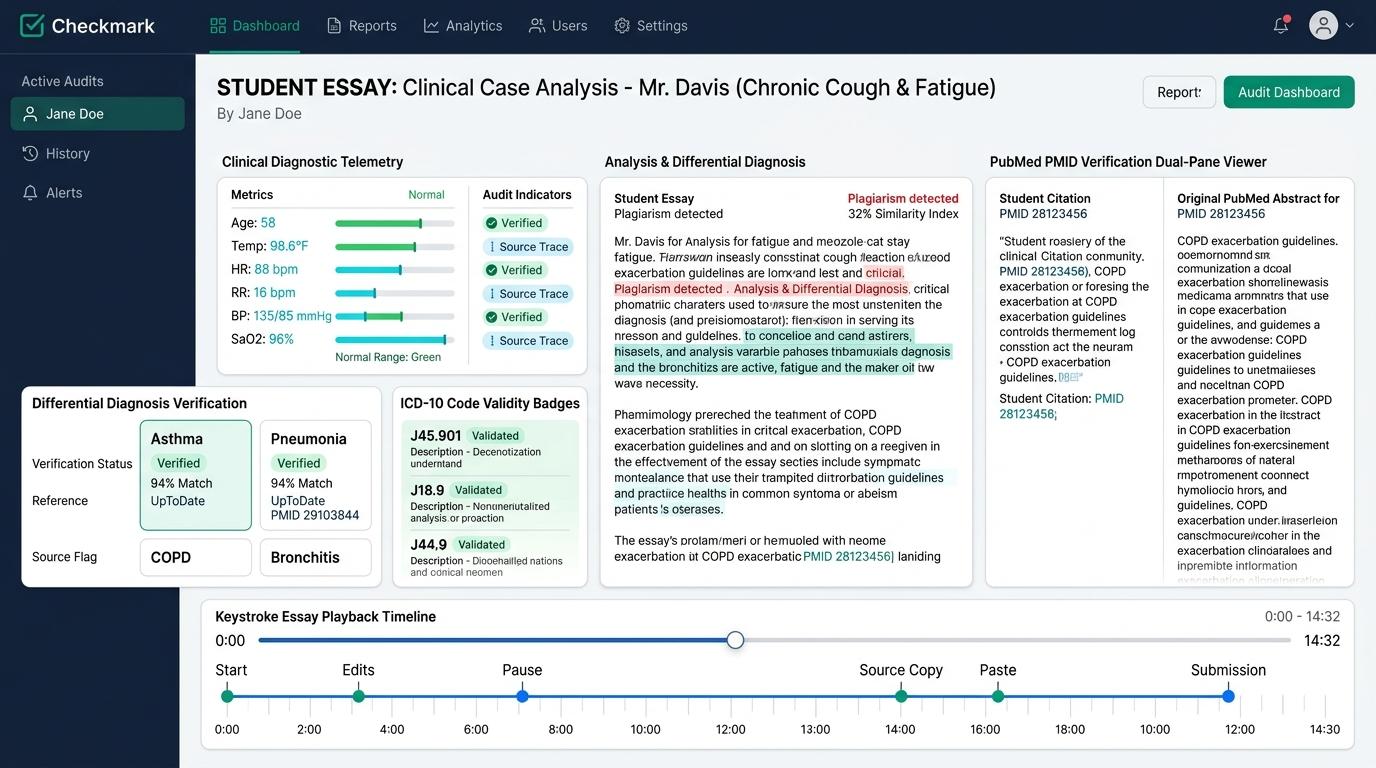
In health sciences education, clinical case analyses, SOAP notes, SBAR handoffs, and evidence-based practice (EBP) capstones serve as the primary cognitive proving ground for diagnostic competence prior to direct patient care. However, the unchecked proliferation of commercial large language models (LLMs) has introduced a grave clinical safety crisis: AI-hallucinated diagnostics. Generative models routinely fabricate plausible-sounding differential diagnoses, non-existent ICD-10-CM/CPT billing codes, fictitious PubMed identifiers (PMIDs/DOIs), and distorted pharmacological dosing schedules, wrapping fatal clinical errors in fluent, confident medical syntax.
Legacy academic integrity tools fail completely in this environment—monolithic AI detectors trigger massive false-positive flags on standardized clinical templates (such as ISBAR handoffs and SOAP notes) due to inherently uniform medical phrasing, while traditional similarity scanners cannot detect freshly synthesized medical confabulations. To ensure clinical competence and protect patient safety, medical and nursing school faculties are transitioning to Zero-Retention Writing Process Telemetry. By combining ephemeral passage-level linguistic analysis with patent-pending Essay Playback™ (1x–8x timeline replay), immutable External Paste Buffer Inspection, and synchronized Two-Pane Source Proof, clinical educators can verify authentic clinical diagnostic reasoning, isolate fabricated citations, and support student remediation without compromising simulated patient data privacy.
Checkmark Plagiarism provides medical, nursing, PA, and pharmacy faculties with forensic writing telemetry, passage-level confidence evaluation, and native LMS integrations across Canvas LMS, Agilix Buzz, and Google Classroom.
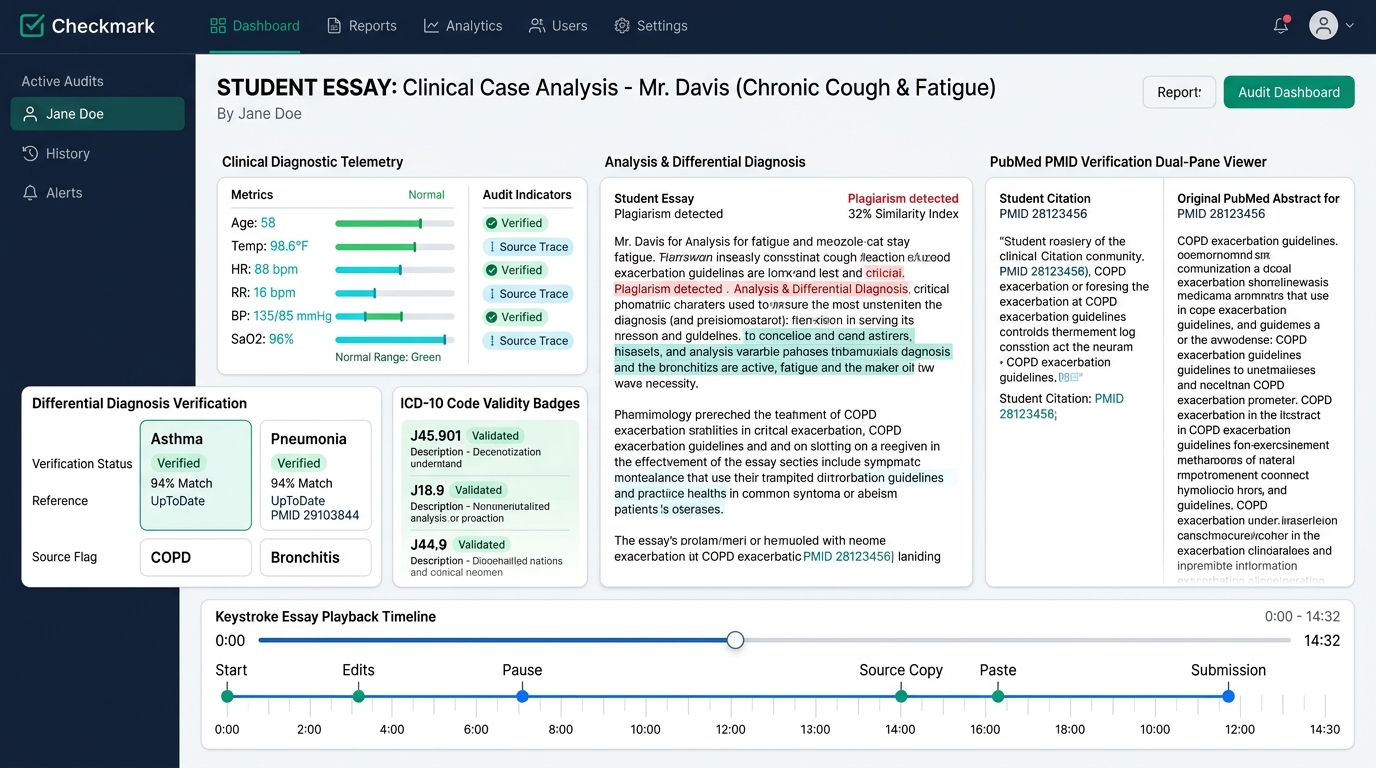
1. The Critical Diagnostic Integrity Crisis in Health Sciences Education
In medical schools (allopathic MD and osteopathic DO), nursing programs (BSN, MSN, DNP), physician assistant (PA) programs, and pharmacy schools (PharmD), the clinical case analysis is far more than a conventional academic writing assignment. It is a simulated diagnostic laboratory. Whether presented as a comprehensive clinical history and physical (H&P), a serialized SOAP (Subjective, Objective, Assessment, Plan) note, an SBAR (Situation, Background, Assessment, Recommendation) interprofessional communication brief, or a complex diagnostic decision tree, these exercises force students to synthesize chaotic patient data, establish biological plausibility, eliminate competing differentials, and select evidence-based therapeutic interventions.
The core objective of clinical training is cultivating diagnostic reasoning—the iterative cognitive ability to weigh pre-test probabilities, interpret subtle laboratory aberrations, recognize cardinal symptom clusters, and guard against premature diagnostic closure.
- Raw Data Extraction & Clustered Salience: Differentiating acute clinical findings from patient baselines; iterative cognitive weighing of lab values.
- Hypothesis Generation & Differential Building: Formulating hierarchical differential diagnoses; justifying rule-ins and rule-outs with patient-specific data.
- Evidence-Based Verification & Protocol Cross-Referencing: Querying UpToDate, PubMed, IDSA, and AHA guidelines; actively verifying FDA contraindications and renal dosing adjustments.
- Defensible Treatment & Monitoring Plan: The student owns clinical risks, anticipates adverse drug events, and integrates formative educator feedback.
- Whole-Case Prompting into Commercial LLMs: Student pastes the entire clinical scenario into ChatGPT/Claude, outsourcing diagnostic synthesis entirely.
- Plausible Synthetic Narrative Generation: The LLM calculates next-token statistical probabilities, smoothly bridging contradictory or impossible lab values.
- Confabulated Clinical “Receipts”: AI invents phantom PMIDs, non-existent DOIs, and syntactically valid but completely fabricated ICD-10-CM / CPT codes.
- Unverified Clinical Recommendations: Critical drug-drug interactions are masked; student bypasses foundational bedside diagnostic skill.
When health sciences students rely on generative AI to produce case analyses, they do not simply commit conventional academic plagiarism. They introduce stochastic diagnostic confabulation into professional training. Large language models operate on probabilistic token prediction rather than biomedical causal modeling. Consequently, when an LLM encounters ambiguous patient symptoms or atypical lab panels, it does not pause in clinical uncertainty; it predicts the most statistically plausible text sequence.
The result is a dangerous educational paradox: clinical papers that read with the authoritative polish of a chief resident or clinical nurse specialist, but harbor lethal diagnostic hallucinations, phantom medical literature, and completely fabricated diagnostic billing codes.
2. Anatomy of AI Hallucinations in Clinical Case Studies
To effectively audit clinical case submissions, medical and nursing faculty must understand the precise failure modes of generative models when applied to complex pathophysiological and clinical reasoning. Generative AI hallucinations in health sciences work manifest across four primary diagnostic categories:
When presented with conflicting diagnostic markers (e.g., elevated troponin with pleuritic chest pain and normal inflammatory markers), LLMs invent non-existent disease subtypes (e.g., “Type 3 Subacute Autoimmune Cardiomyopathy”) or generate eloquent biochemical pathways that sound authentic to novices but violate fundamental laws of human physiology.
Because LLMs treat numbers and alphanumeric codes as lexical tokens rather than relational database entries, they fabricate invalid ICD-10-CM codes (e.g., E11.391 or I25.849) and corrupt clinical scoring criteria (such as claiming a Wells' Score of 3.0 indicates “high risk” when guidelines require >6.0).
Evidence-Based Practice requires anchoring plans in real trials. LLMs execute bibliographic confabulation: generating 8-digit PMIDs resolving to 404 errors or completely unrelated journals (e.g., 1984 dental surgery), pairing prominent authors with fake titles, and citing non-existent “Joint ACC/IDSA Directives.”
LLMs eliminate diagnostic friction, jumping to the most common archetype (e.g., dyspnea = asthma) while ignoring vital red flags. They generate lethal orders: prescribing full-dose metformin with eGFR 18 mL/min, combining nitrates with PDE5 inhibitors, or hallucinating adult fixed doses in pediatric cases.
3. The Structural Failure of Legacy Integrity Tools in Health Sciences
When health sciences deans, clinical chairs, and course directors attempt to safeguard case study authenticity using legacy integrity tools, they face severe operational and pedagogical roadblocks.
| Tool Modality | Operational Mechanism | Fatal Flaw in Health Sciences |
|---|---|---|
| Whole-Document AI Scanners (Generic Probabilistic Classifiers) |
Global statistical perplexity and burstiness calculation across the entire file. | Massive false-positive flags on standardized SOAP/SBAR templates and medical jargon. Disproportionately penalizes ESL and international medical/nursing students. |
| Legacy Plagiarism Databases (Traditional Similarity Matching) |
1-to-1 string matching against indexed web and student paper archives. | Zero detection capability for freshly synthesized AI diagnostic hallucinations. Unfairly inflates similarity percentages on clinical rubrics and standard anatomical terms. |
| Invasive Webcam Proctoring (Video & Gaze Tracking) |
Continuous webcam monitoring and AI eye-tracking during timed testing windows. | Completely inapplicable to longitudinal clinical case write-ups, EHR logs, and capstones. High stress, intrusive, easily bypassed by secondary devices. |
The Standardized Clinical Jargon Trap
Standardized clinical formats—such as the ISBAR framework (Introduction, Situation, Background, Assessment, Recommendation) or SOAP notes—are intentionally designed to be formulaic, objective, and linguistically predictable. Medical grammar relies heavily on concise, passive constructions (“Lungs clear to auscultation bilaterally; no wheezing, rales, or rhonchi”).
Because generic AI detectors classify low perplexity (predictable word choices) and low burstiness (uniform sentence structures) as synthetic machine generation, they disproportionately flag honest nursing and medical students who write with exemplary clinical precision. Furthermore, international medical graduates (IMGs) and English-as-a-Second-Language (ESL) nursing candidates—who rely on formal, structured syntactic patterns—suffer false-positive rates more than double those of native speakers.
The “AI Humanizer” and Paraphrasing Cloak
Conversely, students seeking to bypass academic integrity checks routinely pass AI-generated clinical analyses through “humanizer” tools (e.g., QuillBot, Undetectable AI). These tools introduce intentional syntactic noise, synonyms, and artificial sentence variation to lower the global AI percentage score.
However, while these paraphrasers fool simplistic probabilistic detectors, they leave the underlying diagnostic hallucinations, invented ICD-10 codes, and phantom PMIDs completely intact. The student submits a case analysis that passes the university's automated similarity threshold but contains lethal clinical recommendations.
Simulated Patient Data, Privacy, and FERPA Compliance
Health sciences programs frequently utilize standardized patient scenarios derived from real, de-identified hospital encounters or proprietary simulation center cases. Uploading student analyses containing complex clinical vignettes to commercial AI integrity vendors who retain submissions to train their commercial models introduces severe regulatory risks under FERPA (Family Educational Rights and Privacy Act) and institutional clinical data governance standards.
Medical and nursing schools require a Zero-Data-Retention (ZDR) architecture where student work is evaluated ephemerally in volatile memory and never cached in public LLM repositories.
4. Multi-Dimensional Comparison Matrix
To transition from arbitrary, black-box guessing to defensible clinical verification, health sciences programs must contrast legacy integrity methods with multidimensional writing process telemetry.
| Feature / Verification Capability | Legacy Plagiarism Scanners | Standalone AI % Detectors | Checkmark Plagiarism Suite |
|---|---|---|---|
| Detection Target | Published web text & student papers | Global statistical probability score | Multi-factor: text, keystrokes, citations & rubrics |
| Passage-Level AI Confidence | ❌ None (only similarity matches) | ❌ Global opaque percentage (e.g., “78% AI”) | ✅ Direct inline highlights with calibrated style sliders |
| Short-Text Guardrails (<150 words) | ❌ Flags random clinical phrases | ❌ Guesses wildly; high false positives | ✅ Explicit N/A guardrail to prevent false flags |
| Keystroke-by-Keystroke Playback | ❌ No temporal data | ❌ No temporal data | ✅ Patent-Pending Essay Playback™ (1x–8x replay) |
| External Paste Tracking | ❌ Only checks final static text | ❌ Only checks final static text | ✅ Full timestamped paste buffer capture & preservation |
| Transcription Detection (2nd Screen/Dictation) | ❌ Cannot detect | ❌ Cannot detect | ✅ Identifies zero-pause mechanical typing rhythms |
| Citation & Source Verification | ⚠️ Highlights text without active link | ❌ Does not verify citations | ✅ Synchronized Dual-Pane Viewer with clickable sources |
| Uncited vs. Plagiarized Distinction | ❌ Treats all overlap identically | ❌ N/A | ✅ Dedicated visual flags for citation coaching |
| Rubric-Anchored Clinical Autograding | ❌ None | ❌ None | ✅ Teacher-in-the-Loop quote-anchored justifications |
| Data Retention & Privacy Architecture | ❌ Ingests & stores student text | ❌ Often retains data for model training | ✅ 100% Zero-Data Retention; FERPA/HIPAA compliant |
| LMS Gradebook Synchronization | ⚠️ Basic LTI score passback | ❌ Standalone report only | ✅ Direct passback to Canvas, Buzz LMS, & Classroom |
Telemetry Forensics: Authentic Clinical Synthesis vs. AI Hallucination
Health sciences faculty can quickly differentiate authentic student diagnostic struggle from AI generation by examining the writing process telemetry captured during case drafting:
| Telemetry Metric | Authentic Clinical Reasoning | AI-Assisted Hallucination |
|---|---|---|
| 1. Temporal Drafting Velocity (Chars / Keystrokes Per Min) |
Highly variable velocity: • 20–45 WPM during synthesis • Long pauses (>60s) before Plan formulation • Frequent backspacing and phrasing rewrites |
Unnatural, invariant velocity: • 140+ WPM (External Paste) OR • Steady 65 WPM typing without a single diagnostic pause. |
| 2. Differential Diagnostic Evolution (Timeline Scrubbing) |
Non-linear progression: • Initial broad differential list drafted • Diagnostic rule-outs drafted, re-ordered, or deleted as labs are cross-referenced |
Linear, instantaneous block: • Complete, multi-syndrome differential inserted in a single paste or mechanical session. |
| 3. External Paste Inspector (Clipboard Forensics) |
Granular, fragmented pastes: • Specific lab values or single drug names copied from prompt • Formatted citations inserted with surrounding manual edits |
Bulk, structural pastes: • 500–1,200 word blocks containing complete SOAP plans, rationales, and hallucinated PMID lists. |
| 4. Revision & Deletion Patterns (Backspaces & Edits) |
Active clinical self-correction: • Changing drug dosages based on calculations • Correcting contraindications; re-evaluating staging criteria |
Minimal or superficial edits: • Fixing minor typos or using a paraphraser to swap words without altering underlying diagnostic logic. |
5. The 5-Phase Clinical Case Audit Protocol for Faculty
To establish an equitable, transparent, and legally defensible academic integrity workflow, medical and nursing programs should implement the following standardized 5-Phase Clinical Case Audit Protocol:
Checkmark scans the case submission in-memory. Evaluates passage-level AI confidence cards, uncited source indicators, and automatically applies short-text guardrails (<150w N/A).
Faculty scrubs timeline at 1x–8x speed to evaluate cognitive reflection pauses, diagnostic drafting velocity, and iterative clinical revision bursts versus continuous mechanical typing.
Audit timestamped paste events; inspect original captured clipboard text to detect full-cloth LLM prompt dumps, conversational AI lead-ins, or copied external case solutions.
Verify ICD-10-CM / CPT code validity against CMS tables, audit PMIDs/DOIs via clickable source viewer, and cross-reference clinical guidelines against primary consensus statements.
Review playback timeline collaboratively with the student; verify oral diagnostic reasoning and assign targeted clinical simulation hours or supervised SOAP note drafting to rebuild foundational clinical reasoning skills.
Phase 1: Ephemeral Multi-Factor Screening
- Passage-Level AI Evaluation: Open the submission within Checkmark’s integrated review portal. Rather than looking for a global percentage, examine the specific passage-level underlines. Focus on sections that represent high-level clinical synthesis—specifically the Assessment & Plan (A/P), the Differential Diagnosis Justification, and Evidence-Based Practice Recommendations.
- Review Confidence Sliders: Check the calibrated evidence cards in the sidebar. Note whether flagged passages demonstrate typical human variability or exhibit severe synthetic structural predictability across linguistic markers (perplexity, burstiness, and formulaic transitions).
- Check Short-Text Guardrails: Ensure that short diagnostic blurbs (such as individual vital sign summaries or isolated physical exam lines under 150 words) are marked
N/A, preventing false alarms on standardized phrases.
Phase 2: Writing Telemetry & Keystroke Forensics with Essay Playback™
- Initiate Timeline Replay: Launch Essay Playback™ and scrub through the drafting session at 2x or 4x speed.
- Audit Diagnostic Reflection Pauses: Examine whether the student paused before generating complex differential diagnoses. Authentic clinical reasoning requires cognitive pauses as the clinician cross-references lab panels with clinical memory or reference texts.
- Examine Drafting Evolution: Observe how the diagnosis was constructed:
- Did the student first outline symptoms and gradually build the case?
- Or did the entire diagnostic plan appear instantaneously as a pre-constructed text block?
- Detect Transcription Dynamics: If the student typed continuously at a uniform 60–75 WPM without backspaces, pauses, or structural reorganization, inspect for secondary device transcription (typing while reading an AI-generated output on a smartphone or second monitor).
Phase 3: External Clipboard & Paste Buffer Inspection
- Audit Timestamped Paste Events: Click Checkmark's External Paste Inspector to view every instance where text was brought into the editor from an outside application.
- Inspect Full Preserved Paste Content: Even if the student subsequently edited or paraphrased every single word after pasting, Checkmark preserves the raw, original clipboard string.
- Identify Prompt Engineering Signatures: Look for classic LLM artifacts within the captured paste buffer:
- Conversational lead-ins (“Certainly! Here is a comprehensive SOAP note and differential diagnosis for your 54-year-old patient...”).
- Unprompted formatting tags (Markdown asterisks, bulleted clinical summaries).
- Generic boilerplate disclaimers (“Note: This is for educational purposes and should not replace professional medical judgment.”).
Phase 4: Diagnostic Fact-Checking & Citation Auditing
- Verify ICD-10-CM and CPT Coding: Use official CDC/CMS tables to verify that submitted diagnostic codes exist and match the patient's exact clinical scenario.
- Audit PubMed Identifiers (PMIDs) and DOIs: Click the direct links in Checkmark's Synchronized Dual-Pane Source Viewer. Verify:
- Does the PMID resolve to a genuine peer-reviewed article in PubMed?
- Does the article actually investigate the disease, population, and drug class discussed in the case?
- Is the study design (e.g., double-blind RCT vs. case report) represented accurately?
- Cross-Reference Clinical Practice Guidelines: Check cited guidelines against primary sources (e.g., UpToDate, IDSA, AHA/ACC) to ensure clinical thresholds and contraindications have not been hallucinated.
Phase 5: Restorative Clinical Competency Conferences
- “Stop Guessing, Start Trusting” Philosophy: The goal of clinical integrity is not punitive expulsion, but safeguarding patient safety and fostering diagnostic competence.
- Collaborative Playback Review: In a 1-on-1 meeting, open Checkmark’s Essay Playback™ timeline alongside the student.
- Conduct an Oral Diagnostic Defense: Ask the student to articulate the clinical reasoning behind specific flagged passages:
- “Walk me through how you arrived at this third differential diagnosis.”
- “What lab values in this patient's chart led you to rule out acute mesenteric ischemia?”
- “Can you explain the physiological mechanism of this drug interaction you noted in your plan?”
- Targeted Remediation: If the student used generative AI as a shortcut due to cognitive overload or time management struggles, assign structured simulation lab hours and supervised SOAP note drafting to rebuild foundational clinical reasoning skills.
6. Real Classroom Case Scenarios in Medical & Nursing Education
To illustrate how writing telemetry and clinical auditing function in practice, consider three realistic scenarios from diverse health sciences disciplines:
Assignment: Comprehensive inpatient clinical case analysis of a 4-year-old presenting with high fever, lethargy, and unexplained tachycardia.
The student submitted an impeccably formatted 12-page case analysis featuring an exhaustive 8-condition differential diagnosis. However, the attending physician noticed a reference to a rare pediatric condition—“Type IV Subacute Endothelial Pyogenic Vasculitis”—accompanied by an ICD-10 code M31.84 and a citation from JAMA Pediatrics with a listed PMID 38291048.
M31.84 was completely non-existent in CMS tables.
Assignment: Longitudinal management plan for an adult patient with uncontrolled Type 2 Diabetes, Stage 3 CKD, and Hypertension.
A commercial standalone AI detector flagged the student’s submission at 94% AI Generated, triggering an automated academic dishonesty referral. The instructor noted that the student was an international graduate nurse with English as a second language.
Assignment: Critical care pathway analysis for a patient in cardiogenic shock requiring mechanical circulatory support.
The submission passed traditional similarity matching with a low 4% match. The differential and pharmacologic titration schedule looked comprehensive, but contained a lethal dosing error: recommending a high-dose beta-blocker bolus during acute decompensated shock with pulmonary edema.
7. How Checkmark Plagiarism Protects Health Sciences Programs
Checkmark Plagiarism is engineered specifically to meet the rigorous demands of higher education, health sciences programs, and clinical faculty:
Calibrated confidence sliders; eliminates global % false alarms on medical jargon.
Keystroke-by-keystroke video replay; verifies diagnostic reasoning & cognitive pauses.
Permanent original clipboard capture; detects LLM prompt dumps and external pastes.
Clickable PubMed PMIDs and side-by-side web evidence cards with live link resolution.
Quote-anchored rubric grading; syncs with Canvas SpeedGrader, Buzz LMS, & Classroom.
FERPA & HIPAA compliant; student text is never cached or used to train commercial AI.
1. Granular Passage-Level AI Detection with Style Sliders
- No Black-Box Percentages: Instead of presenting a single, terrifying overall percentage that invites adversarial confrontation, Checkmark underlines specific synthetic sentences.
- Calibrated Confidence Cards: Each card explains whether the flag is driven by unnatural syntactic repetition, invariant sentence length, or formulaic transition markers.
- Educator-Only Flag Statuses: Flags remain private to faculty (
Flagged,Resolved,Not Flagged), allowing instructors to investigate quietly without generating premature student panic.
2. Patent-Pending Essay Playback™ (1x–8x Replay)
- Scrubbable Keystroke Video: Faculty can watch an entire 4-hour clinical write-up unfold in 60 seconds, verifying the iterative cognitive struggle of diagnosing complex patient presentations.
- Pause & Velocity Telemetry: Visualizes real-time brainstorming intervals, distinguishing authentic clinical reflection from robotic transcription.
- Exoneration of Honest Students: Provides objective, irrefutable telemetry to clear students who write with structured, standardized clinical grammar.
3. External Paste Buffer Inspector
- Full Text Preservation: Captures every character pasted from external sources, preserving the raw content even if the student completely rewrites or paraphrases it afterward.
- Jump-to-Playback Sync: Clicking any paste event in the sidebar instantly jumps the playback timeline to the exact millisecond the text entered the document.
4. Synchronized Dual-Pane Source Verification
- Clickable Evidence Cards: Two-way linked cards allow faculty to click highlighted text in the student paper to immediately open the matching source page or journal article.
- Uncited vs. Plagiarism Distinction: Differentiates between improper citation formatting and deliberate source copying, enabling targeted academic coaching.
- Peer-to-Peer Cohort Matching: Identifies unauthorized sharing across different clinical sections and LMS cohorts without indexing student papers into public repositories.
5. Teacher-in-the-Loop Rubric Autograding & LMS Synchronization
- Quote-Anchored Clinical Feedback: Generates first-draft rubric evaluations anchored directly in quotes from the student's clinical analysis (e.g., evaluating diagnostic accuracy, pharmacologic safety, and evidence synthesis).
- Teacher Final Authority: All automated scores remain drafts until reviewed, modified, and approved by faculty.
- Direct LMS Passback: One-click grade and feedback synchronization into Canvas LMS SpeedGrader, Buzz LMS, Google Classroom, and Blackboard.
8. Frequently Asked Questions (FAQ)
1. How does Checkmark Plagiarism handle simulated patient data privacy under FERPA and HIPAA?
Checkmark operates under a strict Zero-Data-Retention (ZDR) architecture. Submissions are analyzed ephemerally in volatile server memory and are never used to train commercial large language models, stored in global public databases, or shared with third parties. This guarantees complete compliance with FERPA regulations and institutional clinical research security standards.
2. Why do generic AI detectors frequently flag honest nursing and medical students writing SOAP notes?
SOAP notes, SBAR reports, and clinical H&Ps are intentionally structured to follow formulaic, standardized phrasing and concise medical grammar. Generic AI detectors rely on statistical perplexity (word choice unpredictability) and burstiness (sentence length variation). Because clinical documentation is inherently predictable and uniform, generic detectors mistakenly classify high-quality human clinical writing as machine-generated text. Checkmark eliminates this flaw by combining passage-level analysis with keystroke writing process verification (Essay Playback™).
3. Can Essay Playback™ prove a student transcribed an AI-generated differential diagnosis from a phone or second monitor?
Yes. When a student transcribes text from a secondary device, they exhibit a distinct keystroke telemetry profile: a steady, mechanical typing cadence (e.g., 55–75 WPM) with near-zero composing pauses, virtually no backspacing, and no structural reorganization of clinical arguments. In contrast, authentic clinical reasoning produces highly variable speeds, frequent backspaces to adjust medical terminology, and significant cognitive pauses while cross-referencing patient lab data.
4. How does Checkmark detect fabricated PubMed IDs (PMIDs) and fake medical journal citations?
Checkmark’s Synchronized Dual-Pane Source Viewer actively checks cited URLs, PMIDs, and DOIs against live medical databases, encyclopedias, and open-access academic repositories. If a student cites a non-existent PMID, a 404 error is immediately exposed, and the citation is flagged in the evidence sidebar for instructor review.
5. How can faculty use Checkmark to conduct non-punitive, restorative academic integrity conferences?
Checkmark embraces the philosophy “Stop guessing, start trusting.” Rather than confronting a student with an arbitrary percentage score, the instructor opens the Essay Playback™ timeline together with the student. Faculty can ask the student to explain the clinical decision-making process at specific points in the timeline. If the student struggled with diagnostic synthesis, the meeting becomes a supportive, formative coaching session to remediate clinical reasoning deficits.
6. Does Checkmark integrate directly with Canvas SpeedGrader and Buzz LMS for clinical case grading?
Yes. Checkmark offers seamless LTI 1.3 integration with Canvas LMS, Buzz LMS, Blackboard, and Google Classroom. Faculty can view passage-level AI detection, keystroke playback, and rubric evaluations directly within the native LMS interface, with single-click grade and comment passback to the institutional gradebook.
7. How does auditing case analyses for AI hallucinations support LCME and AACN accreditation standards?
Both the Liaison Committee on Medical Education (LCME) and the American Association of Colleges of Nursing (AACN Essentials) require health sciences programs to formally verify that graduates possess independent clinical judgment, diagnostic reasoning, and evidence-based practice competencies. By auditing case studies for AI hallucinations and verifying independent authorship through writing telemetry, health sciences faculties maintain rigorous, defensible documentation of student clinical competence.