
When secondary teachers discover uncredited source material, developmental patchwriting, or unapproved generative AI text in student essays, the traditional institutional reflex has been punitive and adversarial: assign an automatic zero (0%), log an administrative disciplinary referral, and trigger a contentious parent confrontation. For Secondary Instructional Coaches, ELA and Humanities Department Chairs, Restorative Justice Coordinators, and Assistant Principals of Curriculum & Instruction, this retributive model represents a pedagogical dead end. Automatic zeroes destroy gradebook mathematical validity, fracture student-teacher trust, incite acrimonious parental disputes over black-box AI detector scores, and fundamentally fail to teach authentic research, citation, and synthesis competencies.
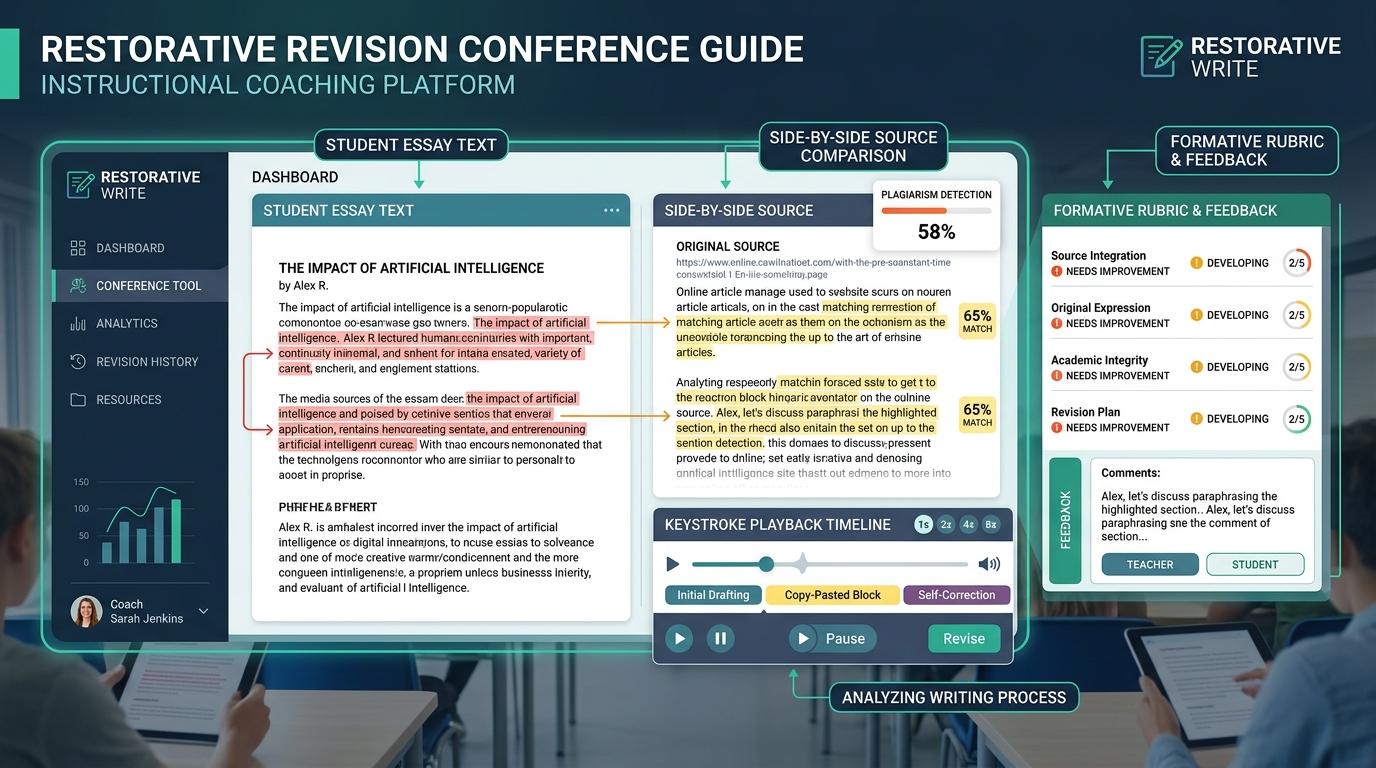
By spearheading a Restorative Post-Plagiarism Revision Conference Framework, instructional coaches can empower middle and high school faculty to transition from prosecutorial investigators into diagnostic instructional coaches. Powered by Checkmark Plagiarism’s multi-evidence suite—featuring synchronized dual-pane side-by-side text comparison, patent-pending Essay Playback™ (1x–8x keystroke video replay with 100% paste buffer preservation), calibrated passage-level AI confidence sliders with <150w short-text guardrails, and teacher-in-the-loop rubric autograding synced directly to Canvas LMS, Buzz LMS, and Google Classroom—educators can co-view objective drafting evidence alongside students, diagnose underlying cognitive and emotional root causes, and execute structured Restorative Revision Agreements (RRAs) that transform integrity breakdowns into masterclasses in original scholarship.
Checkmark Plagiarism equips instructional leaders and secondary departments with the exact tools needed to eliminate retributive penalties: integrating patent-pending Essay Playback™ with passage-level AI detection, synchronized dual-pane plagiarism checking, formative rubric autograding, and native LMS integrations for Canvas LMS, Google Classroom, and Buzz LMS.
1. The Professional Learning Challenge: Breaking the Secondary “Gotcha” Reflex
Secondary instructional coaches and humanities department leaders occupy a demanding vantage point in contemporary education. Every semester, particularly around major research benchmarks, midterm assessments, and capstone submissions, coaches witness a recurring staffroom crisis: exhausted teachers wrestling with compromised student essays, feeling betrayed, overwhelmed, and morally indignant.
For decades, secondary schools have operated within a retributive disciplinary paradigm:
Teacher spots an advanced vocabulary shift or receives an uncalibrated whole-paper percentage (“74% AI Detected”).
Emotionally charged meeting across a desk: teacher accuses student of cheating; student enters defensive fight-or-flight panic.
Automatic zero entered into gradebook; formal discipline write-up logged; parents escalate; zero writing remediation occurs.
While understandable as an emotional reaction to grading exhaustion and academic dishonesty, this punitive cycle fails students, teachers, and school systems across five foundational areas:
A single 0% mathematically destroys a semester GPA, requiring multiple 100% scores just to reach a passing C.
Students branded as cheaters shut down intellectual vulnerability, concealing future research struggles.
Zeroes teach zero writing mechanics. Students learn evasion tactics rather than citation and synthesis skills.
Opaque AI detector percentages trigger acrimonious parent disputes, appeals, and administrative strain.
Faculty spend countless unpaid hours acting as forensic prosecutors rather than nurturing literary thought.
The 5 Systemic Failures Deconstructed
- The Mathematical Distortion of Mastery: As assessment researchers Dr. Thomas Guskey and Dr. Douglas Reeves have rigorously proven, an automatic zero (0%) on a 100-point scale is mathematically lethal. A single zero on a major summative research essay plunges a student's course standing by 15–25 percentage points, requiring multiple consecutive 100% scores merely to attain a passing C. The grade ceases to represent standard mastery (e.g., Common Core W.11-12.1 or W.11-12.8) and becomes a blunt instrument of behavioral retribution.
- The Psychological Collapse of Academic Trust: Accusing a secondary student of cheating based on intuition (“This vocabulary is too sophisticated for you”) or an uncalibrated whole-document AI percentage induces defensiveness, humiliation, and alienation. When adolescents feel branded as dishonest, they permanently disengage from academic vulnerability and conceal future drafting roadblocks.
- The Pedagogical Void: Punitive zeroes teach zero writing mechanics. A student who copied paragraphs from Wikipedia or outsourced a counterargument to ChatGPT because they did not understand how to synthesize opposing viewpoints receives no instruction on synthesis, quotation integration, or signal phrasing.
- Adversarial Parental and Legal Conflict: When teachers penalize students based on opaque whole-document detector scores (e.g., “68% AI Detected”), parents frequently push back, pointing to documented false positives, non-native English writing patterns, or neurodivergent drafting styles. Without transparent, verifiable writing telemetry, school leaders are left defending unprovable accusations.
- Teacher Exhaustion and Moral Fatigue: Acting as forensic prosecutors drains faculty energy. Secondary humanities teachers spend countless unpaid hours hunting down obscure URLs, highlighting matching clauses, and bracing for hostile disciplinary conferences, diverting focus from formative writing instruction.
2. The Instructional Coaching Paradigm Shift: From Prosecutorial Investigator to Diagnostic Coach
To break this destructive cycle, instructional coaches must lead a systemic cultural and procedural pivot across secondary English Language Arts (ELA), Social Studies, Science, and Humanities departments:
| Coaching Dimension | The Prosecutorial Mindset (Traditional/Punitive) | The Diagnostic Coaching Mindset (Checkmark Restorative) |
|---|---|---|
| Initial Stance | “I caught you cheating on this assignment.” | “Let's explore where your drafting process broke down.” |
| Evidentiary Grounding | Relies on vague hunches or opaque single-percentage AI scores | Grounded in transparent writing telemetry and synchronized dual-pane matching |
| Primary Objective | Punitive retribution (automatic zero, formal referral, disciplinary record) | Standard mastery, root-cause diagnosis, and structured revision pathways |
| Interpersonal Dynamic | Adversarial teacher vs. student interrogation across a barrier desk | Collaborative co-inquiry: Teacher and student examine telemetry side-by-side |
| Long-Term Impact | Conceals writing breakdown; teaches sophisticated evasion tactics | Exposes friction points to coach authentic research, synthesis, and voice |
- Checkmark dual-pane source proof
- Essay Playback™ 1x–8x replay
- 100% paste buffer preservation
- Pause topography & burst ratios
- Shared screen co-viewing
- Socratic root-cause inquiry
- Deploy De-Escalation Wedge
- Preserve psychological safety
- 3-Pass Paraphrasing Protocol
- Source-Tracking Synthesis Matrix
- Time-bound milestone checks
- Full mastery credit guarantee
- Teacher autograding review
- Quote-anchored rubric scoring
- 1-click LTI 1.3 LMS grade passback
- Resolve flag in Checkmark
Deconstructing the Root Causes of Secondary Integrity Breakdown
Instructional coaches must train teachers to recognize that academic dishonesty in secondary writing almost never occurs in a vacuum of malicious deceit. Instead, it is typically triggered by the Panic-Overload-Isolation Triad:
Adolescents juggling multiple AP/IB courses, extracurricular commitments, part-time jobs, and family responsibilities hit severe time barriers at 11:30 PM on submission night. Faced with an impending deadline, panic eclipses long-term ethical reasoning.
When middle and high school students encounter complex academic prose (e.g., scholarly journal articles on JSTOR, primary historical documents, or specialized scientific literature), working memory collapses. Unable to comprehend the dense syntax, they resort to developmental patchwriting or prompt an LLM.
Struggling writers frequently believe their peers draft effortlessly. Intimidated by the prompt and terrified of exposing perceived inadequacy, they turn to digital shortcuts rather than approaching the teacher for assistance.
| Integrity Breakdown Category | Drafting & Telemetry Symptoms | Root Cause Diagnosis | Restorative Intervention Pathway |
|---|---|---|---|
| 1. Developmental Patchwriting | Clustered synonym swaps; identical clause structures; high lexical overlap with web source. | Cognitive overload with complex scholarly syntax; fear of losing technical accuracy. | 3-Pass Paraphrasing Protocol & Signal Phrasing Coach; side-by-side citation drill. |
| 2. Uncited Source Integration | Direct verbatim text blocks from web articles without quotation marks or parenthetical citations. | Poor digital note-taking habits; lost original source URLs; citation format anxiety. | Source-tracking graphic organizers; Checkmark 4-badge citation triage clinic. |
| 3. Panic AI Generation | Massive external paste event (>300w) at 1:00 AM; uniform sentence burstiness; sudden voice jump. | Acute deadline panic; multi-exam collision; complete composing stall on counterarguments. | Scaffolded outline rebuild; time-management coaching; staged drafting check-ins. |
| 4. Second-Screen Transcription | Steady monotonic typing (65–80 WPM) with zero composing pauses, zero structural revisions, <1.5% backspaces. | Deliberate evasion attempt to bypass paste detectors using phone or secondary screen. | Essay Playback™ review; live oral explanation of claims; monitored in-class redraft. |
| 5. Illicit Peer / Tutor Dependency | Exact student-to-student text match across class cohorts; sudden rhetorical maturity dissonance. | Peer pressure; lack of academic self-efficacy; external tutoring service ghostwriting. | Collaborative boundary coaching; individualized thesis pivot with clean-slate drafting. |
3. The 3 Pillars of Restorative Writing Conferences
Instructional coaches must provide secondary faculty with a clear, replicable three-part conference structure that transforms what used to be a confrontational interrogation into a collaborative, instructionally rich diagnostic meeting:
- Eliminate subjective accusations (“This doesn't sound like your voice”)
- Sit side-by-side at a shared monitor with Essay Playback™ and dual-pane matches
- Position telemetry as a neutral third-party artifact: “Let's look at what the writing timeline recorded.”
- Apply non-judgmental open stems: “Walk me through what happened at 11:42 PM.”
- Deploy the “De-escalation Wedge” to separate student identity from drafting error
- Diagnose panic, syntax barriers, or source note-taking disorganization
- Execute binding Restorative Revision Agreement (RRA) with milestone dates
- Require targeted remediation (3-Pass Paraphrasing, Synthesis Matrix)
- Guarantee 100% full mastery credit on resubmission against standard rubric
Pillar 1: Objective Evidence Grounding (The “Shared Screen” Paradigm)
The single greatest source of friction in academic integrity meetings is subjective ambiguity. When a teacher opens a conference with:
- “This essay doesn't sound like your usual voice.”
- “You used words like 'epistemological hegemony' that we never covered in class.”
- “My AI detector gave this a 78% AI score.”
The student immediately enters a fight-or-flight defensive posture. They feel personally attacked, deny everything, or clam up. If the teacher relies on a single opaque percentage, the conference devolves into an unresolvable argument over algorithm accuracy.
The Coaching Solution: Coaches train teachers to conduct the meeting around a shared screen displaying Checkmark Plagiarism's objective, multi-dimensional evidence dossier. The teacher frames the data neutrally:
“I invited you here so we could look at the drafting telemetry together. Checkmark recorded a large external paste event here in paragraph three, and a direct textual overlap with this Smithsonian article. Let's scrub through the timeline together so you can walk me through how you built this section.”
By focusing on observable, timestamped keystrokes and side-by-side text matches, the teacher removes emotional accusation from the table. The evidence speaks for itself, inviting honest dialogue.
Pillar 2: Diagnostic Socratic Inquiry (Uncovering the “Why”)
Once the objective evidence is on the table, the teacher's role is to diagnose the underlying pedagogical or emotional breakdown. Coaches train teachers to deploy specific Socratic question stems:
- To Explore Process: “Looking at this replay, you typed steadily for 20 minutes, paused for 15 minutes, and then pasted this 350-word section. What challenge did you hit right before that pause?”
- To Assess Conceptual Comprehension: “In this second body paragraph, you cite Dr. Martinez's study on neural plasticity. In your own words, what was Dr. Martinez's central finding, and how does it support your thesis?”
- To Explore Source Management: “When you were researching these three web sources, how were you storing your notes and quotes before bringing them into your draft?”
The “De-escalation Wedge”
If a student becomes defensive or tearful, teachers apply the de-escalation wedge:
“I want to be completely clear: I am not here to punish you, kick you out of honors, or give you a permanent mark. You are a valued student in this room, and your voice matters. My job as your teacher is to make sure you know how to research, synthesize, and write with your own intellectual power. Right now, this draft doesn't reflect your authentic thinking. Let's figure out what went wrong so we can fix it together.”
Pillar 3: Growth-Oriented Revision Contracts (Restorative Mastery Recovery)
Restorative justice requires active repair of the educational breach. Simply giving a student a free pass or a punitive zero both fail the student. Instead, the student earns their grade through a structured Restorative Revision Agreement (RRA).
The RRA establishes:
- The Specific Repair Tasks: The student will not simply click “regenerate” or run a paraphraser. They will execute targeted remediation (e.g., clearing the unoriginal section, completing a source-tracking synthesis matrix, and executing the 3-Pass Paraphrasing Protocol).
- Firm Milestones: Outlining conference date (e.g., 48 hours), body draft check-in (e.g., 96 hours), and final resubmission.
- Full Mastery Credit Guarantee: When resubmitted through Checkmark's platform and verified via Essay Playback™, the paper is graded against the standard course rubric without arbitrary point deductions. Mastery of writing standards deserves mastery credit.
4. Checkmark Plagiarism: The Formative Coaching & Verification Suite
To execute restorative revision conferences effectively, secondary faculty need purpose-built educational technology that prioritizes evidence transparency over punitive opacity. Checkmark Plagiarism was engineered specifically to support formative writing diagnostics and defensible restorative practices.
- 00:14:22 [P-Burst] 142 words composed (4 pauses > 6,000ms)
- 00:38:10 [R-Burst] 18 backspaces, 2 sentence restructurings
- 01:12:05 [External Paste] 380 words inserted (Original text preserved)
- 01:45:30 [Cadence] Steady 74 WPM monotonic; 0 backspaces
Clicking any highlighted phrase jumps directly to its chronological replay milestone. Original external paste text is permanently archived even if later rewritten.
1. Synchronized Side-by-Side Dual-Pane Source Proof
Checkmark scans billions of live web pages, academic repositories, and institutional student archives. When an uncredited match is found:
- Two-Way Linked Scrolling: Clicking any highlighted sentence in the student's submission instantly scrolls the source pane to the exact matching paragraph in the original article.
- 4-Badge Source Taxonomy:
- 🟢 Quoted & Verified: Properly cited direct quotations with matching bibliography.
- 🟡 Paraphrased with Source: Source referenced, sentence structure closely aligned.
- 🔴 Uncited External Match: Substantial text overlap with no corresponding in-text citation.
- 🟣 Unverified Citation Alert: Flagged when an in-text citation points to a non-existent or hallucinated academic source.
2. Patent-Pending Essay Playback™ (1x–8x Scrubbable Keystroke Replay)
The cornerstone of Checkmark's restorative toolkit is Essay Playback™:
- Keystroke-by-Keystroke Reconstruction: Teachers and students can scrub through the entire writing session like a high-definition video at 1x, 2x, 4x, or 8x speed.
- 100% Paste Buffer Preservation: When a student pastes external text into the document, Checkmark captures and stores the exact raw text that was pasted—even if the student subsequently spends hours rewriting, synonym-swapping, or re-formatting every single word. A dedicated “Jump to Playback” button transports the educator to the precise millisecond of the paste event.
- Transcription Detection: Identifies mechanical, rhythmic typing without natural composing pauses or backspacing (the signature of a student manually copying text from a smartphone or second monitor).
- Pause Topography: Maps composing pauses (>5 seconds, >30 seconds, >5 minutes), highlighting exactly where the student encountered cognitive friction or writer's block.
3. Passage-Level AI Detection with Calibrated Confidence Sliders
Unlike traditional black-box detectors that assign an arbitrary whole-paper score (e.g., “82% AI”):
- Micro-Granular Passage Cards: Checkmark analyzes text at the individual paragraph and sentence level, generating sidebar evidence cards with calibrated confidence sliders (typical human writing variation vs. typical AI predictability patterns).
- Honest Guardrails on Short Text: For any passage or submission under ~150 words, Checkmark displays
N/Arather than guessing on statistically insufficient sample sizes, completely eliminating false-positive flags on short reading responses and thesis statements. - Educator-Only Flag Statuses: Flag statuses (Flagged, Resolved, Not Flagged) are private to teachers, preventing premature or automated disciplinary triggers.
4. Teacher-in-the-Loop AI Rubric Autograding & LMS Passback
- First-Draft Rubric Generation: Checkmark evaluates essays against custom school, district, or AP/IB rubrics, generating criterion-by-criterion score recommendations anchored directly to quotes in the student's prose.
- Teacher Final Authority: AI evaluations remain formative drafts until reviewed, modified, and approved by the teacher.
- Direct LMS Grade Passback: With 1-click LTI 1.3 integration, finalized rubric scores and personalized restorative revision notes push directly into Canvas SpeedGrader, Buzz LMS, and Google Classroom.
| Feature / Capability | Traditional Plagiarism Tools | Checkmark Plagiarism Restorative Suite |
|---|---|---|
| Evidence Granularity | Whole-document % similarity or single-number AI probability | Synchronized side-by-side dual-pane token matching |
| Writing Process Tracking | None (static final file only) or rudimentary version history | Essay Playback™ (1x–8x keystroke video replay) |
| External Paste Capture | Completely blind to paste source once text is rewritten/edited | 100% paste buffer preserved with pre-edit text capture |
| Short-Text Guardrails | Hallucinates percentages on short inputs (<150 words) | Enforces strict <150w N/A rule to prevent false flags |
| AI Detection Style | Opaque single % score (triggers false accusations) | Passage cards with calibrated confidence sliders & metrics |
| Student Advocacy & Exoneration | None (students presumed guilty until proven innocent) | Authentic typing telemetry exonerates honest writers |
| Rubric & LMS Integration | Isolated silo or static grade passback without rubric context | LTI 1.3 direct passback to Canvas, Buzz, Google Classroom |
5. A 4-Phase Restorative Coaching PD Workshop Blueprint for Secondary Faculty
Instructional coaches can implement this comprehensive 4-phase professional development workshop series during department professional learning communities (PLCs), staff development days, or targeted coaching cycles:
| Phase & Duration | Module Title | Core Learning Objectives | Faculty Activities & Deliverables |
|---|---|---|---|
| Phase 1 (90m) | The Math & Mindset of Restorative Integrity |
• Deconstruct grading distortion of automatic zeroes (0%). • Shift from prosecutorial to diagnostic teacher mindset. |
• Gradebook simulation: Score impact of 0% vs. RRA. • Draft Department Academic Integrity Vision Statement. |
| Phase 2 (90m) | Evidence Literacy & Telemetry Analysis |
• Master Checkmark Playback™, paste buffer, and dual-pane. • Distinguish patchwriting from panic AI and transcription. |
• Telemetry Lab: Analyze 4 blind student files (paste, transcription, legitimate, patchwriting). |
| Phase 3 (90m) | The Socratic Writing Conference Lab |
• Practice de-escalation wedge and Socratic inquiry stems. • Handle student defensiveness, denial, and emotional distress. |
• Fishbowl Simulation: Coach-facilitated live role-play. • Peer trios practice scripts (Teacher, Student, Observer). |
| Phase 4 (60m) | Restorative Revision Agreements & LMS Sync |
• Implement Restorative Revision Agreements (RRAs). • Configure LTI 1.3 sync for Canvas, Buzz, and Google. |
• Build department-specific RRA templates & rubrics. • Test SpeedGrader/Buzz LMS mastery grade passback. |
Detailed Workshop Module Guides
Phase 1: The Math & Mindset of Restorative Writing Integrity (90 min)
- Opening Spark: Present a hypothetical gradebook scenario where two students with identical writing abilities experience different outcomes: one receives an automatic zero for an uncredited paragraph, while the other receives an RRA. Faculty calculate the final semester GPA disparity and reflect on standard validity.
- The Neuroscience of Adolescent Decision-Making: Review adolescent executive functioning research, showing how late-night deadline pressure impairs ethical risk assessment.
- Mindset Shift Protocol: Guide faculty in rewriting syllabus academic integrity clauses, replacing punitive threats (“Cheating will result in an automatic F and office referral”) with restorative commitments (“Authentic drafting is essential to developing your voice. If an integrity breakdown occurs, we will conference, examine drafting telemetry, and execute a restorative revision pathway”).
Phase 2: Evidence Literacy & Telemetry Analysis (90 min)
- Hands-on Telemetry Lab: Provide teachers with four anonymized Checkmark reports representing:
- Student A: Legitimate research with developmental patchwriting (high similarity, authentic keystroke pauses, manual edits).
- Student B: Panic AI generation at 1:15 AM (single 450-word paste event, uniform sentence burstiness).
- Student C: Second-screen transcription (continuous typing at 65 WPM with zero pauses or backspaces).
- Student D: Legitimate, non-linear neurodivergent writer falsely accused by a generic detector (heavy deletions, structural reorganizations, low perplexity variation).
- Collaborative Calibration: Teachers work in grade-level pairs to analyze the Essay Playback™ timelines and identify the appropriate diagnostic category.
Phase 3: The Socratic Writing Conference Lab (90 min)
- Master Fishbowl Demonstration: The instructional coach models a live, 8-minute restorative conference with a department chair acting as a defensive student. The coach demonstrates opening the shared screen, applying the de-escalation wedge, and negotiating an RRA.
- Triad Role-Playing: Teachers break into groups of three:
- Role 1 (Teacher): Facilitates the conference using dialogue scripts.
- Role 2 (Student): Simulates various student archetypes (the crier, the stone-waller, the angry denier).
- Role 3 (Coach/Observer): Uses an observation checklist to evaluate teacher neutrality, evidence grounding, and de-escalation.
Phase 4: Restorative Revision Agreements & LMS Sync (60 min)
- Contract Standardization: Departments customize the Restorative Revision Agreement (RRA) template, establishing grade-level milestone timelines and revision requirements.
- LMS Workflow Setup: Teachers link Checkmark's LTI 1.3 app to Canvas SpeedGrader, Buzz LMS, or Google Classroom, verifying that resubmitted essays flow seamlessly into the gradebook upon teacher approval.
6. Word-for-Word Teacher Facilitator Dialogue Scripts & De-escalation Protocols
Instructional coaches should equip secondary teachers with laminated quick-reference conversation scripts to keep on their desks during student conferences:
“Let's look at your drafting telemetry together.”
Scrub Playback™ timeline to the specific moment.
“Walk me through what happened right here.”
Set milestones, 3-pass rewrite, full credit guarantee.
Uncited Source Matches & Developmental Patchwriting
Student: Marcus (10th Grade)
Assignment: Industrial Revolution Research Paper
Telemetry Signature: Clustered synonym swaps; slow typing; looking back and forth; heavy similarity match to encyclopedia.
Diagnostic Assessment:
Student found legitimate evidence but suffered cognitive syntax overload, resorting to thesaurus synonym swaps.
Teacher: “Thanks for meeting with me, Marcus. Let's pull up your draft on Checkmark side-by-side with the sources. In paragraph two, we see significant highlighted overlap with this historical journal article. When we watch the Essay Playback™, I can see you were looking back and forth, changing words like 'ubiquitous' to 'everywhere' and 'pivotal' to 'important.' Marcus, this tells me something important: you found great evidence, but you felt trapped by the author's sentence structure. When a source is written in dense academic language, it's really common to feel like you can't say it any better than they did. Is that what happened here?”
Marcus: (Relieved) “Yeah. Every time I tried to write it, it sounded dumb compared to the article.”
Teacher: “That is completely normal for developing researchers. But right now, this is patchwriting, which prevents your authentic voice from coming through. Let's use our 3-Pass Paraphrasing Protocol: we're going to close the source, explain the concept out loud to me in one sentence, write that down, and then cite the historian. Let's do the first one together right now.”
Unapproved AI Generation & Midnight Paste Events
Student: Elena (11th Grade AP Lang)
Assignment: 1,500-word Persuasive Policy Paper
Telemetry Signature: 45 mins of authentic drafting on pages 1–2; single external paste of 400 words at 1:22 AM; 0 revisions.
Diagnostic Assessment:
Deadline panic & exhaustion; student hit writer's block on counterargument and used ChatGPT to generate the section.
Teacher: “Hi Elena. Thank you for sitting down with me. I want to look at your essay's writing timeline together. When we look at the first two pages, we see beautiful, authentic drafting—you spent 45 minutes working through your thesis, deleting sentences, and refining your claims. Then at 1:22 AM, there's a single paste event where these 400 words appeared in less than a second, followed by no revisions. Elena, looking at that time stamp, I don't see a student who doesn't care; I see a dedicated student who was exhausted, ran out of time, and hit a panic wall at 1:20 in the morning. Am I reading that right?”
Elena: (Tearfully) “I had two other tests the next day, and I stared at the counterargument prompt for an hour and couldn't think of anything. I just asked ChatGPT to write a counterargument about renewable energy subsidies.”
Teacher: “Thank you for your honesty, Elena. I know how heavy your course load is right now. However, outsourcing your thinking means you missed the chance to practice one of the hardest skills in rhetoric: anticipating an opponent's objection. Here is how we fix this: We are going to wipe that pasted section clean. You are going to sign a Restorative Revision Agreement. By Friday, you will submit an authentic counterargument that you draft from scratch. I will grade your final revised essay on our standard rubric for full credit. How does that sound?”
Handling Student Defensiveness, Denial, or Stonewalling
Student: Jordan
Context: Student insists they typed the entire paper from memory despite Checkmark paste buffer preserving external clipboard content.
Teacher Strategy:
Ground firmly in immutable telemetry receipts; avoid personal ego battle; present clear binary choice (RRA vs administrative referral).
Teacher: “Jordan, I hear that you feel frustrated right now. But let's look together at what the system recorded. Checkmark's paste buffer preserves the exact clipboard text at 8:14 PM, which matches this URL word-for-word, including the hyperlink formatting that was initially pasted before you reformatted the font. I want to remind you why we are here: My goal is not to send you to the principal's office or give you a zero. I am here because I believe in your ability to write this argument yourself. If we spend our time arguing about what the software recorded, we lose the chance to help you master this skill. I am offering you a clean path to revise this draft, learn the citation rules, and earn full credit on this assignment. Are you willing to partner with me on that revision?”
Facilitating Restorative Conferences with Parents
Parent: Mr. Davis (Parent of Sophia)
Trigger: Parent concerned about disciplinary consequences, college transcripts, and unproven AI detection accusations.
Teacher Strategy:
Immediately alleviate disciplinary panic; demonstrate transparent Essay Playback™; highlight mastery recovery policy.
Teacher: “Good morning, Mr. Davis. Thank you so much for reaching out. I know how stressful academic integrity conversations can be, and I want to reassure you immediately: your daughter is not being suspended, there is no permanent misconduct mark on her record, and she has not received a failing grade. At our school, we don't rely on black-box percentage scores. Instead, we use Checkmark Plagiarism to examine the actual writing journey. I would love to share my screen and show you the Essay Playback™ timeline alongside Sophia. You will see that she wrote the first half beautifully, but hit a severe roadblock late at night on the synthesis section. We have already established a Restorative Revision Agreement where Sophia is revising that specific section under my guidance. Once resubmitted, she is eligible for full mastery credit on the assignment. Our entire focus is ensuring Sophia masters collegiate research skills in a supportive environment.”
7. Restorative Revision Agreement (RRA) Template & The 3-Pass Paraphrasing Protocol
Instructional coaches should provide departments with ready-to-use, standardized artifacts that operationalize restorative integrity policies across classrooms:
Official Restorative Revision Agreement (RRA)
Secondary English Language Arts & Humanities Departments
Identified Breakdown Area(s):
Root Cause Context (Time scarcity, source complexity, writer's block):
__________________________________________________________________________________________
Date: _______ Time: _______
Date: _______ Time: _______
Date: _______ Time: _______
- The resubmitted draft will be evaluated using the standard course summative rubric via Checkmark's teacher-in-the-loop autograder.
- Student is eligible for FULL MASTERY CREDIT (up to 100%) based on the quality of the revised submission. No arbitrary punitive point penalties will be applied.
- Original gradebook entry will display a temporary placeholder (“In Revision / Incomplete”) rather than an automatic zero (0%).
The 3-Pass Paraphrasing Protocol
When students struggle with patchwriting or source dependence, coaches train teachers to implement the 3-Pass Paraphrasing Protocol:
- Read the source passage twice carefully.
- Identify the author's central claim and core evidence.
- Underline 2–3 irreplaceable domain-specific technical terms.
- Flip the source paper face down or close the browser tab.
- Speak the concept out loud to a peer or teacher: “What this author is really saying is...”
- Draft the concept in your own sentence structure from memory.
- Reopen source and place drafts side-by-side.
- Check: Did you mirror 3+ consecutive words? If so, revise or quote.
- Attach mandatory signal phrase & citation: “As historian Elena Vance argues in The Industrial Shift...”
8. Real-World Instructional Coaching Case Studies
High School ELA Department 4-Week Coaching Sprint
The Challenge: Following the introduction of generative AI, junior and senior English teachers were submitting an average of 45 academic integrity disciplinary referrals per marking period. Grade appeals had increased by 300%, parent-teacher conferences were combative, and department morale was at an all-time low.
The Coaching Intervention: The high school instructional coach, in partnership with the ELA department chair, executed a 4-week restorative coaching sprint:
- Week 1: Deployed Checkmark Plagiarism across all Canvas course shells, activating Essay Playback™ and dual-pane matching.
- Week 2: Facilitated 4-Phase Restorative Coaching PD Workshop with all 14 teachers.
- Week 3: Co-facilitated live student conferences during teacher planning periods.
- Week 4: Standardized 3-Pass Paraphrasing Protocol across all research paper units.
Middle School Humanities Team Eliminating 85% of Integrity Referrals
The Challenge: 7th and 8th-grade social studies and ELA teachers were overwhelmed by copy-paste plagiarism from Wikipedia and History.com. Novice teachers were assigning zeroes, leading to widespread student failure in 8th-grade humanities.
The Coaching Intervention: The instructional coach introduced Checkmark's <150w short-text guardrail to protect reading responses from false flags and trained the team to use Essay Playback™ to observe middle school writing stamina. Uncredited copying was reclassified as “Novice Citation Inexperience” and addressed via 5-minute in-class micro-conferences.
Novice Teacher Mentoring Protocol: Exonerating an Honest Student
The Scenario: A first-year teacher was distraught after seeing complex rhetorical vocabulary in an essay submitted by a struggling student on To Kill a Mockingbird. Anxious about confronting the student and fearing parent backlash, the teacher sought coach guidance.
Coaching Telemetry Audit: The coach and teacher reviewed the Checkmark dossier together. Essay Playback™ revealed the student had typed manually for 3.5 hours, with heavy backspacing, synonym searches, and extensive drafting pauses. The student had used a digital thesaurus heavily to impress the teacher, but wrote every word authentically.
9. Data Privacy, Ethics, and FERPA Zero-Training Architecture
Secondary school districts operate under strict federal and state privacy statutes. When instructional coaches train faculty on academic integrity platforms, they must guarantee that student privacy rights are rigorously protected.
Checkmark Plagiarism is engineered with enterprise-grade privacy and zero-training guarantees:
Student essays are NEVER fed into or used to train, fine-tune, or calibrate public or commercial LLM models. Submissions remain strictly the property of the student and sponsoring school district.
Strict Student Data Privacy Consortium (SDPC) alignment. All data encrypted in transit (TLS 1.3) and at rest (AES-256) with zero unauthorized third-party sharing.
Seamless SSO via Google Workspace & Microsoft 365. Direct gradebook sync with Canvas SpeedGrader, Buzz LMS, and Google Classroom with role-based access control.
10. Frequently Asked Questions (FAQs) for Instructional Coaches
Q1: How can instructional coaches convince veteran teachers to give up automatic zeroes when their course syllabus has mandated them for 20 years?
A: Lead with grading math and student outcome data. Show veteran teachers the statistical reality: an automatic zero (0%) does not motivate students; it mathematically destroys their semester standing, turning grades into behavioral sanctions rather than standard mastery measures. Frame the Restorative Revision Agreement (RRA) not as “lowering standards,” but as increasing rigor. A punitive zero lets the student off the hook—they take the failing grade and never do the writing. An RRA forces the student to complete the cognitive work: researching, paraphrasing, and revising until they demonstrate authentic mastery.
Q2: What should a teacher do if a student refuses to participate in a restorative revision conference or denies obvious paste evidence?
A: Keep the focus strictly on the objective telemetry. Do not engage in an emotional tug-of-war. The teacher calmly presents the Checkmark dossier: “The system recorded an external paste event of 380 words at 10:14 PM that matches this published source. I cannot accept unverified writing for standard credit. You have two choices: we can sign this Restorative Revision Agreement today and work together so you earn full mastery credit, or I can submit the unverified draft to administration for formal review under the school handbook. I strongly encourage you to choose the revision path so you can build these skills.” In over 95% of cases, when presented with a calm, supportive revision option, students choose the restorative contract.
Q3: How do we manage teacher workload if multiple students require restorative revision conferences?
A: Implement “In-Class Writing Workshop Micro-Conferences.” Teachers should not hold 45-minute after-school marathons. Because Checkmark provides two-way linked evidence cards and timestamped paste locations, a restorative conference should take 5 to 7 minutes. While the rest of the class is engaged in independent drafting or peer review, the teacher calls the student to a side conference desk, co-views the shared screen, signs the RRA, and assigns the 3-Pass Paraphrasing Protocol.
Q4: How does Essay Playback™ prevent false accusations against students with neurodivergent drafting habits or non-native English writing patterns?
A: Generic AI detectors evaluate text statically, frequently flagging non-native English writers because their vocabulary choices can exhibit lower perplexity (predictable word choices) and uniform syntax. Essay Playback™ protects these students by capturing their authentic drafting journey: their typing velocity, pauses, real-time dictionary lookups, structural re-orderings, and backspace deletions. The presence of continuous, authentic keystrokes serves as incontrovertible proof of human authorship, instantly exonerating the student regardless of what a third-party statistical detector claims.
Q5: What happens if a student commits an integrity infraction a second or third time during the school year?
A: Restorative frameworks use a tiered response structure. A first infraction is handled entirely in the classroom between teacher and student via an RRA. For a repeat infraction, the conference escalates to include the Instructional Coach, Department Chair, and Parent, along with a mandatory academic writing intervention lab. However, the goal remains restorative: diagnosing why the student continues to hit panic barriers and establishing intensive drafting scaffolds rather than resorting to exclusionary discipline.
Q6: How does Checkmark handle short responses under 150 words without triggering false positives?
A: Short text samples (e.g., warm-up prompts, exit tickets, 2-sentence thesis statements) lack the statistical token length necessary for reliable linguistic analysis. Checkmark enforces a strict <150w guardrail, displaying N/A rather than guessing or generating uncalibrated probability scores. This prevents teachers from making unwarranted accusations on micro-assignments.
Q7: How do finalized restorative grades sync back into Canvas SpeedGrader, Buzz LMS, or Google Classroom?
A: Checkmark features native LTI 1.3 integration. Once a student completes their RRA and the teacher reviews and approves the revised draft, the teacher clicks “Sync Grade.” Checkmark automatically updates the student's rubric criterion scores, embeds the teacher's quote-anchored restorative feedback notes, and publishes the finalized grade directly into the LMS gradebook with zero manual data re-entry.
11. Conclusion: Transforming Academic Integrity into an Instructional Victory
The true measure of a school's academic integrity policy is not how many students it catches and punishes, but how many struggling writers it transforms into confident, ethical scholars.
When secondary instructional coaches and humanities leaders train faculty to replace the punitive “gotcha” reflex with restorative post-plagiarism revision conferences, they achieve a profound institutional transformation:
- Teachers trade emotional exhaustion and adversarial conflict for objective diagnostic clarity.
- Students learn that mistakes in the writing process are opportunities for cognitive growth rather than permanent moral indictments.
- Schools foster an enduring culture of academic trust, transparency, and authentic scholarship.
By anchoring this instructional philosophy in Checkmark Plagiarism’s multi-evidence suite—combining synchronized side-by-side source proof, patent-pending Essay Playback™, passage-level AI confidence sliders, and teacher-in-the-loop rubric autograding—secondary educators can finally stop guessing and start trusting.
- Schedule a Department Integrity Audit: Convene your secondary ELA and Humanities teams to audit current syllabus integrity clauses and eliminate automatic zero language.
- Deploy Checkmark Plagiarism: Integrate Checkmark's LTI 1.3 app across your district's Canvas LMS, Buzz LMS, or Google Classroom environments.
- Conduct the 4-Phase Restorative Coaching PD Workshop: Equip your faculty with Socratic dialogue scripts, the 3-Pass Paraphrasing Protocol, and standardized Restorative Revision Agreements.
- Transform Your Writing Culture: Empower teachers and students to co-view drafting evidence, build authentic research skills, and celebrate genuine human scholarship.