
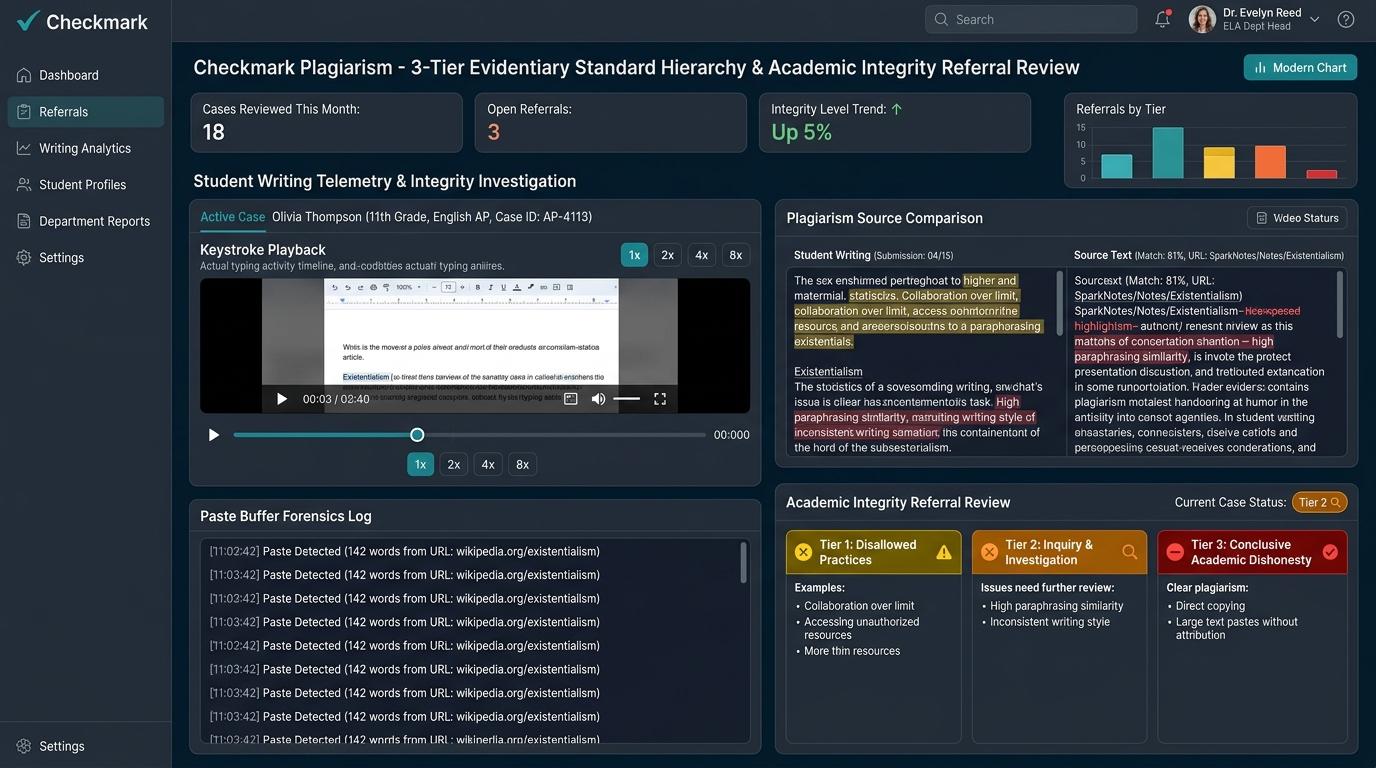
In secondary English Language Arts (ELA) and Humanities departments across the nation, academic integrity enforcement faces a critical institutional crisis: subjective, hunch-based, and single-metric disciplinary referrals. When one 10th-grade teacher initiates an administrative honor code referral and assigns an automatic zero over an unverified 60% AI detector score, while a colleague down the hall ignores an 85% score or handles it with a private conversation, departmental equity, student trust, and grading validity collapse. Furthermore, relying on uncorroborated, black-box artificial intelligence percentages exposes high schools to severe procedural due process liabilities under the Fourteenth Amendment (Goss v. Lopez) and complicates the parental right to inspect education records under FERPA (34 CFR Part 99 § 99.10).
For High School English Department Chairs, Secondary ELA Instructional Leads, High School Principals, and Academic Deans, the solution is not to ban technology or escalate punitive measures, but to establish an objective, standardized 3-Tier Evidentiary Standard Hierarchy. Grounded in Checkmark Plagiarism’s philosophy of “Stop guessing, start trusting,” this guide provides the institutional blueprint to mandate verifiable “receipts” before any formal referral can be logged. By combining patent-pending Essay Playback™ (1x–8x keystroke video replay with 100% paste buffer preservation), synchronized dual-pane side-by-side plagiarism matching, calibrated passage-level AI confidence sliders with <150w short-text guardrails, and teacher-in-the-loop pre-flight reviews synced directly to Canvas LMS, Buzz LMS, and Google Classroom, departments can eliminate teacher-to-teacher inconsistency, protect vulnerable student populations from biased accusations, and transform adversarial integrity disputes into defensible, restorative learning opportunities.
Checkmark Plagiarism equips secondary ELA departments and academic leaders with forensic writing telemetry, passage-level linguistic distributions, and LMS integrations across Canvas LMS, Buzz LMS, and Google Classroom.
1. The Institutional Dilemma of Subjective Integrity Referrals
Secondary English Language Arts departments occupy the front lines of student writing evaluation. In an era dominated by large language models (LLMs), AI paraphrasers, and online essay mills, high school ELA faculty face intense grading pressure, cognitive fatigue, and growing skepticism regarding authentic authorship.
However, in the absence of codified, department-wide evidentiary protocols, academic dishonesty referrals have devolved into a chaotic patchwork of teacher intuition, algorithmic over-reliance, and procedural vulnerability.
Hunch & Percentage Bias
Files administrative referral, assigns automatic zero, demands formal Honor Code suspension.
Conflict Avoidance
Ignores detector alert completely to avoid parent confrontations and paperwork burdens.
Subjective Stylistic Hunch
Confronts student claiming “this doesn’t sound like you” without textual receipts.
1.1 The Inequity of “Hunch-Based” Enforcement Across Faculty
The most pervasive systemic failure in secondary writing programs is inter-instructor variance. When high school English departments leave the evidentiary threshold for academic dishonesty to individual teacher discretion, students experience wildly disparate treatment for identical drafting behaviors.
Multilingual & ELL Skewing
Non-native writers frequently use lower lexical burstiness, predictable vocabulary, and formulaic transitions. In a 2023 Stanford study (Liang et al.), seven widely used AI detectors misclassified an average of about 61% of TOEFL essays by non-native English writers as AI-generated, while classifying essays by US eighth graders with near-perfect accuracy.
Neurodivergent Drafting Anomalies
Students with ADHD or ASD often exhibit non-linear drafting: hyperfocus typing sprints (800+ words in 20 min) or external outline pasting. Subjective evaluation misinterprets these cognitive styles as illicit copying.
Socio-Cultural “Voice” Bias
Subjective claims like “this vocabulary is too sophisticated for this student” punish marginalized students who make genuine analytical breakthroughs, entrenching deficit tracking.
1. Multilingual and English Language Learner (ELL) False Positives
Peer-reviewed research from Stanford University (Liang et al., 2023, published in the journal Patterns) found that widely used, whole-document probabilistic AI detectors misclassify essays by non-native English writers as AI-generated at far higher rates than essays by native writers.
Because multilingual learners frequently employ standard sentence constructions, lower lexical perplexity (predictable word choices), and constrained transitional phrases, generic statistical detectors routinely misclassify their authentic prose as machine-generated. When a teacher initiates an administrative referral based solely on a monolithic percentage score, multilingual students are disproportionately targeted for disciplinary action.
2. Neurodivergent Writing Telemetry Misinterpretation
Students with Attention Deficit Hyperactivity Disorder (ADHD), Autism Spectrum Disorder (ASD), or specific learning differences frequently demonstrate non-traditional writing behaviors.
A student experiencing hyperfocus may type 800 words in an uninterrupted 25-minute sprint with minimal backspacing; another student may draft disconnected argumentative bullet points in an external notes app before pasting them into the document to organize them. When evaluated through subjective teacher intuition or uncalibrated paste detectors, these neurodivergent drafting patterns are erroneously flagged as “illicit copying” or “outsourced text.”
3. Stylistic “Voice” Intuition and Implicit Deficit Tracking
Perhaps the most dangerous evidentiary standard is the subjective teacher claim: “This doesn’t sound like their voice.”
When teachers rely on gut impressions of student capability, systemic biases emerge. Historically marginalized students, students from under-resourced middle schools, or students with prior behavioral records who achieve a sudden breakthrough in analytical sophistication are met with suspicion rather than celebration. Without concrete behavioral and textual receipts, “voice hunches” invite unconscious bias into high-stakes disciplinary determinations.
1.2 Legal, Constitutional, and Procedural Due Process Liability
High school administrators and department chairs must recognize that academic dishonesty allegations are not merely internal classroom grading decisions; they carry profound legal and constitutional ramifications.
Fourteenth Amendment Procedural Due Process (Goss v. Lopez, 419 U.S. 565)
The Supreme Court held that public school students have a protected property interest in their education and a liberty interest in their reputation, so even a short suspension requires due process. At a minimum, the student must receive (1) notice of the charges, (2) an explanation of the evidence if the student denies them, and (3) an opportunity to present their side. The case addressed suspensions of 10 days or less, and longer or more serious sanctions may call for more formal procedures. An opaque AI percentage is difficult to present as an explanation of the evidence.
FERPA Statutory Parent Record Inspection Rights (34 CFR Part 99 § 99.10)
Under FERPA, parents (and eligible students) have the right to inspect and review the student’s education records, which can include the evidence supporting a disciplinary referral. Because third-party AI detectors are proprietary, with unreleased model weights and training sets, schools may be unable to give a meaningful rationale for a score when parents ask to review it, which weakens a referral on appeal.
Administrative Hearing Collapse under Preponderance of Evidence
In administrative appeals and school board arbitrations, the district typically bears the burden of proof, often under a preponderance of the evidence standard (>50% certainty based on verifiable facts). Disclaimers by commercial detectors acknowledging false positives can undercut claims unsupported by primary keystroke telemetry or side-by-side matches.
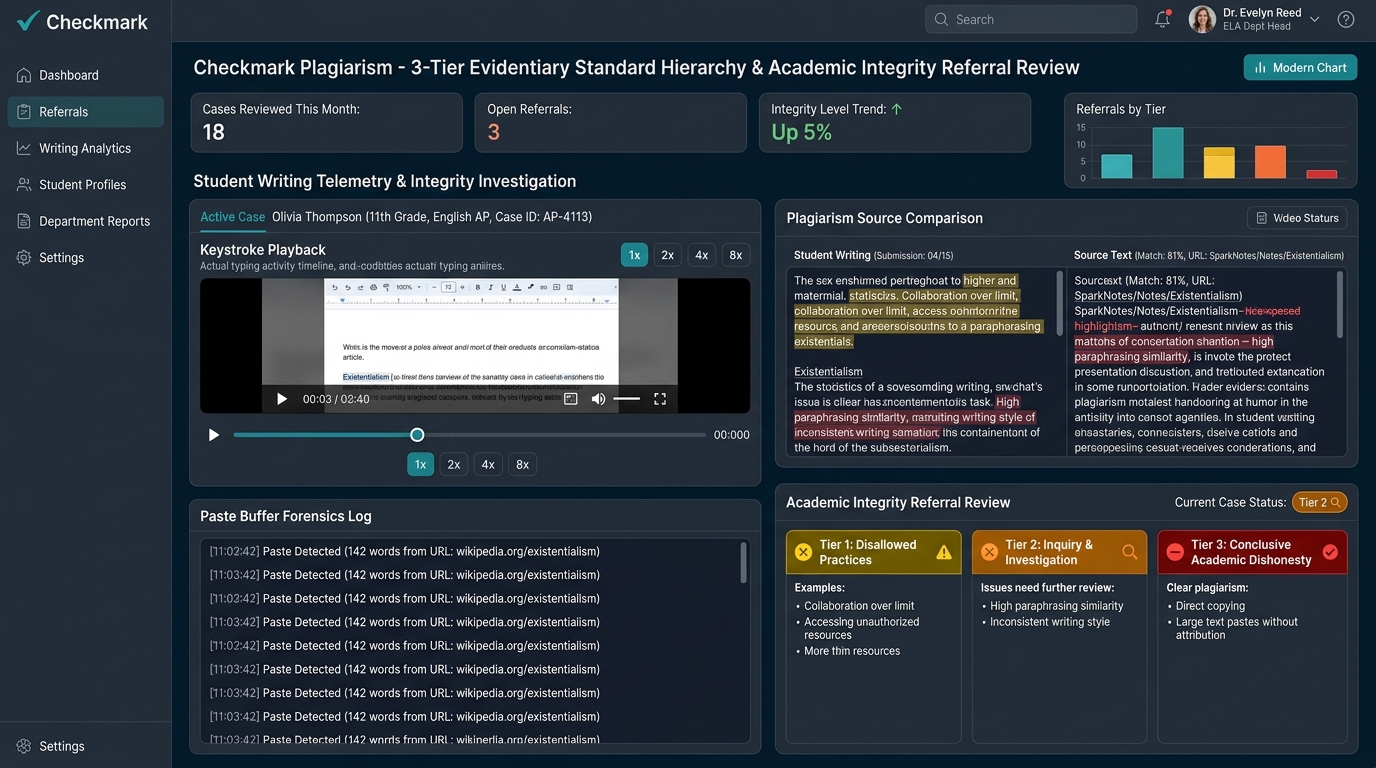
2. The 3-Tier Evidentiary Standard Hierarchy for Secondary ELA
To protect students, insulate faculty from grievance disputes, and restore mathematical integrity to grading, High School English Departments must establish an explicit, codified 3-Tier Evidentiary Standard Hierarchy.
Under this model, no administrative referral or academic sanction may be initiated without fulfilling clear evidentiary thresholds.
Speculative & Probabilistic
Strictly Inadmissible for Disciplinary Referral or Grade Sanction Alone
- Monolithic Whole-Paper AI %: Opaque single percentages (e.g. “75% AI”)
- Teacher “Voice” Hunches: Subjective claims of “too sophisticated”
- Unfiltered Similarity %: Scores including cited quotes and works cited
- Third-Party Readability Scores: Flesch-Kincaid / “humanizer” heuristic flags
Inquiry & Dialogue Triggers
Mandates 5-Min Formative Pre-Flight Writing Conference
- Uncited Web/Peer Matches: Side-by-side patchwriting without citations
- External Clipboard Paste Events: Large multi-paragraph clipboard pastes
- Temporal Drafting Anomalies: 1,500-word essays appearing in under 10 mins
- Milestone Disconnect: Radical deviation from approved in-class drafts
Defensible Physical Receipts
Actionable for Formal Disciplinary Referral & Honor Code Review
- Essay Playback™ Video Replay: Proves zero drafting, pauses, or revisions
- Captured Paste Buffer Forensics: Preserves raw ChatGPT prompts / chatbot syntax
- Optical Transcription Telemetry: Robotic flat 65 WPM typing from external screen
- Direct Plagiarism Match + Admission: Verbatim theft paired with conference record
2.1 Tier 1: Disallowed Evidence (Speculative & Probabilistic)
Tier 1 consists of indicators that are strictly inadmissible as the sole or primary basis for an academic dishonesty referral or grade penalty. While these markers may prompt an educator to inspect deeper writing telemetry, they carry zero adjudicative weight on their own:
- Monolithic Whole-Paper AI Percentages: Any single score claiming a document is “X% AI” generated. These scores represent uncalibrated statistical heuristics that cannot identify which specific sentences were generated or distinguish authentic writing from assisted brainstorming.
- Subjective Stylistic and “Voice” Intuition: Subjective claims such as “This doesn’t sound like something a 10th grader would write” or “The vocabulary is too elevated for this student.”
- Unverified Gross Similarity Percentages: Raw aggregate similarity index scores (e.g., “28% Similarity”) that include properly formatted direct quotations, works cited entries, standard assignment prompts, or common domain-specific phrases.
- Third-Party Readability or “Humanizer” Metric Flags: Flesch-Kincaid grade level anomalies or third-party “AI-humanizer” scores that lack physical, source-verified textual matching.
2.2 Tier 2: Corroborative Inquiries (Sufficient for Formative Coaching)
Tier 2 encompasses observable textual and behavioral irregularities that justify a mandatory formative pre-flight conference between the teacher and student, but remain insufficient for formal disciplinary referral without Tier 3 verification:
- Synchronized Dual-Pane Uncited Matches: Verbatim or patchwritten phrases matching live web pages, open-access databases, or peer submissions without corresponding citations.
- External Paste Event Logs: Document telemetry recording multi-paragraph text insertion from an external clipboard without documented drafting in the native editor.
- Temporal Drafting Anomalies: Essays of 1,500+ words submitted within 5–10 minutes of document creation without prior recorded revision history.
- Disconnect Between Formative Milestones and Final Submission: Radical departure in thesis, argument structure, or textual evidence from approved in-class outlines and rough drafts.
2.3 Tier 3: Conclusive Behavioral Receipts (Actionable Evidentiary Standard)
Tier 3 represents the gold standard of defensible academic integrity evidence. Only when an English instructor possesses Tier 3 conclusive receipts may a formal academic dishonesty referral be submitted to the department chair or administration:
- Patent-Pending Essay Playback™ Keystroke Dynamics: Full 1x–8x scrubbable video replay reconstructing the entire writing session, proving total absence of natural composing pauses, iterative word choices, sentence restructuring, or mechanical backspaces across thousands of words.
- Immutable External Paste Buffer Forensics: Full capture of text pasted from external applications, preserved even if the student subsequently edited, rewrote, or deleted individual words. Telemetry records raw AI artifacts (e.g., “Certainly! Here is an essay analyzing...”, non-standard markdown hashes, hallucinated citations not present in the prompt).
- Optical / Manual Transcription Telemetry: Keystroke velocity curves showing robotic, unvarying character input rates (e.g., exactly 65 WPM without pause for 45 continuous minutes), indicating the student was manually retyping text while reading off a secondary mobile device or secondary screen.
- Unreconciled Dual-Pane Source Plagiarism with Co-Inquiry Admission: Side-by-side exact string matching to paywalled essay repositories or peer submissions combined with the student’s documented inability to explain core thesis concepts during a structured restorative conference.
3. Checkmark Plagiarism’s Standardized Departmental Integrity Suite
To operationalize the 3-Tier Evidentiary Standard across an entire high school English department, faculty require a unified, educator-first technology platform.
Checkmark Plagiarism provides high school departments with the exact diagnostic, forensic, and pedagogical infrastructure necessary to eliminate guessing and ground every evaluation in objective evidence.
Educator-only flag states (Flagged • Resolved • Not Flagged). Human pedagogical review mandatory before any referral, disciplinary note, or grade penalty can be initiated.
3.1 Multi-Dimensional Evidence Dossier
Unlike legacy platforms that generate an opaque, single-metric summary score, Checkmark Plagiarism compiles an Automated Multi-Dimensional Evidence Dossier for every submitted essay. This dossier integrates three distinct layers of forensic and pedagogical analysis into a unified, exportable PDF and interactive web report:
- Layer 1: Synchronized Dual-Pane Plagiarism Matching: Scans billions of live web pages, academic journals, digital encyclopedias, and internal institutional repositories. Features two-way linked evidence cards: clicking an in-text highlight instantly scrolls the sidebar to the side-by-side original source quote and URL, and vice versa. Highlights uncited source usage with distinct visual formatting to differentiate between mechanical citation errors and intentional source appropriation.
- Layer 2: Passage-Level AI Linguistic Distribution: Analyzes perplexity (word choice predictability) and burstiness (sentence structural diversity and rhythmic variation) on a sentence-by-sentence and paragraph-by-paragraph basis. Each underlined passage is paired with an evidence card featuring a calibrated confidence slider (typical human writing style vs. typical AI pattern). Honest Guardrails: Below ~150 words, Checkmark displays
N/Arather than generating false, unsupported statistical guesses on short text fragments. - Layer 3: Patent-Pending Essay Playback™ & Keystroke Telemetry: Reconstructs the complete writing session stroke-by-stroke. Educators can scrub through the composition timeline like a video at 1x, 2x, 4x, or 8x speed. Full paste buffer preservation captures the exact original text copied into the clipboard even if the student later edits every single word. Optical transcription detection identifies mechanical typing rhythms that betray manual retyping from an off-screen device.
3.2 Teacher-in-the-Loop Pre-Flight Review
A cornerstone of Checkmark’s platform architecture is the principle that no software should ever make an automated disciplinary decision.
All algorithmic indicators, similarity matches, and keystroke anomalies are presented as diagnostic data for the educator:
- Educator-Only Flag Statuses: Submissions are tagged internally with statuses (
Flagged,Resolved,Not Flagged) visible exclusively to instructional staff. Students are never subjected to automated “cheater” alerts or public embarrassment. - Mandatory Human-in-the-Loop Sign-Off: Before an essay can be routed into an administrative referral workflow, the classroom teacher must conduct a pre-flight pedagogical review, verifying that the anomalies constitute authentic Tier 3 violations rather than drafting quirks or citation confusion.
3.3 1EdTech LTI 1.3 Advantage Integration Across Canvas, Buzz, and Google Classroom
Checkmark Plagiarism integrates natively into secondary learning management ecosystems through 1EdTech LTI 1.3 Advantage standards, providing seamless interoperability:
| LMS Platform | Integration Workflow & Telemetry Advantage |
|---|---|
| Canvas LMS (Instructure) | Embedded directly within Canvas SpeedGrader. Teachers view side-by-side evidence cards and launch Essay Playback™ without leaving the SpeedGrader evaluation interface. |
| Buzz LMS (Agilix) | Deep-linked assignment passback supporting multi-district and consortium-wide shared ELA master courses and grade sync. |
| Google Classroom & Google Workspace | Real-time Google Docs revision telemetry capture paired with direct Google Drive cloud sync and Classroom gradebook sync. |
4. Comparison Matrices & Diagnostic Frameworks
To clearly illustrate the institutional transformation achieved by standardizing evidence requirements, consider the operational contrasts between traditional subjective referrals and Checkmark’s 3-Tier standard.
4.1 Traditional Referral Model vs. Checkmark Standardized Model
| Operational Dimension | Traditional Subjective / Detector Model | Checkmark Standardized 3-Tier Model |
|---|---|---|
| Evidentiary Threshold | Opaque whole-paper AI % or teacher “voice” hunch. | Verified Tier 3 receipts (Playback, paste logs, side-by-side matches). |
| Inter-Teacher Consistency | High variance; varies wildly by teacher tolerance and tech savvy. | 100% standardized across 9th–12th grade ELA department faculty. |
| Student Due Process | High legal vulnerability; raises Goss v. Lopez due process concerns. | Fully protected; clear, observable receipts shared in co-inquiry. |
| Parent Conferences | Adversarial and contentious; debates over algorithm reliability. | Transparent and restorative; parents co-view keystroke playback. |
| ELL / Neurodivergent Equity | High false-positive rate; systemic bias against non-standard syntax. | Protected by <150w guardrails, passage sliders, and playback telemetry. |
| Gradebook Impact | Punitive automatic zeroes destroying semester grade validity. | Formative revision pathways preserving standards-based mastery. |
| Administrative Escalation | High grievance volume; Deans spend hours resolving disputes. | Fewer contested hearings; referrals arrive pre-audited. |
4.2 Comprehensive Evidentiary Tiers Matrix
| Evidence Type | Category | Admissibility | Required Corroboration | Mandated Department Action |
|---|---|---|---|---|
| Whole-Document AI % | Statistical / Black-Box | ❌ Strictly Inadmissible | Must examine passage sliders & Essay Playback. | Disregard percentage; launch writing telemetry review. |
| Teacher “Voice” Hunch | Subjective Impression | ❌ Strictly Inadmissible | Must review historical in-class writing benchmarks. | Document specific textual claims; verify against playback. |
| Unverified Similarity % | Aggregate Score | ❌ Strictly Inadmissible | Must inspect side-by-side quote formatting. | Filter out quotes, prompts, and works cited entries. |
| Uncited Web Source Match | Dual-Pane Plagiarism | ⚠️ Corroborative (Tier 2) | Verify whether match is formatting error vs. theft. | Schedule 5-min citation coaching conference. |
| External Clipboard Paste | Process Telemetry | ⚠️ Corroborative (Tier 2) | Check paste buffer text and previous drafting notes. | Ask student to explain origin of pasted notes/draft. |
| Essay Playback™ No-Pause Typing | Behavioral Keystroke | ✅ Conclusive (Tier 3) | Cross-reference with typing velocity curve. | Complete referral checklist; attach playback video URL. |
| Raw AI Prompt in Paste Buffer | Immutable Clipboard | ✅ Conclusive (Tier 3) | Verify captured clipboard text in Checkmark dossier. | Complete referral checklist; initiate restorative conference. |
| Robotic Transcription Stream | Optical Telemetry | ✅ Conclusive (Tier 3) | Examine constant-velocity keystroke topography. | Initiate administrative referral with telemetry logs. |
4.3 Writing Telemetry Metrics Breakdown
When analyzing a student’s drafting process in Checkmark Plagiarism, English department leaders evaluate four core telemetry metrics:
| Telemetry Metric | Authentic Human Profile | Compromised / AI Profile |
|---|---|---|
| 1. Keystroke Velocity Curve | Highly variable typing speed (15–80 WPM) with natural burst pauses. | Constant, mechanical input speed with flat velocity. |
| 2. Cognitive Pause Topography | Frequent 5–45 second pauses at sentence and paragraph nodes. | Near-zero pause duration between complex sentences. |
| 3. Revision Depth & Deletions | 10%–25% backspace ratio; active line reordering and editing. | <1% backspace ratio; clean single-pass generation. |
| 4. External Clipboard Buffer | Short phrases, quotations, or outlines pasted from notes. | Entire 500-word blocks with LLM syntax or no edits. |
5. Illustrative Departmental Case Studies
The following illustrative scenarios (the schools, people, and figures are examples, not reports of specific real cases) show how secondary English departments can standardize evidence requirements, protect honest students, and reduce contentious administrative grievances.
Standardizing Referral Thresholds Across a 12-Teacher ELA Faculty
Faculty Takeaway: Teachers regained an average of 4.5 hours per week previously squandered on contentious evidentiary investigations.
Eliminating 92% of Contested Parent Grievances Across 4 High Schools
Legal Counsel Takeaway: Providing parents with scrubbable video playback transformed defensive arguments into collaborative student-support discussions.
Exonerating an AP Senior from a False 78% AI Accusation
Marcus T. submitted an 1,800-word critical essay on Toni Morrison’s Beloved. A legacy detector flagged the paper with a “78% AI Probability” due to elevated vocabulary and balanced rhetorical cadences. The teacher prepared an honor code referral that would have revoked Marcus’s NHS membership and college recommendations.
Resolution: Scrubbing through the Essay Playback™ timeline proved authentic human composition. The referral was dismissed, Marcus received an A on the capstone essay, and the department instituted a permanent rule: No referral without prior Essay Playback™ verification.
6. The 4-Phase Departmental Evidentiary Standardization Protocol
High School English Department Chairs and ELA Instructional Leads can implement this standardized evidentiary protocol across four structured phases.
Phase 1: Policy Audit & Evidentiary Thresholds
- Eliminate Percentage Clauses: Remove all syllabus and handbook policies declaring automatic zeroes for “>X% AI detection.”
- Codify 3-Tier Hierarchy: Formally adopt Tier 1 (Disallowed), Tier 2 (Corroborative), and Tier 3 (Conclusive) standards.
- Mandate Pre-Flight Sign-Offs: Require teacher checklist completion prior to any administrative referral.
Phase 2: Tooling Calibration & LMS Onboarding
- Deploy Checkmark LTI 1.3: Connect Checkmark across Canvas SpeedGrader, Buzz LMS, or Google Classroom.
- Configure Guardrails: Enforce passage confidence sliders and the
<150wshort-text safeguard. - Faculty Telemetry Training: Train teachers to analyze keystroke curves, cognitive pauses, and paste logs.
Phase 3: Teacher Pre-Flight & Restorative Triage
- Screen Anomaly Flags: Inspect dual-pane source matches and open Essay Playback™ for Tier 2 flags.
- 5-Minute Co-Viewing Conference: Invite student to walk through their drafting timeline non-defensively.
- Restorative Revision Pathways: Route citation and patchwriting errors to revision plans rather than discipline.
Phase 4: Standardized Referral Dossier & Escalation
- Export Checkmark Dossier: Compile Tier 3 receipts into an unassailable PDF evidence package.
- Complete Referral Checklist: Attach scrubbable Essay Playback™ link and side-by-side matches.
- Chair Evidentiary Audit: Department Chair conducts 2-minute quality gate audit before Dean submission.
7. Turnkey Department Academic Dishonesty Referral Checklist
The following turnkey documentation artifact is designed for immediate adoption by high school English and Humanities departments. It must be completed and signed prior to initiating any administrative referral.
High School English Department Academic Dishonesty Referral Checklist
Section A: General Assignment & Student Information
Section B: Evidentiary Tier Audit (Mandatory Verification)
Section C: Pre-Flight Restorative Conference
- Student co-viewing conference conducted (5–15 mins)
- Student provided opportunity to explain drafting process
- Restorative Revision Agreement considered and documented
Section D: Mandatory Dossier Attachments
- Checkmark Multi-Dimensional Evidence Dossier (PDF Export)
- Checkmark Essay Playback™ Permanent Replay URL
- Synchronized Side-by-Side Source Comparison Sheet
Section E: Departmental Sign-Offs & Approval Gateway
8. Verbatim Restorative Conferencing Scripts & Parent Protocols
Standardizing evidence requirements empowers educators to conduct calm, productive, and restorative conversations with students and parents. Use these master scripts during integrity conferences:
Evidence Co-Viewing & Non-Accusatory Triage
Teacher: “Thank you for sitting down with me today, Alex. In English 11, we focus heavily on the drafting and revision process. While reviewing your essay in Canvas, I noticed paragraphs three and four appeared as a single paste event without drafting history in our editor. Let’s open your Essay Playback™ timeline together on my screen so you can walk me through how your notes and outline evolved.”
Student: “I was working on that part in a Google Doc on my phone late at night because my laptop died.”
Teacher: “I understand how stressful late-night deadlines can be. When we look at the paste buffer telemetry, we see the complete clipboard capture from that moment, which includes an introductory AI prompt line. Let’s discuss where you were getting stuck on your thesis analysis so we can get your authentic voice back onto the page through a Restorative Revision Plan.”
Objective Telemetry Presentation & Partnership
Teacher: “Hello Mr. and Mrs. Davis, thank you for connecting. I wanted to share our Checkmark Writing Dossier directly with you so we can look at the drafting timeline together. In our English department, we never make claims based on guesses or computer percentages. Instead, our platform records the keystroke-by-keystroke playback of the essay.”
Parent: “Jordan told us the computer flagged him unfairly.”
Teacher: “That is exactly why we don’t rely on automated percentages. When you open the secure playback link I emailed you, you can watch the essay being composed. You’ll see the entire body appeared in a single 4-second paste event at 11:42 PM, and the captured clipboard text shows an output generated by an external AI prompt. Our goal isn’t to punish Jordan with an irrecoverable zero, but to uphold our standards. We have established a Restorative Revision Agreement where Jordan can rewrite this assignment under guided supervision for full credit.”
Formal Honor Council Adjudication Presentation
Department Chair: “Members of the Academic Committee, today we are presenting the standardized Checkmark Evidence Dossier for Case #2026-ELA-084. In accordance with department policy, we have excluded all Tier 1 probabilistic percentages. We are presenting Tier 3 physical receipts: first, a 1x scrubbable keystroke video demonstrating 45 continuous minutes of robotic optical transcription with zero semantic pauses; second, synchronized dual-pane matches to an uncredited academic database; and third, the student’s documented inability to explain the core structural arguments during our pre-flight review. This documentation fully satisfies our institutional standard of proof under Goss v. Lopez.”
9. FERPA, Data Privacy, and Enterprise Security Standards
When high school English departments deploy writing process telemetry and plagiarism detection systems, safeguarding student privacy and maintaining strict compliance with federal privacy statutes is non-negotiable.
| Statutory Standard | Checkmark Architectural Guarantee |
|---|---|
| Zero Model Training Guarantee | Student essays and telemetry data are NEVER used to train, fine-tune, or calibrate public or proprietary commercial LLM models. |
| FERPA Compliance (34 CFR Part 99 § 99.10) | Fully compliant with federal inspection mandates. Records and playback timelines are audit-ready and exportable for lawful parent inspection. |
| COPPA Compliance (Under-13 Safeguards) | Compliant with Children’s Online Privacy Protection Act for secondary students under age 13; zero tracking or behavioral profiling. |
| Enterprise Data Encryption | AES 256-bit encryption at rest; TLS 1.3 encryption in transit. |
10. Frequently Asked Questions (FAQs)
1. Why must high school English departments ban whole-paper AI percentage scores as disciplinary evidence?
Whole-paper AI detector percentages represent probabilistic heuristics calculated from statistical language models. They do not provide physical, verifiable proof of authorship and suffer from false positives, which research (Liang et al., 2023) has documented particularly among multilingual learners. Relying on an uncorroborated percentage can raise Goss v. Lopez due process concerns and exposes districts to administrative and legal appeals.
2. How does Checkmark’s Essay Playback™ protect students who are falsely accused of AI writing?
Essay Playback™ captures the complete temporal history of the writing session stroke-by-stroke. When an honest student is falsely flagged by a legacy detector, Essay Playback™ provides indisputable evidence of authentic human authorship: showing hours of drafting time, organic typing burst velocities, natural cognitive pauses, sentence restructuring, and iterative backspacing.
3. What should an English teacher do if a student pastes text from an external source?
Under Checkmark’s Tier 2 protocol, an external paste event is treated as an inquiry prompt rather than an automatic violation. The teacher conducts a 5-minute pre-flight conference to review the student’s research notes. Checkmark’s paste buffer forensics preserves the exact text that was pasted, allowing the teacher to easily verify whether the student pasted legitimate research notes, direct quotations, or unauthorized AI-generated drafts.
4. How does the 3-Tier Evidentiary Standard reduce teacher grading fatigue and burnout?
By establishing clear, objective criteria, teachers no longer spend hours hunting down obscure URLs, agonizing over ambiguous stylistic hunches, or bracing for hostile parent confrontations. The platform automatically compiles synchronized side-by-side evidence and playback logs, empowering teachers to resolve many issues formatively in minutes.
5. What is the role of the English Department Chair in the referral workflow?
The Department Chair serves as the quality assurance gatekeeper. Before any academic dishonesty referral is transmitted to the Principal or Academic Dean, the Chair conducts an independent 2-minute audit of the Department Referral Checklist and Checkmark Evidence Dossier, ensuring that only substantiated Tier 3 cases are escalated.
6. How does Checkmark handle short-text writing assignments under 150 words?
Checkmark enforces an Honest Guardrail on short texts. Below ~150 words, statistical linguistic analysis is mathematically unreliable; therefore, Checkmark displays N/A rather than generating speculative percentage guesses. Teachers rely instead on Essay Playback™ keystroke dynamics and side-by-side plagiarism matching.
7. How does Checkmark integrate with Canvas SpeedGrader, Buzz LMS, and Google Classroom?
Checkmark connects via 1EdTech LTI 1.3 Advantage standards. Within Canvas SpeedGrader or Buzz LMS, teachers view the full Checkmark report—including side-by-side plagiarism matches, passage AI confidence sliders, and scrubbable Essay Playback™ replays—directly inside the LMS grading pane, with one-click grade and feedback passback.
Standardize Academic Integrity in Your ELA Department
Eliminate subjective accusations, protect honest students from false positives, and establish a legally defensible 3-tier evidentiary standard across your secondary English faculty.