
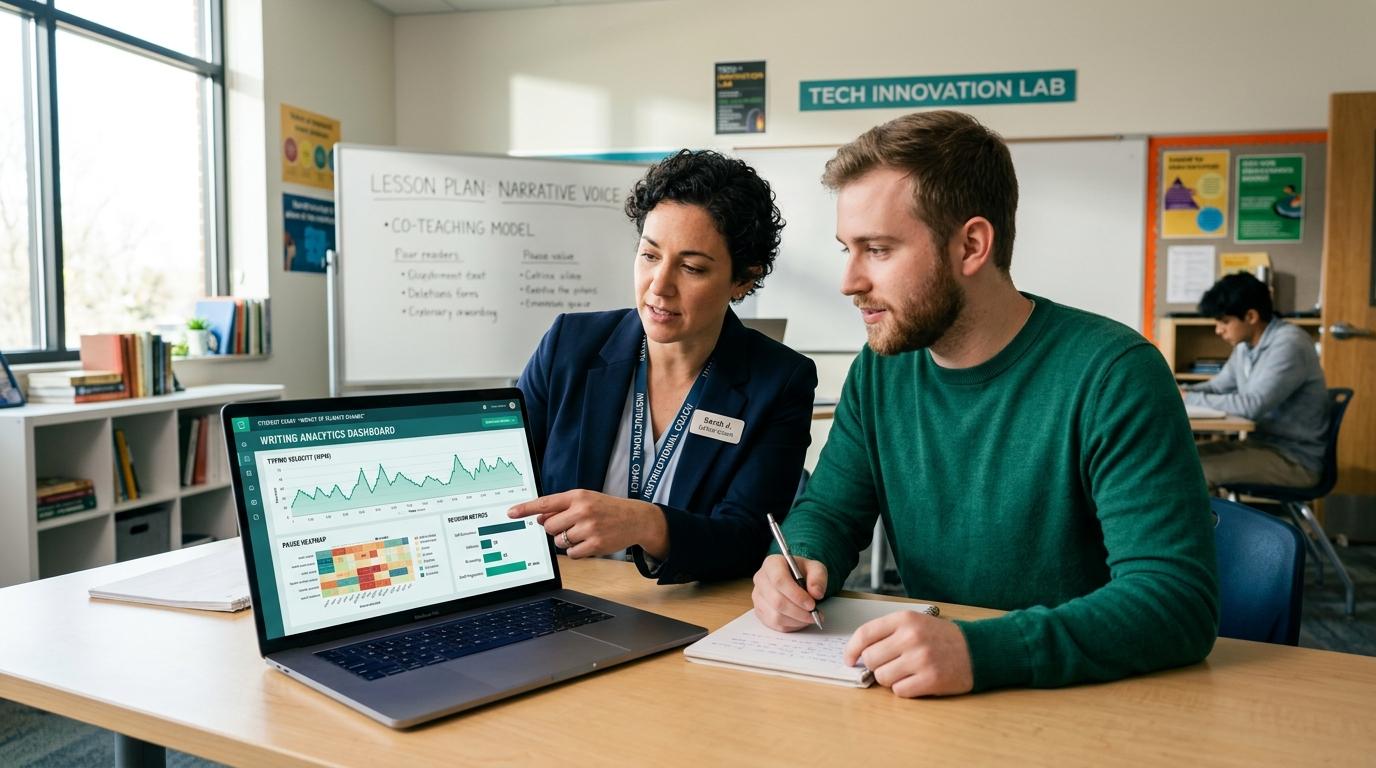
For District Instructional Technology Coaches (ITCs), Digital Learning Specialists, Academic Deans, and Humanities Department Chairs, the proliferation of generative AI tools and automated writing assistants has created a profound instructional dilemma. When secondary and higher education institutions first encounter keystroke logging and writing replay technologies, faculty instincts frequently lean toward forensic surveillance: treating temporal telemetry exclusively as punitive proof of academic misconduct. However, framing writing analytics as a digital panopticon alienates students, heightens writing anxiety, and destroys the teacher-student trust essential for authentic literacy growth.
This authoritative guide outlines how district coaches can lead a transformative professional development shift—training educators to repurpose patent-pending Essay Playback™ writing telemetry into an indispensable formative diagnostic tool for 1-on-1 student writing conferences. By equipping faculty to read the digital “X-ray of the writing mind”—diagnosing Cognitive Revision Stalls, distinguishing Superficial from Substantive Revision Churn, and verifying Paste Buffer Provenance—coaches empower teachers to conduct high-impact, 3-stage formative conferences that elevate student metacognition, accelerate draft quality, and replace adversarial confrontation with transparent, growth-oriented coaching.
Checkmark Plagiarism equips school districts and university departments with an educator-first writing integrity suite: combining patent-pending Essay Playback™ (1x–8x keystroke video replay), external paste buffer provenance inspection, calibrated passage-level AI confidence sliders with <150w short-text guardrails, synchronized dual-pane plagiarism checks, and teacher-in-the-loop rubric autograding with direct LTI 1.3 synchronization to Canvas LMS and Agilix Buzz LMS.

1. The Crisis in Secondary & Higher Ed Writing Conferences: The Pitfalls of “Gotcha” Surveillance vs. Formative Diagnostics
In the contemporary humanities, English Language Arts (ELA), and college composition classroom, 1-on-1 writing conferences represent the single most effective pedagogical intervention for developing advanced writing competencies. Decades of composition research consistently affirm that individualized formative feedback delivered while a student is actively drafting produces dramatically higher learning gains than evaluative comments scribbled across a finalized summative essay.
Yet, despite their proven pedagogical power, traditional writing conferences are plagued by a fundamental structural blind spot: educators only see the static final artifact, never the cognitive journey that produced it.
- Polished, static paragraphs submitted on a screen
- Grammatical surface errors and sentence fragments
- Missing counterarguments, warrants, or citations
- Final word count and document layout formatting
- Where did the student experience severe writer's block?
- Which conceptual claims caused drafting friction?
- Was drafting organic and fluent or fragmented and toxic?
- What content was pasted vs. authentically composed?
Teacher spends 4 minutes reading raw prose cold • Surface-level critique of mechanical flaws • Speculative guesses regarding student thinking • Student nods passively without activating authentic metacognition
The Static Artifact Dilemma and the Rise of Generative AI
When an educator sits down with a student for a brief 5-to-7-minute conference, they are forced to spend the vast majority of the time reading unfamiliar prose cold and formulating post-hoc hypotheses:
- Why is the third paragraph underdeveloped? Did the student run out of time, fail to comprehend the primary source document, or lose their analytical line of reasoning?
- Why is the thesis statement so vague? Is the student struggling with conceptual synthesis, or did they draft the thesis five minutes before the bell rang?
- Why does the tone shift abruptly in the conclusion? Did the student consult an external LLM, paste an uncredited summary from the web, or experience an authentic breakthrough in authorial voice?
With the ubiquitous availability of large language models (LLMs) such as ChatGPT, Claude, and Gemini, this evaluation gap has intensified into an acute crisis of instructional confidence. Faced with polished, syntactically complex prose that may not reflect student capability, faculty frequently resort to one of two destructive behaviors:
- The Cynical Accusation: Relying on opaque, whole-paper AI detection percentages to interrogate students, generating defensive confrontations that permanently fracture educator-student rapport.
- The Superficial Pass: Ignoring deeper process gaps entirely and correcting surface-level punctuation, leaving core cognitive and structural deficiencies unaddressed.
The Panopticon Risk: Keystroke Telemetry as Forensic Surveillance
As school districts deploy keystroke tracking and document version history tools to restore integrity, District Instructional Technology Coaches encounter a critical cultural hazard: the weaponization of telemetry.
When administrators and faculty introduce keystroke replay solely as an integrity audit tool—proclaiming, “We are recording your keystrokes so we know if you cheat”—they establish a digital panopticon. This punitive framing triggers severe unintended consequences:
Students perceive telemetry as institutional surveillance, inducing anxiety and incentivizing counter-evasion tactics such as manual transcription from phones or secondary monitors.
Reluctant and neurodivergent writers become terrified of pausing to brainstorm or experimenting with non-linear drafting, fearing irregular typing cadences will trigger suspicion.
Educators are forced into the exhausting role of digital forensic detectives and police officers, pulling them away from their core calling as empathetic writing mentors.
Premise: Retributive / Distrust-Grounded
- Motto: “We are watching your keystrokes to catch dishonesty.”
- Visibility: Replay tool is hidden until an accusation is levied.
- Target: Focuses exclusively on paste flags and typing speed anomalies.
- Atmosphere: Student feels interrogated, trapped, and defensive.
- Outcome: Resentment, heightened anxiety, sophisticated evasion.
Premise: Developmental / Growth-Grounded (Checkmark)
- Motto: “Let’s look at your drafting journey to see how you solved problems.”
- Visibility: Replay tool is co-viewed openly during writing conferences.
- Target: Focuses on pause topography, revision breadth, and cognitive flow.
- Atmosphere: Student is empowered to self-narrate decision-making.
- Outcome: Metacognitive awareness, revision stamina, student-teacher trust.
The Coach's Mandate: Reframing Telemetry as the “X-Ray of the Writing Mind”
District Instructional Technology Coaches must lead the professional development charge to reframe writing process telemetry across secondary and higher education campuses. Keystroke playback is not a digital polygraph; it is an X-ray of the human writing mind.
Just as a physical therapist uses dynamic motion capture to diagnose muscular imbalances rather than accuse an athlete of poor posture, a composition educator uses Checkmark Essay Playback™ to diagnose cognitive stalls, drafting friction, and revision strategies in real time.
Students know their authentic effort, late-night drafting struggles, and non-linear revisions are visible, validated, and celebrated.
Teachers eliminate conference guesswork, pinpointing exact moments of analytical friction in under one minute before meeting the writer.
Students co-view their replay, narrating their authorial choices and developing deep awareness of their personal composing habits.
2. Deconstructing Writing Telemetry: The 3 Core Diagnostic Signals Coaches Must Teach Faculty
To conduct effective formative writing conferences, teachers do not need to spend hours watching entire drafting sessions in real time. Instructional Technology Coaches must train faculty to interpret writing process telemetry through three high-yield diagnostic patterns:
Pause Topography • Idle Intervals
15–45 minute idle gaps occurring immediately prior to thesis statements or topic transitions, signaling acute cognitive overload.
Faigley-Witte Taxonomy
Distinguishing superficial local synonym swapping from macrostructural paragraph additions, deletions, and structural reorganizations.
Clipboard Buffer Topography
Differentiating pre-writing outline imports and legitimate direct quotes from unapproved full-essay generative AI dumps.
Signal 1: Cognitive Revision Stalls (Pause Topography & Idle Intervals)
One of the most revealing indicators captured by Checkmark Essay Playback™ is pause topography—the spatial and temporal distribution of typing pauses throughout a drafting session.
In expert writers, brief pauses (2 to 10 seconds) occur naturally at clause and sentence boundaries as the writer plans immediate syntax. However, when telemetry reveals prolonged idle pauses (15 to 45 minutes) occurring immediately prior to critical structural elements, it signals acute cognitive overload or writer's block.
A student writes an introductory hook, types three words of a thesis statement, pauses for 32 minutes with zero keystrokes, deletes the words, and pauses for another 15 minutes.
Diagnostic Insight:
The student understands where the thesis belongs but lacks a clear analytical line of reasoning or cannot synthesize conflicting evidence.
Formative Coaching Move:
“I noticed you spent half an hour thinking right here before your thesis. What were the two competing ideas you were wrestling with?”
A student inserts a direct quotation from a historical document or novel, followed by a 20-minute gap with erratic single-word drafting and deletion cycles.
Diagnostic Insight:
The student knows how to cite evidence but lacks analytical transition verbs (e.g., corroborates, complicates, underscores) to bridge the quotation into their broader argument.
Formative Coaching Move:
The teacher provides targeted sentence frames and analytical warrants tailored to quotation integration.
Signal 2: Superficial vs. Substantive Revision Churn (The Faigley-Witte Taxonomy)
Composition researchers Lester Faigley and Stephen Witte established a foundational distinction in writing pedagogy between Surface Changes (orthographic corrections, word substitutions that do not alter meaning) and Text-Based Changes (macrostructural additions, deletions, and reorganizations that transform the underlying argument).
Without writing telemetry, secondary teachers cannot distinguish between an active reviser and a student caught in non-productive revision churn. Checkmark’s scrubbable playback makes this distinction immediately visible:
- 45 minutes spent tweaking synonyms in paragraph 1
- Swapping “good” for “beneficial” repeatedly
- Fixing minor punctuation without altering claim logic
- Word count remains identical; argument unchanged
- Telemetry: Rapid localized cursor jitter and micro-swaps
- Student cuts an entire weak paragraph boldly
- Re-sequences claims based on logical hierarchy
- Drafts a fresh counterargument paragraph
- Expands analytical warrants by 300 words
- Telemetry: Broad deletions followed by generative typing blocks
Coaching the Two Types of Churn:
- The “Thesaurus Spinner” (Superficial Churn): A student spends 40 minutes cycling through right-click synonym replacements on adjectives without clarifying their thesis. The coach trains faculty to use playback to show the student how localized tinkering prevents them from addressing global structural clarity.
- The “Reluctant Deleter”: A student writes a flawed argument in Draft 1 and, despite realizing it contradicts their evidence, refuses to delete it because of the sunk-cost fallacy of typing effort. The teacher uses Essay Playback™ to validate the effort: “Look at how quickly you generated these 200 words. You have the typing stamina; let’s boldly cut this section and rebuild it around your stronger second point.”
Signal 3: Paste Buffer Provenance (Clipboard Topography)
The sudden appearance of large blocks of text in a digital document is often the primary trigger for plagiarism investigations. However, coaches must train faculty to recognize that paste events are not inherently unethical.
In contemporary digital composition, proficient writers frequently compose across multiple tabs, graphic organizers, research notes, and speech-to-text brainstorming apps. Checkmark Plagiarism’s External Paste Buffer Inspector preserves 100% of clipboard text, timestamping the exact insertion point and retaining the original source text even if the student subsequently edits, paraphrases, or deletes the content.
- Bulleted, informal text pasted into draft
- Followed by 20 min of sentence expansion
- Action: Praise planning habit
- 60-word clean excerpt from library database
- Student immediately types analysis around quote
- Action: Coach citation syntax
- 500-word fully formed essay with formulaic prose
- Zero subsequent edits or structural revisions
- Action: Restorative conference
Diagnostic Telemetry Summary Matrix
The following matrix provides district coaches and classroom educators with a quick-reference guide for translating telemetry signals into formative instructional actions:
| Telemetry Signal | Typical Punitive Interpretation | Checkmark Diagnostic Insight | High-Impact Coaching Action |
|---|---|---|---|
| 30-min idle pause before Paragraph 2 | “Student was off-task or distracted.” | Cognitive Overload / Topic Transition Barrier: Student cannot connect context to claim. | Ask: “What was the hardest choice you faced when connecting your background info to your primary claim right here?” |
| 15 rapid deletions and rewrites of 1 sentence | “Student lacks confidence; poor typing skills.” | Syntactic Wrestling / Line of Reasoning Friction: Actively refining precision and voice. | Praise effort: “I love how you experimented with three different verbs here. Let's examine why version 2 was the strongest.” |
| Instant paste of a 150-word block | “Immediate plagiarism flag; copied from unauthorized source.” | Outline Migration vs. Uncited Sourcing: Inspect paste buffer to verify notes vs. source text. | Click “Inspect Clipboard”: If notes, celebrate pre-writing; if source material, coach signal phrases and quotation marks. |
| High typing velocity with zero backspaces for 500w | “Student is a fast, confident typist.” | Transcription Alert: Student is likely hand-typing while reading off an unapproved phone screen. | Co-view replay at 2x: “Walk me through your drafting here. You typed without a single pause—were you retyping an earlier draft?” |
| Passage slider flags conclusion paragraph (88%) | “Student cheated on the conclusion; assign zero.” | Conclusion Fatigue / AI Assistance: Student ran out of cognitive stamina at session end. | Review prompt: “Your first 3 paragraphs show authentic drafting voice. What happened at the conclusion? Did you seek outside help?” |
3. The 3-Stage Formative Writing Conference Model Powered by Writing Telemetry
To operationalize writing telemetry without overwhelming teachers or exceeding short conference timeframes, district coaches train faculty on the 3-Stage Formative Telemetry Conference Model. This structured framework compresses conference prep to 60 seconds and structures a high-impact, 6-minute student interaction:
Teacher opens Checkmark inside Canvas SpeedGrader / Buzz LMS • Scans typing velocity curve, pause heatmap, and paste events • Selects 1 or 2 high-leverage timestamps to investigate.
Screen placed between teacher and student • Plays Checkmark Playback™ at 2x–4x speed • Metacognitive prompt: “Walk me through what you were thinking right here...” • Student self-narrates cognitive journey.
Teacher provides a single targeted revision prompt tied to rubric criteria • Student logs action item on Restorative Revision Agreement (RRA) • Draft rubric scores updated in LMS with quote justifications.
Stage 1: The 60-Second Pre-Conference Telemetry Scan
Before calling the student to the conference table, the educator spends exactly one minute reviewing the submission's visual telemetry dashboard inside their LMS (Canvas SpeedGrader, Agilix Buzz, Schoology, or Google Classroom):
- Velocity & Session Overview: The teacher checks total active drafting time (e.g., 2 hours 15 minutes across 3 distinct sessions) and typing velocity (words per minute curve).
- Pause Heatmap Audit: The teacher identifies the longest idle pause (e.g., a 28-minute stall between paragraph 1 and paragraph 2).
- Paste Buffer Triage: The teacher clicks red paste flags to inspect preserved clipboard text, confirming whether it represents graphic organizer notes, quotations, or external text.
- Passage-Level AI & Plagiarism Scan: The teacher reviews calibrated passage-level sliders, noting if any specific section requires authentic voice verification.
By spending 60 seconds on this pre-flight scan, the teacher enters the conference with complete situational awareness, eliminating the need to spend conference time reading raw text from scratch.
Stage 2: Student-Led Replay Co-Viewing
Stage 2 represents the pedagogical core of the model. The teacher places the laptop or tablet between themselves and the student, creating a collaborative, side-by-side co-viewing environment.
Instead of lecturing, the teacher launches Checkmark Essay Playback™ at 2x or 4x speed, jumping directly to the timestamp identified in Stage 1, and invites the student to take the lead:
“Let’s take a look at your writing replay. I’m going to scrub forward to the 35-minute mark right where you were finishing your second body paragraph. Watch what happens here on screen, and walk me through what was going through your mind.”
Watching one’s own drafting process on video externalizes internal cognitive struggles. Students observe their hesitations, gaining objective perspective.
Because the teacher is not making an accusation, the student does not activate defensive barriers. The student sees the objective record and explains their thinking.
Students articulate deep insights: “Right there I realized my quote proved the opposite of my thesis, so I was stuck figuring out how to rebuild it.”
Stage 3: Targeted Micro-Intervention & Rubric Action Plan
In the final two minutes of the conference, the teacher channels the student's metacognitive realization into an actionable, rubric-anchored revision plan.
Rather than giving broad advice like “Improve your analysis,” the teacher deploys a Targeted Micro-Intervention:
- For a Thesis Stall: Provide a 3-part thesis scaffold: [Although X counter-argument], [Y main claim], [because Z evidence line of reasoning].
- For Superficial Revision Churn: Challenge the student to execute one “macro-cut”—deleting an entire redundant paragraph and drafting a fresh counter-argument claim in its place.
- For Uncited Paste Material: Model the integration of a formal signal phrase and MLA/APA parenthetical citation directly into the document editor.
4. Checkmark Plagiarism’s Integrated Formative Telemetry & Integrity Suite
To support district-wide implementation of formative writing conferences, Checkmark Plagiarism provides a purpose-built, educator-first software architecture. Unlike standalone, punitive plagiarism checkers or opaque whole-essay AI detectors, Checkmark delivers a unified multi-evidence ecosystem designed specifically for formative coaching:

- Dynamic Keystroke Replay: Reconstructs the complete composition journey millisecond by millisecond at 1x, 2x, 4x, or 8x speed.
- Typing Cadence Graphs: Visualizes natural bursts of human writing fluency contrasted with mechanical transcription.
- Pause Topography: Automatically maps idle pauses across document sections, highlighting cognitive bottlenecks for quick targeting.
- 100% Text Preservation: Captures and permanently stores raw clipboard content upon paste events.
- Tamper-Proof Provenance: Retains original clipboard payload even if the student backspaces or rewrites every word.
- Direct Context Jumping: Snaps playback viewer to the exact millisecond and paragraph where the paste occurred.
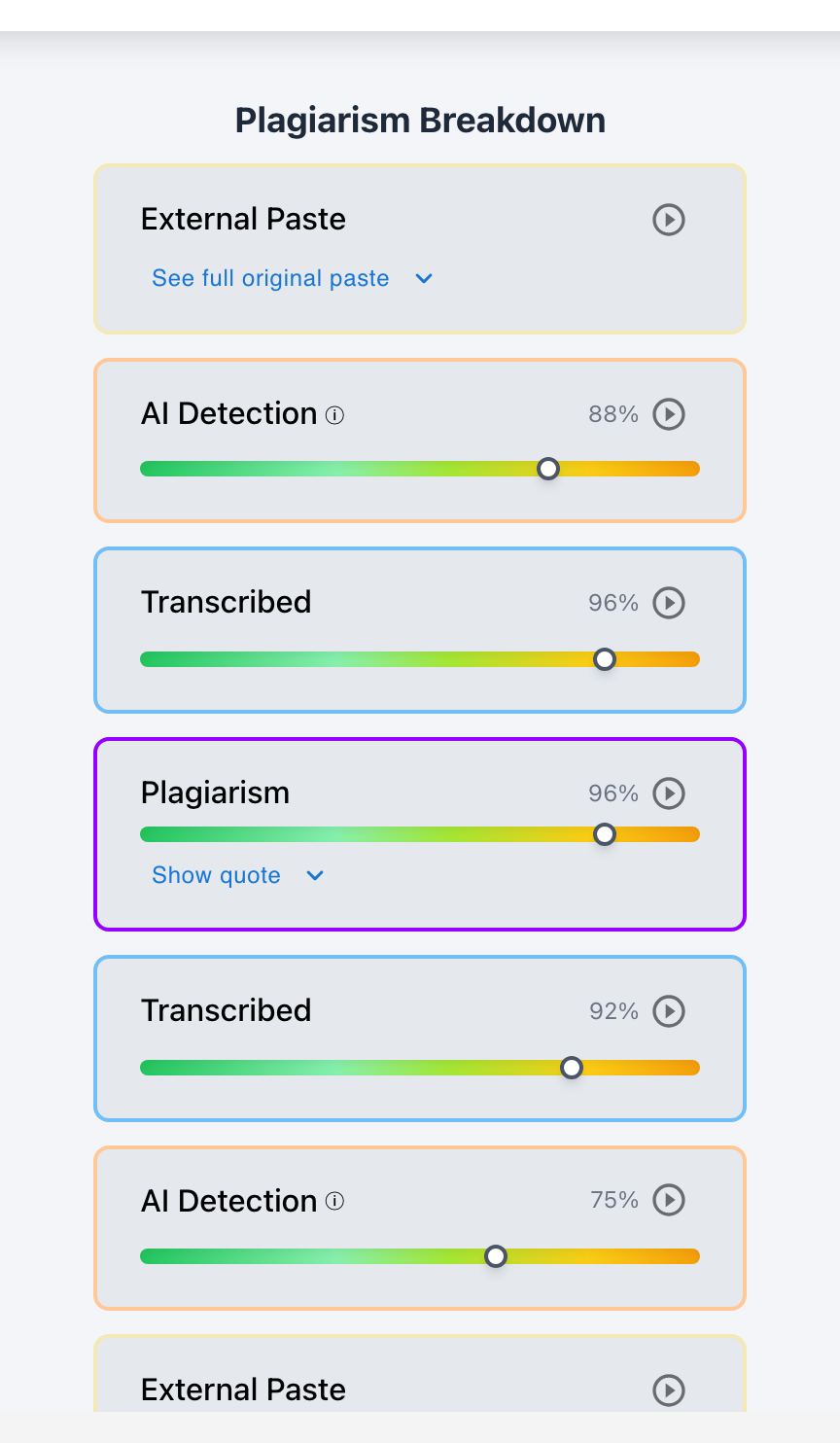
- Granular Confidence Sliders: Evaluates text passage by passage, providing sentence-level perplexity and burstiness metrics.
- Honest <150w Short-Text Guardrails: Displays
N/Aon statistically insufficient samples to prevent false accusations. - Educator-Only Flag Visibility: Flags remain private to the educator's dashboard, ensuring students are never prematurely stigmatized.
- AST Rubric Parsing: Parses district and state rubrics into structured evaluation nodes.
- Quote-Anchored Justifications: Extracts verbatim textual quotes grounding each draft score in empirical evidence.
- LTI 1.3 Advantage AGS 2.0: Certified two-way synchronization with Canvas SpeedGrader, Agilix Buzz, Schoology, and Google Classroom.
5. The 4-Phase District Instructional Coaching Workshop Blueprint
To train faculty across a multi-campus school district or university department, District Instructional Technology Coaches should implement the following 4-Phase Professional Development Workshop Blueprint:
- The “Panopticon vs. Diagnostic” paradigm shift
- Empathy drafting exercise: Faculty experience keystroke recording
- Establishing district norms for non-punitive formative telemetry
- Hands-on analysis of authentic Checkmark Playback artifacts
- Artifact sorting activity: 5 distinct student writing scenarios
- 45-second pre-flight diagnostic triage drills
- Fishbowl coaching demo: 6-minute Stage 2 conference
- Peer roleplaying using word-for-word restorative dialogue scripts
- Calibrating micro-interventions against common rubric criteria
- Configuring Checkmark inside Canvas SpeedGrader and Buzz LMS
- Practicing 60-second pre-conference scans in live gradebooks
- Establishing departmental conference scheduling protocols
6. Turnkey Formative Telemetry Conference Guidebook & Restorative Dialogue Scripts
To support immediate classroom execution, district coaches should distribute this turnkey conference guidebook and dialogue toolkit to all humanities, ELA, and STEM writing faculty.
The Pre-Conference Quick-Scan Checklist (60 Seconds)
Verbatim Restorative Dialogue Scripts
Context: Student stalled for 32 minutes at the end of the intro paragraph, typing and deleting 3 different thesis statements.
Teacher Dialogue:
“Thanks for sitting down with me today, Marcus. I was looking at your Checkmark Essay Playback, and I noticed something fascinating right around the 18-minute mark. Let’s watch the replay together at 2x speed. Look right here: you wrote a great background hook about the Industrial Revolution, but then you paused for about 30 minutes, typed a sentence, deleted it, and paused again. Walk me through what was happening in your head during that half-hour.”
Student Response (Typical):
“I knew I was supposed to say whether urbanization was positive or negative, but the child labor evidence made it seem bad, while the economic growth documents made it seem good, and I didn't know how to choose.”
Targeted Micro-Intervention:
“That hesitation is actually the sign of a sophisticated historian! You recognized that the evidence is complex. Instead of choosing all-or-nothing, let's write a complex thesis: 'Although urbanization stimulated unprecedented economic expansion, it simultaneously exacerbated urban poverty and labor exploitation.' Let's draft that line of reasoning together right now.”
Context: Student spent 45 minutes on Draft 2 changing words with a thesaurus but made zero structural changes to an underdeveloped argument.
Teacher Dialogue:
“Elena, let’s scrub through your revision session on Checkmark Playback at 4x speed. Watch the cursor movements here. You spent almost 45 minutes refining individual adjectives in your first paragraph—changing 'big' to 'immense' and 'bad' to 'detrimental.' But notice how your third body paragraph about renewable energy is still only three sentences long. Why do you think you focused so much energy on polishing word choices in paragraph 1 rather than building out the argument in paragraph 3?”
Student Response:
“I was scared that if I tried to add more evidence in paragraph 3, I’d mess up the flow, so I just wanted to make paragraph 1 sound really smart.”
Targeted Micro-Intervention:
“Your vocabulary is already strong. Real academic power comes from the depth of your evidence. For the next 15 minutes, I want you to ignore word choices completely. We are going to add two specific pieces of data to paragraph 3 using this Claim-Evidence-Reasoning frame.”
Context: Telemetry indicates a 250-word paste event at minute 4 of the drafting session.
Teacher Dialogue:
“Jayden, when I looked at your writing timeline, I noticed a large paste event right at the start of your session. When I clicked Checkmark's Paste Inspector, it showed me this bulleted outline. Tell me about where these notes came from and how you used them to draft your paper.”
Student Response:
“That was my graphic organizer from our library research day on Tuesday. I took notes in Google Keep and pasted them over so I wouldn't forget my points.”
Teacher Affirmation & Coaching:
“That is an outstanding pre-writing habit. Notice how your drafting speed increased right after you imported those notes because you already had your roadmap. Next time, let's make sure you link your sources next to those bullet points so you can drop your in-text citations in as you write.”
Context: Checkmark's calibrated passage slider flagged conclusion (85% AI confidence), while paragraphs 1–4 show authentic typing dynamics and zero flags.
Teacher Dialogue:
“Sofia, let’s look at your Checkmark writing report together. Your first four paragraphs show a wonderful authentic drafting journey—we can see your brainstorming pauses, your revisions, and your unique voice. When we look at the conclusion paragraph, however, Checkmark’s passage slider highlighted a noticeable shift in linguistic rhythm, and your keystroke history shows this entire 180-word conclusion appeared in three seconds with zero drafting pauses. Can you walk me through what happened when you reached the end of this assignment?”
Student Response:
“It was 11:30 PM the night before it was due. I was so exhausted and stressed about my chemistry test that I asked ChatGPT to write a concluding summary for me. I'm sorry.”
Restorative Resolution:
“Thank you for your honesty, Sofia. Academic exhaustion is real, but outsourcing your voice means you miss out on synthesizing your own ideas. Because the rest of your essay is authentically yours, we are not going to treat this as a punitive referral. Here is our Restorative Revision Agreement: you will delete this conclusion right now, and you have 24 hours to write a fresh 4-sentence conclusion in your own voice using our synthesis checklist. Let's draft the first sentence together before you leave.”
Restorative Revision Agreement (RRA) Template
7. Real-World District Coaching Case Studies
Secondary ELA Sprint: 120 teachers trained on 3-Stage Formative Telemetry Conferences via Canvas LMS.
- 68% Drop in Misconduct Referrals: Replaced punitive write-ups with RRAs.
- 300% Boost in Multi-Draft Submissions: Assignment completion surged to 91%.
- Zero Parent Integrity Appeals: Disputes resolved transparently in 15 min.
Peer-Tutor Replay Lab: 35 peer tutors trained to use 4x playback during initial triage.
- Tutors used pause heatmaps to celebrate student brainstorming pauses and validate effort.
- Tutee satisfaction ratings jumped by 52%.
- Repeat student visits doubled over one academic year.
1st-Year 10th Grade ELA: 165 students across 5 periods; overwhelmed by grading times.
- Reduced individual conference prep time from 15 minutes to 60 seconds.
- Conducted 100% of student conferences within contractual hours.
- Completely eliminated grading burnout.
8. Privacy, Ethics, and District FERPA Compliance
When school districts adopt advanced writing telemetry and automated rubric evaluation platforms, District Technology Directors, Privacy Officers, and Instructional Coaches must ensure absolute compliance with federal and state student privacy regulations.
Student writing and keystroke logs are never used to train foundation models. Legally binding vendor agreements protect student intellectual property.
Telemetry processed in isolated, encrypted cloud pods without caching student essays in public LLM repositories or external databases.
Zero commercial data monetization. Fully compliant with California SDPC, Texas NDPA, and New York Ed Law 2-D. District retains 100% data ownership.
9. Frequently Asked Questions (7 Targeted FAQs for Coaches, Faculty, and District Leaders)
Coaches train faculty on the 60-Second Pre-Conference Scan protocol. Teachers do not watch entire writing sessions in real time; they open Checkmark inside Canvas SpeedGrader or Buzz LMS, scan the visual velocity curve and pause heatmap in 30 seconds, and scrub directly to one or two high-leverage timestamps (e.g., a 25-minute stall or major paste). This pre-flight scan actually saves time by eliminating the need to spend conference minutes reading cold text.
The key lies in transparent framing and student-led narration. Coaches train teachers to introduce playback at the beginning of the semester as a supportive diagnostic tool—the “X-ray of the writing mind.” During conferences, the teacher places the screen between them and invites the student to drive the replay: “Let's look at your drafting journey together. Walk me through what you were thinking right here.” Framing telemetry around cognitive problem-solving removes fear and empowers metacognition.
The teacher should never jump to an immediate accusation. First, open Checkmark's Paste Buffer Inspector to examine the raw clipboard text. If the text represents bulleted brainstorming notes or an outline, praise the pre-writing. If it is uncredited source text, coach proper citation. If it appears to be unapproved external AI generation, use the Stage 2 co-viewing script to ask the student to explain their drafting process, leading to a restorative revision agreement.
Traditional educators often misinterpret erratic writing rhythms or non-linear drafting (e.g., jumping between paragraphs, massive deletions, long brainstorming pauses) as disorganized or suspicious. Checkmark Essay Playback™ provides empirical proof of authentic human effort, validating non-linear composition styles and protecting neurodivergent learners from false-positive AI flags.
Yes. Checkmark is fully certified for 1EdTech LTI 1.3 Advantage (AGS 2.0 and Deep Linking). When an educator opens Canvas SpeedGrader, Agilix Buzz LMS, Schoology, or Google Classroom, the Checkmark Playback viewer, Paste Buffer Inspector, and quote-anchored rubric recommendations load natively within the grading pane.
Traditional detectors output a single, opaque number (e.g., “65% AI”) with zero context, leaving teachers with no actionable feedback. Checkmark evaluates drafts sentence by sentence, displaying calibrated confidence sliders alongside evidence cards in the sidebar. If a student wrote an authentic essay but used AI for the conclusion, the teacher can validate paragraphs 1–4 and specifically coach the conclusion without penalizing the entire submission.
Checkmark enforces a strict Zero-Training and Zero-Retention Guarantee. Student essays, keystrokes, and revision timelines are processed in secure, isolated containers and are never used to train commercial AI models or shared with third-party vendors. School districts maintain 100% ownership and governance of their student data.
10. Conclusion & Call to Action: Stop Guessing, Start Trusting in District Writing Instruction
Writing instruction stands at a historic crossroads. In an educational landscape transformed by artificial intelligence, school districts cannot afford to retreat into defensive surveillance or rely on opaque, punitive black-box detectors.
When district leaders equip teachers with patent-pending Essay Playback™ writing telemetry, Paste Buffer Provenance tracking, and Teacher-in-the-Loop Rubric Autograding, they unlock a humane, evidence-grounded paradigm for literacy education:
- Eliminate Guesswork: Transform opaque student writing into transparent, visual cognitive maps that pinpoint drafting hurdles in seconds.
- Empower Student Metacognition: Turn 1-on-1 writing conferences into collaborative, reflective masterclasses where students take pride in their authentic composing journeys.
- Standardize Formative Rigor: Connect writing process diagnostics directly to LMS rubrics and standards-based mastery across every secondary and higher ed classroom.
- Protect Trust and Integrity: Exonerate honest student writers, eliminate adversarial accusations, and replace punitive zeroes with growth-oriented restorative revision.
Transform Writing Conferences Across Your District
Stop guessing and start trusting. Equip your instructional coaches, humanities faculty, and academic integrity teams with the transparent, formative writing telemetry of Checkmark Plagiarism.