
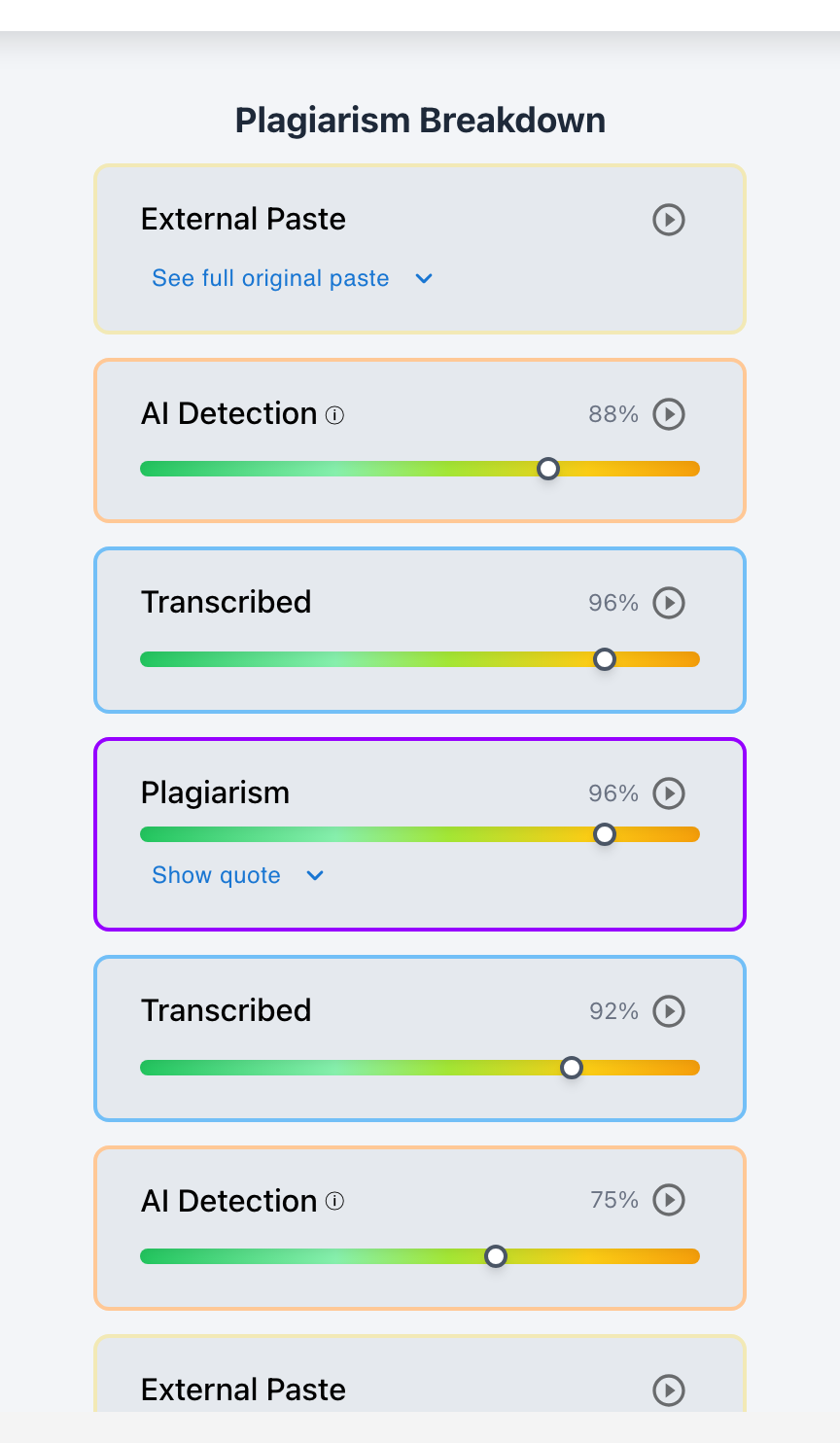
Identifying that a paste event occurred is only the first step: determining the exact origin of the pasted text—whether from the web, a peer, a generative AI model, or an authentic offline draft—is critical for fair evaluation.
When an instructor notices that 800 words appeared in a student's document in a single second, the critical question becomes: "Where did this text originate?" Did the student copy a paragraph from an academic journal, purchase an essay from an online paper mill, receive text from a classmate via Discord, generate it with ChatGPT, or simply paste their own notes from Microsoft Word?
Through Checkmark Plagiarism's Paste + Source Matching engine, instructors can isolate the raw paste payload and cross-reference it across billions of web pages, peer student databases, and advanced AI detection models in seconds.
Checkmark Plagiarism powers source matching by pairing essay writing playback with AI detection, plagiarism detection, autograding, and integrations with Canvas and Google Classroom.
The 4 Potential Origins of a Pasted Text Block
1. Web & Academic Database Sources
Text copied from Wikipedia, JSTOR articles, Chegg, Course Hero, or online blogs without proper quotation marks.
2. Peer-to-Peer Student Collusion
Text copied from a current classmate's document or an archived essay from a previous semester.
3. Generative AI Output
Text generated by ChatGPT, Claude, or Gemini containing synthetic statistical markers and hallucinated citations.
4. Student's Authentic Offline Draft
Text composed independently in Microsoft Word, Apple Pages, or personal handwritten notes and pasted into the LMS.
How Checkmark Paste + Source Matching Solves the Puzzle
Rather than guessing, Checkmark Plagiarism isolates the exact raw pasted string and subjects it to targeted forensic analysis:
- Billion-Webpage Index Search: Automatically searches global internet archives and scholarly databases to locate exact matching URL sources.
- Institutional Peer Cross-Checking: Scans the institutional repository to determine if the exact paste string appears in another student's submission.
- Targeted AI Probability Analysis: Runs the isolated paste block through dual static and writing playback AI neural engines to evaluate perplexity and burstiness.
- Original Paste Preservation: Displays the unedited text as it existed at the microsecond of insertion, bypassing any downstream synonym swaps.
Read more in how Checkmark writing process analysis works.
Diagnostic Matrix: Identifying the Source of Pasted Text
Plagiarized Web / Peer Source
- Plagiarism engine shows high direct match % with specific URL.
- Citations point to real, existing academic articles.
- Contains formatting artifacts (hidden web links, odd font styles).
Generative AI (ChatGPT) Source
- Plagiarism engine shows 0% direct match (text is novel).
- AI detector flags 95%+ probability; low burstiness score.
- Citations contain hallucinated authors, fake DOIs, or phantom journals.
A 5-Step Educator Source Identification Protocol
Educator Source Tracing Checklist:
- 1. Open the essay writing playback report in Canvas or Google Classroom.
- 2. Click the highlighted paste event to isolate the raw pasted text payload.
- 3. Review the Checkmark Plagiarism Source Match report for direct web or peer links.
- 4. Check the AI Detection breakdown for that specific pasted segment.
- 5. Verify cited bibliography entries in Google Scholar to confirm if sources are real or fabricated.
How Checkmark Plagiarism Powers Source Matching
Checkmark Plagiarism combines **AI detection, essay writing playback, static AI detection, plagiarism detection, autograding, and Canvas/Google Classroom integrations** to automatically trace the origin of pasted text, giving teachers fast, indisputable proof of source origins.
Frequently Asked Questions
Can teachers find out where I copied text from?
Yes. Plagiarism scanners cross-reference pasted text against billions of web pages and student papers, while AI detectors identify machine-generated text.
What if I copy text from a website that requires a login?
Checkmark indexes subscription academic journals, scholarly repositories, and millions of student papers, allowing detection across restricted databases.
How do teachers tell if pasted text came from ChatGPT or a website?
Web plagiarism produces direct match URLs with real sources, while ChatGPT text shows 0% plagiarism, high AI probability, and hallucinated citations.
Can teachers see if I copied text from a classmate?
Yes. Checkmark's institutional repository cross-checks submissions across all course sections and past semesters to detect peer collusion.
What if I pasted text that I wrote in Microsoft Word?
Provide your original Word file with creation metadata and revision history to prove you authored the text offline before pasting.
Does changing a few words in pasted text prevent source matching?
No. Checkmark's fuzzy matching and Original Paste Preservation capture both the original unedited paste and downstream edits.
Can teachers see what time text was pasted?
Yes. Essay writing playback logs the exact millisecond and date of every paste event in the document audit trail.
What should a teacher do if a source match is found?
Highlight the matching URL in the report, compare the original text side-by-side, and discuss academic citation rules in a student conference.
How does Checkmark Plagiarism integrate with Canvas LMS?
Checkmark Plagiarism embeds visual writing playback timelines, source match links, and AI scores directly inside Canvas SpeedGrader.
How does source matching protect honest students?
It confirms when pasted text is a legitimate, properly formatted quotation or reference, clearing honest students of suspicion.
Clarity and Precision in Integrity Audits
Knowing where pasted text originated transforms uncertain suspicions into clear, actionable evidence. By pairing paste detection with global source matching and essay writing playback, Checkmark Plagiarism provides educators with the forensic clarity needed to uphold academic truth.
Checkmark Plagiarism supports this comprehensive approach with AI detection, essay writing playback, static AI detection, plagiarism detection, autograding, and integrations with Canvas and Google Classroom.
See how Checkmark pairs essay writing playback with multi-signal detection to trace the exact origins of pasted text inside your LMS. View a sample report or request a demonstration.