
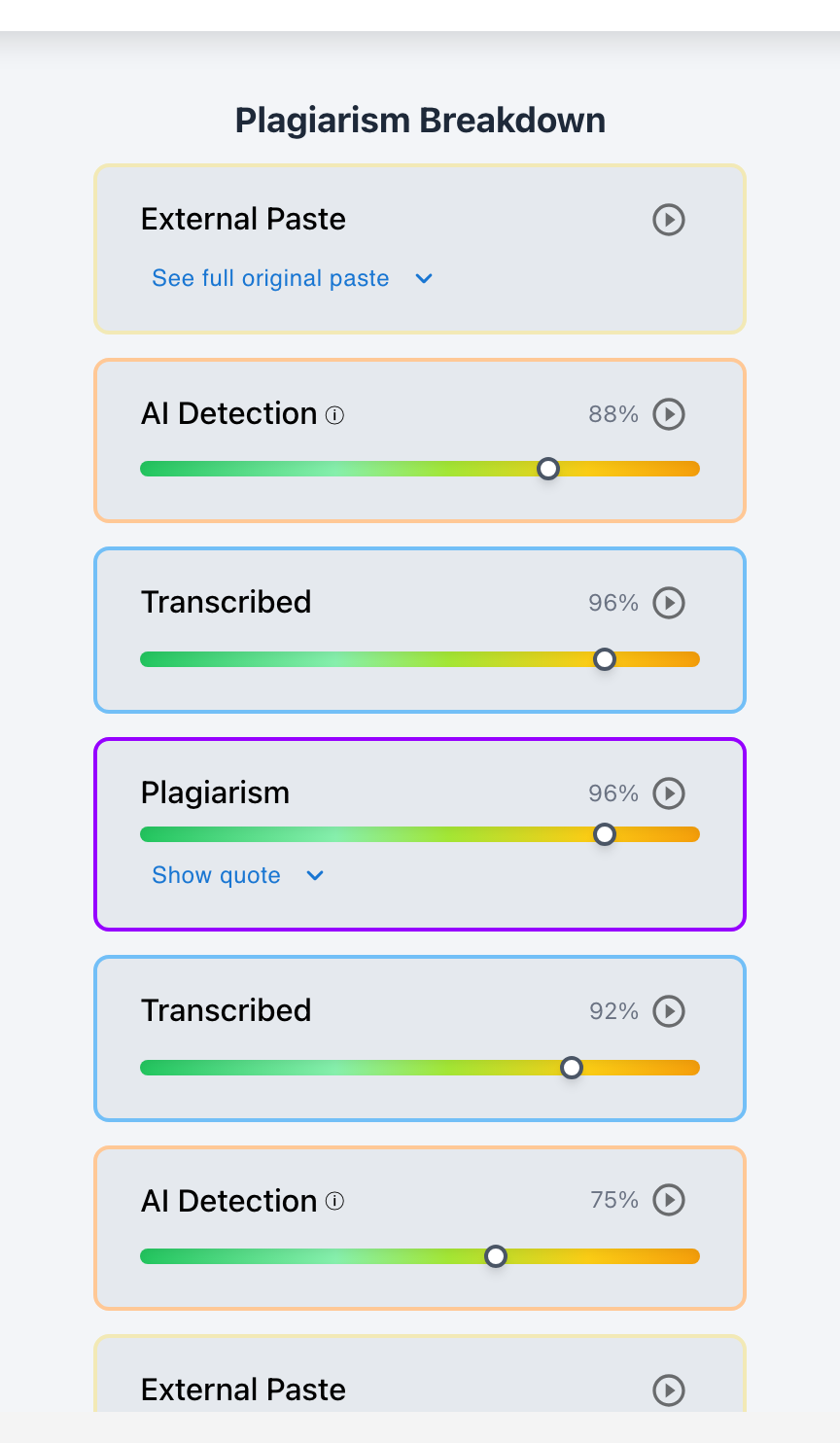
Determining whether two students copied from each other—and identifying who was the original author versus the copier—requires combining side-by-side peer matching with timestamped writing process analytics.
When an instructor discovers two essays with identical arguments, matching sentences, or shared idiosyncratic typos, both students often claim: "We studied together, but I wrote my own paper!" or "They stole my document without my permission!" Relying on verbal claims leads to frustration. However, by pairing Peer Submission Matching with Essay Writing Playback, educators can establish the exact timeline of creation with undeniable physical proof.
Below is a step-by-step forensic framework for investigating peer copying and resolving authorship disputes fairly.
Checkmark Plagiarism powers peer investigations by pairing plagiarism detection with essay writing playback, AI detection, autograding, and integrations with Canvas and Google Classroom.
The 4 Forensic Pillars for Investigating Peer Copying
1. Side-by-Side Peer Text Alignment
Checkmark displays both submissions side-by-side, color-coding identical sentences, matching transition words, and shared typographical errors.
2. Document Creation Timestamps
Examines when each document was initialized in the LMS or Google Drive, establishing who began drafting days in advance.
3. Keystroke Playback Replay
Observes the composition process: the creator shows hours of iterative typing and backspaces; the copier shows an instant paste or linear transcription.
4. Individual Oral Defense
Conducts separate 2-minute oral check-ins asking each student to explain specific arguments, define vocabulary, and defend thesis claims.
What Shared Errors and Typographical Artifacts Prove
In forensic linguistics, shared errors provide the "smoking gun" of copying:
- Idiosyncratic Typos: If Student A misspelled a word in an unusual way (e.g., "necesary" or "revelant") and Student B has the exact same typo in the exact same sentence, independent creation is mathematically impossible.
- Identical Citation Formatting Errors: A missing closing parenthesis or fabricated page number present in both bibliographies proves direct copying.
- Paraphrased Structural Echoes: Even if Student B replaced adjectives with synonyms, the exact clause order and reasoning flow remain identical.
Read more in how Checkmark writing process analysis works.
Comparison: Original Creator vs. Peer Copier in Writing History
Student A: Original Creator Profile
- Document created 7 days before deadline.
- Active typing duration: 4.2 hours across 4 sessions.
- 24% backspaces, deletions, and moved paragraphs.
- Fluently explains thesis and sources during oral check-in.
Student B: Peer Copier Profile
- Document created 3 hours before deadline.
- Active typing duration: 3 minutes (1 paste event).
- <1% backspaces; zero structural reorganization.
- Struggles to define complex terms used in the paper.
A 5-Step Educator Protocol for Resolving Peer Copying Cases
Educator Peer Copying Protocol:
- 1. Open the Checkmark Plagiarism report to view highlighted side-by-side peer matches.
- 2. Review the writing playback replays for both students to compare active drafting hours.
- 3. Identify the author through high revision rates (15–30%) and multi-day drafting.
- 4. Identify the copier through instant wholesale pastes or unbroken linear transcription.
- 5. Hold separate, objective conferences with each student using the playback timeline.
How Checkmark Plagiarism Powers Peer Investigations
Checkmark Plagiarism combines **AI detection, essay writing playback, static AI detection, plagiarism detection, autograding, and Canvas/Google Classroom integrations** to turn peer copying investigations into clear, objective, and indisputable determinations.
Frequently Asked Questions
How do teachers know which student copied from the other?
By comparing Checkmark Writing Playback replays: the original author has hours of multi-session typing and revisions, while the copier has an instant paste or linear transcription.
What if both students claim they wrote their own essay?
The keystroke timeline provides objective physical proof: the student with multi-day drafting history and 20%+ revisions is the author; the student with a 3-minute paste is the copier.
Can students get in trouble for letting someone copy their paper?
Most school policies classify unauthorized sharing of academic work as "facilitating academic dishonesty," which carries disciplinary consequences.
What if two students studied together and have similar ideas?
Studying together produces similar concepts, but distinct sentence structures, vocabulary, and typos. Identical 20-word sentences indicate direct text sharing.
How does writing playback show text was shared via email or Google Drive?
Playback logs show an instant paste event into the recipient's document, capturing the exact timestamp when the external text was inserted.
How does Checkmark Plagiarism integrate with Canvas LMS?
Checkmark Plagiarism displays visual writing playback timelines, side-by-side peer comparisons, and dual AI/plagiarism reports directly inside Canvas SpeedGrader.
What should a teacher do if a student stole another student's paper without permission?
Review the author's multi-day draft history to clear them of wrongdoing, and address the academic misconduct solely with the student who took the paper.
Does peer matching detect essays copied across different class periods?
Yes. Checkmark cross-scans all submissions across all course sections, teachers, and school-wide repositories in real time.
Can an oral defense confirm who wrote the paper?
Yes. Asking 2–3 specific questions about the thesis, evidence, and vocabulary instantly reveals who did the cognitive labor versus who copied the text.
Why is combining peer matching with writing history essential?
Peer matching identifies that copying occurred, while writing history proves who authored the original draft and who took the shortcut.
Forensic Clarity Replaces Guesswork
When peer copying occurs, guessing who wrote the paper creates tension and unfairness. By pairing side-by-side peer matching with essay writing playback and student dialogue, Checkmark Plagiarism ensures that truth prevails with absolute forensic certainty.
Checkmark Plagiarism supports this comprehensive approach with AI detection, essay writing playback, static AI detection, plagiarism detection, autograding, and integrations with Canvas and Google Classroom.
See how Checkmark pairs essay writing playback with multi-signal detection to investigate peer matches and writing history inside your LMS. View a sample report or request a demonstration.