
Designing assignments that are resistant to generative AI does not require banning technology—it requires shifting assessment from generic output to authentic cognitive process.
Traditional generic prompts (e.g., "Write a 5-page paper on the themes of The Great Gatsby") are trivial for ChatGPT to generate in seconds because they rely on broad, heavily indexed literary summaries. When teachers redesign assignments to anchor in local classroom discussions, require multi-stage drafting milestones, incorporate personal reflections, and track creation timelines with essay writing playback, AI shortcuts become nearly impossible to execute.
Below is a comprehensive educator blueprint for designing authentic, engaging, and AI-resistant assessments across all grade levels and disciplines.
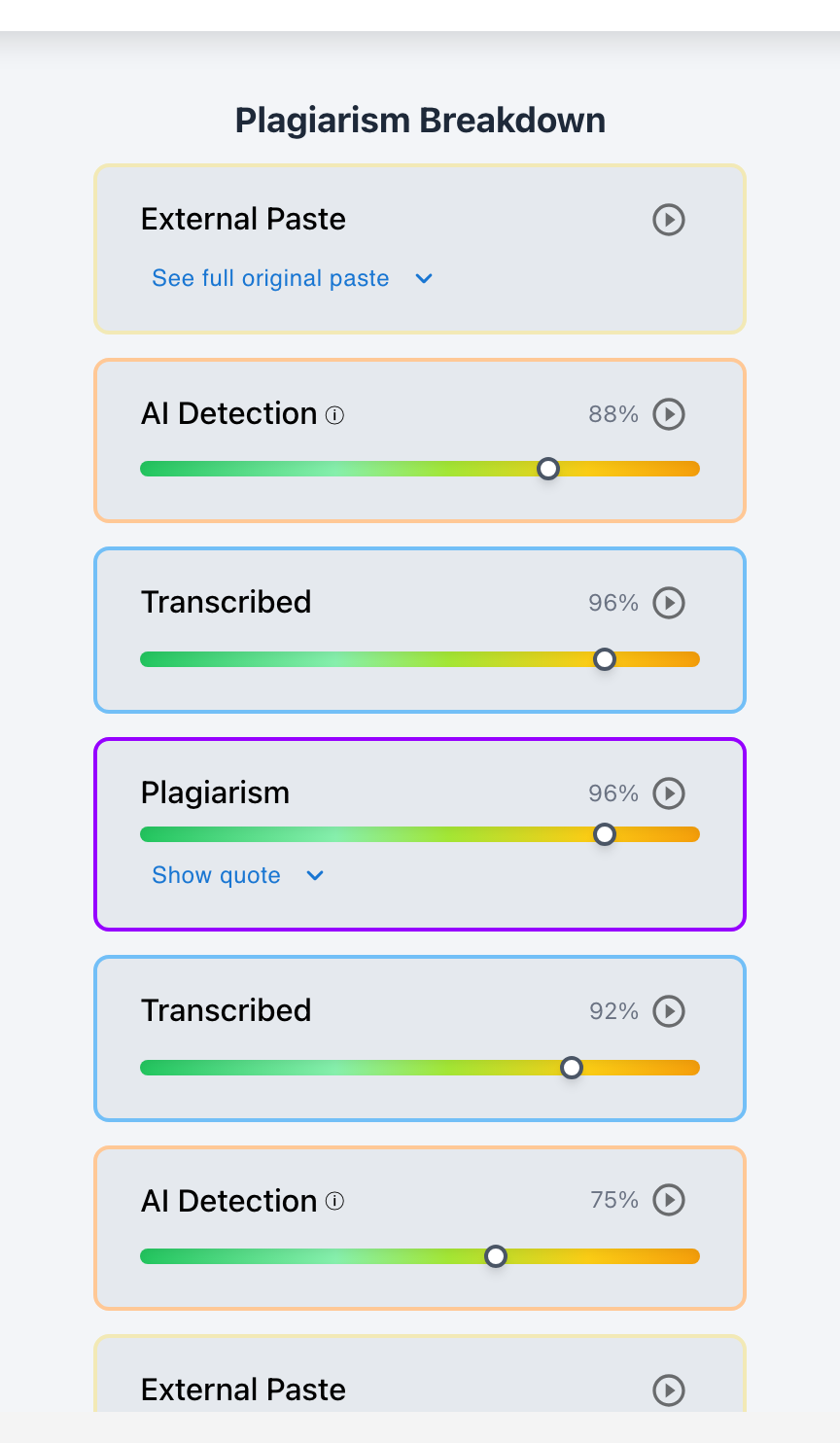
Checkmark Plagiarism supports AI-resistant course design by pairing essay writing playback with AI detection, plagiarism detection, autograding, and integrations with Canvas and Google Classroom.
The 4 Core Principles of AI-Resistant Assignment Design
1. Localized Classroom Anchoring
Require students to reference specific classroom discussions, Tuesday's guest speaker, lab observations, or local community events that AI cannot access.
2. Multi-Stage Process Scaffolding
Break assignments into distinct graded milestones: brainstorm → annotated bibliography → rough draft → peer review → final essay.
3. Personal & Metacognitive Reflection
Require students to articulate their personal perspective, defend revision choices, or explain how their thinking evolved during research.
4. Writing Process Playback
Utilize writing playback to verify multi-session keystroke drafting and eliminate overnight wholesale copy-paste shortcuts.
Prompt Redesign: Before vs. After Examples
Vulnerable to AI (Generic Output)
- "Analyze the causes and effects of the Industrial Revolution."
- "Discuss the symbolism of the conch in Lord of the Flies."
- "Write an essay on ethical considerations in artificial intelligence."
AI-Resistant (Context & Process Anchored)
- "Compare our town's historical mill history from our field trip to the primary source letters we read in Thursday's seminar."
- "Select two quotes from our in-class debate on Jack vs. Ralph and explain how they contradict Golding's argument on page 142."
- "Analyze our school's acceptable use policy, interview one classmate, and propose three specific amendments based on our lecture notes."
How Essay Writing Playback Secures Assignment Design
Even with creative prompts, tracking the physical writing process provides the ultimate guarantee of authentic student authorship. With Checkmark Plagiarism's essay writing playback:
- Milestone Verification: Teachers can review how the thesis developed across multiple drafting sessions over two weeks.
- Eliminating Overnight Pastes: Playback automatically flags when a 1,500-word essay appears in a single instant paste event without prior keystrokes.
- Rewarding True Revision: Instructors can reward students for substantive structural restructuring rather than just surface-level polishing.
Read more in how Checkmark writing process analysis works.
A 6-Step Checklist for Designing AI-Resistant Assignments
Educator Assignment Redesign Checklist:
- 1. Anchor prompts to recent classroom discussions, specific lecture slides, or local campus events.
- 2. Require primary source materials distributed exclusively in class.
- 3. Scaffold the assignment into 3–4 graded milestone submissions across 2–3 weeks.
- 4. Incorporate a brief metacognitive reflection: "Explain two major revisions you made between drafts."
- 5. Enable essay writing playback tracking inside Canvas or Google Classroom.
- 6. Conclude with a brief 2-minute oral check or peer defense session.
How Checkmark Plagiarism Empowers Process-Based Pedagogy
Checkmark Plagiarism combines **AI detection, essay writing playback, static AI detection, plagiarism detection, autograding, and Canvas/Google Classroom integrations** to give educators effortless visibility into student drafting, making AI-resistant course design practical and scalable.
Frequently Asked Questions
Is it possible to make an assignment 100% immune to AI?
No single prompt is completely immune, but combining localized classroom context with multi-stage scaffolding and essay writing playback makes unauthorized AI use virtually impossible.
Why do generic essay prompts fail in the AI era?
Because language models have billions of parameters trained on standard academic topics, allowing them to generate flawless high-level essays in seconds.
How does scaffolding prevent AI cheating?
Scaffolding requires students to submit outlines, annotated bibliographies, and rough drafts over time, making it much harder to generate a finished paper overnight.
What is a metacognitive reflection?
A short paragraph where students explain their own writing decisions, research challenges, and how their thesis evolved during drafting.
How does writing playback support assignment design?
Playback captures the active typing timeline, verifying that students developed their ideas incrementally over multiple sessions.
What if a student uses AI to generate the outline and drafts the paper manually?
If course policy permits AI for brainstorming, writing playback confirms authentic student authorship of the actual text and syntax.
Should teachers include oral components in assignments?
Yes. A brief 2-minute conversation or peer defense reinforces authentic ownership and easily verifies conceptual understanding.
How can STEM instructors design AI-resistant problem sets?
Require students to explain their reasoning in words, justify why alternative formulas failed, and integrate data collected in live laboratory experiments.
Does redesigning assignments increase grading time?
Not when paired with Checkmark Plagiarism, which automates milestone tracking, writing playback replays, and LMS grading workflows.
How does Checkmark Plagiarism integrate with Canvas LMS?
Checkmark Plagiarism embeds dual AI and plagiarism reports alongside visual writing playback directly inside Canvas SpeedGrader.
Focus on Process to Protect Authentic Learning
By designing assignments that prioritize localized context, iterative drafting, and transparent writing playback, educators transform assessment from a high-stakes vulnerability into a celebration of authentic human growth.
Checkmark Plagiarism supports this comprehensive approach with AI detection, essay writing playback, static AI detection, plagiarism detection, autograding, and integrations with Canvas and Google Classroom.
See how Checkmark pairs essay writing playback with multi-signal detection to make your assignment design truly AI-resistant. View a sample report or request a demonstration.