
To check whether a student's sources actually exist quickly and accurately, teachers should use a 4-step verification workflow: click the cited DOI on doi.org (to confirm active registration), search the exact article title in quotation marks on Google Scholar or Crossref, query book titles on WorldCat, or use Checkmark Plagiarism's automated Citation Verification Engine inside Canvas SpeedGrader.
Manually checking every citation in a 20-page research paper has historically been too time-consuming for busy educators. However, with generative AI capable of fabricating dozens of plausible-sounding citations in seconds, verifying source existence has become a critical integrity checkpoint. Fortunately, modern database tools and automated citation verification make it possible to validate an entire bibliography in under 30 seconds without tedious manual searching.
Below is a practical educator guide on checking source existence quickly and conclusively.
Checkmark Plagiarism verifies source existence by pairing plagiarism detection with AI detection, essay writing playback, autograding, and integrations with Canvas and Google Classroom.
The 4-Step Fast Source Verification Workflow
Step 1: Check DOI Registration
Click the cited DOI link (e.g., https://doi.org/[string]). If it returns a "DOI Not Found" 404 error, the citation was likely fabricated by AI or mistyped.
Step 2: Exact-Match Google Scholar Search
Copy the exact article title into Google Scholar enclosed in quotation marks (e.g., "GPT detectors are biased against non-native English writers", a real 2023 paper in Patterns). Real papers return immediate hits.
Step 3: Query WorldCat for Books
For cited academic books, search worldcat.org to confirm the ISBN, author, and publisher exist in global library catalogs.
Step 4: Automated Checkmark Scan
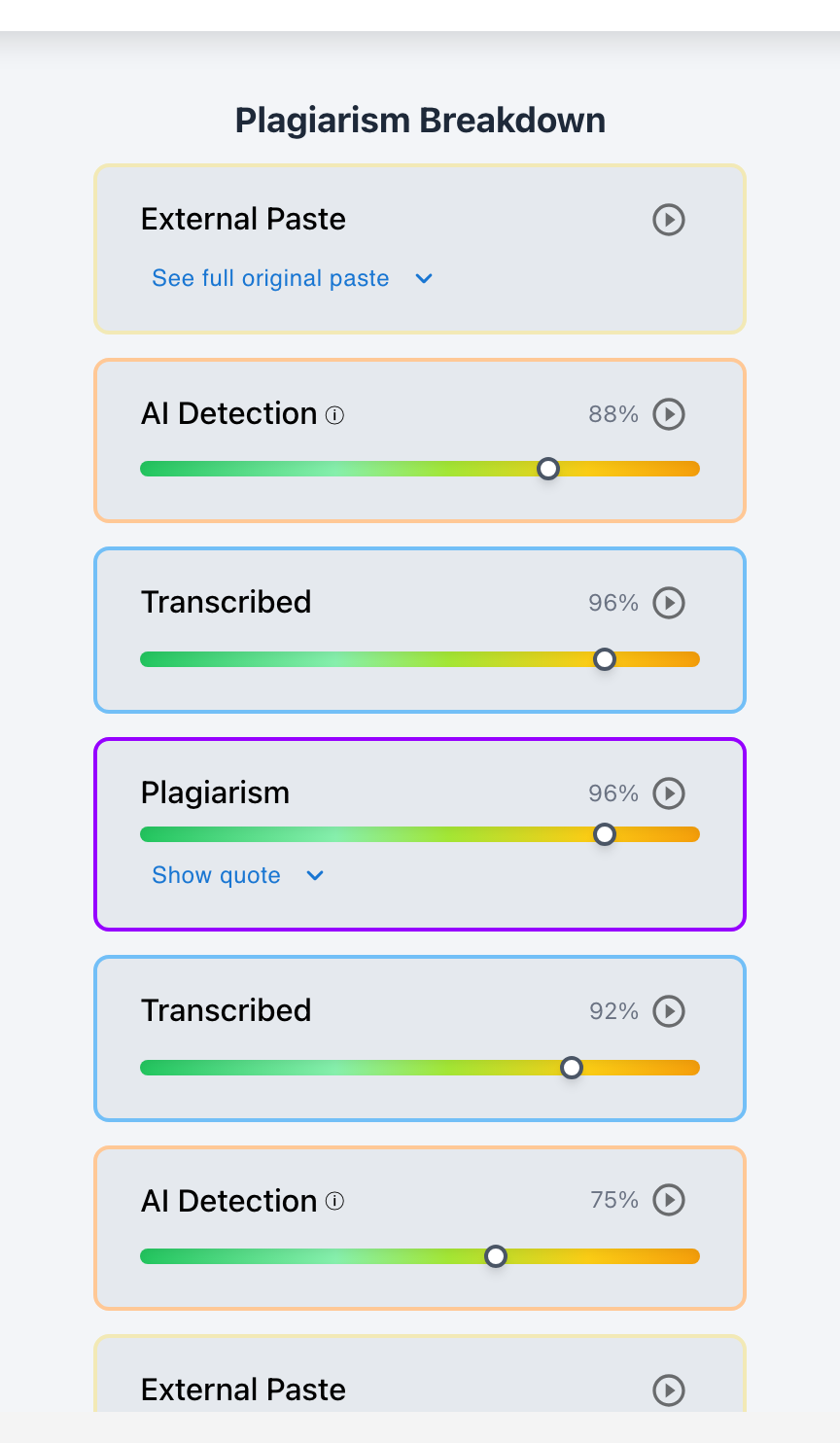
Checkmark Plagiarism scans the entire bibliography automatically upon submission, highlighting unresolvable sources in bright red directly in SpeedGrader.
What Happens When a Source Is Real vs. Hallucinated
Understanding the search results returned across academic registries:
- Real Sources: Return immediate results on Crossref, Google Scholar, and PubMed with matching author names, publication year, volume numbers, and direct publisher links.
- Formatting Typos: If a student made a minor typo in an author's name, Google Scholar will still return the correct paper with a "Showing results for..." prompt.
- AI Hallucinations: Return zero results across all databases, proving the title was synthetically generated.
Read more in how Checkmark writing process analysis works.
Comparison: Real Source Verification vs. AI Hallucination Signals
Real Source Verification (Verified Scholar)
- DOI resolves directly to publisher journal page.
- Exact title search returns scholarly citations.
- Student can produce full-text PDF upon request.
- Playback shows research reading pauses and active notes.
AI Hallucination Signals (Fictitious)
- DOI returns 404 "DOI Not Found" on doi.org.
- 0 results on Google Scholar, Crossref, and PubMed.
- Student cannot produce the source or explain it.
- Playback shows instant wholesale text insertion.
A 5-Step Educator Protocol for Verifying Student Sources
Source Verification Checklist:
- 1. Open the student's submission in Checkmark Plagiarism inside Canvas SpeedGrader.
- 2. Review the automated Citation Verification report: red tags highlight fake DOIs and missing titles.
- 3. If a citation is flagged, click the direct Crossref query link to confirm database absence.
- 4. Check the Writing Playback telemetry: verify whether citations were typed over time or pasted in bulk.
- 5. Hold a 2-minute conference: ask the student to show the original PDF or book during class.
How Checkmark Plagiarism Powers Instant Source Audits
Checkmark Plagiarism combines **AI detection, essay writing playback, static AI detection, plagiarism detection, autograding, and Canvas/Google Classroom integrations** to automatically validate every bibliography item against global academic registries upon submission.
Frequently Asked Questions
How long does it take to verify a student's bibliography?
With Checkmark Plagiarism, verification is instant—the platform queries academic databases automatically upon submission and displays verified/unverified badges in SpeedGrader.
What is Crossref?
Crossref is a DOI registration agency and open metadata registry for scholarly publications, holding records for over 150 million scholarly works, including journal articles and books.
What does a 404 DOI error mean?
It means the DOI cited by the student is not registered with any DOI registration agency. That is a strong sign the citation was fabricated or mistyped, so check the spelling before concluding it was invented.
What if a student cited a source that is behind a paywall?
Even paywalled scholarly articles have public metadata indexed on Crossref and Google Scholar showing the title, author, and abstract.
Can students fake bibliography entries by copying from Wikipedia?
Wikipedia citations usually exist, but Checkmark Plagiarism will flag the Wikipedia source matching and verify whether the student actually integrated the content.
How does Checkmark Plagiarism integrate with Canvas LMS?
Checkmark provides certified LTI 1.3 integration, SpeedGrader sidebar embeds, two-way grade passback, and single sign-on (SSO).
What should a teacher do if a student cannot produce a cited source?
Hold a conference to explain that academic integrity requires verifiable evidence, requesting a rewrite using real, accessible sources.
Can writing playback show if a student looked up a source?
Yes. Playback logs research pauses (15–45 minutes) where the student was reading the source before resuming keyboard drafting.
What if a student cited a real author but a fake article title?
This is a classic "Frankenstein citation" generated by AI; searching the exact title on Google Scholar will confirm that no such paper exists.
Why is source verification essential in the AI era?
Because verifying source existence provides concrete, objective proof that eliminates subjective guesswork in academic integrity reviews.
Defending Scholarly Truth with Automated Verification
Accurate citation is the cornerstone of academic research. By using Checkmark Plagiarism to automate source validation and analyze drafting process telemetry, educators can verify student research in seconds, protect honest scholarship, and uphold uncompromising academic standards.
Checkmark Plagiarism supports this comprehensive approach with AI detection, essay writing playback, static AI detection, plagiarism detection, autograding, and integrations with Canvas and Google Classroom.
See how Checkmark pairs automated source verification with multi-signal detection to check student citations. View a sample report or request a demonstration.