
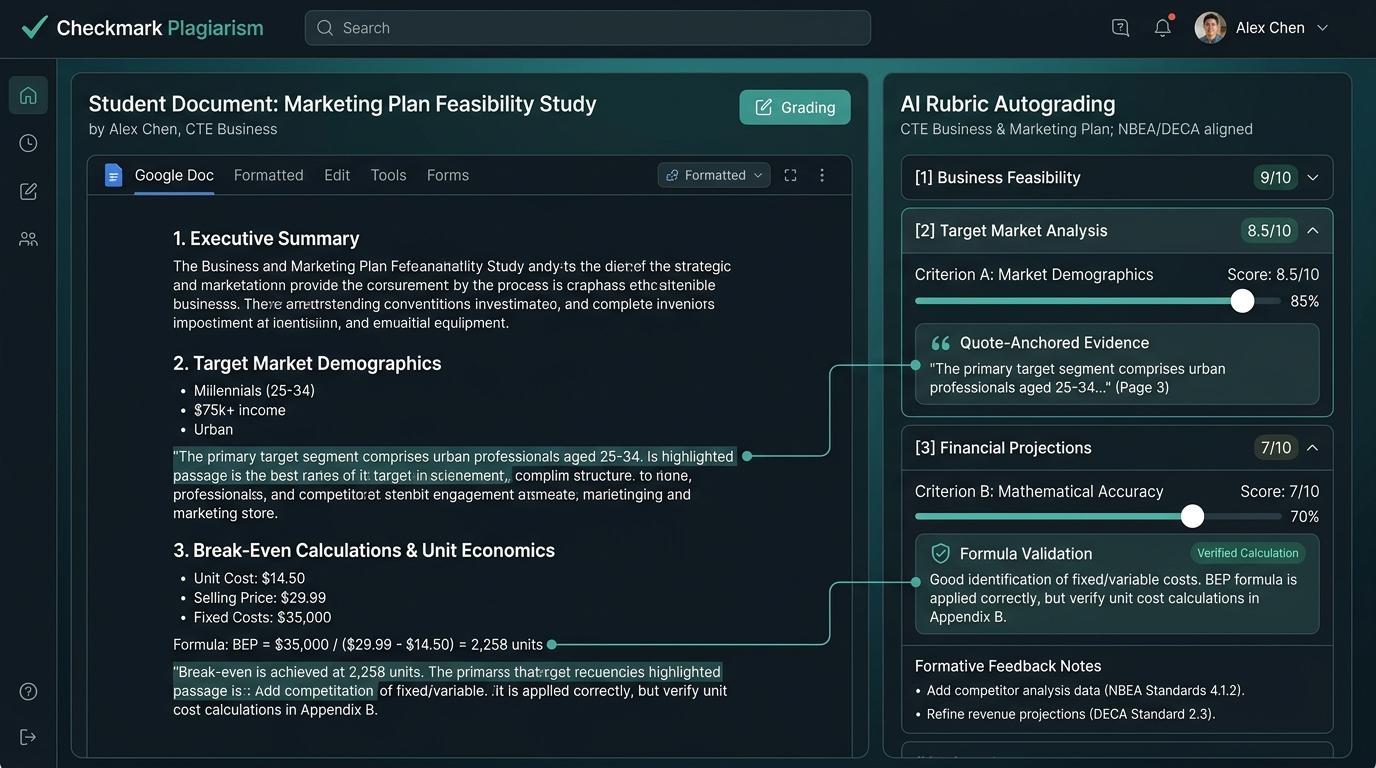
Career and Technical Education (CTE) Business & Marketing educators, DECA/FBLA chapter advisors, entrepreneurship program leads, and vocational department chairs face a staggering assessment bottleneck: evaluating comprehensive 15–25 page Student Marketing Plans and Business Feasibility Studies across 80 to 150 students per semester. With each submission demanding rigorous scrutiny across six complex domains—Executive Summary, Market Analysis (TAM/SAM/SOM), Competitive Matrix, Financial Projections & Unit Economics, Marketing Mix (4Ps), and Operational Feasibility—a single grading cycle generates 1,200 to 3,750 pages of technical student prose and financial modeling, requiring 50 to 100+ hours of grading time.
This challenge is further complicated by the “AI Boilerplate Business Plan” crisis, where generative LLMs produce slick, corporate-sounding jargon that conceals completely hallucinated financials, nonexistent localized demographics, and impossible operational assumptions. Checkmark Plagiarism resolves this structural dilemma through AI-Assisted Quote-Anchored Rubric Autograding and Writing Process Telemetry. By parsing complex NBEA, DECA, and state CTE analytic rubrics via Abstract Syntax Trees (ASTs), extracting verbatim student textual and mathematical evidence for every performance indicator, providing a 3-minute Pre-Flight Teacher Review Console, and streaming verified grades and comments directly into Canvas SpeedGrader, Buzz LMS, or Google Classroom via 1EdTech LTI 1.3 Advantage, Checkmark cuts evaluation time by up to 75%. Combined with patent-pending Essay Playback™ (keystroke dynamics, 1x–8x replay, and 100% clipboard paste buffer preservation), educators can eliminate grading burnout, detect synthetic business plans, and elevate authentic student entrepreneurship.
Checkmark Plagiarism empowers Career and Technical Education (CTE) business educators and vocational faculties by combining AI rubric autograding with writing process telemetry, passage-level AI detection, side-by-side plagiarism matching, and seamless LMS integration for Canvas LMS SpeedGrader and Agilix Buzz LMS.
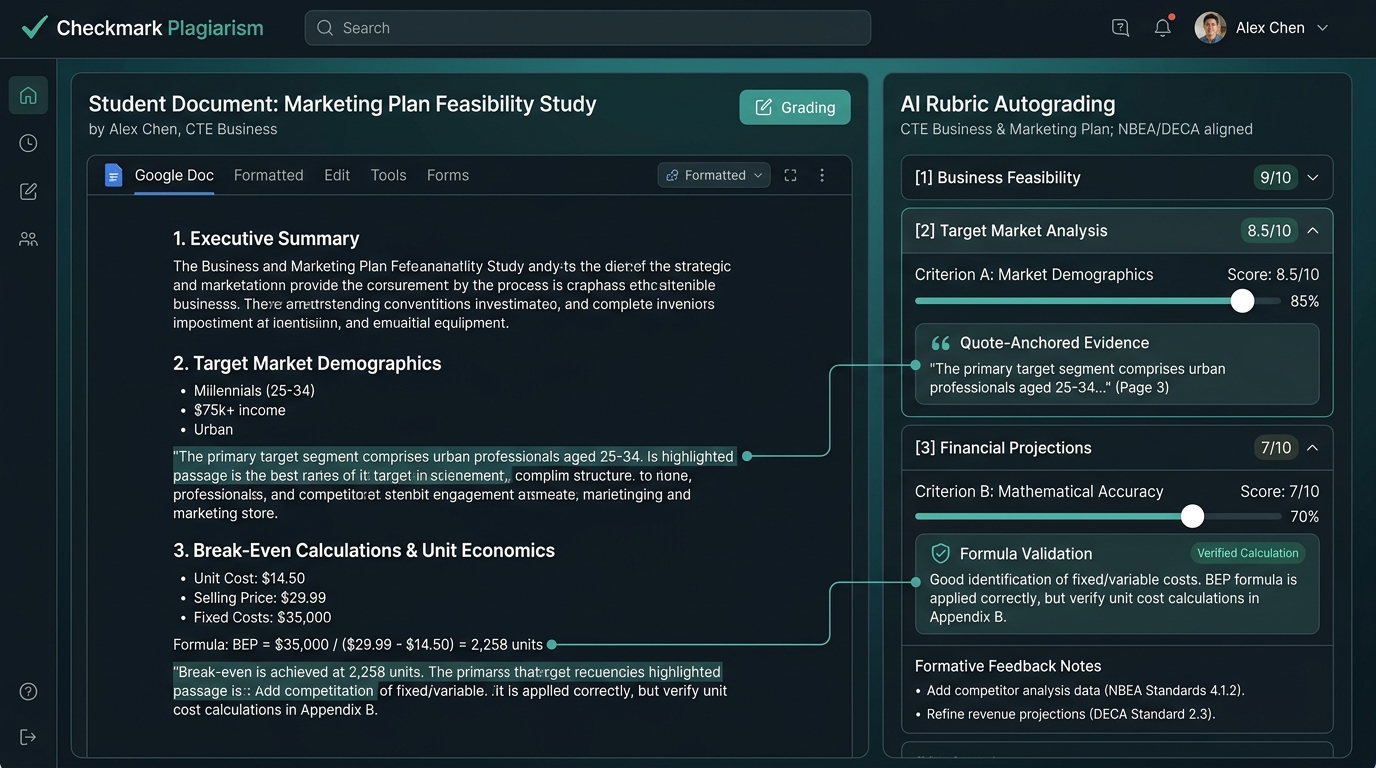
1. The High-Volume CTE Business Assessment Dilemma
Career and Technical Education (CTE) programs in Business Management, Marketing, and Entrepreneurship represent the vanguard of applied, career-connected learning in secondary and post-secondary institutions. Guided by standards from the National Business Education Association (NBEA), state CTE frameworks, and Career and Technical Student Organizations (CTSOs) such as DECA and FBLA (Future Business Leaders of America), students do not merely memorize theory; they design living enterprises.
The capstone artifact of these programs is the formal Business Feasibility Study and Integrated Marketing Plan—a professional, multi-section document spanning 15 to 25 pages that requires students to prove the commercial, operational, and financial viability of a proposed venture.
- • Vague comments: “Good marketing ideas; tighten financials”
- • Hidden mathematical errors in COGS and margin calculations
- • Feedback delivered 3–4 weeks late (past competition deadlines)
- • Student entrepreneur revision window closes before pitch day
- • Slick, corporate-sounding LLM prose with zero real substance
- • Zero primary market research or local foot-traffic data
- • Completely hallucinated unit economics & operating costs
- • Evades standard whole-paper AI percentage detectors
The Assessment Volume Reality
For a CTE educator managing three sections of Entrepreneurship, two sections of Sports & Entertainment Marketing, and advising the school’s DECA chapter, grading these capstone plans is an overwhelming operational challenge:
- Staggering Word Count: 100 students submitting 20-page business plans generate 600,000 words of technical writing—the equivalent of reading War and Peace and Les Misérables combined, accompanied by hundreds of complex financial spreadsheets.
- Cognitive Load per Document: Evaluating a feasibility study is far more complex than scoring a standard English essay. The teacher must simultaneously check prose clarity, verify mathematical logic (e.g., Does the contribution margin cover the calculated monthly fixed overhead?), audit market research credibility (e.g., Are the demographic numbers sourced from real local census data or fabricated?), and evaluate strategic coherence across all six sections.
- Feedback Latency: Manual line-by-line review requires 35 to 50 minutes per plan. Across 100 students, this represents 60 to 85 hours of grading. Consequently, graded drafts often take 3 to 4 weeks to return to students—long after the instructional unit has ended and past the registration deadlines for CTSO competitive events.
The Downfall of Superficial Holistic Grading
Faced with grading fatigue, even dedicated teachers are forced into cognitive triage, relying on holistic scanning and generic rubric checkboxes:
- “Strong competitive matrix, but tighten your financial projections.”
- “Good customer persona; make sure your marketing budget aligns with revenue.”
- “Ensure your break-even units make sense.”
These holistic comments provide zero actionable guidance for student entrepreneurs. A high school senior preparing for the DECA International Career Development Conference (ICDC) or a community college student pitching for seed capital cannot convert “tighten your financial projections” into an improved balance sheet. The student needs to see the precise calculation where variable labor costs were omitted, understand why their Customer Acquisition Cost (CAC) exceeds their Customer Lifetime Value (LTV), and receive formative revision prompts grounded in their own drafted prose.
2. The 5 Core Criteria of CTE Business Feasibility & The “AI Boilerplate” Crisis
To understand why automated grading must be quote-anchored and financially validated rather than purely syntactic, educators must analyze the five fundamental pedagogical pillars of business feasibility assessment—and how generative AI models actively undermine them.
- Total/Serviceable/Obtainable Market (TAM/SAM/SOM): Rigorous quantitative market sizing grounded in specific geographic radii.
- Primary Field Research: Authentic customer surveys, in-person discovery interviews, and foot-traffic density counts.
- Hyper-Local Demographics: Municipal census tract data, target persona psychographics, and purchasing frequency models.
- Itemized Bill of Materials (BOM): Granular Cost of Goods Sold (COGS) itemizing ingredients, raw materials, and packaging.
- Contribution Margin & Gross Margin: Accurate mathematical derivation of unit profit and gross margin percentages.
- Monthly Fixed vs. Variable Overhead: Modeling commercial leases, utilities, insurance, POS software, and debt service.
- Defensible Break-Even Math: Exact calculation of break-even units and break-even revenue per operating day.
- Supply Chain & Distributor Pricing: Concrete vendor identification with wholesale price quotes and lead times.
- Facility Footprint & Zoning: Commercial real estate parameters, health department compliance, and vendor permits.
- Staffing Schedules & Labor Burden: Hourly wage rates, payroll taxes, shift coverage, and manager compensation.
- Milestone Implementation Timeline: Actionable Gantt chart mapping pre-launch, buildout, and operational launch.
- Direct vs. Indirect Competitors: Identification of actual local brick-and-mortar and digital competitors within the market area.
- Multi-Attribute Comparison Matrix: Side-by-side pricing, product features, service speed, and customer ratings.
- Defensible Unique Value Proposition (UVP): Clear articulation of customer switching incentives and competitive moat.
- Sustainable Barriers to Entry: Proprietary processes, local exclusive distributor agreements, or network effects.
- Actionable SWOT Synthesis: Cross-quadrant strategic initiatives linking strengths to external market threats.
- Regulatory & Liability Compliance: Business licensing, insurance coverage, health code mandates, and ADA compliance.
- Financial Sensitivity Scenarios: 3-scenario modeling (Worst-Case, Expected, Best-Case revenue outcomes).
- Contingency Capitalization: Explicit reserves for supply chain delays, cash flow shortfalls, and seasonal downturns.
The “AI Boilerplate Business Plan” Crisis
With the ubiquity of generative AI (ChatGPT, Claude, Gemini), CTE educators face an unprecedented assessment crisis. When instructed to “Write a comprehensive marketing plan for an eco-friendly mobile coffee truck in Denver,” an LLM instantly generates a 20-page document filled with sophisticated corporate jargon:
“Our enterprise leverages an omni-channel customer engagement paradigm, deploying synergistic social media campaigns and hyper-personalized loyalty algorithms to maximize brand resonance and optimize customer acquisition funnels...”
To an unassisted, exhausted grader scanning for key vocabulary, this prose looks exceptional. However, a rigorous pedagogical inspection reveals that the plan is an empty synthetic shell:
- Hallucinated Market Sizing: The AI invents demographic statistics that sound plausible but have no basis in municipal census data or local foot-traffic reality.
- Mathematically Broken Unit Economics: The AI asserts that a cup of specialty espresso costs $0.35 to produce and sells for $6.50, but omits commercial espresso machine depreciation, milk spoilage, barista hourly wages ($18.50/hr + payroll tax), commercial vehicle insurance, mobile generator fuel, municipal vendor permits, and water filtration costs.
- Fictitious Competitors: The AI invents generic competitor names (“Green Bean Cafe”, “Peak Coffee Co.”) rather than analyzing the actual brick-and-mortar coffee roaster sitting two blocks away from the proposed route.
- Zero Primary Field Research: The submission contains no original customer surveys, no foot-traffic counts, no distributor pricing quotes, and no evidence of human entrepreneurial discovery.
| Synthetic Generative AI Boilerplate | Authentic, Grounded CTE Student Feasibility Study |
|---|---|
|
❌ Baseless Market Assumption “We will capture 15% of the local beverage market in Year 1 through viral social media marketing.”No demographic boundary, no survey sample, no foot-traffic evidence. |
✅ Grounded Demographic Research “Based on U.S. Census Tract 402 data, there are 14,280 residents within a 1-mile radius; our 150-person in-person survey revealed 64% buy coffee daily, yielding an SOM of 914 daily target customers.” |
|
❌ Vague, Broken Unit Economics “Our COGS is extremely low, leading to high profit margins and rapid initial growth.”Omits itemized ingredients, packaging, hourly barista labor, and spoilage buffers. |
✅ Granular Bill of Materials “Itemized Bill of Materials: 18g organic beans ($0.58), oat milk 6oz ($0.42), biodegradable cup/lid ($0.22), labor at $0.85/drink. Total Unit COGS = $2.07. Selling Price = $5.75. Unit Contribution Margin = $3.68 (64% Gross Margin).” |
|
❌ Arbitrary Break-Even Assertion “Break-even will occur quickly in the third month of operation as customer awareness rises.”No fixed overhead schedule, no mathematical break-even formula applied. |
✅ Audited Break-Even Calculation “Fixed Monthly Overhead: Van lease ($850), commissary kitchen rent ($600), insurance ($350), POS/software ($120), debt service ($400) = $2,320/mo. Break-even = $2,320 / $3.68 = 631 units/month (21 drinks/day across 30 operating days).” |
|
❌ Hallucinated Competitor Names “We face competition from generic local cafes and corporate coffee franchises.”Fictitious competitors; zero pricing matrix or drive-thru speed comparison. |
✅ Localized Competitor Audit “Direct Competitor Analysis: ‘Bean & Leaf’ (0.4 mi away) charges $6.25 for cold brew with no drive-thru; our mobile curbside app-ordering delivers 3.5-minute faster service at a $0.50 discount.” |
When teachers grade holistically, synthetic boilerplate often receives higher grades than raw, authentic student work because the AI writes with flawless syntax and impressive vocabulary. Checkmark’s Quote-Anchored Rubric Autograder reverses this injustice by penalizing ungrounded assertions and rewarding verifiable, evidence-backed student reasoning.
3. The Architecture of Checkmark’s CTE Rubric Autograding Engine
Checkmark Plagiarism’s rubric engine is not a generic language model prompt. It is a purpose-built, multi-stage educational assessment pipeline designed specifically for complex, evidence-dense academic and technical writing.
Deconstructs PDF, scanned image, or LMS rubrics into structured criteria trees, point bands, and target quantitative benchmarks.
Scans 20-page plans to extract verbatim sentences, survey statistics, and financial tables, auditing arithmetic accuracy.
Provides a 3-minute side-by-side verification interface with 1-click accept, adjust sliders, and LMS Grade Passback.
Checkmark strictly adheres to teacher-in-the-loop governance. The AI drafts evidence-anchored suggestions; the educator retains 100% moderation authority prior to gradebook publication.
1. Abstract Syntax Tree (AST) Rubric Parsing
Checkmark accepts rubrics in any format: uploaded PDFs, scanned image rubrics, native LMS rubric syncs (Canvas, Buzz, Moodle), or customized CTSO rubrics (DECA Integrated Marketing Campaign, FBLA Business Financial Plan).
The system decomposes the rubric into an Abstract Syntax Tree (AST):
- Root Node: Assignment Metadata (e.g., DECA Entrepreneurship Innovation Plan - 100 Points Total).
- Branch Nodes (Criteria): Individual assessment dimensions (e.g., Criterion 1: Market Analysis & Demographics - 20 pts; Criterion 2: Financial Strategy & Unit Economics - 25 pts).
- Leaf Nodes (Performance Levels): Specific qualifying descriptors across achievement bands (Exceeds Standards [23–25 pts], Meets Standards [18–22 pts], Developing [12–17 pts], Inadequate [0–11 pts]).
2. Grounded Quote-Anchored Evidence Extraction
Rather than generating vague narrative summaries, Checkmark’s engine acts as an evidentiary auditor. For each criterion in the AST, the engine scans the student’s submission and extracts the exact sentences, data points, and mathematical formulas that justify the achievement level:
- For Market Demographics, Checkmark isolates the specific lines citing target population figures, survey sample sizes, and income brackets.
- For Unit Economics, Checkmark pulls the itemized Cost of Goods Sold bill of materials and recalculates the student’s break-even arithmetic to verify mathematical accuracy.
- For Competitive Advantage, Checkmark extracts the direct comparisons between the student’s venture and identified market rivals.
“Evidence Gap Detected: Criterion 4 (Financial Projections) requires a detailed 12-month cash flow forecast. The submission mentions ‘steady positive cash flow’ in Section 4.2 but provides no supporting financial schedule, operating expense breakdown, or monthly cash buffer modeling.”
3. The Pre-Flight Teacher Review Console
Checkmark firmly upholds the principle of Teacher Final Authority. The AI never publishes a grade directly to a student. Instead, it populates the Pre-Flight Teacher Review Console:
- Side-by-Side Verification: The student’s 20-page document appears on the left; the interactive Rubric Breakdown sidebar appears on the right.
- Two-Way Linked Evidence Cards: Clicking any criterion in the sidebar instantly scrolls the document to the highlighted student sentences and financial tables that served as evidence. Conversely, clicking any highlighted sentence in the text opens the corresponding rubric justification card.
- 1-Click Moderation: The teacher can accept the AI’s suggested score with a single keystroke, adjust the point value with a slider, or modify the drafted qualitative feedback before approval. Total review time per 20-page plan drops from 45 minutes to under 4 minutes.
“To determine operational viability, we modeled our unit economics based on supplier quotes from EcoPackaging Corp (Source 4). With a unit COGS of $2.07 and a retail price of $5.75, our unit contribution margin is $3.68 (64% gross margin). With fixed monthly overhead of $2,320, our break-even threshold is exactly 631 units per month, or 21 units per operating day.”
“Excellent mathematical rigor in your break-even model. Your contribution margin accurately covers fixed commissary and van lease overhead. To achieve a perfect 25/25 on final submission, incorporate a 10% seasonal cash buffer for slower winter sales months in Denver.”

4. 1EdTech LTI 1.3 Advantage Integration & Direct LMS Passback
Checkmark integrates natively into enterprise educational ecosystems via 1EdTech LTI 1.3 Advantage, supporting Assignment and Grade Services (AGS 2.0) and Names and Role Provisioning Services (NRPS 2.0):
- Canvas LMS & SpeedGrader: Checkmark embeds directly within Canvas SpeedGrader. When a teacher approves scores in the Pre-Flight Console, finalized scores, criterion point breakdowns, and quote-anchored feedback cards stream directly into the Canvas Gradebook and student feedback tray.
- Buzz LMS & Agilix: Supports full grade and feedback passback for online and blended vocational academies.
- Google Classroom: Automatically populates private comments with formatted rubric breakdowns and syncs grades to the master class sheet.

4. Multi-Factor Integrity Verification: Essay Playback™ & Keystroke Dynamics
Evaluating a business plan requires more than rubric scoring; it demands empirical proof of authentic authorship. In vocational education, where students frequently research industry reports, download financial spreadsheet templates, and reference market data, traditional AI detectors fail miserably.
Checkmark resolves this through its integrated multi-factor verification suite, combining Essay Playback™, External Paste Buffer Inspection, Granular Passage-Level AI Detection, and Side-by-Side Plagiarism Matching.
- 1x to 8x scrubbable video timeline reconstructing the entire drafting process
- Visualizes active drafting bursts, cognitive brainstorming pauses, deletions, and rewrites
- Distinguishes organic typing from mechanical transcription (typing from a second screen)
- Captures and permanently stores exact clipboard text at the millisecond of insertion
- Preserves original paste even if the student subsequently rewrites or deletes every word
- Instantly differentiates legitimate spreadsheet data imports from illicit AI text drops
- Underlines specific suspect sentences rather than assigning an opaque whole-paper score
- Evaluates linguistic perplexity, burstiness, syntax distribution, and transition cadence
- Honest Guardrails: Automatically assigns N/A on text samples under 150 words
- Scans billions of live web pages, business databases, open-access journals, & peer archives
- Uncited Source Differentiation: Distinguishes missing citations from intentional plagiarism
- Dedicated Student-to-Student repository matching across district sections and previous years
Distinguishing Legitimate Data Imports from AI Text Injections
In a CTE marketing plan, students routinely copy and paste data tables from Google Sheets, Microsoft Excel, municipal census portals, or supplier catalogs.
Generic AI detectors and naive revision history tools flag these large character insertions as “plagiarism” or “AI generation.” Checkmark’s External Paste Buffer Inspector permanently captures the exact clipboard contents at the timestamp of insertion:
- Legitimate Financial Data Import: The paste buffer displays comma-separated values (CSV), raw spreadsheet tables, or itemized vendor price sheets. The student then spends 45 minutes typing paragraphs below the table, analyzing the numbers with natural typing speed, revisions, and backspaces.
- Illicit Generative AI Dump: The paste buffer displays 2,500 words of fully formatted, flawless academic prose containing sophisticated market analysis. Essay Playback™ reveals zero prior brainstorming, zero outline development, and zero subsequent textual editing.
Organic Espresso Beans,DenverRoasters,$14.50,1,$14.50
Oat Milk (Case),BaristaSupply,$24.00,1,$24.00
16oz Compostable Cups,EcoPack,$65.00,500,$0.13"
Subsequent Writing Telemetry:
• Student spends 38 minutes typing analysis below table
• 42 backspaces, 14 word revisions logged
• Keystroke velocity: 48 WPM (Natural human flow)
Subsequent Writing Telemetry:
• Zero typing or structural editing follows paste
• Submission finalized 2 minutes later
• Keystroke velocity: 0 WPM (Instant single drop)

5. Real-World CTE Classroom Case Studies
To see Checkmark’s integrated platform in action, consider three realistic instructional scenarios across high school entrepreneurship, CTSO competition preparation, and post-secondary vocational management.
High School CTE Capstone Pitch & Unit Economics Audit
Setting & Instructor: Marcus Vance, CTE Department Lead (95 students enrolled across 3 sections). 20-Page Business Feasibility Study & Shark Tank Pitch Deck for Advisory Board Night.
Challenge: Marcus had 95 comprehensive business plans to evaluate in 6 calendar days. Manual grading would require approximately 65 hours.
Checkmark Autograding Audit: Student “Jordan K.” submitted a 22-page plan for “Mile High Hydroponics,” an indoor microgreen venture. Checkmark extracted primary restaurant demand data (24 chefs surveyed, 18 weekly buyer commitments; 20/20 pts). However, the mathematical auditor flagged a fatal error: Jordan budgeted monthly electricity at $85/month, but specified 40 commercial 600W fixtures operating 18 hrs/day (actual utility cost = $1,555/month at $0.12/kWh).
Integrity & Outcome: Essay Playback™ confirmed 14.5 hours of active drafting across 8 sessions. Paste buffer verified itemized equipment quotes pasted from a local agricultural distributor. Marcus approved the autograded evaluation in under 4 minutes, adding a coaching note on local grower grants. Jordan revised the utility model before pitching to real local bank loan officers.
DECA Marketing Plan Competitive Event Preparation
Setting & Advisor: Elena Rostova, Marketing Education Coordinator (48 DECA State Qualifiers). DECA Integrated Marketing Campaign - Product (IMCP) 20-Page Written Entry.
Challenge: Elena needed to score 48 highly competitive written entries against official DECA 100-point performance indicator rubrics within 72 hours before the state submission deadline.
Evaluation Results: Elena uploaded the official DECA ICDC Written Event Rubric. Checkmark’s AST parser mapped all 7 core sections. The engine verified consumer personas against DECA Tier-1 benchmarks and cross-checked proposed social media ad spend ($4,500) against projected impressions (120,000) at industry standard CPM rates ($37.50 CPM), validating mathematical soundness.
Outcome: Elena moderated all 48 DECA papers in under 3.5 hours (average 4.3 minutes per plan), delivering quote-anchored formative feedback cards. Her chapter advanced 34 out of 48 entries to the DECA International Career Development Conference (ICDC), setting a school record.
Community College Small Business Management & AI Fraud Detection
Setting & Instructor: Prof. David Chen (130 students across 4 online sections). Small Business Feasibility Study & Operational Plan.
Suspect Submission: Student “Tyler M.” submitted a 24-page plan for a “Global AI-Driven Sustainable Fashion E-Commerce Platform.” The paper featured flawless academic syntax and corporate buzzwords.
Checkmark Multi-Factor Audit: The Rubric Autograder assigned 6/25 on Operational Feasibility, flagging zero warehouse locations, carrier rate cards, or supplier agreements. Essay Playback™ revealed the 24-page doc was created in a single 18-minute session with only 14 human keystrokes (typing student name/title). The Paste Buffer preserved a single clipboard insertion of 7,420 words from an external AI window at 11:14 PM.
Restorative Outcome: Prof. Chen hosted a screen-sharing conference, walking Tyler through the Playback timeline: “A real investor doesn’t fund buzzwords; they fund supply chains and unit economics.” Tyler admitted to generating the plan and redrafted an authentic feasibility plan for a local landscaping business with real equipment pricing.
6. The 4-Phase CTE Business Calibration & Implementation Protocol
To successfully deploy AI rubric autograding and writing telemetry across a CTE business department or vocational school, educators should implement the following standardized 4-Phase Calibration Protocol.
Upload NBEA, DECA, FBLA, or state rubrics; define quantitative thresholds (BOM, 3 local competitors, census sources) and map criterion weights.
Students submit rough drafts via Canvas/Buzz; Checkmark extracts quote cards and performs automated math audits on COGS and break-even tables.
Teacher opens Pre-Flight Console (3–4 min per plan), verifies linked quote cards, checks Essay Playback™ timeline, and approves scores.
Sync finalized scores and feedback to Canvas SpeedGrader with 1-click; students execute precise, data-driven revisions before final pitch night.
Phase 1: Rubric Ingestion & AST Benchmark Alignment
- Import Curriculum Standards: Import your state’s CTE Business Management standards, DECA/FBLA competitive event guidelines, or NBEA standards into Checkmark.
- Configure Quantitative Guardrails: Specify required technical artifacts within the rubric criteria:
- Require an itemized Bill of Materials (BOM) under Unit Economics.
- Require at least three named local competitors with pricing comparisons under Competitive Analysis.
- Require primary demographic survey citations under Market Analysis.
- Calibrate Point Distributions: Ensure weights reflect real-world venture viability (e.g., allocating 40% of total score to Financial and Operational Feasibility rather than prose style alone).
Phase 2: Formative Draft Submission & Evidence Extraction
- Native LMS Assignment Creation: Create the milestone assignment in Canvas, Buzz LMS, or Google Classroom with the Checkmark LTI 1.3 Advantage tool enabled.
- Automated Evidence Mapping: As students submit their drafts, Checkmark’s background pipeline parses the text and financial schedules, generating quote-anchored evidence cards for every rubric criterion.
- Automated Mathematical Audit: The engine audits the student’s financial calculations, verifying that Gross Margin %, Contribution Margin, Fixed Overhead Sums, and Break-Even formulas balance across sections.
Phase 3: Teacher-in-the-Loop Pre-Flight Review & Telemetry Audit
- Batch Review Workflow: The teacher launches the Pre-Flight Console. For each submission:
- Review the AI’s suggested scores and highlighted quote cards.
- Check the Mathematical Audit box for formula validation.
- Glance at the Essay Playback™ timeline (verifying natural drafting cadence and checking external paste buffer cards for authentic research vs. synthetic text drops).
- Formative Feedback Customization: The teacher adds personalized coaching notes or accepts the AI’s quote-anchored suggestions.
- Score Approval: Click Accept Score or slide the point value to reflect teacher judgment.
Phase 4: 1-Click LMS Grade Passback & Formative Revision Conferences
- Gradebook Synchronization: Click Sync Batch to LMS. Checkmark automatically pushes overall points, criterion breakdowns, and formatted comment cards directly into Canvas SpeedGrader, Buzz, or Google Classroom.
- Student Evidence-Driven Revision: Students receive clear, actionable feedback tied directly to their own sentences:
- “In Section 3.2, you identified two direct competitors but omitted their pricing structures. Review your local competitor matrix and add price points before final submission.”
- Final Capstone / Competition Submission: Students submit their polished, financially defensible plans for final grading or CTSO competitive evaluation.
7. Comparative Analysis: Assessment Workflows in CTE Business
| Evaluation Dimension | Traditional Manual Grading | Checkmark Quote-Anchored Autograding |
|---|---|---|
| Grading Time per 20-Page Plan | 35 to 50 minutes | 3 to 4 minutes (Pre-Flight Console) |
| Cohort Turnaround (100 Plans) | 60 to 85 hours (3–4 weeks) | 5 to 7 hours (Same-week turnaround) |
| Feedback Granularity | Holistic, generic comments (“tighten math”) | Verbatim quote-anchored evidence cards |
| Financial Math Validation | Manually spot-checked (errors frequently slip) | Automated calculation audit of COGS, margins, & break-even |
| AI Fraud Detection | Opaque whole-paper percentage | Keystroke Playback + 100% paste buffer preservation |
| Spreadsheet Data Imports | Often misclassified as copy-paste cheating | Preserved clipboard inspector verifies raw tables |
| LMS Integration | Manual point entry across 6 rubric rows | 1-Click 1EdTech LTI 1.3 AGS passback to Canvas SpeedGrader & Buzz |
| Student Privacy & FERPA | Variable (some tools train commercial models) | Strict Zero Model Training Guarantee; FERPA & COPPA compliant |
8. Enterprise Privacy, Ethics, and FERPA Compliance
In Career and Technical Education, student business plans frequently contain proprietary business concepts, novel product inventions, localized family business financial records, and student intellectual property (IP).
School districts and vocational institutions must enforce rigorous data security standards when deploying AI assessment technology.
- No Model Ingestion: Student marketing plans, financial spreadsheets, pitch decks, and keystroke telemetry streams are never used to train, fine-tune, or calibrate public or commercial generative AI models.
- FERPA & COPPA Compliance: Submissions are processed in isolated, encrypted tenant environments. Student records are protected under the Family Educational Rights and Privacy Act (FERPA, 34 CFR Part 99) and the Children’s Online Privacy Protection Act (COPPA).
- Enterprise Encryption: All data is encrypted in transit using TLS 1.3 and at rest using AES-256 encryption.
- Educator-Only Integrity Flags: All AI detection scores, keystroke playback logs, and plagiarism source cards remain strictly private to authorized educators to prevent unwarranted accusations or student stigmatization.
9. Frequently Asked Questions (FAQs)
1. How does Checkmark evaluate complex financial spreadsheets and tables embedded in student marketing plans?
Checkmark’s document structural parser extracts both formatted prose and embedded tabular data (Markdown tables, HTML tables, and pasted spreadsheet structures). The engine performs an automated Mathematical Consistency Audit, verifying that unit selling prices minus Cost of Goods Sold (COGS) equal the stated Contribution Margin, and that monthly fixed costs divided by contribution margin equal the calculated Break-Even Point. If a student states a break-even threshold that contradicts their own table data, Checkmark flags the mathematical discrepancy directly in the Financial Feasibility evidence card.
2. Can Checkmark distinguish between a student pasting a legitimate financial spreadsheet versus pasting an AI-generated essay?
Yes, definitively. Checkmark’s External Paste Buffer Inspector permanently captures and stores 100% of the raw clipboard text at the microsecond of insertion. When a student pastes data from Google Sheets or Excel, the preserved paste card displays raw delimited tabular data, formulas, or vendor price lists. Furthermore, Essay Playback™ logs the subsequent human drafting time as the student writes narrative explanations below the table. Conversely, when a student pastes an illicit AI-generated essay, the paste card reveals thousands of characters of polished prose inserted in a single second with zero subsequent typing or editing.
3. How does Checkmark save CTE teachers grading time while keeping the teacher in complete control?
Checkmark uses a Teacher-in-the-Loop model. The AI parses the analytic rubric and extracts verbatim student sentences and data points for each criterion, pre-populating the Pre-Flight Review Console with suggested scores and drafted formative feedback. Instead of spending 40 minutes reading 20 pages and typing repetitive comments, the teacher reviews the pre-extracted quote cards, adjusts scores if necessary, and approves the evaluation in 3 to 4 minutes per plan. Final scores and comments sync directly into Canvas SpeedGrader, Buzz LMS, or Google Classroom with one click.
4. How does the system handle DECA, FBLA, or state-specific CTE rubrics?
Checkmark’s Abstract Syntax Tree (AST) Rubric Parser can ingest any analytic or holistic rubric. Educators can upload official DECA or FBLA competition scoring rubrics as PDFs or images, import rubrics directly from Canvas LMS / Buzz LMS, or create custom rubrics in Checkmark’s visual builder. The system maps the specific performance indicators (e.g., Channel Management, Market Identification, Promotional Mix ROI) and evaluates student submissions against those exact standards.
5. What happens if a student uses generative AI to write generic marketing jargon without real market research?
Checkmark’s Quote-Anchored Evidence Engine specifically identifies Evidence Gaps. While generic AI detectors may be fooled by polished corporate syntax, Checkmark evaluates whether the text contains concrete, localized data points (e.g., census population figures, primary survey results, named competitor price points). If a student submits vague boilerplate (e.g., “We will use social media to capture significant market share”), the engine flags the absence of supporting quantitative metrics and lowers the suggested score on Market Analysis accordingly.
6. Does Checkmark share student business plans or pitch ideas with third parties or AI companies?
No. Checkmark enforces an absolute Zero Model Training Policy. Student business concepts, intellectual property, financial projections, and writing telemetry are never sold, cached in public repositories, or used to train commercial AI systems. All data is processed securely in compliance with FERPA, COPPA, and state student privacy regulations.
7. How does Checkmark integrate with Canvas SpeedGrader and Buzz LMS?
Checkmark is certified under 1EdTech LTI 1.3 Advantage, supporting Assignment and Grade Services (AGS 2.0) and Names and Role Provisioning Services (NRPS 2.0). Teachers launch Checkmark directly within Canvas SpeedGrader or Buzz LMS. Once the teacher approves the pre-flight evaluation, finalized scores, criterion point breakdowns, and quote-anchored formative feedback cards stream instantly into the LMS gradebook and student dashboard without any manual data entry.
Conclusion: Empowering the Next Generation of Entrepreneurs
The goal of Career and Technical Education is to bridge the gap between academic theory and real-world execution. When students graduate from CTE business programs, they should possess the critical thinking, market research skills, and financial literacy required to launch viable enterprises and lead modern industries.
Evaluating these capstone marketing plans should not drive passionate educators to grading exhaustion, nor should it allow superficial AI boilerplate to replace authentic entrepreneurial discovery.
By combining AI-assisted quote-anchored rubric autograding, mathematical financial auditing, and patent-pending Essay Playback™ writing telemetry, Checkmark Plagiarism empowers CTE educators to reclaim their time, deliver transformative formative feedback, and uphold the highest standards of academic integrity.
Ready to Scale Formative Feedback Across Your CTE Business Program?
Discover how Checkmark’s certified LTI 1.3 integration accelerates grading in Canvas SpeedGrader and Buzz LMS while protecting student entrepreneurship.