
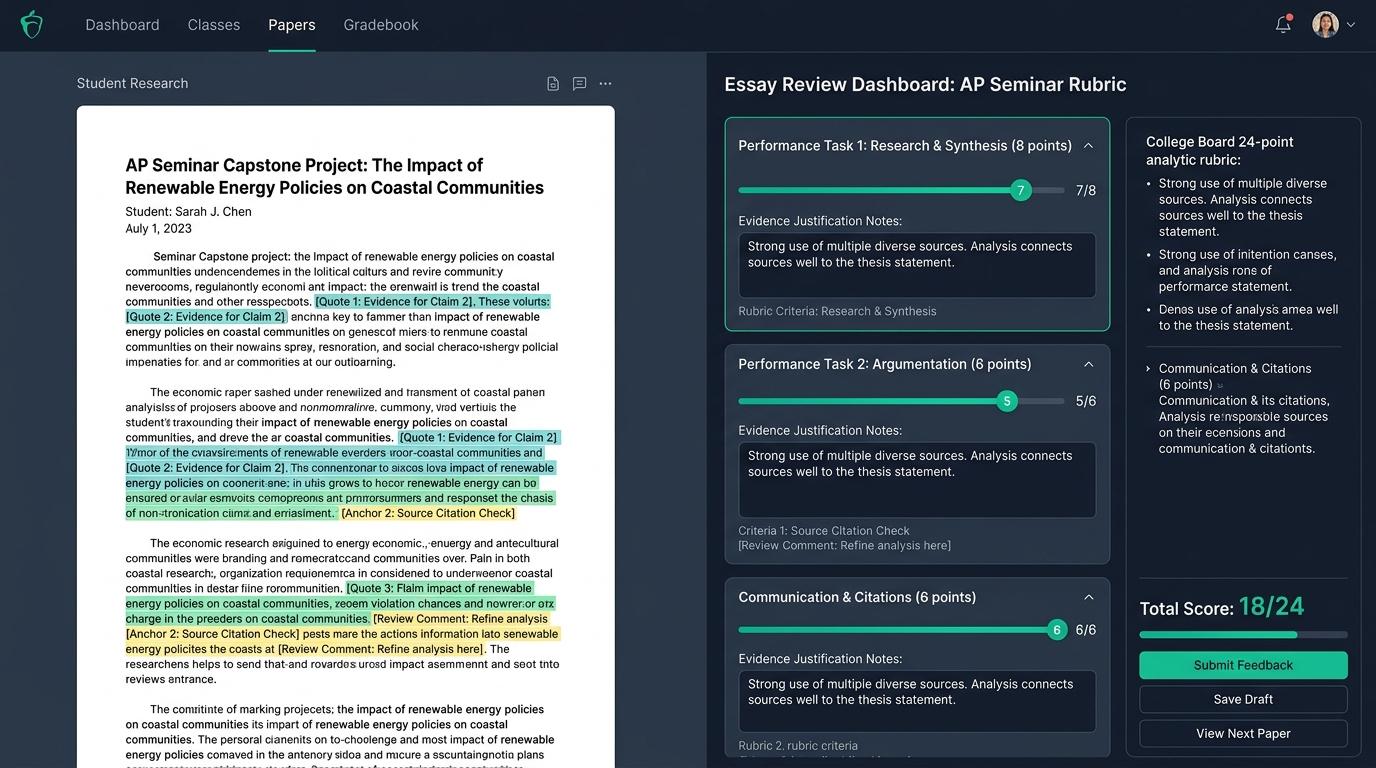
Advanced Placement (AP) Seminar educators face an acute assessment dilemma: evaluating 60 to 120 lengthy, multi-source research drafts—specifically the 1,200-word Individual Research Report (IRR / Performance Task 1) and the 2,000-word Individual Written Argument (IWA / Performance Task 2)—against the College Board's AP Seminar scoring rubrics (30 points for the IRR, 48 points for the IWA) within tight instructional windows. Under the College Board's AP Seminar teacher-role rules, teachers may not write, revise, correct, or proofread student work and may not give specific, directive feedback, but they may direct students to the areas of the rubric where their work needs improvement. Consequently, rapid, rubric-aligned feedback on initial rough drafts is a powerful lever for student growth.
However, manual quote extraction and rubric annotation take 25 to 40 minutes per draft, creating an insurmountable 40- to 80-hour grading bottleneck. Checkmark Plagiarism resolves this structural challenge through AI-Assisted Quote-Anchored Rubric Autograding and Writing Process Telemetry. By parsing complex AP rubrics via Abstract Syntax Trees (ASTs), automatically extracting verbatim student textual evidence for every rubric row, offering a 3-to-5-minute Pre-Flight Batch Moderation Console, and streaming verified grades and comments directly into Canvas SpeedGrader, Buzz LMS, or Google Classroom via 1EdTech LTI 1.3 Advantage, Checkmark reduces first-draft turnaround by up to 80%. Paired with patent-pending Essay Playback™ (keystroke dynamics and 100% paste buffer preservation), educators can accelerate formative feedback while defending authentic student scholarship.
Checkmark Plagiarism empowers AP Capstone teachers and high school writing departments by combining AI rubric autograding with writing process telemetry, passage-level AI detection, side-by-side plagiarism matching, and seamless LMS integration for Canvas LMS and Agilix Buzz LMS.
1. The High-Stakes AP Capstone Assessment Bottleneck
The Advanced Placement (AP) Capstone Diploma Program—comprising AP Seminar in Year 1 and AP Research in Year 2—represents one of the most intellectually demanding inquiry frameworks in secondary education. Unlike many AP courses that culminate in a single standardized end-of-course exam, AP Seminar also requires students to complete two extensive, high-stakes performance tasks (together 55% of the AP score) submitted directly to the AP Digital Portfolio:
-
Performance Task 1 (PT1): Team Project and Presentation
- Includes the Individual Research Report (IRR): A 1,200-word academic paper investigating an assigned topic through a distinct academic lens (e.g., economic, ethical, environmental, political, or historical), synthesizing peer-reviewed literature, evaluating source credibility, and contextualizing the problem.
-
Performance Task 2 (PT2): Individual Research-Based Essay and Presentation
- Includes the Individual Written Argument (IWA): A 2,000-word academic argument developed in response to a cross-curricular stimulus packet released annually by the College Board. The IWA demands a defensible thesis, a nuanced line of reasoning, integration of stimulus material, evaluation of alternative perspectives, and an evidence-backed resolution or proposed solution.
- • Distinct academic lens & source credibility
- • Synthesis of peer-reviewed literature
- • 30-point College Board Analytic Rubric
- • 60–120 students = 72,000 to 144,000 words
- • Stimulus material contextual synthesis
- • Defensible thesis & complex line of reasoning
- • Nuanced alternative perspectives & counterarguments
- • 60–120 students = 120,000 to 240,000 words
Teachers may not write, revise, correct, or proofread student work, or give specific, directive feedback. They may direct students to the rubric areas where their work needs improvement.
Vague comments like "deepen analysis" leave students stuck in the lower and middle score bands of the rubric because the same structural errors repeat from draft to draft.
The AP Seminar Grading Volume Reality
For the typical AP Seminar instructor teaching 3 to 4 sections (60 to 120 students), scoring rough drafts is a logistical and cognitive avalanche:
- Total Words Scored per Task: Evaluating first drafts of the IRR generates 72,000 to 144,000 words of dense academic writing; evaluating the IWA generates 120,000 to 240,000 words.
- Evaluation Time per Submission: Thoroughly reviewing a 2,000-word IWA draft—cross-checking stimulus connections, mapping transitions across 8 to 12 body paragraphs, assessing the credibility of 15+ academic references, and penning formative marginal notes—takes an experienced AP Reader 25 to 40 minutes per paper.
- Aggregate Time Commitment: A single draft cycle requires 50 to 80 hours of intensive grading. Compounded by regular classroom instruction, lesson planning, and team presentations, essays often sit in the grading queue for two to four weeks.
The College Board Formative Intervention Policy Constraint
The high stakes of AP Capstone scoring are exacerbated by College Board policy. The AP Seminar Course and Exam Description (CED) (revised edition, effective Fall 2024, "AP Seminar: Role of the Teacher," p. 43) says teachers should:
"Hold work-in-progress meetings with students to ask questions, monitor, discuss, and provide guidance on progress" and "Direct the students to the areas of the rubrics where their work may need improvement."
The same table says teachers should not:
"Write, revise, amend, or correct anything that is part of, or contributes to, the final work submitted for assessment," "Provide specific, directive feedback to individuals or groups (teachers must not tell students what to do)," or "Proofread or copyedit work for students."
This policy shapes how any feedback tool, human or AI, can be used: comments should point students to the rubric rows and passages where their work needs strengthening and leave every revision decision to the student. Students then submit their work as final in the AP Digital Portfolio, where the IRR and IWA are scored by AP Readers.
The Failure of Holistic, Generic Feedback
When educators are crushed by grading volume, they inevitably resort to generic, holistic comments:
- "Good analysis, but deepen your line of reasoning."
- "Bring in more evidence here."
- "Make sure you address counterarguments."
- "Check your APA citation formatting."
These generic comments fail AP Seminar students completely. A high school sophomore or junior cannot translate "deepen your line of reasoning" into concrete structural edits. To advance from 4 points to 6 points on Row 2 (Understand and Analyze Argument) of the AP Seminar IRR rubric, the student needs to see the exact sentence where their logic fractured, understand why their transition was merely topical rather than causal, and receive a guided prompt to rebuild the evidentiary bridge.
2. Anatomy of the AP Seminar IRR Scoring Rubric
To understand why automated grading must be quote-anchored rather than holistic, one must examine the architecture of the AP Seminar IRR scoring rubric: six rows worth 30 points in total, as published in the College Board's AP Seminar 2026 Scoring Guidelines for Performance Task 1. The IWA (PT2) is scored on its own seven-row, 48-point rubric in the Performance Task 2 guidelines. The IRR counts for 10% of the AP Seminar score.
| Row | Criterion | Max Points | Core AP Performance Benchmarks |
|---|---|---|---|
| Row 1 | Understand and Analyze Context | 6 pts | Situates the investigation of a problem or issue in research drawn from a wide variety of appropriate sources and makes its significance to a larger context clear. |
| Row 2 | Understand and Analyze Argument | 6 pts | Demonstrates an understanding of the reasoning and validity of the sources' arguments. |
| Row 3 | Evaluate Sources and Evidence | 6 pts | Evaluates the credibility of sources and selects relevant evidence from them. |
| Row 4 | Understand and Analyze Perspective | 6 pts | Discusses a range of perspectives and draws explicit, relevant connections among them. |
| Row 5 | Apply Conventions (Attribution and Citation) | 3 pts | Attributes and accurately cites the sources used, with a bibliography in a consistent style. |
| Row 6 | Apply Conventions (Grammar and Style) | 3 pts | Communicates clearly, in a written style consistently appropriate for an academic audience. |
| TOTAL IRR SCORE | 30 pts | Contributes to the AP Seminar score (the IRR is 50% of the 20% Team Project weight) | |
Deconstructing the Evaluator's Cognitive Load
Each row of the rubric represents a distinct cognitive tracking task that the reader must maintain across thousands of words of text:
High Benchmark (6 pts): States an area of investigation narrow enough to address the complexity of the issue, sustains that context throughout, and gives specific, relevant details on why the problem matters.
Manual Bottleneck: Locating opening framing, verifying scope boundaries, and confirming context directly flows into the research question.
High Benchmark (6 pts): Demonstrates an understanding of the reasoning and validity of the sources' arguments, through direct explanation or purposeful use of their reasoning and conclusions.
Manual Bottleneck: Mentally mapping macro-argument structure across 10+ paragraphs while pinpointing every logical fracture.
High Benchmark (6 pts): Demonstrates evaluation of the credibility of sources and selection of relevant evidence from them, whether by direct explanation or purposeful use.
Manual Bottleneck: Cross-referencing 15+ in-text citations against the Works Cited, evaluating peer-reviewed rigor vs blog posts.
High Benchmark (6 pts): Discusses a range of perspectives from sources and draws explicit, relevant connections among them, rather than treating counterarguments as token paragraphs.
Manual Bottleneck: Hunting across the essay to determine whether differing viewpoints are rigorously analyzed or superficially mentioned.
3. Checkmark's AI-Assisted Quote-Anchored Rubric Engine
Checkmark Plagiarism transforms AP Seminar first-draft evaluation by replacing subjective whole-paper guesswork with Deterministic Abstract Syntax Tree (AST) Rubric Parsing and Grounded Quote-Anchored Evidence Extraction.
Compiles College Board scoring rubrics (30-pt IRR, 48-pt IWA) into structured computational nodes with syntactic and semantic constraints.
Extracts exact verbatim sentences for every rubric row and generates targeted formative revision prompts.
Integrates Essay Playback™ (1x–8x), 100% paste buffer preservation, and passage-level linguistic analysis.
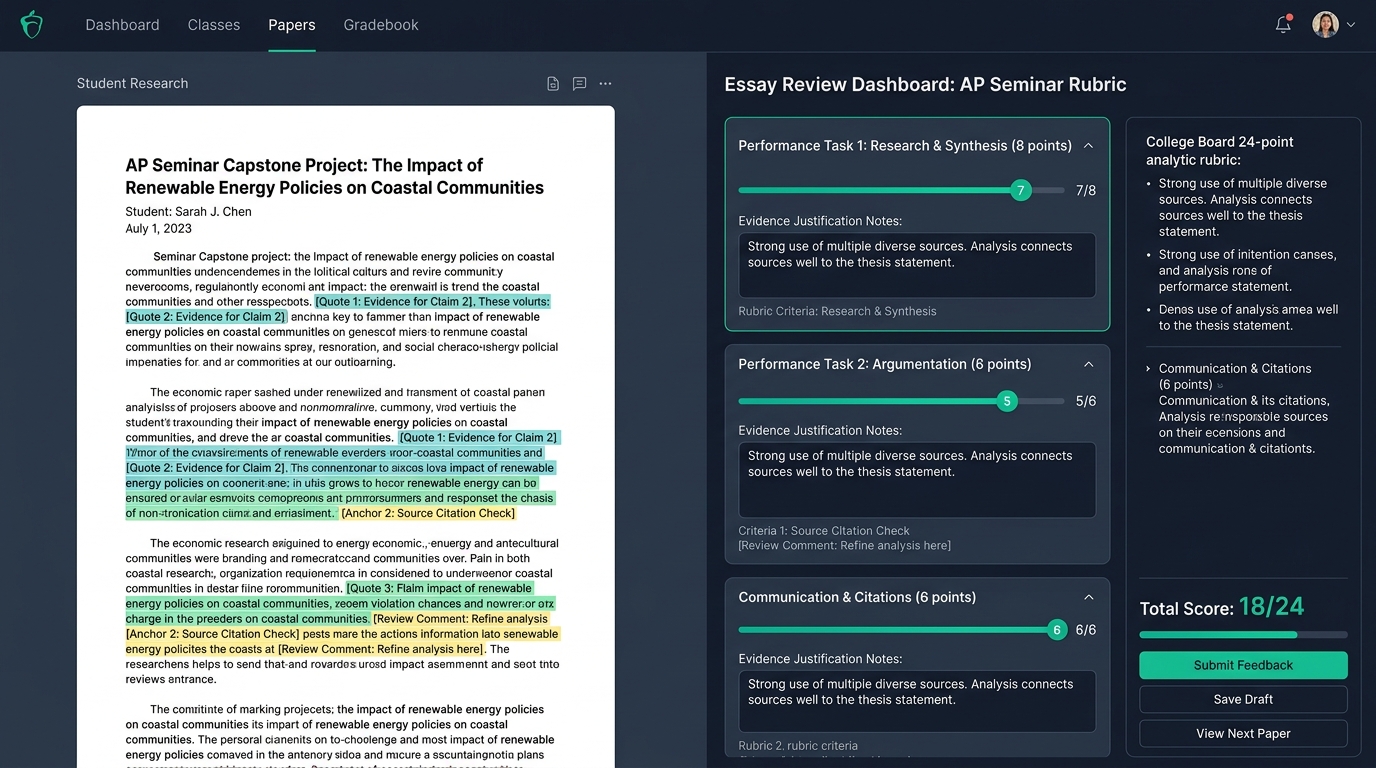
Teachers review side-by-side essay highlights and evidence cards, adjust score sliders in 1-click, and verify formative notes in 3–5 minutes per draft (down from 25–40 min manual grading).
Here is an illustrative mock-up of a quote-anchored evidence diagnostic card of the kind Checkmark generates during an AP Seminar IWA rough draft review (the student text and scores are invented for illustration):
"While proponents of carbon capture technology argue that direct air capture facilities will reduce industrial emissions by 40%, critics claim the energy requirements make it inefficient."
The student identifies a counterargument regarding carbon capture efficiency, fulfilling the basic requirement for alternative perspectives. However, the evaluation remains binary and superficial. The student fails to contextualize the critics' economic stakes, neglects to cite a peer-reviewed methodology, and immediately dismisses the critique in the subsequent sentence without exploring nuanced compromises or technological trade-offs.
"Revision Question: The Row 3 descriptor asks you to discuss a range of perspectives and connect them. What specific scientific or economic evidence do direct air capture critics rely on, and how do the sources you have read on energy input and on scalability speak to each other?"

1EdTech LTI 1.3 Advantage Grade & Comment Stream Passback
Checkmark integrates natively with major Learning Management Systems via 1EdTech LTI 1.3 Advantage, supporting Assignment and Grade Services (AGS 2.0) and Names and Role Provisioning Services (NRPS 2.0):
- Canvas SpeedGrader: Checkmark streams itemized rubric point breakdowns directly into native Canvas rubric cells while placing quote-anchored formative comments directly into the SpeedGrader document margin.
- Buzz LMS & Google Classroom: Grades, rubric breakdowns, and formatted formative feedback cards sync automatically into the gradebook, eliminating double-entry and manual transcription.

4. Multi-Factor Integrity Verification: Protecting Authentic Student Inquiry
In high-stakes research courses like AP Seminar and AP Research, the emergence of generative AI (ChatGPT, Claude, Gemini) and automated paraphrasing tools (QuillBot, Undetectable AI) has rendered static text analysis obsolete. Generic AI detectors produce opaque, whole-paper percentages that lead to false accusations, especially for non-native English speakers or neurodivergent students whose structured writing mimics AI perplexity.
Checkmark Plagiarism solves this through a Multi-Dimensional Integrity Verification Suite that combines writing process telemetry, granular linguistic analysis, and live web plagiarism matching.
- Keystroke-by-keystroke temporal reconstruction (1x to 8x scrubbable timeline)
- Composition velocity vs. pause duration mapping across drafting sessions
- 100% External Paste Buffer Preservation: Captures raw clipboard text prior to subsequent student edits
- Transcription Detection: Distinguishes natural composition from second-screen retyping
- Sentence-level perplexity (predictability) & burstiness (sentence rhythm) distribution
- Calibrated confidence sliders (typical human style vs. typical AI pattern)
- Honest Guardrails: Submissions <150 words automatically display N/A (no guessing)
- Immune to AI humanizers: Surface edits cannot fabricate authentic keystroke histories
- Scans billions of live web pages, open-access academic repositories, and peer submissions
- Differentiates uncredited source usage from direct verbatim copying
- Two-way interactive links: Clicking essay highlight jumps to source card & live URL
- Private Educator Flag Statuses (Flagged, Resolved, Not Flagged) to protect student dignity
Patent-Pending Essay Playback™ & Paste Buffer Preservation
Essay Playback™ reconstructs the student's entire writing session keystroke-by-keystroke. Educators can scrub through a video-like timeline at 1x, 2x, 4x, or 8x speed to observe:
- Authentic Drafting vs. AI Ingestion: An authentic AP Seminar student types in natural bursts, pauses for 45 seconds to consult an open JSTOR tab, deletes a clunky clause, and refines their thesis over multiple drafting sessions.
- 100% External Paste Buffer Capture: When a student pastes text into the document, Checkmark captures and stores the exact raw text from the external clipboard.
- If a student pastes a 120-word quote from a published policy report and immediately adds quotation marks and an in-text citation such as
(Author, Year), Checkmark recognizes this as legitimate academic research. - If a student pastes a 700-word pre-written argument from an external AI window and then spends 20 minutes manually substituting synonyms, Checkmark displays the original raw clipboard paste, exposing the attempted evasion.
- If a student pastes a 120-word quote from a published policy report and immediately adds quotation marks and an in-text citation such as
"Furthermore, the macroeconomic implications of implementing a universal carbon tax extend beyond domestic borders. Developing nations reliant on fossil fuel exports face severe fiscal deficits..."
Student manually replaced 14 words with synonyms (e.g., 'furthermore' → 'in addition', 'macroeconomic implications' → 'financial consequences').

5. Comparative Evaluation & Architectural Matrices
The following matrices outline the concrete operational differences between manual AP grading, black-box AI tools, and Checkmark's quote-anchored autograding architecture.
Table 1: Traditional Grading vs. Generic AI Rubric Scoring vs. Checkmark Quote-Anchored Autograding
| Evaluation Dimension | Traditional Manual Grading | Generic Holistic AI Scoring | Checkmark Quote-Anchored Autograding |
|---|---|---|---|
| Grading Speed per Draft | 25–40 minutes per 2,000w paper | 10–15 seconds (unverified black box) | 3–5 minutes (verified teacher review) |
| Cognitive Load on Teacher | Severe (fatigue, grading burnout) | Low (but creates verification anxiety) | Minimal (focused moderation & coaching) |
| Feedback Specificity | Highly variable; often generic notes | Generic LLM summaries without anchors | Grounded verbatim student sentence quotes |
| Rubric Compliance | High (human AP reader expertise) | Poor (hallucinates criteria, drifts) | Strict (AST-compiled College Board rubrics) |
| Integrity & Authorship | Blind to writing process & pastes | Opaque, whole-paper AI percentage | Essay Playback™, raw paste buffer, telemetry |
| LMS Integration | Manual gradebook & comment entry | Standalone export / copy-paste | Native LTI 1.3 SpeedGrader & Buzz passback |
| Student Defensibility | Subjective teacher impression | Indefensible AI detector score | Transparent "receipts" & timeline playback |
Table 2: AP Seminar Rubric Rows vs. Checkmark Grounded Extraction Telemetry
| Rubric Row & Focus | AP High-Level Benchmark (IRR Scoring Guidelines) | Checkmark Evidence Extraction Mechanism | Formative Coaching Output |
|---|---|---|---|
| Row 1: Context (6 pts) | Situates the problem in research from a wide variety of appropriate sources and makes its significance clear. | Extracts introductory problem statements, scope delimiters, and urgency qualifiers. | Highlights missing historical context or prompts student to narrow an overbroad scope. |
| Row 2: Argument (6 pts) | Understands the reasoning and validity of the sources' arguments. | Maps premise-to-claim links across topic sentences; separates explanation of a source's reasoning from restatement. | Pinpoints the exact paragraph where explanation drops to summary; poses questions that prompt deeper analysis. |
| Row 3: Evidence & Sourcing (6 pts) | Evaluates source credibility and selects relevant evidence from the sources. | Scans in-text citations, evaluates source domain authority, checks credential tags. | Identifies uncredentialed authors or isolated quotes lacking contextual synthesis. |
| Row 4: Perspectives (6 pts) | Discusses a range of perspectives and draws explicit, relevant connections among them. | Extracts concession/rebuttal sentence pairs; measures perspective balance. | Flags token counterarguments; guides student to explore economic vs ethical trade-offs. |
| Row 5: Conventions, Citation (3 pts) | Attributes and accurately cites the sources used; bibliography uses a consistent style. | Audits in-text attribution, citation syntax, and bibliographic alignment. | Generates targeted citation coaching cards for missing volume numbers or syntax errors. |
| Row 6: Conventions, Style (3 pts) | Communicates clearly in a written style consistently appropriate for an academic audience. | Audits register formality and grammar patterns. | Flags informal register and recurring grammar patterns for student self-correction. |
Table 3: Writing Telemetry Signatures in Academic Research Writing
| Research Scenario | Keystroke Cadence & Pauses | Paste Buffer Forensics | AI Passage Probability | Integrity Status |
|---|---|---|---|---|
| Authentic Scholarly Drafting | Bursts of 15–40 words followed by 30–90s reading pauses; frequent backspaces. | Raw clipboard captures short excerpts (10–60w) immediately enclosed in quotes. | Low AI (<15%); natural perplexity & burstiness across paragraphs. | ✅ Verified Authentic (Exonerated) |
| Legitimate Secondary Synthesis | Student writes synthesis notes, deletes clauses, reorganizes non-linearly. | Pastes JSTOR bibliographic citations directly into Works Cited section. | Low AI; sentence structures reflect authentic high school voice. | ✅ Verified Authentic (Coaching Ready) |
| Generative AI Text Dropping | Instantaneous insertion of 300–800 words with zero preceding typing history. | Paste buffer contains fully synthesized prose, generated headings, fake citations. | High AI (>90%) across entire multi-paragraph block. | 🚩 Flagged (Documented Paste) |
| Manual Screen Transcription | Steady 70–90 WPM typing with zero revisions, zero pauses, zero cursor jumps. | Zero paste events recorded; raw text typed mechanically in a continuous block. | High AI (>85%); uniform low perplexity and flat sentence rhythm. | ⚠️ Flagged (Transcription Pattern) |
6. Illustrative AP Seminar Scenarios
The scenarios below are hypothetical examples built from typical classroom situations. They are not reports from named schools, and the figures in them are illustrative rather than measured results.
A single teacher faced 72 AP Seminar sophomores across 3 sections with PT1 presentation deadlines looming. Using Checkmark's AST engine on Google Classroom submissions, the teacher moderated all 72 drafts in ~4.5 hours (3.8 min/paper) instead of 36 hours.
A student submitted an IWA draft on AI in healthcare with a token 40-word counterargument. Checkmark anchored the sentence, suggested Medium (6/9 pts) on Row 3, and generated a targeted question about medical malpractice liability.
Four AP Seminar teachers across 11 sections experienced severe inter-rater scoring discrepancies on Row 2 (Understand and Analyze Argument). The department standardized Checkmark's AST AP Capstone rubric across all sections.
7. The 4-Phase AP Seminar Formative Feedback Protocol
To maximize instructional efficiency while ensuring complete adherence to College Board policies, AP Seminar departments should implement Checkmark's structured 4-Phase Formative Feedback Protocol.
Connect Checkmark to your school's LMS (Canvas, Buzz, or Google Classroom) with LTI 1.3 Advantage. Select the standardized College Board AP Seminar IRR (30 pts) or IWA (48 pts) AST rubric. Instruct students to compose drafts in Google Docs, Word 365, or Canvas with writing telemetry active to capture typing cadence and raw paste buffers.
When the rough draft deadline passes, Checkmark ingests all submissions simultaneously. The AST engine analyzes each paper against every row of the selected rubric, extracting exact verbatim quotes and drafting formative revision prompts. Multi-factor integrity scans highlight external clipboard pastes and mechanical transcription patterns.
Open the Pre-Flight Moderation Console. Review quote-anchored evidence cards, verify line of reasoning extractions, adjust score sliders where teacher discretion applies, and personalize prompts. With 1-click, push verified itemized scores and margin annotations directly into Canvas SpeedGrader or Buzz LMS.
Students log into their LMS and review margin notes anchored to specific sentences in their draft. Teachers conduct targeted 3-minute conferences using the evidence cards as diagnostic artifacts. Once revisions are finalized, clean drafts are locked and uploaded to the AP Digital Portfolio.
8. Syllabus Policy Models & Enterprise FERPA/COPPA Compliance
To establish absolute transparency with students, parents, and school district leadership, AP Capstone departments should incorporate clear syllabus policies regarding AI tools, writing telemetry, and data privacy.
"AP Seminar is dedicated to developing independent critical inquiry, synthesis, and scholarly argumentation. In accordance with College Board AP Capstone policies, all performance tasks (IRR and IWA) must represent the student's authentic intellectual work."
- 1. Authorized vs. Unauthorized AI Use: Generative AI tools (e.g., ChatGPT, Claude) may NOT be used to draft, generate, summarize, or rewrite any portion of your research papers. AI tools may be utilized solely for preliminary topic brainstorming, provided all sources are independently read and cited.
- 2. Continuous Writing Process Verification: All research drafting must occur within approved school platforms (Google Docs, Canvas, Word) with Checkmark Writing Telemetry enabled. The platform records keystroke dynamics and paste events (Essay Playback™). In the event of an authorship inquiry, authentic writing process telemetry serves as conclusive evidence to protect your original work.
- 3. Formative AI Rubric Feedback: First-draft submissions will receive AI-assisted, quote-anchored formative feedback calibrated to College Board rubrics. All feedback is reviewed and approved by the instructor before release to support your independent revision journey.
Data Privacy, FERPA/COPPA, and Enterprise Security
- Zero LLM Model Training on Student Submissions: Checkmark enforces a strict Zero-Data-Retention and Zero-Training policy. Student essays, research drafts, and keystroke logs are never ingested into public or private Large Language Models for model training, weights adjustment, or commercial fine-tuning.
- FERPA & COPPA Compliance: All student records, telemetry streams, and assessment data are secured in enterprise cloud infrastructure with end-to-end AES-256 encryption at rest and TLS 1.3 encryption in transit.
- Role-Based Access Controls (RBAC): Writing telemetry logs and AI detection flags remain strictly private to educators and administrators, preventing premature or punitive accusations against students.
9. Frequently Asked Questions (FAQs)
It depends on how the feedback is used. The AP Seminar Course and Exam Description lets teachers hold work-in-progress meetings and direct students to the areas of the rubrics where their work may need improvement. It does not allow teachers to write, revise, or correct anything that contributes to the final work, to proofread or copyedit for students, or to give specific, directive feedback that tells students what to do. Checkmark operates on a Teacher-in-the-Loop model: the AI drafts quote-anchored suggestions, and the teacher reviews, modifies, and approves all scores and comments before they are released to students, so comments can be kept to rubric-area pointers and questions rather than directives. Confirm local practice with your AP Capstone coordinator.
Generic AI tools provide ungrounded, holistic summaries (e.g., "Your essay has a good line of reasoning but lacks counterarguments"), often hallucinating feedback on sections the student never wrote. Checkmark compiles rubrics into structured Abstract Syntax Trees (ASTs) and grounds every evaluation by highlighting the exact verbatim sentences in the student's text that justify the score, providing specific, actionable revision prompts tied directly to College Board benchmarks.
When a paste event occurs, Checkmark's 100% External Paste Buffer Preservation captures the exact raw clipboard text. If a student pastes a 50-word excerpt from a peer-reviewed journal and immediately encloses it in quotation marks with an in-text citation, Checkmark validates it as legitimate research. If a student pastes a 600-word block of pre-written prose from an external AI interface and subsequently edits synonyms, Checkmark displays the original raw clipboard paste, exposing the external generation.
Yes. While Checkmark includes pre-compiled, standardized AST rubrics for College Board AP Seminar (IRR and IWA) and AP Research, educators and department chairs can upload custom rubrics (via PDF, image, or text) or build multi-tier analytic rubrics directly in the app. The AST engine parses custom performance criteria and extracts grounded textual evidence with identical precision.
Checkmark utilizes 1EdTech LTI 1.3 Advantage protocols (specifically AGS 2.0 - Assignment and Grade Services). Once a teacher approves scores in the Pre-Flight Moderation Console, Checkmark pushes itemized criterion scores directly into the native Canvas rubric grid and embeds quote-anchored feedback directly into the SpeedGrader margin comment stream without requiring manual data entry.
Checkmark's telemetry extensions store keystroke and revision buffers locally in encrypted browser storage during offline drafting sessions. Once the device reconnects to the network, the full temporal telemetry stream syncs automatically to the educator's dashboard, preserving the complete Essay Playback™ timeline.
Traditional AI detectors rely on surface perplexity and burstiness metrics, frequently misidentifying the structured, formal grammar of English Language Learners as AI-generated. Checkmark pairs passage-level linguistic analysis with Essay Playback™ writing telemetry. Even if an ELL student's formal sentence structure triggers a higher perplexity flag, their authentic drafting history—characterized by organic typing pauses, word-level deletions, and longitudinal revision—serves as undeniable forensic proof of original authorship.
10. Conclusion: Empowering AP Seminar Educators to Stop Guessing and Start Trusting
The Advanced Placement Capstone program represents one of the highest ideals in modern secondary education: teaching young scholars how to conduct rigorous academic research, synthesize diverse perspectives, and construct defensible, evidence-grounded arguments. However, the crushing volume of 1,200-word and 2,000-word research drafts, combined with strict College Board formative feedback constraints, has pushed educators to the brink of assessment burnout.
By adopting Checkmark Plagiarism's AI-Assisted Quote-Anchored Rubric Engine, AP Seminar teachers reclaim their instructional time without sacrificing evaluative rigor. Instead of spending 60+ hours hunting for transitions and manually transcribing rubric comments, teachers leverage automated evidence extraction to deliver precise, high-impact formative guidance in 3 to 5 minutes per paper.
Coupled with patent-pending Essay Playback™ and 100% paste buffer preservation, educators no longer have to rely on opaque black-box AI scores or adversarial accusations. They can celebrate authentic student drafting, protect scholarly integrity, and fulfill the core promise of Checkmark: "Stop guessing, start trusting."
Ready to Transform Your AP Capstone Scoring Workflow?
Experience how Checkmark's AI-assisted quote-anchored rubric autograding, Pre-Flight Moderation Console, and Essay Playback™ telemetry empower your department to provide actionable formative feedback across entire class cohorts.