
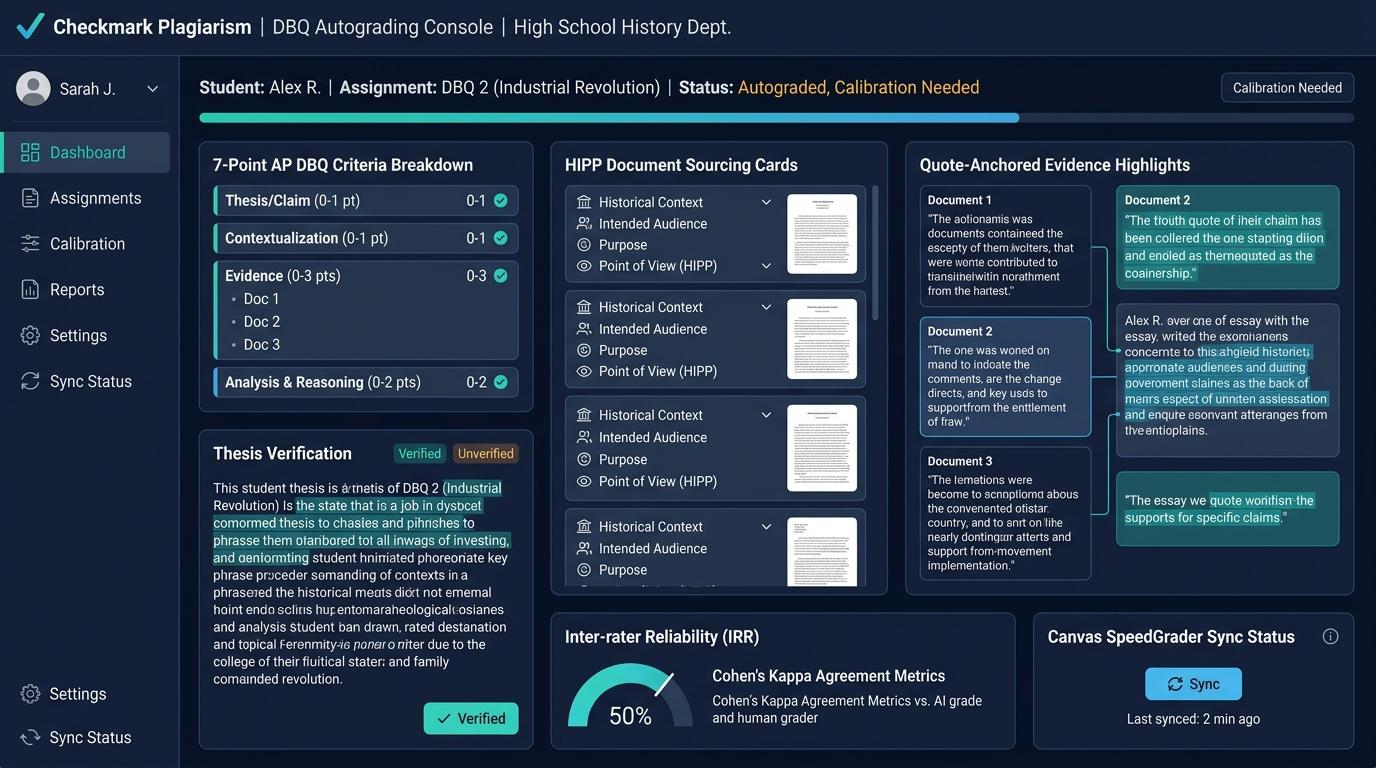
High school history educators teaching Advanced Placement (AP US History, AP European History, AP World History: Modern) and advanced state social studies curricula face an immense instructional bottleneck: the cognitive exhaustion and inter-rater grading variance of Document-Based Questions (DBQs). Evaluating stacks of 120–160 multi-page essays against the College Board’s complex 7-point analytic rubric—spanning Thesis, Contextualization, Document Evidence, Outside Evidence, Sourcing (HIPP/POVA), and Complexity—demands 20 to 35 hours of grading per assignment. This crushing load triggers severe evaluator fatigue, intra-rater drift between paper #1 and paper #120, two-to-three-week feedback delays, and wide inter-rater disparities across classrooms within the same department. Checkmark Plagiarism’s AI Rubric Autograding Suite for History solves this systemic challenge. By transforming flat DBQ rubrics into structured Abstract Syntax Tree (AST) evaluation engines, Checkmark extracts verbatim quote-anchored evidence for every historical criterion, pinpoints HIPP sourcing mechanics, conducts pre-moderation batch calibration across teaching teams, and preserves teacher final authority with a 1-click review console. Seamlessly integrated via 1EdTech LTI 1.3 Advantage (AGS 2.0 / NRPS 2.0) into Canvas SpeedGrader, Agilix Buzz, and Google Classroom—and backed by patent-pending Essay Playback™ writing process telemetry—Checkmark empowers history departments to cut grading turnaround from weeks to hours, achieve near-perfect inter-rater reliability (κ > 0.85), and restore formative writing feedback to the social studies classroom.
Checkmark Plagiarism streamlines social studies evaluation by uniting AI rubric autograding with writing process replay, AI writing detection, side-by-side plagiarism detection, and enterprise integrations for Canvas LMS and Agilix Buzz LMS.
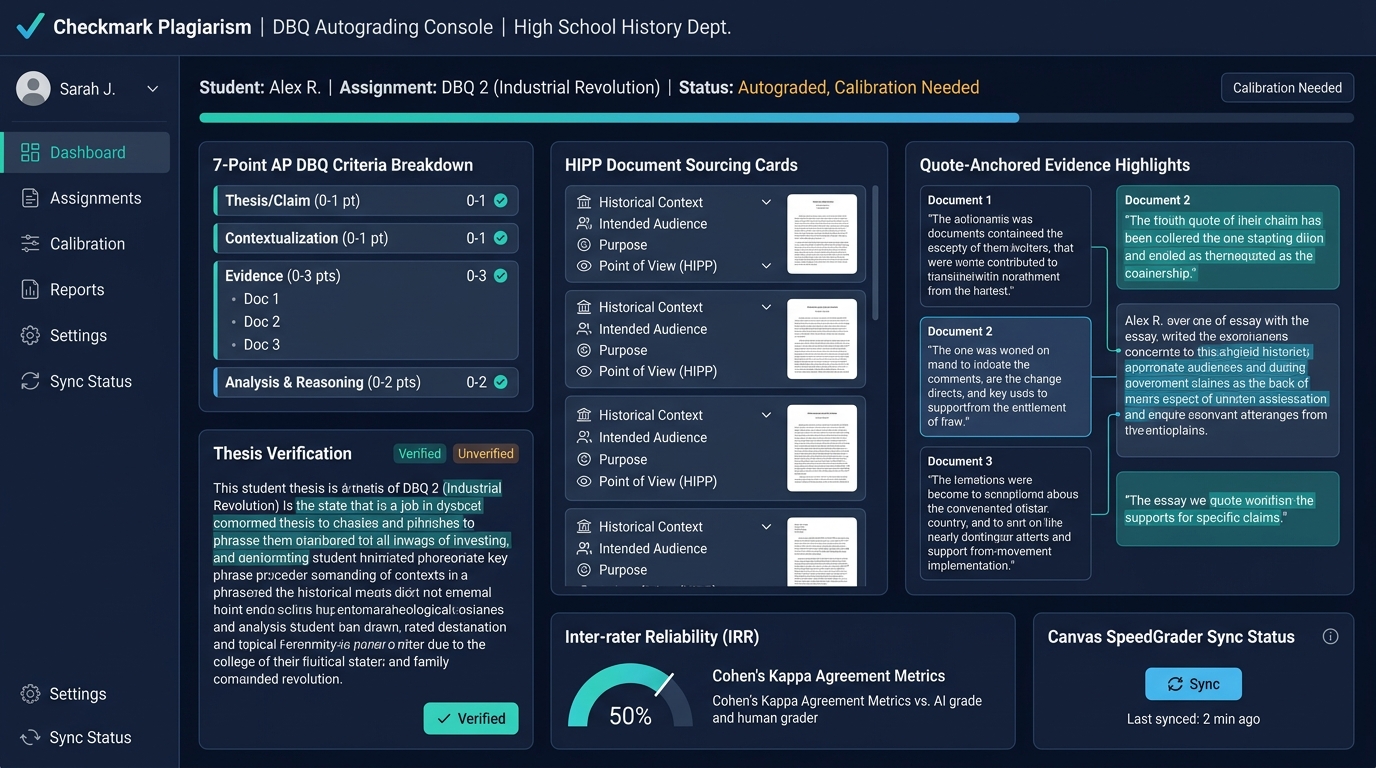
1. The High School History Grading Dilemma: Anatomy of the DBQ Bottleneck
In secondary humanities education, the Document-Based Question (DBQ) represents the pinnacle of disciplinary literacy. Designed to mirror authentic historiography, the DBQ requires students to synthesize a collection of six to seven primary and secondary sources, contextualize broad historical developments, weave unprompted outside historical evidence, analyze authorial intent and point of view (HIPP analysis), and craft a nuanced historical argument within a strict time limit.
For high school social studies departments, however, the DBQ represents a profound structural dilemma:
The Staggering Cognitive Math of DBQ Stacks
A typical high school history teacher instructing four to five sections of APUSH, AP European History, or AP World History manages between 120 and 160 students.
Evaluating a single DBQ requires an educator to track multiple moving historical threads simultaneously:
- Did the student craft a defensible thesis with a clear line of reasoning, or did they simply restate the prompt?
- Does the contextualization describe broader historical processes spanning before, during, or after the era, or is it a passing sentence?
- Did the student accurately describe content from at least three documents?
- Did they use at least four documents (under current College Board standards) to actively support an argument, rather than merely summarize them?
- Did they supply a discrete, accurate piece of specific historical evidence beyond the provided documents?
- Did they explain how or why the document’s Historical Situation, Intended Audience, Purpose, or Point of View (HIPP) is relevant for at least two documents?
- Did the essay demonstrate complex understanding (corroboration, qualification, nuance across historical themes)?
| Grading Audit Metric | Standard Human Measurement | Instructional Consequence |
|---|---|---|
| Total Student Submissions | 140 essays | Standard cohort across 5 AP history periods |
| Average Reading & Annotation Time | 12 minutes per essay | Scanning 4–6 pages of handwritten or typed prose |
| Rubric Calculation & Comment Writing | 3 minutes per essay | Tallying 7 criteria nodes and drafting formative notes |
| Total Teacher Grading Hours per DBQ Set | 35.0 Hours | Equivalent to 4.5 full workdays beyond classroom hours |
| Expected Turnaround Time | 16–21 Calendar Days | Feedback arrives weeks after historical unit concluded |
Because teachers cannot allocate 35 uninterrupted hours during school days, grading occurs late at night and over weekends. Under this severe cognitive load, three destructive phenomena emerge:
Intra-Rater Drift
A teacher grading Essay #1 on Saturday spends 18 minutes writing meticulous feedback. By Sunday night at Essay #115, exhaustion triggers 4-minute skims and generic middle-tier marks.
The 3-Week Feedback Void
By the time students receive graded DBQs 20 days later, the class has moved to the next historical era. Feedback is formatively dead, destroying the writing revision cycle.
The Grading Lottery
Teacher A averages 3.4/7 (thesis gatekeeper), Teacher B averages 4.8/7, and Teacher C averages 5.8/7. Course GPAs reflect instructor assignment rather than student mastery.
2. Deconstructing the 7-Point College Board AP DBQ Rubric Architecture
To automate and standardize DBQ scoring without sacrificing human pedagogical discretion, departments must first deconstruct the exact mechanics of the College Board 7-Point Analytic DBQ Rubric (standardized across AP US History, AP European History, and AP World History: Modern).
| Rubric Node | Criterion Name | Max Pts | Evaluation Rule & College Board Standard |
|---|---|---|---|
| SEC 1 | Thesis / Claim | 0–1 | Defensible claim + clear line of reasoning in introduction or conclusion (1–2 consecutive sentences). |
| SEC 2 | Contextualization | 0–1 | Describes broader historical processes before, during, or continuing after the prompt era (must be > phrase). |
| SEC 3A | Evidence: Doc Content | 0–1 | Accurately describes content from at least 3 documents to address the prompt topic. |
| SEC 3B | Evidence: Doc Argument | 0–1 | Uses content from at least 4 documents to actively support an argument in response to the prompt (total 2 pts). |
| SEC 4 | Evidence Beyond Documents (OI) | 0–1 | Supplies at least 1 specific, accurate historical fact outside the documents that directly supports the thesis. |
| SEC 5 | Sourcing (HIPP / POVA) | 0–1 | Explains how or why Historical Situation, Intended Audience, Purpose, or Point of View is relevant for ≥ 2 documents. |
| SEC 6 | Complex Understanding | 0–1 | Demonstrates nuance, corroboration, qualification, or multi-thematic synthesis across the entire essay. |
Deep-Dive: Criteria Mechanics & Common Human Grading Bottlenecks
3. The Mechanics of AI-Assisted DBQ Rubric Scoring: Grounded Quote-Anchored Evidence Extraction
Generic, consumer AI chatbots fail at DBQ grading because they produce holistic, hand-waving assessments (“This is a well-written 6/7 essay with strong historical voice”). High school history departments cannot use holistic estimates; they require deterministic, evidence-grounded verifications where every point is anchored to verbatim student text.
Checkmark Plagiarism’s DBQ Justification Engine replaces black-box guessing with an Abstract Syntax Tree (AST) Criteria Extraction Pipeline:
Maps explicit citations (“Doc 1”, “Source A”) and implicit primary actors. Disqualifies unanalyzed quote dumping from argument counters.
Verifies macro-historical era boundaries and thematic continuity. Anchors 2–4 introductory or concluding contextual sentences.
Validates Active Argumentation vs. Passive Summary. Formats exact count matrix: Docs Described (≥3) | Docs Argued (≥4).
Pinpoints Historical Situation, Intended Audience, Purpose, or Point of View. Verifies the “How/Why” explanatory connective clause for ≥2 documents.
Compares student prose against assignment document corpus. Identifies novel, accurate historical proper nouns tied to the central claim.
Verbatim Quote-Anchored Evidence Cards: How It Looks in Practice
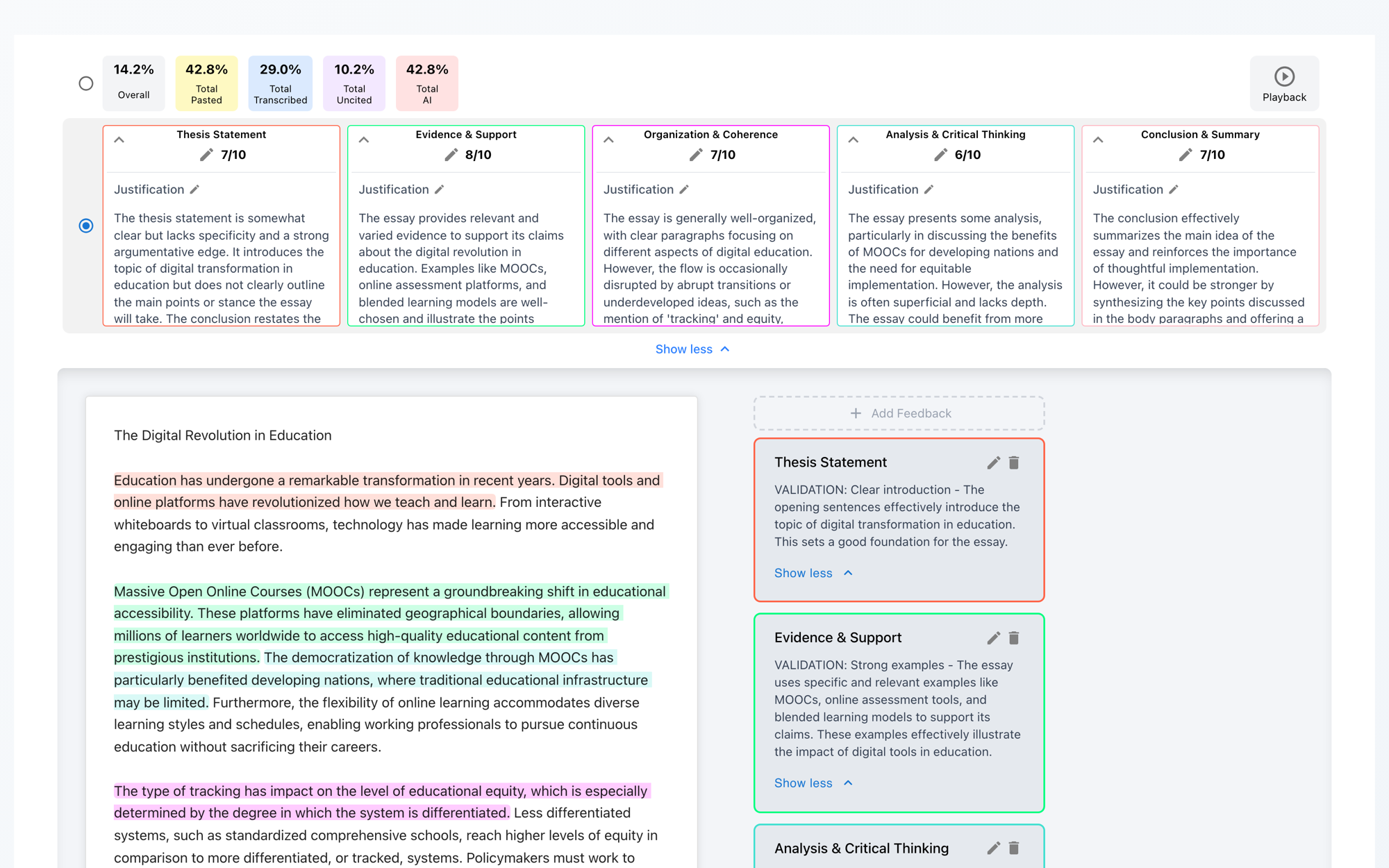
When a history educator opens a student submission in Checkmark, the sidebar presents interactive Evidence Cards linking every rubric point directly to highlighted text in the essay:
Criterion: Document Sourcing & POVA Analysis (Target: ≥2 Documents)
“As a Northern textile factory owner, Lawrence’s glowing endorsement of high tariffs in Doc 2 must be understood through his direct financial stake in blocking cheaper British cotton imports, making his claims of universal prosperity inherently self-serving.”
“Writing in the immediate aftermath of the Panic of 1873, Weaver’s fiery speech in Doc 5 reflects the desperate agrarian crisis and currency deflation that drove Midwestern farmers toward the burgeoning Greenback movement.”
4. Checkmark Plagiarism’s AI Rubric Autograding Suite for History
Checkmark is engineered specifically for secondary and higher-education humanities departments that demand transparency, academic rigor, and total educator authority.
Abstract Syntax Tree (AST) Rubric Schema
Checkmark normalizes diverse DBQ rubrics into structured AST schemas. Whether an AP team uses the standard College Board 7-point scale, a modified 9th-grade Pre-AP 5-point scale, or an IB History Paper 2 rubric, the engine maps discrete evaluative nodes with exact mathematical thresholds:
{
  "rubric_type": "AP_DBQ_7_POINT",
  "subject": "AP_US_HISTORY",
  "schema_version": "2026.1",
  "criteria": [
    {
      "id": "THESIS_01",
      "name": "Thesis and Line of Reasoning",
      "points_possible": 1,
      "evaluation_type": "binary_claim_with_reasoning",
      "requires_consecutive_sentences": true
    },
    {
      "id": "CONTEXT_01",
      "name": "Historical Contextualization",
      "points_possible": 1,
      "evaluation_type": "temporal_macro_process",
      "minimum_sentence_threshold": 2
    },
    {
      "id": "DOC_EVIDENCE_02",
      "name": "Document Evidence and Argumentation",
      "points_possible": 2,
      "tiers": [
        { "points": 1, "rule": "describes_content_min_3_docs" },
        { "points": 2, "rule": "supports_argument_min_4_docs" }
      ]
    },
    {
      "id": "OUTSIDE_EVIDENCE_01",
      "name": "Evidence Beyond the Documents",
      "points_possible": 1,
      "rule": "specific_accurate_entity_not_in_prompt_docs"
    },
    {
      "id": "SOURCING_HIPP_01",
      "name": "Document Sourcing / HIPP",
      "points_possible": 1,
      "rule": "explains_relevance_min_2_docs",
      "subcategories": ["Historical Situation", "Intended Audience", "Purpose", "Point of View"]
    },
    {
      "id": "COMPLEXITY_01",
      "name": "Complex Historical Understanding",
      "points_possible": 1,
      "rule": "demonstrates_nuance_corroboration_or_qualification"
    }
  ]
}
5. The Multi-Factor Academic Integrity Triad for High School DBQs
Timed and untimed DBQs in high school history classes face serious academic integrity threats in the modern generative AI era. Students under intense pressure to earn a 5 on the AP exam or maintain a high GPA frequently turn to AI prompt injection, online study guides (Quizlet, Course Hero), or peer copying.
Opaque whole-paper AI detection percentages are useless for history educators because they generate devastating false positives on formulaic historical writing styles. Checkmark protects students and teachers through a Multi-Dimensional Integrity Triad:
Essay Playback™
Keystroke-by-keystroke video replay (1x to 8x). Reconstructs drafting sessions, natural pauses, deletions, and active composing.
Paste & Telemetry
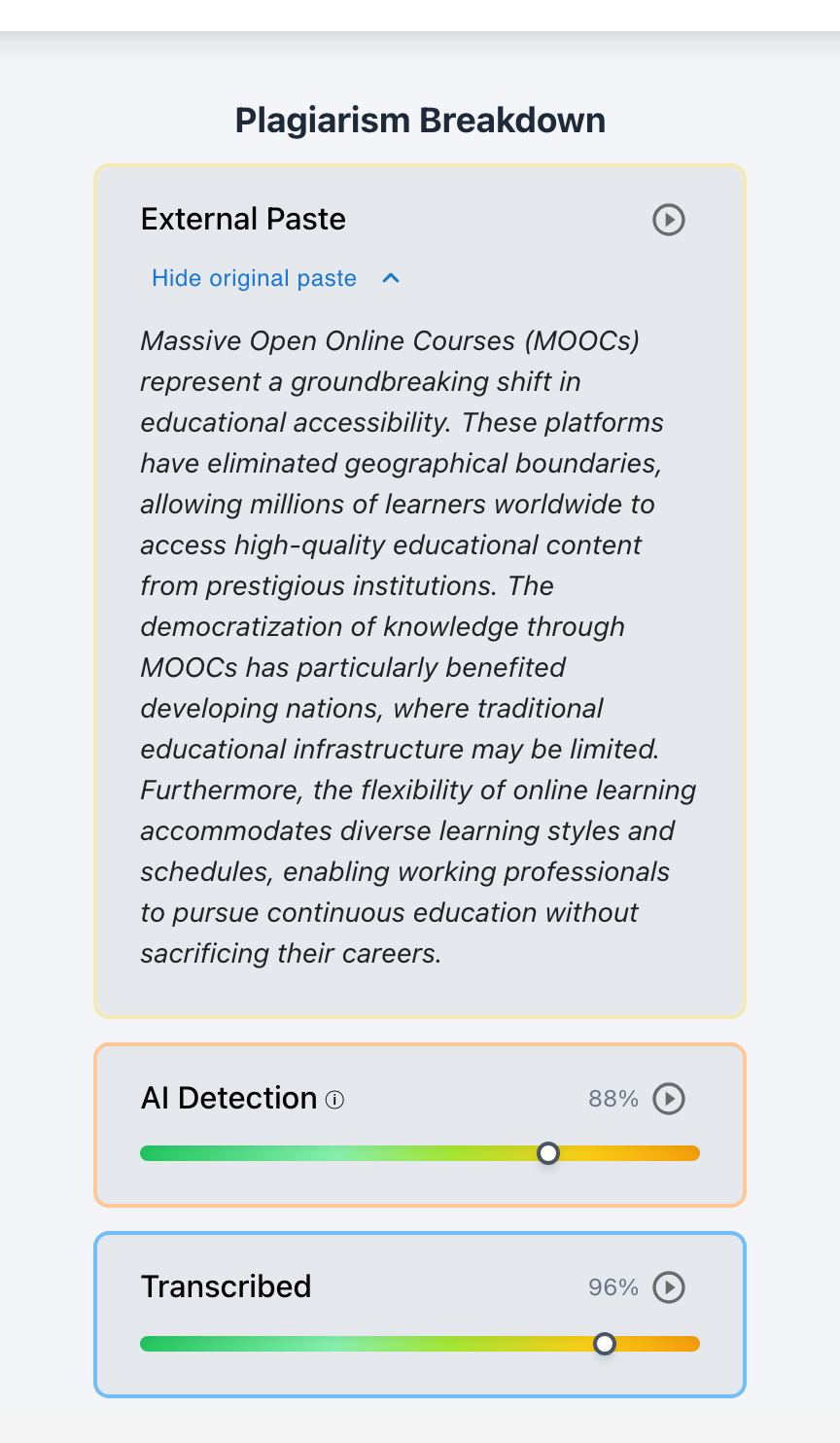
Captures timestamped external paste events with full clipboard preservation. Distinguishes quote pastes from AI dumps.
Passage AI Sliders
Perplexity and burstiness analysis per passage. Honest guardrails (N/A on <150w) prevent false positives on short answers.
| Student Submission State | Typical Generic Detector | Checkmark Integrated Evidence | Adjudication Outcome |
|---|---|---|---|
| Formulaic DBQ Essay (Authored by Student) | 82% AI (False Positive) | Clean Keystroke Playback (48 min), natural composing pauses verified | Exonerated instantly |
| Retyped AI Generation (Copied from Phone) | 12% AI (False Negative) | Transcription Alert: 0 pauses, steady 110 WPM mechanical typing cadence | Flagged for teacher review |
| Pasted AP Study Guide Analysis Paragraph | 0% AI (Missed Plagiarism) | Side-by-Side Source Viewer: Direct match to 2021 AP reading commentary | Flagged uncited match |
Why Essay Playback™ Is the Ultimate Safeguard for AP Writers
AP history students are deliberately taught to write formulaically: “Although [Counter-argument], because [Evidence 1] and [Evidence 2], therefore [Main Claim].” This structured academic syntax often triggers generic AI detectors that mistake high formality for machine generation.
With Essay Playback™, the teacher never has to guess. If a student is flagged by an external detector, the teacher simply clicks “Play Drafting Session.” In 45 seconds at 8x speed, the teacher observes:
- The student spending 12 minutes outlining the prompt and typing notes.
- Composing the thesis, backspacing twice to refine the line of reasoning.
- Pausing for 90 seconds while reading Document 3 before synthesizing it with Document 4.
- Correcting minor historical dates in the conclusion.
Authentic keystroke history provides undeniable proof of authorship, protecting student trust and eliminating wrongful accusations.
6. The 4-Phase Departmental DBQ Calibration Protocol for Social Studies PLCs
When high school history departments adopt rubric autograding, the goal is not merely to grade faster—it is to eliminate inter-rater grading variance across classrooms.
Department Chair selects 3 representative papers (High 7/7, Mid 4/7, Low 2/7). System executes baseline AST rubric parsing and generates evidence cards.
All course teachers grade anchor papers blind in Checkmark calibration console. System calculates team Cohen’s κ and Krippendorff’s α to identify criteria needing alignment.
Checkmark generates draft rubric scores across 150+ submissions in <5 minutes. Chair variance dashboard tracks cohort distribution curves.
Teachers conduct 3-minute quote-anchored DBQ conferences. Class-wide mastery heatmaps drive targeted historical writing mini-lessons.
Phase 2 Mathematics: Inter-Rater Reliability Metrics
During the weekly PLC meeting, teachers evaluate anchor papers blind. Checkmark immediately computes Cohen’s Kappa (κ):
| Kappa / Alpha Metric | Department Calibration Status | Recommended PLC Action |
|---|---|---|
| < 0.40 | Severe Evaluator Divergence | Urgent rubric realignment needed; criteria definitions disagree across classrooms. |
| 0.41 – 0.60 | Moderate / Uncalibrated Standards | Review Sourcing (HIPP) and Complexity evidence cards in 20-minute PLC huddle. |
| 0.61 – 0.80 | Substantial Agreement | Healthy social studies PLC; consistent scoring across core evidence nodes. |
| 0.81 – 1.00 | Exemplary Department Calibration | Statistically defensible grading; proceed to batch autograding with full confidence. |
Phase 3: Real-Time Department Dispersion Dashboard
The department chair monitors the Cohort Score Dispersion Dashboard to detect severity or leniency drift before grades are published:
7. Real-World Case Studies: Transforming High School History Programs
| Case Study Profile | Initial Problem | Checkmark Solution | Measurable Outcome |
|---|---|---|---|
| 1. Suburban APUSH Department (4 Teachers) | 140 DBQs = 18.5 hours/teacher; 18-day turnaround lag; student grade disputes | AST Autograder + 1-Click Review Console + Evidence Cards | Grading time: 2.2 hrs; 24-hr turnaround; zero grade appeals |
| 2. AP European History PLC (2 Teachers) | Severe Inter-Rater Discrepancy (Δ = 2.6 pts); baseline κ = 0.38 | Pre-Flight Blind Calibration & AST Evidence Anchors | Team IRR increased to κ = 0.89; variance narrowed to ±0.3 pts |
| 3. Urban AP World History Cohort (165 Students) | Low exam pass rate; weak Sourcing & Thesis; late feedback cycle | 24-Hour Formative Turnaround + In-Class Revision Workshop | DBQ exam average increased from 3.4/7 to 5.2/7 (+1.8 pts) |
Case Study 1: Suburban APUSH Department (140 DBQs in 2 Hours vs. 18 Hours)
- Setting: High-performing public high school in Illinois with four AP US History teachers and 140 enrolled juniors.
- The Challenge: Following the mid-semester Gilded Age and Progressive Reform DBQ, the team faced an insurmountable backlog. Teachers spent an average of 18.5 hours over two weeks grading essays. Students frequently challenged grades, arguing that Teacher A was stricter on outside information than Teacher B.
- The Implementation: The department deployed Checkmark Plagiarism’s AST Autograder integrated with Canvas LMS SpeedGrader. Submissions were automatically ingested, checked for integrity via Essay Playback™, and pre-graded against the 7-point APUSH rubric.
- The Results: Total human grading time dropped from 18.5 hours to 2.2 hours per teacher. Turnaround was reduced from 18 calendar days to 24 hours. During student conferences, teachers reviewed the exact quote-anchored evidence cards; 100% of grade dispute inquiries were resolved amicably within 2 minutes.
Case Study 2: Cross-Section Inter-Rater Reliability Calibration in AP European History
- Setting: Competitive independent school in New York with two AP European History teachers evaluating a common unit exam on the French Revolution and Napoleonic Era.
- The Challenge: Historical assessment data revealed a chronic grading divide: Teacher 1 (a 22-year veteran) maintained a section mean of 3.2 / 7.0, while Teacher 2 (a second-year educator) maintained a section mean of 5.8 / 7.0. Baseline inter-rater reliability measured a dismal κ = 0.38.
- The Implementation: The humanities chair instituted Checkmark’s 4-Phase Calibration Protocol. The two teachers completed blind calibration on three benchmark papers, using Checkmark’s AST parsing rules to standardize their interpretation of Sourcing (HIPP) and Complexity.
- The Results: Inter-rater reliability soared to κ = 0.89 across all subsequent assessments. Grading variance between the two sections narrowed from a 2.6-point chasm to within ±0.3 points. Teacher 2 gained deep professional confidence in enforcing strict evidence requirements, while Teacher 1 recognized and rewarded implicit student contextualization.
Case Study 3: Formative DBQ Revision Workshop in AP World History Modern
- Setting: Urban magnet high school in Texas with 165 AP World History students preparing for the May College Board exam.
- The Challenge: On the first practice DBQ regarding Transoceanic Maritime Empires (1450–1750), students scored poorly on Document Sourcing and Outside Evidence. In previous years, delayed grading prevented any meaningful revision before the unit test.
- The Implementation: Utilizing Checkmark’s rapid autograding pipeline, all 165 essays were graded and annotated overnight. The next morning, the teacher launched a structured in-class revision workshop using the autogenerated evidence cards.
- The Results: 92% of students completed targeted revisions on their HIPP sourcing paragraphs within 48 hours of writing their initial draft. On the subsequent Age of Revolutions summative DBQ, the cohort average increased from 3.4 / 7.0 to 5.2 / 7.0 (+1.8 points), with 78% of students securing the Document Sourcing point.
8. Step-by-Step Teacher Grading Workflow: From Ingestion to Gradebook Sync
Teacher creates DBQ assignment in Canvas LMS, Buzz LMS, or Google Classroom. Checkmark LTI 1.3 Advantage automatically links the College Board 7-pt AST Rubric.
Students write via Checkmark Native Editor, Google Docs, or LMS essay window. System records keystroke telemetry, captures paste events, and runs plagiarism scan.
NLP parses student prose against the 7 AP criteria. Sidebar populates with highlighted quote-anchored evidence cards.
Teacher reviews integrity flags and verifies or adjusts rubric evidence cards. Optional: Record voice memo or type personalized formative praise.
9. Data Privacy, FERPA Compliance & Zero-Training Architecture for District Social Studies
High school history essays frequently touch upon sensitive personal viewpoints, ethical debates, and demographic reflections. School district technology directors and academic boards must ensure that automated grading tools uphold strict student data privacy standards.
| Privacy & Security Dimension | Checkmark Specification Standard | District Compliance Guarantee |
|---|---|---|
| Student Data Privacy | 100% FERPA & COPPA Compliant | Legally binding Student Data Privacy Agreements (SDPAs) signed for every district. |
| AI Model Training Policy | ZERO Model Training (Zero Retention) | Student essays are never cached or used to train public or foundation LLMs. |
| Data Encryption | AES-256 at Rest, TLS 1.3 in Transit | End-to-end cryptographic protection across all essay submissions and database tiers. |
| LMS Integration Protocol | 1EdTech LTI 1.3 Advantage Certified | AGS 2.0 grade passback and NRPS 2.0 roster sync without manual CSV exports. |
| Identity & Access | Enterprise SAML 2.0 & SSO | Google Workspace, Microsoft Entra ID, ClassLink, and Clever SSO support. |
| Flag Visibility Control | Educator-Only Flag Status | Integrity signals remain confidential to teachers, preventing student grade panic. |
10. Frequently Asked Questions (FAQ)
1. How does Checkmark determine if a student accurately analyzed a document versus merely quoting or summarizing it?
Checkmark’s AST evaluation engine analyzes the syntactic dependency and semantic relationship between the student’s text and the document content. Simple descriptions (“Doc 3 says that women worked in factories”) are tagged as Document Content Description (Tier 1 Evidence). To credit Document Argumentation (Tier 2 Evidence), the algorithm verifies that the document reference is syntactically bound to a causal connective clause (“thereby demonstrating,” “which reinforced,” “substantiating the claim that”) linking the document’s historical reality directly to the student’s overarching thesis claim.
2. Can the AI autograder evaluate non-traditional or modified DBQ rubrics used in 9th and 10th grade Pre-AP courses?
Yes. Checkmark allows department chairs and teachers to customize, add, or remove rubric criteria. If a 9th-grade Pre-AP World History team uses a modified 5-point rubric (excluding Complexity and requiring sourcing for only one document), the teacher can configure the custom point weights and rules directly in the app, upload an existing PDF/image rubric, or sync custom rubrics from Canvas LMS or Buzz LMS.
3. How does Checkmark verify Outside Information without penalizing valid obscure historical facts?
Checkmark’s historical knowledge graph contains comprehensive cross-referenced entity databases for APUSH, AP Euro, and AP World History. When an essay mentions a historical term not present in the provided document set (e.g., the Ostend Manifesto or the Stono Rebellion), the engine verifies that the term represents a historically verified event, person, act, or process occurring within the relevant geographical and temporal window. If an essay introduces an obscure regional event not in the standard knowledge base, the teacher review console highlights the entity with an “Unverified Historical Entity” tag for quick 1-click teacher confirmation.
4. What happens if a student uses speech-to-text dictation or an authorized accessibility accommodation?
Checkmark’s Essay Playback™ telemetry engine is fully calibrated for assistive technology and accessibility accommodations. Speech-to-text dictation creates distinct, legitimate burst-insertion patterns accompanied by active cursor navigation and inline voice-editing pauses. Checkmark distinguishes these authorized accommodations from malicious bulk clipboard pastes or robotic transcription scripts, ensuring students with IEPs or 504 accommodation plans are fully protected.
5. How does Checkmark differentiate between citing a primary source document and committing plagiarism from an online study guide?
Checkmark’s dual-layer engine separates assigned document quotations from external web matches. When a student quotes from the prompt’s assigned primary source, Checkmark recognizes the quote as authorized text within the document set. However, if the student pastes whole analytical sentences explaining the document from an online AP study website (such as Heimler’s History, Fiveable, or Course Hero), Checkmark’s Plagiarism Breakdown sidebar generates a side-by-side match with a direct clickable link to the external web source.
6. Can department chairs monitor inter-rater grading trends across different teachers in real time during a grading cycle?
Yes. Checkmark provides department chairs and curriculum directors with an aggregated Department Calibration Dashboard. Chairs can monitor section score distributions, rater concordance (Cohen’s κ / Krippendorff’s α), average grading review times, and outlier drift alerts (±1.5σ). This enables chairs to provide supportive, targeted norming interventions before grades are finalized in the official school gradebook.
7. How does Checkmark sync DBQ rubric criteria and scores into Canvas LMS SpeedGrader or Buzz LMS without manual data entry?
Checkmark utilizes certified 1EdTech LTI 1.3 Advantage protocols—specifically Assignment and Grade Services (AGS 2.0) and Names and Role Provisioning Services (NRPS 2.0). Once a teacher approves scores in the Checkmark review console, clicking “Publish Scores” pushes the composite grade, individual rubric line-item scores (1/1 Thesis, 1/1 Context, 2/2 Docs, etc.), and full quote-anchored written justifications directly into Canvas SpeedGrader, Agilix Buzz LMS, or Google Classroom gradebooks automatically.
11. Strategic Implementation Checklist for Social Studies Department Chairs
The Path Forward: Stop Guessing, Start Trusting
The Document-Based Question is among the most valuable pedagogical tools in secondary education, teaching students to evaluate evidence, reconcile conflicting perspectives, and articulate defensible arguments. However, when the grading burden forces teachers to spend 35 hours per assessment stack in isolated exhaustion, the formative power of writing is lost.
By pairing AST Rubric Autograding, Quote-Anchored Evidence Extraction, and Patent-Pending Essay Playback™, Checkmark Plagiarism provides high school history departments with a defensible, transparent, and educator-first evaluation framework.
- Teachers reclaim dozens of hours each semester, focusing their energy on high-touch coaching and mentorship.
- Department Chairs eliminate inter-rater grading disparities, ensuring every student is evaluated with equal fairness.
- Students receive fast, actionable, and transparent feedback—empowering them to master the craft of historical writing with confidence.
Transform Your History Department’s DBQ Grading Today
Experience AI rubric autograding with quote-anchored evidence justifications, inter-rater reliability calibration, and seamless Canvas SpeedGrader passback.