
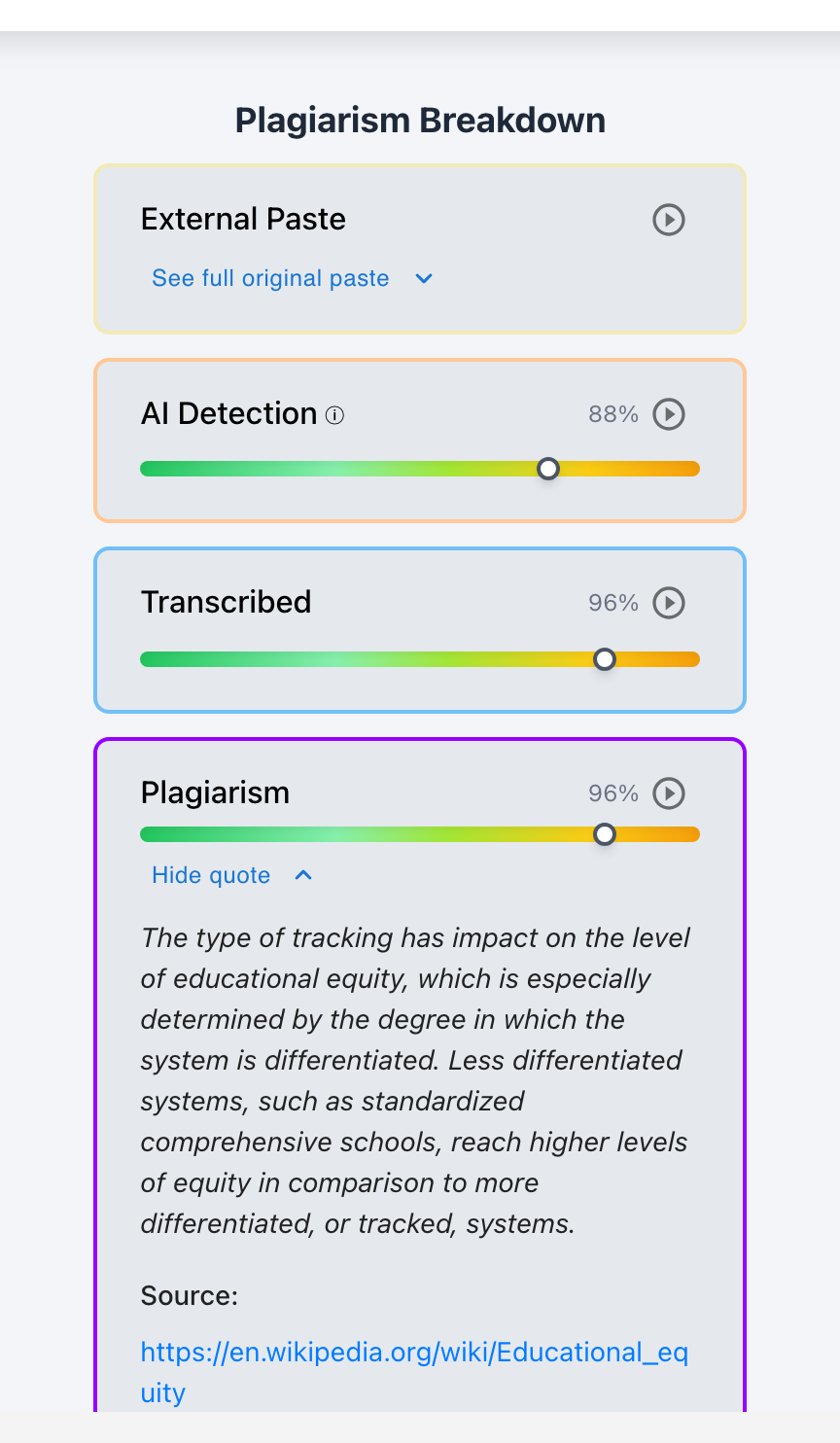
In collegiate cybersecurity education, cyber defense ranges, and collegiate competitions (CCDC/CPTC), the Incident Response (IR) Post-Mortem report is the definitive capstone artifact. It evaluates a student's capacity to reconstruct complex cyberattacks by synthesizing raw packet captures (PCAP), SIEM log telemetry (Splunk, Elastic, Sysmon), host-based forensics, and MITRE ATT&CK technique mappings into an actionable root-cause analysis. However, the rise of frontier Large Language Models (LLMs) has introduced a profound integrity crisis: students generating polished, highly persuasive incident post-mortems that hallucinate non-existent IP addresses, confabulate cryptographic file hashes (MD5/SHA-256), invert attack progression timelines, and recite generic remediation checklists completely disconnected from the actual sandbox telemetry.
Generic whole-document AI text detectors fail catastrophically in cybersecurity education—triggering false positives on standardized command-line syntax, log regex, and CVSS vectors while missing entirely fabricated incident narratives. To safeguard NSA Center of Academic Excellence in Cyber Defense (CAE-CD) Knowledge Units and ABET Cybersecurity Student Outcomes, faculty require an empirical, defensible verification methodology. Checkmark Plagiarism's patent-pending Essay Playback™ bridges this forensic gap through Writing Process Telemetry and Analytical Synthesis Forensics. By combining 1x–8x scrubbable keystroke video replay, 100% immutable clipboard payload inspection, passage-level calibrated AI confidence sliders with short-text guardrails, and teacher-in-the-loop rubric autograding with Canvas LMS and Buzz LMS grade passback, Checkmark empowers cybersecurity educators to distinguish genuine technical investigation from synthetic fabrication—fostering transparent, restorative coaching while safeguarding professional readiness.
Checkmark Plagiarism provides seamless enterprise interoperability for collegiate cybersecurity departments, cyber range directors, and academic integrity boards through its comprehensive suite of writing process replay, passage-level AI detection, side-by-side source verification, AI rubric autograding, and native LMS integrations.
1. The Post-Mortem Crisis in Collegiate Cyber Ranges: The Generative AI Threat
In modern cybersecurity curricula—spanning undergraduate degrees, graduate information security programs, and National Centers of Academic Excellence in Cybersecurity (NCAE-C)—the Incident Response (IR) Post-Mortem Report serves as the gold standard of student assessment. Whether responding to a simulated Advanced Persistent Threat (APT) campaign in an isolated cyber range, analyzing a red-team breach during a Collegiate Cyber Defense Competition (CCDC), or completing a digital forensics capstone, students are tasked with executing the end-to-end incident handling lifecycle defined by NIST SP 800-61 Rev. 2 (since superseded by Rev. 3) and ISO/IEC 27035:
- Detection & Triage: Parsing real-time alerts, correlating firewall drops, and identifying anomalous beaconing.
- Technical Investigation & Containment: Dissecting multi-gigabyte Packet Captures (
.pcap) in Wireshark/tcpdump, querying SIEM indices (Splunk SPL, Elastic KQL), and tracing parent-child process trees in Windows Sysmon logs. - Forensic Attribution & Root Cause: Extracting cryptographic Indicators of Compromise (IoCs), attributing adversary behavior to the MITRE ATT&CK Enterprise Matrix, and identifying the exploited Common Vulnerabilities and Exposures (CVE).
- Post-Incident Remediation: Formulating precise, defensible architectural hardening, firewall access control lists (ACLs), Snort/Suricata detection rules, and patch management strategies.
Historically, a comprehensive, 20-page post-mortem loaded with hex dumps, terminal commands, Sysmon Event IDs, and network flow diagrams was undeniable proof of exhaustive technical analysis.
Today, generative AI has dismantled that foundational assumption.
The Rise of the "Plausible Post-Mortem" Illusion
Frontier Large Language Models excel at generating authoritative, syntactically pristine technical prose. When prompted with a scenario (e.g., "Write an incident response post-mortem report for an APT breach involving a compromised web server, PowerShell lateral movement, and Cobalt Strike C2 beaconing"), an LLM will produce:
- Crisp executive summaries with industry-standard risk scoring.
- Plausible-sounding MITRE ATT&CK technique matrices (e.g.,
T1190 Exploit Public-Facing Application,T1059.001 PowerShell,T1055 Process Injection,T1071.001 Web Protocols). - Standardized tabular IoC listings with formatted IP tables, registry modifications, and file paths.
- Professional remediation roadmaps citing NIST SP 800-53 controls, zero-trust network architecture, and multi-factor authentication (MFA) mandates.
To a faculty member or teaching assistant grading 60 multi-page incident reports, the submission appears exemplary. However, when cross-referenced against the actual lab environment—the specific .pcap capture file distributed to the class or the isolated Splunk forwarder running on the range—the report collapses: the student never touched the command line, never filtered a packet, and never derived a single IoC from the sandbox.
The Four Hallmarks of AI-Fabricated Incident Reports
Collegiate cybersecurity faculty face four recurring failure modes when students submit AI-generated post-mortems:
LLMs cannot execute cryptographic hashing algorithms on non-existent files. When asked for file hashes, they confabulate 32-character (MD5) or 64-character (SHA-256) hexadecimal strings that look visually authentic but fail cryptographic verification against the actual malware sample dropped in the lab. Similarly, LLMs frequently generate invalid IP addresses (e.g., mixing private RFC 1918 addresses 192.168.1.50 with public external C2 ranges 203.0.113.195 in nonsensical contexts or generating unroutable broadcast octets).
Authentic cyberattacks follow strict temporal and operational dependencies (Reconnaissance → Initial Foothold → Privilege Escalation → Credential Access → Lateral Movement → Exfiltration). Generative AI models frequently scramble these dependencies—claiming that an attacker performed LSASS memory credential dumping (T1003.001) prior to gaining administrative privileges, or asserting that data exfiltration over DNS tunneling occurred before the attacker discovered the internal database server.
In an authentic investigation, every claim is anchored to concrete log evidence: a specific Sysmon Event ID, a unique Process GUID, a precise frame number in Wireshark, or an exact Splunk search timestamp. AI-generated reports invent phantom log entries—such as claiming Sysmon Event ID 3 (Network Connection) logged a command-line script execution (which is Event ID 1), or citing Windows Security Event ID 4624 (Logon) with impossible logon types (LogonType = 99).
When an authentic analyst discovers an unauthenticated remote code execution (RCE) flaw in an internal Apache Struts web service, their post-mortem prescribes specific firewall port blocks, Apache configuration hardening, and custom Snort signatures. In contrast, AI-generated reports default to generic corporate boilerplate: recommending "annual security awareness training," "enforcing 14-character password complexity," and "installing endpoint antivirus"—none of which address the actual root-cause vulnerability exploited in the sandbox.
2. The Accreditation & Industry Verification Dilemma: NSA CAE-CD & ABET Cybersecurity Standards
Data fabrication in cybersecurity education is fundamentally distinct from typical academic dishonesty in introductory general education courses. In cybersecurity, academic integrity directly impacts national critical infrastructure protection, organizational defense, and legal compliance.
The NSA CAE-CD Accreditation Threat
For institutions designated as NSA National Centers of Academic Excellence in Cyber Defense (CAE-CD), programmatic accreditation depends on demonstrating that students achieve verified, hands-on mastery of specific Knowledge Units (KUs).
When an institution applies for CAE-CD re-designation, reviewers may examine student artifacts from core courses:
- In network forensics coursework, reviewers may verify that students independently dissected raw PCAP files, extracted reassembled HTTP objects, and identified malicious TLS certificates.
- In incident analysis and response coursework, reviewers may review post-mortem portfolios to ensure students accurately correlated disparate log sources into a defensible attack timeline.
If an institution submits post-mortem dossiers containing AI-synthesized narratives where students never derived authentic IoCs or performed hands-on log triage, the institution's CAE-CD designation could be placed in jeopardy.
Why Legacy AI Detectors and Plagiarism Checkers Fail in Cybersecurity
When cybersecurity faculty attempt to audit post-mortems using commercial, whole-document AI text detectors, they face severe systemic failures:
1. Catastrophic False Positives on Technical Commands and Standardized Syntax
Standard AI detectors calculate statistical perplexity and burstiness across generic prose. However, cybersecurity post-mortems are inherently packed with standardized technical syntax:
Because these commands, regex patterns, and syntax structures are mathematically standardized across industry documentation, their perplexity is naturally near zero. Legacy detectors misinterpret this low perplexity as machine-generated text, flagging authentic, hardworking students with high "AI" scores.
2. Total Blindness to Fabricated Telemetry and Fake Hashes
Legacy checkers analyze language fluency; they cannot check whether an MD5 hash matches a compiled .exe, whether an IP address existed in the lab subnet, or whether a student spent 4 hours analyzing a .pcap file versus 15 seconds pasting an LLM summary.
Cybersecurity faculty cannot rely on opaque percentage scores. They require objective, empirical writing process telemetry.
3. The Cybersecurity Evidentiary Matrix: Static PDFs vs. AI Detectors vs. Checkmark Telemetry Suite
To understand how modern integrity verification operates in technical cybersecurity education, consider this comparative analysis across traditional grading methods, generic AI text checkers, and Checkmark Plagiarism’s integrated writing process telemetry suite:
| Evaluation Dimension | Static PDF / Word Submissions | Generic Whole-Document AI Detectors | Checkmark Plagiarism Telemetry Suite |
|---|---|---|---|
| Primary Artifact Analyzed | Final static document with rendered command screenshots and tables. | Stripped text payload evaluated without formatting, code blocks, or context. | Complete multi-dimensional dossier: interactive prose, keystroke telemetry, clipboard history, and linked source matches. |
| Investigation Telemetry | None; reveals only file metadata timestamps (easily altered or copied). | None; blind to composition duration, revision history, and drafting velocity. | Patent-Pending Essay Playback™: 1x–8x scrubbable video replay capturing the student's step-by-step incident reconstruction. |
| Technical Syntax & CLI Handling | Readable by instructor, but derivation authenticity is unverified. | Severe False Positives: Routinely flags terminal commands, SPL, and MITRE IDs as AI prose. | Honest Short-Text & Technical Guardrails: Isolates CLI blocks; applies passage-level analysis with calibrated confidence sliders. |
| Data & Clipboard Forensics | Cannot determine if log snippets were extracted from a lab VM or an LLM. | Blind to clipboard events; treats all text equally regardless of ingestion origin. | External Paste Inspector: Captures and preserves 100% of clipboard payloads with timestamped origin logs, even if text is edited. |
| Lab VM & PCAP Linkage | Disconnected from student terminal logs, Wireshark sessions, or Splunk queries. | Zero integration with cyber range environments or simulation datasets. | Correlates drafting pauses with sandbox analysis sessions and terminal command copy events. |
| Student Exoneration Capability | Low; devolves into subjective debates over technical competence. | Zero; opaque black-box percentages provide no defensible receipts to clear honest students. | Defensible & Objective: Authentic multi-hour drafting, typing friction, and syntax corrections instantly prove independent authorship. |
| CAE-CD & ABET Defensibility | Vulnerable; lacks auditable proof that student executed hands-on KUs. | Non-defensible; accreditation boards reject probabilistic black-box scores. | Fully Defensible: Provides timestamped keystroke logs, rubric justifications, and student process receipts for ABET/CAE-CD audits. |
| LMS & Grading Workflow | Manual rubric scoring in Canvas SpeedGrader or paper rubrics. | Third-party browser popups with zero gradebook or rubric sync capabilities. | Teacher-in-the-Loop AI Rubric Autograder: Syncs custom ABET/NIST rubrics directly with Canvas LMS, Buzz LMS, and Google Classroom. |
4. Anatomy of Incident Report Fabrication: Four Forensic Failure Modes
To conduct effective audits, cybersecurity faculty, lab directors, and academic integrity officers must understand the specific technical mechanics of how AI models fabricate incident reports—and the forensic contradictions that expose them.
Failure Mode 1: Confabulated Cryptographic Hashes and Hallucinated Subnets
When a student investigates a malware payload in a legitimate cyber range lab, they run a hashing utility on the dropped artifact:
When a student prompts an LLM to generate an incident report, the LLM hallucinates a random 64-character hex string:
"The threat actor dropped a secondary backdoor identified with SHA-256 hash: 8f4b2e1a9c3d5e7f0b2a4c6e8d0f1a3b5c7e9f0a2b4c6d8e0f1a3b5c7e9f0a2b."
The Forensic Contradiction: When the professor hashes the actual lab malware binary, the digest is completely different. Furthermore, LLMs frequently make mathematical syntax errors—such as including non-hex characters (g, h, z) or producing 63-character strings. In network tables, LLMs routinely confabulate IP addresses that contradict the range architecture—such as placing an external Command & Control (C2) server inside the internal RFC 1918 10.0.0.0/8 subnet or referencing unrouted documentation subnets (192.0.2.0/24, 198.51.100.0/24) that were never present in the lab router configurations.
Failure Mode 2: The Inverted MITRE ATT&CK Kill Chain
Adversary operations follow logical physical and technical dependencies. An attacker cannot dump credentials from memory without execution privileges; an attacker cannot pivot laterally across subnets without an initial foothold.
Synthetic incident reports frequently display severe kill-chain contradictions:
- Exfiltration Before Discovery: Claiming the adversary exfiltrated 5 GB of SQL database records via HTTPS before running network discovery commands (
net view,ping,nmap) to locate the database server. - Kerberoasting Without Domain Access: Claiming the adversary performed a Kerberoasting attack (
T1558.003) on a standalone workgroup machine that was not joined to the Active Directory domain controller. - Pass-the-Hash over Non-SMB Protocols: Claiming the adversary executed a Pass-the-Hash attack (
T1550.002) across an isolated web server running only SSH on port 22.
An authentic student analyst documents the chronological progression directly from the timestamped SIEM events. An AI model stitches together disconnected concepts from its training weights, producing a logically impossible attack narrative.
Failure Mode 3: Phantom Sysmon Telemetry and Disconnected Process Trees
In Windows environment investigations, Microsoft Sysmon (System Monitor) logs provide deep host-level visibility through standardized Event IDs:
- Event ID 1: Process Creation (capturing ParentImage, Image, CommandLine, User, Hashes).
- Event ID 3: Network Connection (capturing SourceIP, DestinationIP, DestinationPort).
- Event ID 7: Image Loaded (capturing DLL loading).
- Event ID 10: ProcessAccess (capturing open handles to LSASS or other processes).
- Event ID 13: RegistryEvent (capturing persistence modifications).
AI-generated post-mortems frequently confabulate these relationships. A synthetic report might state:
"Sysmon Event ID 3 detected the adversary executing PowerShell with an encoded command: powershell.exe -enc SQBFAFgAKAA..."
The Forensic Contradiction: Sysmon Event ID 3 does not record command-line arguments; it records network connections. Command-line execution is exclusively recorded in Event ID 1. Furthermore, AI models frequently invent fictitious Process GUIDs (e.g., {12345678-ABCD-EF01-2345-6789ABCDEF01}) and parent-child linkages (e.g., claiming winlogon.exe spawned cmd.exe directly on a standard user interactive session) that contradict the actual Windows operating system architecture.
Failure Mode 4: Hallucinated CVEs and Mismatched CVSS Vectors
In a guided lab scenario, the instructor configures a specific vulnerable service—such as an unpatched vsftpd 2.3.4 backdoor (CVE-2011-2523) or an Apache HTTP Server path traversal (CVE-2021-41773).
When prompted without precise context, an LLM often attributes the breach to a completely unrelated high-profile vulnerability:
- Citing Apache Log4Shell (
CVE-2021-44228) on an environment running exclusively static Microsoft IIS servers. - Citing EternalBlue (
CVE-2017-0144) on a modern, fully-patched Linux Ubuntu server. - Providing a Common Vulnerability Scoring System (CVSS v3.1) vector string where the metrics contradict the vulnerability's nature (e.g., marking Attack Vector as Network
AV:Nfor a local privilege escalation flaw that requires physical accessAV:P).
5. The Step-by-Step Cybersecurity Faculty Audit Protocol
To evaluate student incident response post-mortems with objective rigor and academic fairness, cybersecurity faculty, lab instructors, and integrity boards should follow this four-stage verification protocol.
Stage 1: Ground-Truth Artifact & Telemetry Concordance
Never grade an incident response post-mortem in isolation. The report must be audited directly against the primary sandbox artifacts:
- PCAP Stream & Frame Number Verification: If the student report states: "Wireshark frame #1,428 reveals a TCP SYN scan originating from 192.168.1.105 on port 445", open the master
.pcapin Wireshark or runtshark:tshark -r lab_capture.pcap -Y "frame.number == 1428" -T fields -e ip.src -e ip.dst -e tcp.dstportIf frame 1428 is actually an ARP request or an unrelated DNS query, the student did not analyze the packet capture. - SIEM Query & Log Validation: Inspect the Splunk or Elastic audit logs. Verify that the student's user account actually executed the SPL queries cited in their report during their assigned lab session.
- Malware Hash Cross-Check: Compare the SHA-256 hashes listed in the report's IoC table against the actual cryptographic hashes of the artifacts in the lab repository.
Stage 2: Keystroke Drafting & Process Reconstruction with Essay Playback™
This is where Checkmark Plagiarism provides definitive, patent-pending forensic visibility. Instead of guessing based on static text, open the student's submission in Checkmark Essay Playback™:
• Size: 280 bytes (Raw Sysmon Log)
• Telemetry: EventID=1, CLI args, PID
• Origin: Kali VM / Terminal clipboard
• Student analyzes base64 PowerShell
• Switches between terminal & report
• "The decoded payload reveals an invoke expression targeting winlogon.exe..."
• 14 backspaces; refines MITRE T1059.001
• Types out IoC table row by row
• Size: 5,400 bytes (Full Report)
• Telemetry: Complete formatted post-mortem with tables & IoCs
• Changes student name & section
• Formats 2 markdown headings
• Total Composition Time: 2.5 min
• Zero analytical pauses
• Zero investigative friction
- Scrubbing at 1x to 8x Speed: Watch the student construct their incident narrative. In genuine cybersecurity analysis, students compose in bursts punctuated by high-friction cognitive pauses (20 to 60 seconds). These pauses correspond to the student pivoting between windows: filtering packets in Wireshark, running a CyberChef base64 recipe, querying Splunk, or consulting the MITRE ATT&CK framework.
- Observing Command-Line & Syntax Entry: Notice how technical commands are entered. Authentic students type terminal commands, regex filters, and file paths with natural human typing cadence—frequently correcting typos, adjusting backslashes, and revising parameters. In contrast, AI-generated reports ingest massive blocks of flawless markdown tables and formatted text in single instantaneous paste events.
- External Paste Inspector Forensics: Click on Checkmark's External Paste Inspector. Checkmark captures and stores 100% of clipboard text payloads at the exact millisecond of ingestion. The inspector instantly clarifies whether a paste event was a legitimate raw log snippet copied from an SSH terminal, or a complete 1,200-word incident analysis generated by ChatGPT or Claude.
Stage 3: Attack Chain Chronology & Mathematical Verification
Perform rapid consistency checks on the reported forensic evidence:
- Timestamp Chronometry: Verify that the timestamps in the incident timeline match the internal packet capture epoch timestamps (Δt).
- Hash Integrity: Verify that file hashes are mathematically valid (e.g., ensuring MD5 strings contain exactly 32 hex characters and SHA-256 strings contain exactly 64 hex characters).
- Subnet Boundary Logic: Confirm that network pivots respect the routing tables and firewall rules configured in the cyber range topology.
Stage 4: Conducting Restorative Incident Briefing Defenses
When serious discrepancies arise, cybersecurity faculty must avoid hostile, accusatory confrontations that undermine student confidence. Instead, embody Checkmark’s guiding philosophy: "Stop guessing, start trusting through transparent evidence."
Schedule a Restorative Incident Briefing Conference:
- Open the Telemetry Dossier Collaboratively: Sit beside the student and display the Checkmark Essay Playback alongside the lab range network topology on a shared screen.
- Execute the "Live Pivot Challenge": Ask the student to demonstrate their investigative workflow live: "Your report identifies a malicious Cobalt Strike C2 beacon on IP 198.51.100.42 using port 443 with a 60-second jitter interval. Let's open your Wireshark session together on the lab machine—show me how you formulated the display filter to isolate those beacons."
- Assess Diagnostic Agility: A student who independently performed the analysis will immediately open Wireshark, apply the filter (e.g.,
ip.addr == 198.51.100.42 && ssl), explain their protocol dissection, and walk through their reasoning. A student who submitted AI-fabricated data will be completely paralyzed, unable to formulate basic display filters or navigate the packet tree. - Prescribe a Restorative Technical Recovery Path: Rather than imposing an immediate disciplinary expulsion or automatic zero, guide the student into an authentic engineering recovery loop: grant them 48 hours in the cyber range sandbox to perform the real investigation from scratch, extract verified IoCs, and submit a revised post-mortem with complete Essay Playback tracking.
6. Concrete Cybersecurity Lab Case Scenarios
To illustrate how writing process telemetry and forensic verification operate in collegiate cybersecurity programs, review these three illustrative, hypothetical cyber range scenarios:
The "Perfect" APT29 Threat Hunting Post-Mortem
203.0.113.88) never appeared in the 4 GB PCAP.
Exonerating a Student's Hex-Dense Snort Rule and PCAP Analysis
The "Humanized" Ransomware Incident Report with Disconnected Sysmon Telemetry
7. How Checkmark Plagiarism Empowers Cybersecurity Faculty & Department Chairs
Checkmark Plagiarism provides a comprehensive, educator-first ecosystem engineered specifically for the technical demands of collegiate cybersecurity, computer science, and engineering departments:
Reconstructs the entire incident report drafting session keystroke-by-keystroke. Cybersecurity faculty can scrub through the report's creation like a video, watching CLI commands being formatted, Wireshark packet captures being interpreted, and technical arguments being refined. Keystroke telemetry protects honest students from false accusations while providing undeniable proof when text is pasted from an external generator.
When a student pastes content into the document editor, Checkmark captures the entire raw clipboard payload and preserves it in an immutable audit log. Even if the student subsequently edits, rewrites, or "humanizes" every word over the next three hours, the original pasted payload remains fully accessible to the instructor with a single click.
Rather than outputting a single, opaque whole-document percentage that causes panic and false accusations, Checkmark highlights specific passages with individual evidence cards and calibrated confidence sliders. Short text blocks, terminal syntax, and code snippets under ~150 words display N/A guardrails to prevent unscientific guessing on limited sample sizes.
Checkmark's AI Rubric Assistant evaluates technical incident post-mortems against customized ABET and NSA CAE-CD rubrics, generating per-criterion score recommendations anchored directly to quotes in the student's prose with direct grade passback into Canvas LMS, Buzz LMS, and Google Classroom.
Cybersecurity lab reports frequently involve proprietary exploit code, custom network topologies, and vulnerability disclosures. Checkmark guarantees Zero Model Training on Student Submissions—student reports, code snippets, and network telemetry are never cached, retained, or ingested into public LLM training datasets, ensuring complete FERPA and COPPA compliance.
8. Institutional Cybersecurity Incident Reporting Policy & Syllabus Framework
Cybersecurity department chairs, lab directors, and curriculum committees should adopt clear, standardized syllabus language that defines the boundary between authorized technical tooling and prohibited telemetry fabrication.
Model Syllabus Policy Template for Cyber Defense & Forensics Courses
Cybersecurity is a profession governed by public trust, ethical responsibility, and rigorous adherence to empirical evidence. In this course, all incident response post-mortem reports, forensic timelines, packet capture analyses, and Indicators of Compromise (IoCs) submitted for grading must be authentic, reproducible, and grounded directly in the provided cyber range telemetry.
- Primary Telemetry Concordance Requirement: Every technical claim, packet frame reference, IP address, file hash, and process tree cited in your post-mortem must correspond directly to an observable event within the lab sandbox,
.pcapcapture, or SIEM repository. Reports containing hallucinated IoCs or fabricated log events will receive an automatic grade of zero and be referred for academic integrity review. - Writing Process Telemetry: All written reports must be composed within the LMS editor equipped with Checkmark Plagiarism writing process telemetry. Keystroke drafting history, analytical synthesis pauses, and clipboard imports will be reviewed as part of routine grading.
- Prohibition of Synthetic Analysis: The use of generative AI to synthesize incident timelines, fabricate forensic hashes, or draft root-cause analyses constitutes severe academic misconduct and a direct violation of NSA CAE-CD professional standards. Violations will result in failure of the assignment, potential dismissal from the cybersecurity program, and formal notation in institutional integrity records.
9. Frequently Asked Questions (FAQ)
1. How does Checkmark prevent false AI flags on complex CLI commands, Wireshark display filters, and Splunk SPL queries?
Generic AI detectors evaluate raw text strings, causing standardized technical syntax (e.g., tshark -r capture.pcap -Y "http.request", index=sysmon EventCode=1, CVSS:3.1/AV:N...) to register as AI due to low statistical perplexity. Checkmark’s multi-factor engine uses passage-level granularity and honest short-text guardrails (<150 words) that isolate command-line and code blocks from narrative prose. Furthermore, Checkmark’s Essay Playback™ proves authentic human composition by recording the student’s step-by-step keystroke entry, parameter adjustments, and backspacing history.
2. What should faculty do when a student's post-mortem cites valid technical terminology but cites IoCs that do not exist in the cyber range PCAP?
Never evaluate technical terminology in a vacuum. Cross-reference the report's IoCs against the master lab capture file. If the cited IP addresses, domains, or SHA-256 hashes do not exist in the sandbox telemetry, conduct an in-person Restorative Incident Briefing. Ask the student to open Wireshark and show where the packets originated. A student who genuinely analyzed the file will immediately navigate to the relevant streams; a student who submitted AI-fabricated data will be unable to locate the evidence.
3. How does Essay Playback™ distinguish between copying legitimate log snippets from a terminal vs. pasting AI-generated analysis?
Checkmark’s External Paste Inspector preserves 100% of clipboard text payloads along with their character structure and metadata. When a student copies a raw log line from a terminal (e.g., an SSH session or Splunk search), the payload consists of raw, unformatted ASCII log text. When a student copies from an LLM, the payload contains complete, formatted narrative paragraphs with structured markdown tables. Furthermore, Essay Playback captures what occurs after the paste: authentic analysts spend minutes reviewing and drafting around log snippets, whereas students who paste LLM prose immediately transition to submission.
4. Why are whole-document AI detection percentages dangerous for NSA CAE-CD accreditation documentation?
NSA CAE-CD and ABET program evaluators require verifiable, auditable evidence that students independently mastered specific hands-on skills such as network forensics and host forensics. Opaque black-box percentages (e.g., "78% AI") are non-defensible, scientifically uncalibrated, and provide zero insight into student competency. Checkmark provides granular evidentiary dossiers—including timestamped keystroke replays, clipboard logs, and quote-anchored rubric evaluations—that satisfy rigorous accreditation audit standards.
5. How does Checkmark protect student-discovered vulnerabilities or custom exploit code from leaking into public AI training sets?
Cybersecurity students frequently work with live exploit code, custom proof-of-concept (PoC) scripts, and vulnerability assessments. Checkmark operates under an enterprise Zero Student Data Retention Policy: student text, code, network logs, and reports are never used to train public or proprietary AI models, never shared with third parties, and protected by end-to-end FERPA/COPPA-compliant AES-256 cloud encryption.
6. How should cyber defense competition coaches (CCDC / CPTC) use writing process telemetry during post-competition debriefs?
In rapid-paced competitions like CCDC, team post-mortems must be drafted under intense time constraints. Coaches can use Essay Playback to audit team drafting workflows, verify which team members contributed specific forensic analyses, identify analytical bottlenecks during incident triage, and ensure that competition reports reflect genuine team collaboration rather than last-minute AI generation.
7. Can Essay Playback™ help neurodivergent or non-traditional cybersecurity students prove authentic forensic reasoning?
Yes. Neurodivergent students or English Language Learners (ELL) often write in highly structured, formal, or repetitive styles that trigger high false-positive rates on legacy AI text checkers. Checkmark’s Essay Playback captures the authentic cognitive effort—documenting the student’s hours of drafting, analytical pauses, iterative revisions, and organic composition—providing unassailable proof of genuine authorship regardless of linguistic style.
8. How does teacher-in-the-loop rubric grading speed up post-mortem evaluations while preserving faculty grading authority?
Grading dense, 20-page technical post-mortems across 50 students can take dozens of hours. Checkmark’s AI Rubric Assistant accelerates this process by generating initial draft evaluations against custom ABET/NIST rubrics, highlighting specific evidence quotes within the student's prose for each criterion. Faculty retain complete authority to review, edit, or override any score and feedback before syncing finalized grades directly into Canvas LMS, Buzz LMS, or Google Classroom.
10. Conclusion: Defending Empirical Rigor in the Next Generation of Cyber Defenders
The primary mission of collegiate cybersecurity education is to prepare defenders who can be trusted to protect critical infrastructure, corporate networks, and national security assets during high-stakes cyber incidents. When students outsource their investigative reasoning to generative AI and submit fabricated post-mortem reports, they not only commit academic dishonesty—they graduate without the diagnostic competence required to stop real-world cyber threats.
By moving beyond opaque whole-document text checkers and adopting Checkmark Plagiarism’s multi-factor writing process telemetry, patent-pending Essay Playback™, and external paste forensics, cybersecurity departments can:
- Safeguard NSA CAE-CD & ABET Accreditation by verifying authentic hands-on mastery of core Knowledge Units and Student Outcomes.
- Protect Honest Students from damaging false accusations on technical syntax, CLI commands, and log regex.
- Expose Fabricated IoCs and Inverted Kill Chains with objective, timestamped keystroke and clipboard receipts.
- Foster Restorative Technical Coaching that prepares students for the rigorous demands of enterprise security operations.
Cybersecurity integrity is not about punitive policing—it is about ensuring that every graduate who authoritatively briefs an incident response has the verified, battle-tested analytical skills to defend the digital world.