
Executive Summary & Pedagogical Directive
In Advanced Placement (AP) Spanish and French Language and Culture courses, Free Response Question 4 (FRQ 4)—the Cultural Comparison Presentation—represents one of the most cognitively demanding performance tasks in secondary education. Students must deliver a two-minute, structured spoken presentation comparing a target-language community with their own home culture across complex thematic units such as Global Challenges or Contemporary Life. While the terminal exam restricts preparation to a strict four-minute timed window on paper, teachers scaffold this skill throughout the school year using digital outlines, collaborative slide decks, and multi-day research assignments. In digital environments, however, educators face a pervasive integrity dilemma: students secretly composing full-sentence scripts in English and feeding them through Neural Machine Translation (NMT) engines like DeepL, Google Translate, or ChatGPT to generate polished target-language outlines.
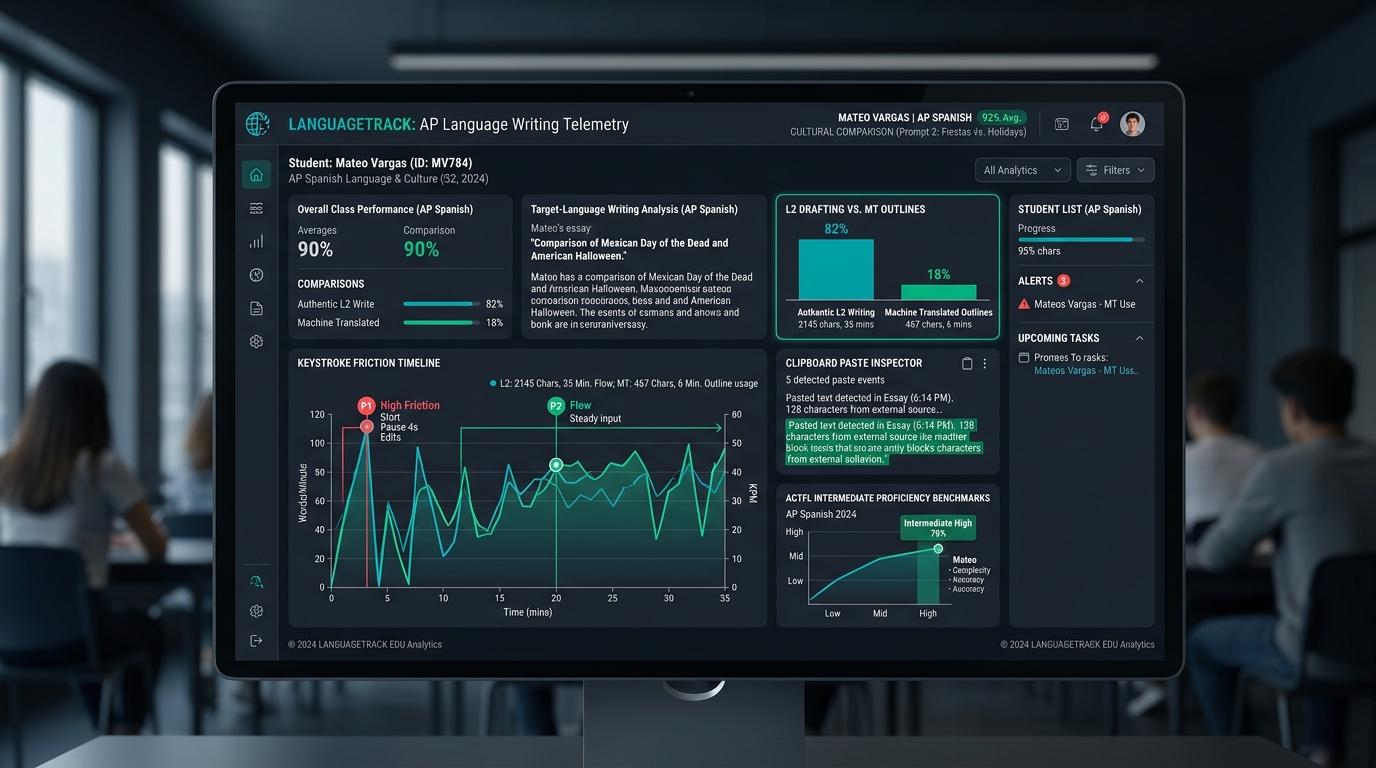
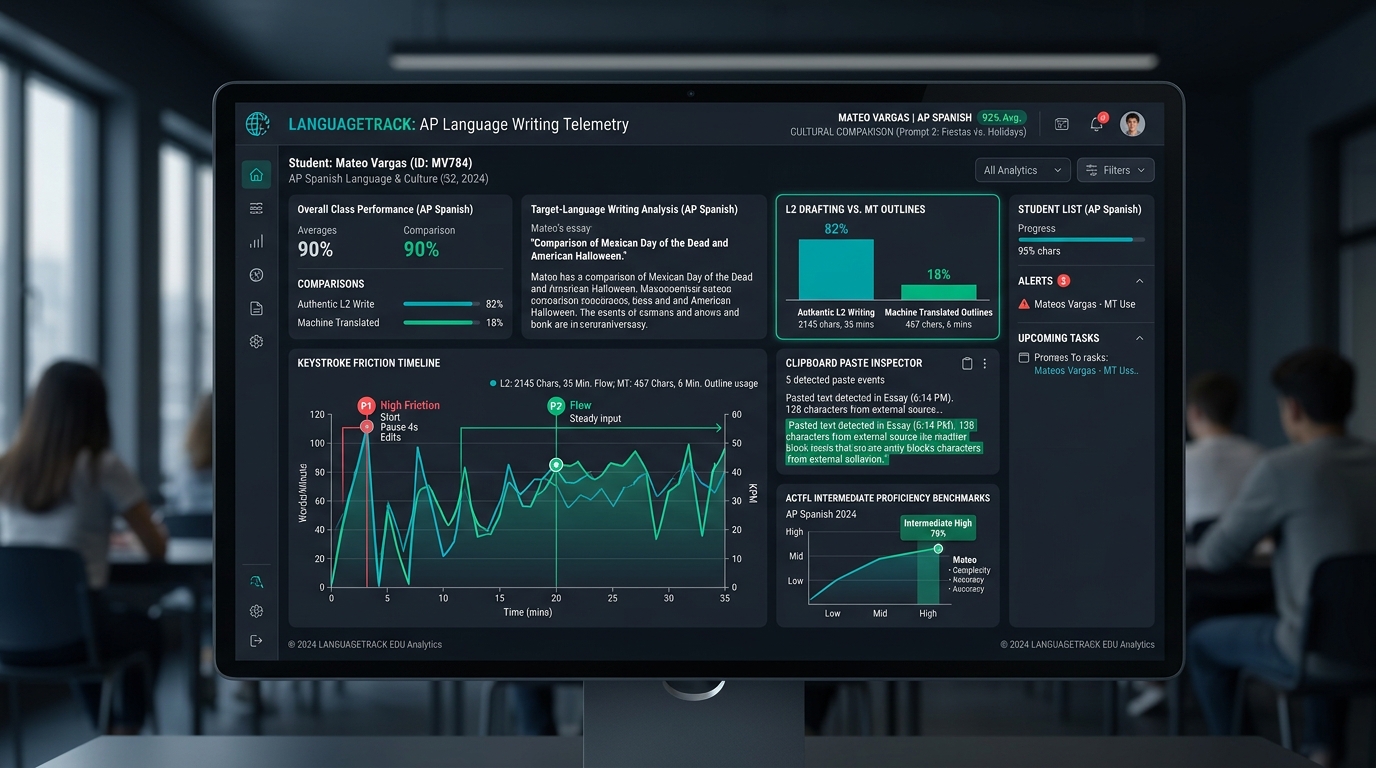
Generic, black-box AI detectors fail catastrophically in world language classrooms—falsely accusing honest students who use formulaic transitional stems while missing machine-translated clauses entirely. To resolve this dilemma, world language departments must move beyond guesswork. By combining ACTFL-aligned linguistic forensic markers (such as syntax calques, unnatural register elevation, and premature subjunctive sequencing) with Checkmark Plagiarism's patent-pending Essay Playback™ and External Paste Buffer Inspector, teachers gain transparent, defensible telemetry. Capturing the organic drafting journey—character-by-character composing friction, accent insertion pauses, morphological self-corrections, and external clipboard dumps—empowers educators to safeguard authentic second-language acquisition, exonerate falsely accused learners, and conduct supportive, restorative language conferences.
Across high school AP Spanish and AP French classrooms nationwide, educators work tirelessly to prepare students for the demands of the May exam. Yet the shift toward formative digital out-of-class assignments has introduced an urgent challenge: separating authentic second-language developmental drafting from synthetic machine-translated scripts.
1. The High-Stakes Crucible of the AP Cultural Comparison (FRQ 4)
In the College Board's AP Spanish Language and Culture and AP French Language and Culture curricula, the Cultural Comparison (Présentation culturelle / Presentación cultural) stands as the ultimate test of integrative communicative competence. Accounting for a decisive portion of the Free Response score, this task evaluates a student's ability to synthesize cultural knowledge, organize a comparative rhetorical argument, and deliver a coherent oral presentation entirely in the target language (L2).
2-minute formal spoken presentation comparing two distinct communities without interruption.
(1) A specific Target-Language Community vs. (2) The Student's Own Home Community.
1 unscripted prompt, exactly 4 minutes of silent outline preparation on paper, 2 minutes of recording.
Months of formative digital drafting, outline building, slide preparation, and oral rehearsals.
The task is anchored across six interdisciplinary thematic units mandated by the College Board:
Global Challenges
Les défis mondiaux / Los desafíos mundiales
Environmental sustainability, socioeconomic inequality, human rights, public health, and migratory movements.
Contemporary Life
La vie contemporaine / La vida contemporánea
Education systems, professional lifestyles, leisure, housing, and social rituals.
Beauty and Aesthetics
La beauté et l'art / La belleza y el arte
Architecture, visual arts, literature, music, and evolving cultural ideals of beauty.
Families and Communities
Familles et communautés / Las familias y las comunidades
Intergenerational dynamics, family structures, citizenship, and cultural customs.
Science and Technology
La science et la technologie / La ciencia y la tecnología
Technological access, bioethics, social media impacts, and scientific innovation.
Personal & Public Identities
La quête de soi / Las identidades personales y públicas
National identity, language preservation, multiculturalism, and regional alienation.
The Pedagogical Scaffolding Dilemma: Formative Scaffolding vs. Digital Shortcuts
Under standard AP Exam testing conditions, students receive an unscripted prompt on paper, have four minutes to review the prompt and write brief outline notes, and must immediately speak into a microphone for two uninterrupted minutes.
However, high school students do not develop spontaneous comparative speaking abilities overnight. Throughout the academic year, world language educators scaffold this skill through structured assignments:
- Multi-week cultural research projects focused on specific francophone or hispanophone regions.
- Digital presentation outline templates (Google Docs, Canvas LMS assignments, Google Slides).
- Peer review sessions and formative recorded rehearsals.
It is during these formative, digital out-of-class drafting phases that the integrity breakdown occurs. When tasked with preparing a structured outline comparing, for example, water access in Cochabamba, Bolivia with their suburban district, or educational pressure in Dakar, Senegal with their local high school, students experience high cognitive strain.
Faced with complex socio-political vocabulary and nuanced comparative syntax, struggling or anxious students often abandon organic interlanguage drafting. Instead, they write an extensive essay-style script in English, paste it into DeepL, Google Translate, or ChatGPT, and paste the resulting French or Spanish text directly into their outline document. When presenting, the student reads this machine-translated text aloud, masking their genuine second-language production.
- Brainstorm concepts directly in L2 using concise bullet points.
- Retrieve learned thematic vocabulary and idiomatic collocations.
- Select appropriate transitional connectors (d'une part, por otro lado).
- Leave mnemonic cues designed for spontaneous oral elaboration.
- Engage mental effort in target-language syntax assembly.
- Draft full narrative paragraphs in native English (L1).
- Feed narrative into DeepL, Google Translate, or ChatGPT.
- Copy flawless French or Spanish output to clipboard.
- Paste full-sentence prose directly into outline document.
- Read script verbatim during recorded oral presentation.
2. The Mechanics of Machine Translation: Why DeepL & Google Translate Bypassed Traditional Detection
To detect machine-translated outlines, teachers must understand why modern translation tools are radically different from the rudimentary word-for-word translation engines of a decade ago.
Neural Machine Translation (NMT) vs. Generative LLMs
Modern translation services—most notably DeepL Pro and Google Translate (NMT Engine)—employ Sequence-to-Sequence (Seq2Seq) Transformer Models equipped with multi-head cross-attention mechanisms.
Unlike an autoregressive Large Language Model (e.g., GPT-4) which invents new sentences from a prompt based on token probabilities, an NMT engine performs a direct semantic vector mapping from a source sentence (L1, English) into a target sentence (L2, Spanish or French).
Extracts semantic dependencies, hierarchical clauses, and contextual relationships.
Applies native target morphology, case, gender agreement, and formal syntactic sequencing.
The ACTFL Proficiency Mismatch
The College Board designs the AP Spanish and French curricula to bring non-native high school learners to the ACTFL Intermediate-Mid to Intermediate-High / Pre-Advanced proficiency level.
At the Intermediate level, student language production is characterized by:
- Active creation with language using discrete sentences, compound strings, and basic paragraph-like structures.
- Emergent mastery of high-frequency transitional phrases (d'une part / d'autre part, en primer lugar / además).
- Frequent interlanguage friction: minor morphological errors in grammatical gender (le/la, el/la), occasional noun-adjective agreement slips, and predictable hesitation pauses when selecting unfamiliar vocabulary.
In contrast, Neural Machine Translation produces Superior- to Distinguished-level target-language prose. It generates flawless subjunctive mood sequencing, hyper-advanced prepositional government, complex passive/impersonal reflexives, and elevated academic register far beyond the developmental stage of a secondary school language learner.
When an Intermediate-Mid student submits an outline containing flawless passé du subjonctif or intricate perífrasis verbales, the linguistic output stands in stark contradiction to their actual developmental interlanguage.
3. Telltale Linguistic Signatures: Spanish & French Machine Translation vs. Authentic Interlanguage
Machine translation leaves distinct structural and syntactic fingerprints in Spanish and French texts. By mastering these linguistic markers, AP teachers, department chairs, and curriculum coordinators can quickly triage suspect submissions.
| Dimension | Machine-Translated (DeepL / MT) | Authentic Student Interlanguage |
|---|---|---|
| Syntactic Calques (L1 Transfer) | Directly mirrors English clause order and literal phrasing. | Constructs simple target-language sentence stems taught in class. |
| Subjunctive & Mood Sequencing | Hyper-complex past subjunctive and counterfactual sequences. | Basic present subjunctive triggers (es importante que...). |
| Register & Lexical Density | Archaic literary or formal bureaucratic prose (es menester, nonobstant). | Standard textbook vocabulary and communicative high-frequency terms. |
| Prepositional Collocations | Rigid literal translations (depende en, demander pour). | Interlanguage trial & error with occasional preposition confusion. |
| Outline Structural Format | Dense, complete narrative prose paragraphs intended to be read aloud. | Concise bulleted keywords, thematic reminders, and mnemonic cues. |
| Keystroke Telemetry Profile | Single 0ms external clipboard paste payload or isochronous typing. | Character-by-character flow with agreement backspaces & accent pauses. |
A. AP Spanish: Machine Translation Fingerprints vs. Authentic Drafting
Spanish machine translation algorithms translate English structural logic directly into Spanish lexical items, creating recognizable syntactic anomalies and premature grammatical masteries.
1. English Idiomatic Calques & Prepositional Mirroring
- “In terms of”: MT consistently outputs “en términos de...” rather than natural Spanish comparative transitions like “en cuanto a,” “con respecto a,” or “en lo que respecta a.”
- “To take a decision”: MT engines occasionally generate “tomar una decisión” instead of native idiomatic expressions such as “adoptar una medida” or “tomar una resolución” in formal socio-cultural contexts.
- Prepositional errors: Literal translation of “depends on” as “depende en” (direct calque of English “on”) or clumsy clause structures like “trabajar en solucionar el problema” instead of “esforzarse por solucionar.”
2. Premature & Hyper-Complex Subjunctive Sequencing
High school AP Spanish students typically control the present subjunctive with common trigger verbs (es importante que tengamos, dudo que sea). Machine translation, however, introduces advanced past subjunctive (subjuntivo imperfecto) and compound counterfactual sequences (pluscuamperfecto de subjuntivo):
3. Passive Voice Overuse (La voz pasiva analítica)
English relies heavily on the passive voice (“The water was contaminated by factories”). While Spanish has a true passive (ser + participio), authentic Spanish communication overwhelmingly favors the impersonal or passive se (se contaminó el agua) or active verbal phrasing (las fábricas contaminaron el agua).
4. Unnatural Register Elevation
MT engines default to high-register literary definitions: translating “to get worse” as “vituperar” or “exacerbarse de manera alarmante” rather than the student's natural vocabulary “empeorar,” or translating “needs” as “es menester que” rather than “es necesario que.”
Prompt: Global Challenges — Environmental Sustainability in Oaxaca vs. Local Community
“En términos del desafío ecológico, es menester enfatizar que la deforestación en Oaxaca ha sido perpetrada por corporaciones que buscan maximizar sus ganancias, mientras que en mi propia comunidad, diversas iniciativas municipales han sido implementadas para mitigar la huella de carbono de manera holística.”
B. AP French: Machine Translation Fingerprints vs. Authentic Drafting
In French, machine translation manifests in distinct syntactic, prepositional, and lexical abnormalities.
1. English Idiomatic Calques & Clumsy Literalisms
- “To make sense”: English writers frequently write “this makes sense.” DeepL and basic engines sometimes output “cela fait du sens” (an unnatural English calque) instead of authentic French “cela a du sens” or “c'est logique.”
- “To look for”: Students thinking in English translate “looking for a solution” literally as “regarder pour une solution” instead of using the transitive verb “chercher une solution.”
- “To ask for”: Translating “ask for help” as “demander pour de l'aide” instead of “demander de l'aide.”
- “On the radio / news”: Translating literally as “sur la radio” or “sur les nouvelles” instead of “à la radio” or “aux informations.”
2. Excessive Subjunctive Past & Literary Tenses
While high school AP French students actively learn the present subjunctive (il faut qu'on fasse attention, bien que ce soit difficile), machine translation introduces advanced literary tenses and mood combinations rarely produced organically by high schoolers:
3. Overuse of Hyper-Formal Connectives
Students learning French rely on clear, functional transition words (d'abord, ensuite, cependant, par exemple, en plus, enfin). Machine-translated English outlines introduce elevated, bureaucratic connectives:
- “Nonobstant le fait que...” (Notwithstanding the fact that...)
- “Eu égard à la crise climatique...” (In light of / Having regard to...)
- “Subséquemment...” (Subsequently...)
- “Il convient de souligner que...” (It is appropriate to emphasize that...)
4. Literal Passive Voice Calques
Authentic French communicative discourse heavily relies on the indefinite pronoun “on” or active sentence structures (On recycle le plastique au Sénégal). Machine translation mirrors English passive constructions:
Prompt: Contemporary Life — The Role of Public Transportation in Paris vs. Local Community
“Eu égard à l'organisation urbaine, il est indéniable que le réseau métropolitain de Paris fonctionne d'une manière exemplaire, nonobstant les grèves périodiques, tandis que dans ma localité, une dépendance excessive à l'égard de l'automobile individuelle engendre une congestion routière permanente.”
4. The Pedagogical & AP Grading Dilemma: The Failure of Black-Box AI Detectors in World Languages
When world language teachers suspect an outline has been machine-translated or generated by AI, many instinctively turn to generic, commercial AI detection software. This approach creates severe pedagogical and ethical hazards.
Student uses standard AP textbook transition formulas: “Pour commencer... D'une part... D'autre part... Par conséquent... En conclusion...”
Student writes complex English narrative paragraphs and translates them via DeepL Pro or Google Translate.
Why Generic AI Detectors Flag Formulaic Transitional Phrases as “AI”
Commercial AI detectors rely on two primary statistical heuristics:
- Perplexity (PPL): The measure of how unexpected or rare a word is in a given sequence. Low perplexity means the words chosen are statistically predictable.
- Burstiness (B): The measure of variation in sentence length and syntactic complexity throughout a text. Low burstiness indicates uniform, robotic sentence structures.
In second-language learning, pedagogy demands formulaic predictability. World language teachers explicitly instruct AP students to master standardized transitional anchors to structure their two-minute oral presentations:
- Spanish: “Para comenzar,” “Por un lado,” “Por otro lado,” “En cambio,” “Asimismo,” “A modo de conclusión.”
- French: “Tout d'abord,” “D'un côté,” “De l'autre côté,” “En revanche,” “En outre,” “Pour conclure.”
When an honest student composes an outline using these required rhetorical scaffolds, a generic AI detector evaluates the text as having ultra-low perplexity and low burstiness. The algorithm flags the student's authentic work as “85%–98% AI Generated,” triggering catastrophic false accusations that destroy student confidence and damage teacher-student rapport.
Why Generic Detectors Miss Neural Machine Translation
Conversely, when a student takes an English paragraph and runs it through DeepL or Google Translate, the resulting French or Spanish text is an encoder-decoder sequence transformation—not an autoregressive synthesis.
Because NMT produces human-like target text that does not exhibit the specific probability artifacts of generative LLMs, generic AI detectors routinely rate machine-translated text as “100% Human.”
The educator is left completely stranded: the software punishes the honest student and rewards the student who bypassed the learning process entirely.
5. The World Language Evidentiary Matrix
To establish a defensible, objective standard for evaluating AP Cultural Comparison outlines, schools must compare traditional methods against modern writing process telemetry.
| Evaluation Dimension | Traditional Paper Outlines | Generic AI Text Detectors | Checkmark Telemetry & Essay Playback™ |
|---|---|---|---|
| Telemetry Resolution | Static physical artifact only | Static text string token probability | Keystroke-by-keystroke temporal timeline |
| External Paste Dump Capture | N/A (Paper-only) | Blind to clipboard insertion history | Full timestamped paste payload preserved |
| False-Positive Protection for L2 Formulas | High (Manual teacher review) | Extremely Poor (Flags AP formulas) | Complete (Replays full typing history) |
| Morphological Self-Correction Visibility | Visible through pen scratch-outs | Invisible | Granular capture of backspaces & edits |
| Accent Mark Insertion Friction | Visible on paper | Invisible | Millisecond pause & modifier key capture |
| Defensibility in Restorative Conferences | Low (Subjective teacher hunch) | Zero (Opaque black-box percentage) | 100% Defensible visual timeline playback |
| Scalability Across LMS (Canvas, Docs) | Cumbersome (Physical paper) | Fast but inaccurate | Seamless Canvas, Google Classroom & Docs sync |
6. Step-by-Step Language Teacher Audit Protocol
When assessing AP Cultural Comparison outlines in digital formats, world language educators should implement a structured, supportive four-phase audit protocol.
Linguistic Triage
Screen outline for script-like prose vs. functional bulleted cues. Check for English calques (en términos de, faire du sens) and compare against oral baseline.
Keystroke Telemetry
Replay session at 2x–4x speed with Essay Playback™. Verify character-by-character composing friction, agreement backspaces, and accent modifier pauses.
Paste Buffer Inspection
Open Checkmark Paste Buffer Inspector. Examine timestamped clipboard events for multi-sentence translation dumps and cross-examine preserved raw text.
Restorative Debrief
Host a non-punitive conference. Walk through the visual timeline together and scaffold the transition from translated prose to authentic keyword-only notes.
Phase 1: Linguistic & ACTFL Benchmark Triage
Before opening digital forensics, conduct a quick linguistic pass over the student's submitted outline:
- Format Check: Is the document an authentic presentation outline (bulleted thoughts, vocabulary reminders, mnemonic structural anchors) or is it a verbatim narrative script written in full paragraphs intended to be read aloud?
- Syntactic Density: Does the outline contain advanced subjunctive mood structures (plus-que-parfait du subjonctif, past hypothetical conditional sentences) that the student has not demonstrated in class?
- Calque Identification: Look for unmistakable English-to-target-language structural calques:
- Spanish: en términos de, hacer sentido, depende en, tomar una decisión, overuse of fue [participio] por.
- French: faire du sens, regarder pour, demander pour, sur la radio, nonobstant.
Phase 2: Keystroke Telemetry & Revision Friction Analysis with Essay Playback™
Open the student's submission in Checkmark Plagiarism and launch Essay Playback™. Replay the composing session at 2x or 4x speed to observe the physical dynamics of second-language composition:
In an authentic L2 drafting session, Essay Playback™ reveals vital interlanguage friction markers:
- Morphological Self-Correction: The student writes “la problème,” pauses for 1.5 seconds, backspaces twice, and corrects it to “le problème.” In Spanish, the student types “las personas son trabajador,” hesitates, and adds “as.”
- Accent Mark Insertion Hesitations: The student pauses briefly before applying dead keys or Alt-codes for accents (é, è, à, ç, ñ, á, í, ó, ú).
- Lexical Retrieval Pauses: Distinct 2- to 5-second pauses occur immediately before thematic vocabulary terms, reflecting the mental retrieval of recently acquired L2 lexicon.
If the student instead engages in transcription (manually typing out a translation displayed on an adjacent phone screen or second monitor), Essay Playback™ displays a continuous, mechanical typing cadence without natural grammatical hesitation pauses, accent adjustments, or morphological self-corrections.
Phase 3: External Paste Payload Inspection
When students use machine translation, the overwhelming majority copy the translated text directly from DeepL, Google Translate, or ChatGPT and paste it into their document editor.
Checkmark's External Paste Buffer Inspector flags and preserves these events:
- Captures the exact timestamp and character volume of every clipboard insertion.
- Preserves the full, raw text of the pasted content—even if the student subsequently edits, reformats, or rewords the text.
- Provides a direct “Jump to Playback” button that synchronizes the paste event with the video timeline.
“A pesar de las marcadas discrepancias socioeconómicas entre la región de Oaxaca y mi comunidad residencial en los suburbios de Illinois, ambas entidades demuestran un compromiso tangible con la preservación de los ecosistemas locales mediante la promulgación de ordenanzas...”

Phase 4: Restorative, Supportive Student Oral Debrief
The Checkmark philosophy is “Stop guessing, start trusting.” When telemetry reveals machine translation in a formative outline, the goal is not punitive discipline, but pedagogical redirection.
Teacher: “Thank you for meeting with me. Our AP Cultural Comparison presentation is designed to build your spontaneous speaking confidence for the exam in May. Let's look at your outline draft together.”
Teacher: “When we look at your drafting timeline in Checkmark, we see that these two paragraphs appeared in a single paste from an outside tab. The vocabulary includes phrases like 'es menester enfatizar' and 'promulgación de ordenanzas,' which are literary Spanish structures.”
Teacher: “Often, students use DeepL because they feel overwhelmed trying to express complex cultural comparisons in Spanish. Were you feeling anxious about having enough vocabulary?”
Student: “Yes, I knew what I wanted to say in English, but I didn't know how to say it in Spanish.”
Teacher: “That makes complete sense! But reading a translated script actually hurts your oral score on the AP exam because it sounds unnatural and prevents spontaneous communication. Let's take one idea from your outline right now and turn it into a 4-word bullet point using words you already know.”
By walking through the visual timeline together, the teacher replaces subjective accusations with transparent facts, allowing the student to acknowledge the shortcut without defensive hostility and redirecting their energy toward authentic language acquisition.
7. Classroom Vignettes: Two High School Case Studies
The following real-world case studies illustrate how Checkmark's multidimensional writing process telemetry operates in AP French and AP Spanish classrooms.
AP Spanish: The Over-Polished Oaxaca Outline
“Mateo” submitted a 300-word Google Doc outline with 4 dense paragraphs. A generic AI scanner scored it 0% AI Detected because DeepL translation lacked GPT autoregressive statistical markers.
Total active time: 1 min 14 sec. Keystroke count: 14 keys. The Paste Buffer Inspector identified a single external paste of 1,240 characters at 00:42 from DeepL.
Teacher showed Mateo the 1-minute replay. Together, they converted the pasted text into 6 keyword-only bullet points. Mateo re-recorded authentically and scored a 4 on the AP rubric.
AP French: Exonerating an Honest Student
“Chloé” submitted an outline using standard AP transition formulas (Tout d'abord... D'un autre côté... En conclusion). The district scanner flagged it as 88% AI-Generated, threatening a disciplinary zero.
48 min active time, 1,842 keystrokes, 162 backspaces. Captured feminine agreement corrections (l'école sénégalais → sénégalaise) and accent key hesitations. 0 external pastes.
Department Chair reviewed the replay, fully exonerated Chloé, dismissed the referral, and updated district policy to prohibit raw AI probability scores against world language students.
8. How Checkmark Plagiarism Empowers AP World Language Departments
Checkmark Plagiarism delivers an integrated, educator-centric suite specifically designed to solve the integrity challenges of digital second-language acquisition.
Patent-Pending Essay Playback™
Scrub through student outline drafting at 1x to 8x speed. Visually verify organic composing, typing cadence, and interlanguage hesitation pauses.
External Paste Buffer Inspector
Captures and stores full raw text of all external clipboard dumps from DeepL, Google Translate, or ChatGPT, even if subsequently edited or deleted.
Passage-Level Granular Sliders
Eliminates misleading whole-document percentages. Evaluates specific sentences with calibrated confidence sliders (Human vs. AI pattern).
Short-Text Safety Guardrails
Displays N/A on text samples below ~150 words to prevent reckless statistical guessing on brief outline notes.
Quote-Anchored Rubric Autograder
Autogrades formative drafts against custom AP FRQ 4 rubrics (Language Usage, Cultural Understanding, Presentation Flow) with teacher-in-the-loop approval.
Zero Model Training Privacy
FERPA and COPPA compliant. Student French and Spanish writing is never ingested to train commercial AI models or shared with third parties.

9. Best-Practice Departmental Guidelines: Policy & Scaffolding Framework
World language departments must pair writing process telemetry with proactive pedagogical policies to cultivate authentic student communication.
Permissible: WordReference, Linguee (single-word lookup & context examples), SpanishDict (conjugation tables).
Prohibited: DeepL, Google Translate (whole-clause/sentence translation), ChatGPT / Claude (outline generation, script writing, or automated editing).
Quarter 1–2: Structured digital outlines in Checkmark-monitored Google Docs with strict word limits (maximum 50 words; bullet points only).
Quarter 3: In-class outline drafting on index cards (10-minute prep window).
Quarter 4: Strict AP Exam simulation (4-minute prep on paper, 2-minute recording).
Use Essay Playback™ during 1-on-1 conferences to show students how mechanical script reading undermines their spoken fluency scores on the College Board 5-point holistic scale.
Scaffolded Outline Template (Enforcing Bulleted Mnemonic Cues)
To prevent students from composing full prose paragraphs, provide a strict, word-capped outline template in your LMS:
10. Frequently Asked Questions (FAQ)
1. How does machine translation in Spanish and French differ from student “interlanguage”?
Interlanguage is the evolving, dynamic linguistic system created by a second-language learner as they progress toward target-language proficiency. It is characterized by natural developmental trial-and-error: active vocabulary retrieval pauses, minor gender/number agreement slips (le problème vs. la problème), and reliance on high-frequency communicative verbs. Machine translation (NMT), by contrast, bypasses cognitive acquisition entirely, producing synthetic target-language text characterized by Superior-level subjunctive sequences, literary passive voice calques, and complex clause hierarchies that reflect English syntactic thought disguised in elevated foreign-language vocabulary.
2. Why do generic AI detectors produce so many false positives on AP French and Spanish student outlines?
Generic AI detectors measure perplexity (word predictability) and burstiness (sentence length diversity). Because AP language pedagogy explicitly teaches students to structure their presentations using standardized, repetitive transitional stems (D'une part / D'autre part, Por un lado / Por otro lado, En conclusión), authentic student writing exhibits naturally low perplexity and uniform sentence cadence. Generic algorithms misclassify these essential communicative formulas as AI-generated text.
3. Can DeepL or Google Translate text be detected if the student rewords or edits the translation?
Yes. Checkmark Plagiarism's External Paste Buffer Inspector captures and retains the original raw text of any external clipboard paste event at the exact millisecond it is inserted into the document. Even if a student pastes a 200-word DeepL translation and subsequently edits every fourth word or deletes half the sentences, the system preserves the full initial paste payload and allows teachers to replay the entire revision process via Essay Playback™.
4. What is the difference between an acceptable digital dictionary (e.g., WordReference) and prohibited machine translation?
An acceptable digital dictionary (such as WordReference or Linguee) functions as an electronic reference for isolated lexical retrieval. The student looks up a single noun, verifies a verb conjugation, or inspects a prepositional collocation, and then manually integrates that word into their own original sentence structure. Prohibited machine translation occurs when a student inputs entire clauses, multi-word English idioms, or complete narrative paragraphs into a translation engine to generate finished target-language prose without engaging in mental grammatical synthesis.
5. How does Essay Playback™ distinguish between typing an original outline vs. typing out a translation from a phone screen (transcription)?
When a student composes organically in a second language, Essay Playback™ reveals interlanguage cognitive friction: variable typing speeds, hesitation pauses before thematic nouns, dead-key pauses for accent marks (é, è, à, ç, ñ), and active backspacing to correct grammatical agreements. When a student transcribes text from a secondary device (e.g., reading a DeepL translation off an iPhone next to their keyboard), the telemetry displays a steady, mechanical typing cadence with uniform character intervals, virtually zero pauses for vocabulary retrieval, and no organic morphological self-corrections.
6. Does Checkmark Plagiarism use student AP essays or outlines to train AI models?
No. Checkmark maintains a strict zero-retention and zero-training policy. In full compliance with FERPA and COPPA, student submissions are never ingested, indexed, or utilized to train general artificial intelligence models or commercial algorithms. Student intellectual property and district data privacy remain 100% protected.
7. How should world language departments transition students from digital outline scaffolding to the timed 4-minute AP Exam format?
Departments should implement a three-stage progressive release model:
Stage 1 (Fall Semester): Formative digital outlines constructed in Google Docs monitored by Checkmark telemetry, enforcing strict 50-word limits and keyword-only bulleting.
Stage 2 (Winter / Early Spring): In-class outline preparation on physical index cards with a 10-minute prep timer, emphasizing the conversion of mental ideas into concise mnemonic notes.
Stage 3 (Spring Exam Preparation): Strict simulation of the College Board testing environment: paper-only prompts, exactly four minutes of unassisted silent preparation, followed immediately by two minutes of uninterrupted audio recording.
Conclusion: Stop Guessing, Start Trusting in World Language Education
The AP Cultural Comparison presentation is not merely an assessment item; it is a transformative educational milestone that builds authentic cross-cultural empathy and spoken second-language fluency. When students rely on machine translation shortcuts, they forfeit the vital cognitive friction required to achieve genuine proficiency. Conversely, when educators rely on opaque, black-box AI detectors, they risk falsely accusing hard-working learners who are simply applying classroom-taught language structures.
By adopting Checkmark Plagiarism's multi-dimensional writing process telemetry, AP French and Spanish educators can replace suspicion with objective clarity. Through Essay Playback™, the External Paste Buffer Inspector, and quote-anchored rubric feedback, teachers gain the defensible receipts needed to protect academic integrity, celebrate authentic student labor, and foster rich, restorative language learning communities.
Equip Your World Language Department with Defensible Writing Telemetry
See how Checkmark Plagiarism integrates seamlessly with Canvas SpeedGrader, Buzz LMS, and Google Docs to protect authentic second-language acquisition without false accusations.
Explore Checkmark for World Languages →