
Executive Summary & AP Physics 1 Integrity Mandate
In the Advanced Placement (AP) Physics 1 curriculum, Unit 7: Torque and Rotational Motion represents the definitive conceptual crossroads where point-mass mechanics transitions into extended rigid-body dynamics. When high school students on 1:1 Chromebooks complete qualitative derivations, Claim-Evidence-Reasoning (CER) lab conclusions, or 7-point Paragraph-Length Responses (PLRs), many turn to Large Language Models (LLMs) to synthesize complex mechanical justifications. However, LLMs consistently generate articulate prose that obscures fatal conceptual errors—such as omitting pivot-point declarations, conflating radial lever arms with perpendicular distances, placing contact forces at centers of mass, or hallucinating frictionless rotational apparatuses.
Simultaneously, legacy “black-box” AI detectors fail science educators by generating false alarms on standard LaTeX notation (τ, ω, α, Σ) while missing entirely synthesized prose arguments. This comprehensive guide details how high school AP Physics instructors, secondary STEM department chairs, and AP coordinators can implement an evidence-based audit protocol. By uniting physical extended Free-Body Diagram (FBD) concordance checks with Checkmark Plagiarism’s patent-pending Essay Playback™, external paste payload inspection, passage-level confidence sliders, and quote-anchored rubric autograding, educators can protect student due process, eliminate grading bottlenecks across 150+ students, and cultivate authentic rotational mechanics mastery.

Layer 1: Extended FBD Concordance
- Cross-check forces against exact physical contact points
- Validate pivot point declaration (P = 0) vs. lever arms
- Identify missing torque terms or hallucinated reactions
- Audit dual equilibrium: ΣF = 0 and Στ = 0
Layer 2: Writing Process Telemetry
- Patent-pending Essay Playback™ (1x–8x keystroke replay)
- Authentic 15–45s scratchpad and TI-84 calculation pauses
- External Paste Inspector (raw clipboard buffer extraction)
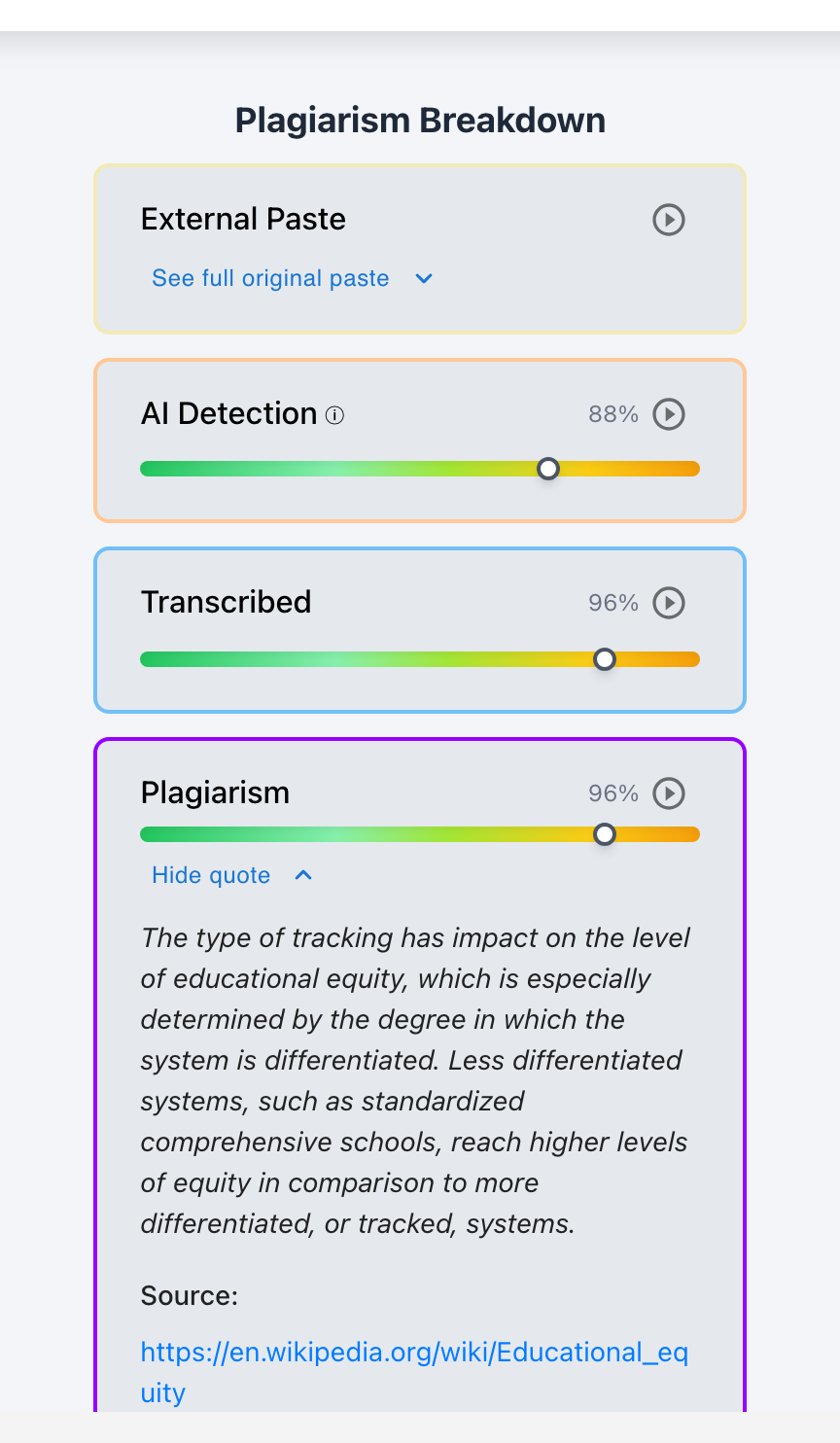
- Passage-level calibrated AI confidence sliders
Layer 3: Restorative Lab Bench Debrief
- Student demonstrates torque balance on physical meter stick
- Collaborative review of telemetry and derivation timelines
- Differentiate conceptual confusion from external generation
- Formative mastery revision pathway for partial credit
1. The Pedagogical Crucible of AP Physics 1 Unit 7: Torque and Rotational Motion
Across the nine units of the College Board AP Physics 1 Course and Exam Description (CED), Unit 7 (Torque and Rotational Motion) historically produces the lowest student free-response scores and the highest concentration of conceptual misconceptions.
Units 1–6: Point-Mass Approximation
- Geometry Ignored: Object dimensions and geometry do not affect kinematics.
- Single Point: All external forces act on a single geometric dot (Center of Mass).
- Single Equilibrium: Translational equilibrium is satisfied when ΣF = 0.
- Pure Translation: Newton’s 2nd Law: a = ΣFnet / m.
Unit 7: Extended Rigid-Body Dynamics
- Geometry Matters: Mass distribution and spatial dimensions determine motion.
- Exact Application Points: Forces act at physical contact boundaries and anchors.
- Dual Equilibrium: Simultaneous equilibrium: ΣF = 0 AND Στ = 0.
- Coupled Motion: Coupled linear and angular kinematics: acm = Rα, vcm = Rω.
In Units 1 through 6 (Kinematics, Dynamics, Circular Motion & Gravitation, Energy, Momentum, and Simple Harmonic Motion), objects are mathematically treated as zero-dimensional point particles. A 2,000 kg truck, a 50 g wooden block, and a pendulum bob are all modeled as a single geometric point where every external force intersects.
Unit 7 shatters this abstraction. Students must confront real-world, extended rigid bodies where the exact location where a force is applied determines whether the object translates, rotates, deforms, or remains in static equilibrium.
The 5 Free-Response Question (FRQ) Types on the AP Physics 1 Exam
The College Board AP Physics 1 Free-Response section comprises five distinct question architectures, each demanding rigorous conceptual communication, physical diagrams, and mathematical translation:
| FRQ Type | Point Value | Suggested Time | Core Cognitive Focus in Unit 7 | Typical Authorship Vulnerability |
|---|---|---|---|---|
| Question 1: Mathematical Routines | 10 Points | 20–25 Min | Multi-step algebraic derivations of torque balance, rotational kinetic energy, and angular acceleration without numeric scaffolding. | Students copy multi-step symbolic steps from online solvers (e.g., Symbolab, Wolfram) or LLMs without internalizing vector sign conventions. |
| Question 2: Translation Between Representations | 12 Points | 25 Min | Connecting physical scenarios to extended FBDs, mathematical equations, and angular velocity vs. time ω(t) or torque vs. angle τ(θ) graphs. | Disconnect between student-sketched diagrams and AI-generated algebraic explanations pasted into LMS text fields. |
| Question 3: Experimental Design & Analysis | 12 Points | 25 Min | Designing a lab to determine an unknown moment of inertia I, analyzing rotary motion sensor data, and modeling frictional losses. | AI hallucinations generating physically impossible apparatus setups or fabricating linear datasets with zero bearing friction. |
| Question 4: Qualitative/Quantitative Translation (QQT) | 8 Points | 15–20 Min | Explaining system behavior qualitatively using prose, followed by an algebraic derivation that mathematically validates the prose argument. | AI prose making qualitative assertions that directly contradict the student’s own mathematical derivation. |
| Question 5: Paragraph-Length Response (PLR) | 7 Points | 15 Min | Constructing a coherent, sequential, unprompted paragraph using Claim-Evidence-Reasoning (CER) to justify a rotational mechanics outcome. | Full-block pasting of LLM responses that sound polished but contain subtle physics hallucinations and no revision history. |
The Governing Physical Laws of Unit 7
To audit student work effectively, educators must evaluate submissions against the core mathematical and physical laws governing rotational mechanics:
1. Vector Definition of Torque
Where θ is the angle between position vector r and applied force F, and d⊥ = r sinθ represents the perpendicular lever arm (shortest distance between chosen pivot and line of action).
2. Conditions for Static Equilibrium (2D)
For complete static equilibrium, the sum of external forces along both Cartesian axes AND the sum of torques about any arbitrary reference axis P must simultaneously equal zero.
3. Newton’s 2nd Law for Rotation
When net external torque is non-zero, the rigid body undergoes angular acceleration α proportional to net torque and inversely proportional to its rotational inertia (moment of inertia) I.
4. Rolling Energy Conservation
For an object with I = cMR² rolling without slipping down height h, final translational speed is strictly independent of mass M and radius R, depending solely on geometric shape factor c.
Pivot: Central symmetry axis. c = 0.50.
Pivot: Perpendicular axis through center of mass.
Pivot: Central axis. All mass at outer radius. c = 1.00.
Pivot: Perpendicular axis through one end.
Pivot: Any diameter axis. c = 0.40.
Pivot: Any diameter axis. c ≈ 0.67.
2. Extended Free-Body Diagrams (FBDs) vs. Point-Mass FBDs: The First Line of Authorship Evidence
In AP Physics 1, Free-Body Diagrams are not decorative sketches; they are foundational analytical models evaluated under strict College Board rubric criteria.
+ (xT)(T sinθ) - (L/2)(Mbg) - (L)(Msg) = 0
Fhinge,x - T cosθ = 0 ⇒ Fhinge,x = T cosθ
The 5 Golden Rules of AP Extended Free-Body Diagrams
Must be drawn originating strictly at the Center of Mass (CM) of the rigid body. For a uniform beam of length L, the vector tail must attach precisely at x = L/2. Drawing gravity at the tip or pivot is an immediate point deduction.
Must originate at the actual physical contact interface between surfaces, directed perpendicular to the contact plane. Normal forces cannot originate at the center of mass.
Must originate at the contact boundary, directed parallel to the surface opposing relative motion or impending slip.
Must originate at the exact physical anchor or eyebolt where the cable/string connects to the beam, directed along the line of the cable.
Must originate directly at the pivot pin, representing the normal and shear constraint forces exerted by the wall/bracket on the beam.
3. The Generative AI Dilemma in High School Physics: Hallucinated Torque Logic & Fabricated Labs
When a high school student in a 1:1 Chromebook environment encounters a complex torque balance problem or PLR prompt, the temptation to consult an LLM is intense. However, because Large Language Models operate on statistical token prediction rather than spatial or Newtonian vector mechanics, they exhibit distinct failure modes when processing rotational physics.
Trap 1: The Missing Pivot Fallacy
The LLM Prompt Output: “Στ = T - mg = 0” without declaring any axis of rotation.
Physics Failure: Conflates linear translational force balance with rotational torque balance. Torque requires distance from a chosen reference axis.
Trap 2: Lever Arm Conflation (r vs. d⊥)
The LLM Prompt Output: Multiplies torque as τ = r · F even when force acts at an angle θ ≠ 90°.
Physics Failure: Fails to compute perpendicular lever arm d⊥ = r sinθ, creating irreconcilable contradictions with subsequent algebra.
Trap 3: Contact Force Misplacement
The LLM Prompt Output: “The normal force acts at the center of the beam to balance gravity.”
Physics Failure: Violates fundamental extended FBD rules; contact and normal forces only act at physical contact boundaries.
Trap 4: The 0.0% Friction Lab Fabrication
The LLM Prompt Output: Synthesizes rotational acceleration data tables with perfect R² = 1.0000 fits and zero friction offset.
Physics Failure: Physically impossible in school labs where rotary motion sensors introduce bearing friction (τf ≈ 0.004 N·m).
4. The AP Scoring & Pedagogical Dilemma: Why Legacy AI Detectors Fail Physics Teachers
When science teachers attempt to police AI usage using first-generation, whole-document “AI percentage detectors” (e.g., tools that assign a single score like “82% Probability of AI”), the results are educationally disastrous.
ΣτP = + (xT)(T sinθ) - (L/2)(Mbeamg) - (L)(Msigng) = 0
T = [ g L (0.5 Mbeam + Msign) ] / [ xT sinθ ]
Because sinθ < 1, decreasing θ requires an increase in T to provide the same perpendicular restoring torque.”
- Flags LaTeX formulas and Greek variables (Σ, τ, θ) as “synthetic patterns.”
- Standard physics phrases (“static equilibrium”, “restoring torque”) have low perplexity.
- Varied vocabulary and flowery prose structure produce high burstiness.
- High token entropy confuses legacy statistical algorithms.
The College Board Paragraph-Length Response (PLR) Holistic Scoring Rubric
| Rubric Dimension | Point Value | AP Scoring Requirement | Why Generic AI Detectors Cannot Evaluate It |
|---|---|---|---|
| Physical Principle Identification | 1 pt | Cites relevant fundamental principles (Στ = 0, Newton’s 2nd Law for Rotation) without extraneous or irrelevant laws. | Cannot evaluate whether a cited principle is physically relevant to the specific prompt. |
| Causal Chain & Evidence Link | 2 pts | Connects initial physical conditions through intermediate rotational states to final system behavior in a logical sequence. | Measures statistical token probability, not physical causality or logical validity. |
| Quantitative/Qualitative Concordance | 2 pts | Mathematical equations and qualitative prose arguments must agree completely (no contradictory statements). | Misses subtle contradictions between student algebraic formulas and pasted AI prose claims. |
| No Fatal Physical Contradictions | 1 pt | Contains no statements that violate fundamental conservation laws or Newtonian principles. | Ignores physical contradictions, rewarding fluent but factually impossible explanations. |
| Coherent Holistic Synthesis | 1 pt | The response reads as a unified, focused physical argument answering the specific prompt. | Assigns arbitrary percentages without providing actionable pedagogical feedback. |
5. The High School Physics Evidentiary Matrix: Comparative Analysis
To evaluate student authorship fairly and defensibly, high school physics teachers and STEM leaders must compare available assessment and integrity modalities:
| Evaluative Criterion | Paper Lab Notebooks | Generic AI Detectors | Google Docs Version History | Checkmark Telemetry & Essay Playback™ |
|---|---|---|---|---|
| Extended FBD Vector Verification | Hand-drawn sketches; difficult to time-stamp. | Inapplicable (cannot parse diagrams). | Cannot track vector origin placement. | Integrated side-by-side view with synchronized image/text submission audit. |
| LaTeX / Formula Handling | Authentic hand-written math; slow to grade. | High False Positive Risk: Flags standard equations. | Shows static formula blocks without typing cadence. | Immune to formula false alarms; analyzes authentic derivation drafting speed. |
| Process Verification (Keystrokes) | None (only final ink is visible). | None (analyzes static text snapshot only). | Coarse snapshots (every 5–15 min); misses bursts. | Patent-Pending Essay Playback™ (1x–8x replay of every keystroke, pause, and edit). |
| External Paste Payload Extraction | Not applicable. | None (cannot determine origin of text). | Shows text insertions without clipboard origin data. | Preserves complete raw external paste payloads with instant timeline jump. |
| Transcription Detection | Not applicable. | None. | Misses steady, unpaused typing from second screens. | Identifies mechanical typing dynamics lacking natural calculation pauses. |
| Rubric Autograding & LMS Sync | 100% manual grading; 15–20 hrs/weekend for 150 students. | None. | None. | Quote-anchored AP rubric autograding with Canvas/Google Classroom gradebook sync. |
| Student Privacy & FERPA Compliance | Fully compliant. | Often violates FERPA by using student work for model training. | Compliant within Google Workspace. | 100% FERPA/COPPA compliant; zero model training on student submissions. |
6. Step-by-Step Physics Teacher Audit Protocol for Torque & Rotational FRQs
When evaluating an AP Physics 1 Unit 7 assignment, lab report, or Paragraph-Length Response, follow this five-phase pedagogical audit protocol:
Phase 1: The Extended FBD & Torque Equilibrium Concordance Audit
Before reading the prose justification, perform a direct 1-to-1 mapping between the student's diagram and their algebraic setup. Count the force vectors drawn on the extended FBD (e.g., Fhinge,x, Fhinge,y, Fg,beam, T, Fg,sign = 5 vectors). If the torque equation includes forces passing through the pivot (where r = 0) or omits non-zero torque forces, investigate whether text was copied from an alternate coordinate convention.
Phase 2: Pivot Selection & Perpendicular Lever Arm Sanity Check
Check that the reference axis is explicitly stated (e.g., “Axis of rotation at hinge P at x = 0”). If the qualitative response asserts that tension increases when θ increases, but the algebraic formula shows T = Torque / (xT sinθ), the student has likely pasted an unverified AI explanation.
Phase 3: Analyzing Keystroke Dynamics with Essay Playback™
Replay the drafting session at 2x to 4x speed. Authentic physics problem-solving features rapid typing of variable names followed by distinct 15–45 second composing pauses where the student consults scratch paper or a calculator, correcting signs and subscripts. Unearned text exhibits instantaneous block insertion or steady, mechanical transcription at 85 WPM with zero pauses.
Phase 4: Inspecting External Paste Buffer Payloads
Click on Checkmark's External Paste Inspector badge to view raw clipboard text. Checkmark preserves original pasted text even if the student subsequently edits, rewords, or deletes sections. Look for telltale LLM headers (e.g., “Here is a paragraph-length response explaining torque balance...”) or markdown bold headers.
Phase 5: The Supportive Restorative Physics Lab Bench Debrief
When telemetry indicates unauthorized AI generation, invite the student to a 3-minute lab bench conference with a physical meter stick on a fulcrum. Say: “Your submitted paragraph makes a very interesting claim about hinge forces. Can you walk me through your scratchpad derivation and show me on this meter stick where you set your pivot point?” This creates a safe, restorative environment focused on genuine physics learning.
7. Classroom Case Studies: Real AP Physics 1 High School Scenarios
A 7-point Paragraph-Length Response justifying how cable tension T and horizontal hinge force Fhinge,x change as attachment angle θ decreases from 60° to 30°. A student submitted an eloquent 280-word paragraph arguing that hinge force decreases because the cable becomes more horizontal and absorbs all lateral stress.
Physically incorrect! As θ decreases, the cable must pull harder to provide vertical restoring torque (T = τ / sinθ). Because T increases and becomes more horizontal, the horizontal component Tx = T cosθ skyrockets. To satisfy ΣFx = 0, the horizontal hinge force Fhinge,x must increase dramatically, not decrease!
Essay Playback™ revealed an external paste event of 1,280 characters at minute 01:14. In the debrief, the student admitted to prompting ChatGPT: “Explain what happens to hinge force when angle decreases.” The teacher coached the student through ΣFx = Fhinge,x - T cosθ = 0, allowing the student to revise their derivation for partial credit.
Students designed a procedure using a rotary motion sensor and hanging mass to calculate the rotational inertia of a metal disk. A submitted lab report contained a τ vs. α graph with an exact (0.000, 0.000) intercept, R² = 1.00000, and a claim of “0.00% error, proving that no friction was present.”
Essay Playback showed the data table was pasted in 14 seconds. During the lab bench debrief, the teacher demonstrated the physical bearing seals on the Pasco Rotary Motion Sensor. The student admitted to using AI to generate data after running out of class time. The teacher hosted an after-school session to collect real data and calculate bearing friction τf using the non-zero y-intercept.
A high-achieving student derived vcm = √[2gh / (1 + c)] and explained why a solid sphere (c = 0.40) rolls faster than a hollow hoop (c = 1.00). A generic AI detector flagged the submission with an 84% AI Score due to standard LaTeX formatting and physics terms.
Checkmark’s Essay Playback™ demonstrated a continuous 38-minute drafting timeline with 142 keystroke revisions, 18 calculation pauses corresponding to algebra steps, and zero paste events. The department cleared the student immediately with full credit.
8. How Checkmark Empowers Secondary STEM Educators and Department Chairs
Checkmark Plagiarism is engineered specifically to meet the high-volume grading and rigor requirements of high school science departments:
1x to 8x video scrub of every keystroke, math pause, and formula edit.
Complete preservation of raw external clipboard text before student rewrites.
Calibrated confidence cards on specific sentences instead of blunt document scores.
Evaluates AP Physics 1 FRQs & CER labs, links feedback directly to student prose lines, and syncs with Canvas, Google Classroom, and Agilix Buzz gradebooks in one click.
1. Teacher-in-the-Loop Rubric Autograding
High school physics teachers managing 150+ students across 5 periods cannot spend 30 hours every weekend manually scoring multi-page rotational mechanics lab reports. Checkmark’s AI Autograder evaluates student responses against custom College Board 7-point PLR or 10-point FRQ rubrics, generating quote-anchored score justifications that remain draft recommendations until approved by the teacher.
2. Native LMS and 1:1 Chromebook Integration
Enjoy seamless single-sign-on (SSO) and assignment synchronization with Canvas LMS, Google Classroom, Buzz LMS, and Schoology. Writing telemetry is captured directly within Google Docs and LMS speedgraders without requiring intrusive browser surveillance extensions.
3. Enterprise Privacy & FERPA Compliance
Under Checkmark’s Zero-Retention Data Policy, student physics derivations, lab data, and personal records are never ingested to train commercial or public AI models. Full compliance with FERPA, COPPA, and state student privacy mandates is guaranteed.
9. Frequently Asked Questions (FAQ)
Q1: How does Checkmark handle LaTeX formulas and Greek physics symbols without triggering false AI positives?
Unlike generic AI detectors that treat mathematical syntax (e.g., τ = r F sinθ, Στ = Iα) as low-entropy “machine-generated” text, Checkmark features a specialized STEM parsing engine. It isolates mathematical expressions and variable notation, evaluating the surrounding prose for genuine drafting cadence rather than penalizing standard scientific vocabulary.
Q2: Can Essay Playback™ detect if a student transcribes an AI response from a smartphone or second monitor?
Yes. When a student copies text by looking back and forth at a second screen or smartphone, their typing dynamics exhibit a distinct mechanical transcription pattern: steady, continuous typing at a uniform rate without the natural pauses, formula re-evaluations, backspaces, and structural reorganizations that occur during authentic physics problem-solving. Essay Playback™ flags these anomalous typing cadences for educator review.
Q3: How should an AP Physics teacher award partial credit on a Paragraph-Length Response if the student used AI for only one sentence?
Checkmark’s passage-level granularity highlights the exact sentences generated externally, accompanied by confidence cards in the sidebar. Teachers can easily award full rubric credit for the student's authentic derivations and explanations while zeroing out only the unearned passage or asking the student to orally defend that specific claim during a quick lab bench check.
Q4: What is the pedagogical difference between authorized AI tutoring and unauthorized authorship fraud in AP Physics?
Authorized AI assistance involves using an AI tutor to ask conceptual questions (e.g., “Why does a hoop have more rotational inertia than a disk of the same mass?”), after which the student synthesizes their own understanding in their own words. Unauthorized authorship fraud occurs when a student prompts an LLM to generate the completed FRQ justification, lab report conclusion, or CER argument and pastes it directly into the submission portal.
Q5: How does Checkmark protect student privacy under FERPA and COPPA during district-wide assessments?
Checkmark operates under a strict Zero-Retention Data Policy. Student submissions are processed securely in transit and at rest using enterprise encryption. Submissions are never shared with third-party AI companies, never made public, and never used to train machine learning models.
Q6: How does Checkmark help physics teachers manage grading loads across 150+ students?
Checkmark’s Quote-Anchored Rubric Autograder pre-evaluates student Paragraph-Length Responses, CER arguments, and lab conclusions against the teacher's custom rubric criteria. It provides draft scores with highlighted textual evidence, allowing teachers to review, edit, and approve grades in seconds and push them directly to Canvas or Google Classroom gradebooks, cutting grading time by up to 70%.
Summary & Next Steps for STEM Educators
Auditing AP Physics 1 Unit 7 submissions for authentic student authorship does not require adversarial surveillance or guesswork. By combining physical Free-Body Diagram vector concordance checks with Checkmark’s patent-pending Essay Playback™, External Paste Inspector, and Quote-Anchored Rubric Autograder, high school physics educators can uphold uncompromising academic standards while providing supportive, restorative learning environments.
To experience how Checkmark transforms academic integrity and grading in high school STEM classrooms, explore our AI Detection suite, explore Essay Playback™, or request a district pilot today.