
The Advanced Placement (AP) Capstone Diploma program—comprising AP Seminar and AP Research—represents one of the most intellectually ambitious undertakings in secondary education. Requiring students to design, execute, and document a year-long, 4,000 to 5,000-word independent academic investigation, the AP Capstone curriculum culminates in a high-stakes digital submission to the College Board. However, guiding adolescents through collegiate-level research introduces a severe structural vulnerability: the “Mentorship Dilemma.” When mentors rely on periodic, static spot-checks (e.g., grading isolated PDF drafts every six weeks), they remain blind to students' day-to-day cognitive struggles, executive functioning bottlenecks, and literature synthesis roadblocks. Under looming submission deadlines and imposter syndrome, struggling students frequently resort to “late-stage AI panic dumping”—generating wholesale literature reviews, synthetic methodologies, or hallucinated citations via frontier Large Language Models (LLMs) hours before upload windows close.
Generic, whole-paper AI detectors cannot solve this dilemma. Standalone percentage scores (e.g., “62% AI Detected”) produce adversarial standoffs, introduce catastrophic false positives against specialized academic prose, and fail to distinguish between authorized AI brainstorming and unauthorized authorship substitution.
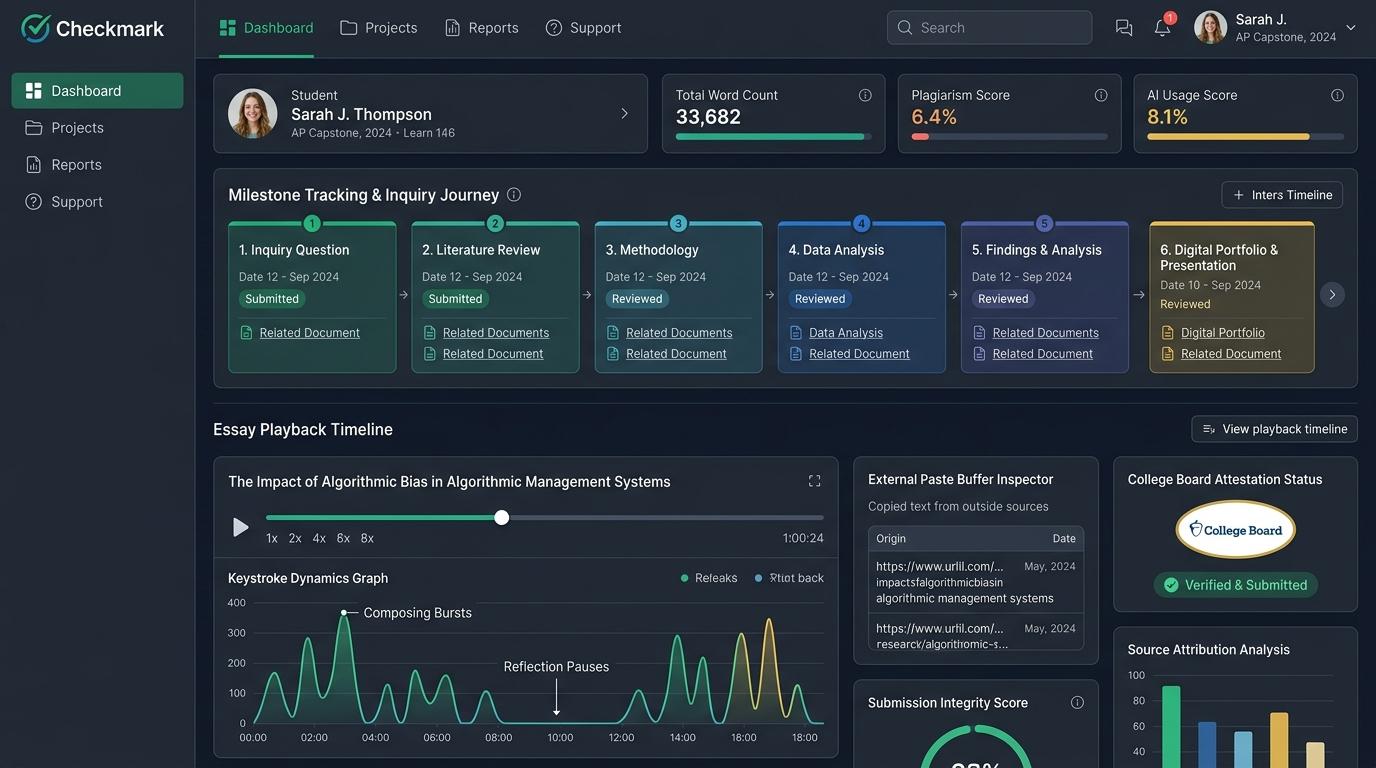
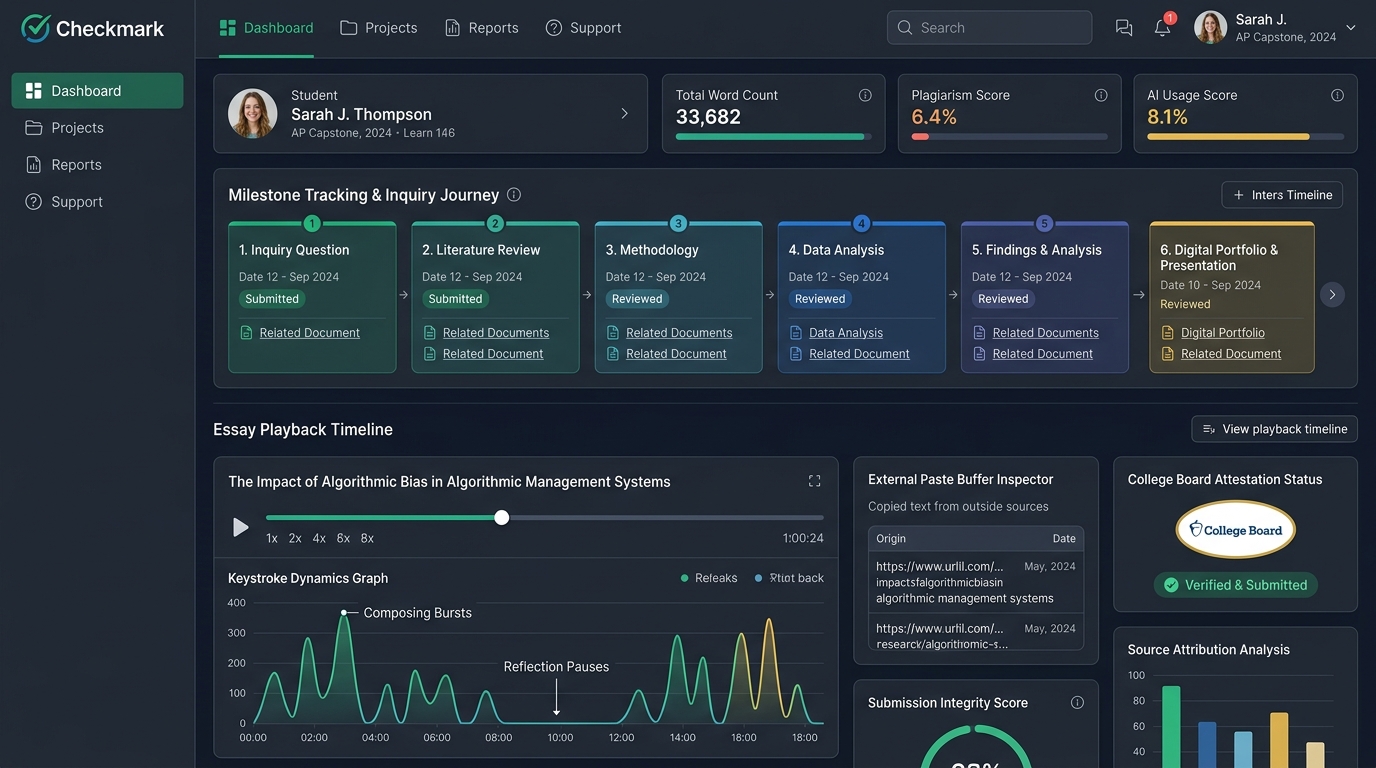
To preserve the integrity of independent inquiry while providing compassionate, proactive pedagogical scaffolding, AP Capstone educators must shift from punitive post-submission policing to Writing Process Telemetry and Formative Keystroke Playback. By utilizing Checkmark's Patent-Pending Essay Playback™ (1x–8x scrubbable session replay), External Paste Provenance tracking with complete clipboard retention, Transcription Detection, and passage-level calibrated confidence sliders, mentors can transform the writing timeline into an observable laboratory of student thought. This guide establishes a comprehensive, milestone-by-milestone framework for AP Seminar and AP Research educators to monitor independent inquiry, substantiate authentic student authorship, and foster genuine academic resilience.
Checkmark Plagiarism equips AP Capstone Coordinators, AP Research advisors, Seminar teachers, and school leadership with forensic writing telemetry and enterprise LMS integrations across Canvas LMS, Agilix Buzz, and Google Classroom.
1. The High-Stakes Architecture of AP Capstone: Independent Inquiry in the Generative AI Era
The College Board’s AP Capstone program is structured around the QUEST inquiry framework:
Explore & formulate narrow researchable questions
Analyze arguments, lines of reasoning & evidence
Assess multiple perspectives, biases & limitations
Synthesize ideas & formulate original claims
Team, transform & defend findings in final papers
In both AP Seminar (through the Team Project and Presentation, which includes the 1,200-word Individual Research Report [IRR], and the Individual Research-Based Essay and Presentation, which includes the 2,000-word Individual Written Argument [IWA]) and AP Research (culminating in the 4,000–5,000 word Academic Research Paper and Presentation and Oral Defense [POD]), students must demonstrate scholarly autonomy. They must identify a genuine gap in existing academic literature, formulate a focused and disciplined research question, execute a viable methodology (qualitative, quantitative, mixed-methods, historical, or artistic), synthesize complex primary and secondary sources, and defend original findings.
- Team Project & Presentation (includes IRR - 1,200w)
- Individual Research-Based Essay & Presentation (includes IWA - 2,000w)
- Cross-Curricular Stimulus Material Analysis
- Foundational Source Credibility & Scholarly Synthesis
- Year-Long Independent Inquiry (No Shared Stimulus Packet)
- 4,000–5,000 Word Academic Research Paper
- Presentation & Oral Defense (POD)
- Process and Reflection Portfolio (PREP)
Mentors must certify that work is authentic, original, and compliant with College Board AI policies, yet traditional supervisory tools only capture static snapshots, hiding the drafting struggle.
1.1 The Anatomy of the AP Research Paper and the PREP Portfolio
In AP Research, students do not receive a standardized stimulus packet. The inquiry is entirely student-directed. To ensure students do not drift into aimless browsing or academic misconduct, the College Board requires the Process and Reflection Portfolio (PREP), a structured record in which students document their inquiry processes, their communication with teachers and any expert advisers, and their reflections on their own thought processes.
However, the PREP portfolio itself has become vulnerable to retrospective fabrication. When a student falls behind on weekly journal entries, generative AI tools allow them to generate dozens of convincing, introspective reflection entries in minutes.
The centerpiece of AP Research assessment remains the academic paper, which the College Board scores holistically on a 5-point scale. The six dimensions below are a mentor-friendly paraphrase of what that scale describes, not the College Board's own row names:
Situating the inquiry within an ongoing scholarly conversation and identifying a clear, justifiable gap.
Articulating a focused, feasible, and disciplined scope capable of sustaining empirical or archival inquiry.
Justifying a replicable, ethical, and discipline-appropriate method of data collection, generation, or archival extraction.
Generating original evidence, testing hypotheses, and interpreting quantitative or qualitative data without overreaching.
Articulating new understandings, boundaries of findings, unresolved questions, and future scholarly trajectories.
Maintaining formal academic register, precise discipline-specific conventions, and meticulous attribution across all sources.
1.2 The Anatomy of “Late-Stage AI Panic Dumping”
High school juniors and seniors facing their first collegiate-scale research paper experience predictable psychological and developmental hurdles. Unlike typical 3-to-5 page analytical essays, a 5,000-word academic paper requires prolonged cognitive stamina, iterative restructuring, complex citation management, and tolerance for ambiguity when experiments or surveys yield inconclusive data.
- High enthusiasm & grand ideas
- Broad, unbounded inquiry scope
- Disorganized preliminary notes
- Research & data collection stalls
- Inconclusive or missing survey data
- Superficial, fabricated PREP logs
- Severe drafting paralysis
- Acute imposter syndrome
- Avoidance of mentor check-ins
- Wholesale LLM generation
- Hallucinated ghost citations
- 4,000 words pasted in 3 hours
When students hit the Drafting Paralysis phase in early spring, the psychological barrier to writing becomes overwhelming. The accessibility of generative LLMs (e.g., GPT-4o, Claude 3.5 Sonnet, Gemini Advanced) offers an irresistible escape valve:
- The Synthetic Literature Review: The student prompts an LLM to “summarize 15 peer-reviewed studies on microplastic bioaccumulation in freshwater teleosts,” pasting the output directly into Section II.
- Hallucinated Academic Citations (“Ghost Sources”): The LLM invents plausible-sounding journal titles, volume numbers, and DOIs. The student pastes these without ever opening the underlying papers.
- Synthetic Methodology & Data Generation: When survey response rates fall short (e.g., collecting only 12 responses instead of 100), students prompt AI to generate synthetic qualitative response themes or simulate quantitative data distributions.
- The Paraphrased “Humanizer” Evasion: Aware that schools utilize basic plagiarism checkers, students run generated text through tools like QuillBot, BypassGPT, or Undetectable AI to shuffle syntax before pasting.
1.3 The College Board's AI Policy & The Mentor's Supervisory Mandate
The College Board's AP Capstone Policy on Use of Generative Artificial Intelligence (AI), published in the AP Seminar and AP Research Course and Exam Descriptions, states:
“Generative AI tools must be used ethically, responsibly, and intentionally to support student learning, not to bypass it. Accordingly, all performance tasks submitted in AP Seminar and AP Research must be the student’s own work. […] Students may not use generative AI tools to write or create their assignments for them.”
The policy permits optional AI use for exploring potential topics of inquiry, running initial source searches, confirming understanding of a complex text, and checking (but not rewriting) writing for grammar and tone. It also requires students to complete interim “checkpoints” with their teacher, and failure to complete the checkpoints results in a score of zero on the associated task.
Furthermore, AP Capstone teachers are required by the College Board to affirm in the AP Digital Portfolio that each submitted paper represents the student's authentic work. Signing this attestation without empirical verification leaves educators in an untenable position: either sign blindly based on trust or subject students to arbitrary accusations based on black-box detectors.
2. The Mentorship Dilemma: Why Spot-Checks and Generic Detectors Fail
High school AP Capstone teachers typically oversee 30 to 60 independent research projects simultaneously across wildly divergent disciplines—from behavioral neuroscience and municipal zoning economics to post-colonial literary criticism and machine learning algorithms.
Under these operational constraints, traditional supervisory practices inevitably break down.
Static prompt check; no visibility into source discovery or search methodology.
Static PDF submission; cannot detect whether text took 3 weeks or 12 seconds to generate.
Detector outputs “48% AI”; teacher faces adversarial stalemate with parents and students.
1x–8x replay tracks organic question evolution.
Full clipboard archive tracks source quoting.
Pause duration reveals genuine literature synthesis.
Keystroke rhythm verifies manual data entry.
100% defensible student authorship dossier.
2.1 The Failure Modes of Periodic Static Checkpoints
- The Six-Week Horizon Blindspot: When mentors only review finished milestone documents at 6-week intervals, they miss the formative window where intervention is pedagogically effective. A student who copied an entire literature review in Week 8 has spent the subsequent 10 weeks building a flawed methodology on a fraudulent foundation.
- The “Clean Final Draft” Illusion: A polished academic paper with flawless semicolon placement, sophisticated transitions, and complex jargon can easily deceive an exhausted teacher. However, polish is no longer a proxy for student mastery; in the AI era, excessive structural polish is often the primary symptom of machine generation.
- Inability to Diagnose Executive Dysfunction: When a student fails to submit a milestone draft, teachers often assume apathy or laziness. In reality, the student is frequently paralyzed by research anxiety. Without writing telemetry, teachers cannot see that the student spent four hours opening and closing a blank document, typing and deleting the same thesis statement twelve times.
2.2 Why Standalone AI Detector Percentages Destroy the Mentor-Student Relationship
When a teacher runs a student's 4,500-word AP Research draft through a generic, whole-paper AI detector and receives an opaque score like “71% AI Generated,” the pedagogical relationship is poisoned:
- The Inability to Present “Receipts”: The teacher cannot point to specific uncredited external sources, nor can they demonstrate how the text was fabricated. The score is an uninterpretable probability output by a neural network.
- Severe False-Positive Risk on Academic Literature: Academic prose—characterized by formal passive voice, highly structured technical syntax, standardized citation formulas (e.g., “According to a 2021 longitudinal study conducted by Smith et al...”), and low burstiness—naturally exhibits high linguistic predictability (low perplexity). Generic detectors routinely misclassify rigorous student-written literature reviews as machine-generated.
- Adversarial Escalation: Confronted with an unprovable percentage, students become defensive, parents threaten administrative or legal appeals, and the focus shifts entirely away from research quality to software reliability.
2.3 The “AI Humanizer” and Paraphrasing Bypass in Scholarly Literature
To circumvent basic detectors, high school students increasingly deploy sophisticated evasion chains:
These text-spinning algorithms break n-gram matching and introduce synthetic perplexity spikes. Static text detectors cannot reliably detect this pipeline. However, the evasion chain is completely powerless against Keystroke Telemetry and Writing Process Replay. A humanizer can alter surface vocabulary, but it cannot manufacture three months of organic keyboard pauses, natural cognitive revision bursts, real-time source quoting, and genuine sentence restructuring.
3. Technical Telemetry vs. Basic Revision History: A Comparative Matrix
Many educators believe that built-in LMS tools (such as Google Docs Version History or Microsoft Word Track Changes) provide sufficient visibility into student drafting. This assumption represents a critical technical misunderstanding.
Snapshot 1: Oct 12, 4:15 PM (12 words)
← 45-Minute Blackout Window (No data captured) →
Snapshot 2: Oct 12, 5:00 PM (1,850 words inserted)
Did the student type steadily? Paste from notes? Paste from ChatGPT? Transcribe from a phone? UNKNOWN.
- 4:15:02 PM • Keystroke ‘The’ (IKI: 140ms - Normal composing)
- 4:15:18 PM • Cognitive Pause (16.2s - Reading secondary source)
- 4:15:34 PM • Revision Burst (Backspaced 14 chars; restructured clause)
- 4:18:12 PM • Paste Event: 642 chars cached with raw clipboard
- 4:18:15 PM • Immediate Replay Available at 1x, 2x, 4x, 8x Speed
3.1 Standard LMS Version History vs. Checkmark Essay Playback™ Writing Telemetry
| Feature / Metric | Standard Google Docs / Word History | Canvas / LMS SpeedGrader | Checkmark Essay Playback™ & Telemetry |
|---|---|---|---|
| Data Capture Frequency | Coarse, periodic batch snapshots (every 5–30 mins or on save) | Static single-point submission snapshot | Continuous, event-driven millisecond keystroke logging |
| Visual Timeline Replay | Step-by-step jump between diff snapshots | No replay capability | 1x to 8x scrubbable video reconstruction of full drafting session |
| External Paste Tracking | Highlights pasted block in green; loses original clipboard text if edited | Blind to paste origin; shows only final submitted string | Timestamped capture of exact clipboard text with jump-to-timeline button |
| Keystroke Dynamic Analysis | None (cannot measure typing cadence or rhythm) | None | Calculates Inter-Keystroke Intervals (IKI), burstiness, and composing cadence |
| Transcription Detection | Invisible (appears as standard fast typing between snapshots) | Invisible | Identifies mechanical, monotonic typing without cognitive pauses (retyping off phone/second monitor) |
| Non-Linear Revision Tracking | Difficult to follow; highlights entire paragraphs as modified | None | Visualizes structural reordering, cut-and-paste section swaps, and thesis pivots |
| Passage-Level AI Confidence | None | Third-party whole-paper percentage | Granular sentence/paragraph sliders (Typical Human Style vs. AI Pattern) |
| Plagiarism Source Integration | Separate report; disconnect between diff and source | Disconnected sidebar match list | Two-way linked cards: click essay text to jump to live source quote and playback timestamp |
| Attestation & Defense Dossier | Manual screenshotting of revision history | None | One-click exportable Student Authorship Dossier for College Board / AP audits |
3.2 Keystroke Dynamics, Composing Rhythm, and Cognitive Pauses Explained
Authentic academic writing is inherently non-linear, dysfluent, and cognitively taxing. When an AP Capstone student synthesizes complex empirical literature or interprets data, their keyboard telemetry exhibits distinct physiological and cognitive signatures:
Typing Burst (3–8 words) → Pause (4–15s: Reading Source) → Deletion/Edit → Burst → Macro Pause (30s)
- Highly variable Inter-Keystroke Interval (IKI: 90ms to 800ms)
- High backspace/deletion ratio (12% to 25% of all keystrokes are corrections)
- Frequent cursor repositioning across paragraphs to refine earlier claims
Instantaneous Document Insertion: 800+ words inserted in 0 milliseconds
- 0 milliseconds drafting time for multi-paragraph blocks
- Telemetry flags instant clipboard event with character count and preserved source string
Unbroken, Monotonic Typing Stream: Constant 160ms ± 20ms across 1,500 consecutive characters
- Near-zero cognitive pauses (>5s pauses absent because no internal synthesis is occurring)
- Unusually low deletion rate (<2%), indicating student is copying visible text rather than composing
3.3 External Clipboard Provenance and Immutable Paste Preservation
A major challenge for AP mentors is distinguishing between legitimate clipboard usage (e.g., pasting an excerpt from a JSTOR article to quote it, or moving a paragraph from a personal brainstorm doc) versus illegitimate generative text dumps.
Checkmark's External Paste Inspector solves this by maintaining an immutable record of every paste event:
- Timestamp & Character Volume: Exact time, date, and size of the insertion.
- Complete Source Text Retention: Even if the student pastes 1,000 words of AI text and subsequently rewrites 80% of the words to hide the paste, Checkmark preserves the original raw clipboard string.
- Jump-to-Playback Sync: Clicking the paste card instantly scrubs the Essay Playback™ video to the exact millisecond the paste occurred, allowing the mentor to observe what the student did immediately before and after the insertion.

4. The 6-Stage AP Capstone Milestone Audit Protocol
To replace late-stage panic with structured, transparent progress, AP Seminar and AP Research teachers should implement the following Milestone Audit Protocol. This framework maps directly to the College Board curriculum and utilizes writing telemetry at each formative checkpoint.
Narrowing research scope; vetting 8–12 peer-reviewed sources in academic databases.
1,200–1,800 words categorizing debates and defining the scholarly gap.
Instrument justification, survey matrices, lab protocols, and ethics approvals.
Representing primary data, statistical models, and qualitative coding themes.
Contextualizing results, tempering claims, and outlining future inquiry paths.
Final formatting, reference cross-checking, and mentor attestation sign-off.
Milestone 1: Inquiry Question Formulation & Source Curation (September – October)
- Pedagogical Goal: Formulate a narrow, researchable question addressing an authentic scholarly gap; compile an initial Annotated Bibliography (8–12 peer-reviewed sources).
- Telemetric Observability: In the early inquiry phase, writing telemetry should show short, exploratory drafting sessions, extensive re-phrasing of the central question, and short paste events containing source titles, DOIs, and block quotes from academic databases.
- Red Flags in Telemetry: Instantaneous generation of an entire 10-source annotated bibliography within a single 15-minute session; uniformly formatted annotations lacking idiosyncratic student notes; fabricated DOIs or non-existent authors.
- Mentor Formative Action: Open Checkmark Playback for the student's question-drafting document. Review the evolution of the research question. If the annotated bibliography shows large pasted blocks, use the Paste Inspector to verify whether the student pasted from their own reading notes or an unverified external source.
Milestone 2: Literature Review & Scholarly Gap Synthesis (November – December)
- Pedagogical Goal: Construct a 1,200 to 1,800-word literature review that categorizes existing scholarly perspectives, establishes thematic debates, and clearly defines the research gap.
- Telemetric Observability: Organic literature synthesis is highly fragmented. Telemetry should reveal frequent switching between source quoting and student commentary, high backspace activity as students wrestle with academic terminology, and mid-sentence pauses representing source verification.
- Red Flags in Telemetry: The “Monolithic Lit Review Dump” (1,500 words appearing in a single paste event or drafted in a single 45-minute unbroken burst without cognitive pauses); superficial patchwriting highlighted in plagiarism breakdowns; passage-level AI flagging on theoretical frameworks.
- Mentor Formative Action: Conduct a 5-minute “Receipts-Based Check-In.” Pull up Essay Playback™ alongside the student. Ask them to explain the transition between two contrasting perspectives in Section II. An authentic author can immediately explain their organizational logic; a student who generated the section will struggle to summarize the argument without re-reading the text.
Milestone 3: Research Methodological Design & Tool Justification (January – February)
- Pedagogical Goal: Write a rigorous, replicable methodology section justifying chosen tools (e.g., surveys, interviews, lab protocols, statistical models, historical archives) and detailing IRB/human-participant ethics approvals.
- Telemetric Observability: The methodology section should show direct integration of specific instruments: survey question matrices, equipment calibration settings, or coding rubrics. Telemetry should show deliberate composition of procedural steps.
- Red Flags in Telemetry: Generic, textbook-style descriptions of methodology (e.g., a 600-word theoretical essay on the benefits of Likert scales) with zero concrete details regarding the student's actual sample size, geographic location, or recruitment channels; high passage-level AI confidence scores on survey protocol descriptions.
- Mentor Formative Action: Compare the telemetry in the student's draft with their physical research artifacts (e.g., raw survey forms, signed consent logs, laboratory notebook entries). Ensure that the timeline of methodology drafting corresponds chronologically with their actual data collection timeline.
Milestone 4: Data Collection, Analysis, & Findings Drafting (February – March)
- Pedagogical Goal: Present collected primary/secondary data using discipline-specific representations (data tables, descriptive/inferential statistics, qualitative coding themes) without speculative over-interpretation.
- Telemetric Observability: Authentic findings drafting involves constant micro-adjustments: typing numerical values, calculating percentages, cross-referencing figures, and modifying table layouts. Telemetry shows frequent pauses as students look back and forth between raw spreadsheets (CSV/Excel) and their manuscript.
- Red Flags in Telemetry: Synthetic data generation (perfectly clean, mathematically improbable survey distributions or qualitative interview quotes containing unnaturally formal, eloquent language uncharacteristic of high school respondents); sudden appearance of complex statistical models without earlier exploratory data calculations.
- Mentor Formative Action: Use Checkmark's Quote-Anchored Rubric Feedback to evaluate the alignment between raw data tables and textual claims. If data tables were pasted in bulk, require the student to present the raw, unedited spreadsheet data file with timestamps matching the writing timeline.
Milestone 5: Discussion, Implications, & Limitations (March – April)
- Pedagogical Goal: Interpret the significance of findings, contextualize results within the broader scholarly discipline, explicitly acknowledge methodological limitations, and propose future inquiry trajectories.
- Telemetric Observability: This section represents the student's purest intellectual contribution. Writing telemetry should reflect slow, deliberate reflection, extensive paragraph re-ordering, and self-correcting revisions as the student tempers overgeneralized claims.
- Red Flags in Telemetry: The “Flawless Generalization” (a discussion section that ignores sample size limitations, presents grandiose societal solutions, and uses stereotypical LLM concluding rhetoric); high passage-level AI detection paired with low keystroke revision counts.
- Mentor Formative Action: Scrub through Essay Playback™ at 4x speed across the Discussion section. Look for student-initiated revisions that tone down conclusions (e.g., changing “This proves that...” to “These findings suggest a potential correlation between...”). The presence of authentic nuance drafting proves high-level critical thinking.
Milestone 6: Final Digital Portfolio Assembly & Attestation (Late April)
- Pedagogical Goal: Final manuscript formatting, reference list cross-referencing, word count verification (staying within the 4,000–5,000 word parameter), and teacher-student attestation prior to College Board digital locking.
- Telemetric Observability: The final 72 hours should show formatting adjustments, citation standardization (APA/MLA/Chicago), and minor proofreading edits.
- Red Flags in Telemetry: Massive text replacement events (>1,500 words replaced or inserted) within 48 hours of the deadline; disappearance of earlier drafted sections replaced by polished, machine-styled prose.
- Mentor Formative Action: Generate the final Checkmark Authorship & Integrity Dossier. Review the complete timeline from September to April. Verify that the final submission represents the culmination of cumulative, verified milestones. Once verified, sign the College Board attestation with total empirical confidence.
5. Checkmark's Integrated Suite: Empowering AP Mentors and Students
Checkmark Plagiarism is engineered specifically to eliminate the friction, suspicion, and administrative chaos of high-stakes academic writing. Rather than functioning as a punitive “gotcha” filter, Checkmark serves as a collaborative pedagogical environment.
1x to 8x timeline scrubbing with millisecond pause telemetry. Exonerates honest students and reveals authentic struggle.
- 1x–8x scrubbable video player
- Inter-keystroke interval logging
- Visual composing vs. reading pauses
100% full clipboard text retained forever with jump-to-timeline synchronization.
- Immutable raw clipboard cache
- Timestamp & character volume
- Jump-to-playback direct sync
Calibrated confidence per paragraph with strict short-text guardrails (<150w displays N/A).
- Educator-only private flag status
- Perplexity & burstiness metrics
- Immune to text humanizers
First-draft AP scoring suggestions anchored directly to student prose with LMS passback.
- Official AP scoring guidelines
- Quote-anchored feedback cards
- One-click sync to Canvas & Buzz
5.1 Real-Time 1x–8x Essay Playback™ as an Exoneration and Coaching Tool
The cornerstone of Checkmark is Patent-Pending Essay Playback™. By capturing native keystroke events across Google Docs, Canvas LMS, Buzz LMS, and Microsoft Word, Essay Playback™ reconstructs the entire physical drafting journey.
- Exonerating High-Achieving Students: Gifted AP students who naturally write with advanced vocabulary, complex clause structures, and formal academic cadence are frequently victimized by generic AI detectors. When a false positive occurs, the student does not need to plead their case in tears. The teacher opens Essay Playback™, watches the student construct the complex sentences keystroke-by-keystroke over 30 hours, and immediately dismisses the flag.
- Diagnosing Research Blocks: If a student is falling behind, the mentor scrubs through their session timeline at 8x speed. Seeing 45 minutes of constant typing, deleting, and cursor jumping reveals that the student understands their topic but is struggling with paragraph organization—allowing the mentor to provide targeted structural coaching.
5.2 Deep Paste Tracking: Unmasking Source Misattribution vs. Outright Fraud
When students conduct literature reviews, pasting text is a natural part of note collection. The critical distinction is whether the pasted text was properly transformed, attributed, or passed off as original prose.
Checkmark's Two-Way Linked Evidence Cards allow mentors to click on any highlighted passage in the essay and immediately inspect:
- The exact web or academic journal source match with side-by-side quote alignment.
- The exact moment the text entered the document via clipboard.
- Whether the student attempted to paraphrase the text or cited it correctly.
Furthermore, Checkmark provides a dedicated Uncited Source Differentiation visual mode. Accidental citation omissions or formatting errors are highlighted in coaching blue rather than plagiarism red, allowing teachers to treat citation mechanics as a teachable moment rather than an honor code violation.

5.3 Passage-Level AI Confidence Sliders: Navigating Permissible AI Brainstorming
The College Board allows students to use AI for conceptual brainstorming (e.g., exploring theoretical frameworks or refining search keywords), but forbids AI authorship. Whole-paper detectors cannot navigate this nuance; they return a single catastrophic percentage that conflates a student who used AI to generate a search query with a student who had AI write their entire Discussion section.
Checkmark delivers Passage-Level Granularity:
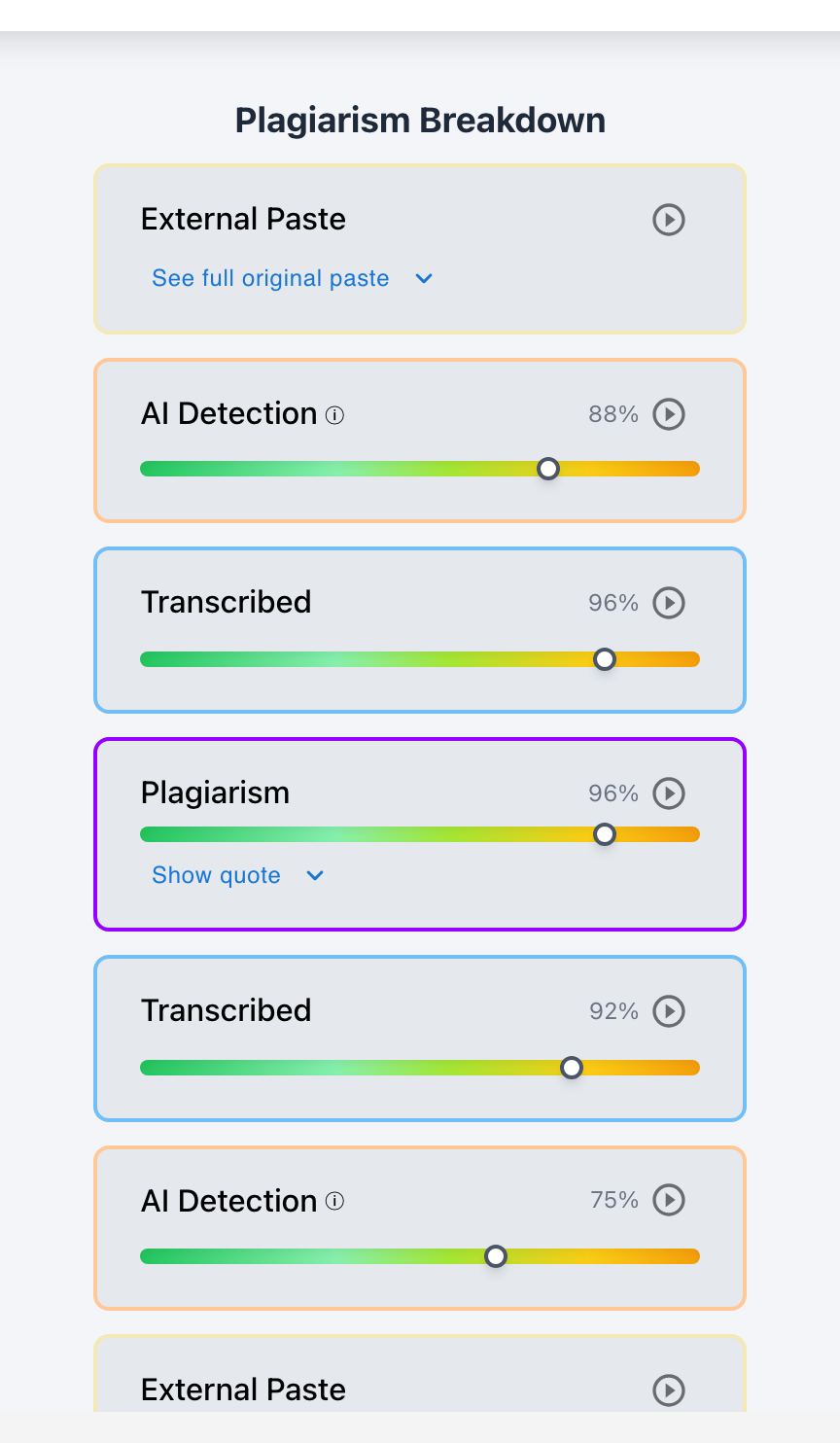
- Individual paragraphs receive calibrated confidence cards displaying linguistic metrics (perplexity, burstiness, transition entropy).
- Educator-Only Flag Statuses: Flags (Flagged, Resolved, Not Flagged) remain strictly private to teachers, preventing automated, traumatic accusations from reaching students before human review.
- Honest Guardrails: Any passage under ~150 words displays
N/A, preventing statistically unsound false alarms on short transition sentences or abstract headers.
5.4 Quote-Anchored Rubric Autograding Aligned to AP Capstone Criteria
AP Capstone mentors spend dozens of hours providing detailed rubric feedback. Checkmark’s AI Autograder accelerates this workflow while keeping the teacher firmly in control:
- Custom AP Rubric Integration: Sync rubrics directly from Canvas LMS, Buzz LMS, or upload custom AP Research scoring guidelines.
- Quote-Anchored Justifications: The autograder does not merely assign a point value; it anchors every rubric score to specific sentences in the student's text, highlighting exact passages that satisfy or fail each criterion.
- Teacher-in-the-Loop Authority: All autograded feedback remains a provisional draft. Mentors can edit comments, adjust point allocations, add personalized encouragement, and push finalized grades directly back to the LMS gradebook with a single click.

5.5 Privacy, FERPA/COPPA Compliance, and Zero Student Model Training
Independent research papers often contain sensitive student data: personal reflections, proprietary local survey results, institutional interview transcripts, and original intellectual property.
Checkmark enforces strict enterprise data protection:
- Zero Model Training: Student submissions are never used to train commercial or open-weight AI models.
- Full Legal Compliance: Certified compliant with FERPA, COPPA, and state student data privacy laws.
- Enterprise SSO & Encryption: Seamless Google SSO and Microsoft SSO deployment with end-to-end encryption in transit and at rest.
6. Classroom Case Scenarios: Adjudicating Disputed AP Research Submissions
The following illustrative classroom scenarios (composites, not reports of specific schools or students) demonstrate how writing telemetry and Essay Playback™ resolve complex integrity challenges in AP Capstone courses.
| Case Scenario | Initial Suspicion / Flag | Telemetric Finding | Final Pedagogical Resolution |
|---|---|---|---|
| 1. The Technical Bioinformatics Paper (Student Maya) | Generic AI detector outputs “88% AI” due to formal scientific syntax. | 44 hours of organic keystroke drafting; high backspace rate; natural reading pauses. | Full Exoneration; False positive dismissed without student conflict. |
| 2. The “Ghost Source” Lit Review (Student Liam) | 4,200-word History draft submitted with zero similarity match. | Three 1,200-word paste events from external clipboard; hallucinated citations caught via web scanner. | Formative Reset; Student guided to locate real primary sources in archives. |
| 3. Second-Monitor Transcription (Student Jordan) | Stylistically flawless Discussion section; zero clipboard paste events. | Monotonic typing cadence (155ms IKI, 0.3% edits, zero cognitive pauses). | Restorative Meeting; Student admitted retyping off Claude; rewrote section in lab. |
| 4. The Neurodivergent Non-Linear Composer (Student Alex) | Sudden massive deletion and restructuring of 2,200 words in one night. | Essay Playback™ reveals 5 hours of deliberate conceptual reorganization and color-coding. | Commended for synthesis; Zero penalty; celebrated for structural courage. |
Case 1: The Technical Scientific Paper False Positive Exonerated via Playback
- The Situation: Maya, a senior in AP Research, submitted a 4,800-word paper investigating CRISPR-Cas9 off-target cleavage rates in agricultural genomics. When the teacher ran the draft through a legacy detector, the tool returned an alarming 88% AI-Generated score. The teacher was shocked, as Maya had been an engaged student throughout the year.
- The Telemetric Investigation: Instead of confronting Maya with an accusation, the teacher opened Maya’s Checkmark report and clicked Essay Playback™. The timeline documented 44 hours and 18 minutes of active writing across 16 distinct sessions spanning three months. In Section III (Methodology), the telemetry revealed a high backspace frequency (18.4%) and extensive pause intervals (averaging 14.2 seconds between sentences) as Maya carefully cross-referenced genetic nomenclature and molecular protocols. Checkmark’s Passage-Level Confidence Sliders revealed that the legacy detector had flagged standard genomic terminology tables and passive scientific constructions (“PCR amplification was conducted using the following thermal cycling parameters...”).
- The Resolution: The teacher immediately marked the flag as Resolved (Educator Dismissed). Maya was never subjected to an agonizing interrogation, preserving her trust in the teacher and validating her authentic scholarly dedication.
Case 2: The “Ghost Source” Literature Review Unmasked via Paste Inspector
- The Situation: Liam, an AP Seminar student completing his Individual Written Argument (IWA), submitted a polished 2,000-word paper on the economic viability of small modular nuclear reactors. A traditional plagiarism scan returned a pristine 3% similarity score.
- The Telemetric Investigation: The teacher opened Checkmark's External Paste Inspector. The report revealed that at 11:42 PM the night before the deadline, Liam performed a single clipboard paste of 1,412 words directly into Section II. Checkmark preserved the original raw clipboard text. When the teacher clicked the embedded academic search link on the citations within the pasted block, the cited journals, including “Journal of Sustainable Nuclear Economics (2022)” and “International Energy Policy Review (Vol 48)” (invented titles used here as examples of fabricated references; neither is a real publication), returned no records in any academic database and were identified as ghost citations generated by an LLM.
- The Resolution: In a private conference, the teacher opened the Paste Inspector and showed Liam the preserved timestamp and the missing journal records. Confronted with undeniable factual evidence rather than an abstract percentage, Liam admitted he had panicked at midnight and used ChatGPT to generate the literature review. The teacher instituted a Milestone Reset Protocol, giving Liam a structured 5-day extension to locate authentic peer-reviewed articles and rebuild the section under guided supervision.
Case 3: Second-Monitor Transcription Detected via Velocity Dynamics
- The Situation: Jordan submitted an exceptionally articulate Discussion section for his AP Research paper on adolescent sleep architecture. The document contained zero clipboard paste events, and traditional detectors yielded ambiguous results. However, the prose style felt markedly discordant with Jordan’s previous writing.
- The Telemetric Investigation: The teacher examined Jordan's keystroke dynamics in Checkmark: Over 1,200 words, Jordan’s Inter-Keystroke Interval (IKI) remained locked at an unvarying 155 milliseconds ± 12ms, resembling an electric typewriter. His deletion rate was 0.3% (less than 4 backspaces across 7,000 characters). Most critically, the session contained zero cognitive pauses greater than 2 seconds. Jordan never paused to reflect, review a previous sentence, or check a note.
- The Resolution: The telemetry clearly established Mechanical Transcription—Jordan was reading text off his smartphone screen and manually retyping it into the document to avoid paste detection. During their check-in, the teacher demonstrated the mechanical cadence in Essay Playback™. Jordan acknowledged transcribing an AI output. Because the milestone was caught formatively in March rather than post-submission in May, Jordan was able to draft an authentic discussion in the research lab.
Case 4: The Neurodivergent Non-Linear Composer Protected from False Flags
- The Situation: Alex, an AP Research student with ADHD, logged into their document at 9:00 PM and completely deleted 2,200 words of their existing draft, replacing it with a newly structured 2,500-word document by 2:00 AM. In a standard LMS, this appeared as an enormous block insertion, raising immediate flags for contract cheating or AI dumping.
- The Telemetric Investigation: The mentor opened Essay Playback™: The video replay showed Alex actively cutting paragraphs from their original draft, pasting them into a temporary holding area at the bottom of the canvas, color-coding thematic clusters, and systematically rewriting transitions between the rearranged sections. The keystroke velocity reflected intense bursts of composing followed by rapid cursor navigation up and down the document.
- The Resolution: What appeared in Google Docs as a suspicious mass-paste was proven in Checkmark to be a brilliant, authentic 5-hour breakthrough in conceptual synthesis. The mentor added an encouraging note in the Quote-Anchored Rubric tool, commending Alex's structural courage.
7. Restorative Mentorship Conference Protocols: The “Receipts-Based” Check-In
When writing telemetry indicates an integrity anomaly or severe milestone breakdown, AP mentors must avoid punitive, accusatory confrontations. The goal of AP Capstone is student growth, scholarly independence, and intellectual resilience.
- Review full keystroke timeline
- Inspect preserved paste buffer
- Verify academic database links
- Invite student to sit beside mentor
- Open Essay Playback™ together
- Ask neutral, process-based questions
- Identify executive functioning gap
- Differentiate panic from malice
- Agree on factual timeline record
- Structured milestone schedule
- Supervised in-class drafting
- Final integrity dossier sign-off
7.1 Pre-Conference Telemetry Review Workflow
Before inviting a student to a conference:
- Audit the Entire Session Timeline: Never evaluate a single session in isolation. Review the cumulative drafting journey across all months.
- Verify Source Integrity: Click all two-way linked plagiarism cards to confirm whether matched text represents uncited patchwriting, legitimate quoting, or common disciplinary phrasing.
- Examine Paste Archives: Determine whether external clipboard entries originated from personal research notes, LMS course pages, or generative AI interfaces.
- Formulate Open-Ended Inquiries: Prepare specific, curious, non-accusatory questions centered on the student’s intellectual decision-making.
7.2 The Supportive, Non-Accusatory Conference Script
7.3 Remediating Late-Stage Crisis: The Milestone Reset Strategy
When unauthorized AI generation or paste anomalies are discovered formatively before the College Board lock date:
- Quarantine the Compromised Text: The student removes all unverified or machine-generated text from their active manuscript.
- Re-anchor to Physical Primary Artifacts: The student must present raw research logs, survey spreadsheets, laboratory notebooks, or interview audio recordings to re-ground the inquiry.
- Structured Sprints with Monitored Telemetry: The student drafts replacement sections in supervised classroom environments or structured library sessions with Checkmark active, creating a pristine, unassailable keystroke timeline.
- Final Portfolio Attestation: Once the new drafting timeline is verified via Essay Playback™, the mentor and student can sign the College Board authenticity attestation with genuine confidence and pride.
8. Frequently Asked Questions (FAQs for AP Capstone Educators & Coordinators)
Q1: How does writing process telemetry comply with College Board policies for AP Seminar and AP Research?
The College Board mandates that AP Capstone teachers confirm that student submissions represent authentic work while strictly prohibiting AI authorship. However, College Board guidelines also prohibit teachers from providing direct line-by-line editing or rewriting student drafts. Writing process telemetry is the ideal supervisory tool because it is strictly observational and formative; it allows mentors to monitor inquiry milestones and verify student authorship without violating College Board coaching restrictions.
Q2: What should an AP mentor do if a student writes portions of their paper offline or in an unmonitored editor?
AP Capstone coordinators should establish a clear syllabus policy at the start of the academic year requiring all official drafting to occur within the school’s integrated writing environment (e.g., Google Docs, Canvas, or Word connected to Checkmark). If a student drafts an initial outline or notes offline, they should be coached to paste their rough notes into a designated “Research Notes” appendix and compose the final prose directly within the monitored document. If an offline drafting claim arises during an integrity review, the student must provide the original timestamped local files, handwritten notes, and demonstrate mastery through an oral defense of the text.
Q3: How do keystroke timelines distinguish between authorized AI brainstorming and unauthorized AI generation?
Authorized AI assistance (e.g., using an LLM to explore search keywords or clarify a statistical concept) occurs outside the document and results in the student returning to their manuscript to type original synthesis with natural cognitive pauses, revisions, and backspaces. In contrast, unauthorized AI authorship results in large external clipboard paste events or steady-state mechanical transcription without revision pauses. Checkmark’s combination of Essay Playback™ and the External Paste Inspector makes this distinction immediately obvious.
Q4: Does Essay Playback™ penalize neurodivergent students or students with non-linear writing styles?
No. In fact, Essay Playback™ provides vital protection for neurodivergent writers (such as students with ADHD, dyslexia, or autism). These students frequently write in rapid, erratic bursts, jump between distant paragraphs, or conduct massive late-night restructuring that triggers false alarms in traditional detectors. Essay Playback™ proves that these unconventional drafting patterns are 100% human, displaying their active problem-solving, re-writing, and organic thought processes in real time.
Q5: How can AP Research mentors use telemetry when working with external Expert Advisers?
AP Research students often collaborate with external expert advisers (university professors, scientists, industry professionals). While advisers may provide domain-specific guidance, they are strictly prohibited from writing or editing student papers. Mentors can share the Checkmark Authorship Dossier with expert advisers to ensure all parties have transparent visibility into student drafting progress, preventing well-meaning advisers from over-editing student prose.
Q6: How does Checkmark protect student research data under FERPA and COPPA?
Checkmark adheres to strict enterprise data privacy standards. Student research papers, proprietary survey findings, and writing telemetry are encrypted in transit and at rest, and are never shared with third parties or used to train commercial AI models. School districts maintain full ownership of all student data.
Q7: Can a student fake an authentic keystroke timeline using automated typing scripts or browser extensions?
No. Automated typing scripts (bots) output characters at perfectly uniform mathematical intervals (e.g., exactly 100ms per character), producing an unnaturally flat velocity signature with zero human latency variance. Furthermore, automated scripts do not replicate natural eye-tracking pauses, contextual backspace corrections, or non-linear paragraph navigation. Checkmark’s telemetry engines instantly flag synthetic or automated keystroke injection.
Q8: How should department chairs introduce writing process telemetry to parents and students at the start of the year?
Frame writing telemetry through the philosophy of “Stop guessing, start trusting.” Explain that telemetry is implemented not as surveillance, but as a digital laboratory notebook that protects students from false AI accusations, validates their intellectual labor, and allows teachers to provide timely, supportive coaching before deadlines become overwhelming. Provide parents with a transparent overview of the Essay Playback™ interface during AP Capstone orientation nights.
9. Conclusion: Restoring Trust and Scholarly Rigor to Independent Inquiry
The AP Capstone Diploma program represents the pinnacle of secondary academic achievement. It prepares young scholars to enter university not merely as passive consumers of information, but as disciplined, ethical creators of original knowledge.
In an educational landscape transformed by generative artificial intelligence, relying on opaque, punitive detection tools degrades the mentorship relationship into one of mutual suspicion. By embracing Writing Process Timelines, Keystroke Dynamics, and Patent-Pending Essay Playback™, AP Capstone educators can restore transparency, protect honest students, and ensure that every AP research paper represents a genuine journey of discovery, resilience, and authentic scholarship.
Transform Independent Inquiry in Your AP Capstone Program
Equip your AP Seminar and AP Research faculty with verifiable writing process timelines, keystroke playback, and quote-anchored rubric autograding.
Schedule an Institutional Demo