
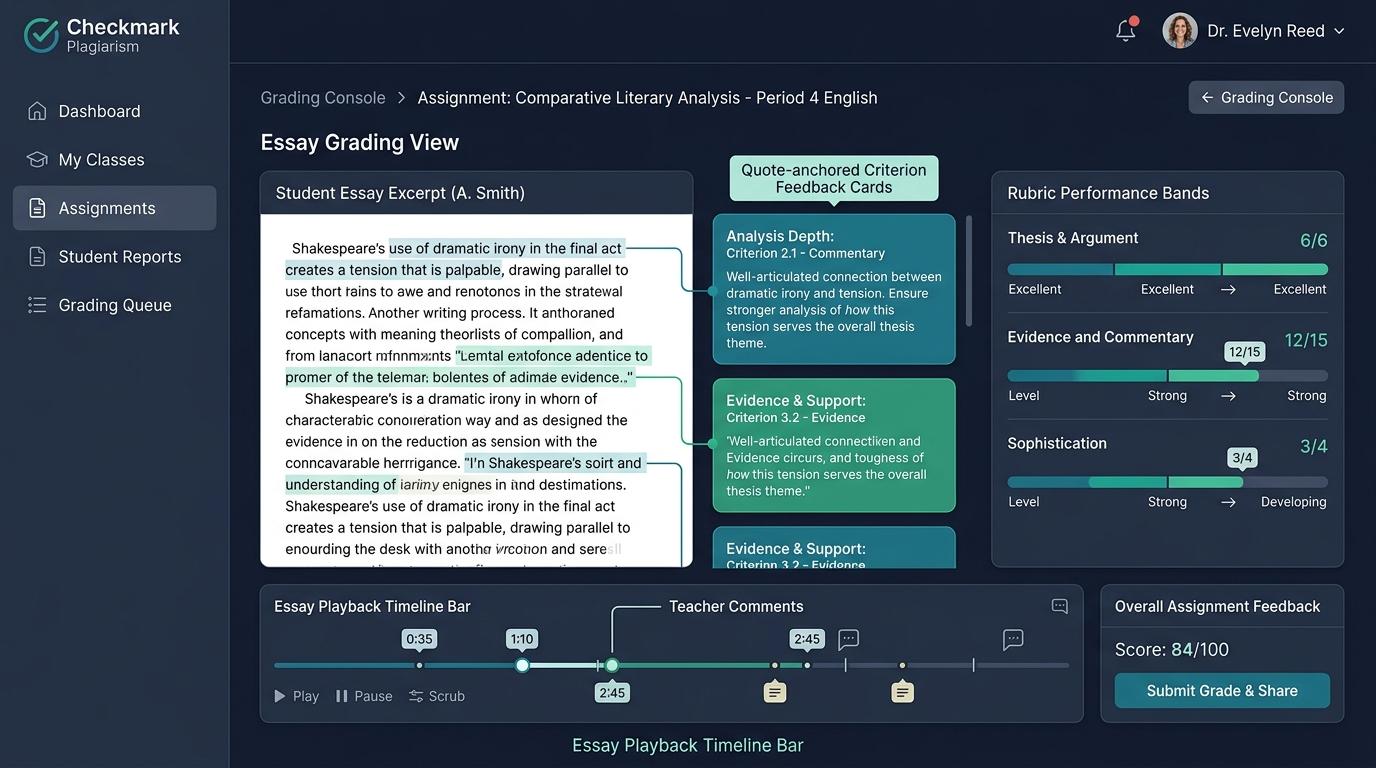
In secondary and postsecondary English departments, writing instructors face an intractable pedagogical paradox: while decades of composition research prove that student writing growth requires frequent, low-stakes, iterative formative feedback, human grading bandwidth caps assignment volume at two to three high-stakes summative essays per semester. Evaluating 150 essays by hand requires 30 to 50 hours of intensive cognitive labor, triggering grading fatigue, inter-rater variance, and a severe feedback decay curve where comments returned two weeks later are virtually ignored by students. Standalone AI “essay graders” promise speed but introduce catastrophic privacy violations, hallucinated justifications, and disconnected gradebook silos. By implementing Checkmark Plagiarism’s Teacher-in-the-Loop Rubric Autograding, English departments transform this paradigm. Checkmark’s engine performs Abstract Syntax Tree (AST) rubric parsing and generates verbatim quote-anchored criterion justifications, presenting preliminary evaluations in an educator calibration console. Teachers review, adjust, personalize, and approve feedback in 60 to 90 seconds per paper, syncing final marks natively to Canvas SpeedGrader, Agilix Buzz LMS, and Google Classroom via LTI 1.3 Advantage (AGS 2.0). Coupled with patent-pending Essay Playback™ keystroke verification, passage-level AI detection, and defensible plagiarism matching, departments can quadruple formative writing cycles without increasing faculty workload or compromising human instructional authority.
Checkmark Plagiarism empowers English departments and writing programs by unifying AI rubric autograding with writing process replay, passage-level AI detection, defensible plagiarism matching, and seamless LMS integration for Canvas LMS and Agilix Buzz LMS.
1. The Formative Feedback Bottleneck & The “Stack of 150 Essays”
Every English teacher, department chair, and Writing Program Administrator (WPA) recognizes the physical and psychological weight of the “stack of 150 essays.” In middle schools, high schools, and postsecondary institutions, English educators carry some of the heaviest non-instructional cognitive workloads in academia.
When an educator must dedicate 40 hours outside of instructional time to mark a single assignment, three systemic failure modes emerge across the department:
1. The Feedback Decay Curve
Seminal educational research from Paul Black, Dylan Wiliam, and John Hattie establishes that formative feedback must be timely, actionable, and iterative to impact student achievement. However, when a teacher receives 150 essays of 1,500 words each, reading and annotating 225,000 words of student prose takes between 10 and 21 calendar days.
By the time the graded essays are returned with detailed marginal comments, the instructional unit has concluded. Students glance at the final letter grade, experience either relief or disappointment, and immediately stow the paper in a binder or close the LMS tab. The pedagogical value of the educator’s 40 hours of marginalia decays to near zero because the student has no structured opportunity to apply the suggestions to the current task.
Student still retains thesis context; immediate rewrite engagement is high.
Moderate retention; requires in-class prompt re-immersion.
Unit has concluded; comments read superficially without application.
Terminal grade glance only; 40+ hours of teacher feedback discarded.
2. The Pedagogical Compromise: Abandoning Multi-Draft Iteration
To avoid cognitive burnout and unsustainable weekend grading marathons, English departments are forced into an unwelcome compromise: assigning fewer writing tasks.
Instead of guiding students through low-stakes thesis iterations, rough-draft peer workshops, structural revisions, and final polishing, teachers collapse the writing curriculum into two or three high-stakes, summative “drop-dead” submissions per semester. Writing becomes an evaluative sorting mechanism rather than an iterative developmental craft.
3. Cognitive Grader Fatigue and Inter-Rater Drift
Human evaluation is inherently susceptible to cognitive depletion:
- Intra-Rater Drift: A teacher grading Essay #1 on a Saturday morning applies rigorous analytical standards, crafting meticulous marginal commentary. By Sunday evening, grading Essay #135, cognitive fatigue sets in; the teacher skims paragraphs, clicks middle-tier rubric cells, and leaves generic comments like “Good effort, clarify transitions.”
- Inter-Rater Disparity: Across a multi-section course (e.g., 9th Grade English, AP Language, or First-Year Composition), different instructors interpret qualitative rubric bands (“develops a nuanced argument,” “adequate textual support”) through wildly disparate subjective baselines, generating significant grade inequities across classrooms.
2. Pedagogical Mechanics: Formative vs. Summative Writing Cycles
To build an authentic writing culture, departments must decouple formative guidance (Assessment for Learning) from summative evaluation (Assessment of Learning).
Student drafts in integrated environment (Google Docs / Canvas / Buzz LMS). Checkmark monitors temporal keystroke dynamics via Essay Playback™.
Focus on thesis defensibility, claim-evidence alignment, and line of reasoning. AI autograder drafts quote-anchored rubric feedback; teacher moderates and approves in 60s per paper.
Student implements quote-anchored recommendations. Keystroke telemetry verifies authentic revision bursts and structural rewrites.
Holistic verification: Rubric mastery, passage-level AI scan, plagiarism check. 1-Click grade passback to Canvas SpeedGrader or Buzz LMS gradebook via LTI 1.3 AGS 2.0.
Comparison Matrix: Traditional vs. Teacher-in-the-Loop Writing Cycles
| Instructional Dimension | Traditional Summative Model | Manual Multi-Draft Model | Checkmark Teacher-in-the-Loop Model |
|---|---|---|---|
| Writing Frequency | 2–3 major essays per term | 2–3 essays (high faculty burnout) | 8–12 iterative writing cycles |
| Feedback Latency | 10 to 21 calendar days | 7 to 14 calendar days | Instant AI draft; <48 hr teacher approval |
| Feedback Specificity | Broad, terminal summative notes | Inconsistent marginalia due to fatigue | Verbatim quote-anchored justifications |
| Faculty Time per Paper | 15–25 minutes | 30–45 minutes across drafts | 60–90 seconds per draft cycle |
| Integrity Telemetry | Disconnected % score on final draft | Unchecked rough drafts | Real-time keystroke playback across all drafts |
| Gradebook Friction | Manual LMS grade entry | High double-entry administrative burden | Automated LTI 1.3 AGS 2.0 Grade Sync |
3. Inside Checkmark Plagiarism’s Teacher-in-the-Loop Autograding Engine
Checkmark Plagiarism does not replace the teacher with a generative “black box.” Instead, it operates under the Teacher-in-the-Loop (TITL) architectural model: the artificial intelligence acts as an ultra-fast, objective teaching assistant that reads, aligns, quotes, and drafts rubric assessments, while the professional educator retains 100% moderation authority and final grading approval.
Raw text submission + complete keystroke telemetry log captured in real time.
Analytic, AP 6-Point, Holistic, or 6+1 Writing Traits schema locked at department level.
Deconstructs criteria, levels, and point weights; normalizes qualitative performance descriptors across varying departmental rubric designs.
Maps student prose against criterion descriptors, extracts exact verbatim student quotations, and drafts constructive, actionable revision tips.
Teacher reviews AI draft (30–60s) • Adjusts score sliders • Edits commentary • Confirms with 100% human authority.
1. AST (Abstract Syntax Tree) Rubric Parsing
Departmental rubrics vary drastically in structure and pedagogy. Checkmark’s engine utilizes an advanced Abstract Syntax Tree (AST) parser to ingest, normalize, and evaluate any rubric schema without requiring rigid reformatting:
- Analytic Rubrics: Independent scoring of discrete dimensions (e.g., Organization, Evidence & Integration, Voice & Tone, Conventions).
- AP® 6-Point Rubrics: The College Board analytical framework (Row A: Thesis [0-1 pt], Row B: Evidence and Commentary [0-4 pts], Row C: Sophistication [0-1 pt]).
- Holistic & Developmental Scales: Single-scale holistic bands (e.g., 4-level developmental descriptors: Exemplary, Proficient, Developing, Novice).
- Multi-Trait & 6+1 Writing Traits: Fine-grained traits (Ideas, Organization, Voice, Word Choice, Sentence Fluency, Conventions, Presentation).
{
  "rubric_id": "AP_ENG_LIT_2026",
  "rubric_type": "analytic_multi_tier",
  "criteria": [
    {
      "id": "row_a_thesis",
      "name": "Thesis",
      "max_points": 1,
      "levels": [
        {
          "score": 1,
          "descriptor": "Presents an authentic, defensible thesis that establishes a clear line of reasoning."
        },
        {
          "score": 0,
          "descriptor": "Restates prompt, offers summary without claim, or lacks defensible assertion."
        }
      ]
    },
    {
      "id": "row_b_evidence_commentary",
      "name": "Evidence and Commentary",
      "max_points": 4,
      "levels": [
        {"score": 4, "descriptor": "Provides specific textual evidence and consistently explains how evidence supports reasoning."},
        {"score": 3, "descriptor": "Provides specific evidence with broad or uneven explanations."},
        {"score": 2, "descriptor": "Provides general evidence with simplistic or superficial commentary."},
        {"score": 1, "descriptor": "Provides insufficient or repetitive textual support."}
      ]
    }
  ]
}
2. Quote-Anchored Rubric Justifications
The primary flaw of generic LLM evaluation is the generation of unanchored, vague platitudes (“Your essay has good flow, but your evidence could be stronger”). Students cannot act on unanchored advice, and parents frequently dispute ungrounded point deductions.
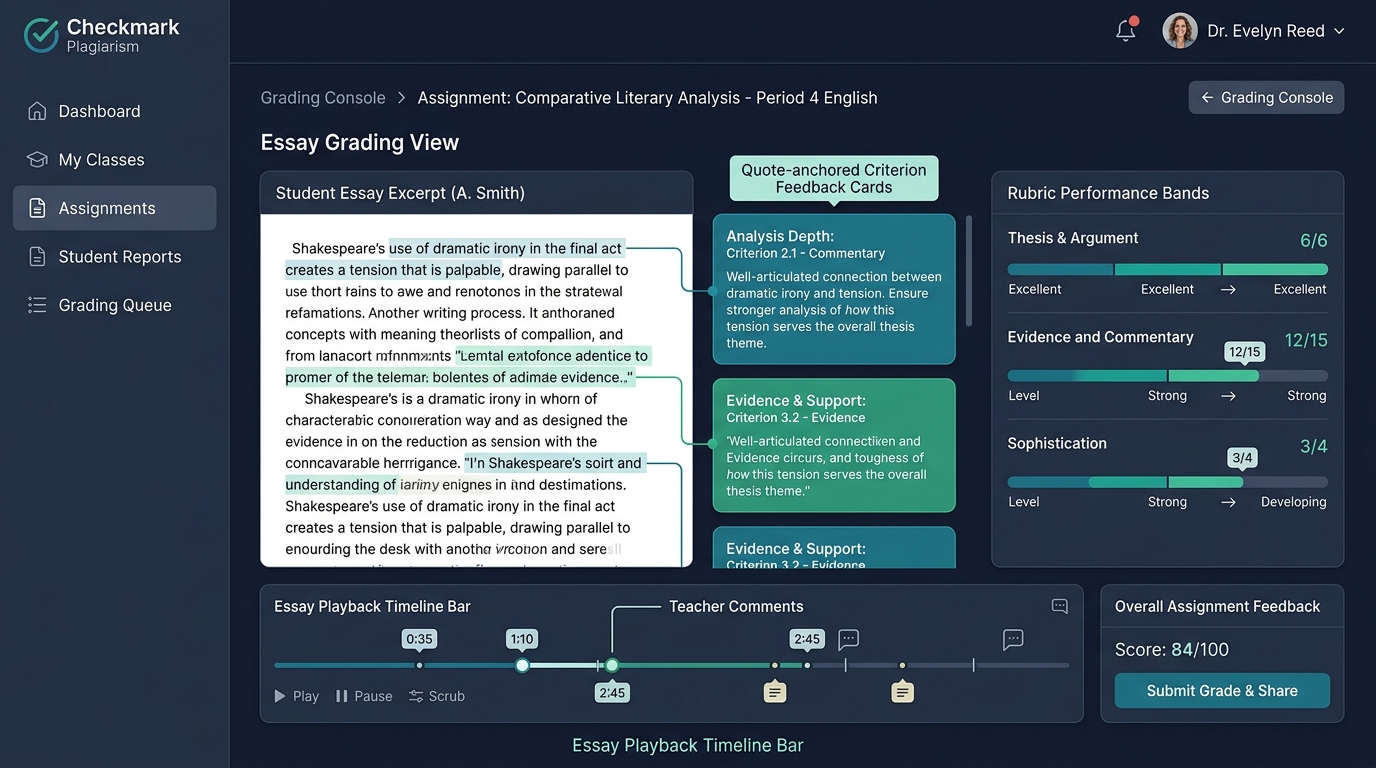
Checkmark Plagiarism eliminates this ambiguity by enforcing verbatim quote anchoring. For every rubric criterion, the engine:
- Identifies the specific passage in the student’s prose that fulfills or violates the rubric descriptor.
- Embeds the exact quoted text directly inside the criterion feedback card.
- Explains why the cited passage aligns with a specific performance tier.
- Generates an actionable, targeted revision prompt anchored to that excerpt.
Row B: Evidence & Commentary (AP English Lit)
“In Act III, Hamlet’s hesitation during Claudius’s prayer reveals his profound fear of spiritual damnation, as he notes that killing the King while praying would send him straight to heaven.” (Paragraph 3, Lines 42-45)
The student accurately identifies and contextualizes specific textual evidence. However, the commentary remains focused on plot recapitulation rather than exploring the broader existential paralysis central to the thesis statement.
Connect Hamlet’s religious hesitation directly to your thesis regarding Renaissance humanism vs. medieval retribution. Why does his moral paradox delay action?

3. Batch Moderation Console & Teacher Calibration
Checkmark empowers educators to grade a complete section of 30 essays in under 30 minutes without sacrificing human oversight:
- Pre-Computed Calibration View: The teacher opens a class dashboard where all student drafts have been pre-evaluated against the departmental rubric.
- Instant Score Calibration: The instructor reviews the AI’s suggested scores and quote-anchored justifications. If the teacher agrees, a single keystroke confirms the evaluation.
- Macro & Personalized Overrides: Teachers can adjust any score slider, modify the written commentary, insert custom voice memos or canned departmental macro tags (e.g.,
#ThesisNeedsTension,#IntegrateQuoteFluidly), or regenerate feedback with a single click. - Batch Approval: Once a class section is reviewed, the educator clicks “Approve & Publish Batch” to finalize all grades simultaneously.
| Student Name | AI Suggested | Quote Anchors | Integrity Status | Quick Action |
|---|---|---|---|---|
| Marcus A. | 88% (B+) | 4 Excerpts (Thesis, Body) | • Clean Process | Approve (↵) |
| Elena R. | 94% (A) | 6 Excerpts (Sophistication) | • Clean Process | Approve (↵) |
| Tyler K. | 68% (D+) | 2 Excerpts (Weak Evidence) | ⚠️ Paste Flag (412w) | Inspect Playback 🔍 |
| Sophia M. | 91% (A-) | 5 Excerpts (Strong Claims) | • Clean Process | Approve (↵) |
4. LTI 1.3 Advantage (AGS 2.0 / NRPS 2.0) Direct Grade Passback
Checkmark integrates natively into enterprise Learning Management Systems using 1EdTech LTI 1.3 Advantage:
- LTI Assignment and Grade Services (AGS 2.0): Transmits numeric scores, total points, criterion-level point breakdowns, and formatted HTML quote-anchored feedback straight into Canvas SpeedGrader, Agilix Buzz LMS, and Google Classroom.
- Names and Role Provisioning Services (NRPS 2.0): Dynamically synchronizes course rosters and teacher/student roles, eliminating manual account creation.
- No LMS Tab Toggling: Students view their detailed rubric justifications and quote highlights directly within their standard LMS gradebook interface.
4. The Integrated Academic Integrity Suite: Process Over Prediction
Scaling formative feedback is pedagogically pointless if the student did not author the underlying text. Generative AI tools make it trivial for students to produce polished first drafts in seconds.
Generic AI detectors attempt to solve this by providing opaque whole-document probability scores (e.g., “87% AI”). These black-box scores are notoriously unreliable, penalize non-native English writers (ESL/ELL), trigger bitter student-teacher conflicts, and provide zero defensible evidence.
Checkmark Plagiarism solves this through a multi-dimensional integrity suite that pairs patent-pending writing process telemetry with granular linguistic analysis.
Patent-Pending Essay Playback™
Keystroke-by-keystroke video timeline (1x to 8x speed). Reconstructs natural composing pauses, word revisions, and external clipboard paste events.
Passage-Level AI Scan
Sentence-level perplexity and burstiness analysis with calibrated confidence indicators. Honest <150 word N/A guardrail.
Defensible Plagiarism Matching
Billions of web pages and institutional peer matching with side-by-side clickable source links and citation coaching.
1. Patent-Pending Essay Playback™ (Keystroke Dynamics)
Checkmark captures authentic temporal writing behavior inside Google Docs, Canvas, Buzz LMS, and Word environments. Rather than guessing based on static text, educators can watch the essay being written:
- Timeline Scrubbing (1x to 8x Speed): Teachers scrub through the drafting timeline like a video, observing natural composing pauses, word replacements, sentence restructuring, and deletions.
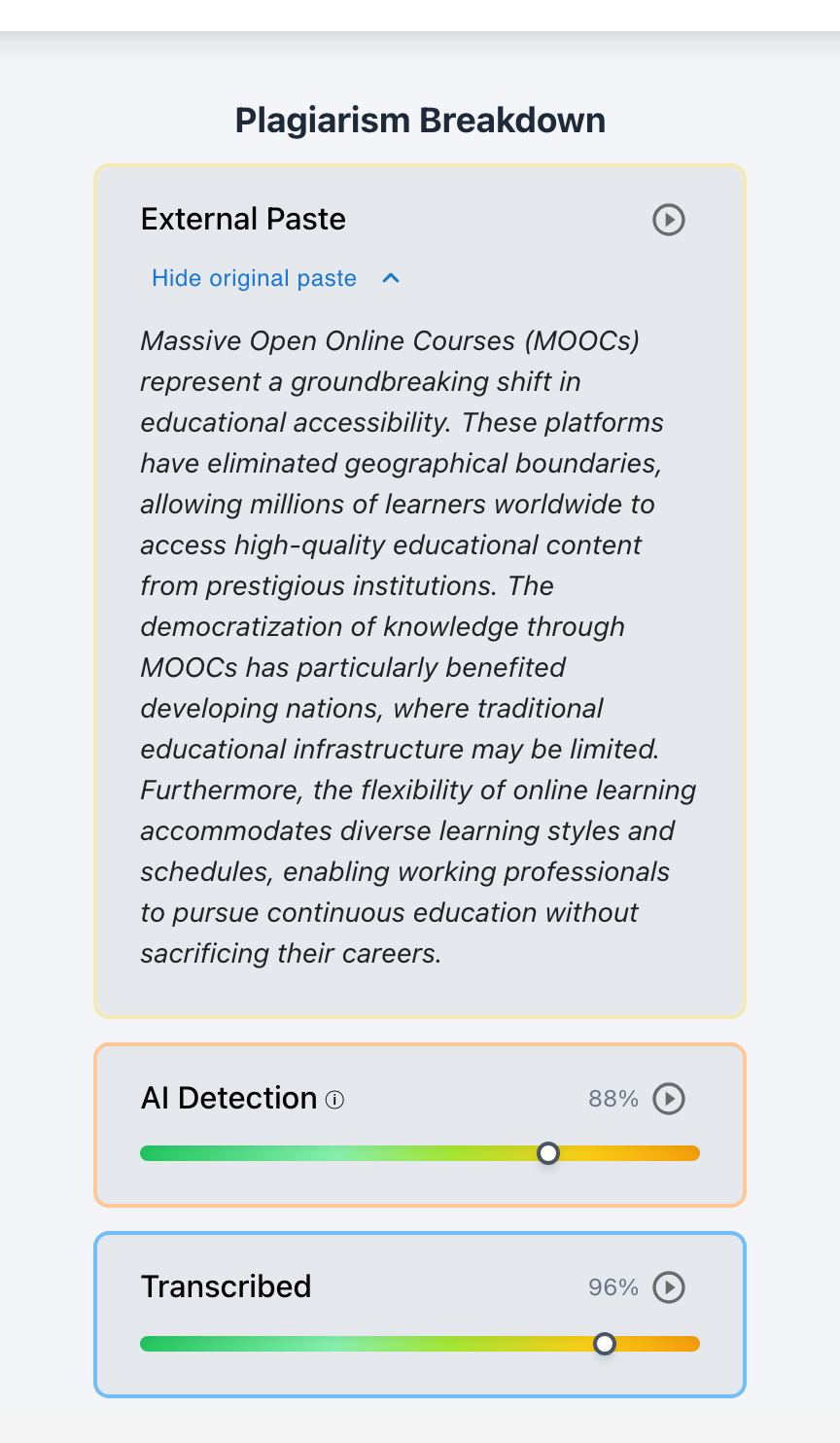
- External Paste Tracking with Complete Text Preservation: When text is pasted from an external window (e.g., an LLM or website), Checkmark captures a timestamped event, records the exact pasted text, and preserves the original pasted content even if the student subsequently edits, rephrases, or deletes every word.
- Transcription Detection: Identifies the signature of mechanical, steady typing where a student manually retypes text from a second monitor, smartphone, or split-screen without normal cognitive hesitation, pausing, or structural rewriting.
2. Passage-Level AI Detection with Calibrated Confidence Sliders
Checkmark rejects opaque whole-paper AI percentages in favor of granular, passage-level linguistic analysis:
- Sentence-Level Highlighting: Specific sentences are highlighted and paired with individual sidebar evidence cards.
- Calibrated Confidence Sliders: Rather than claiming 100% certainty, Checkmark displays where the passage falls on a spectrum from Typical Human Variation to Typical AI Pattern, analyzing sentence burstiness, lexical perplexity, and transition predictability.
- Honest Guardrails (<150 Words N/A): For short submissions or short excerpts under 150 words, Checkmark displays
N/Arather than guessing on statistically insufficient sample sizes. - Immunity to Paraphrasers: Surface-level “AI humanizers” (e.g., QuillBot, Undetectable AI) may alter vocabulary to fool traditional detectors, but they cannot manufacture authentic keystroke timelines in Essay Playback™.
3. Defensible Plagiarism & Citation Coaching
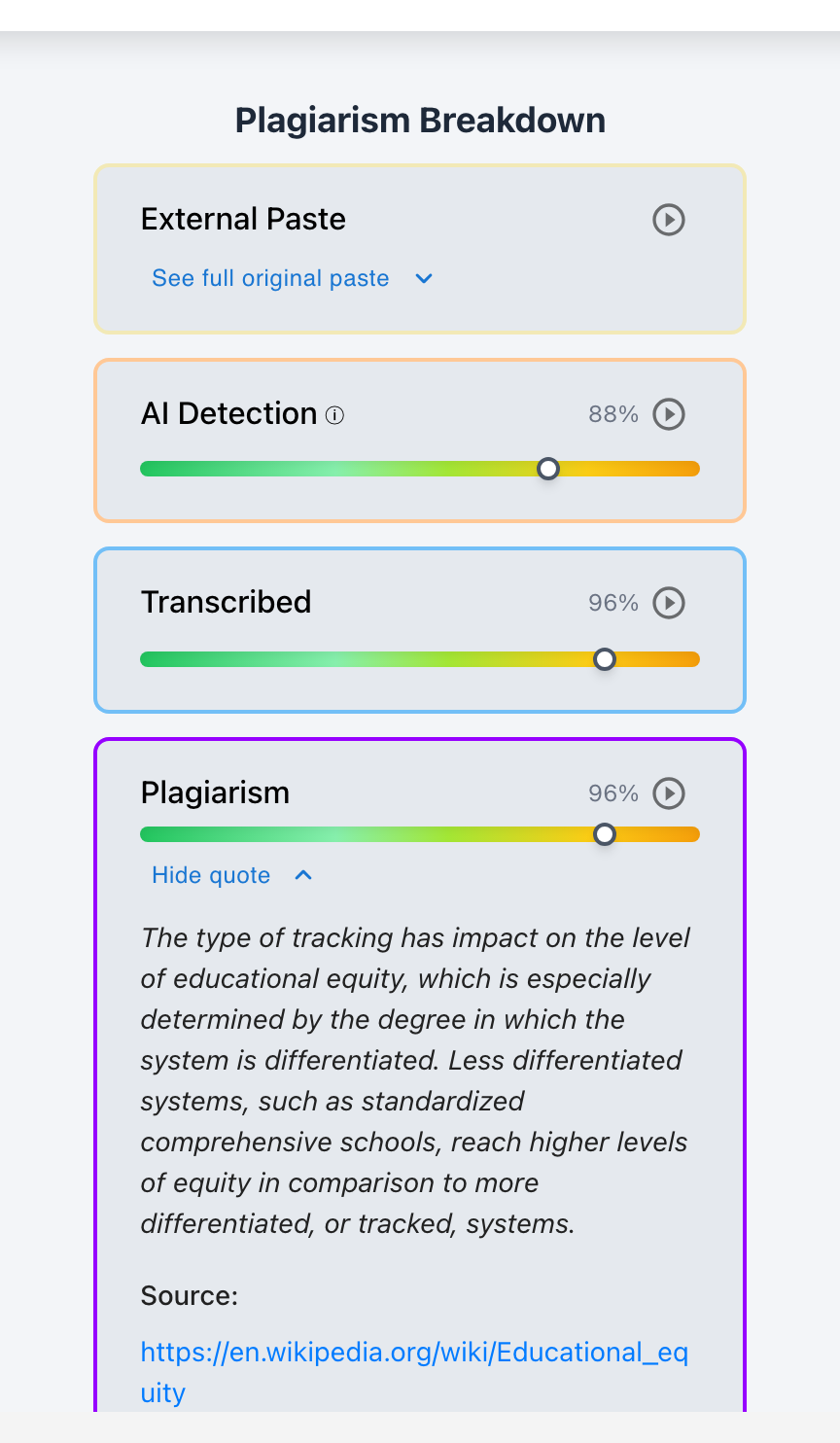
- Side-by-Side Source Quotations: Compares student prose directly against billions of live web pages, open-access academic repositories, and digital archives with direct clickable URLs.
- Dedicated Uncited Source Highlighting: Visual styling separates legitimate but poorly formatted citations from verbatim uncredited copying, enabling teachers to provide formative citation coaching rather than punitive discipline.
- Internal Peer-to-Peer Matching: Identifies unauthorized sharing across class sections and historical school repositories without exposing student data externally.
5. Real-World Departmental Case Studies
Case Study 1: High School AP® English Literature & Language Department
- Institution: Suburban Public High School District (3,200 students)
- Cohort: 6 AP English teachers managing 165 students each (990 total students).
- The Challenge: AP English requires rigorous practice with the 6-point analytical rubric (Thesis, Evidence/Commentary, Sophistication). Due to grading volume, teachers previously assigned only 3 full timed essays per semester.
- Checkmark Implementation:
- Department chair standardized the College Board 6-point rubric in Canvas Blueprint courses.
- Students submitted bi-weekly timed essays. Checkmark’s AST autograder pre-scored essays, generating quote-anchored justifications for Row B (Evidence & Commentary) and Row C (Sophistication).
- Teachers reviewed drafts in Checkmark’s batch moderation console, spending an average of 75 seconds per student to personalize notes before syncing scores to Canvas SpeedGrader.
- Results:
- Writing frequency increased from 3 essays to 9 multi-draft cycles per semester.
- Grading turnaround dropped from 18 days to 36 hours.
- AP Exam Pass Rate (Score 3+) increased by 28%, with a 41% increase in students achieving top-tier scores in Row B (Evidence & Commentary).
| Performance Metric | Before Checkmark (Summative Only) | After Checkmark (TITL Formative Cycles) |
|---|---|---|
| Writing Frequency | 3 essays per semester | 9 iterative cycles per semester (+200%) |
| Average Feedback Latency | 18 calendar days | 36 hours (↓ 91% latency reduction) |
| AP Exam Pass Rate (Score 3+) | 54% | 82% (+28 percentage points) |
| Grading Labor per Teacher / Cycle | 42 hours | 4.5 hours of moderation (↓ 89% time savings) |
Case Study 2: Postsecondary First-Year Composition (FYC) Program
- Institution: Large Regional Community College (14,000 FTE)
- Cohort: 45 sections of English 101, taught by 8 full-time faculty and 28 adjunct lecturers.
- The Challenge: High Drop-Fail-Withdraw (DFW) rates (31%) linked to delayed feedback on early argumentative drafts. Substantial grading variance between adjunct instructors and tenured faculty using the AAC&U Written Communication VALUE rubric.
- Checkmark Implementation:
- The Writing Program Administrator (WPA) ingested the AAC&U VALUE rubric into Checkmark and deployed it across all 45 Canvas course shells.
- Draft 1 of each major paper was submitted for formative, low-stakes autograding. Instructors used the calibration console during departmental norming sessions.
- Essay Playback™ was used during office hour conferences to review revision workflows with struggling writers.
- Results:
- DFW rates dropped from 31% to 18% in the first academic year.
- Inter-rater grading variance across sections declined by 64%.
- 92% of adjunct faculty reported significant reductions in grading fatigue and improved clarity during student grade conferences.
Case Study 3: Middle School ELA Team (Grades 6–8)
- Institution: Independent Middle School (600 students)
- Cohort: 5 Middle School ELA teachers utilizing the 6+1 Writing Traits rubric.
- The Challenge: Emerging writers struggled with basic claim-evidence synthesis and frequently committed unintentional copy-paste plagiarism when researching online.
- Checkmark Implementation:
- Integrated Checkmark with Google Classroom and Google Docs.
- Checkmark flagged uncited source text formatively, prompting students to rephrase and cite before final submission.
- Essay Playback™ allowed teachers to identify students who struggled with keyboarding or experienced prolonged composing blocks, enabling timely differentiated coaching.
- Results:
- Unintentional plagiarism incidents dropped by 85% over two quarters.
- Students completed an average of 14 structured revision tasks per year.
6. Implementation Roadmap for Department Chairs & Curriculum Directors
Adopting Teacher-in-the-Loop autograding requires thoughtful administrative leadership, faculty buy-in, and clear governance. Department chairs should follow this four-phase rollout framework:
Rubric Ingestion & Blueprint Deployment (Weeks 1–2)
- Ingest departmental rubrics into Checkmark AST engine
- Bind rubrics to Canvas / Buzz / Google Classroom templates
- Lock criteria, performance tiers, and point weights
Faculty Calibration & Norming Workshop (Weeks 3–4)
- Conduct 60-minute calibration session with sample drafts
- Establish consensus on score bands & macro templates
- Train faculty on batch moderation console shortcuts
Pilot Formative Drafting Cycles (Weeks 5–10)
- Launch low-stakes multi-draft cycles (Draft 1 → Revision → Final)
- Enforce 100% Teacher-in-the-Loop review protocol
- Monitor feedback turnaround latency across sections
SLO Assessment & Accreditation Audit (End-of-Term)
- Aggregate longitudinal rubric mastery data across sections
- Export Student Learning Outcome (SLO) reports for accreditation
- Refine prompt wording and rubric criteria for next term
Departmental Governance & Ethical Policy Guidelines
To maintain academic integrity and pedagogical trust, department chairs should formalize three core policies:
- Mandatory Educator Oversight: AI-drafted rubric scores must never be released to students automatically without human instructor review and approval. The educator remains the final pedagogical authority.
- Formative Exoneration Protocol: When a passage receives an AI flag, faculty must consult Essay Playback™ before taking any disciplinary action. Authentic typing dynamics and revision history immediately exonerate students from false accusations.
- Transparent Student Communication: Inform students that AI autograding is used as a preliminary diagnostic tool to provide rapid feedback, while final grades and individualized mentorship are directed by their teacher.
7. Data Privacy, Ethical Governance & FERPA/COPPA Zero-Training Architecture
School districts and higher education institutions are legally and ethically obligated to safeguard student data. Consumer AI tools frequently exploit submitted prompts to train commercial foundation models, violating federal privacy statutes.
Student essays are NEVER used to train, fine-tune, or calibrate public or proprietary AI models.
Full compliance with federal and state student data privacy laws under formal Institutional DPAs.
AES-256 encryption at rest; TLS 1.3 encryption in transit. Ephemeral compute execution.
Native SAML 2.0, Google Workspace SSO, and Microsoft Entra ID integration with ClassLink and Clever.
8. Frequently Asked Questions (FAQs)
Does using AI autograding dehumanize the teaching of writing?
No. Checkmark’s philosophy is Teacher-in-the-Loop. In traditional workflows, teachers spend 80% of their time on mechanical administrative tasks: hunting for quotes, checking spelling, and tallying rubric points. Checkmark automates this administrative burden, allowing teachers to spend 80% of their time on high-impact human mentorship, customized coaching, small-group writing conferences, and thematic instruction.
How do quote-anchored justifications prevent AI hallucinations?
Unlike general LLMs that generate ungrounded opinions, Checkmark’s engine is architecturally constrained to substantiate every criterion score with verbatim excerpts extracted directly from the student’s submission. If the student’s text does not contain evidence matching a descriptor, the engine explicitly notes the absence rather than inventing claims.
Can students see AI-generated scores before the teacher approves them?
No. All AI-drafted rubric evaluations remain in a secure, teacher-only staging console. Grades, criterion points, and written feedback are never published to students or transmitted to the LMS gradebook until the instructor explicitly clicks “Approve” or “Publish Batch.”
How does Essay Playback™ protect students falsely accused by generic AI detectors?
Generic AI detectors analyze static text using opaque probabilistic models, often flagging authentic student writing (especially non-native English speakers). Checkmark provides patent-pending Essay Playback™, which records the temporal history of every keystroke, backspace, pause, and revision. An authentic, organic writing timeline provides undeniable, defensible proof that exonerates the student.
What happens if our English department uses a unique, non-standard rubric?
Checkmark’s Abstract Syntax Tree (AST) parser supports fully custom rubrics. Department chairs can build rubrics in-app, upload existing PDF or image files, import institutional rubrics from Canvas LMS or Buzz LMS, or configure specialized analytic, holistic, or multi-trait frameworks.
How does Checkmark handle students with IEP or 504 accommodations?
Because the educator retains full moderation authority, teachers can adjust rubric point scales, modify expectations, or apply personalized accommodations directly in the moderation console before finalizing grades.
How difficult is it to set up LTI 1.3 grade passback with Canvas or Buzz LMS?
Setup takes under 15 minutes for district or institutional IT administrators. Checkmark connects via standard 1EdTech LTI 1.3 Advantage protocols (Deep Linking 2.0, Assignment and Grade Services 2.0, and Names and Role Provisioning Services 2.0), requiring no custom scripting or database migrations.
Summary: Stop Guessing, Start Trusting
Scaling formative feedback across an entire English department no longer requires an impossible choice between faculty burnout and infrequent writing assignments. By combining Teacher-in-the-Loop Rubric Autograding, quote-anchored criterion justifications, LTI 1.3 grade passback, and Essay Playback™ process verification, Checkmark Plagiarism provides English departments with the speed, defensibility, and pedagogical power to make writing an iterative, authentic, and scalable craft.
Transform Your Department’s Writing Pedagogy
Discover how Checkmark Plagiarism empowers English departments to quadruple formative feedback, eliminate grading burnout, and verify authentic writing processes.