
Few administrative duties carry higher emotional voltage or procedural risk for English Department Chairs, ELA Instructional Leads, and Assistant Principals than the disputed AI plagiarism parent conference. When a classroom teacher assigns a failing grade or files an academic dishonesty report based solely on an opaque commercial AI score (e.g., “78% AI Generated”), the administrative conference almost invariably deteriorates into an adversarial standoff. Distressed parents—who often personally witnessed their child spending hours researching and drafting at the kitchen table—rightfully reject black-box statistical percentages, while threatened grade disputes escalate into superintendents’ offices, formal board appeals, or legal challenges alleging due process violations under the Fourteenth Amendment and FERPA (34 CFR Part 99 § 99.10).
The fundamental root of this institutional breakdown is an evidentiary mismatch: probabilistic AI classifiers output a speculative mathematical guess, whereas academic adjudication demands transparent, reproducible empirical proof. Checkmark Plagiarism resolves this high-stakes administrative dilemma through its Restorative Parent Conference Architecture. By anchoring discussions in patent-pending Essay Playback™ keystroke telemetry, immutable external paste buffer records, granular passage-level linguistic distributions with calibrated confidence sliders, and side-by-side plagiarism matching, department chairs can shift the room from accusatory interrogation to collaborative forensic review. This guide provides department chairs and instructional leaders with the legal framework, behavioral telemetry mechanics, real-world case studies, a 4-phase restorative conference protocol, and verbatim de-escalation dialogue models necessary to defend honest students, address authentic misconduct with pedagogical dignity, and preserve school-community trust.
Checkmark Plagiarism equips English Department Chairs, Secondary Instructional Leads, and K–12 Administrators with writing process replay telemetry and seamless LMS integrations across Canvas LMS, Agilix Buzz, and Google Classroom.
1. The High-Stakes Administrative Crisis: Anatomy of the Disputed AI Allegation
Across middle schools, high schools, and preparatory academies nationwide, English Department Chairs have become the frontline arbiters of an explosive technological crisis. Generative AI tools have inundated secondary education, but the tools purchased by districts to detect them have introduced a profound administrative vulnerability: the unprovable, high-stakes accusation of authorship fraud.
- Chair presents static 78% printout
- Parents demand: “Show us which words are AI!”
- Teacher cannot produce primary sources or logs
- Attorney cites Due Process / FERPA violations
- OUTCOME: Broken trust, formal grievance, district liability, demoralized staff
- Chair opens Checkmark Multi-Evidence Dossier
- Group watches 1x–8x Essay Playback™ of live drafting
- Clipboard Inspector verifies 100% of pasted quotes
- Passage sliders show authentic cognitive progression
- OUTCOME: Empirical clarity, student agency, repaired trust, and restorative growth
When an English teacher notices that an honors student’s prose sounds unusually sophisticated or when a commercial classifier flags a paper with a high percentage, the teacher often feels obligated to uphold departmental standards. However, when that teacher enters a zero in Canvas LMS or Buzz LMS and informs parents of an academic integrity violation based solely on that percentage, the department chair inherits a procedural nightmare.
To effectively de-escalate these meetings, department leaders must understand why traditional AI-flagged parent conferences break down along three distinct fault lines:
1. The Failure of Probabilistic Classifiers in High-Stakes Meetings
Commercial AI detectors do not detect copying; they calculate statistical probability. They scan an essay’s text and compute mathematical indicators:
- Perplexity: The measure of how expected or predictable each sequential word is to a language model.
- Burstiness: The variation in sentence length, rhythm, and structural complexity across the document.
Because Large Language Models (LLMs) generate text by calculating mathematically optimal next-token distributions, their output tends to exhibit uniform perplexity and low burstiness. However, human writers who are highly disciplined, students adhering strictly to standardized five-paragraph templates, non-native English speakers (ESL/ELL), and neurodivergent students naturally produce prose that matches these exact statistical characteristics.
When a department chair sits at a conference table and places a sheet of paper showing “78% AI Detected” in front of parents, the chair has presented a mathematical hypothesis, not factual evidence:
- The chair cannot explain why sentence 14 was flagged while sentence 15 was not.
- The detector cannot produce a matching primary source or URL.
- The algorithm cannot differentiate between a student using Grammarly for comma placement, consulting an AI for an outline, or having an LLM write the entire essay.
Faced with an opaque, unexplainable number that threatens their child’s GPA, class rank, and college admissions, parents react with understandable fury, defensiveness, and procedural skepticism.
2. The “Kitchen Table” Paradox: The Parent’s Lived Reality
The most common and distressing dynamic in an AI dispute involves the parent who actively witnessed the writing process.
In this scenario, the teacher and the parent are operating in two completely incompatible realities:
- The Teacher’s Reality: A digital tool with institutional branding has declared with “high confidence” that the essay was artificially generated.
- The Parent’s Reality: Direct, empirical observation of their child’s physical effort and emotional labor over six consecutive hours.
When the school offers no evidentiary middle ground between a black-box machine score and the parent’s lived experience, the meeting collapses into an unresolvable battle of credibility. The student feels falsely persecuted, the teacher feels undermined, and the department chair is caught in an administrative deadlock.
3. The Legal and Procedural Due Process Standard
When parent conferences escalate beyond the classroom level, they quickly intersect with state education codes, district school board policies, and federal administrative law. Department chairs must recognize that student discipline based on unprovable algorithmic scores carries severe legal and regulatory liabilities:
- Supreme Court Precedent: Goss v. Lopez, 419 U.S. 565 (1975).
- Legal Requirement: Students possess protected property and liberty interests in their education, academic standing, and permanent records. Academic sanctions (zeroes, suspension, removal from honors/AP courses) cannot be imposed arbitrarily without notice and a fair opportunity to review unredacted, verifiable primary evidence.
- Application: An unexplainable black-box AI score fails the evidentiary threshold of “substantial and credible evidence” required to sustain a punitive disciplinary sanction.
- Statutory Requirement: Parents and eligible students possess an absolute federal right to inspect and review all education records, including digital audit trails, investigative notes, and algorithmic logs used to make disciplinary or grading determinations.
- Application: If a school uses a proprietary AI detector whose vendor refuses to disclose the specific feature weights or forensic data behind a flag, the district cannot fulfill its statutory FERPA disclosure obligations, exposing the school to civil liability.
- Legal Doctrine: Express and implied contract governed by published Student/Parent Handbooks.
- Application: Handbooks guaranteeing “fundamental fairness” and “evidence-based adjudication” are breached when discipline relies on proprietary statistical classifiers without factual corroboration, leading to successful tuition refund claims and defamatory record challenges.
When parents arrive at a conference accompanied by retained legal counsel or an educational advocate, the attorney will immediately probe the school’s evidentiary chain of custody:
- “What is the false-positive rate of this software for non-native English speakers or AP-level writers?”
- “Can the school produce the exact prompt, session log, or external text repository showing where this text originated?”
- “Where in the district policy is a probabilistic machine score defined as conclusive proof of academic fraud?”
If the department chair has nothing to offer except a commercial AI percentage printout, the school is forced to retreat, retract the grade penalty, and endure significant reputational damage.
2. The Evidentiary Divide: Probabilistic AI Scores vs. Behavioral Writing Telemetry
To resolve these confrontations definitively, English Department Chairs must replace probabilistic guessing with behavioral writing telemetry.
The following comparison illustrates why traditional AI detection percentages fail in parent conferences while multi-dimensional process evidence builds immediate consensus:
| Evaluation Dimension | Commercial AI Classifiers (Turnitin, GPTZero, CopyLeaks) | Checkmark Plagiarism Multi-Evidence Architecture |
|---|---|---|
| Primary Data Source | Surface-level text snapshot (static string of submitted words) | Complete temporal drafting telemetry (keystroke-by-keystroke event stream) |
| Core Metric | Statistical token probability (Perplexity & Burstiness distribution) | Behavioral composition dynamics (Inter-Key Intervals, typing cadence, revisions) |
| Evidentiary Standard | Probabilistic Guess: “This text resembles patterns seen in LLMs.” | Empirical Record: “Here is the exact video replay of how this sentence was written.” |
| Parent Conference Impact | Generates instant defensiveness, skepticism, and adversarial confrontation | Invites collaborative review; parents and student observe physical writing history |
| Clipboard Transparency | Completely blind to paste events; cannot distinguish note pastes from AI generation | External Paste Buffer Inspector: Preserves 100% of clipboard text, timestamp, & count |
| Vulnerability to Paraphrasers | Easily bypassed by QuillBot, Undetectable AI, or manual word-swapping | Immune: AI humanizers cannot fabricate authentic temporal typing cadence and pauses |
| Granularity & Guardrails | Opaque document-wide score; prone to false positives on short passages | Passage-level calibrated confidence sliders; <150w short-text honest N/A guardrails |
| Legal Defensibility | Low; vulnerable under FERPA § 99.10 and Fourteenth Amendment Due Process | High; unassailable primary source forensic dossier meeting administrative due process |
| Pedagogical Outcome | Punitive zero, broken student-teacher relationship, administrative grievance | Formative insight, targeted writing coaching, and restorative revision pathway |
Why Keystroke Telemetry Defeats “AI Humanizers” and False Accusations
When students attempt to evade legacy AI detectors, they frequently use “AI Humanizers” or paraphrasing engines (such as Undetectable AI, QuillBot, or HideMyAI). These tools introduce intentional syntactic noise, irregular punctuation, and synonym substitutions to artificially inflate perplexity and burstiness. Legacy detectors are baffled by these manipulations, either missing the AI generation entirely or flagging innocent sentences around them.
However, temporal keystroke dynamics cannot be faked. A student who generates an essay with an AI humanizer must still transfer that text into their document. When they do so:
- The Mass Paste: The text arrives in a single 1,200-word burst at 0.0 seconds, captured permanently by the External Paste Buffer Inspector.
- The Mechanical Transcription: If the student attempts to retype the humanized text from a second monitor or phone, they exhibit an unnatural, metronomic typing cadence (40–60 WPM without cognitive pausing, zero sentence restructuring, and no thematic drafting pauses).
Conversely, an honest student who is falsely flagged by a generic AI detector has an undeniable digital fingerprint: dozens of Inter-Key Interval (IKI) pauses where they paused to think, frequent backspaces to fix word choices, restructuring of topic sentences, and hours of organic document evolution.
3. Checkmark Plagiarism’s Restorative Parent Conference Architecture
Checkmark Plagiarism transforms the parent conference from an adversarial interrogation into a transparent, supportive, and objective consultation through its 4-Pillar Multi-Evidence Suite:
- Captures 100% of clipboard text at the millisecond
- Retains raw original text even if edited later
- Direct “Jump-to-Playback” timeline synchronization
- Differentiates quotes from AI preambles
- Passage-level confidence sliders (Human vs. AI)
- Short-text honest guardrail (returns N/A below 150w)
- Dual-pane side-by-side web & peer plagiarism matching
- Educator-only flag statuses for private review
- Formative criterion scoring synced with Canvas/Buzz
- Quote-anchored justifications grounded in student prose
- Full teacher override power for all grades
- Objective rubrics defend grading decisions
Pillar 1: Patent-Pending Essay Playback™
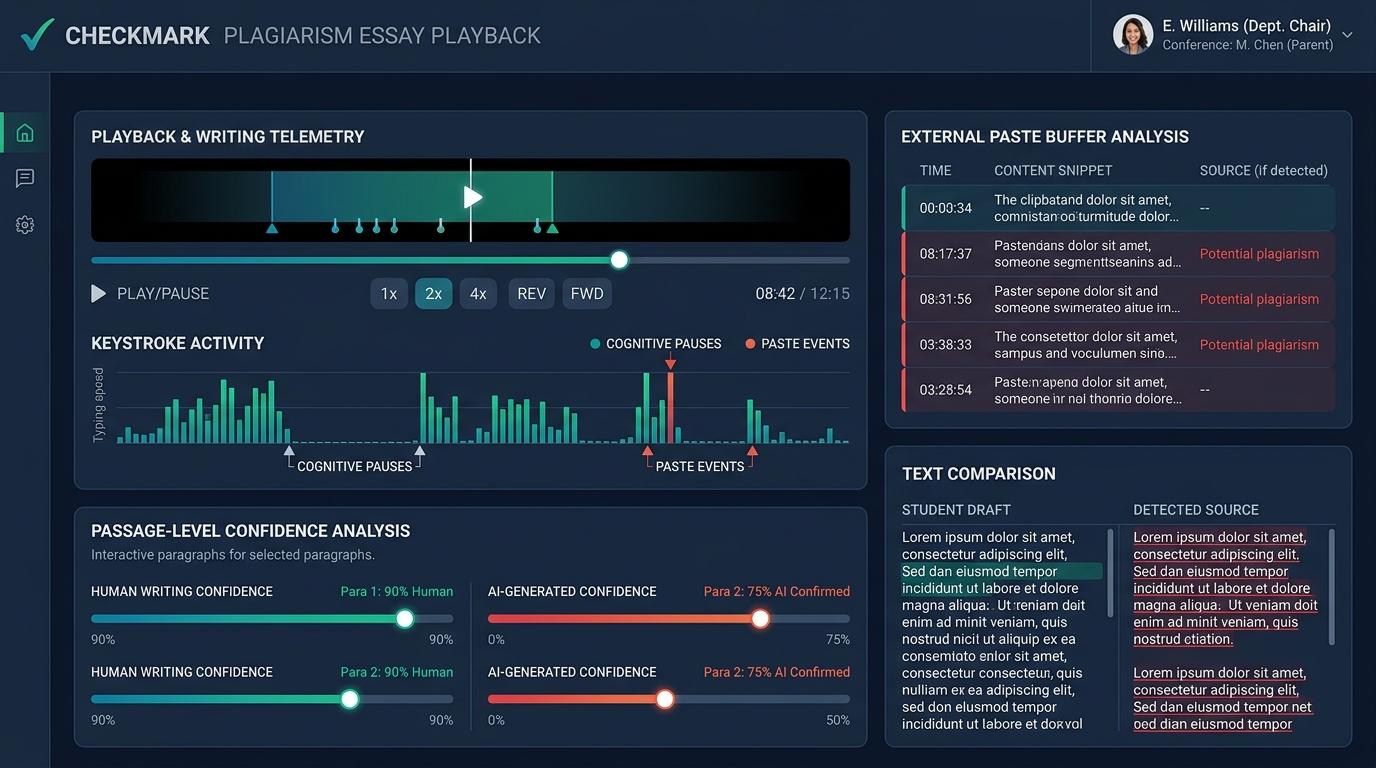
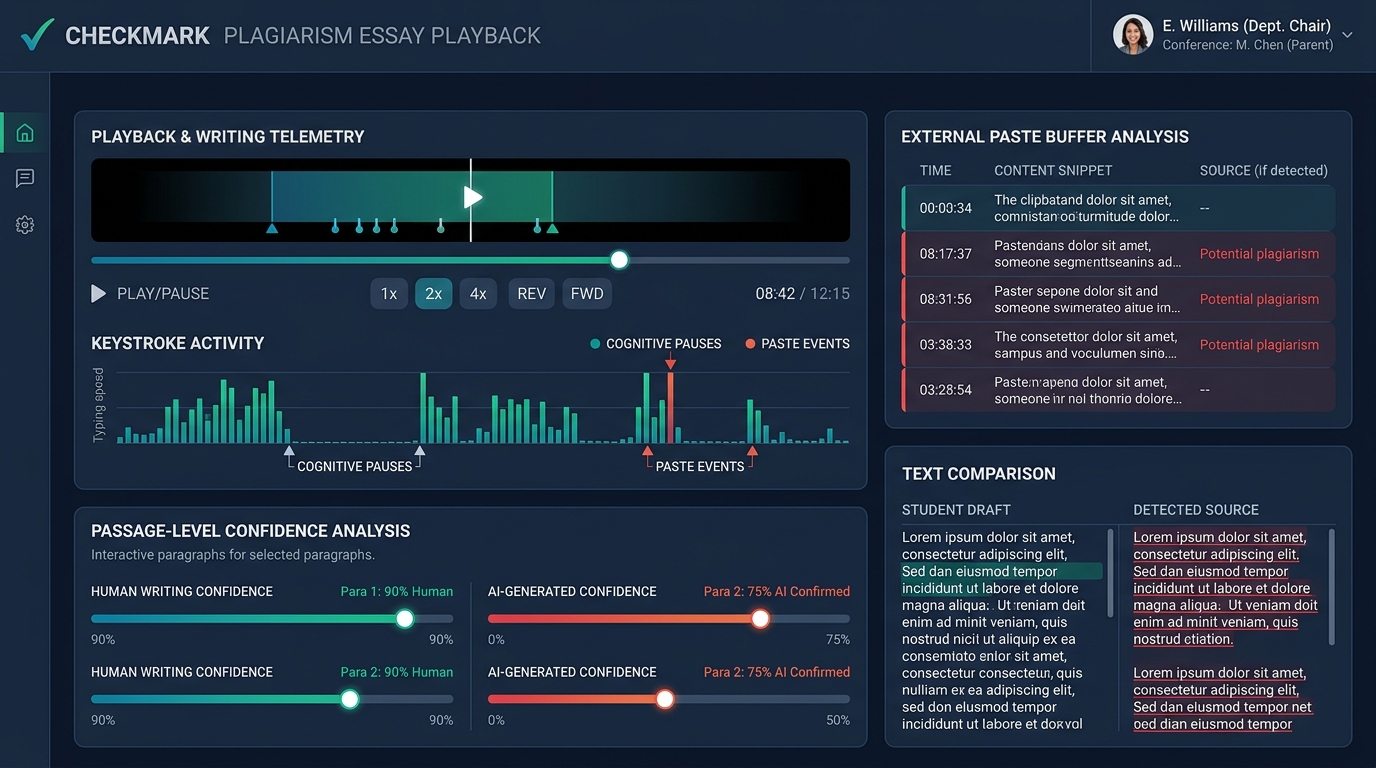
The centerpiece of any restorative conference is Essay Playback™. Built directly into Checkmark’s platform, Essay Playback™ captures the continuous event-stream of the student’s writing session and renders it as an interactive, scrubbable video timeline.
During a parent conference, the department chair does not argue over opinions; the chair simply projects the Essay Playback™ interface on a conference screen:
- Scrubbable Speed Controls (1x to 8x): The chair, teacher, parents, and student can watch the essay assemble itself in real time or accelerate through long drafting periods.
- Cognitive Pause Identification: Authentic writing is characterized by bursts of drafting (typing a clause at 25–45 WPM) followed by distinct pauses (3 to 12 seconds) where the writer pauses to formulate ideas, check source notes, or choose vocabulary.
- Organic Revision Patterns: The replay highlights where the student deleted an awkward opening paragraph, rearranged sentences between body paragraphs, or reworded their thesis statement three times before settling on a final version.
- Definitive Exoneration: For the falsely accused student, watching their authentic 4-hour writing struggle play out on screen provides instantaneous, emotionally validating proof that dismisses the false AI accusation within minutes.
Pillar 2: The Immutable External Paste Buffer Inspector
One of the greatest sources of confusion in plagiarism disputes is the copy-paste action. When a student pastes text into an essay, legacy tools simply see a block of words. They cannot tell if the student pasted:
- A legitimate direct quotation copied from a JSTOR database article.
- An outline the student brainstormed earlier on their phone’s Notes app.
- A paragraph copied directly from a peer’s Google Doc.
- A 1,000-word essay generated by ChatGPT.
“Certainly! Here is a 1,500-word comparative essay analyzing the themes of hysteria and institutional authority in Arthur Miller’s The Crucible... In conclusion, Miller demonstrates that fear undermines rational governance...”
- [23:42:25] Student backspaces and deletes the first 28 words: “Certainly! Here is a 1,500-word comparative essay analyzing...”
- [23:43:10] Student adds MLA heading and custom title.
- [23:47:00] Student clicks “Submit Assignment” in LMS portal.
Checkmark’s External Paste Buffer Inspector logs every single paste event with forensic precision:
- Timestamped Event Log: Records the exact date, hour, minute, and second of every insertion.
- 100% Text Preservation: Stores the complete, raw clipboard text permanently. Even if the student subsequently spends two hours rewriting every third word to disguise an AI paste, the inspector retains the pristine original pasted string.
- Character & Word Counts: Quantifies the exact scope of the pasted block.
- “Jump to Playback” Button: Clicking any paste log instantly jumps the video replay to the exact millisecond before and after the text entered the canvas, showing how the student interacted with the pasted material.
Pillar 3: Granular Passage-Level AI Analysis with Honest Guardrails
Rather than assigning a single, blunt percentage to the entire document, Checkmark analyzes text at the granular passage level:
- Calibrated Confidence Sliders: Individual evidence cards in the analysis sidebar show where specific sentences fall along a calibrated spectrum (typical human writing style vs. typical AI pattern), highlighting lexical predictability without making absolute pronouncements.
- Honest Short-Text Disclaimers (
N/Aunder 150 words): Short reading responses, single-paragraph answers, and short intro hooks lack the statistical token length required for reliable mathematical analysis. Checkmark displaysN/Arather than returning a deceptive guess. - Educator-Only Flag Statuses: Flags (Flagged, Resolved, Not Flagged) remain strictly private to the instructional team until fully investigated, preventing automated, premature notifications from traumatizing families.
Pillar 4: Synchronized Side-by-Side Plagiarism Matching
When text is copied from published literature, websites, or student peer repositories, Checkmark displays a synchronized dual-pane viewer:
- Side-by-Side Comparison: The student’s essay appears on the left; the matching external source appears on the right with matching strings highlighted.
- Clickable Live Links: Direct URLs allow parents and administrators to verify the original publication date, author, and context instantly.
- Uncited Source Differentiation: Checkmark visually separates mechanical citation errors (a student who quoted a source accurately but forgot quotation marks or page numbers) from deceptive plagiarism (wholesale uncited copying), enabling targeted coaching rather than punitive discipline.
4. Real-World Case Studies from the Department Chair's Desk
The following three case studies demonstrate how English Department Chairs have used Checkmark’s Multi-Evidence Dossier to resolve complex, high-stakes parent confrontations.
- 4 hours and 18 minutes of active composition across four writing sessions.
- 42 backspace revisions on the thesis statement in paragraph 1.
- Paste buffer showed only two 45-word block quotes from Project Gutenberg digital edition.
- Flag was caused by formal AP syntactic structures with low perplexity.
- 5 hours and 12 minutes active drafting with average 18 WPM typing velocity.
- Frequent 15–30s pauses between clauses during bilingual dictionary consultations.
- Manual vocabulary substitutions (e.g., typing “contamination”, deleting, typing “pollution”).
- Proved classifier bias against standard subject-verb-object declarative syntax.
- Blank canvas for 7 minutes at 11:35 PM before deadline.
- At 11:42:18 PM, single paste event: 1,482 words inserted in 0.0 seconds.
- Paste buffer retained raw ChatGPT introductory prompt text deleted on canvas.
- Student only stayed 4 minutes to format heading and submit.
5. The 4-Phase Restorative Parent Conference Protocol
To standardize academic integrity inquiries and protect faculty, students, and administrators, English Department Chairs should implement the following 4-Phase Restorative Conference Protocol:
- Department Chair conducts independent audit of Checkmark Multi-Evidence Dossier
- Review Essay Playback™ (verify total composition time, typing cadence, & revisions)
- Inspect External Paste Buffer (verify origin of all pasted strings)
- Pre-brief classroom teacher: establish neutral, non-punitive, evidence-based stance
- Welcome family warmly; frame meeting around transparency, student growth, and clarity
- Explicitly disavow black-box percentages: “We do not discipline based on automated scores”
- State meeting objective: collaborative review of the authentic writing process
- Project Checkmark Essay Playback™ on conference screen at 2x–4x speed
- Invite the student to narrate their drafting choices, thesis revisions, and research steps
- Examine paste logs collaboratively (validate legitimate research vs. unapproved text)
- Provide space for honest reflection without shame or prosecutorial pressure
- If Exonerated: Immediate grade restoration, formal record clearance, positive closure
- If Misconduct Confirmed: Restorative rewrite agreement, writing center coaching sessions
- Issue formal written conference summary to parents, teacher, and student file
Phase 1: Pre-Conference Telemetry Audit & Instructional Alignment
Before any parent crosses the threshold of the school:
- Chair Independent Audit: The department chair must personally review the complete Checkmark Multi-Evidence Dossier—never rely second-hand on a teacher’s summary.
- Telemetry Verification Checklist:
- Total active writing duration (e.g., 3.5 hours vs. 4 minutes).
- Typing cadence and velocity curve (natural WPM variation vs. flat mechanical transcription).
- Paste buffer inspection (zero pastes, cited source pastes, or mass uncredited blocks).
- Side-by-side plagiarism matches and passage-level AI confidence cards.
- Teacher Pre-Briefing: The chair meets with the classroom teacher 15 minutes prior to the conference to ensure alignment:
- Reiterate that the school’s policy forbids quoting commercial AI percentages as absolute facts.
- Direct the teacher to adopt an objective, curious, and supportive demeanor rather than a defensive posture.
Phase 2: Neutral Opening & Establishing Shared Educational Goals
When parents arrive, tensions are invariably high. The chair’s opening remarks must immediately disarm defensiveness:
- The Philosophy: Shift the narrative from “Did the student cheat?” to “Let’s look at how the student constructed this paper.”
- The Non-Punitive Disclaimer: Explicitly reassure the parents that no permanent disciplinary determinations have been finalized and that the purpose of the meeting is to ensure absolute fairness.
Phase 3: Collaborative Playback Review & Student-Led Narration
Rather than presenting static printouts, the chair turns to the interactive screen:
- Student-Led Process: The chair invites the student: “Marcus, walk us through how you developed your argument. Let’s watch the replay of your drafting session together.”
- Empowering Honest Students: If the student wrote the paper, their face lights up as they explain their revisions: “Right here, I realized my second paragraph didn’t support my thesis, so I deleted it and found a quote from Orwell instead.”
- Dignified Accountability for Misconduct: If the student pasted unapproved AI text, the visible timeline eliminates the need for aggressive questioning. The student recognizes the factual clarity and is given the dignity of explaining what led to the panic or shortcut.
Phase 4: Evidence-Based Resolution & Restorative Action Plan
The conference concludes with a clear, written, and agreed-upon resolution:
- Full Exoneration: If the telemetry proves authentic authorship, the chair formally withdraws the flag on the spot, updates the Canvas/Buzz LMS gradebook, and ensures the student leaves with their dignity and record intact.
- Restorative Revision Plan: If unauthorized AI use is confirmed, the chair enacts the department’s restorative policy:
- A structured rewrite opportunity on an alternate prompt.
- Mandatory check-in milestones in the school’s writing center.
- Formative reflection on ethical technology use and authentic voice.
- Written conference summary emailed to parents within 24 hours.
6. Department Chair Facilitation Scripts & De-Escalation Dialogue Models
Department Chairs often face intense emotional volatility during integrity conferences. The following battle-tested verbatim scripts provide professional, de-escalating responses to high-stakes scenarios:
I want to assure you right now: at our school, we never penalize a student based on an automated percentage score. Commercial AI percentages can be unreliable, and they do not tell us the whole story. That is why we do not rely on them.
Instead, we use Checkmark’s writing process replay, which records the actual, live drafting history of the document as it was written. We are here today not to accuse Maya, but to look at her actual writing process together. Let’s look at the screen, watch the playback of her essay taking shape, and give Maya the opportunity to show us her work.”
Our evaluation is grounded entirely in empirical behavioral writing telemetry captured through our secure learning environment under our published academic technology standards. We have compiled a comprehensive Multi-Evidence Dossier that includes the millisecond-accurate keystroke replay of the document, the external clipboard buffer audit, and granular source comparisons.
We are prepared to review this primary evidence with you and your clients right now, including every keystroke, pause, and paste event from the initial blank canvas to final submission.”
Before we speak with the parents, let’s open the Checkmark Essay Playback. Let’s look at how those advanced words entered the text. If we see him typing sentence by sentence, looking up synonyms, and pausing to revise, we are seeing a student expanding his vocabulary. If we see a 900-word paste block from an external source at midnight, we have objective proof.
Let’s let the telemetry guide our decision so that our conclusions are 100% defensible and supportive of the student.”
We don’t do these reviews to embarrass you or trap you. We do them because honesty and authentic learning matter. When we look at this timeline, we see that you had four major assignments due on the same Friday, and you got overwhelmed at 11:30 PM.
Using AI to generate your assignment was a serious mistake, but it is a mistake we can learn from and repair. What matters right now is taking ownership, understanding why it happened, and working together on our restorative revision plan so you can master this writing skill yourself.”
Alex will meet with Mrs. Jenkins in the Writing Center during advisory period on Tuesday and Thursday to outline and draft an original argumentative essay on an alternative topic. When the final draft is submitted with authentic process history next Friday, it will be graded without prejudice for a maximum earned score of 80%.
No permanent disciplinary record will be attached to Alex’s file. We are focused on Alex’s long-term growth as an authentic writer, and we appreciate your partnership in supporting him.”
7. Departmental Governance: Establishing an Evidence-First Integrity Policy
To permanently eliminate hostile parent conferences, English Department Chairs must establish clear departmental standard operating procedures (SOP) that align teachers, administrators, and families around evidence-based integrity:
Teachers are strictly prohibited from entering a failing grade or misconduct flag based solely on an automated AI probability percentage.
Before contacting parents regarding suspected academic dishonesty, the instructor must audit the Checkmark Essay Playback™ and External Paste Buffer log.
Allegations must cite specific, passage-level telemetry anomalies (e.g., mass uncredited pastes, unnatural typing cadence, or direct source matches) rather than whole-document scores.
Writing assignments must incorporate structured drafting milestones (outlines, thesis approvals, and rough draft check-ins) synced directly through Canvas LMS, Buzz LMS, or Google Classroom.
For first-time integrity infractions, departments must prioritize restorative rewrites under supervised drafting over punitive permanent zeroes, fostering long-term writing confidence.
By institutionalizing these rules across the department, English leaders protect teachers from untenable confrontations, safeguard students against false accusations, and assure parents that academic integrity decisions are always transparent, objective, and fair.
8. Frequently Asked Questions (FAQ)
1. What if a student claims they drafted their essay offline in a separate program and pasted it in all at once?
This is the most frequent explanation offered by students when a large paste block is identified. Checkmark provides multiple layers of verification: Checkmark’s External Paste Buffer Inspector captures raw text showing whether AI preamble artifacts or machine syntax patterns were included. Furthermore, if the student wrote the essay in another program (like Microsoft Word or Apple Pages), the student can provide the local .docx file or revision history. Finally, the chair can conduct a 5-minute low-stakes oral defense asking the student to define specialized vocabulary and summarize key arguments.
2. Can Essay Playback™ distinguish between speech-to-text dictation and an unauthorized AI paste?
Yes. Students with 504 Plans, IEP accommodations, or physical writing challenges frequently use speech-to-text dictation tools (such as Apple Voice Dictation or Google Voice Typing). Dictated text enters the document in short, natural acoustic bursts of 3 to 15 words corresponding to spoken phrases, accompanied by frequent real-time corrections. In contrast, AI generation arrives in massive, instantaneous blocks of 300 to 1,500 words in 0.0 seconds without acoustic pauses.
3. How does Checkmark Plagiarism comply with FERPA when sharing evidence with parents?
Under FERPA (34 CFR Part 99 § 99.10), parents have the right to inspect all educational records directly related to their child. Checkmark ensures 100% compliance: Checkmark never uses student submissions to train commercial AI models, and chairs can export clean, unredacted Multi-Evidence Dossiers containing timestamped keystroke telemetry, paste logs, and source links without exposing data from peer comparison databases.
4. What should a department chair do if a classroom teacher insists on failing a student based solely on a commercial AI score?
The department chair must intervene based on institutional policy: privately explain the technical limitations and legal liabilities of probabilistic classifiers, demonstrate how Checkmark’s Essay Playback™ provides empirical proof that supersedes hypothetical scores, and if telemetry shows authentic composition, exercise departmental authority to clear the student’s record and ensure the essay is graded on its academic merits.
5. How do calibrated passage-level confidence sliders prevent false accusations against ESL/ELL writers?
Standard AI detectors evaluate whole documents using monolithic algorithms trained primarily on native English prose. Consequently, the formulaic sentence structures and lower lexical perplexity characteristic of developing bilingual writers trigger high false-positive rates. Checkmark’s passage-level sliders evaluate text within localized contexts, allowing educators to see that syntactic regularity is consistent throughout an authentic drafting timeline rather than indicative of machine generation.
6. What role does the AI Autograder play in supporting department chairs during grading disputes?
Checkmark’s Teacher-in-the-Loop Rubric Autograder generates objective, criterion-by-criterion evaluations anchored to specific quotes within the student’s text. In parent conferences involving contested grades, the chair can present the transparent rubric justification showing exactly how the student’s prose met or fell short of specific assignment criteria, while confirming that human instructional authority guided the final grade.
7. How does writing process replay protect neurodivergent students?
Neurodivergent writers (such as students with ADHD or Autism Spectrum Disorder) frequently compose non-linearly—writing the conclusion first, jumping between body paragraphs, typing rapid bursts of thought, or deleting large blocks when hyperfocused. Standard AI tools frequently misclassify their structured phrasing as AI-generated. Essay Playback™ visually captures this authentic, non-linear drafting journey, proving that unique compositional habits reflect genuine cognitive labor.
9. Conclusion: Moving from Guesswork to Trust
The era of accusing students of academic dishonesty based on unexplainable, black-box AI percentages must come to an end. In the modern educational landscape, single-score classifiers do not protect academic integrity; they generate procedural chaos, alienate families, expose school districts to legal vulnerabilities, and damage the essential trust between teachers and students.
English Department Chairs, ELA Instructional Leads, and School Administrators now have access to a fundamentally better approach. By centering parent conferences around Checkmark Plagiarism’s Multi-Evidence Dossier and Essay Playback™ telemetry, educational leaders can:
- Exonerate honest students instantly with undeniable visual proof of their authentic writing process.
- Address confirmed misconduct with objective, non-adversarial evidence that fosters accountability and restorative growth.
- Protect school districts with legally defensible documentation that satisfies FERPA and constitutional due process.
- Restore community trust by replacing punitive suspicion with transparent, supportive, and pedagogical clarity.
Academic integrity is not about catching students; it is about building confident, authentic writers. With Checkmark Plagiarism, department leaders can finally stop guessing and start trusting.
Equip Your English Department with Restorative Writing Telemetry
Discover how Checkmark Plagiarism, Essay Playback™, and Multi-Evidence Dossiers protect student due process and deliver unassailable evidentiary clarity for parent conferences.