
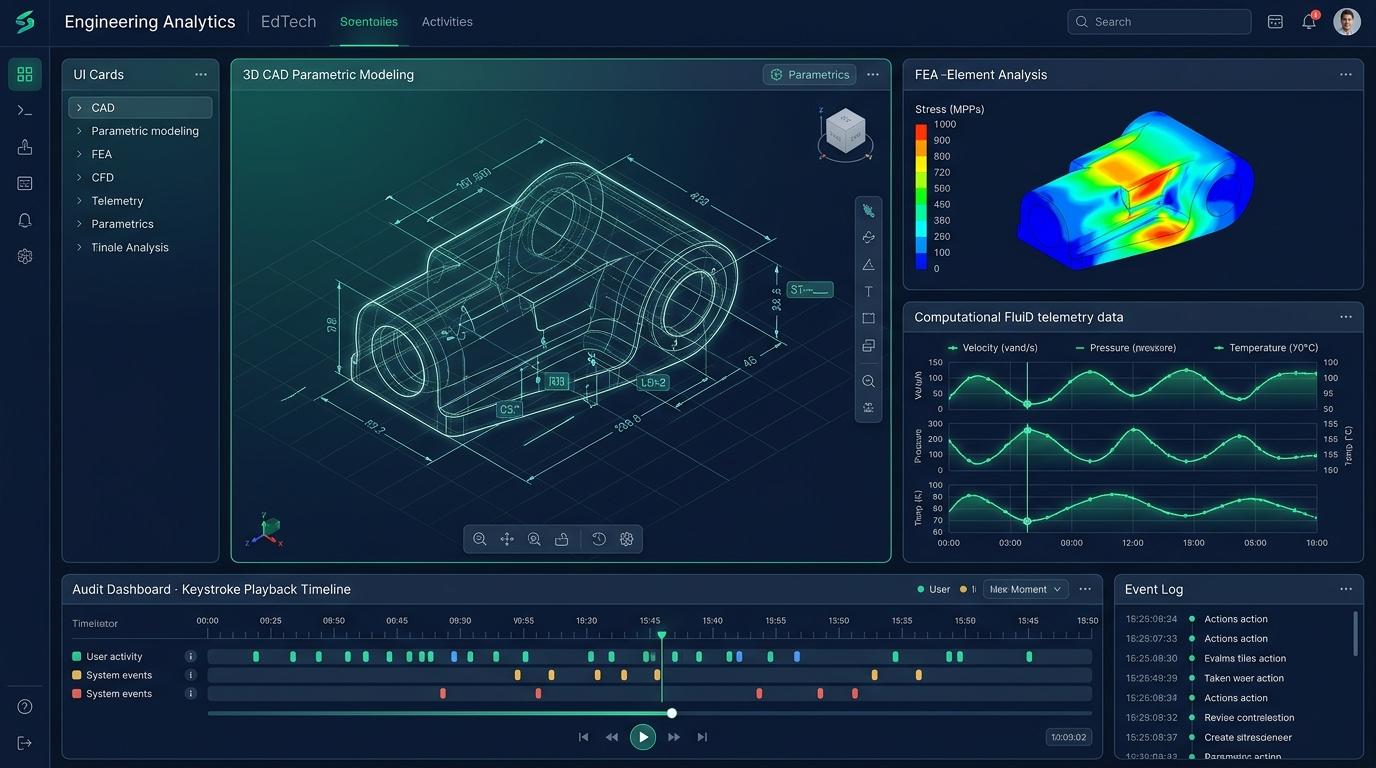
In undergraduate and graduate engineering education—spanning Mechanical, Aerospace, Civil, Electrical, Chemical, and Biomedical disciplines—the Senior Design Capstone represents the culmination of professional preparation. However, the emergence of advanced Large Language Models (LLMs) and multimodal reasoning systems has created an unprecedented vulnerability: students synthesizing plausible-sounding engineering narratives, confabulating material properties (yield strength, Young's modulus, Poisson's ratio), inventing Finite Element Analysis (FEA) and Computational Fluid Dynamics (CFD) convergence residuals, and manufacturing entire parametric CAD iteration histories out of thin air. Conventional plagiarism checkers and generic, whole-document AI text detectors fail catastrophically in engineering because they flag standard governing equations and technical nomenclature as "AI" while missing completely fabricated simulation datasets and synthetic hardware telemetry.
To safeguard ABET accreditation standards (Student Outcomes 1, 2, and 6) and uphold the public safety mandates of the NCEES, IEEE, and ASME Codes of Ethics, engineering faculty require an empirical, defensible audit methodology. Checkmark Plagiarism's patent-pending Essay Playback™ resolves this challenge through Writing Process Telemetry and Analytical Synthesis Forensics. By combining scrubbable 1x–8x keystroke video replay, 100% immutable clipboard payload inspection, passage-level calibrated AI confidence sliders with short-text guardrails, and teacher-in-the-loop rubric autograding with Canvas LMS and Buzz LMS grade passback, Checkmark empowers engineering educators to separate authentic computational reasoning from synthetic data fabrication—fostering transparent, restorative technical coaching while protecting honest students.
Checkmark Plagiarism provides seamless enterprise interoperability for engineering departments and capstone committees through its comprehensive suite of writing process replay, passage-level AI detection, side-by-side plagiarism checking, AI rubric autograding, and native LMS integrations.
1. The Senior Capstone Design Integrity Crisis: Generative AI in the Engineering Pipeline
Senior design capstone projects are the crowning milestone of collegiate engineering curricula. Over one or two semesters, student teams are tasked with executing an end-to-end engineering cycle: defining problem statements, formulating design requirements, developing parametric 3D Computer-Aided Design (CAD) models, running complex Finite Element Analysis (FEA) and Computational Fluid Dynamics (CFD) simulations, coding embedded controllers, acquiring sensor telemetry, and assembling physical or virtual prototypes.
The primary artifact evaluating this multi-month effort is the Comprehensive Capstone Technical Report. Traditionally, a dense, 60-page technical dossier populated with von Mises stress contours, residual convergence plots, MATLAB state-space responses, and parametric CAD iteration tables was prima facie evidence of rigorous analytical engineering.
Today, that assumption has completely collapsed.
The Rise of the "Clean Capstone Report" Illusion
Generative AI models are exceptionally proficient at mimicking the tone, style, and structure of technical engineering literature. When prompted with basic parameters (e.g., "Write a capstone design report section on the structural optimization of a 6061-T6 aluminum quadcopter arm under 150 N dynamic thrust"), frontier LLMs will reliably generate:
- Perfect LaTeX-formatted differential equations and tensor stress matrices.
- Professional discussions of boundary layer turbulence using the
k-εandk-ω SSTmodels. - Convincing narratives describing multi-stage design iterations and weight reduction trade-offs.
- Tabular data showing plausible Factors of Safety (
FoS), deflection margins, and thermal dissipation rates.
However, beneath this pristine prose lies a dangerous void: none of the calculations, boundary conditions, or iterations were grounded in physical simulations or parametric models. The students have generated what engineering educators call the "Clean Capstone Report"—a purely fictional document that looks publication-ready to a casual reader but represents zero authentic computation.
The Four Manifestations of Synthetic Engineering Fabrication
In modern engineering capstones, data fabrication manifests across four distinct computational domains:
LLMs frequently hallucinate or blend material constants from unrelated alloy tempers or composite layups. An AI-generated report might quote the ultimate tensile strength (S_ut) of annealed aluminum when calculating yield failure for a precipitation-hardened alloy, or mix up isotropic Young's moduli with anisotropic orthotropic stiffness matrices (C_ijkl) in carbon-fiber layups. Because the numbers look ballpark-plausible (e.g., quoting E = 71 GPa instead of 68.9 GPa), these fabrications regularly bypass cursory grading.
Capstone rubrics heavily weight the iterative design process—rewarding teams that progress from initial conceptual sketches through intermediate geometry to final mass-optimized assemblies. To avoid the weeks of remodeling required in SolidWorks, Autodesk Fusion 360, PTC Creo, or Onshape, students prompt AI to generate elaborate iteration tables detailing phantom changes in wall thickness, rib placements, and fillet radii that never existed in the actual CAD feature tree or timeline.
In real Finite Element Analysis and Computational Fluid Dynamics, convergence is hard-won. Real meshes produce stress singularities at sharp internal reentrant corners, unrefined boundary layers cause CFD solutions to diverge, and continuity residuals oscillate violently before settling. AI-generated reports bypass this reality by describing flawless asymptotic convergence down to 10−6 residuals on the very first iteration, presenting static screen-captured plots stolen from online repositories or generated by AI image tools with cropped coordinate axes.
When physical hardware testing fails—or when teams run out of time before the final symposium—students frequently prompt generative tools or Python scripts to synthesize realistic-looking Data Acquisition (DAQ) time-series data. These synthetic telemetry arrays exhibit artificially smooth Gaussian noise, impossible Nyquist sampling rates, or step responses that mathematically violate the transfer function poles derived earlier in the report.
2. The ABET Accreditation & Professional Safety Dilemma
Data fabrication in an engineering capstone is fundamentally different from plagiarism in a standard humanities essay. In engineering, academic integrity is directly linked to public safety, professional licensure, and legal liability.
The ABET Accreditation Threat
When ABET (Accreditation Board for Engineering and Technology) evaluators audit an engineering program, the senior capstone design dossier is the primary evidence base used to demonstrate compliance with Criterion 3 (Student Outcomes):
- Outcome 1 (Complex Problem Solving): Evaluators examine whether students independently set up governing differential equations, defined constitutive relationships, and solved boundary value problems. If the math in the report was synthesized by an LLM without student derivation, Outcome 1 is violated.
- Outcome 2 (Design Under Realistic Constraints): Evaluators check whether trade-offs in manufacturability, safety factors, and material costs were authentically evaluated. AI-generated trade-off matrices provide the illusion of design analysis while bypassing the actual engineering decisions.
- Outcome 6 (Experimentation & Engineering Judgment): This outcome explicitly mandates that students conduct experimentation, analyze real data, and apply engineering judgment. Submitting synthetic telemetry or unverified simulation plots represents an active breach of Outcome 6, endangering the department's program accreditation.
Why Legacy AI Detectors and Plagiarism Checkers Fail in Engineering
When engineering faculty attempt to police capstone integrity using generic, commercial text checkers, they encounter two catastrophic failure modes:
1. Massive False Positives on Technical Formulas and Nomenclature
Standard AI text detectors rely on statistical perplexity and burstiness metrics trained on generic web prose. When an authentic engineering student writes a section dense with standard mathematical nomenclature—such as the Navier-Stokes momentum equation:
or standard definitions of shear stress (τ = VQ / It), the statistical perplexity drops to near zero because these formulas are mathematically standardized across textbooks. Legacy tools flag authentic student derivation as "95% AI-generated," triggering traumatic, unwarranted accusations against honest students.
2. Complete Invisibility to Fabricated Simulation Telemetry
Legacy checkers analyze text strings; they cannot inspect whether an attached FEA displacement plot matches the boundary constraints, whether a tabular column of Young's moduli matches the alloy specified, or whether an external paste dropped 4,000 characters of unverified simulation prose into the LMS editor in 0.2 seconds.
Engineering educators cannot rely on black-box percentage scores. They need transparent, empirical, and multi-dimensional evidentiary receipts.
3. The Engineering Evidentiary Matrix: Static Reports vs. AI Detectors vs. Checkmark Verification
To understand how modern integrity verification operates in technical STEM disciplines, consider the structural comparison between traditional submission workflows, generic AI text checkers, and Checkmark Plagiarism’s multi-factor writing process telemetry suite:
| Evaluation Dimension | Static PDF Capstone Submissions | Generic AI Text Detectors | Checkmark Plagiarism Telemetry Suite |
|---|---|---|---|
| Primary Artifact Analyzed | Final static PDF with isolated rendered figures and tables. | Raw text stripped of formatting, equations, and context. | Complete multi-dimensional dossier: interactive text, keystroke telemetry, clipboard history, and linked sources. |
| Telemetry & Time Verification | None; only reveals the final file save timestamp (easily spoofed). | None; blind to composition duration, revision bursts, and typing velocity. | Patent-Pending Essay Playback™: 1x–8x scrubbable video replay of drafting, equation composition, and analytical pauses. |
| Mathematical Equation Handling | Formulas visible on page, but derivation authenticity is unverified. | Severe False Positives: Flags standard engineering math and LaTeX formulas as AI text. | Honest Short-Text & Technical Guardrails: Isolates formula blocks; applies passage-level analysis with calibrated confidence sliders. |
| Data & Clipboard Forensics | Cannot detect if data tables were typed organically or pasted from an LLM. | Blind to clipboard events; treats all text equally regardless of origin. | External Paste Inspector: Preserves 100% of clipboard payloads with timestamped origin logs, even if text is subsequently edited. |
| CAD & Simulation Linkage | Disconnected from raw .sldprt, .f3d, .cas, or .m simulation files. |
Zero integration with engineering files or simulation environments. | Cross-references drafting pauses with simulation file timestamps and clipboard exports from MATLAB/Python. |
| Student Exoneration Capability | Low; turns into an adversarial "he-said-she-said" debate over competence. | Zero; opaque percentage score provides no actionable receipts to clear honest students. | High & Defensible: Authentic multi-hour keystroke history and formula backspacing instantly proves independent authorship. |
| ABET Audit Defensibility | Vulnerable; fails to provide verifiable proof of individual Outcome 1 & 6 mastery. | Non-defensible; ABET review boards reject black-box probability scores. | Fully Defensible: Provides timestamped keystroke logs, rubric justifications, and student process receipts for ABET portfolios. |
| LMS & Grading Integration | Manual rubric scoring in Canvas or paper grading sheets. | Third-party popups with zero gradebook or rubric sync capabilities. | Teacher-in-the-Loop AI Rubric Autograding: Syncs custom ABET rubrics directly with Canvas LMS, Buzz LMS, and Google Classroom. |
4. Anatomy of Engineering Fabrication: Four Critical Failure Modes
To conduct effective audits, capstone coordinators and faculty must understand the precise technical mechanics of how AI models fabricate engineering data—and what physical contradictions betray synthetic origin.
Failure Mode 1: The "Ghost Convergence" in FEA and CFD
In authentic computational mechanics, solving the Navier-Stokes equations or structural stiffness matrices ([K]{u} = {F}) requires careful mesh refinement. In Computational Fluid Dynamics, capturing wall shear stress requires resolving the viscous sublayer where the dimensionless wall distance y+ satisfies:
When students prompt an LLM to write their CFD methodology, the generated text invariably claims pristine convergence:
"The steady-state incompressible Navier-Stokes equations were discretized using a second-order upwind scheme. Residual convergence for continuity, x-momentum, y-momentum, and k-ω SST turbulence parameters dropped monotonically below 10−6 within 350 iterations, confirming numerical stability."
The Forensic Contradiction: When faculty inspect the actual mesh files (.cas, .msh, or Fusion 360 simulation setup), they discover an unrefined tetrahedral mesh with 8,000 cells, element aspect ratios exceeding 50:1, and a first-layer height yielding y+ > 120. In an actual solver (ANSYS Fluent, OpenFOAM, or SimScale), this mesh would violently diverge or produce numerical diffusion errors exceeding 40%. The text was generated independently of the computational reality.
Failure Mode 2: The Confabulated Material Property Envelope
In structural and aerospace design, material properties are rarely single scalar values; they depend heavily on heat treatment, rolling direction, temper, operating temperature, and cyclic fatigue limits.
Consider a common senior capstone scenario involving an aircraft landing gear bracket manufactured from Titanium Grade 5 (Ti-6Al-4V):
- Annealed Temper: Yield Strength
S_y ≈ 880 MPa, Ultimate Tensile StrengthS_ut ≈ 950 MPa. - Solution Treated & Aged (STA): Yield Strength
S_y ≈ 1,100 MPa, Ultimate Tensile StrengthS_ut ≈ 1,170 MPa.
When an LLM generates the structural discussion, it frequently confabulates these values—claiming the component is "standard raw annealed stock" while using the aged 1,100 MPa yield limit in its stress equations to achieve a passing Factor of Safety (FoS > 1.5). Furthermore, LLMs regularly neglect stress concentration factors (K_t) at geometric discontinuities, asserting that a structural hole in a tension member experiences nominal stress σ = P/A without applying the theoretical K_t ≈ 3.0 multiplier.
Failure Mode 3: The Phantom CAD Iteration Tree
Engineering design is fundamentally iterative. A genuine CAD model in SolidWorks, Fusion 360, PTC Creo, or Autodesk Inventor contains an extensive Parametric Feature Tree (or timeline) documenting:
- Base sketches and primary extrusions.
- Draft angles, shelling, and internal stiffening ribs.
- Fillets and chamfers applied after initial FEA stress localization.
- Suppressed features, rollback bars, and version iterations.
Synthetic capstone submissions present polished comparison tables claiming four distinct design cycles:
- Iteration 1 (Baseline Solid): Mass = 620 g, Max Von Mises Stress = 240 MPa.
- Iteration 2 (Pocketing): Mass = 410 g, Max Von Mises Stress = 195 MPa.
- Iteration 3 (Rib Reinforcement): Mass = 310 g, Max Von Mises Stress = 145 MPa.
- Iteration 4 (Topology Optimization): Mass = 215 g, Max Von Mises Stress = 110 MPa.
The Forensic Contradiction: When the instructor opens the student's submitted CAD file, the FeatureManager tree contains only three basic extrusions created the night before the deadline, with no rollback history, no parametric configurations, and no intermediate part files. The "iterations" were synthesized solely to fulfill the rubric criteria.
Failure Mode 4: The Synthetic MATLAB / Simulink Telemetry Drop
In mechatronics, robotics, and electrical engineering capstones, sensor telemetry (IMU accelerations, optical encoder velocities, strain gauge voltages, thermocouple readings) contains distinct physical signatures:
- Quantization Noise: Analog-to-Digital Converters (ADCs) produce discrete integer-step voltage levels based on bit resolution (e.g., 10-bit ADC at 3.3V = 3.22 mV per LSB).
- High-Frequency Thermal Noise: Real physical sensors exhibit Johnson-Nyquist noise and ambient electromagnetic interference (EMI).
- Sampling Jitter: Microcontrollers running RTOS or Arduino loops exhibit microsecond-level timing jitter in time-delta (
Δt) columns.
LLM-synthesized or script-generated telemetry arrays exhibit dead giveaways:
- Continuous floating-point decimals with infinite precision that ignore ADC quantization steps.
- Perfectly symmetrical Gaussian noise generated via
numpy.random.normal()that lacks physical sensor drift or bias offsets. - Second-order system step responses that show exact mathematical decay without any mechanical backlash, friction stick-slip, or sensor saturation.
5. The Step-by-Step Engineering Faculty Audit Protocol
To evaluate engineering capstone reports with scientific rigor and pedagogical fairness, faculty and capstone review boards should follow this four-stage audit protocol.
.cas, .msh, .fem) for element quality, skewness, and y+; match solver runtime timestamps against cited report milestones.
P/A, flexure formula σ = My/I, Newton's Law of Cooling); check boundary constraint singularities; verify material properties against verified engineering handbooks.
Stage 1: Primary CAD & Simulation Artifact Cross-Referencing
Never grade a capstone report in a vacuum. The report must be audited directly against the raw computational design files:
- CAD Feature Tree Audit: Open the native part or assembly file (
.SLDPRT,.F3D,.PRT). Check the feature count and creation dates. A legitimate 8-month capstone mechanism should have dozens of sketches, parent-child geometric relationships, named dimensions, and material assignments. - Mesh Quality and Boundary Condition Verification: Open the simulation tree. Check the mesh statistics:
- Aspect Ratio: Should be
< 5:1in critical stress concentration zones. - Skewness: Must be
< 0.85for reliable CFD calculations. - Boundary Constraints: Ensure fixed constraints do not create artificial infinite stress singularities on knife-edge boundary nodes that the report conveniently ignores.
- Aspect Ratio: Should be
- Solver Log Timestamp Matching: Inspect the simulation solver output files (
.out,.log,.lis). Check the total CPU core runtime and completion timestamps. Compare these timestamps against the dates cited in the report’s design progress milestones.
Stage 2: Keystroke Drafting & Process Reconstruction with Essay Playback™
This is where Checkmark Plagiarism provides definitive, patent-pending forensic visibility. Instead of guessing based on static text, open the student's submission in Checkmark Essay Playback™:
• Size: 450 bytes (CSV Data)
• Telemetry: 8 columns, 20 rows
• Origin: MATLAB export script
• Student analyzes sensor voltage spikes
• Switches between MATLAB plot & report
• "The observed step response exhibits an overshoot of 14.2%, which..."
• 12 backspaces; recalculates ζ
• Types LaTeX equation for peak time tp
• Size: 4,200 bytes (Full Report)
• Telemetry: Complete formatted prose with math & tables
• Replaces 2 words
• Adds section heading
• Total Composition Time: 3 min
• Zero mathematical pauses
• Zero derivation friction
- Scrubbing at 1x to 8x Speed: Watch the student team construct their technical argument. In authentic engineering writing, students compose in bursts punctuated by high-friction cognitive pauses (15 to 60 seconds). These pauses correspond to the student referencing a SolidWorks drawing, running a MATLAB calculation, or checking an ASME boiler code table.
- Analyzing Formula Composition: Observe how equations are entered. Genuine students type LaTeX or equation-editor symbols sequentially, frequently correcting indices, sub-scripts (
x_ij), and units (N•m). In contrast, AI-generated text appears as a single massive paste payload containing complete mathematical blocks. - Clipboard Payload Forensics: Click on Checkmark's External Paste Inspector. Checkmark captures and stores 100% of clipboard text payloads at the exact moment of ingestion. The inspector immediately reveals whether a paste event was a legitimate raw numerical table copied from Excel/MATLAB, or a complete 800-word discussion generated by Claude or ChatGPT.
Stage 3: First-Principles Theoretical Spot-Checks
Perform rapid, order-of-magnitude back-of-the-envelope sanity checks on the reported numbers:
- Direct Axial Stress: Check
σ = P / A. If an aluminum link carries 5,000 N with a cross-sectional area of 20 mm2, the stress must be 250 MPa. If the report’s FEA plot claims 45 MPa under that load, the boundary conditions were improperly applied or fabricated. - Beam Bending Stress: Check maximum bending stress using the flexure formula:
σmax = (M • c) / I = M / ZCompare this theoretical value against the peak von Mises stress in the report.
- Energy Balance & Thermal Dissipation: For heat transfer capstones, verify conservation of energy:
q_in = q_out + ΔE_st. If an enclosure dissipates 500 W through natural convection and the report quotes a surface temperature rise of only 4°C with a 0.05 m2 area, the physics violate Newton's Law of Cooling (q = h A ΔT).
Stage 4: Conducting Restorative Design Defense Debriefs
When discrepancies arise, engineering educators must avoid punitive, accusatory confrontations that destroy faculty-student trust. Instead, employ the Checkmark philosophy: "Stop guessing, start trusting through transparent evidence."
Schedule a Restorative Design Defense Conference:
- Open the Telemetry Dossier Together: Sit beside the student team and project the Checkmark Essay Playback and CAD models onto a shared screen.
- Apply the Parameter Perturbation Challenge: Ask the team to demonstrate their computational pipeline live: "Your report presents an optimal Factor of Safety of 2.1 for this mounting bracket under a 400 Nm torsional load. Let's open your native SolidWorks simulation together, change the torque to 600 Nm, and re-run the solver."
- Evaluate Technical Agility: A student team that independently built the simulation will effortlessly navigate the software, adjust the boundary load, re-mesh, and interpret the new stress contours. A team that submitted AI-fabricated data will be completely immobilized, unable to explain basic boundary constraints or solver settings.
- Prescribe a Restorative Engineering Remediation: Rather than assigning an immediate zero or honor code suspension, guide the team into an authentic engineering recovery loop: give them 72 hours to re-run the physical or computational simulation from scratch, document their real failure modes, and submit a verified revision with complete Essay Playback tracking.
6. Concrete Engineering Case Studies & Forensic Telemetry
To illustrate how these principles operate in collegiate engineering programs, review these three realistic capstone scenarios:
The "Pristine" Drone Chassis FEA
FoS = 4.5 under a 6g landing impact (1,200 N).
Exonerating a Formula-Dense Aerospace Reentry Report
The Fabricated Battery Thermal Management CFD
0 m/s with zero convective heat transfer coefficients.
7. How Checkmark Plagiarism Empowers Engineering Departments & Capstone Committees
Checkmark Plagiarism provides a comprehensive, educator-first ecosystem engineered to meet the stringent demands of ABET-accredited engineering programs:
Reconstructs the entire writing session keystroke-by-keystroke. Engineering faculty can scrub through the report's creation like a video, watching equations being derived, data tables being interpreted, and technical arguments being refined. Keystroke telemetry protects honest students while exposing bulk synthetic pasting.
When a student pastes content into the document editor, Checkmark captures the entire raw clipboard payload and preserves it in an immutable audit log. Even if the student subsequently rewrites or "humanizes" text for hours, the original pasted payload remains accessible with a single click.
Rather than outputting an opaque whole-document percentage, Checkmark highlights specific passages with calibrated confidence sliders. Short text blocks under ~150 words display N/A guardrails to prevent unscientific guessing on limited sample sizes.
Checkmark's AI Rubric Assistant evaluates technical capstone drafts against customized ABET rubrics, generating per-criterion score recommendations anchored directly to quotes in the student's prose with direct grade passback into Canvas LMS, Buzz LMS, and Google Classroom.
Capstone projects frequently involve corporate sponsors, Non-Disclosure Agreements (NDAs), and patent-pending student inventions. Checkmark guarantees Zero Model Training on Student Submissions—student engineering reports, CAD specifications, and code are never cached, retained, or ingested into public LLM training datasets, ensuring complete FERPA and COPPA compliance.
8. Institutional Capstone AI Policy & Syllabus Guidelines for Engineering Chairs
Engineering department chairs and curriculum committees should adopt clear, standardized syllabus language that defines the boundary between authorized computational assistance and prohibited data fabrication.
Model Syllabus Policy Template for Senior Capstone Courses
Engineering is a profession governed by public trust, ethical responsibility, and strict adherence to physical truth (NCEES Model Rules § 240.15; ASME/IEEE Codes of Ethics). In this course, all CAD models, finite element simulations, computational fluid dynamics solutions, and sensor telemetry submitted in technical reports must be authentic, reproducible, and grounded in verifiable primary files.
- Primary Artifact Submission Requirement: Every technical claim, stress contour, or telemetry curve presented in your report must correspond directly to an attached, executable primary engineering file (
.SLDPRT,.STEP,.F3D,.cas/.dat,.m,.py,.csv). Reports submitted without verifiable native simulation or CAD files will receive an automatic incomplete. - Writing Process Telemetry: All written reports must be composed using the department-designated learning management editor equipped with Checkmark Plagiarism telemetry. Keystroke drafting history, analytical synthesis pauses, and clipboard imports will be reviewed as part of regular milestone audits.
- Prohibition of Synthetic Data: The use of generative AI to fabricate simulation convergence, invent material constants, manufacture CAD iteration histories, or synthesize sensor data constitutes severe academic and professional misconduct. Violations will result in immediate failure of the capstone project, referral to the Academic Integrity Board, and formal documentation in ABET compliance records.
9. Frequently Asked Questions (FAQ)
1. How does Checkmark handle LaTeX mathematical equations without generating false positive AI flags?
Standard AI checkers evaluate raw text strings, causing standard mathematical expressions (e.g., Navier-Stokes equations, Euler-Bernoulli beam formulas, Fourier transforms) to register as AI due to low statistical perplexity. Checkmark’s multi-factor engine utilizes passage-level granularity and honest short-text guardrails (<150 words) that isolate equation blocks from narrative prose. Furthermore, Checkmark’s Essay Playback™ proves authentic mathematical derivation by recording the student’s step-by-step keystroke entry, index corrections, and backspacing history.
2. What should an engineering professor do if an FEA plot looks plausible but native files are missing?
Never accept rendered simulation plots in a static PDF without the accompanying native files (.SLDPRT, .F3D, .FEM, .CAS). If a team claims an FEA analysis was performed on an external machine that crashed or lost the files, require an immediate in-person Restorative Design Defense. Ask the team to recreate the boundary conditions and run the mesh in front of you. A team with authentic engineering competence can set up a basic static analysis in under 15 minutes; a team that faked the data will be unable to operate the pre-processor.
3. How does Checkmark protect student intellectual property and corporate sponsor NDAs?
Many senior capstone projects are sponsored by aerospace, defense, automotive, or biomedical corporations under strict Non-Disclosure Agreements (NDAs). Checkmark operates under an enterprise Zero Student Data Retention Policy: student text, CAD metadata, simulation telemetry, and reports are never used to train public or proprietary AI models, never shared with third parties, and stored using end-to-end FERPA/COPPA-compliant AES-256 cloud encryption.
4. Can Essay Playback™ distinguish between copying raw data from MATLAB vs. pasting AI-generated text?
Yes. Checkmark’s External Paste Inspector logs 100% of clipboard text payloads along with their formatting and character structure. When a student copies a numerical data array or CSV table from MATLAB or Excel, the payload structure displays tabular numeric grids. When a student copies text from ChatGPT or Claude, the payload contains complete conversational syntax and formatted paragraphs. Furthermore, Essay Playback captures what happens after the paste: authentic students spend minutes analyzing and drafting around raw data tables, whereas students who paste LLM prose immediately transition to submission.
5. How does Checkmark support ABET accreditation audits?
During ABET program reviews, evaluators require verifiable evidence that students independently achieved Student Outcomes 1 (complex problem solving), 2 (design under constraints), and 6 (experimentation and data analysis). Checkmark enables department chairs to export comprehensive Evidentiary Dossiers containing timestamped keystroke playback logs, rubric score breakdowns with quote-anchored justifications, and student revision histories—proving active, authentic student learning for accreditation review teams.
6. How should faculty handle multi-student capstone teams where only one student used AI to fake data?
In group capstone projects, assigning collective blame damages honest team members. Checkmark integrates natively with LMS multi-author environments (Google Docs, Canvas LMS group assignments), attributing specific keystroke sequences, typing sessions, and clipboard paste events to individual student login IDs. Faculty can pinpoint exactly which team member pasted synthetic text or fabricated telemetry while protecting and exonerating the contributing teammates.
7. What is the pedagogical difference between "punitive AI detection" and Checkmark's "restorative integrity coaching"?
Punitive detection relies on black-box percentage scores to accuse and penalize students, creating an adversarial classroom dynamic. Checkmark’s philosophy is "Stop guessing, start trusting." By providing transparent, empirical receipts—including scrubbable writing playback, exact clipboard history, and quote-anchored rubric feedback—Checkmark transforms integrity checks into objective technical coaching sessions where students learn authentic engineering verification and professional accountability.
10. Conclusion: Restoring Trust and Scientific Truth in Engineering Education
The ultimate objective of an engineering education is to produce professionals who can be trusted with the design of bridges, aircraft, electrical grids, medical implants, and autonomous systems. When students outsource their computational thinking to generative AI and submit fabricated simulation telemetry, they not only violate academic integrity—they compromise their ability to practice engineering safely and ethically.
By moving beyond opaque, single-percentage text checkers and implementing Checkmark Plagiarism’s multi-dimensional writing process telemetry, patent-pending Essay Playback™, and external paste forensics, engineering departments can:
- Defend ABET Accreditation Standards by verifying authentic student mastery of Outcomes 1, 2, and 6.
- Protect Honest Students from devastating false accusations on technical math and formulas.
- Expose Synthetic Data and Phantom Iterations with undeniable, timestamped clipboard and keystroke receipts.
- Foster Restorative Engineering Coaching that prepares students for the rigorous ethical demands of professional licensure.
Engineering integrity is not about catching students—it is about ensuring that every graduate who signs their name to a design calculation has the competence, honesty, and empirical rigor to protect the public welfare.