
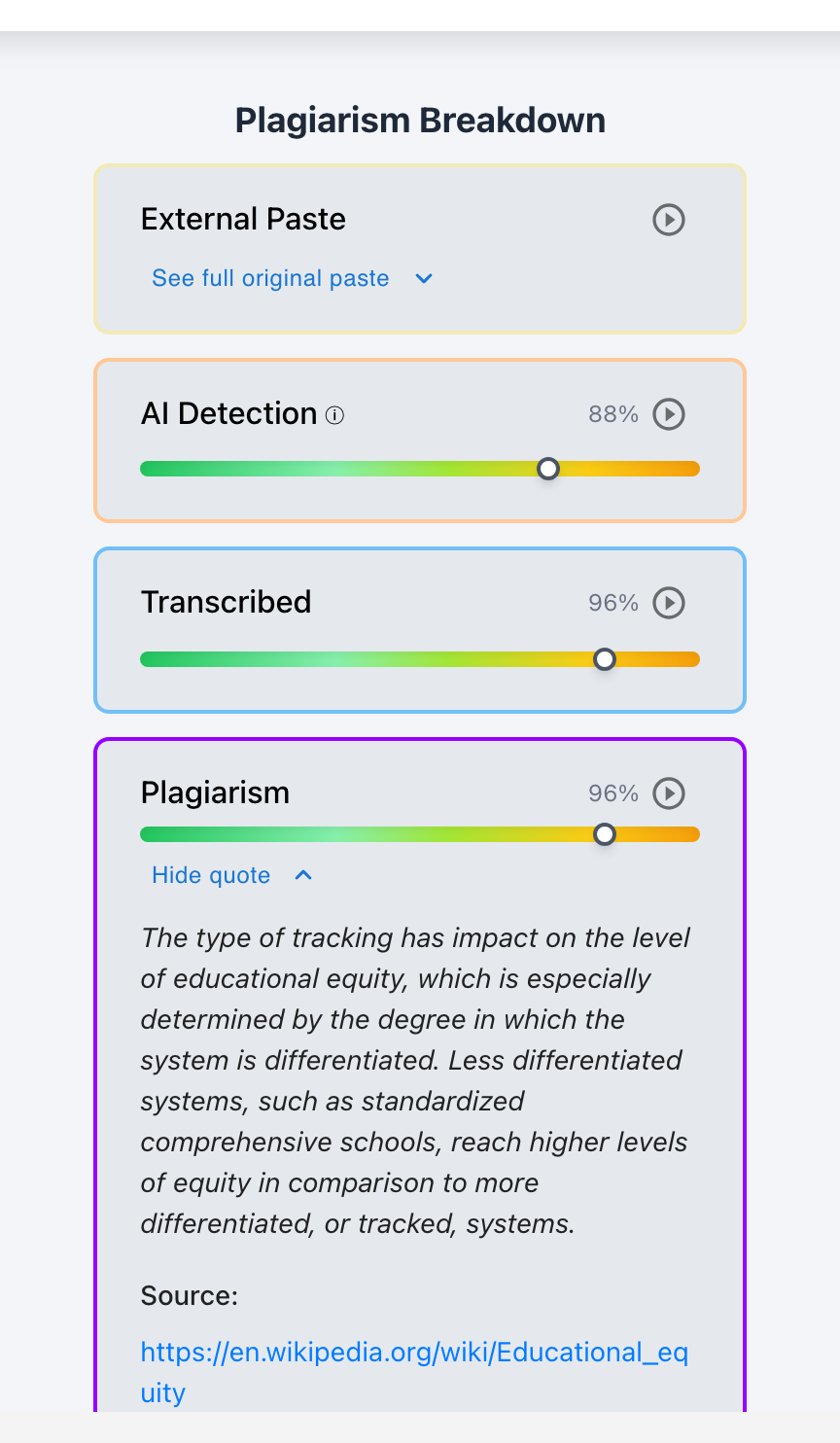
Dual enrollment and concurrent credit composition programs sit at the most critical juncture in American literacy education: high school juniors and seniors earning transferable college credit in English 101/102 while navigating the steep cognitive leap from secondary “summarize-and-quote” book reports to collegiate multi-source synthesis across dense, multi-genre nonfiction texts (peer-reviewed empirical studies, public policy white papers, historical primary sources, and contrasting philosophical essays). When secondary students encounter complex academic syntax and unfamiliar disciplinary jargon, they routinely fall into the “patchwriting and serial quoting” trap—stacking isolated quote sandwiches with zero cross-textual dialogue or mechanically swapping synonyms (“rogeting”) to mask clause copying. Historically, dual enrollment faculty were forced to rely on punitive, whole-document plagiarism percentages that misdiagnosed developmental cognitive struggle as intentional cheating, or black-box AI detectors that triggered false accusations on authentic student writing. Checkmark Plagiarism transforms academic integrity from a punitive “gotcha” into an interactive, visual synthesis workbench. By uniting synchronized dual-pane side-by-side source viewers, a 4-Badge Citation Taxonomy (🟢 Quoted & Formally Cited, 🟡 Paraphrased with Attribution, 🔴 Uncited Direct Match / Patchwriting, 🟣 Hallucinated / Unverified Citation Alert), patent-pending Essay Playback™ (1x–8x scrubbable keystroke replay), and Teacher-in-the-Loop Rubric Autograding, dual enrollment instructors can visually diagnose syntactic mimicry, coach students through the 3 Levels of Academic Synthesis, and uphold rigorous, transferable collegiate standards across Canvas LMS SpeedGrader, Agilix Buzz LMS, Schoology, and Google Classroom.
Checkmark Plagiarism equips dual enrollment educators with transparent authorship verification, combining side-by-side source comparison with patent-pending Essay Playback™ writing telemetry, passage-level AI writing detection, and quote-anchored rubric autograding.

1. The Dual Enrollment Crucible: Bridging High School Reporting and Collegiate Nonfiction Synthesis
Dual enrollment, dual credit, and concurrent enrollment partnerships have grown quickly in the United States. According to federal IPEDS data analyzed by the Community College Research Center, more than 3 million high school students took a college course in 2024–25, up 24% from 2.5 million in 2022–23, with English Composition I (ENG 101) and English Composition II (ENG 102 / Academic Research & Argumentation) serving as common gateway courses.
For secondary students, dual enrollment offers accelerated degree completion, substantial tuition savings, and early immersion in collegiate academic culture. However, for the educators who teach these courses—whether secondary high school teachers certified as adjunct college faculty or university professors teaching high school cohorts—the classroom dynamic presents an intense cognitive, institutional, and pedagogical friction.
How emerging dual enrollment scholars navigate the structural and cognitive leap from high school ELA to collegiate English 101/102
- 5-paragraph formulaic essay architecture (RACER / Quote Sandwiches)
- 1 isolated quote inserted per body paragraph without cross-text dialogue
- Single-source book reports, character sketches, or thematic summaries
- Surface-level summary: “Did the student find a good quote?”
- Patchwriting overlooked or mistaken for “good paraphrasing with a thesaurus”
- Organic line-of-reasoning structured around student’s independent thesis
- Multi-source conversational synthesis (2–4 scholarly texts per paragraph)
- Multi-genre complex nonfiction (empirical studies, white papers, primary sources)
- Conceptual tension: “How do sources qualify, complicate, or refute one another?”
- Strict citation attribution; active authorial voice commanding the scholarly conversation
The Pedagogical Chasm: “Quote Sandwiches” vs. Conversational Nonfiction Synthesis
In standard secondary English Language Arts (ELA), students are repeatedly drilled in structural formulas designed for state standardized testing: the rigid five-paragraph essay, the RACER method (Restate, Answer, Cite, Explain, Review), or the three-sentence “quote sandwich” (introduce quote, insert direct quote, explain quote in isolation). In these environments, writing success is largely measured by compliance: finding an excerpt that matches a prompt and mechanically dropping it into a body paragraph.
When these same students enter dual enrollment English 101, they are confronted with a completely different rhetorical universe. College composition syllabi demand that students:
Digest empirical research papers, longitudinal socioeconomic studies, historical primary source documents, and contrasting philosophical essays.
Identify intersections, qualifications, methodological disputes, and underlying philosophical tensions across four, six, or eight disparate scholarly voices.
Scholarly sources must serve as warrants and evidence supporting the student’s central thesis, rather than allowing source quotes to dictate the structure of the essay.
When novice secondary writers attempt to bridge this divide, cognitive overload takes over. Lacking the rhetorical fluency to summarize dense 25-page academic treatises in their own voice, students retreat into survival strategies: serial quote stacking (filling 70% of the body paragraphs with massive block quotations) or developmental patchwriting (copying academic sentences and running them through a digital thesaurus).
The Institutional and Accreditation Stakes
Dual enrollment composition is not merely an advanced high school course; it carries real-world collegiate transcript credit governed by strict institutional agreements:
- Regional Accreditation Mandates: Regional accrediting bodies (such as the Higher Learning Commission [HLC], the Southern Association of Colleges and Schools Commission on Colleges [SACSCOC], and the New England Commission of Higher Education [NECHE]) expect dual credit courses to maintain equivalent academic rigor, learning outcomes, and assessment standards as on-campus university sections.
- Faculty Credentialing & Syllabus Concordance: Concurrent enrollment instructors are expected to show that high school students are achieving collegiate-level information literacy and written communication outcomes, and some programs use the Association of American Colleges and Universities (AAC&U) VALUE Rubrics as a shared reference point.
- Articulation & Transferability Risks: If receiving four-year universities discover that a community college’s dual credit English sequence fails to teach authentic multi-source research and dialectical synthesis—relying instead on superficial high school book reports—articulation agreements can be jeopardized.
Why Legacy Similarity Scores and Black-Box AI Detectors Sabotage Instruction
For over two decades, academic integrity software relied on single aggregate numbers—such as a blunt “32% Similarity Score” or an opaque “84% AI Detected” probability. In a dual enrollment composition classroom, these blunt metrics create severe instructional dysfunction:
| Legacy Integrity Approach | Operational Mechanism | Pedagogical Failure in Dual Enrollment Composition |
|---|---|---|
| Aggregate Similarity Percentages (Legacy Plagiarism Scanners) | Condenses all matched strings across a paper into a single whole-document percentage score. | Punishes Legitimate Scholarly Engagement: A student analyzing three supreme court cases and quoting essential legal definitions receives an alarming 35% match, creating false panic. Meanwhile, a student who extensively patchwrites an academic journal using synonym swaps scores under 8%, hiding developmental failure. |
| Black-Box AI Probability Scores | Generates a static probabilistic likelihood (e.g., “78% AI-Generated”) with zero line-by-line evidence or revision context. | Triggers False Misconduct Allegations: When high school students attempt elevated academic transitions (“Furthermore, empirical data suggests...”), black-box detectors trigger false positives. Honest students are traumatized, while tech-savvy students using AI humanizers easily bypass detection. |
| Static Document Inspection | Examines only the final submitted PDF or Word document, completely blind to the drafting journey. | Eliminates Formative Intervention: Instructors cannot see whether a paragraph took two hours of deep synthesis drafting or two seconds of external clipboard pasting, forcing faculty into speculative grading. |
To achieve the promise of dual enrollment, composition instructors need a transparent, formative tool that renders the intellectual work of synthesis visible, coachable, and defensible.
2. Deconstructing the Pedagogy & Cognitive Mechanics of Nonfiction Synthesis
To design effective pedagogical interventions, dual enrollment instructors must understand the cognitive science underpinning academic reading and writing. Why do capable secondary students struggle so profoundly when asked to synthesize complex nonfiction?
How emerging writers transition from working memory overload to dialectical synthesis
Empirical studies with statistical data (p-values, sample sizes) • Theoretical frameworks • Competing policy proposals
Working memory capacity (~4–7 cognitive chunks) overwhelmed by unfamiliar syntax and discipline-specific jargon
- Patchwriting: Syntactic mimicry and thesaurus synonym swapping (“rogeting”)
- Serial Quoting: Block quote sandwiches with zero authorial voice
- Automated AI Paraphrasing: Evading cognitive work through digital tools
- Level 1: Isolated Juxtaposition (Serial source stacking)
- Level 2: Comparative Dialogue (Consensus and conflict)
- Level 3: Dialectical Conceptual Synthesis (Original line of reasoning)
The “Patchwriting & Serial Quoting” Trap
The concept of patchwriting comes from Dr. Rebecca Moore Howard. It was later examined at scale by the multi-institutional Citation Project (Sandra Jamieson, Howard, and colleagues), which coded 174 first-year student research papers from sixteen U.S. colleges and universities. Patchwriting appeared in roughly half of the five-page extracts coded, about 42% of the 1,911 citations were direct quotations, and only about 6% were summaries. Their work helped shift how many composition scholars understand patchwriting:
- Patchwriting is Developmental, Not Deceptive: Howard defined patchwriting as “copying from a source text and then deleting some words, altering grammatical structures, or plugging in one-for-one synonym substitutes” (“A Plagiarism Pentimento,” Journal of Teaching Writing, p. 233), and she characterized it as a composing strategy through which writers practice “entry-level manipulation of new ideas and vocabulary.”
- The Cognitive Function of Patchwriting: When students encounter texts written beyond their current reading comprehension zone, they cannot fully unpack the conceptual meaning. Patchwriting serves as an intellectual scaffold—a cognitive stepping stone where the novice writer attempts to inhabit the vocabulary and syntax of the disciplinary expert.
- Common Forms of Source Misuse:
- Exact Copying Without Quotes: Wholesale copying of clauses with or without attribution.
- Synonym Substitution (“Rogeting”): Keeping the exact clause structure of the source while replacing adjectives and verbs with thesaurus equivalents (e.g., changing “The empirical evidence demonstrates a profound disparity” to “The experimental data shows a deep inequality”).
- Grammatical Restructuring: Inverting active/passive voice or shifting dependent clauses while maintaining identical conceptual phrasing.
- Serial Quoting / Source Stacking: Pasting verbatim sentences connected only by generic transitions (“Furthermore,” “Additionally,” “In conclusion”), stripping the student of any authentic authorial voice.
When dual credit teachers treat patchwriting as an intentional honor code violation subject to automatic failure, they alienate emerging scholars. Conversely, if instructors ignore patchwriting, students fail to develop the analytical competencies required for university-level research.
The 3 Levels of Academic Synthesis Taxonomy
To move students along the developmental continuum, composition instructors must teach synthesis as a distinct three-tier taxonomy:
Student Behavior: Paragraph 1 summarizes Source A entirely. Paragraph 2 summarizes Source B entirely. The student provides no connective tissue, no comparative analysis, and no overarching thesis that bridges the two findings.
Rhetorical Failure: Zero cross-talk between texts. The student acts as a passive reporter filing isolated summaries rather than entering a scholarly conversation.
Student Behavior: The student brings both authors into the same paragraph using established rhetorical moves (e.g., Gerald Graff & Cathy Birkenstein’s They Say / I Say model): “While Dr. Martinez (2024) asserts that decentralized solar microgrids eliminate transmission loss, Peterson’s (2025) municipal cost-benefit analysis reveals that initial battery storage capital expenditures present an insurmountable barrier for rural utility districts.” (Martinez and Peterson are fictional authors used for illustration throughout this article.)
Rhetorical Advancement: The student identifies where sources agree, where they conflict, and what nuances distinguish their arguments.
Student Behavior: The student establishes an independent, arguable thesis regarding municipal grid modernization. Martinez, Peterson, and federal regulatory data are marshaled as precise warrants supporting the student’s own framework.
Rhetorical Mastery: Multiple sources (A, B, C, D) are woven seamlessly across the essay. The student no longer reports on what others have said; they actively use disciplinary scholarship to build new knowledge.
Visual Source Verification as a Transformative Teaching Tool
How do educators guide a high school senior from Level 1 patchwriting to Level 3 conceptual synthesis? By making source integration visually transparent.
When a student sees their paragraph placed directly alongside the original peer-reviewed PDF in a synchronized side-by-side viewer—with exact lexical overlaps highlighted in red, adapted paraphrases flagged in yellow, and properly cited quotes framed in green—the cognitive abstraction disappears. The student can immediately perceive:
- “I didn’t actually synthesize Martinez’s argument; I just copied their third sentence, rearranged two prepositional phrases, and swapped two words.”
- “Both of my body paragraphs cite Source A five times, but Source B is never mentioned until paragraph four. I am stacking sources, not synthesizing them.”
Side-by-side text comparison transforms the integrity report from a punitive post-mortem into a real-time, interactive composition laboratory.
3. Checkmark Plagiarism’s Side-by-Side Source Proof & Synthesis Workbench
To operationalize formative synthesis instruction at scale, Checkmark Plagiarism (checkmarkplagiarism.com) provides dual enrollment programs with a purpose-built educational environment: the Side-by-Side Source Proof & Synthesis Workbench.
While Martinez et al. (2024) argue that decentralized solar microgrids eliminate transmission inefficiencies , empirical capital assessments reveal deep disparities. Specifically, the upfront acquisition costs of commercial lithium-iron batteries remain prohibitive for rural cooperatives without federal matching grants (Peterson, 2025).
1. Synchronized Dual-Pane Source Viewer with Token-Level Mapping
Checkmark’s dual-pane interface eliminates the disjointed back-and-forth of switching between tabs, PDFs, and student documents:
- Token-Level Lexical & Syntactic Alignment: Checkmark scans billions of academic journal articles (via integrations with open-access repositories, JSTOR, PubMed, and institutional databases), public web sources, and peer institutional repositories. When a match is identified, Checkmark maps student clauses directly to the source passage down to individual tokens.
- Synchronized Interactive Scrolling: Clicking any highlighted sentence in the student’s draft instantly snaps the right-hand pane to the exact page, paragraph, and line of the original scholarly source.
- Structural Rhythm Highlighting: Checkmark visually flags sentence-level mimicry where vocabulary words have been swapped via thesaurus but the underlying grammatical clause structure remains identical to the source.
2. The 4-Badge Citation Taxonomy
Unlike generic similarity checkers that paint all matched text with an undifferentiated red highlighter, Checkmark implements a multi-tiered citation classification:
Direct verbatim text enclosed in standard quotation marks with compliant in-text citation. Verifies proper quoting mechanics.
Conceptual overlap where the student’s syntax is original and cites the source correctly. Celebrates authentic student paraphrase and multi-source conceptual synthesis.
Uncredited verbatim text or sentence-level patchwriting lacking quotation marks or attribution. Pinpoints clause-level developmental patchwriting for targeted revision.
In-text citation points to a non-existent journal, fabricated volume, or hallucinated LLM paper. Instantly flags generative AI “hallucinations” without adversarial guessing.
This 4-badge taxonomy allows dual enrollment instructors to instantly triage a student’s submission: if a draft is heavy in Green and Yellow, the student is engaging in authentic academic discourse; if a draft is littered with Red, the instructor can target specific syntactic patchwriting habits without accusing the student of malicious fraud; if a draft triggers a Purple Alert, the instructor has concrete evidence of fabricated citations to guide a restorative inquiry.
3. Patent-Pending Essay Playback™ (1x–8x Replay): Unmasking the Writing Process
The true breakthrough for dual enrollment composition instructors is Checkmark’s patent-pending Essay Playback™. While static text analysis only shows what the student submitted, Essay Playback™ reveals how the student composed it:

- 1x to 8x Scrubbable Keystroke Timeline: Instructors can watch the entire drafting journey unfold like a video.
- Paste Buffer Provenance Tracking: When text is pasted into the editor, Checkmark captures the exact timestamp, character count, and raw clipboard content. Even if the student subsequently edits every single word of the pasted block, Checkmark preserves the original source text with a one-click “Jump to Playback” link.
- Exoneration of Authentic Effort: When an overzealous generic AI detector falsely flags a high school student’s sophisticated vocabulary, Essay Playback™ provides unassailable forensic proof of authentic human composition—showing forty-five minutes of deliberate drafting, cognitive pauses, and organic revision.
4. Teacher-in-the-Loop Rubric Autograding & LMS Synchronization
Checkmark integrates directly with institutional Learning Management Systems—including Canvas LMS SpeedGrader, Agilix Buzz LMS, Schoology, and Google Classroom via 1EdTech LTI 1.3 Advantage:

- AST-Powered Rubric Parsing: Checkmark evaluates student synthesis against standard collegiate frameworks, including the AAC&U VALUE Written Communication and Information Literacy Rubrics and custom departmental English 101/102 rubrics.
- Quote-Anchored Justifications: Checkmark does not generate generic feedback. Every rubric score is accompanied by specific textual citations anchored directly to the student’s prose and source proof:
“Criterion: Synthesis & Line of Reasoning (Mastery - 4/4): In Paragraph 3, the student effectively synthesizes Dr. Martinez’s empirical data with Peterson’s municipal policy critique, using Peterson’s findings to qualify Martinez’s conclusions regarding rural grid adoption.”
- Teacher Final Authority: Every automated evaluation serves as an editable draft recommendation. The instructor retains complete authority to adjust scores, edit commentary, and push finalized grades directly into the Canvas or Buzz gradebook with a single click.
4. Comprehensive Comparison Matrices & Pedagogical Diagnostic Frameworks
To establish clarity across dual enrollment departments, the following matrices contrast legacy workflows with Checkmark’s side-by-side synthesis architecture.
Matrix 1: High School Quoting vs. Collegiate Synthesis vs. Patchwriting
| Evaluative Dimension | High School “Quote Sandwich” Paradigm | Developmental Patchwriting (“Rogeting”) | Collegiate Nonfiction Synthesis (ENG 101/102) |
|---|---|---|---|
| Primary Rhetorical Purpose | Prove that the student read the assigned text by locating an isolated quote. | Cope with dense academic vocabulary by mimicking source sentence structures. | Put multiple scholarly perspectives into active conversation to advance an original thesis. |
| Source Density per Paragraph | 1 isolated source per paragraph. | 1 source, heavily manipulated at the clause level. | 2–4 interconnected sources woven seamlessly as warrants. |
| Authorial Voice | Passive reporter or formulaic narrator. | Subordinated to the rhythm and syntax of the source author. | Dominant, commanding voice directing the scholarly discussion. |
| Checkmark Viewer Signature | 🟢 Large green verbatim quote blocks surrounded by sparse student commentary. | 🔴 Clustered red highlights showing matching syntax with yellow synonym swaps. | 🟡 Balanced yellow paraphrases, tight green evidence anchors, zero red patchwriting. |
| AAC&U VALUE Rubric Score | Benchmark (Level 1 / 4) | Milestone (Level 2 / 4) | Capstone (Level 4 / 4) |
Matrix 2: Traditional Plagiarism Detection vs. Checkmark Synthesis Workbench
| Feature / Capability | Traditional Plagiarism Scanners (e.g., Turnitin, SafeAssign) | Generic Black-Box AI Detectors (e.g., GPTZero, CopyLeaks) | Checkmark Plagiarism Synthesis Workbench |
|---|---|---|---|
| Source Matching Granularity | Single aggregate percentage score across the entire document. | Whole-document probability percentage (e.g., “72% AI”). | Clause-level, synchronized dual-pane side-by-side text proof. |
| Citation Attribution Analysis | Treats all matching text as identical similarity, blurring quotes and plagiarism. | No citation verification; flags high-level academic vocabulary as AI. | 4-Badge Taxonomy: Differentiates quoted, paraphrased, uncited, and hallucinated sources. |
| Process Verification | Blind to writing process; only evaluates final static submission. | Blind to writing process; relies on statistical token predictability. | Patent-Pending Essay Playback™: 1x–8x scrubbable video replay of all drafting and revision. |
| Paste Buffer Forensics | Cannot determine if text was typed or pasted. | Cannot determine clipboard provenance. | Complete Paste Buffer Tracking: Stores raw clipboard text and timestamped origin. |
| LMS Rubric Integration | Basic text annotation; static rubric scoring. | Standalone report with no rubric alignment. | Teacher-in-the-Loop Autograding: Quote-anchored rubric justifications synced to Canvas & Buzz. |
| Data Privacy Policy | Often retains student papers in commercial repositories. | May use student submissions to train commercial LLMs. | Strict Zero-Training Guarantee: FERPA/COPPA compliant; 100% district data ownership. |
Matrix 3: Keystroke Telemetry Signals Across Synthesis Writing Modes
| Composing Mode | Telemetry Rhythm Profile | Key Revision Signatures | Pedagogical Diagnosis |
|---|---|---|---|
| 1. Authentic Dialectical Synthesis | Burst-Pause Drafting: Typing 10–25 words, followed by 30–120 second pauses (source re-reading / cognitive brainstorming). | High intra-sentence backspacing; reorganizing sentence clauses; deleting and refining transitions. | Authentic Human Thinking |
| 2. Syntactic Patchwriting (“Rogeting”) | Continuous Low-Velocity Typing: Unbroken 35–45 WPM cadence with minimal macro-restructuring. | Frequent pauses on individual words; right-click synonym menu events or sequential adjective replacement. | Cognitive Scaffolding in ZPD |
| 3. Mechanical Manual Transcription | Steady-State High Velocity: Unbroken 90–120 WPM cadence with near-zero backspaces or edits. | Zero cognitive brainstorming pauses; zero paragraph restructuring; linear start-to-finish typing. | Second-Screen Copying |
| 4. External AI / Clipboard Paste | Instant Single-Event Insertion: 0 ms duration for 400–1,200 words. | Document length jumps instantly; external paste buffer captured in Checkmark panel. | Clipboard Provenance Flag |
5. Real-World Dual Enrollment Case Studies
The following case studies illustrate how dual enrollment educators across diverse institutional partnerships use Checkmark’s Side-by-Side Source Viewer and Essay Playback™ to teach advanced synthesis.
The Institutional Challenge: In a 6-week research unit on municipal climate resilience, 68 high school seniors were required to synthesize four dense nonfiction sources: an IPCC scientific summary, a state economic impact report, a local environmental justice manifesto, and an energy grid white paper. On the first draft, 72% of submissions exhibited Level 1 Isolated Juxtaposition—devoting one paragraph per source with zero dialogue.
The Checkmark Intervention: The instructor conducted 5-minute formative writing conferences using Checkmark’s Dual-Pane Source Viewer. In the viewer, students saw their isolated summaries juxtaposed against the original articles. The instructor used Checkmark’s Tension Mapping Tool to demonstrate how the environmental justice manifesto directly challenged the economic cost-benefit model in the state report.
The Pedagogical Result: On the revised submission, Level 1 stacking dropped from 72% to 11%. Over 88% of students successfully achieved Level 2 Comparative Dialogue or Level 3 Dialectical Synthesis, weaving opposing data into an integrated thesis.
The Institutional Challenge: High school cohort tasked with authoring a 3,000-word literature review examining the cognitive impacts of generative AI on adolescent neural development struggled with dense peer-reviewed neuroscience literature from PubMed and IEEE. The initial Checkmark scan revealed a high concentration of Red Badges (syntactic patchwriting) and two Purple Alerts (hallucinated AI citations).
The Checkmark Intervention: Rather than filing academic integrity disciplinary charges, the instructor loaded Checkmark’s Essay Playback™. For the patchwriting students, telemetry showed authentic 90-minute drafting sessions filled with extensive cognitive pauses—proving cognitive struggle rather than malicious intent. For the Purple Badge submission, the playback clearly revealed an instant 1,200-word paste from ChatGPT.
The Pedagogical Result: Patchwriting students were guided through Checkmark’s 3-Pass Synthesis Workshop to unpack vocabulary, while the AI paste student completed a mandatory rewrite under keystroke tracking, successfully passing the course.
The Administrative Challenge: University department chairs expressed concern that dual enrollment composition sections taught by high school adjuncts were grading synthesis far more leniently than on-campus university faculty, threatening the transferability of ENG 101 credits.
The Checkmark Intervention: The consortium implemented Checkmark across all 14 high school campuses, integrating directly into Canvas LMS SpeedGrader. The consortium standardized the AAC&U VALUE Written Communication Rubric within Checkmark’s AST autograding engine, generating quote-anchored justifications for synthesis and evidence integration.
The Pedagogical Result: Consortium-wide grading calibration achieved an unprecedented 0.94 inter-rater reliability score. University faculty reviewed blind sample portfolios and confirmed authentic collegiate synthesis rigor, safeguarding transfer articulation agreements across all participating institutions.
6. Turnkey Classroom Implementation Models & The 3-Pass Workshop Protocol
To empower dual enrollment instructors to implement side-by-side synthesis instruction immediately, Checkmark provides a structured 4-Phase Synthesis Calibration Protocol and a classroom-ready 3-Pass Synthesis Workshop Model.
Pre-Draft Matrix
Students map 3–5 complex texts into a shared conceptual matrix (Claims, Warrants, Tensions).
Diagnostic Scan
First drafts scanned in Checkmark; 4-Badge Citation Taxonomy & Dual-Pane Source Proof generated.
1-on-1 Conferences
Teacher & student co-view draft in Checkmark: triage 🔴 Red Patchwriting & review Playback telemetry.
LMS Autograde
Teacher-in-the-loop autogrades final submission against AAC&U rubric; 1-click sync to Canvas/Buzz.
The Turnkey 3-Pass Synthesis & Paraphrasing Workshop Model
Dual enrollment instructors can execute this 3-step workshop during computer lab sessions or asynchronous drafting cycles to systematically dismantle patchwriting habits:
- Step 1: Student reads Source A and Source B side-by-side.
- Step 2 (Screen Flip): Student closes the source documents completely.
- Step 3: In a blank scratchpad, student writes 2 sentences explaining: “Where do these authors violently disagree, and why does that disagreement matter to our central question?”
- Step 1: Student identifies the 3 specialized technical terms that cannot be replaced (e.g., “photosynthesis,” “GDP,” “stare decisis”). These are quarantined in green.
- Step 2: All non-technical adjectives, verbs, and sentence connectors from the source are banned.
- Step 3: Student reconstructs the author’s logical claim using an entirely new sentence architecture starting from the impact rather than the cause.
- Step 1: Student places Source A and Source B into the same paragraph in Checkmark.
- Step 2: Student must use a transitional bridge of qualification (e.g., “While X demonstrates..., Y’s longitudinal data complicates this premise by revealing...”).
- Step 3: Student runs Checkmark Side-by-Side scan to verify: 0 🔴 Red Badges, 2 🟡 Yellow Badges.
Synthesis Prompt Engineering for Dual Enrollment Faculty
To prevent patchwriting and AI generation before a single word is drafted, instructors should structure essay prompts to mandate dialectical tension rather than passive reporting:
“Write a 5-page research paper examining the arguments for and against nuclear energy using at least four scholarly sources.”
Flaw: Invites Level 1 serial source stacking and isolated quote sandwiches.
“Evaluate how the economic model for small modular reactors presented in Source A withstands or fails against the environmental justice critique articulated in Source B. Your paper must formulate an original municipal energy policy that resolves the tension between capital scalability and local resource sovereignty.”
Strength: Mandates Level 3 dialectical synthesis and subordinated warrants.
7. Restorative Teacher-Student Conference Scripts & Dialogue Protocols
When reviewing Checkmark reports during 1-on-1 conferences, instructors must adopt a supportive, non-punitive, evidence-grounded coaching posture. The philosophy of Checkmark is “Stop guessing, start trusting.”
Instructor: “Let’s look at your Checkmark report together. I love how deeply you’ve researched this topic—you found fantastic empirical data from Dr. Chen in Paragraph 2 and a great historical analysis from Professor Adams in Paragraph 3. Notice all the green highlights? That tells us your citation formatting is rock-solid.”
Student: “Thanks! I worked really hard to find those quotes.”
Instructor: “And it shows. But notice what happens when we look at the structure: Chen is in his own room in Paragraph 2, and Adams is in a different room in Paragraph 3. They never talk to each other. In college composition, your job isn’t just to seat them in the same building; your job is to host a dinner party and make them talk. If Chen were sitting across from Adams, how would Chen respond to Adams’s claim about historical regulatory failure?”
Student: “Well, Chen would probably say that modern digital monitoring makes the old historical failures irrelevant.”
Instructor: “Boom! That sentence you just spoke—that is your authorial voice synthesizing both sources. Let’s draft that exact transitional bridge right now into Paragraph 2.”
Instructor: “Let’s pull up the Side-by-Side Source Viewer on Paragraph 4. Look at the right pane: here is Dr. Henderson’s original article. On the left is your paragraph. See how Checkmark highlighted these three sentences in red? Let’s examine why: Henderson wrote, 'The systemic volatility of decentralized credit markets precipitates sudden capital flight.' You wrote, 'The structural instability of decentralized loan markets causes rapid money withdrawal.' What happened when you were drafting this section?”
Student: “Honestly, I understood what he meant, but his vocabulary sounded so smart. Every time I tried to write it myself, it felt dumb, so I just used a thesaurus to change some words so it wouldn't be copied.”
Instructor: “I completely understand. That’s called patchwriting, and almost every college writer does it when they encounter dense academic economics. It’s not cheating—it’s your brain trying to learn Henderson’s language. But in English 101, I don’t want Henderson’s voice with different adjectives; I want your brain explaining the concept. Let’s do our 'Screen Flip' exercise: turn your laptop around. In plain, everyday language, how would you explain Henderson’s point to your roommate who has never taken economics?”
Student: “If people get scared that a crypto bank is failing, they all pull their cash out at once and crash the system.”
Instructor: “That is crystal-clear, accurate, and completely in your own voice. Let’s put that on the page and cite Henderson at the end.”
Instructor: “Let’s look at this Purple Citation Alert in Section 3 of your Checkmark report. When our system cross-referenced the global academic repository, it flagged that this 2023 Garrison & Thorne paper in the Journal of Educational Sociology doesn't actually exist. When we look at Essay Playback™, we see this 600-word section was pasted into your draft at 11:42 PM on Sunday. Walk me through how this text was generated.”
Student: (Pauses) “I was overwhelmed with my AP exams and this paper was due at midnight. I asked ChatGPT to write a literature review on educational tracking and give me academic citations for it. I didn't realize it made up the source.”
Instructor: “Thank you for your honesty. Generative AI tools frequently 'hallucinate' plausible-sounding academic citations because they predict language patterns rather than querying real databases. In our dual credit syllabus, submitting AI-fabricated scholarship violates our academic integrity standards. However, because you were honest with me today, we are going to handle this restoratively. You have 72 hours to select two real peer-reviewed articles from our university library database, complete our 3-Pass Synthesis Workshop, and draft the section under Checkmark’s active keystroke tracking. Can we agree to that plan?”
Student: “Yes, absolutely. Thank you for giving me the chance to fix it.”
8. Institutional Governance, FERPA Compliance, and Ethical Dual Credit Administration
Dual enrollment partnerships involve complex multi-institutional data sharing between secondary public school districts and postsecondary college systems. Implementing educational technology in this environment requires uncompromised data governance and legal compliance.
Student submissions, keystroke telemetry, and peer comparisons remain strictly isolated within the institution’s encrypted tenant. Student essays are NEVER used to train commercial AI models.
Encrypted in transit (TLS 1.3) and at rest (AES-256). Protects minor student records (ages 15–17) with granular Role-Based Access Control (RBAC) across high school and university portals.
Seamless grade passback and rubric sync between high school portals (Google Classroom, Agilix Buzz) and university parent instances (Canvas SpeedGrader).
9. Frequently Asked Questions (FAQ)
1. How does Checkmark differentiate between developmental patchwriting and deliberate plagiarism in dual enrollment composition?
Checkmark does not rely on a blunt whole-document similarity score. Through its Side-by-Side Dual-Pane Viewer and 4-Badge Taxonomy, Checkmark maps exact token overlaps (🔴 Red Badge) alongside cited paraphrases (🟡 Yellow Badge). Furthermore, Checkmark’s Essay Playback™ analyzes the drafting timeline: developmental patchwriting is characterized by long, effortful typing sessions with high intra-sentence revision and thesaurus lookups, whereas deliberate plagiarism appears as instant external clipboard dumps or rapid continuous mechanical transcription.
2. Can high school dual enrollment instructors use Checkmark if their high school uses Google Classroom but the sponsoring college uses Canvas LMS?
Yes. Checkmark is fully certified for 1EdTech LTI 1.3 Advantage. Checkmark operates seamlessly in hybrid institutional environments, allowing secondary faculty to collect assignments via Google Classroom or Buzz LMS while simultaneously syncing quote-anchored rubric assessments and grades directly into the sponsoring university’s Canvas LMS SpeedGrader.
3. How does Essay Playback™ protect honest students from false-positive AI allegations?
When generic AI detectors flag a student’s essay due to elevated academic vocabulary or formal sentence transitions, Checkmark’s Essay Playback™ provides empirical proof of authentic authorship. Educators can scrub through the 1x–8x keystroke timeline to observe the student's organic composition process—including real-time sentence construction, natural cognitive pauses, deletions, and structural revisions—exonerating the student without adversarial confrontation.
4. What happens if a student copies and pastes text from an approved scholarly PDF into their draft?
Checkmark’s Paste Buffer Provenance Inspector logs the exact timestamp and character count of the pasted block and preserves the original clipboard text. The instructor can click “Jump to Playback” to see how the student integrated the paste. If the student properly formatted and cited the quote, Checkmark assigns a 🟢 Green Badge. If the student pasted source text and attempted to disguise it through synonym replacement, Checkmark flags the section with a 🔴 Red Badge for targeted revision coaching.
5. How does Checkmark detect hallucinated or fabricated citations generated by artificial intelligence?
Checkmark continuously cross-references in-text citations and bibliographies against global academic repositories, including Crossref, PubMed, JSTOR, and open-access databases. If a citation references a non-existent author, fabricated journal volume, or impossible DOI—a hallmark of generative AI “hallucinations”—Checkmark displays a 🟣 Purple Badge Alert directly within the educator’s analysis sidebar.
6. Does Checkmark’s AST-powered rubric autograder replace the instructor’s grading authority?
No. Checkmark strictly enforces a Teacher-in-the-Loop model. Checkmark generates draft rubric evaluations with quote-anchored justifications tied to the AAC&U VALUE Written Communication Rubric or custom departmental rubrics. The instructor reviews, edits, adjusts, and approves all scores and comments before any grade is published to the LMS gradebook.
7. How does Checkmark comply with student privacy laws when high school students take college courses?
Checkmark complies with FERPA, COPPA, and state-level student privacy laws. All student submissions and keystroke telemetry data are encrypted in transit (TLS 1.3) and at rest (AES-256). Checkmark enforces a strict Zero-Training Guarantee, ensuring that student essays are never cached in public repositories, shared with third parties, or used to train commercial AI models.
10. Conclusion & Call to Action: Stop Guessing, Start Trusting in Dual Enrollment Composition
Dual enrollment composition represents one of the most transformative educational opportunities available to secondary students—a bridge that turns aspiring high schoolers into confident, critical collegiate scholars.
Yet, when institutions rely on blunt plagiarism percentages or opaque AI detectors, that bridge turns into a minefield of suspicion, developmental misunderstanding, and adversarial conflict.
By equipping dual enrollment faculty with Checkmark Plagiarism’s Side-by-Side Source Proof & Synthesis Workbench, institutions achieve a humane, evidence-grounded paradigm for literacy education:
1. Eliminate Guesswork
Replace opaque similarity numbers with transparent, clause-level side-by-side textual proof.
2. Transform Integrity into Pedagogy
Use the 4-Badge Citation Taxonomy to diagnose patchwriting formatively and guide students through the 3 Levels of Synthesis.
3. Empower Trust with Essay Playback™
Verify authentic cognitive effort, celebrate organic revision, and exonerate honest students with scrubbable keystroke replay.
4. Standardize Collegiate Rigor
Scale quote-anchored rubric feedback across high school and university LMS portals via seamless LTI 1.3 integration.
Elevate Nonfiction Synthesis in Your Dual Enrollment Program
Equip your faculty with synchronized side-by-side source viewers, 4-badge citation taxonomies, patent-pending Essay Playback™, and teacher-in-the-loop rubric autograding designed for Canvas LMS SpeedGrader, Buzz LMS, and Google Classroom.