
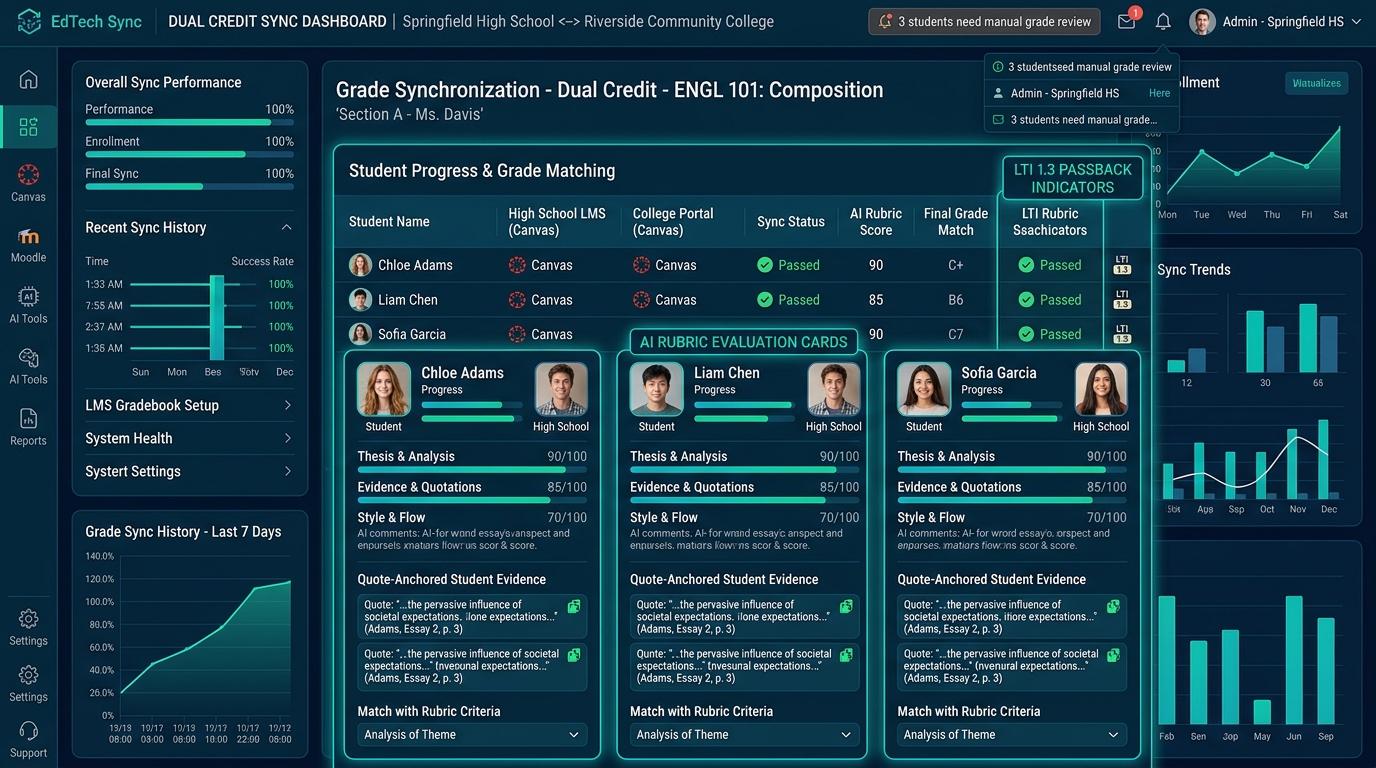
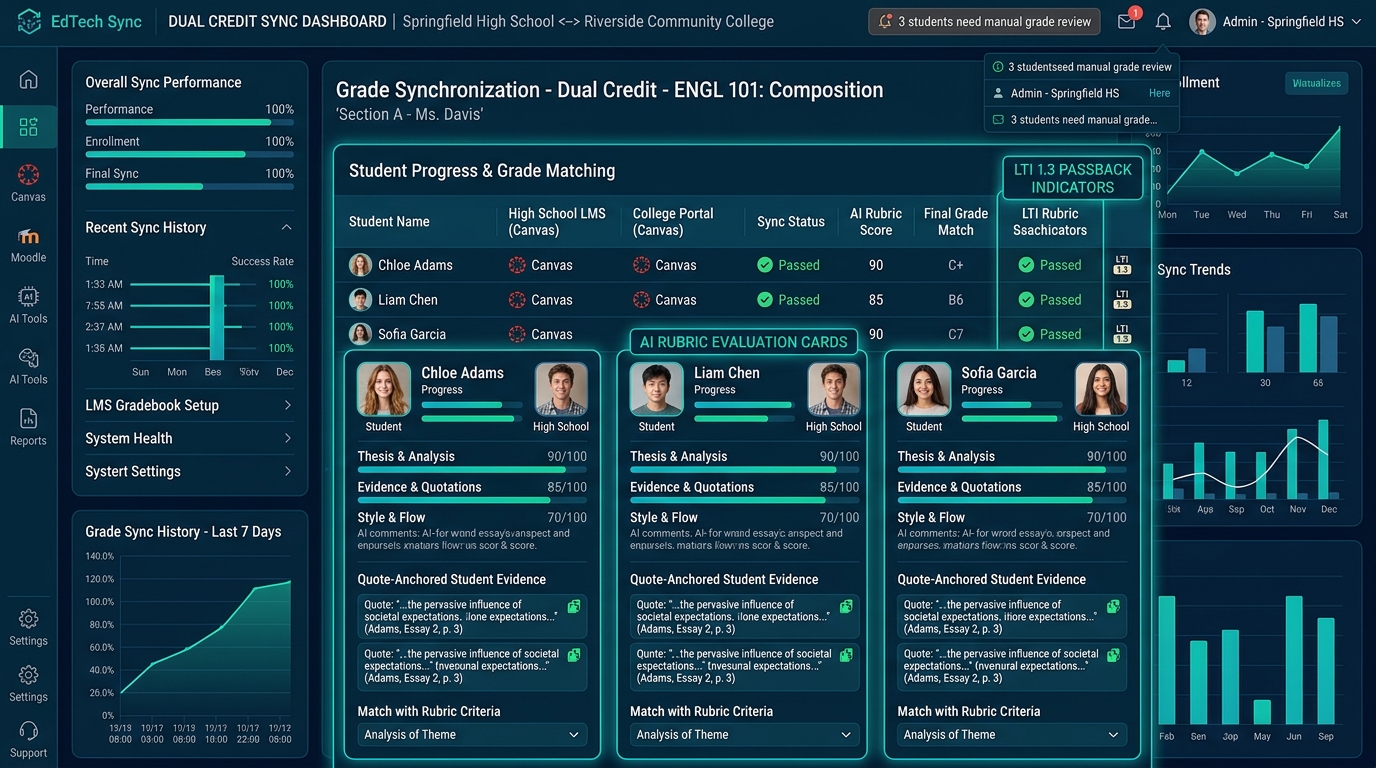
Over 2.5 million high school students across the United States participate in Dual Credit, Concurrent Enrollment, and Early College programs, earning transferable collegiate credits in foundational writing courses such as English 101/102, College Composition, and Advanced Humanities. However, these vital secondary-postsecondary partnerships suffer from a costly operational bottleneck: the multi-LMS dual-gradebook divide. High school adjunct instructors are routinely forced to manually evaluate student writing, calibrate complex collegiate analytic rubrics, and double-enter scores and comments across two isolated Learning Management Systems (e.g., district Google Classroom/Canvas and university Canvas/Buzz LMS/Blackboard). This disconnected workflow creates severe gradebook latency, transcription errors, grading fatigue, and accreditation risks regarding inter-rater reliability.
Checkmark Plagiarism resolves this friction by pairing 1EdTech LTI 1.3 Advantage Dual-Target Passback (leveraging Assignment and Grade Services AGS 2.0 and Names and Role Provisioning Services NRPS 2.0) with an AI-assisted, teacher-in-the-loop rubric evaluation suite. By combining Abstract Syntax Tree (AST) rubric parsing, quote-anchored diagnostic evidence extraction, a pre-flight educator review console, and patent-pending Essay Playback™ keystroke dynamics, Checkmark delivers instant, synchronized rubric evaluations across high school and collegiate portals while preserving authentic collegiate rigor and full teacher authority.
Checkmark Plagiarism streamlines dual-enrollment evaluation workflows by pairing AI autograding with writing process replay, AI detection, plagiarism detection, and deep cross-platform integrations with Canvas LMS, Agilix Buzz LMS, and Google Classroom.
1. The Dual Credit Interoperability Crisis: The Burden of the Multi-Portal Divide
Dual Credit, Concurrent Enrollment, and Early College High School programs represent one of the most transformative equity engines in modern education. By enabling high school students to complete credit-bearing college coursework before high school graduation, these initiatives significantly reduce student loan debt, accelerate degree completion, and build collegiate self-efficacy among first-generation and historically underserved student populations.
In disciplines centered on intensive written scholarship—most notably English 101 (College Composition I), English 102 (Literature and Research), and Dual-Credit US History / Political Science—the integrity and validity of the collegiate credit hinge entirely on rigorous, standardized rubric evaluations. Secondary instructors (frequently credentialed high school teachers serving as collegiate adjunct faculty) are tasked with upholding postsecondary departmental grading criteria while managing high school class loads of 120 to 160 students.
Yet beneath this collaborative academic model lies a glaring technological deficit: the multi-portal infrastructure gap.
High School / K-12 Portal
- LMS: Google Classroom / HS Canvas / Agilix Buzz
- District SIS: PowerSchool / Infinite Campus
- Identity: K-12 District Google Workspace
- Grading Policy: Formative weights, 100-point percentage scale
- Parent Visibility: Real-time parent portal access required
College / Higher Ed Portal
- LMS: Collegiate Canvas / D2L Brightspace / Blackboard
- Collegiate ERP: Ellucian Banner / Colleague / Workday
- Identity: University SSO ID (Shibboleth / Entra ID)
- Grading Policy: Summative analytic rubrics, 4.0 / Letter grades
- FERPA Domain: Adult student-only access (34 CFR § 99.5)
Grade essay → Fill out HS rubric & score → Authenticate to College VPN/MFA → Re-evaluate against College rubric → Re-type qualitative feedback comments → Manually reconcile point conversions.
The Anatomy of the Dual-Gradebook Dilemma
When high school instructors manage dual credit courses, they are caught between two distinct institutional ecosystems that rarely communicate:
- The High School District Ecosystem: Driven by state accountability mandates, district Student Information Systems (SIS) such as PowerSchool or Infinite Campus, and district-managed LMS deployments (Google Classroom, high school Canvas instances, or Agilix Buzz LMS). High school systems prioritize continuous formative updates, standard-based competency tracking, and weekly grade visibility for parents and counselors.
- The Postsecondary Collegiate Ecosystem: Governed by regional accreditation bodies (e.g., Higher Learning Commission [HLC], SACSCOC, WSCUC) and National Alliance of Concurrent Enrollment Partnerships (NACEP) standards. Submissions, rubrics, and final marks must be officially recorded within the college's enterprise LMS (Canvas, Blackboard Learn Ultra, D2L Brightspace) and synced to the university registrar (Ellucian Banner, Colleague, or Workday Student).
Without automated cross-system synchronization, instructors are trapped in a grueling cycle of manual double-entry. An instructor evaluating 60 dual-enrollment research papers must read the essay, score a 5-criterion collegiate rubric in the college LMS, calculate the weighted secondary conversion, log into the high school LMS, fill out the district gradebook, and copy-paste qualitative feedback across both platforms.
This manual redundancy introduces severe systemic vulnerabilities:
- Transcription Discrepancies: Inadvertent data-entry errors lead to conflicting marks between high school transcripts and official college grade reports, triggering fraught parent disputes and registrar audits.
- Formative Feedback Loss: To save time, exhausted instructors often enter detailed feedback only in the high school LMS, leaving the college LMS with blank scorecards that fail postsecondary accreditation audits.
- Calibration Drift & Inflation: Isolated high school adjuncts, lacking real-time collegiate department norming and diagnostic rubric tools, gradually drift from university writing benchmarks, inflating grades on essays that would receive lower marks on campus.
2. Deconstructing the Interoperability Architecture: 1EdTech LTI 1.3 Advantage & Dual-Target Passback
Solving the dual-gradebook challenge requires moving beyond fragile, custom API scripts or third-party web scrapers. The modern standard for secure, standards-compliant educational data exchange is the 1EdTech Learning Tools Interoperability (LTI) 1.3 Advantage framework.
Checkmark Plagiarism leverages a proprietary Dual-Target LTI 1.3 Passback Engine engineered specifically for multi-institutional concurrent enrollment consortia.
• Crosswalk Identity Engine: Maps HS Student SIS ID ↔ University Registrar Banner/SSO ID
• Unified Assignment Context: Binds HS LineItem API ↔ College LineItem API Context
The Core LTI 1.3 Advantage Services in Dual-Target Synchronization
The LTI 1.3 specification separates interoperability into core security and three specialized Advantage services. Checkmark coordinates these services across both secondary and postsecondary endpoints simultaneously:
Security Framework & Multi-Tenant OIDC Authentication
LTI 1.3 replaces deprecated shared-secret signatures with asymmetric OAuth 2.0 / OpenID Connect (OIDC) authentication using JSON Web Tokens (JWT) and JSON Web Key Sets (JWKS).
- When an instructor launches Checkmark from either the high school Canvas shell or the college Canvas/Buzz environment, Checkmark authenticates the user's institutional identity, deployment ID, and authorization scopes.
- Checkmark's Federation Core establishes a cryptographic crosswalk: linking the student's high school profile (e.g.,
student@district.k12.st.us) with their collegiate registration profile (e.g.,student_id@communitycollege.edu), ensuring single-sign-on fidelity without password replication.
Assignment and Grade Services (AGS 2.0 / LineItem API)
Traditional basic grade passback (LTI 1.1) was limited to transmitting a single decimal fraction between 0.0 and 1.0. Under AGS 2.0, Checkmark creates and binds multiple LineItem containers across both LMS portals.
- When an instructor finalizes an essay evaluation, Checkmark executes an atomic dual-target grade passback:
- Pushes official collegiate criterion points, overall scores, and rubric scorecards to the college LMS endpoint (
https://college.instructure.com/api/lti/courses/{course_id}/line_items/{item_id}/scores). - Automatically translates and scales the score according to high school district grading policies (e.g., converting a 4-point collegiate rubric outcome into a 100-point secondary grade scale) and pushes the result to the high school LMS endpoint.
- Injects synchronized, quote-anchored formative feedback comments into the submission comments stream of both learning management systems.
Names and Role Provisioning Services (NRPS 2.0)
NRPS 2.0 automates roster synchronization across institutional domains.
- In dual credit programs, roster discrepancies are common: students may add or drop the high school class without immediately updating the college registrar, or vice versa.
- Checkmark's NRPS 2.0 listener queries both LMS rosters at scheduled intervals, flagging discrepancies (such as a student attending the high school class who is unlisted in the college roster) before grading cycles begin, preventing lost student submissions.
Deep Linking 2.0
Enables secondary instructors or college department coordinators to configure dual-credit writing assignments once and distribute them across multiple district high school sections. Rubric associations, integrity parameters, and grade passback targets are configured upstream, eliminating manual per-teacher setup errors.
3. Comparison Matrix: Grade Passback & Rubric Synchronization Workflows
To understand the operational and pedagogical efficiency of unified LTI 1.3 dual-target passback, examine how different grading workflows compare across key administrative and educational dimensions:
| Architectural Dimension | Manual Double-Entry (Status Quo) | Basic Single-Target LTI (1.1 / Legacy) | Checkmark Dual-Target LTI 1.3 Advantage |
|---|---|---|---|
| Grade Entry Overhead | Severe (140+ hrs/term): Instructors re-enter all scores and comments twice. | Partial (70+ hrs/term): Passes grade to one LMS; second LMS requires manual entry. | Zero Overhead (<5 seconds): Single-click evaluation pushes to both high school and college portals simultaneously. |
| Rubric Criterion Sync | Disconnected: High school gets raw number; college gets manual rubric clicks. | Unsupported: Transmits only monolithic total score; no criterion breakdown. | Full AST Matrix Sync: Pushes individual criterion scores, performance bands, and written rationales to both portals. |
| Formative Feedback Delivery | Fragmented: Long comments typed in HS portal; brief notes in college portal. | Truncated: Single-line text snippet; stripped formatting and quotes. | Quote-Anchored Dossier: Rich, formatted feedback cards tied directly to student text synchronized to both systems. |
| Grading Scale Conversion | Manual Math: Adjunct manually calculates 4-point collegiate to 100-point HS scale. | Error-Prone: Direct percentage passback ignores district weighting policies. | Automated Normalization: Configurable algorithmic translation matching district and collegiate grade scales. |
| Inter-Rater Reliability Audit | Impossible: College deans cannot review high school feedback without manual exports. | Opaque: Deans see single score numbers without diagnostic evidence. | Institutional Dashboard: Aggregated inter-rater calibration matrices and score distributions across all high school sections. |
| Authorship & Integrity Telemetry | Severed: Standalone files stripped of revision history and keystroke data. | Basic Similarity Only: Opaque whole-paper percentage with high false-positive risk. | Patent-Pending Essay Playback™: 1x–8x keystroke replay, 100% paste buffer preservation, and passage-level AI sliders. |
| FERPA Data Protection | Risky: Unencrypted spreadsheets and shared logins used to balance gradebooks. | Variable: Generic cloud caching with potential LLM training exposure. | Zero-Retention Guarantee: Full compliance with FERPA (34 CFR § 99.5) and COPPA; zero model training on student work. |
4. Bridging Secondary and Collegiate Standards: AI-Assisted Rubric Calibration & Norming
Dual credit programs operate under strict accreditation mandates. Organizations such as the National Alliance of Concurrent Enrollment Partnerships (NACEP) and regional accreditors mandate that concurrent enrollment courses must adhere to the identical academic rigor, learning outcomes, and evaluation standards as on-campus sections.
However, high school adjunct instructors frequently face intense local pressures:
- District administrators and parents demanding high pass rates.
- Familiarity with K-12 formative standards that emphasize effort and growth over strict disciplinary conventions.
- Isolation from campus faculty colloquia and departmental norming sessions.
Checkmark Plagiarism solves this calibration challenge through AI-assisted, teacher-in-the-loop rubric evaluation.
• AAC&U VALUE Written Communication
• English 101 Analytic Matrix (5 Criteria)
• 1,800-Word Argumentative Research
• Live Keystroke History & Paste Buffer Telemetry
1. Abstract Syntax Tree (AST) Rubric Parsing
Checkmark accepts any institutional rubric format: uploaded PDFs, Word documents, Canvas rubric exports, or standardized frameworks like the AAC&U VALUE Written Communication Rubric.
- Evaluation Dimensions: Thesis Development, Evidence & Synthesis, Rhetorical Awareness, Structural Cohesion, Conventions & Citation.
- Performance Bands: Advanced (4), Proficient (3), Developing (2), Novice (1).
- Granular Descriptors: Specific disciplinary benchmarks defining each band.
2. Grounded Quote-Anchored Evidence Extraction
Unlike black-box generative AI tools that produce generic praises (e.g., “Good job on your thesis”), Checkmark anchors every evaluation directly in the student's actual prose:
“According to Dr. Smith, technology is bad for teens (Smith 14). Also, Johnson says screens hurt sleep.”
“The draft introduces two relevant scholarly sources but presents them as isolated 'quote drops' without synthesized analysis or dialectical tension. To reach the Proficient (3/4) band, integrate a transitional warrant connecting Smith's findings on cognitive development with Johnson's sleep data.”
3. The Pre-Flight Teacher Review Console
Checkmark firmly rejects fully automated, unattended grading. The Pre-Flight Review Console places the high school adjunct in total command:
- The teacher views the essay in the center pane, the patent-pending Essay Playback™ timeline at the top, and the interactive Rubric Sidebar on the right.
- AI-generated criterion scores and quote-anchored justifications appear as provisional drafts.
- The teacher can validate the recommendation with a single click, adjust points up or down using calibrated stepper controls, or edit the written feedback directly.
- Once approved, the teacher clicks “Finalize & Sync to Both Portals”, initiating the atomic LTI 1.3 AGS 2.0 dual passback.
5. Integrated Multi-Factor Verification: Preserving Integrity Across Borders
A synchronized rubric evaluation is only as valid as the authenticity of the underlying student writing. In dual credit programs—where high school students write on district-issued Chromebooks at home and college deans hold strict academic integrity oversight—educators cannot rely on unverified text or opaque whole-paper AI detection percentages.
Checkmark Plagiarism embeds a comprehensive 5-Pillar Multi-Evidence Dossier into every rubric review:
Patent-Pending Essay Playback™ (Keystroke Timeline)
- Full temporal session reconstruction from first keystroke to final submission.
- Scrub at 1x, 2x, 4x, or 8x speed to observe natural drafting, pauses, rewrites, and edits.
- Distinguishes authentic generative drafting from mechanical transcription (retyping off phone or secondary device).
Immutable External Paste Buffer & Clipboard Tracking
- 100% text preservation of all external paste events with millisecond timestamps.
- Stores original raw pasted content even if the student subsequently rewrites every word.
- “Jump-to-Playback” button navigates directly to the exact millisecond of the paste event.
Passage-Level AI Detection with Calibrated Confidence Sliders
- Underlines specific passages directly in the text with granular linguistic evidence cards.
- Evaluates burstiness, perplexity, and syntax predictability without whole-document scores.
- Honest Guardrails: Automatically displays N/A for short passages under 150 words.
Defensible Side-by-Side Plagiarism Matching
- Scans billions of live web pages, academic repositories, and internal cross-cohort archives.
- Synchronized dual-pane viewer highlights matching student text alongside live source quotes.
- Uncited Source Differentiation: Distinguishes mechanical citation errors from copying.
Restorative Evidence Dossier for High School & College Adjudication
- Generates single-page, tamper-proof PDF audit dossiers for parent and dean conferences.
- Replaces speculative accusations with empirical drafting telemetry (“receipts”).
- Protects honest students falsely accused by generic probabilistic black-box detectors.
Generic AI detectors generate high false-positive rates on formal, structured academic prose—precisely the style high school students are trained to write in college composition courses. When a collegiate honor board receives a generic “78% AI” report on a dual credit submission, the high school student risks severe academic sanctions, loss of transferable credit, and disciplinary marks on their permanent record. With Checkmark, the educator opens Essay Playback™ to review 4.5 hours of authentic writing telemetry: drafting pauses, outlining, sentence restructuring, and localized revisions—definitively exonerating the honest writer.
6. Real-World Case Studies: Dual Credit LMS Synchronization in Action
Statewide 12-High School Consortium
Google Classroom ↔ College Canvas • 1,400 Students
- Challenge: 28 high school adjuncts teaching English 101/102 suffered 3.5-week grading lag and severe calibration drift (HS avg GPA 3.82 vs College 2.94).
- Solution: Deployed Checkmark LTI 1.3 Dual Passback with college's standardized 50-pt analytic rubric and Pre-Flight review console.
- Outcome: Saved 280+ total faculty hours per term; inter-rater reliability jumped from 64% to 92%; grade lag dropped to 2 seconds.
Suburban High School District
HS Canvas ↔ Blackboard / Buzz LMS • 680 Students
- Challenge: Dual-credit US History / Pol Sci faced 45+ parent grade disputes due to errors converting 4.0 collegiate rubrics to 100-pt weighted high school scales.
- Solution: Configured Checkmark automated score scaling engine via AGS 2.0 to push raw 4-pt rubric to Blackboard and weighted % to HS Canvas.
- Outcome: 100% elimination of mathematical transcription errors; successfully defended regional HLC accreditation audit.
AP & Dual Enrollment Hybrid
District Buzz ↔ University Canvas • 320 Students
- Challenge: Instructors had to score essays against both College Board's 6-pt AP Rubric and the University's 100-pt General Ed Matrix.
- Solution: Configured Checkmark Dual-Matrix Evaluator, extracting quote-anchored evidence for both AP sophistication and college synthesis.
- Outcome: Single 4-minute grading session per paper pushed AP diagnostic reports to district and competency outcomes to university registrar.
7. The 4-Phase Dual Credit Calibration and Synchronization Protocol
To ensure seamless technological integration and pedagogical alignment, dual credit partnerships should implement the following 4-Phase Dual Credit Protocol:
Pre-Term Ingestion & Mapping
- Tool Registration: Configure Checkmark as an approved LTI 1.3 Advantage tool across high school and collegiate LMS platforms.
- Roster Crosswalk Binding: Run NRPS 2.0 synchronization to link secondary SIS IDs with collegiate student records.
- Rubric Ingestion: Collegiate Department Chairs upload master English 101/102 rubrics, locking criteria and point scales.
Formative Drafting & Telemetry
- Authentic Drafting: High school students compose in Checkmark or connected Google Docs / Word environments.
- Telemetry Capture: Logs granular keystroke dynamics, typing bursts, drafting pauses, and clipboard paste events.
- Early Interventions: Instructors monitor drafting progress to identify writer's block or structural issues before submission.
AI First-Draft & Teacher Review
- AST Rubric Extraction: Checkmark extracts quote-anchored evidence for each rubric criterion, generating provisional scores.
- Teacher Pre-Flight Console: The high school adjunct reviews suggestions in the side-by-side console.
- Calibrate & Approve: The teacher adjusts scores where necessary, adds personal notes, and approves evaluation.
Atomic Passback & Dean Analytics
- Simultaneous Injection: Atomic AGS 2.0 calls publish scores, criterion breakdowns, and feedback to both LMS portals.
- Department Norming Dashboard: College deans review cross-institutional score distributions and inter-rater reliability.
- Audit-Proof Records: Complete cryptographic logs preserve evidence for NACEP and regional accreditation reviews.
8. Step-by-Step LTI 1.3 Dual-Target Configuration Guide for IT Directors
Step 1: High School LMS Registration
- In HS Canvas/Buzz Admin → Developer Keys → + LTI Key.
- Enter parameters:
Redirect URI: https://api.checkmarkplagiarism.com/lti/launchOIDC Login: https://api.checkmarkplagiarism.com/lti/authJWKS URL: https://api.checkmarkplagiarism.com/lti/jwks.json
- Enable AGS 2.0 (LineItem & Score), NRPS 2.0, and Deep Linking 2.0.
- Save and set Key to ON. Note generated HS Client ID.
Step 2: Collegiate LMS Registration
- In College Canvas/Blackboard/D2L Admin, repeat LTI 1.3 Key creation.
- Assign College Administrative Deployment ID and note College Client ID.
- Log into
admin.checkmarkplagiarism.com→ Dual-Target LTI 1.3 Orchestration. - Click “Add Cross-Institutional Bridge” to bind HS Client ID ↔ College Client ID.
Dual LineItem Passback JSON Payload Sample
{
  "timestamp": "2026-08-19T14:32:00Z",
  "scoreGiven": 46.5,
  "scoreMaximum": 50.0,
  "comment": "<h3>Evaluated via Checkmark AI Rubric Suite</h3><p><strong>Thesis Development:</strong> Advanced (10/10) - <em>'Strong dialectical tension established in paragraph 2.'</em></p><p><strong>Source Synthesis:</strong> Proficient (8.5/10) - <em>'Synthesizes 4 peer-reviewed sources effectively; strengthen transitional warrants.'</em></p>",
  "activityProgress": "Completed",
  "gradingProgress": "FullyGraded",
  "userId": "usr_col_8839201",
  "https://checkmarkplagiarism.com/claims/dual_sync": {
    "secondary_target": {
      "lms": "Canvas_K12",
      "lineitem_id": "hs_lineitem_40912",
      "calculated_score": 93.0,
      "scale": "percentage"
    }
  }
}
9. FERPA, COPPA, and Multi-Jurisdictional Privacy Compliance
Dual credit programs operate at the complex intersection of K-12 and Higher Education privacy laws. Instructional technology directors and academic deans must navigate overlapping federal mandates:
Under federal law (34 CFR § 99.5(a)(1)), when a student attends both a high school and a postsecondary institution through a concurrent enrollment program:
Checkmark's dual-target architecture respects both domains: parent-visible summary cards route to the secondary LMS, while collegiate honor board dossiers and official college records remain restricted to authorized postsecondary evaluators and the student.
Many commercial writing assistants claim broad rights to ingest, store, and train LLMs on student prose—violating FERPA, COPPA, and state student data privacy laws (e.g., California SOPIPA, New York Ed Law 2-D). Checkmark explicitly guarantees Zero Model Training: student essays and district rubrics are processed in isolated enclaves and are never used to train or refine general AI models.
10. Frequently Asked Questions (FAQs)
1. How does Checkmark handle different grading scales between the high school and college LMS?
Checkmark features a built-in, configurable Algorithmic Normalization Engine. During initial LTI 1.3 setup, administrators configure translation mappings between the college's grading framework (e.g., a 4.0 GPA scale, letter grades, or a 50-point AAC&U rubric) and the high school's grading system (e.g., a 100-point percentage scale with honors weighting). When the teacher finalizes an evaluation, Checkmark passes the raw collegiate score to the college LMS and automatically calculates and injects the corresponding scaled grade into the high school LMS.
2. What happens if an instructor adjusts a grade or feedback comment after initial passback?
Checkmark supports dynamic re-synchronization. If a teacher conducts an essay conference with a student and decides to award additional points for a revised draft, the instructor simply updates the rubric in Checkmark's console and clicks “Re-Sync”. Checkmark issues an updated LTI 1.3 AGS 2.0 payload to both LMS endpoints, immediately overwriting the previous scores and comments with a timestamped audit note.
3. Can high school students view collegiate rubric comments if they only have high school LMS credentials?
Yes. Because Checkmark executes dual-target passback, the full, formatted rubric breakdown and quote-anchored formative feedback comments are injected directly into the high school LMS assignment submission stream (e.g., Google Classroom private comments or Canvas SpeedGrader comments). High school students receive the complete collegiate diagnostic feedback without needing separate credentials for the college portal.
4. How does LTI 1.3 maintain secure authentication when the high school and college use different Single Sign-On (SSO) providers?
Checkmark acts as an Identity Federation Broker. The high school district may authenticate via Google Workspace SSO or ClassLink, while the university authenticates via Microsoft Entra ID (Azure AD) or Shibboleth/SAML. Checkmark maps these disparate identity tokens to a single unified student profile using verified SIS/ERP identifiers (such as State Student IDs or collegiate Banner IDs) negotiated during NRPS 2.0 roster sync.
5. What legal documentation or MOU language is required between the school district and college under FERPA?
Dual credit partnerships typically execute a Memorandum of Understanding (MOU) designating Checkmark as a “School Official” with legitimate educational interests under 34 CFR § 99.31(a)(1)(i)(B). The MOU outlines data exchange protocols, zero-retention guarantees, and FERPA dual-jurisdiction handling. Checkmark provides standardized, attorney-vetted MOU addendum templates for district and college legal counsels.
6. How does Essay Playback™ protect dual credit instructors during grade appeals or collegiate academic integrity board hearings?
In traditional programs, high school adjunct instructors struggle to defend grading decisions to skeptical collegiate deans or litigious parents when armed only with static text or controversial whole-document AI percentages. With Checkmark, the instructor exports a Multi-Evidence Dossier containing the patent-pending Essay Playback™ timeline, immutable paste buffer logs, and quote-anchored rubric justifications. This empirical, minute-by-minute drafting provenance (“receipts”) provides indisputable proof of student authorship and grading objectivity.
7. Can collegiate department chairs audit rubric evaluations across multiple high school sections to ensure accreditation compliance?
Yes. Checkmark provides Higher Education Academic Deans and Department Chairs with an Institutional Calibration Dashboard. Chairs can monitor grade distributions, average rubric criterion performance, and inter-rater reliability scores across all participating high school adjunct sections in real time. This data provides the concrete empirical evidence required by accreditation bodies (such as NACEP and HLC) to prove that dual credit courses maintain identical rigor to on-campus sections.
11. Conclusion: Stop Guessing, Start Trusting Across Institutional Borders
The expansion of Dual Credit and Concurrent Enrollment programs is one of the most promising developments in modern education. Yet forcing educators to bridge the high school-college divide through exhausting manual double-entry and uncalibrated grading undermines both teacher sustainability and collegiate academic rigor.
By deploying Checkmark Plagiarism's AI-Assisted Rubric Autograding and LTI 1.3 Dual-Target Synchronization Suite, educational institutions achieve a unified, transparent, and defensible writing ecosystem:
- High School Instructors save hundreds of hours of duplicative administrative grading while receiving objective, quote-anchored AI assistance.
- Collegiate Deans & Department Chairs maintain strict accreditation standards and inter-rater reliability across all concurrent enrollment sections.
- High School & College Registrars eliminate transcription errors through instant, atomic gradebook synchronization across disparate LMS platforms.
- Honest Students receive rich, timely formative feedback and enjoy complete authorship protection powered by patent-pending Essay Playback™ telemetry.
Stop guessing, start trusting.
Eliminate the dual-gradebook divide and elevate your dual credit writing programs today.