
Executive Summary
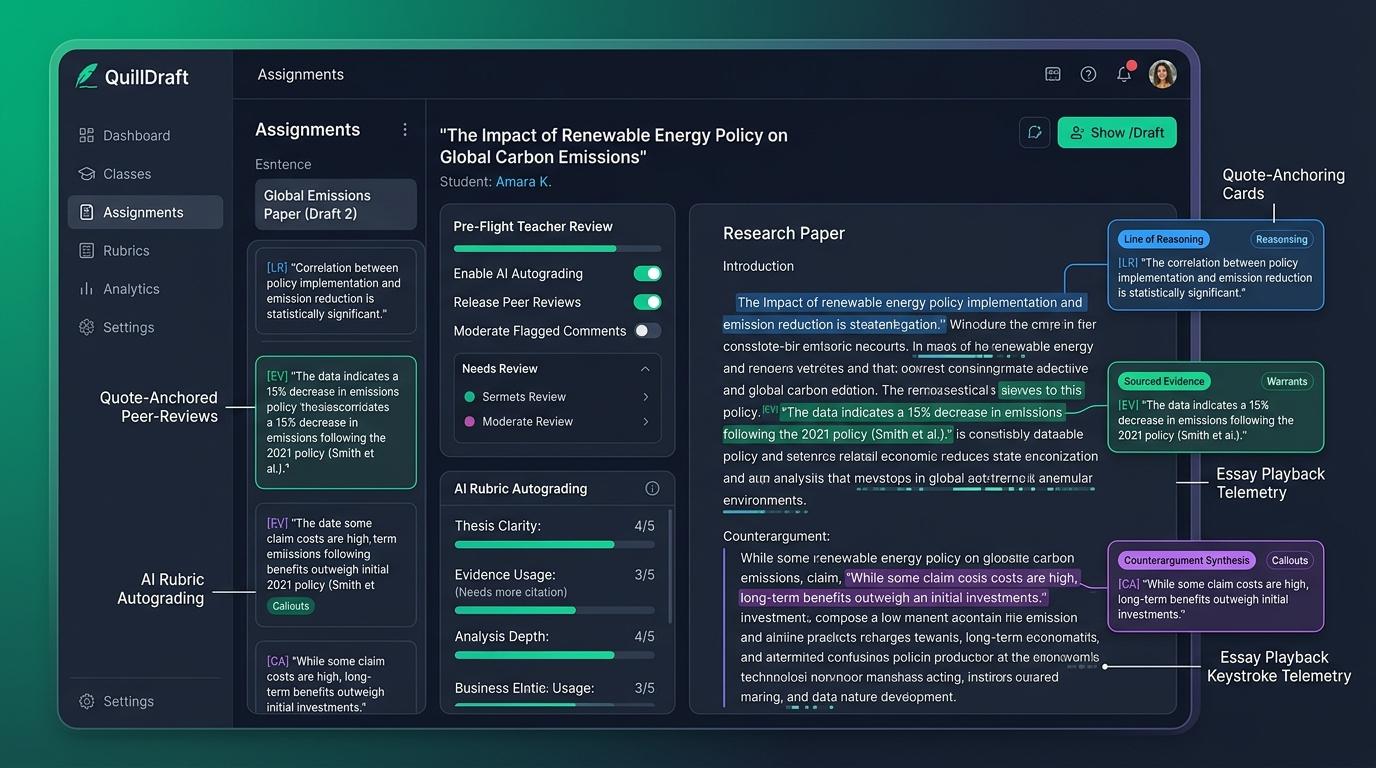
Multi-draft research papers (1,500 to 4,000 words) represent the pinnacle of student inquiry in Advanced Placement (AP) Capstone courses, high school humanities sequences, and college composition programs. Yet educators face an intractable formative assessment bottleneck: unguided peer-review workshops routinely devolve into superficial proofreading—students hunt for misplaced commas while overlooking fractured lines of reasoning and weak evidentiary synthesis—because novice reviewers lack structural diagnostic tools, and instructors cannot manually annotate 140 rough drafts overnight. Checkmark Plagiarism resolves this crisis through a Dual-Feedback Scaffolding Architecture. By deploying Teacher-Controlled AI Rubric Autograding powered by Abstract Syntax Tree (AST) rubric parsing, Checkmark extracts grounded, quote-anchored diagnostics (identifying exact sentences for 🔵 Line of Reasoning, 🟢 Sourced Empirical Warrants, and 🟣 Synthesized Counterarguments) and delivers them to a Pre-Flight Educator Review Console. Once validated by the teacher in minutes, these objective diagnostic cards prime student peer reviewers, elevating classroom collaboration from passive proofreading to rigorous macro-structural critique. Coupled with patent-pending Essay Playback™ (1x–8x keystroke replay with 100% paste buffer preservation) and two-way 1EdTech LTI 1.3 gradebook passback for Canvas, Buzz LMS, and Google Classroom, educators can dramatically accelerate formative writing cycles while safeguarding authentic scholarship.
1. The High-Volume Formative Assessment Crisis in Multi-Draft Writing
Across high school English departments, Advanced Placement (AP) Seminar and Research courses, and university writing programs, the multi-draft research paper is universally recognized as the gold standard for developing critical thinking, rhetorical agility, and scholarly independence. Whether students are composing the 2,000-word Individual Written Argument (IWA) for AP Seminar, a 4,000- to 5,000-word AP Research Academic Paper, a capstone historical investigation, or a First-Year Composition (FYC) argumentative synthesis, genuine mastery emerges through iterative drafting.
However, orchestrating meaningful revision cycles across large student cohorts presents an agonizing pedagogical paradox:
- ✓ 3 to 4 iterative drafting cycles per research paper
- ✓ Immediate, formative structural feedback on Draft 1
- ✓ Deep, metacognitive peer dialogue on lines of reasoning
- ✓ Substantive macro-revisions on Drafts 2 and 3 before grading
- ✗ 140 students × 2,500 words = 350,000 words
- ✗ Manual teacher scoring: 25–40 minutes per draft
- ✗ 60–90 hours of grading backlog per assignment
- ✗ Unguided peer review collapses into superficial typo-hunting
The Math Behind the 140-Draft Avalanche
Consider the typical workload of a secondary humanities teacher or college writing instructor:
- Cohort Size: 4 to 5 class sections totaling 120 to 150 students.
- Draft Scope: A 2,000- to 3,000-word analytical research paper synthesizing 10 to 20 secondary sources.
- Total Word Volume: 300,000 to 450,000 words of student writing submitted simultaneously at the Draft 1 milestone.
- Evaluation Velocity: Reading a complex research draft, validating in-text citations against a bibliography, mapping logical claims, and writing constructive rubric commentary requires 25 to 35 minutes per student for seasoned evaluators.
- The Aggregate Deficit: Scoring 140 drafts requires 60 to 80 hours of uninterrupted teacher labor.
If a teacher attempts to provide comprehensive written feedback before the scheduled peer-review workshop, drafts sit in a grading backlog for two to three weeks. By the time students receive their marked-up papers, the classroom has moved on to the next unit, the intellectual momentum is lost, and students merely accept the grade rather than engaging in authentic, exploratory revision.
"Write, revise, amend, or correct anything that is part of, or contributes to, the final work submitted for assessment." (listed under what teachers must not do)
Source: AP Seminar Course and Exam Description (College Board, effective Fall 2024), "Role of the Teacher." The same table also bars teachers from providing specific, directive feedback to individuals or groups, while allowing them to direct students to the rubric areas where work may need improvement and to provide guidelines for peer-to-peer review and feedback. Because teachers cannot revise the work themselves, structured, rubric-guided peer review on rough Draft 1 is one of the main supports students can get while their argument is still taking shape. Missing this window leaves structural flaws in place when the final work is submitted.
2. Anatomy of the "Superficial Peer-Review" Breakdown
To bypass the overnight grading bottleneck, educators have historically relied on in-class peer review workshops. The theoretical rationale is sound: peer review promises active learning, metacognitive reflection, exposure to diverse argumentative models, and collaborative problem-solving.
In practice, however, unguided peer review in high school and undergraduate classrooms almost universally collapses into superficial proofreading.
Sweller's Cognitive Overload
Reviewers cannot track macro-structure (logic, source synthesis) while simultaneously decoding raw prose. Novice readers default to low-effort micro-level proofreading (hunting typos) to conserve mental bandwidth.
Social Hesitancy & "Rubber-Stamping"
Students fear social conflict or offending classmates. They offer non-committal praise ("Looks great! Flows well!") rather than pointing out missing warrants or unverified claims.
Lack of Diagnostic Vocabulary
Novice writers sense that an essay "feels confusing" but lack the analytical metalanguage to diagnose a non-sequitur transition, an ungrounded warrant, or an isolated citation string ("quote-bombing").
"The Blind Leading the Blind"
When two struggling writers are paired without objective rubric anchors, misconceptions compound rather than resolve. Students confirm each other's faulty interpretations of assignment criteria.
3. The Dual-Feedback Scaffolding Model: AI Diagnostics + Human Peer Collaboration
The solution to the peer-review crisis is not to eliminate human collaboration, nor is it to replace teachers with automated grading algorithms. Rather, the solution lies in a hybrid pedagogical framework: The Dual-Feedback Scaffolding Model.
Identifies thesis, claim nodes & transition gaps
Underlines empirical warrants & verifies attribution
Evaluates rebuttal logic & alternative viewpoints
- • Verbatim quote-anchored evidence cards
- • Flags ungrounded assertions & isolated citations
- • Dynamic peer discussion coaching questions
- • Debates real-world stakeholder impact
- • Interrogates persuasive resonance and tone
- • Brainstorms creative argumentative solutions
The Division of Evaluative Labor
By establishing a clear, intentional division of evaluative labor between automated diagnostic intelligence, peer dialogue, and teacher supervision, the Dual-Feedback Scaffolding Model maximizes the strengths of each participant:
1. AI Rubric Engine
Objective Structural Baseline
- • Executes computational heavy lifting instantly across 140 drafts.
- • Deconstructs complex analytic rubrics via AST parsing.
- • Highlights exact sentences fulfilling Line of Reasoning, Evidence, and Counterargument criteria.
- • Generates open-ended peer coaching questions.
2. Student Peer Reviewer
Subjective & Rhetorical Dialogue
- • Relieved of the cognitive burden of manually searching for structure.
- • Uses AI diagnostic cards as a roadmap to dive straight into substantive debate.
- • Evaluates tone, real-world feasibility, and persuasive resonance.
- • Co-creates concrete revision solutions with the author.
3. Classroom Teacher
Pedagogical Calibration & Final Authority
- • Reviews AI diagnostic suggestions in a rapid 10-minute Pre-Flight Batch Console.
- • Calibrates rubric weighting to align with current instructional focus.
- • Conducts targeted 3-minute mini-conferences with struggling writers.
- • Retains 100% sovereign grading authority over all scores.
Comparative Evaluation Matrix
| Evaluative Dimension | Traditional Unguided Peer Review | Fully Autonomous AI Grading | Checkmark Scaffolded Peer Review |
|---|---|---|---|
| Turnaround Velocity | 1 to 2 class periods | Instant (Seconds) | Instant AI generation + 10-min Teacher Moderation |
| Structural Diagnostic Depth | Very Low (Focuses on typos & formatting) | High (Pattern matching), but opaque | Extremely High (Quote-anchored AST rubric extraction) |
| Rhetorical & Human Resonance | Moderate (When students talk, but unguided) | Zero (Machine lacks reader empathy) | Exceptional (AI scaffolds deep peer intellectual dialogue) |
| Teacher Time Required | Zero upfront, but 60+ hrs post-workshop | Zero (Completely hands-off) | 10–15 minutes batch pre-flight review |
| Student Agency & Metacognition | Low (Blind leading the blind) | Low (Passive receipt of machine output) | Very High (Collaborative discovery & active debate) |
| Grading Transparency & Trust | Variable & subjective | Black-box score / percentage | 100% transparent "receipts" tied to prose |
| Integrity & Process Telemetry | None (Inspects static file only) | None (Analyzes text snapshot) | Integrated Essay Playback™ (1x–8x keystroke dynamics) |
4. Preserving Teacher Agency: Why Autonomous AI Grading Fails and Teacher-in-the-Loop Triumphs
In recent years, several educational technology vendors have proposed fully autonomous, "black-box" AI grading platforms that ingest student essays, calculate an automated letter grade, and post scores directly to the learning management system (LMS) without educator intervention.
Checkmark Plagiarism rejects autonomous grading categorically.
Stripping teachers of grading agency reduces master educators to administrative proctors. Teachers understand classroom context, student growth trajectories, IEP/504 accommodations, and assignment nuances that no language model can perceive.
When students realize an unmonitored algorithm is assigning their grades, they quickly learn to "game" the system. They insert complex transition words ("Furthermore," "Notwithstanding") and inflate vocabulary to trigger positive heuristic scores without conveying genuine meaning.
Large language models running without rigid semantic constraints can hallucinate justifications, praising non-existent sources or penalizing unconventional yet brilliant rhetorical structures.
Submitting high-stakes academic grades generated solely by unmoderated algorithms exposes school districts and universities to severe accreditation challenges, FERPA complaints, and parental appeals.
5. Checkmark Plagiarism’s AI Rubric Autograding & Diagnostic Engine
Checkmark’s autograding architecture is engineered specifically for complex, multi-layered research papers. Rather than running generic text prompts through a basic conversational model, Checkmark utilizes a multi-stage, deterministic pipeline designed for academic rigor and zero hallucination.
Assignment Ingestion
Syncs assignment criteria and analytical rubrics directly from Canvas, Buzz, or Google Classroom.
AST Decomposition
Deconstructs rubrics into hierarchical semantic nodes: Line of Reasoning, Evidence Synthesis, Counterarguments.
Quote Extraction
Extracts exact student sentences matching rubric criteria with color-coded vector anchors.
Peer Prompt Generation
Generates targeted, open-ended coaching prompts tethered directly to the student's extracted sentences.
Pre-Flight Review
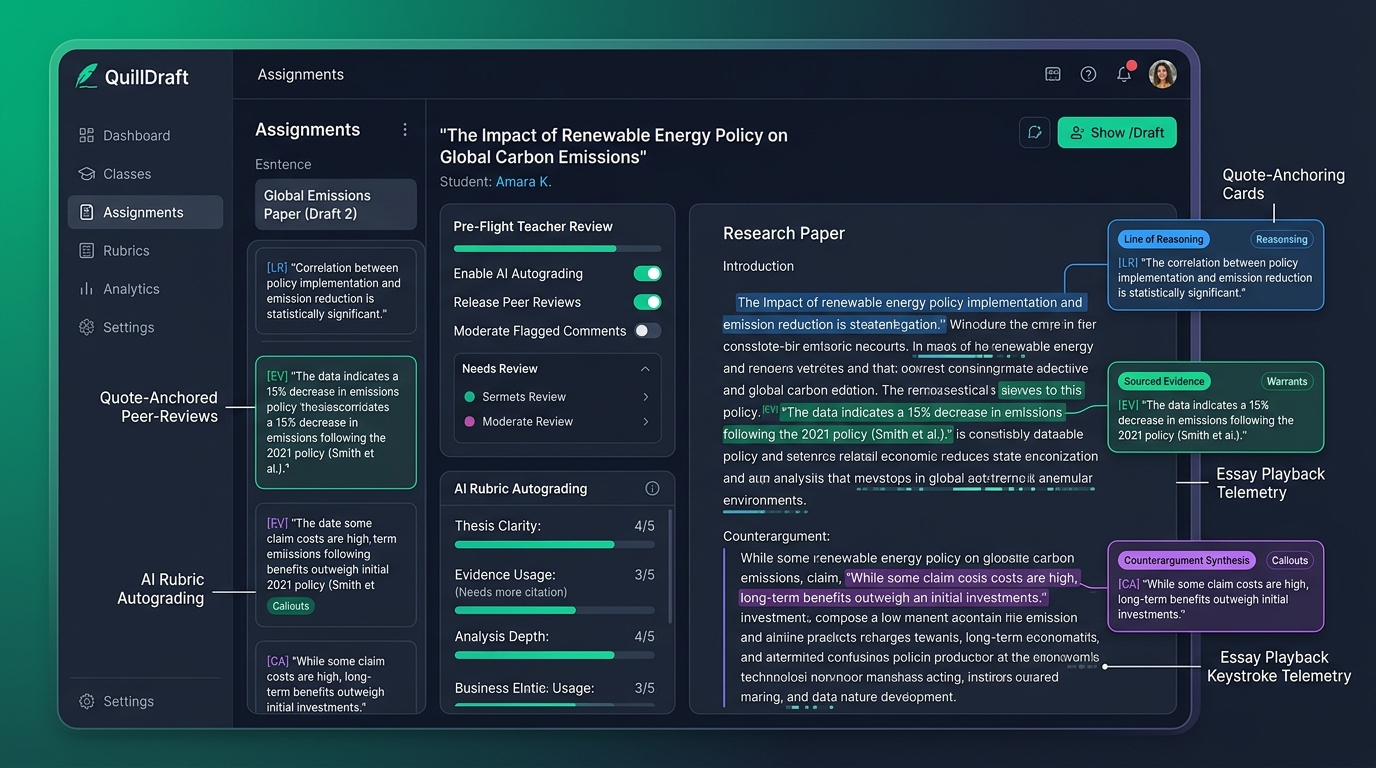
Teacher moderates, edits, and approves all diagnostic cards in a rapid 10-minute batch dashboard.
LTI 1.3 Passback
Two-way synchronization pushes approved annotations into Canvas SpeedGrader or Buzz LMS.
1. Abstract Syntax Tree (AST) Rubric Parsing
Standard AI tools struggle with analytical rubrics because they treat complex rubrics as flat text blocks. Checkmark transforms multi-trait rubrics—such as the AP Capstone performance task rubrics, the AAC&U VALUE Written Communication rubric, or state 6-trait writing standards—into structured Abstract Syntax Trees (ASTs):
{
  "rubric_ast": {
    "title": "Example Analytic Rubric (illustrative)",
    "nodes": [
      {
        "row_id": "ROW_2_REASONING",
        "name": "Line of Reasoning",
        "max_score": 6,
        "eval_logic": {
          "level_high (6)": "Cohesive progression of claims with explicit causal connectors between all major premises",
          "level_med (4)": "Identifiable line of reasoning; occasional abrupt transitions or unsupported sub-claims",
          "level_low (2)": "Disjointed claims; loose topical association without deductive or inductive progression"
        },
        "extraction_target": "causal_connectors_and_claim_bridges",
        "color_code": "#2563EB"
      },
      {
        "row_id": "ROW_3_EVIDENCE",
        "name": "Evidence and Sourcing",
        "max_score": 6,
        "eval_logic": {
          "level_high (6)": "Synthesizes multiple credible academic sources; contextualizes author credentials and methodology",
          "level_med (4)": "Cites credible sources but presents evidence in isolation (quote-bombing) without synthesis",
          "level_low (2)": "Relies on non-credible popular sources or makes unverified empirical assertions"
        },
        "extraction_target": "citation_integration_and_synthesis_bridges",
        "color_code": "#059669"
      }
    ]
  }
}
2. Grounded Quote-Anchored Evidence Extraction
Unlike generic AI tools that provide vague summaries ("Your evidence is good"), Checkmark enforces strict quote anchoring. For every rubric criterion, the engine highlights the exact student sentences that satisfy or fall short of the standard, creating an interactive evidence card in the document sidebar:
Structural Analysis: This causal conclusion is introduced without an antecedent warrant explaining municipal financing mechanisms.
Guided Peer Prompt: "Ask the author: How does the municipal tax base support this subsidy without cutting other civic services? Have them show you where in Paragraph 3 that fiscal bridge is established."
Attribution Gap: Unattributed statistic dropped without lead-in credentials or institutional methodology.
Guided Peer Prompt: "Ask the author: Who conducted this study, and under what climate conditions? Help them draft an attribution frame (e.g., 'According to a [year] field trial by [named research organization]...')."
Nuance Deficit: Dismissive strawman rebuttal that fails to acknowledge upfront equipment and electrical panel upgrade costs.
Guided Peer Prompt: "Challenge the author to treat the cost objection seriously: What upfront grid modifications must homeowners make before installation? How does the payback period vary by climate zone?"
6. The Multi-Factor Integrity Triad in Multi-Draft Research
Accelerating multi-draft peer review with AI diagnostics creates a new challenge: How do educators ensure that student writing remains authentically human and rigorously cited?
If students use unauthorized generative AI to compose their rough drafts, peer-review workshops become meaningless exercises in evaluating machine output. Conversely, if schools rely on inaccurate "black-box" AI detectors, honest students who spend 30 hours researching in the library risk being falsely accused based on arbitrary percentage scores.
Checkmark Plagiarism solves this through its Multi-Factor Integrity Triad, uniting writing process telemetry, passage-level AI detection, and side-by-side plagiarism matching:
1. Essay Playback™
Writing Process Telemetry
- • 1x to 8x Variable Playback: Scrub through the drafting session like a video.
- • 100% External Paste Buffer Capture: Records original clipboard content timestamped in the dashboard.
- • Transcription Rhythm Alert: Flags mechanical re-typing from second screens.
- • Student Exoneration: Provides concrete physical proof of human authorship.
2. Passage-Level AI Detection
Calibrated Confidence Sliders
- • No Bogus Whole-Paper Scores: Underlines isolated passages rather than assigning a total % number.
- • Perplexity & Burstiness: Evaluates lexical diversity and syntactic cadence.
- • <150w Honest Guardrail: Displays honest
N/Adisclaimer on short text snippets. - • Educator-Only Flag Statuses: Keeps flags private to prevent student anxiety.
3. Defensible Plagiarism Match
Side-by-Side Source Dissection
- • Billions of Web Pages & Journals: Side-by-side comparison with live URL links.
- • Uncited Source Differentiation: Separates intentional plagiarism from accidental citation formatting errors.
- • Cross-Cohort Comparison: Identifies unauthorized peer sharing across class sections.
7. The 4-Phase Scaffolding Peer-Review Protocol
To implement teacher-controlled autograding seamlessly in high school and college classrooms, educators can follow this turnkey, 4-phase protocol across a standard 2-day multi-draft revision unit:
Draft 1 Ingestion & Teacher Pre-Flight Calibration
- • Students submit Draft 1 (1,500–3,000 words) via Canvas, Buzz, or Google Classroom.
- • Checkmark parses the assignment rubric, tags quote anchors, and generates peer discussion questions.
- • Teacher opens Pre-Flight Console, moderates suggested diagnostic cards, and adjusts focus criteria for the workshop.
Student Individual Diagnostic Triage
- • Author opens their private Checkmark Diagnostic Report.
- • Author reviews highlighted structural nodes (🔵 Logic, 🟢 Evidence, 🟣 Counterarguments).
- • Author writes two self-identified "Revision Focus Questions" on their Peer Coaching Sheet before handing it to their partner.
Quote-Anchored Peer-Review Workshop
- • Reviewers pair up; reviewer opens author's draft with AI diagnostic cards enabled.
- • Reviewer utilizes Checkmark's Guided Peer Discussion Prompts to interrogate claims and test reasoning.
- • Reviewer completes the Peer Review Coaching Worksheet, citing specific paragraph anchors.
Targeted Revision Sprint & Mini-Conferences
- • Teacher conducts rapid 3-minute mini-conferences with students showing critical structural gaps.
- • Students execute macro-revisions on Draft 2 in the Checkmark-enabled editor.
- • Essay Playback™ logs authentic revision history leading into final submission.
8. Turnkey Classroom Tool: The Quote-Anchored Peer Review Coaching Worksheet
Teachers can distribute this reproducible, high-impact worksheet to guide student reviewers during Phase 3 workshops:
Reproducible Formative Revision Guide for Grade 10–12 & Higher Education
1. Locate the 🔵 Blue Thesis Highlight in the Author's Introduction:
2. Checkmark Line-of-Reasoning Transition Audit:
3. Source Credibility & Contextualization:
4. Multi-Source Synthesis Check:
5. Counterargument & Rebuttal Rigor:
9. Data Privacy, Ethics, and FERPA/COPPA Compliance
When introducing artificial intelligence into formative assessment and peer review workflows, educational leaders must uphold the highest standards of data security, student privacy, and ethical compliance.
Student essays, drafts, keystrokes, and peer annotations are NEVER used to train, fine-tune, or improve public or commercial language models.
100% compliant with Family Educational Rights and Privacy Act (FERPA), COPPA, and state Student Data Privacy agreements.
Encrypted with TLS 1.3 in transit and AES-256 at rest. Role-Based Access Controls (RBAC) keep diagnostic flags strictly private to educators.
School District AI Vendor Compliance Audit Checklist
Before procuring any AI-assisted autograding or plagiarism detection platform, district technology directors, CFOs, and academic integrity officers should verify the following 5 requirements:
10. Frequently Asked Questions (FAQs)
Q1: Does providing AI rubric feedback before peer review make students intellectually lazy or over-reliant on the machine?
No. The workflow is designed to do the opposite. When novice students are thrown into unguided peer review without structural scaffolding, they experience cognitive overload and retreat into passive proofreading (fixing commas). By providing an objective structural baseline (identifying where the line of reasoning is clear or where evidence is missing), Checkmark relieves cognitive strain and empowers students to engage in higher-order critical debate, challenging each other's assumptions and refining rhetorical tone.
Q2: How does Checkmark ensure that the AI autograder does not hallucinate rubric justifications?
Checkmark enforces strict Abstract Syntax Tree (AST) deterministic parsing and grounded vector matching. The engine is mathematically prohibited from generating feedback comments that are not tethered directly to verbatim, extracted student sentences. If a student's paper lacks evidence for a particular rubric criterion (e.g., no counterargument is present), Checkmark highlights the absence rather than fabricating a fictional justification.
Q3: How do teachers prevent students from blindly accepting AI peer prompts without critical thinking?
In Checkmark's 4-Phase Protocol, the AI generates coaching questions, not ready-made answers. Prompts are deliberately designed around open-ended inquiry (e.g., "Ask the author how Source B directly challenges the empirical findings of Source A in Paragraph 3"). The student reviewer must read the text, discuss the question verbally with the author, and co-create an original revision strategy recorded on their worksheet.
Q4: Can this workflow be adapted for shorter middle school essays or responses under 1,000 words?
Yes. Checkmark's AST Rubric Engine supports any customized analytic rubric, including standard 6-Trait writing scales, Claim-Evidence-Reasoning (CER) scientific explanations, and Document-Based Questions (DBQs). For shorter assignments (500–1,000 words), the Pre-Flight review time drops to under 5 minutes per class cohort, allowing middle school team leads to run rapid, same-day diagnostic revision sprints. (Note: For passages under ~150 words, Checkmark maintains an honest N/A guardrail on statistical AI writing detection to eliminate false positives).
Q5: What happens if a student writes their essay in an external tool and pastes the entire text into the editor at once?
Checkmark’s patent-pending Essay Playback™ detects large external paste events instantly. When an external paste occurs, Checkmark captures 100% of the original clipboard text in the teacher dashboard with a timestamp. If the student drafted the essay authentically in another approved tool (e.g., Microsoft Word or Scrivener), the teacher can request the external revision history or conduct a brief restorative conversation using the paste timeline as an objective reference anchor.
Q6: How does 1EdTech LTI 1.3 grade passback work with Canvas SpeedGrader and Buzz LMS?
Checkmark establishes an encrypted, two-way LTI 1.3 Advantage connection with your LMS. When an educator completes their Pre-Flight moderation in Checkmark, verified rubric criterion scores, quote-anchored margin annotations, and overall point totals sync directly into Canvas SpeedGrader or Buzz LMS with a single click. Students access their rich, interactive feedback directly within their familiar LMS portal.
Q7: How does this system protect non-native English speakers (ELL / ESL) from biased evaluation?
Generic whole-document AI detectors and traditional grammar checkers frequently penalize non-native English writers due to predictable syntax structures, lower lexical perplexity, and minor prepositional irregularities. Checkmark protects ELL/ESL scholars by separating grammar from structural argumentation (evaluating reasoning, source synthesis, and logical progression independently of grammatical perfection) and verifying writing process proof via Essay Playback™ keystroke dynamics.
11. Conclusion & Strategic Implementation Roadmap for Educational Leaders
Accelerating multi-draft research writing is the single most effective intervention schools can make to elevate student intellectual achievement. By pairing Teacher-Controlled AI Rubric Autograding with collaborative peer review and transparent writing process telemetry, institutions can eliminate the 80-hour grading bottleneck, energize classroom workshops, and build a culture of authentic scholarship.
Ready to Transform Multi-Draft Research Assessment Across Your Institution?
Experience the power of Teacher-Controlled AI Rubric Autograding, Quote-Anchored Peer Review Scaffolding, and patent-pending Essay Playback™ writing telemetry.