
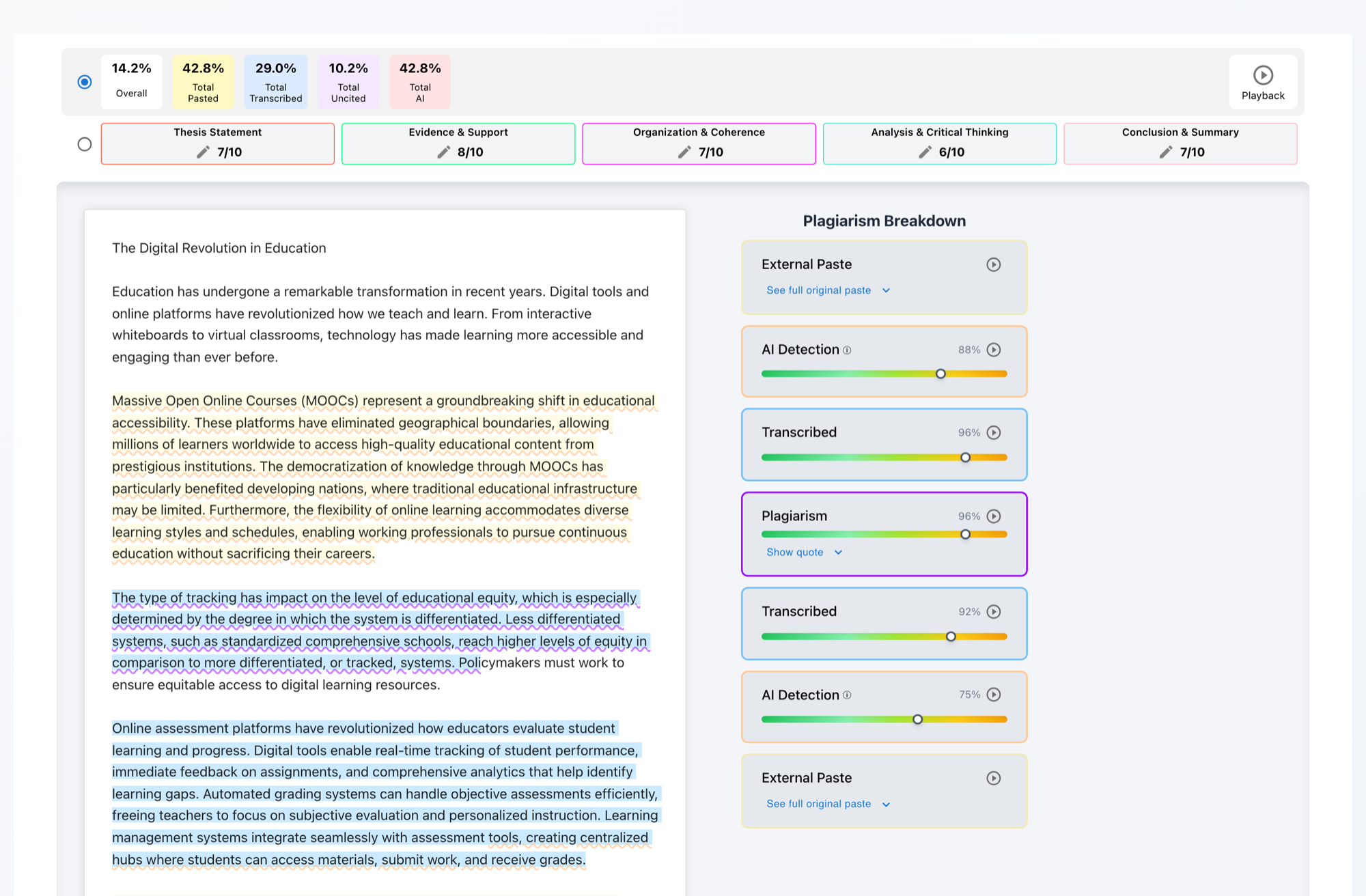
Capstone projects, senior honors theses, and master’s dissertations represent the pinnacle of student scholarly inquiry. Yet, when evaluated through legacy plagiarism scanners, their extensive 15-to-30-page literature reviews routinely trigger alarming aggregate similarity scores (e.g., 28% to 45%). These monolithic percentages fail to distinguish between intentional copy-paste fraud, legitimate disciplinary terminology, and uncited patchwriting—a well-documented developmental phase where novice researchers mimic source syntax while grappling with dense academic discourse. For department chairs and integrity committees, this creates crippling administrative bottlenecks, contentious disputes, and demoralizing false accusations. Checkmark Plagiarism resolves this systemic crisis through its Multidimensional Plagiarism Matching Architecture. By decoupling uncited source matches (🟡 Amber) from direct uncredited plagiarism (🔴 Red) and peer cohort matches (🟣 Purple), synchronizing live two-pane source comparisons with DOI resolution, and corroborating text with patent-pending Essay Playback™ keystroke dynamics and granular passage-level AI detection, Checkmark provides defensible, objective evidence (“receipts”). This guide outlines the theoretical foundations of patchwriting (Howard’s Citation Project, Swales’ Move Analysis), details Checkmark’s multi-factor verification engine, and provides department chairs with a comprehensive 4-Phase Triage Protocol to uphold rigorous standards while fostering authentic scholarly growth.
Checkmark Plagiarism provides academic leadership with an integrated, enterprise-grade integrity suite uniting multidimensional plagiarism detection, keystroke writing process replay, passage-level AI writing detection, and quote-anchored rubric autograding with seamless grade passback for Canvas LMS, Buzz LMS, and Google Classroom.
1. The Capstone Crisis: Why Monolithic Similarity Scores Paralyze Capstone Programs
In higher education institutions, secondary AP Capstone programs, and graduate divisions, the submission of a culminating thesis or capstone project marks a critical milestone. A standard undergraduate or master’s capstone is an exhaustive undertaking: 15 to 40 pages of multi-disciplinary synthesis, empirical analysis, and theoretical framing, supported by 30 to 80 primary and secondary scholarly citations.
However, when these substantial manuscripts are ingested by legacy plagiarism checkers, the evaluation process frequently devolves into administrative paralysis.
How monolithic scoring algorithms collapse valid scholarship and developmental learning into false fraud alarms
52 Peer-Reviewed Journal Citations • Complex Theoretical Synthesis • Disciplinary Literature Review
- 16% Properly cited block quotes & APA parenthetical citations
- 8% Standard methodological formulas, statistical collocations & terms
- 4% Works Cited bibliography & journal DOI metadata headers
- 6% Developmental Uncited Patchwriting (Novice syntax mimicry in Literature Review)
- 0% Intentional, malicious cut-and-paste academic fraud
- Automated graduation hold placed on candidate degree audit
- Department Chair receives formal student grievance and escalation
- Faculty advisor spends 6+ hours manually cross-referencing journal PDFs
- Honor Council docket backlog expands with false-positive inquiries
- Student experiences acute emotional trauma and research discouragement
The Breakdown of Aggregate Mathematical Scoring
Legacy plagiarism checkers evaluate authenticity through a rudimentary mathematical formula: calculating the raw percentage of overlapping word strings (n-grams) against an indexed database of web pages, publisher archives, and institutional repositories:
While this calculation is computationally trivial, it is pedagogically and diagnostically bankrupt when applied to capstone-level scholarship. In a 30-page literature review, a 34% similarity index collapses entirely disparate textual phenomena into a single alarming red metric:
Accurately punctuated, block-indented, and attributed excerpts from foundational theoretical texts.
Standardized nomenclature (e.g., “randomized double-blind placebo-controlled trial”) that cannot be altered without error.
Institutional signature sheets, formatted reference lists, journal DOIs, and appendix table titles.
Struggling student restructures source sentences with close synonym swaps while omitting quotation marks or immediate cites.
Intentional, uncredited cut-and-paste copying of unique analysis, original conclusions, or creative synthesis from unacknowledged external manuscripts.
The Administrative Gridlock for Department Chairs
When academic departments mandate rigid arbitrary cutoffs—such as flagging any submission exceeding a 15% or 20% similarity threshold—department chairs and integrity committees face severe administrative challenges:
Disproportionate Faculty Labor
Faculty advisors spend countless hours manually cross-referencing matched passages against PDF journal articles to confirm whether a 28% score represents rigorous scholarship or deliberate misconduct.
Adversarial Chilling Effect on Student Research
Fearful of triggering automated similarity alarms, capstone students delete critical literature review citations, distort academic vocabulary using unnatural synonyms, or avoid primary literature altogether.
The “Sophisticated Cheating” Blind Spot
While legacy scanners generate false alarms on thorough, heavily cited papers, they routinely assign low similarity scores (e.g., 4% to 8%) to contract-cheated papers, synonym-spun text from essay mills, and unmonitored generative AI.
Criminalization of Novice Discourse
Treating developmental citation lapses as formal honor code violations creates an adversarial campus climate that penalizes emerging scholars, particularly first-generation college students and non-native English speakers.
To restore integrity to the capstone adjudication process, academic leadership must replace single-score legacy checkers with a multidimensional analysis platform that isolates the underlying mechanics of student writing.
2. Theoretical Foundations: Why Novice Researchers Patchwrite
To establish fair and effective capstone evaluation policies, department chairs and faculty advisors must ground their integrity frameworks in established writing research. For decades, composition scholars and applied linguists have demonstrated that sentence-level textual borrowing is rarely an act of moral deviance; rather, it is a predictable cognitive phase in academic development.
Mapping academic discourse acquisition from mechanical reproduction to autonomous theoretical synthesis
Verbatim theft of source text; zero original intellectual processing; deliberate deception designed to bypass assignment requirements.
Syntactic mimicry and synonym substitution; student relies on source structure to navigate unfamiliar concepts; indicates cognitive overload during discourse acquisition.
Accurate conceptual attribution, occasional reliance on block quotes; emerging distinct voice with proper citation mechanics.
Autonomous conceptual synthesis; integrates multiple conflicting theories into an original scholarly voice; seamless execution of disciplinary rhetorical moves.
Rebecca Moore Howard and The Citation Project
In her 1992 article “A Plagiarism Pentimento” (Journal of Teaching Writing, vol. 11, pp. 233–246) and her later 1999 monograph Standing in the Shadow of Giants, composition scholar Rebecca Moore Howard named and defined the term patchwriting:
“Copying from a source text and then deleting some words, altering grammatical structures, or plugging in one-for-one synonym-substitutes.” (Howard, 1992, p. 233)
The Citation Project, a multi-institutional study that coded 1,911 citations in 174 first-year student papers from 16 U.S. colleges and universities (Jamieson & Howard, 2013), revealed startling baseline realities:
| Citation Project Finding | Observed Prevalence | Cognitive & Pedagogical Implication |
|---|---|---|
| Prevalence of Patchwriting and Unmarked Copying Across Papers | 56% of papers (98 of 174) | More than half of the papers included at least one cited passage that was patchwritten or copied without quotation marks. Across all citations, 16% were patchwritten. |
| Shallow Source Reading Depth | 69% from first 2 pages (46% from page 1) | Students drew most citations from the opening pages of their sources, which the study’s authors read as a sign of limited engagement with the full text. |
| Summary of Source Ideas | 6% of citations | Novice researchers worked mostly at the level of individual sentences rather than representing the larger ideas of a source. |
| Cognitive Scaffolding Role | Howard’s interpretation (not a measured rate) | Howard (1999) argues that patchwriting can serve as a positive learning strategy, one way writers new to a discourse community work with unfamiliar source language while developing their own voice. |
Source: Jamieson, S., & Howard, R. M. (2013). Sentence-mining: Uncovering the amount of reading and reading comprehension in college writers’ researched writing. In R. McClure & J. P. Purdy (Eds.), The New Digital Scholar (pp. 111–133). American Society for Information Science and Technology.
Treating patchwriting as direct plagiarism fails to recognize this fundamental developmental reality. When a department chair issues a punitive suspension for uncited patchwriting in a capstone literature review, they are punishing a student for being in the middle of the learning process rather than the end.
John Swales’ Genre Analysis & The CARS Model
In applied linguistics, John Swales revolutionized our understanding of scholarly writing through Genre Analysis: English in Academic and Research Settings (Cambridge University Press, 1990) and its CARS (Create a Research Space) Model. Swales demonstrated that research article introductions follow a recurring pattern of rhetorical “moves”:
| Swales Rhetorical Move | Academic Scholarly Function | Patchwriting Vulnerability |
|---|---|---|
| Move 1: Establishing a Territory (Literature Review) | Stating the importance of the topic, reviewing previous research, summarizing theoretical consensus. | EXTREME: Novice writers mirror authoritative syntax when summarizing consensus. |
| Move 2: Establishing a Niche (The Research Problem) | Indicating a gap, raising a question, or extending prior scholarly inquiry. | MODERATE: Framing counter-arguments requires technical comparative collocations. |
| Move 3: Occupying the Niche (Original Contribution) | Announcing present research, stating main findings, and outlining thesis structure. | LOW: Original methodology and empirical findings foster natural, authentic phrasing. |
When novice researchers draft Move 1, they are tasked with summarizing decades of published scholarship in a discipline whose linguistic conventions they have not yet mastered. Under this intense cognitive load, students naturally exhibit high levels of syntactic borrowing.
Cognitive Load Theory in Capstone Synthesis
The cognitive process model of writing proposed by Flower & Hayes (1981), read alongside Sweller’s (1988) Cognitive Load Theory, helps explain why capstone literature reviews are particularly prone to patchwriting:
During capstone drafting, the student’s working memory is overwhelmed by:
- Decoding dense academic vocabulary (Intrinsic Load): Internalizing high-level theoretical terminology and statistical models.
- Synthesizing conflicting arguments (Germane Load): Cross-referencing 40+ distinct empirical sources into a cohesive narrative.
- Managing citation formatting rules (Extraneous Load): Juggling APA 7th, MLA 9th, Chicago, or IEEE formatting rules while organizing a 30-page document.
When working memory capacity is exceeded, lower-level linguistic generation breaks down. The student involuntarily borrows sentence structures directly from the source text they are reading. To evaluate capstone submissions accurately, academic leaders require software capable of identifying the precise nature of textual overlap—separating cognitive synthesis challenges from deceptive misconduct.
Works cited in this section
- Flower, L., & Hayes, J. R. (1981). A cognitive process theory of writing. College Composition and Communication, 32(4), 365–387.
- Howard, R. M. (1992). A plagiarism pentimento. Journal of Teaching Writing, 11, 233–246.
- Howard, R. M. (1999). Standing in the shadow of giants: Plagiarists, authors, collaborators. Ablex.
- Jamieson, S., & Howard, R. M. (2013). Sentence-mining: Uncovering the amount of reading and reading comprehension in college writers’ researched writing. In R. McClure & J. P. Purdy (Eds.), The New Digital Scholar (pp. 111–133). American Society for Information Science and Technology.
- Swales, J. M. (1990). Genre analysis: English in academic and research settings. Cambridge University Press.
- Sweller, J. (1988). Cognitive load during problem solving: Effects on learning. Cognitive Science, 12(2), 257–285.
3. Checkmark’s Multidimensional Plagiarism Matching Architecture
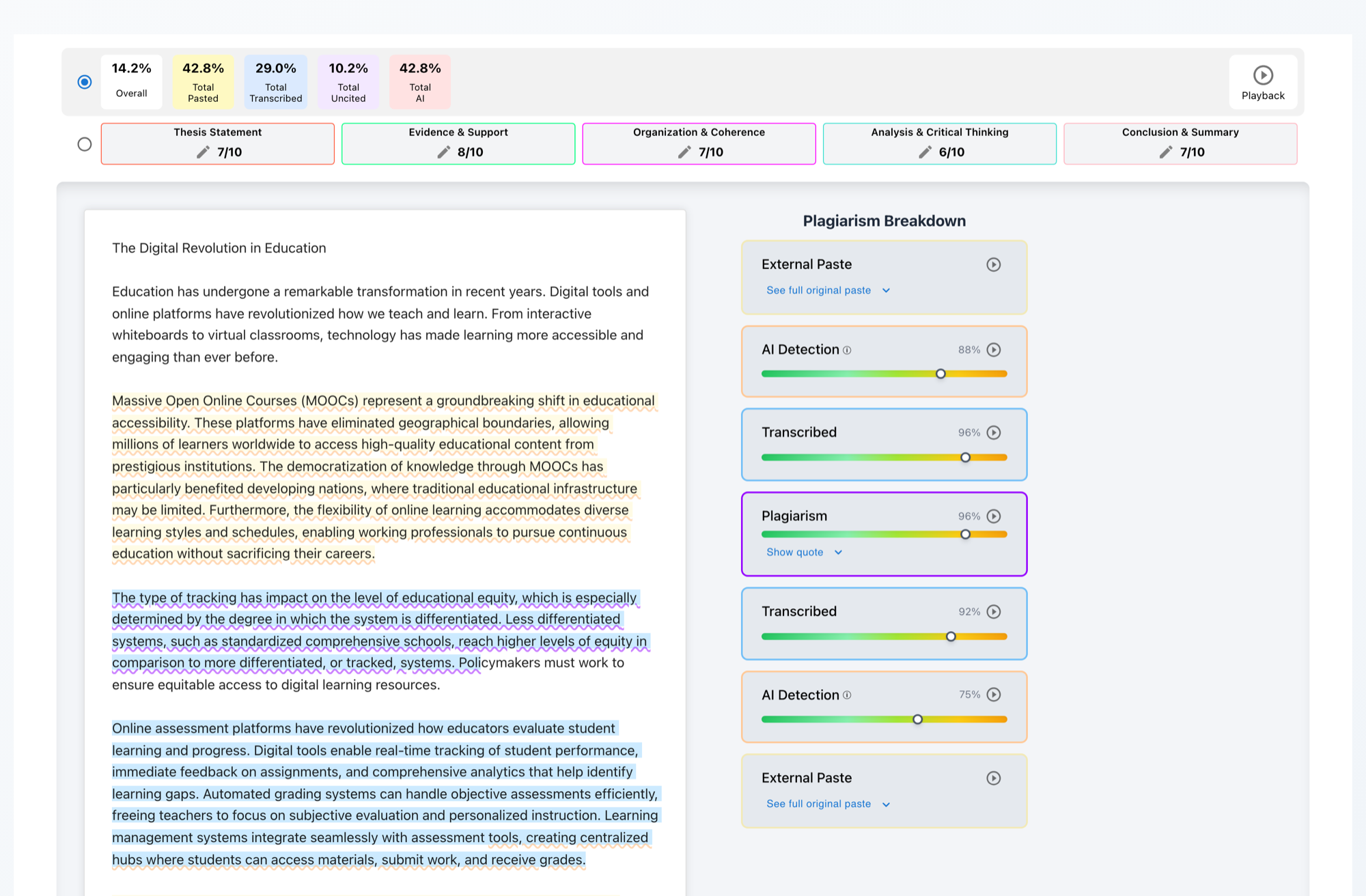
Checkmark Plagiarism was built to eliminate the flaws of monolithic similarity scoring. Rather than reducing a 30-page capstone to a single undifferentiated number, Checkmark’s Multidimensional Plagiarism Matching Architecture provides a clear breakdown of text origins, attribution types, and drafting behaviors.
...According to recent epidemiological findings, rural health networks exhibit structural disparities in tertiary cardiovascular care allocation across underserved corridors ...
...Furthermore, as Martinez (2024) observed, “mobile telemetry units reduce 30-day readmission rates by 22.4% in non-metropolitan clinical catchment zones” (p. 112) ...
...In contrast, the raw dataset indicates that the proprietary algorithm adjusts for census tract economic variables without calibration ...
Illustrative mockup. The authors, journals, quotations, and statistics shown in the sample reports, overlays, and scripts in this article are fictional examples, not real publications.
1. Discrete Visual Taxonomy Badges
Checkmark categorizes all detected textual overlaps using four distinct visual indicators, providing faculty with an immediate overview of submission integrity:
Text enclosed in quotation marks or formatted as block quotes with matching parenthetical citations and bibliography entries. Highlighted to confirm scholarly attribution.
Text sharing high syntactic and semantic similarity with an external source that lacks quotation marks, exhibits synonym swaps, or omits direct page attribution. Signals developmental writing needs.
Verbatim, unacknowledged text blocks imported from web pages, digital encyclopedias, published journals, or commercial essay repositories with zero attribution.
Text matching submissions within the institution’s private repository (e.g., senior thesis from a previous cohort), protected by zero-training FERPA encryption.
2. Synchronized Two-Pane Source Verification Workbench
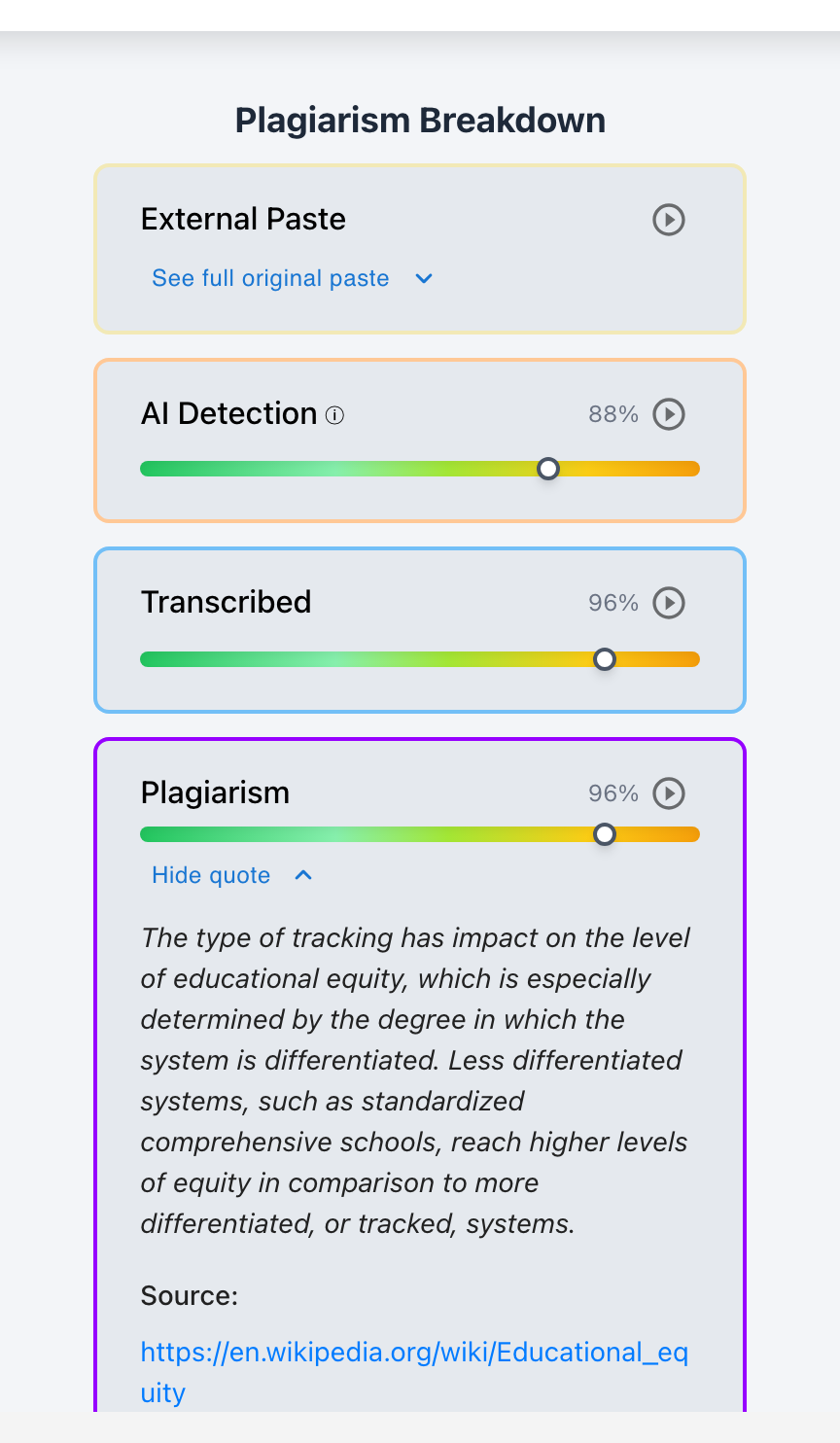
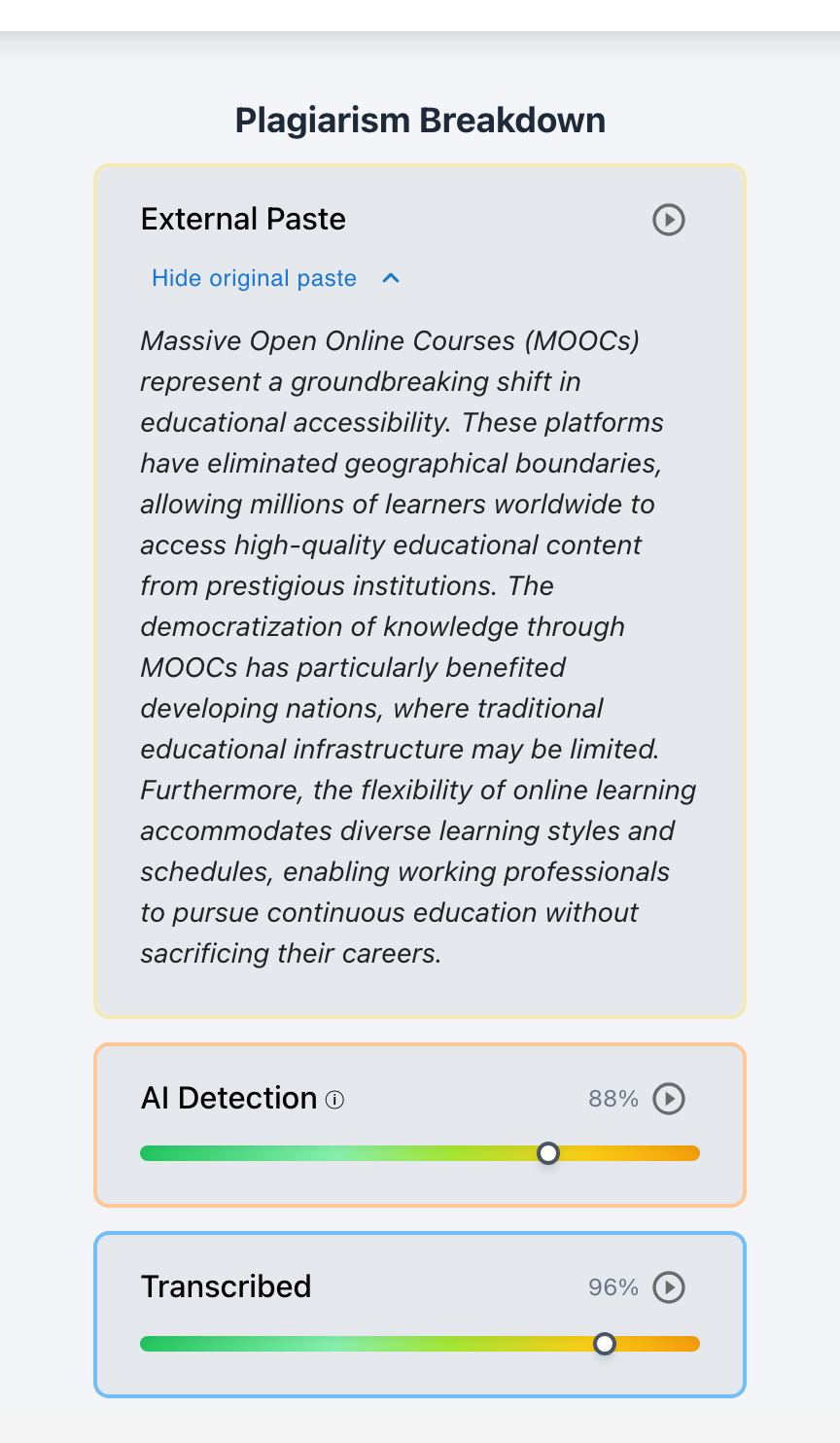
When an advisor clicks any highlighted passage in a capstone essay, Checkmark’s synchronized two-pane interface dynamically aligns the student’s text against the original source document:
3. Formative Citation Overlays for Capstone Mentorship
Rather than simply flagging errors, Checkmark provides actionable pedagogical feedback. When an amber patchwriting flag is identified, the platform generates a Formative Citation Overlay tailored to the document’s citation style (APA 7th, MLA 9th, or Chicago 17th):
- Direct Quotation: Place quotation marks around the verbatim phrasing and append
(Garrison et al., 2022, p. 104). - Autonomous Paraphrase: Reconstruct the core concept by starting with the broader context, changing the sentence structure, and citing the author: “Garrison et al. (2022) argue that financial constraints in rural hospitals directly impede triage implementation.”
4. Multi-Factor Verification: Keystroke Dynamics, Granular AI Detection, & Rubric Autograding
True academic integrity cannot be verified by analyzing static text alone. A finished manuscript shows what was written, but not how it was produced. Checkmark combines multi-dimensional text matching with dynamic writing process telemetry, passage-level AI detection, and rubric autograding.
🟢 Quoted & Cited, 🟡 Amber Patchwriting, 🔴 Red Direct Theft, 🟣 Peer Cohort repository.
1x–8x timeline video scrubber, IKI cadence rhythms, paste buffer text cache, transcription detection.
Sentence perplexity & burstiness, confidence sliders, <150w N/A guardrail, educator-only flags.
Quote-anchored feedback justifications, advisor final authority, one-click Canvas / Buzz LMS sync.
1. Patent-Pending Essay Playback™ & Keystroke Dynamics
Checkmark’s flagship innovation, Essay Playback™, records and reconstructs the student’s entire writing process keystroke-by-keystroke. Educators can review the drafting timeline like a video at 1x, 2x, 4x, or 8x speed to evaluate authentic composition patterns:
- Composing Pauses & Cognitive Bursts: Natural human writing features irregular typing cadences—rapid bursts of 5 to 15 words followed by 3-to-30-second pauses while the writer consults research notes, organizes thoughts, and plans the next sentence.
- Deletion & Revision Trajectories: Authentic writers constantly edit their work, backspacing to fix typos, restructuring sentences, deleting entire paragraphs, and testing alternative phrasing.
- External Paste Buffer Capture with Text Preservation: When text is pasted into the document, Checkmark flags the event on the timeline and preserves 100% of the original clipboard content. Even if the student subsequently rewrites, splits, or paraphrases every word over several hours, advisors can inspect the raw pasted text with a single click.
- Transcription Telemetry: If a student retypes text while reading off a second screen, phone, or printout to evade copy-paste detection, Essay Playback identifies the anomaly. Mechanical typing without natural pauses, revisions, or structural changes indicates transcription rather than original composition.
| Writing Telemetry Metric | Authentic Student Drafting Profile | Retyped Transcription / Spun AI Profile |
|---|---|---|
| Inter-Key Interval (IKI) Variance | Highly variable (80ms to 4,200ms) with cognitive pauses | Unnaturally uniform (110ms–180ms) metronomic speed |
| Backspace / Deletion Keystroke Ratio | 12% to 28% of total keystroke operations | Less than 2% of total keystroke operations |
| Revision & Structural Restructuring | Frequent paragraph relocations & word rewrites | Strictly linear left-to-right production without edits |
| Paste Activity Dynamics | Short quotes, reference URLs, empirical table numbers | Massive unformatted text blocks (400+ words at once) |
| Total Active Time on Manuscript | 15 to 40+ hours across multiple drafting sessions | 45 minutes of continuous unbroken typing |
2. Granular Passage-Level AI Writing Detection
Rather than outputting a single, unreliable overall AI probability score, Checkmark utilizes Passage-Level AI Detection:
- Sentence-by-Sentence Analysis: Highlights specific phrases and sentences directly within the text, accompanied by sidebar evidence cards featuring calibrated confidence sliders (typical human writing style vs. typical AI pattern).
- Perplexity and Burstiness Metrics: Evaluates word choice predictability (perplexity) and sentence length variation (burstiness). Authentic human writing displays high burstiness—mixing short, direct assertions with complex compound-complex sentences—whereas LLM-generated text tends toward uniform sentence lengths.
- Short-Text Guardrails (<150 Words): To prevent false positives on brief passages, Checkmark displays an honest
N/Adisclaimer for text samples under 150 words rather than guessing on insufficient data. - Immunity to AI Humanizers: Paraphrasers and “AI humanizer” tools (e.g., Undetectable AI, QuillBot) alter surface text to bypass traditional pattern detectors. However, they cannot forge a natural writing history within Essay Playback™. A submission with “humanized” text that appears as a single massive paste or a steady, uninterrupted transcription is instantly flagged for review.
- Educator-Only Flag Statuses: Flag statuses (Flagged, Resolved, Not Flagged) remain private to educators, protecting students from premature or unfounded accusations.
3. AI Autograder with Quote-Anchored Rubric Feedback
Capstone advising requires detailed, constructive feedback on student arguments and methodology. Checkmark’s AI Autograder streamlines this process with comprehensive rubric-based reviews:
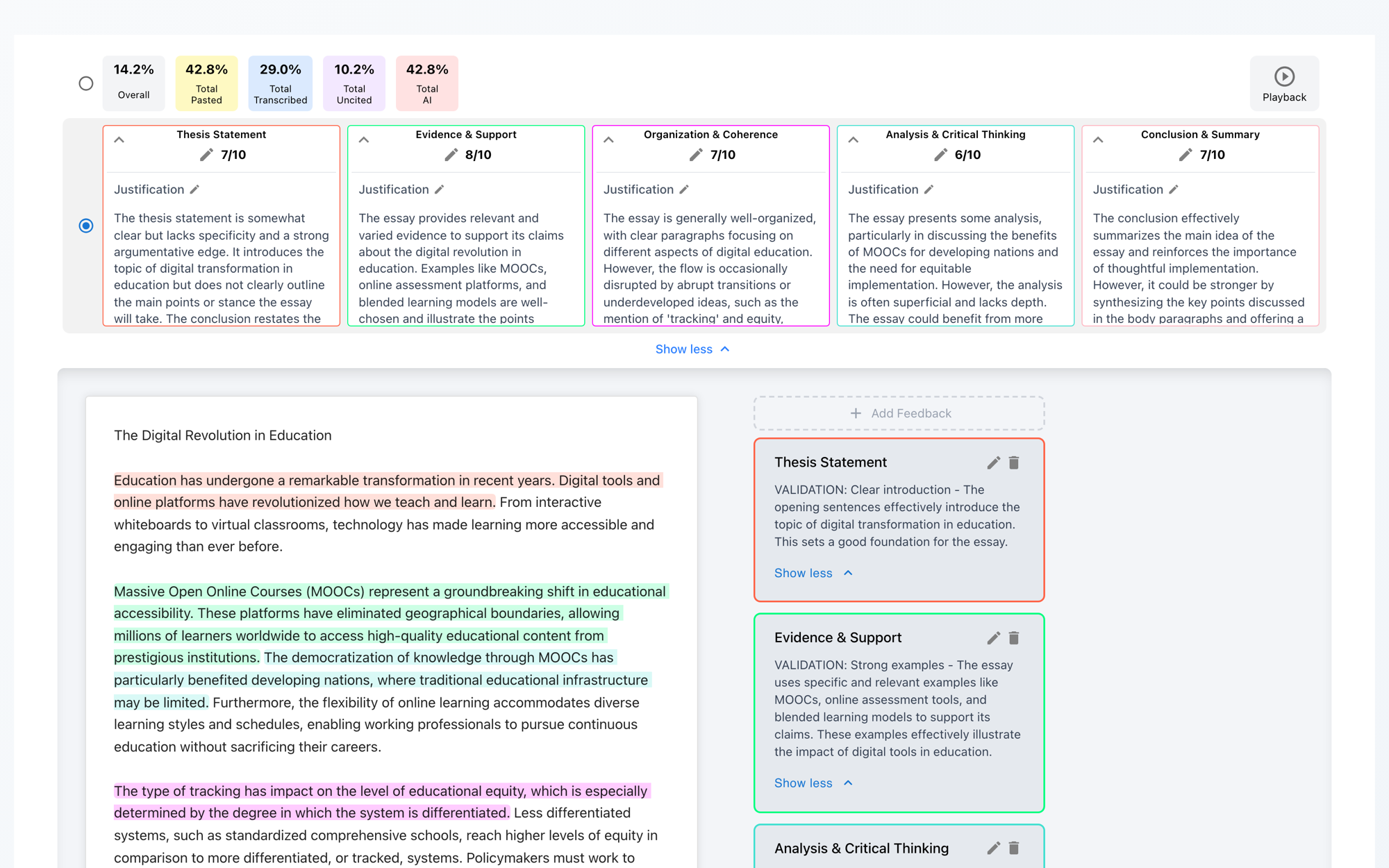
- Custom Rubric Integration: Ingests departmental capstone rubrics via PDF/image upload, in-app configuration, or direct sync from Canvas LMS, Buzz LMS, or Google Classroom.
- Quote-Anchored Written Justifications: For each rubric criterion (e.g., Theoretical Framework, Methodological Rigor, Literature Synthesis), the autograder provides draft scores linked directly to specific passages in the student’s text.
- Teacher Final Authority: All AI-generated grades and comments serve as initial recommendations. The faculty advisor can edit, override, or replace any score before approval.
- Seamless LMS Grade Passback: With a single click, approved rubric scores, point breakdowns, and narrative feedback sync directly to the LMS gradebook, eliminating manual data entry.
5. Architectural & Comparative Analysis
The following technical comparison illustrates the architectural differences between single-score legacy plagiarism checkers and Checkmark’s Multidimensional Integrity Suite.
| Architectural Capability | Legacy Plagiarism Scanners | Checkmark Multidimensional Suite |
|---|---|---|
| Output Metric & Granularity | Single aggregate percentage (e.g., “31% Similarity”) | Multidimensional taxonomy (🟢 Quoted, 🟡 Patchwriting, 🔴 Plagiarism, 🟣 Peer Match) |
| Patchwriting Differentiation | Fails completely; lumps patchwriting with direct plagiarism | Accurately identifies uncited syntax; provides formative coaching overlays |
| Writing Process Verification | None; only analyzes final static text snapshot | Patent-pending Essay Playback™ keystroke timeline (1x–8x video speed) |
| External Paste Tracking | Undetected; only checks strings against indexed databases | Timestamped capture; preserves 100% of original clipboard text cache |
| Transcription Detection | Fails; retyped text appears as authentic manual input | Flags unnatural, continuous typing cadence lacking pauses and backspaces |
| AI Writing Detection | Whole-document probability score with high false alarms | Passage-level granularity with confidence sliders & <150w N/A guardrails |
| Source Verification Interface | Cluttered list of URL matches with overlapping highlights | Synchronized two-pane workbench with DOI links and diff viewer |
| Rubric Feedback Generation | None; purely punitive similarity reporting | Quote-anchored rubric drafts with one-click Canvas / Buzz LMS grade passback |
| Student Data Privacy & FERPA | May ingest student essays into global commercial repositories | Zero model training on submissions; private encrypted institutional repository |
6. Real-World Case Studies in Capstone Adjudication
The following case studies illustrate how Checkmark’s multidimensional platform resolves complex academic integrity inquiries in capstone courses.
| Academic Context | Initial Flag & Legacy Challenge | Checkmark Investigation & Final Resolution |
|---|---|---|
| Senior Capstone in Public Health (Higher Ed) | Legacy scanner flagged 34% similarity; graduation hold initiated over literature review. | Multidimensional analysis isolated 28% valid citations/terms, 6% patchwriting. Playback proved 18h authentic drafting. Result: Restorative citation conference. |
| Honors Thesis in Economics (Higher Ed) | Low 14% similarity; advisor suspected sophisticated text spinning from working paper. | Playback revealed 4-paragraph paste from uncredited NBER draft, followed by rapid synonym edits. Full receipts. Result: Clear academic misconduct ruling. |
| AP Research Capstone (Secondary Education) | Legacy detector flagged 48% AI probability on literature review on urban heat islands. | Granular analysis showed scientific terms triggered false AI alarm. Playback confirmed 22h authentic work. Result: Complete student exoneration. |
Case Study 1: Senior Capstone in Public Health (32-Page Healthcare Disparity Analysis)
Institutional Context: A major state university’s Department of Public Health requires an extensive capstone thesis for graduation.
The Incident: An undergraduate senior submitted a 32-page thesis titled “Evaluating Structural Obstacles to Telecardiology Adoption Across Appalachian Critical Access Hospitals.” The university’s legacy plagiarism scanner flagged the manuscript with an aggregate 34% Similarity Index. Under department policy, any score over 20% triggered an automated hold on graduation and an administrative review.
Legacy Diagnostic Failure: The legacy report highlighted extensive sections of Chapter 2 (Literature Review), flagging standard CDC epidemiological terminology, federal rural hospital definitions, and synthesized literature summaries as potential plagiarism.
- 🟢 Quoted & Correctly Cited: 18.2% (Primary data, federal regulations, quotes)
- 🟡 Uncited Patchwriting: 5.8% (3 literature review passages with syntax mimicry)
- 🔴 Direct Plagiarism Matches: 0.0% (Zero uncredited external text blocks)
- Disciplinary Collocations / References: 10.0% (CDC terms, Works Cited list)
Case Study 2: Undergraduate Honors Thesis in Economics (24-Page Econometric Modeling Paper)
Institutional Context: An Honors Program in Economics at a selective liberal arts college.
The Incident: A senior honors candidate submitted a 24-page thesis on “Spatial Autoregressive Analysis of Municipal Bond Risk Premia.” The legacy scanner returned a modest 14% Similarity Index, well below the department’s 20% inquiry threshold. However, during the oral defense, an examiner noted that the theoretical derivation in Chapter 3 seemed unusually sophisticated compared to the rest of the manuscript.
Case Study 3: AP Research Capstone Paper (Secondary Advanced Academics)
Institutional Context: A public high school offering the AP Capstone Diploma program.
The Incident: A student submitted their 5,000-word AP Research academic paper on “Microclimate Mitigation: Urban Canopy Density and Surface Albedo in Subtropical Metropolitan Zones.” The teacher ran the paper through a legacy AI detector, which flagged the Literature Review with a 48% AI Probability Score. The student was accused of using ChatGPT to generate their research context and faced disqualification from the AP exam.
7. The 4-Phase Departmental Capstone Triage Protocol for Academic Leaders
To help department chairs, graduate directors, and thesis committees manage academic integrity efficiently, Checkmark provides a standardized 4-Phase Capstone Triage Protocol.
A standardized administrative workflow separating mechanical citation coaching from disciplinary adjudication
Ingest via Canvas LMS / Buzz LMS / Google Classroom SSO. Automatically isolate 🟢 Quoted/Cited text and technical collocations. Filter submissions into Green (Clean), Amber (Patchwriting Review), or Red (Administrative Review).
If 🟡 Amber flags appear: Inspect two-pane workbench for syntactic mimicry vs. synthesis. If 🔴 Red flags appear: Review Essay Playback™ paste buffer to recover original text. Verify writing telemetry: Confirm authentic composing pauses and revision patterns.
Review the interactive report collaboratively with the student. For patchwriting: Use Formative Citation Overlays to teach proper paraphrasing. For confirmed fraud: Use timestamped playback receipts to conduct an objective inquiry.
Authorize targeted revisions for developmental citation errors within a 72-hour window. Sync finalized rubric scores and feedback directly back to the LMS gradebook. Archive verified manuscripts in the school’s private, zero-training FERPA repository.
Phase 1: Automated Ingestion & Taxonomy Triage
- LMS Assignment Configuration: Configure capstone milestone submission portals in Canvas LMS, Buzz LMS, or Google Classroom with Checkmark integration enabled.
- Automated Triage Ingestion: As students submit capstone drafts, Checkmark scans the manuscripts against web sources, academic databases, and private institutional repositories.
- Automated Status Sorting:
- Tier 1 (Green Status • Clear): Papers with high verified quotation rates (🟢) and zero red flags are cleared for faculty evaluation.
- Tier 2 (Amber Status • Formative Review): Papers exhibiting uncited source overlap (🟡) without direct copy-pasting are routed to the advisor for citation coaching.
- Tier 3 (Red Status • Administrative Review): Papers containing uncredited direct text blocks (🔴) or major paste anomalies are flagged for departmental review.
Phase 2: Forensic Verification via Synchronized Workbench & Essay Playback™
For any Tier 2 or Tier 3 submission, the department chair or advisor conducts a structured 5-minute review:
- Source Inspection: Open the Synchronized Two-Pane Workbench to evaluate whether matched text represents developmental patchwriting (🟡) or wholesale copying (🔴).
- Timeline Review: Open Essay Playback™ and scrub through the writing timeline at 4x speed. Check that total drafting time matches the scope of the project and verify natural composing pauses.
- Paste Buffer Verification: Click on any flagged paste events to inspect the preserved clipboard content. Confirm that pasted text consists only of authorized material (e.g., bibliographies, survey questions, or personal notes).
Phase 3: Restorative Diagnostic Faculty Conference
When meeting with a student to discuss flagged passages, advisors should focus on constructive dialogue supported by objective evidence:
“Our writing analysis platform identified that your literature review in Section 2 closely follows the sentence structure of the 2023 study by Jackson and Miller. We know you cited this source in your bibliography, but the phrasing mirrors the original text too closely for an academic paraphrase. Let’s look at the two-pane comparison together so you can see where your own voice can lead the synthesis.”
“When reviewing your drafting history in Essay Playback, we noticed that four pages of theoretical analysis were pasted in at 2:15 AM as a single text block, with no previous drafting or revision history. Can you walk us through how you researched and developed this section?”
Phase 4: Capstone Revision, Milestone Tracking, & Institutional Archiving
- Structured Resubmission Windows: For students with developmental citation errors (🟡), grant a 72-hour revision window to restructure patchwritten passages into mature synthesis using Checkmark’s citation overlays.
- One-Click LMS Passback: After review, the advisor approves the AI Autograder’s rubric evaluation and syncs the scores directly to the Canvas or Buzz LMS gradebook.
- Private FERPA-Compliant Archiving: Finalized capstone manuscripts are archived in the department’s private repository to protect against future peer-to-peer copying, ensuring student data is never shared externally.
8. Department Chair Implementation Guide: Faculty Norming & Institutional Calibration
A tool is only as effective as the departmental policies that guide its use. Department chairs can use the following framework to establish clear standards across capstone advisors and thesis committees.
| Textual Category | Technical Diagnostic Criteria | Mandatory Departmental Action |
|---|---|---|
| Legitimate Citation & Terminology | 🟢 Green Highlight; accurate quotation marks and in-text cite | Full credit; validate scholarly depth and discipline-specific vocabulary. |
| Developmental Patchwriting | 🟡 Amber Highlight; source cited in bibliography, syntax mirrored in-text; authentic playback time | Formative revision required; complete Checkmark citation coaching overlay; no formal honor code sanction. |
| Deliberate Direct Plagiarism | 🔴 Red Highlight; verbatim text from uncredited source; external paste buffer verified in replay | Formal academic integrity review; provide Essay Playback paste receipts; disciplinary action per policy. |
| Retyped Transcription or Purchased Essay | Steady, unpaused typing without revisions; paste buffer or lack of drafting history in playback | Oral defense required; student must explain methodology and sources without notes; formal inquiry. |
Running a Departmental Calibration Seminar
Before launching the capstone sequence each academic year, department chairs should conduct a 60-minute norming session for all faculty advisors:
- Review Benchmark Papers: Distribute three sample literature reviews (one containing proper citations, one with patchwriting, and one with cloaked plagiarism).
- Review Checkmark Reports: Have faculty evaluate each paper using Checkmark’s multi-dimensional badges and Essay Playback timelines.
- Standardize Grading Norms: Ensure all advisors apply consistent distinctions between developmental writing issues (🟡) and intentional academic fraud (🔴).
9. Data Privacy, Ethical Governance, & FERPA Zero-Training Compliance
In capstone research, student manuscripts often contain original intellectual property, proprietary laboratory data, or sensitive qualitative interviews. Educational institutions must ensure that plagiarism software adheres to strict data privacy standards.
Guaranteed data sovereignty for student intellectual property and institutional research
- Scans against live web & publisher indexes via secure APIs
- Indexes submissions in a private, encrypted school-only repository
- Preserves 100% intellectual property ownership for student and institution
- Deletes temporary scan data per district retention policy schedules
- Integrates securely via Canvas LMS, Buzz LMS, and LTI 1.3 standards
- NEVER trains general AI/LLM models on student research
- NEVER sells or monetizes student manuscripts to third parties
- NEVER shares unpublished student text with public repositories
- NEVER retains unencrypted biometric or behavioral data
- NEVER compromises FERPA, COPPA, or state privacy standards
10. Frequently Asked Questions (FAQs)
1. How does Checkmark distinguish between developmental patchwriting and deliberate plagiarism?
Checkmark evaluates both text structure and drafting history. The platform uses Multidimensional Taxonomy Badges to separate uncredited external text blocks (🔴 Red) from cited sources that mirror original syntax too closely (🟡 Amber). Additionally, advisors can review the student’s writing process in Essay Playback™ to confirm whether the passage was developed through authentic drafting and revision or imported as a single external paste.
2. Can a student fool Essay Playback™ by retyping an essay from a second screen or phone?
No. Checkmark’s Transcription Telemetry monitors typing rhythms, inter-key intervals (IKIs), and revision behaviors. Retyping text from a second screen produces a distinctive mechanical cadence with minimal pauses, few backspaces, and no structural reorganization. When these patterns appear in Essay Playback, the platform flags the submission for an advisor review.
3. What happens if a capstone literature review contains a high volume of necessary scientific terms?
Checkmark’s engine recognizes standardized disciplinary collocations and fixed nomenclature (e.g., “randomized double-blind placebo-controlled trial”). These established terms are separated from plagiarism alerts and highlighted under proper attribution rules, preventing false alarms on technical papers.
4. How does Checkmark handle short-text passages or abstract summaries under 150 words?
To prevent false positives, Checkmark displays an honest N/A status for AI detection on text selections under ~150 words. The platform avoids guessing on short text samples where statistical perplexity cannot be calculated reliably.
5. Are student capstone theses used to train general AI models or added to public databases?
No. Checkmark maintains a strict Zero Model Training Policy. Student submissions are never used to train machine learning models or shared with commercial entities. Institutional repositories remain private and fully compliant with FERPA and COPPA standards.
6. How does Checkmark integrate with our existing Canvas LMS SpeedGrader or Buzz LMS environment?
Checkmark integrates directly with Canvas LMS, Buzz LMS, and Google Classroom. Faculty can launch Checkmark reports directly within their LMS interface, review multi-dimensional integrity badges, and sync approved rubric scores and feedback back to the gradebook with a single click.
7. What should a department chair do if an advisor and student disagree on a patchwriting finding?
The chair can open the submission in Checkmark to review the objective evidence:
- Review the Synchronized Two-Pane Workbench to inspect the matched source text alongside the student’s writing.
- Review the Essay Playback™ timeline to evaluate active writing time, drafting pauses, and paste history.
- Use Checkmark’s objective telemetry receipts to guide a productive, evidence-based conversation focused on academic growth.
Conclusion: Stop Guessing, Start Trusting
Capstone research should inspire deep inquiry, critical synthesis, and intellectual growth. For too long, single-percentage plagiarism checkers have undermined this process—generating anxiety over harmless citation errors while missing sophisticated academic fraud.
With Checkmark Plagiarism’s Multidimensional Matching Architecture, Essay Playback™ keystroke dynamics, and Teacher-in-the-Loop AI Autograding, academic institutions no longer have to rely on guesswork. Department chairs and faculty advisors now have access to transparent, defensible evidence to uphold academic standards, streamline administrative workflows, and mentor the next generation of scholars with confidence.
Empower Your Department with Multi-Dimensional Integrity Evidence
Discover how Checkmark Plagiarism equips capstone advisors and department chairs with two-pane source verification, keystroke process playback, and quote-anchored rubric autograding.