
In Advanced Placement (AP) Capstone—encompassing AP Seminar (1,200-word IRR and 2,000-word IWA) and AP Research (4,000–5,000-word Academic Paper)—as well as the International Baccalaureate (IB) Extended Essay, high school students are tasked with executing complex academic investigations across dozens of peer-reviewed scholarly sources. Confronted with dense disciplinary literature from JSTOR, PubMed, or specialized academic journals, emerging researchers frequently fall into developmental patchwriting: restructuring clauses, swapping synonyms through a right-click thesaurus (“rogeting”), or leaning heavily on an author's sentence architecture.
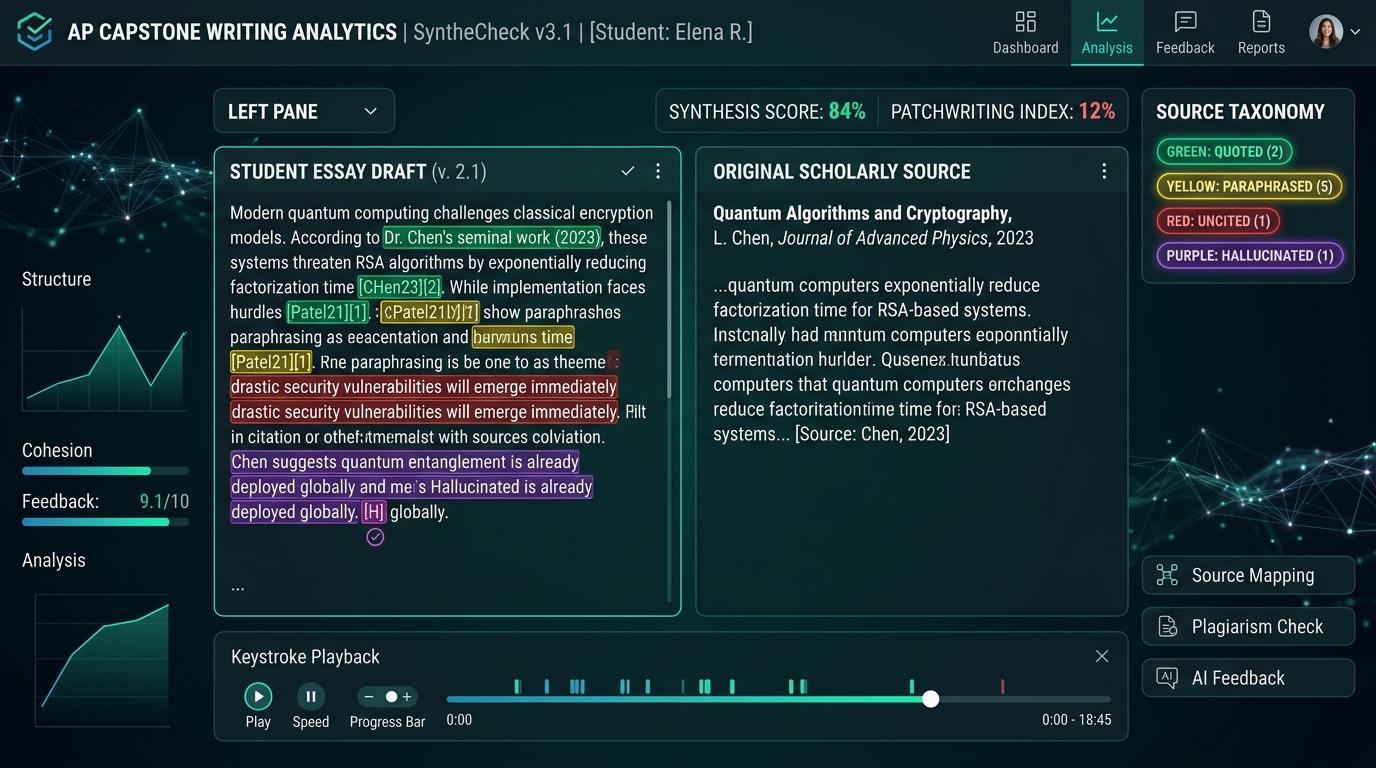
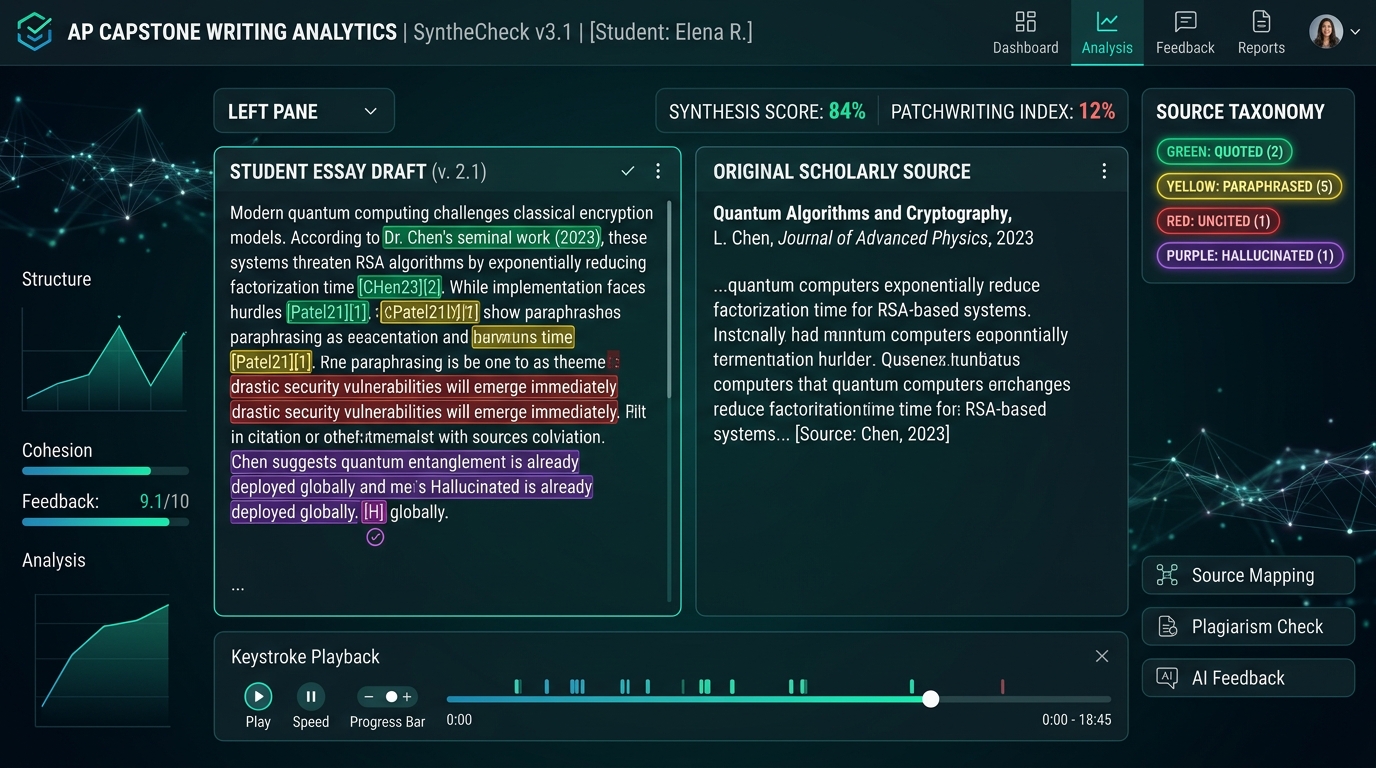
While historically misdiagnosed as intentional plagiarism or obscured by opaque whole-document similarity percentages, patchwriting is fundamentally an epistemic and developmental challenge rooted in cognitive overload. Yet, on AP Capstone scoring rubrics, patchwriting directly penalizes students on the rubric criteria for analyzing perspectives and sourcing and for building a line of reasoning. Checkmark Plagiarism provides AP Capstone educators with a formative synthesis workbench. By combining synchronized dual-pane side-by-side text comparison, a 4-Badge Source Taxonomy (🟢 Quoted & Verified, 🟨 Paraphrased with Source, 🔴 Uncited External Match, 🟣 Unverified/Hallucinated Citation Alert), patent-pending Essay Playback™ (1x–8x keystroke replay), and teacher-in-the-loop rubric autograding, Checkmark empowers educators to transform source investigations into high-impact, non-punitive masterclasses in dialectical academic synthesis.
Checkmark Plagiarism equips AP Capstone teachers, AP Research advisors, Seminar instructors, and Humanities department chairs with transparent side-by-side source verification and seamless LMS integrations across Canvas LMS, Agilix Buzz, and Google Classroom.
1. The AP Capstone Synthesis Crisis: When Novice Researchers Face Scholarly Giants
The Advanced Placement (AP) Capstone™ Diploma Program represents one of the most intellectually ambitious curricular frameworks in secondary education. Designed by the College Board to cultivate independent inquiry, critical thinking, and collegiate research competencies, the sequence requires high school sophomores, juniors, and seniors to produce rigorous academic papers:
- AP Seminar (Year 1): Students complete the Individual Research Report (IRR) (1,200 words evaluating multi-perspective academic literature on a team theme) and the Individual Written Argument (IWA) (2,000 words formulating a defensible, evidence-based argument synthesizing thematic stimulus material and outside scholarly literature).
- AP Research (Year 2): Students spend an entire academic year formulating a primary research question, designing an ethical methodology, conducting empirical or qualitative data collection, and authoring a 4,000-to-5,000-word Academic Research Paper defended during an oral presentation.
- IB Extended Essay & Advanced Humanities: Similarly demands a 4,000-word independent scholarly investigation requiring exhaustive engagement with primary and secondary historiography, scientific studies, or literary criticism.
- Individual Research Report (IRR - 1,200w)
- Individual Written Argument (IWA - 2,000w)
- Multi-perspective scholarly synthesis
- Stimulus material conceptual integration
- Academic Research Paper (4,000 to 5,000w)
- Year-long empirical or qualitative inquiry
- Comprehensive scholarly literature review
- Process and Reflection Portfolio (PREP)
Teachers may not write, revise, or correct work submitted for assessment, proofread or copyedit it for students, or give specific, directive feedback.
Teachers affirm, to the best of their knowledge, that the student's final submission is authentic student work.
- Sentence-by-sentence syntactic mimicry
- Mechanical synonym swapping (“Rogeting”)
- Isolated source stacking (Serial summaries)
- Rubric collapse on perspectives & sourcing criteria
- Multi-source dialectical dialogue
- Student-led original line of reasoning
- Corroborated warrants and contextual nuance
- AP Rubric Mastery (Score 5 / High Band)
The Institutional Burden of the College Board's Teacher-Role Limits
AP Capstone educators operate under a strict, high-stakes institutional constraint: the College Board's teacher-role guidelines. Under these guidelines, instructors may not write, revise, amend, or correct work submitted for assessment, may not proofread or copyedit it for students, and may not give specific, directive feedback. Teachers cannot rewrite a clumsy paragraph or fix broken citations line by line.
Instead, educators must act as formative advisors. Yet, in the College Board Digital Portfolio, the teacher must affirm, to the best of their knowledge, that the student's final submission is authentic student work.
When students struggle with complex source material, these limits create an instructional dilemma: How can a teacher teach students how to synthesize high-level academic texts without violating the College Board's teacher-role guidelines or resorting to punitive accusations?
Why Legacy Similarity Scores and Black-Box AI Detectors Fail
For decades, high school English and humanities departments relied on single aggregate “similarity percentages” (e.g., a blunt 28% Similarity Score from legacy tools). In the context of AP Capstone and advanced inquiry, this aggregate metric creates catastrophic pedagogical distortions:
- Pervasive False Positives on Legitimate Scholarship: A student who quotes a dense legal statute, cites standard environmental toxicology metrics, or includes an extensive 45-source bibliography receives a high similarity score, even when their analysis is entirely original.
- Invisible Structural Patchwriting: When a student copies a paragraph from The American Economic Review, replaces every fifth word with a thesaurus synonym, and changes passive verbs to active voice, legacy text-matching engines often report a low similarity score (e.g., under 10%), masking profound developmental failure.
- Opaque AI Score Invalidation: Generic AI detectors produce whole-document probabilistic scores (e.g., “64% Likely AI”) without explaining why. When students use specialized academic vocabulary, non-native English writing patterns, or structured transitions, black-box AI tools trigger false allegations that destroy teacher-student trust.
To teach synthesis effectively, educators need transparent, side-by-side visual evidence that separates authentic cognitive struggle from superficial sentence manipulation.
2. Deconstructing the Pedagogy: Rebecca Moore Howard, The Citation Project, and the Forensics of Patchwriting
To understand why advanced high school students patchwrite, educators must examine the foundational composition research of Dr. Rebecca Moore Howard and the multi-institutional Citation Project.
- Clause structure mirroring
- Mechanical synonym replacement
- Unwitting citation gaps
- Incomplete conceptual comprehension
- Instant clipboard paste events
- Generative AI ghostwriting
- Automated paraphrasing scramblers
- Intentional concealment of source origins
The “Howard Taxonomy” of Patchwriting
In her seminal 1993 essay “A Plagiarism Pentimento” (Journal of Teaching Writing), composition theorist Rebecca Moore Howard introduced the academic world to the concept of patchwriting:
Patchwriting is “copying from a source text and then deleting some words, altering grammatical structures, or plugging in one-for-one synonym substitutes.”
Howard established that patchwriting is not an act of malicious deception or academic fraud. Rather, it is a normal, developmental stepping stone in novice academic socialization. When students attempt to “invent the university” (Bartholomae, 1985) and write like professional political scientists, epidemiologists, or art historians, they do not yet possess the deep conceptual frameworks necessary to express those expert ideas independently.
The Citation Project: Empirical Realities of Student Research
The multi-campus Citation Project (Jamieson, 2013), which grew out of a smaller pilot study (Howard, Serviss, & Rodrigue, 2010), coded 1,911 citations in 174 first-year student research papers from 16 colleges and universities. The findings were striking:
| Source Integration Behavior | Citation Project Percentage | Impact on AP Capstone & Advanced Research |
|---|---|---|
| Patchwriting | 52% of papers; 16.0% of all analyzed citations | More than half of the papers include at least one patchwritten citation, and about one in six citations is patchwritten rather than truly paraphrased. |
| Summary of Source Material | 6.3% of all analyzed citations | Only about one in sixteen citations summarizes the source; students work from one or two sentences in 94% of their citations. |
| Engagement Beyond Page 2 | 30.5% of all analyzed citations | About 70% of citations point to the first or second page of the source, so students rarely engage with the body of an article. |
| Verbatim Text Without Quotes | 4.3% of all citations | Students attempt honest attribution by naming the source in the bibliography, but omit quotation marks around verbatim text. |
Cognitive Load Theory in High School Inquiry
Why do AP Capstone students patchwrite? Under John Sweller's Cognitive Load Theory (Sweller, 1988), a student's working memory has finite processing bandwidth. When an 11th grader in AP Seminar or a 12th grader in AP Research reads an article from the Journal of Neuroscience, their working memory is overwhelmed by three simultaneous layers of friction:
- Disciplinary Lexicon: Decoding specialized scientific or legal vocabulary (e.g., “neurogenesis,” “epigenetic methylation,” “jurisprudential precedent”).
- Syntactic Architecture: Navigating dense, multi-clause academic sentences loaded with qualifying phrases and passive constructions.
- Citation Mechanics: Managing parenthetical MLA/APA formatting, in-text attributive tags, and bibliography management.
When working memory capacity is exceeded, the student cannot hold the author's abstract concept in their head long enough to rebuild it from scratch. As a result, they use the source author's sentence structure as a grammatical crutch—substituting adjectives, flipping active verbs to passive, and calling it a paraphrase.
3. How Patchwriting Destroys AP Capstone Scores: The AP Rubric Breakdown
While patchwriting is developmentally understandable, on College Board scoring rubrics it is catastrophic. In both AP Seminar and AP Research, papers burdened by patchwriting fail to reach the higher performance bands.
1. AP Seminar Rubric Impact (IRR & IWA)
- IRR Row 4: Understand and Analyze Perspective: To earn the top score (6 points), the student must place sources in direct conversation, comparing perspectives across political, economic, environmental, or ethical lenses. When a student patchwrites, they write serial summaries (Source A paragraph followed by Source B paragraph) without establishing relationships between them, capping the score at the lower levels (2 or 4 points).
- IWA Row 4: Establish Argument: To score at the top level (12 points), an essay must exhibit a clear, logically organized progression of claims supported by evidence. Patchwritten essays follow the source author's organizational logic rather than the student's own, creating disjointed, rambling papers that stay at the lower levels (0 or 8 points).
2. AP Research Academic Paper Rubric Impact
The AP Research Academic Paper is scored holistically on a single 1-to-5 scale, with descriptors for focus, context, method, conclusion, communication, and citation. Patchwriting undermines several of them:
- Contextualization & Literature Review: High-scoring papers synthesize the scholarly conversation to identify an explicit research gap. Patchwriting produces a descriptive catalogue of studies rather than a critical synthesis of existing methodologies and theoretical tensions.
- Line of Reasoning: When paragraphs are constructed from patchwritten snippets, the paper lacks an overarching thread. The student cannot defend their original methodological choices because their contextual framework is borrowed.
- Sourcing and Attribution: Patchwritten text frequently incorporates 4–7 word verbatim strings without quotation marks. AP Readers identify these as uncredited borrowings or citation errors, penalizing the student on attribution accuracy.
4. The Three Structural Hallmarks of Patchwriting vs. The Three Levels of Genuine Synthesis
To effectively diagnose student drafts, educators must be able to recognize the structural fingerprints of patchwriting and teach students how to advance through the three levels of authentic synthesis.
The syntactic skeleton is identical; only surface vocabulary is tweaked.
Right-click thesaurus syndrome produces semantic drift and unnatural vocabulary.
A single parenthetical citation is placed at the end of a multi-sentence borrowed block.
The Three Levels of Genuine Synthesis
To elevate student writing from developmental patchwriting to scholarly mastery, educators guide students through three progressive levels of synthesis:
Serial summaries with zero connective tissue or conversational friction.
Puts two or more sources in direct conversation around a shared point of contention.
“While early urban planning research focused primarily on zoning density to reduce automobile emissions (Chen, 2018), more recent longitudinal transportation analyses suggest that pedestrian infrastructure investments yield significantly greater carbon reductions in mid-sized metropolitan areas (Alvarez & Davis, 2023).”
Illustrative example: the cited authors, studies, and figures are fictional.
Paragraph is organized around the student's original conceptual claim or inquiry warrant.
“Decentralized municipal water filtration systems offer superior climate resilience compared to centralized treatment plants, primarily due to their modular adaptability during extreme flood events. Although traditional civil engineering models prioritize centralized economies of scale (Miller, 2019), empirical hydrological assessments following Hurricane Ida demonstrated that distributed micro-filtration networks maintained 94% operational uptime (Patel & Vance, 2022). This operational continuity corroborates resilience theory in municipal infrastructure (O'Connor, 2020), suggesting that capital expenditure policies must shift from mega-facility consolidation to distributed regional nodes.”
Illustrative example: the cited authors, studies, and figures are fictional.
Comparative Matrix: Patchwriting vs. The Three Levels of Synthesis
| Pedagogical Dimension | Patchwriting | Level 1: Stacking | Level 2: Dialogue | Level 3: Dialectical |
|---|---|---|---|---|
| Syntactic Independence | 0% – 20% (Mirrored) | 100% (Single Source) | 100% (Comparative) | 100% (Original) |
| Voice & Agency | Source author masked by awkward synonyms. | Passive narrator reporting what author said. | Active moderator comparing two scholars. | Authoritative investigator driving an original argument. |
| Organizational Logic | Dictated by source sentence order. | Dictated by source article sequence. | Organized around a shared topic/tension. | Organized around student's inquiry thesis warrants. |
| AP Rubric Scoring | Low Band | Med Band | High-Med Band | High Band |
| Cognitive Operation | Mechanical substitution under cognitive overload. | Serial comprehension and isolated summary. | Analytical comparison and contradiction mapping. | Conceptual synthesis and original warrant formulation. |
5. Checkmark Plagiarism's Dual-Pane Source Workbench & Forensic Ecosystem
To bridge the gap between developmental patchwriting and Level 3 dialectical synthesis, educators cannot rely on red ink or generic similarity reports. Checkmark Plagiarism provides an integrated, formative synthesis workbench engineered specifically for advanced secondary and collegiate research writing.
“While traditional civil engineering models prioritize centralized economies of scale (Miller, 2019), empirical assessments demonstrate that distributed networks maintained 94% uptime.”
“Traditional civil engineering models prioritize centralized economies of scale across municipal utilities.” (Miller, 2019, illustrative source)
1. Synchronized Dual-Pane Source Comparison
Checkmark's Synchronized Dual-Pane Viewer locks the student's submission pane to the original scholarly source pane (JSTOR, PubMed, Nature, HeinOnline, government archives, or open web publications). As the educator or student scrolls through the essay, the right pane automatically tracks and scrolls to the exact matching paragraph in the source.
- Token-Level Lexical & Syntactic Mapping: Checkmark highlights exact string matches in red/orange, identified synonym shifts in purple, and preserved clause skeletons in yellow.
- Instant Disciplinary Visualization: In a 30-second visual scan, a teacher can see whether a student copied the author's clause structure or developed an independent syntactic framework.
2. The 4-Badge Source Taxonomy
Checkmark moves beyond blunt “plagiarism percentages” by categorizing every source interaction into an objective 4-Badge Source Taxonomy:
Verbatim text enclosed in quotation marks with accurate parenthetical citation and verified bibliographic entry.
Pedagogical Action: Commend proper attribution mechanics.Cited source material mapped for syntactic independence vs. developmental patchwriting.
Pedagogical Action: Review in Dual-Pane viewer to coach restructuring.Verbatim or near-verbatim source borrowing lacking parenthetical citations or quotation marks.
Pedagogical Action: Coach student on attribution rules or investigate fraud.In-text citations or bibliography entries pointing to non-existent DOIs, fabricated journals, or AI hallucinations.
Pedagogical Action: Audit research authenticity in student conference.
3. Patent-Pending Essay Playback™ (1x–8x Replay)
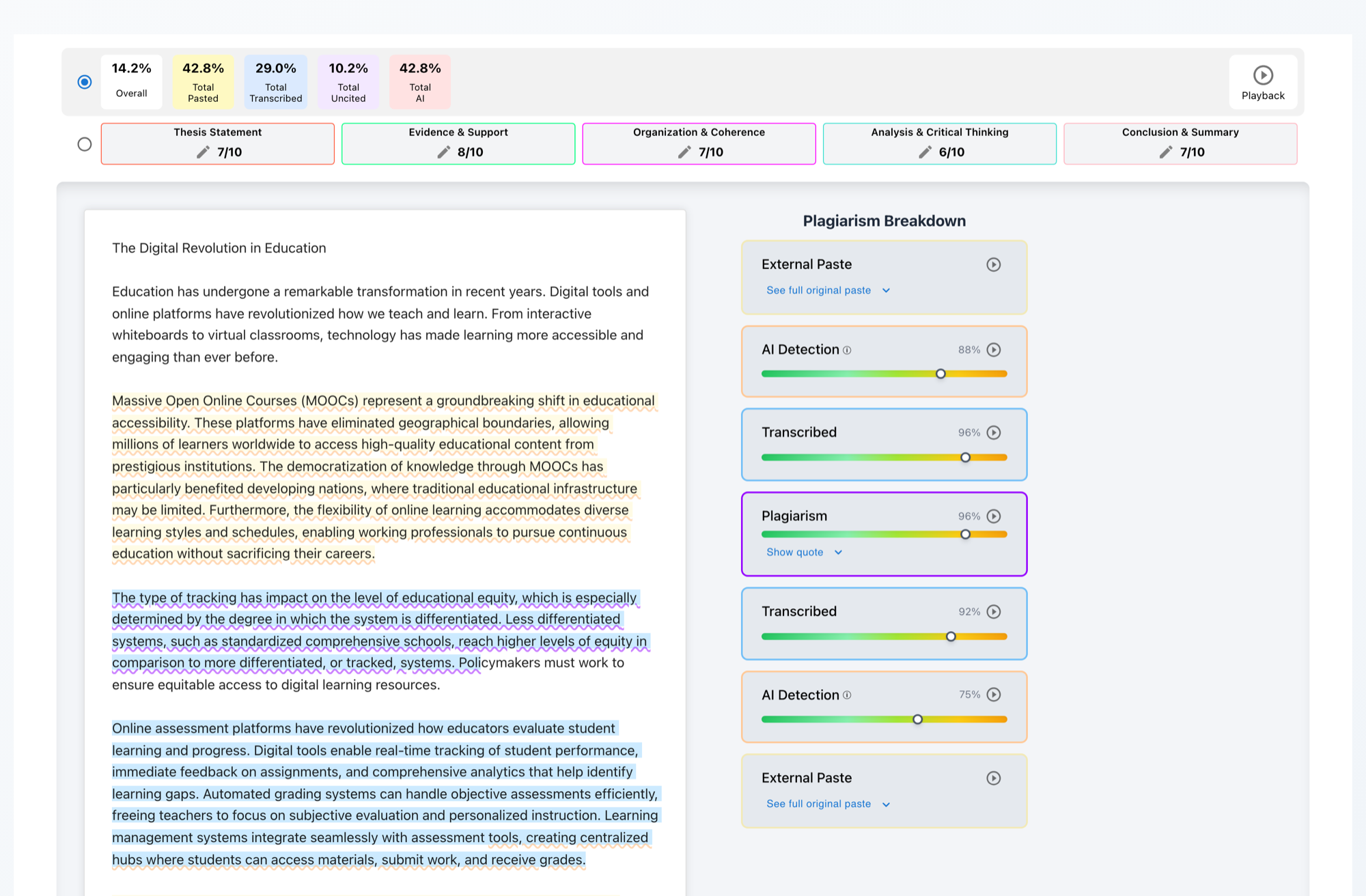
The ultimate forensic differentiator between developmental patchwriting and deceptive AI/humanizer generation is temporal writing process evidence. Checkmark's Essay Playback™ records every keystroke, deletion, revision burst, and pause during drafting:
- Scrubbable 1x–8x Replay: Teachers can watch the student compose the paper in real time. If a student spent 45 minutes drafting a paragraph—pausing for 20 seconds between clauses, consulting research notes, backspacing three times to refine vocabulary—the teacher has definitive “receipts” proving authentic intellectual effort.
- 100% External Paste Buffer Preservation: If a student copies text from ChatGPT or a paraphrasing website and pastes it into the document, Checkmark captures the raw, unedited clipboard text instantly. Even if the student subsequently spends an hour rewriting every word to evade AI detectors, Checkmark displays the original pasted text and flags the event on the timeline with a direct “jump-to-playback” button.
- Transcription Detection: Identifies mechanical, rhythmic typing without natural composing pauses, exposing students who manually retype text while reading from a second screen, tablet, or mobile phone.

4. Teacher-in-the-Loop AI Rubric Autograding with AP Alignment
Checkmark integrates an AI Rubric Autograder designed with strict teacher-in-the-loop governance:
- Quote-Anchored Justifications: The system generates draft rubric scores directly aligned with College Board AP Seminar and AP Research rubric criteria. Every point suggestion is accompanied by quote-anchored citations from the student's text explaining why the paragraph achieved Level 2 Dialogue vs. Level 3 Dialectical Synthesis.
- Full Teacher Authority: All AI suggestions remain private drafts until reviewed, modified, or approved by the educator.
- Direct LMS Passback: Once finalized, scores and formative feedback push seamlessly into Canvas LMS SpeedGrader, Buzz LMS, or Google Classroom.

6. Illustrative AP Capstone Case Studies
The following illustrative classroom scenarios show how AP Capstone instructors can use Checkmark's side-by-side comparison and process telemetry to transform patchwriting into high-scoring synthesis. They are composite examples; the students, sources, and figures are not reports of real cases.
Inquiry Question: Microplastics filtration in wastewater treatment plants and freshwater bioaccumulation.
- Problem: Novice 10th grader patchwrites agency and journal sources side-by-side (82% syntactic mimicry).
- Checkmark Diagnostic: Dual-Pane Token Mapping flags yellow synonym swaps and clause skeletons.
- Outcome: Formative 3-Pass restructuring elevates the IRR perspectives row from 2/6 to 6/6.
Inquiry Question: Smartphone notification frequency and adolescent working memory latency.
- Problem: Student overwhelmed by fMRI neuroscience jargon flagged with 82% AI Probability by black-box detector.
- Checkmark Diagnostic: Essay Playback™ proves 4.2 hours of authentic drafting across 3 evenings with zero paste events.
- Outcome: Theoretical synthesis matrix elevates paper to AP Score 5 and undergraduate journal submission.
Inquiry Question: Domestic political pressures in Soviet decision-making during the 1962 Cuban Missile Crisis.
- Problem: Isolated juxtaposition (Level 1 stacking) of Khrushchev memoirs vs ExComm transcripts.
- Checkmark Diagnostic: 4-Badge Taxonomy identifies unbridged serial source summaries.
- Outcome: Dialectical restructuring around Allison's Bureaucratic Politics Model produces high-scoring historical debate.
Case Study 1: Dual-Pane Text Comparison in Action
In Maya's AP Seminar draft, Checkmark's side-by-side viewer visually highlighted the exact clause-by-clause mirroring:
During a 5-minute PREP check-in, Maya's teacher projected Checkmark's synchronized viewer. Guided by the platform's synthesis prompts, Maya restructured the passage into Level 3 Dialectical Synthesis:
“Although standard biological wastewater treatments theoretically capture up to 90% of synthetic microfibers under laboratory conditions (Author A, 2021), real-world municipal infrastructure often operates far below this threshold. Field measurements across 14 Bavarian treatment plants revealed that heavy storm runoff reduces hydraulic retention times by half, causing microfiber capture rates to drop to 43% (Author B, 2022). Consequently, regulatory standards based solely on optimal laboratory conditions underestimate actual environmental discharge into freshwater tributaries.”
Illustrative example: the source passage, authors, and figures in this case study are invented for demonstration.
7. The 4-Phase AP Synthesis Calibration Protocol & The Formative 3-Pass Paraphrasing Workshop
To standardize source synthesis across entire AP Capstone cohorts, schools implement Checkmark's 4-Phase AP Synthesis Calibration Protocol.
Early-draft submission through Checkmark during initial PREP milestones. Identifies syntactic mirroring, synonym swapping, and citation gaps.
Pass 1: Textual Deconstruction (Source Open) • Pass 2: Blind Synthesis Drafting (Source Closed) • Pass 3: Dual-Pane Verification (Checkmark Open).
Peer partners review dual-pane highlights. 5-minute student-teacher check-ins guided by Playback timeline telemetry.
Quote-anchored scoring aligned with AP Seminar/Research rubrics. Instant score and feedback synchronization to Canvas SpeedGrader or Buzz LMS.
The Formative 3-Pass Paraphrasing Workshop Model
- Student reads the scholarly source in full.
- Identifies: (a) Core Claim, (b) Empirical Methodology, (c) Quantitative Finding.
- Golden Rule: Student writes 3 bullet points using ONLY their own shorthand notes; no full sentences allowed.
- Student physically minimizes or covers the original journal article.
- Student drafts the synthesis paragraph relying solely on their conceptual bullet points.
- Synthesizes the finding with a secondary source to establish dialogue or theoretical tension.
- Student uploads draft to Checkmark's Dual-Pane Workbench.
- Checks token mapping: Are there yellow syntactic mirroring badges?
- Verifies citation badges: 🟢 Quoted, 🟨 Paraphrased, 🟣 Hallucination Alert.
- Refines transitions to achieve Level 3 Dialectical Synthesis.
8. Enterprise Security, FERPA/COPPA Compliance, and Ethical AI Guardrails
When deploying writing integrity and AI-assisted educational technology in advanced high school environments, school districts must maintain rigorous data privacy safeguards.
Student research drafts, literature reviews, and PREP logs are NEVER ingested to train, fine-tune, or calibrate public or proprietary LLMs.
All student Personally Identifiable Information (PII) is encrypted at rest (AES-256) and in transit (TLS 1.3). User metadata is completely isolated by district tenant.
LTI 1.3 certified integration with Canvas LMS, Buzz LMS, Schoology, Google Classroom, and single sign-on via Google SSO and Microsoft Azure Active Directory.
9. Frequently Asked Questions (FAQs)
1. How does Checkmark's side-by-side text comparison differ from traditional plagiarism checkers like Turnitin?
Traditional plagiarism checkers generate a single, aggregate “similarity percentage” that groups legitimate quotations, standard disciplinary terminology, and developmental patchwriting into one monolithic number. Checkmark provides a Synchronized Dual-Pane Viewer with token-level lexical and syntactic mapping, accompanied by an objective 4-Badge Source Taxonomy (🟢 Quoted, 🟨 Paraphrased, 🔴 Uncited, 🟣 Hallucinated). Furthermore, Checkmark pairs text comparison with patent-pending Essay Playback™ (1x–8x keystroke replay), allowing teachers to see how the text was drafted over time rather than judging static prose alone.
2. Do the College Board's teacher-role guidelines allow teachers to use Checkmark's side-by-side viewer with AP Capstone students?
Yes, when used formatively. The College Board's teacher-role guidelines prohibit teachers from writing, revising, or correcting student work, proofreading or copyediting it, and giving specific, directive feedback. They do not prohibit work-in-progress meetings, guidance on progress, pointing students to the rubrics, or whole-class teaching of skills such as synthesis. Using Checkmark's side-by-side viewer to help students visualize their own clause mirroring or citation gaps can serve those formative purposes, with the teacher asking questions and the student revising their own work independently prior to final Digital Portfolio submission.
3. How does Essay Playback™ distinguish between an honest student struggling to paraphrase and someone using an AI humanizer or paraphrasing tool?
An honest student struggling to paraphrase exhibits natural, human writing telemetry: typing bursts, 15-to-45 second cognitive pauses, deletions, rephrasing, and gradual paragraph formation over 20–60 minutes. In contrast, a student using an AI humanizer (such as QuillBot or Undetectable AI) typically exhibits an instant clipboard paste event of hundreds of words in a single millisecond. Even if they subsequently tweak words, Checkmark's Paste Buffer Preservation captures the original pasted text and reveals the absence of authentic organic drafting.
4. How can teachers use Checkmark to detect hallucinated or fabricated citations generated by LLMs in AP Research papers?
When students use generative AI models to draft literature reviews, LLMs frequently invent plausible-sounding citations with real author names but fake article titles, fabricated DOIs, or non-existent volume numbers. Checkmark's automated source verification engine queries live academic databases (Crossref, PubMed, Semantic Scholar, JSTOR) and flags unresolvable metadata with a 🟣 Unverified / Hallucinated Citation Alert, allowing educators to address citation fabrication immediately.
5. What is the recommended classroom workflow for integrating the 3-Pass Paraphrasing Workshop into an AP Seminar or AP Research curriculum?
Integrate the 3-Pass Workshop during initial literature review milestones: (1) Pass 1 (Deconstruction): Students extract 3 core conceptual bullet points from a scholarly source with the article open. (2) Pass 2 (Blind Drafting): Students close the source and compose an integrated synthesis paragraph combining two perspectives. (3) Pass 3 (Dual-Pane Verification): Students submit their draft to Checkmark's Dual-Pane Workbench to verify syntactic independence, check for clause mirroring, and calibrate citations before submitting to peer review.
6. How does Checkmark integrate with Canvas LMS SpeedGrader and Buzz LMS for rubric autograding and feedback passback?
Checkmark connects via LTI 1.3 standards. Teachers launch Checkmark directly inside Canvas SpeedGrader or Buzz LMS. The platform generates draft rubric scores with quote-anchored justifications tied to AP Seminar/Research rubric rows. Once the teacher reviews, edits, and approves the evaluation, scores and written rationales automatically pass back into the LMS gradebook with zero manual data entry.
7. How does Checkmark handle short-text reading responses or preliminary inquiry proposals under 150 words?
Checkmark enforces honest short-text guardrails. Below ~150 words, statistical linguistic pattern analysis (perplexity and burstiness) is statistically unreliable due to small sample sizes. Rather than generating inaccurate, probabilistic guesses, Checkmark's AI detector displays N/A with an explanatory disclaimer, while continuing to provide full dual-pane source matching and keystroke playback telemetry.
10. Conclusion: Transforming Academic Integrity into Scholarly Growth
The ultimate objective of AP Capstone and advanced humanities education is not to catch students cheating—it is to mentor emerging scholars into independent thinkers who can navigate complex academic discourse with confidence, integrity, and intellectual agency.
When educators replace punitive aggregate scores with Checkmark Plagiarism's synchronized dual-pane text comparison, 4-badge source taxonomy, and patent-pending Essay Playback™, the classroom dynamic shifts from adversarial policing to formative mentorship:
- Novice writers receive the visual scaffolding they need to move past developmental patchwriting and master dialectical synthesis.
- Honest students are definitively protected against false AI accusations through tamper-proof keystroke playback evidence.
- AP Capstone Coordinators and Teachers can support the teacher's College Board authenticity affirmation with defensible, transparent proof.
Stop guessing, start trusting. Equip your AP Capstone program with the formative writing tools needed to foster authentic scholarship. Explore Checkmark Plagiarism at checkmarkplagiarism.com and schedule an institutional demonstration today.