
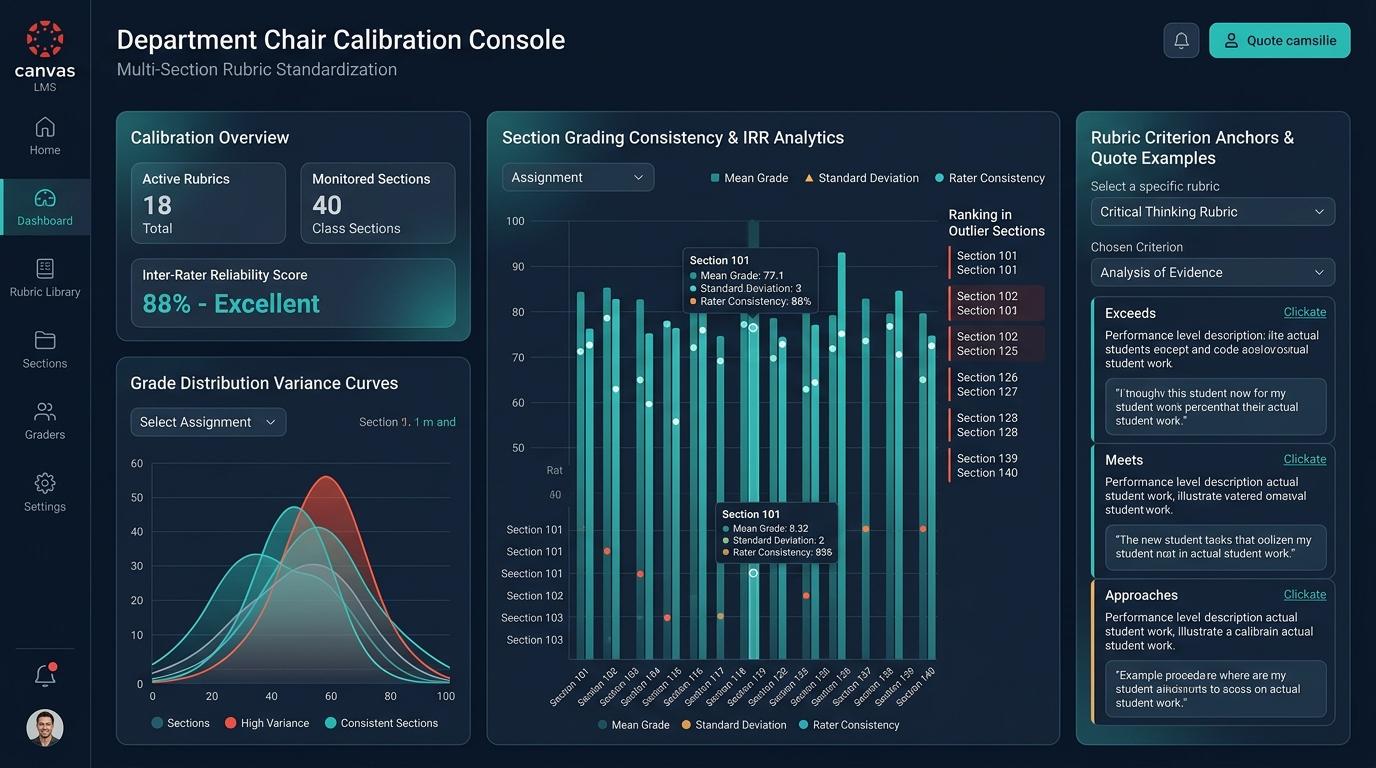
In multi-section courses spanning dozens of course shells, department chairs, Writing Program Administrators (WPAs), and instructional leads face a persistent crisis of inter-rater reliability. Variations between “harsh” and “lenient” graders, subjective rubric interpretation, and grading fatigue create massive grade disparities across sections, fueling student grievances, skewing departmental learning outcomes, and compromising institutional equity. While Instructure Canvas LMS provides account-level rubrics and Blueprint Courses, native LMS tools cannot standardize human subjective interpretation or verify writing authenticity. By integrating Checkmark Plagiarism via 1EdTech LTI 1.3 Advantage (Assignment and Grade Services - AGS 2.0 & Names and Role Provisioning Services - NRPS 2.0), academic departments establish an objective, standardized AI first-draft evaluation baseline. Graders receive quote-anchored criterion justifications, department chairs gain cross-section variance analytics, and students are protected through patent-pending Essay Playback™ typing dynamics—preserving faculty final authority while ensuring fair, defensible, and uniform grading across every Canvas section.
Checkmark Plagiarism streamlines multi-section academic calibration by uniting AI autograding with writing process replay, AI writing detection, plagiarism detection, and enterprise integrations with Canvas LMS and Agilix Buzz LMS.
1. The Multi-Section Grading Crisis: Subjectivity, Drift, and Inter-Rater Disparities
In higher education institutions, secondary school districts, and online course programs, foundational courses are rarely taught by a single instructor. A typical First-Year Composition (FYC) program, AP English cohort, Introductory Psychology sequence, or secondary Humanities department often spans 10 to 60 distinct Canvas course sections, staffed by a diverse teaching team:
- Full-time tenured and tenure-track faculty
- Adjunct instructors and contingent lecturers across multiple campuses
- Graduate Teaching Assistants (GTAs) with varying instructional experience
- High school teachers delivering dual-enrollment sections
While all sections share a common course catalog description, syllabus objectives, and standardized Canvas assignment rubric, the actual grades students receive often depend more on which section they were assigned than the objective quality of their writing.
The Five Evaluator Archetypes and Rubric Drift
Even when instructors utilize an identical, detailed scoring rubric in Canvas SpeedGrader, human evaluators interpret qualitative descriptors (“thoroughly develops argument,” “demonstrates nuanced insight,” “adequate textual support”) through subjective personal lenses. Over a 15-week academic term, departments routinely observe five evaluator archetypes:
The Severe Penalizer (“The Gatekeeper”)
Grades with punitive rigor. A single unsupported claim or non-standard transitional phrase drops an essay from “Exemplary” to “Developing.” Class averages hover in the low 70s.
The Leniency Maximizer (“The Crowd Pleaser”)
Assigns top-bracket scores to avoid student friction, grade appeals, or negative student evaluations. Class averages exceed 92%, masking foundational writing deficiencies.
The Central Tendency Hedger
Hesitates to award either failing marks or full credit. Every student receives a mid-level “B” (82%–86%), flattening the distribution curve and failing to distinguish exceptional analysis from mediocre summary.
The “Halo & Horns” Grader
Allows early impressions of a student’s verbal participation, draft outlines, or formatting aesthetics to dictate scores across unrelated criteria (e.g., docking points on “Critical Argumentation” because the Works Cited page had an incorrect indent).
The Fatigued Drifter
Starts grading with high precision on Essay #1 (providing extensive marginalia and strict scoring) but succumbs to cognitive fatigue by Essay #80, rapidly clicking mid-tier rubric criteria to meet gradebook submission deadlines.
The Institutional Consequences for Department Leadership
When inter-rater variance remains unchecked, the damage extends far beyond individual classroom friction:
Section Shopping & Equity Gaps
Students quickly learn which instructors are “easy A’s” and flood registration for those sections, while demanding sections suffer low enrollment. Students enrolled in rigorous sections face unearned GPA penalties.
Corrupted Accreditation & SLO Data
Department chairs must submit student learning outcome (SLO) data for regional accreditation (SACSCOC, HLC, MSCHE, NECHE, WSCUC). If Section A reports 95% mastery on Information Literacy while Section B reports 62%, the aggregate data is statistically invalid.
Escalating Grade Grievances
When students compare papers with peers in other sections and discover identical analytical errors penalized by 15 points in one section but ignored in another, academic grievance committees are overwhelmed with appeals.
Inconsistent Academic Integrity Standards
Without unified integrity baselines, one instructor accuses a student of unauthorized AI generation based on a gut feeling, while another instructor in the adjacent section fails to notice an unedited 2,000-word copy-paste from Wikipedia.
2. Technical Mechanics in Canvas LMS: Native Capabilities & Architectural Limitations
To address grading variance, enterprise institutions rely on Instructure Canvas LMS. Canvas provides robust structural tools for course management, but understanding the boundary between structural configuration and evaluative calibration is essential.
District / University Institutional Instance
General Education Outcomes • University-Wide Core Competencies (Written & Quantitative Literacy)
College of Arts & Sciences > Department of English
Departmental Locked Rubrics • Standardized Scoring Criteria & Rating Descriptions
Master_ENG101 Shell
Standardized Assignment Prompts • Locked Rubrics Bound to AGS Line Items • Blueprint Sync
Account-Level & Sub-Account Institutional Rubrics vs. Course-Level Inheritance
In Canvas, rubrics can be created at three hierarchical levels:
- Root Account Level: Available across every college, department, and course shell in the institutional instance. Typically reserved for university-wide general education competencies (e.g., Written Communication, Quantitative Reasoning).
- Sub-Account Level: Created within specific departmental sub-accounts (e.g., College of Arts & Sciences > Department of English). All course shells housed under that sub-account inherit these rubrics. Department chairs can lock criteria and rating scales to prevent individual instructors from modifying point values.
- Course Level: Created by individual instructors within their specific course shells. These rubrics cannot be audited centrally and represent the primary source of unauthorized rubric variation.
Canvas Blueprint Courses: Centralized Deployment
Department chairs utilize Canvas Blueprint Courses (Course ID: Master_ENG101) to standardize assignments. When an assignment with an attached sub-account rubric is created in a Blueprint shell and synced:
- The assignment description, point value, submission type, and attached rubric lock into all associated course shells.
- Individual section instructors cannot alter the rubric point scale or delete criteria.
- Updates made to the Blueprint rubric automatically cascade to all active sections upon running a synchronization cycle.
Why Native Canvas Rubrics Fall Short: The “Interpretation Gap”
While Blueprint courses solve the structural distribution problem, they do not solve the cognitive evaluation problem.
Canvas SpeedGrader presents the instructor with a clickable matrix of criteria and rating descriptions. However:
Clicking a rubric criterion (e.g., “Adequate Evidence: 15/20”) does not link that score to any specific paragraph or sentence in the student’s document.
Canvas provides no indication to the instructor if their average score across the first 10 papers is 2.5 standard deviations higher than departmental norms.
To audit grading consistency across 40 sections in native Canvas, a department chair must manually open 40 individual course shells and click through submissions one by one.
Similarity reports appear as isolated percentages in a sidebar icon without direct contextual integration into the rubric criterion for “Originality and Source Attribution.”

3. Technical Implementation: 1EdTech LTI 1.3 Advantage Integration
To bridge the gap between static Canvas rubrics and standardized, evidence-anchored evaluation, enterprise departments deploy Checkmark Plagiarism through 1EdTech LTI 1.3 Advantage.
LTI 1.3 replaces legacy LTI 1.1/1.2 protocols with OAuth2 authentication, JSON Web Tokens (JWT), and three specialized Advantage services that allow bi-directional synchronization between Canvas and Checkmark:
- Account & Sub-Account Hierarchy
- Section Rosters & Enrollment Endpoints
- Canvas SpeedGrader & Gradebook Columns
- Master Blueprint Course Rubric Schemas
- OAuth2 JWT Token Handshake & State Validation
- NRPS 2.0 Multi-Section Roster Sync
- Deep Linking 2.0 Assignment Launch
- AGS 2.0 Line Item & Sub-Score Results Passback
Algorithmic baseline • Quote-anchored evidence • Criterion justification generation
Passage-level AI detection • Side-by-side plagiarism • Patent-pending Essay Playback™
Cross-Section Distribution Curves (μ, σ) • Outlier Drift Detection (±1.5σ) • Teacher-in-the-Loop 100% Sign-Off Authority
1. Names and Role Provisioning Services (NRPS 2.0)
NRPS 2.0 eliminates manual roster uploads and enrollment errors. When Checkmark launches within a Canvas course shell:
- It queries the Canvas API to retrieve the complete course roster, including student Canvas IDs, names, and assigned section numbers (
Section 01,Section 02, etc.). - It distinguishes between administrative roles (
Department Chair,Lead Instructor), grading roles (Teacher,Teaching Assistant), and student roles (Student). - It establishes a unified multi-section cohort, allowing department chairs to view aggregate statistics across all sections while restricting individual instructors to their specific student submissions.
2. Assignment and Grade Services (AGS 2.0)
AGS 2.0 governs how grades, criterion breakdowns, and rubric feedback pass back into the Canvas gradebook:
- LineItem Resource: Checkmark creates and manages the primary gradebook column in Canvas.
- Score Publishing: When an instructor approves an AI-drafted rubric evaluation, Checkmark sends an HTTP
POSTrequest containing the final score, submission timestamp, and grading progress status (FullyGraded). - Sub-Score Criterion Breakdown (
resultObject): Checkmark maps its AI-evaluated criteria directly to the corresponding Canvas rubric criterion IDs, populating individual rubric cells inside Canvas SpeedGrader. - Submission Comments: Checkmark formats the quote-anchored written justifications into structured markdown and posts them directly into the Canvas SpeedGrader comment feed, ensuring students see transparent feedback without leaving Canvas.
4. Checkmark’s Standardized AI Rubric Autograding Engine
To eliminate inter-rater variance, Checkmark Plagiarism provides a standardized AI first-draft grading baseline. Rather than relying on disconnected prompts in commercial chatbots, Checkmark embeds a sophisticated, pedagogical evaluation engine directly into the departmental workflow.
The Power of Quote-Anchored Criterion Justifications
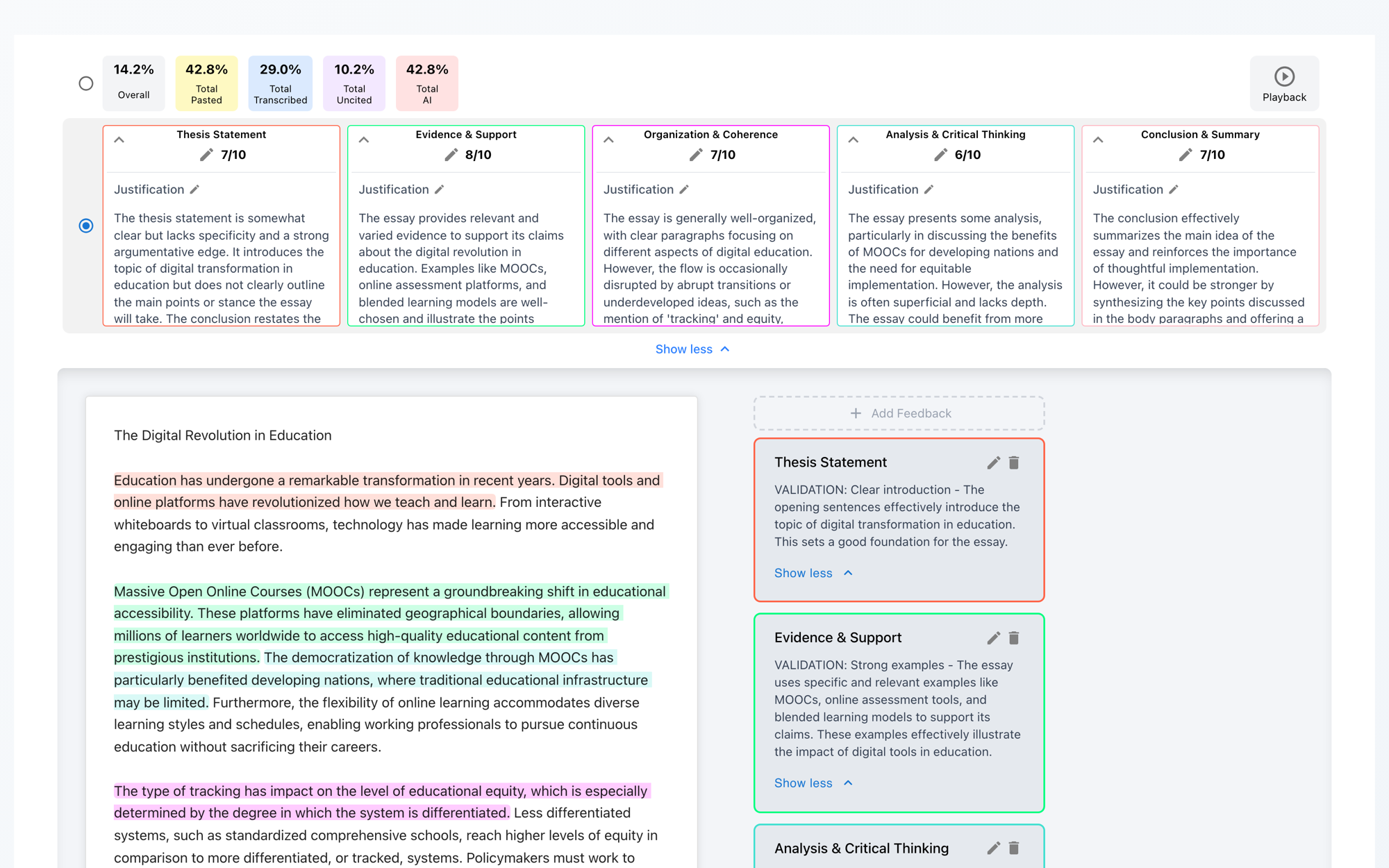
A common weakness of both human and generic AI grading is vague, unhelpful feedback (e.g., “Good analysis, but transitions need work”). Checkmark solves this by anchoring every criterion score in direct textual evidence extracted from the student’s submission.
Use of Textual Evidence & Synthesis
The submission incorporates relevant primary textual evidence in Paragraphs 2 and 4 to support the thesis regarding industrialization. However, Paragraph 3 relies on an unanalyzed block quotation without explanatory synthesis connecting it to the claim.
In Paragraph 3, replace the broad summary with 1-2 sentences explaining specifically how Dickens’ paradox reflects the socioeconomic divide documented in your Manchester data.
By providing direct quote anchors:
- Instructors Save Time: Teachers do not have to spend 10 minutes copying and pasting student sentences into marginal comments.
- Grading Consistency is Guaranteed: The AI applies the exact same threshold for “effective textual integration” whether it is evaluating Paper #1 in Section 01 or Paper #45 in Section 38.
- Student Disputes Dissolve: When students receive specific citations showing where their analysis succeeded and where it faltered, grade disputes drop significantly.
Batch Moderation & Department Chair Analytics Console
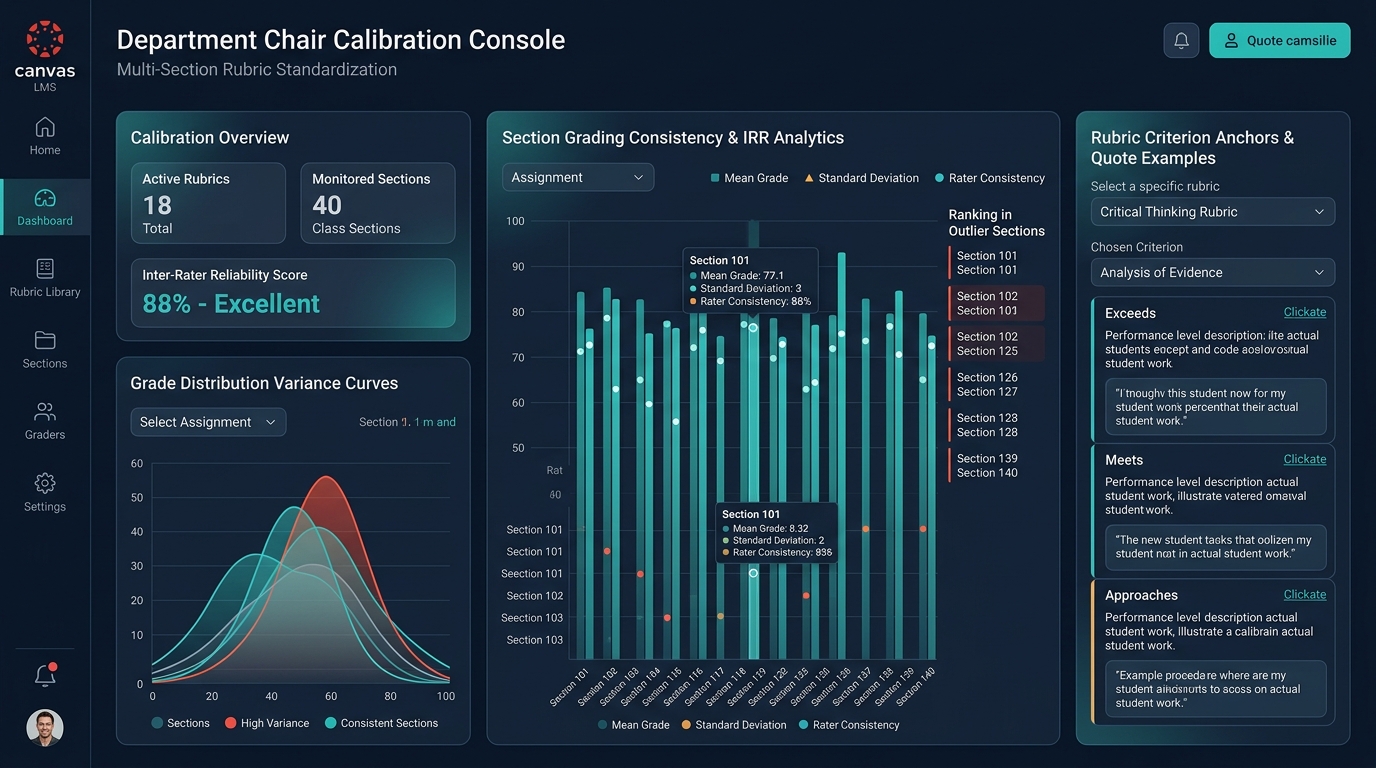
For department chairs, Checkmark introduces a dedicated Multi-Section Moderation Console. Instead of remaining blind to grading trends until final grades are posted, chairs can monitor live evaluation telemetry across every section:
- Real-Time Distribution Curves: Visualizes mean (μ), median, and standard deviation (σ) across all course sections simultaneously.
- Outlier Drift Detection: Automatically flags instructors whose score adjustments deviate by more than ±1.5 standard deviations from the departmental baseline.
- Criterion Heatmaps: Identifies specific rubric criteria where students across all sections are struggling (e.g., a department-wide drop in “Counterargument Synthesis”), providing actionable data for mid-semester curricular adjustments.
| Section | Instructor | Submissions | Mean Score | Std Dev (σ) | Calibration Status |
|---|---|---|---|---|---|
| ENG101-01 | Prof. Adams | 24 / 24 | 82.4% | 6.2 | • Calibrated |
| ENG101-02 | TA Baker | 22 / 22 | 83.1% | 5.8 | • Calibrated |
| ENG101-03 | Adj. Clark | 25 / 25 | 94.8% | 2.1 | Δ High Leniency Flag (+2.1σ) |
| ENG101-04 | Prof. Davis | 23 / 23 | 71.2% | 12.4 | Δ High Severity Flag (-2.4σ) |
| ENG101-05 | TA Evans | 24 / 24 | 81.9% | 6.0 | • Calibrated |
Teacher-in-the-Loop: Non-Negotiable Final Authority
Checkmark operates under a strict teacher-in-the-loop pedagogical framework. The AI autograder produces a comprehensive first-draft recommendation; it does not finalize or publish grades autonomously.
- Draft Status: All autograded criteria remain in “Draft Mode” until an instructor opens the submission.
- 1-Click Adjustments: Instructors can accept the AI draft, adjust a criterion score up or down with a single click, or type custom notes.
- Pedagogical Autonomy: If an instructor knows a student overcame a specific learning challenge or followed an approved alternative prompt, the instructor retains full authority to override any score.
- Audit Trail: Checkmark maintains a complete revision log documenting original AI recommendations, instructor adjustments, and final published scores.
5. Multi-Dimensional Academic Integrity Telemetry: Beyond the Grade
Standardizing grading across multiple sections requires more than rubric alignment—it requires standardizing how academic integrity violations are investigated and resolved.
Traditional AI detectors rely on opaque, whole-paper percentage scores (e.g., “87% AI”). These black-box scores lack evidentiary backing, produce false positives on neurodivergent and English Language Learner (ELL) prose, and lead to adversarial teacher-student confrontations. Checkmark integrates a multi-dimensional evidence suite directly into the rubric grading interface:
Patent-Pending Essay Playback™
Keystroke-by-keystroke video timeline (1x to 8x speed). Reconstructs natural typing, pauses, deletions, and external paste events.
Passage-Level AI Detection
Analyzes perplexity and burstiness at the passage level with confidence sliders. Honest N/A guardrail for text under 150 words.
Defensible Plagiarism Matching
Scans billions of live web pages and internal institutional repositories. Side-by-side quote links and peer match analysis.
1. Patent-Pending Essay Playback™: Keystroke & Temporal Dynamics
Checkmark’s flagship innovation, Essay Playback™, records the authentic drafting process keystroke-by-keystroke. Educators can scrub through the entire writing session like a video timeline at 1x, 2x, 4x, or 8x speed.
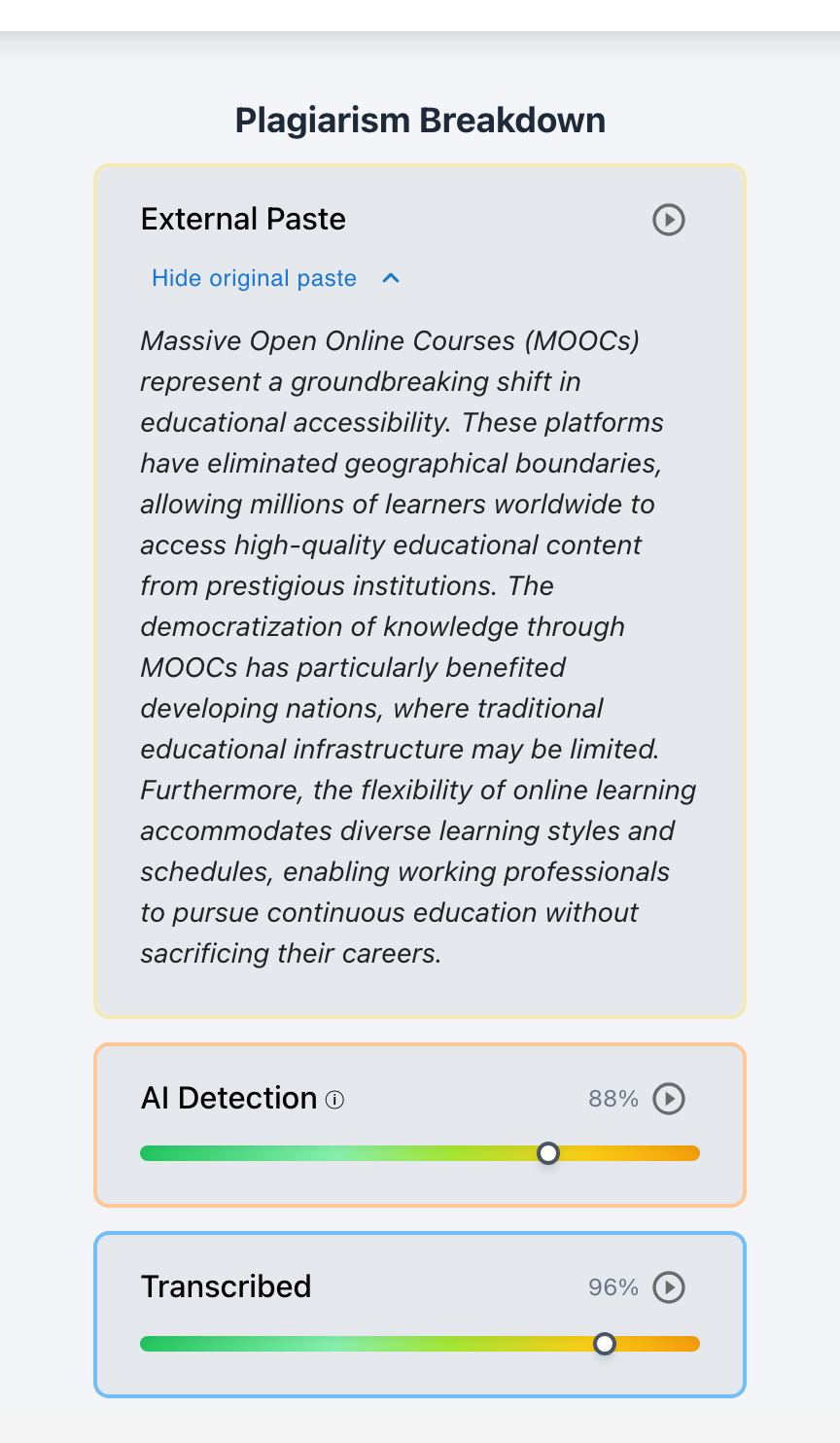
- Natural Composing Dynamics: Authentic human writing exhibits characteristic bursts of typing (25–65 WPM), interspersed with cognitive pauses (thinking, planning, consulting sources), deletions, and syntactic restructuring.
- External Paste Tracking: If a student pastes text from an external source, Checkmark flags the exact timestamp, character count, and duration.
- Full Original Text Preservation: Checkmark preserves the complete original pasted text even if the student subsequently rewrites, paraphrases, or edits every word over the next two hours.
- Transcription Detection: Identifies mechanical, steady typing without natural pauses or backspaces—a hallmark of students manually retyping text while reading off a smartphone, second screen, or dictation feed.
- Exonerating Honest Students: If an external detector falsely flags an authentic paper as AI, Essay Playback™ serves as undeniable proof of genuine, organic authorship.
2. Passage-Level AI Detection with Calibrated Sliders
Rather than outputting a single, arbitrary percentage for the entire document, Checkmark highlights specific passages:
- Passage-Level Granularity: Underlines individual paragraphs with calibrated confidence indicators (Typical Human Style vs. Typical AI Pattern).
- Linguistic Telemetry: Evaluates perplexity (vocabulary predictability) and burstiness (sentence length variation).
- Honest Guardrails (<150 Words): If a passage is under ~150 words, Checkmark displays
N/Arather than guessing on insufficient sample sizes. - Educator-Only Flag Statuses: Flags (Flagged, Resolved, Not Flagged) remain strictly private to educators, preventing premature or automated student accusations.
3. Defensible Plagiarism Matching & Uncited Source Coaching
Checkmark scans billions of live web pages, open-access academic repositories, and internal institutional submissions:
- Side-by-Side Quote Matching: Highlights matched text alongside clickable links to the live original source.
- Dedicated Uncited Source Differentiation: Differentiates between intentional plagiarism and poor citation mechanics, allowing instructors to use the report for citation coaching.
- Student-to-Student Cohort Matching: Detects unauthorized collaboration across different sections within the same Canvas institution without exposing student data externally.
6. Real-World Case Studies & Departmental Impact
Case Study 1: Multi-Section First-Year Composition (FYC) Program
- Institution: Large Public Research University
- Scope: 45 sections of English 101, 32 instructors (20 GTAs, 8 adjuncts, 4 full-time faculty), 1,080 students.
- Challenge: High inter-rater variance (σ = 14.2). Section averages ranged from 71.4% to 92.8%. Over 65 formal grade appeals were filed in the prior fall semester.
- Section Mean Range: 71.4% – 92.8% (21.4% swing)
- Inter-Rater Std Dev (σ): 14.2
- Grading Turnaround: 16.4 days
- Formal Grade Appeals: 68 appeals filed
- GTA Grading Time: 28 hours / paper cycle
- Section Mean Range: 81.2% – 84.6% (3.4% swing)
- Inter-Rater Std Dev (σ): 3.8 (↓ 73% reduction)
- Grading Turnaround: 4.2 days (↓ 74% faster)
- Formal Grade Appeals: 4 appeals (↓ 94% drop)
- GTA Grading Time: 9 hours / paper cycle
Implementation: The Writing Program Administrator (WPA) deployed a locked 5-criterion rubric via a Canvas Blueprint Course. Checkmark generated standardized AI first-draft evaluations. GTAs and faculty used quote-anchored justifications to review and calibrate their grading. The WPA monitored the Multi-Section Moderation Console weekly, holding short calibration check-ins with outlier instructors.
Case Study 2: High School AP English Department
- Institution: Suburban Public High School District
- Scope: 6 AP English Literature teachers across 14 sections, 380 students.
- Challenge: Subjective drift on the College Board 6-Point Analytic Rubric (Thesis: 0–1, Evidence & Commentary: 0–4, Sophistication: 0–1). Novice AP teachers struggled to calibrate the “Sophistication” point consistently.
- Implementation: The department chair configured the exact AP 6-point scoring schema in Checkmark. The AI engine specifically highlighted quote anchors demonstrating complex literary synthesis or contextual tension required for the Sophistication point. Teachers reviewed drafts during bi-weekly PLC meetings.
- Outcome: District mock exam scoring achieved a 0.88 inter-rater correlation with official College Board reader benchmarks, up from 0.54 the previous year.
Case Study 3: STEM Department Biology Lab Reports
- Institution: Mid-Sized State College
- Scope: 1,200 students in General Biology across 24 lab sections, staffed by 12 Graduate TAs.
- Challenge: Severe grading inconsistencies on the “Scientific Discussion & Error Analysis” sections of lab reports. TAs routinely overlooked copy-pasted methodology text from online lab repositories.
- Implementation: Sub-account rubric deployed with weighted criteria for Hypothesis Formulation, Data Representation, and Error Analysis. Checkmark’s side-by-side plagiarism scan and Essay Playback™ identified students pasting pre-calculated data sets from prior semesters.
- Outcome: TA grading hours dropped from 18 hours/week to 6 hours/week, while uncredited lab protocol reuse dropped by 82% due to consistent, visible detection.
7. The 5-Phase Departmental Calibration Protocol: A Playbook for Chairs
To successfully implement standardized rubric grading across Canvas course shells, department chairs and instructional leads should follow this structured 5-phase operational protocol:
Blueprint & Rubric Locking
Pre-Semester Setup
- Create master rubric at Sub-Account level
- Bind to Canvas Blueprint Master Course
- Lock criteria, descriptors, & point scales
- Cascade Blueprint sync to all shells
Benchmark Anchoring Session
Weeks 1–2
- Select 3 sample anchor papers (A, B, C/D)
- Run Checkmark AI autograder baseline
- Conduct 45-min faculty norming meeting
- Align team on criterion score thresholds
AI First-Draft & Faculty Review
Active Grading Window
- Students submit via Canvas LMS
- Checkmark drafts scores & quote anchors
- Instructors review & personalize in console
- Faculty 1-click approve & sync to LMS
Chair Variance Audit
Mid-Cycle Moderation
- Monitor cross-section distribution curves
- Identify leniency or severity drift (>1.5σ)
- Review sample submissions with outlier staff
- Conduct supportive 1-on-1 calibration coaching
Post-Cycle Debrief & Curricular Refinement (End-of-Term)
Aggregate criterion-level mastery data across all 1,000+ students • Refine ambiguous rubric descriptors • Archive top anchor papers and Essay Playback™ sessions for training next semester’s incoming teaching assistants and adjuncts.
8. Comparative Analysis: Manual SpeedGrader vs. Generic AI vs. Checkmark
| Evaluation Dimension | Manual Canvas SpeedGrader | Standalone Generic AI (ChatGPT / Copilot) | Checkmark Plagiarism Unified Engine |
|---|---|---|---|
| Inter-Rater Consistency | ❌ Low (Severe drift between adjuncts, TAs, and faculty) | ⚠️ Variable (Subject to prompt drift & temperature) | ✅ High (Standardized algorithmic baseline across all sections) |
| Evidence Grounding | ❌ Manual (Instructor must copy/paste quotes manually) | ⚠️ Generic (Broad summaries; hallucination risk) | ✅ Quote-Anchored (Direct citations tied to every rubric criterion) |
| LMS Integration | ✅ Native (Standard SpeedGrader interface) | ❌ None (Requires manual copy-pasting of text & scores) | ✅ 1EdTech LTI 1.3 Advantage (Bi-directional AGS 2.0 & NRPS 2.0) |
| Chair Analytics | ❌ None (Requires manual course-by-course inspection) | ❌ None (Zero departmental oversight) | ✅ Multi-Section Moderation Console (Real-time distribution & drift alerts) |
| Writing Process Telemetry | ❌ None (Evaluates static submitted file only) | ❌ None (Blind to composition history) | ✅ Patent-Pending Essay Playback™ (Keystroke dynamics, pauses, paste tracking) |
| FERPA & Privacy | ✅ Compliant (Institutional Canvas contract) | ❌ High Risk (Consumer tools may train models on student prose) | ✅ Enterprise FERPA/COPPA Compliant (Zero model training on student work) |
| Teacher Authority | ✅ 100% Teacher Authority | ❌ Disconnected from course workflow | ✅ Teacher-in-the-Loop (AI drafts preliminary scores; faculty retains final sign-off) |
9. Taxonomy of Grader Biases & Checkmark Mitigation Strategies
1. Leniency Bias
Manifestation: High A-rate to avoid student frictionCheckmark Mitigation Engine: Multi-section moderation console flags section averages exceeding >1.5σ from cohort mean. Quote-anchored rubric justifications provide instructors with concrete evidence to support rigorous marks without fearing appeals.
2. Severity Bias
Manifestation: Disproportionate point cuts for minor stylistic flawsCheckmark Mitigation Engine: Algorithmic first-draft baseline evaluates prose strictly against explicit criterion band descriptors, preventing penalization based on idiosyncratic instructor preferences.
3. Central Tendency Bias
Manifestation: Clustering all scores in the 82–86% rangeCheckmark Mitigation Engine: Multi-criterion discrete band scoring enforces full-scale distribution, identifying both exemplary synthesis and foundational skill gaps.
4. Halo & Horns Effect
Manifestation: Prior student impressions skew analytical criteriaCheckmark Mitigation Engine: Modular criterion evaluation isolates analytical logic from formatting or syntax, ensuring independent score calculation.
5. Evaluator Fatigue
Manifestation: Grading quality decays from Paper #1 to Paper #90Checkmark Mitigation Engine: Consistent algorithmic processing quality across 10,000+ submissions ensures Paper #90 receives the exact same depth of evaluation and quote-anchoring as Paper #1.
10. Frequently Asked Questions (FAQs)
1. Does standardized AI rubric grading undermine faculty academic freedom?
No. Checkmark is designed strictly as a teacher-in-the-loop decision-support tool, not an autonomous grading authority. The AI autograder produces an objective first-draft recommendation with quote-anchored justifications. Faculty retain 100% autonomy to modify scores, rewrite feedback, and account for nuanced classroom context before publishing. Standardizing the initial baseline protects academic freedom by eliminating arbitrary grading disparities while relieving faculty of mechanical grading fatigue.
2. How does Canvas handle rubric updates if an assignment is already deployed across 40 sections?
When rubrics are managed via a Canvas Blueprint Master Course, any modifications made to the Blueprint rubric cascade to all associated course shells upon initiating a Blueprint Sync. If submissions have already been graded, Canvas preserves existing historical scores while updating the rubric schema for subsequent grading cycles. Through Checkmark’s LTI 1.3 integration, rubric schema updates sync dynamically without disrupting active student submissions.
3. What happens if a student disputes a grade generated in this workflow?
Grade disputes are resolved faster and more constructively because the evaluation is backed by transparent evidence. Instead of debating subjective impressions, the student and instructor examine the Checkmark Evidence Report, which pairs specific rubric criteria with exact quotations from the student’s text, alongside the student’s authentic Essay Playback™ drafting timeline. This shifts conversations from adversarial confrontation to targeted writing coaching.
4. How does Checkmark protect student privacy under FERPA and COPPA?
Checkmark operates under a strict Zero-Training Enterprise Privacy Policy. Student submissions are encrypted in transit (TLS 1.3) and at rest (AES-256) and are never used to train commercial Large Language Models or public AI systems. Checkmark complies fully with the Family Educational Rights and Privacy Act (FERPA) and the Children’s Online Privacy Protection Act (COPPA), operating under formal Institutional Data Protection Agreements (DPAs).
5. Can department chairs monitor grading progress across all sections without logging into each Canvas course shell?
Yes. Checkmark’s Multi-Section Moderation Console aggregates grading telemetry across all enrolled Canvas sections into a single dashboard. Chairs can monitor submission counts, grading completion percentages, mean score distributions, and standard deviation alerts across 50+ sections without ever needing to log into individual Canvas course shells.
6. How does Checkmark evaluate qualitative criteria like “Voice,” “Tone,” or “Originality”?
Checkmark’s AI autograder evaluates qualitative criteria by analyzing syntactic variety, rhetorical transitions, figurative language, and vocabulary register against the specific level descriptors defined in your rubric. If a criterion evaluates “Authorial Voice,” the engine extracts specific sentences demonstrating distinctive stylistic choices or passages that lapse into mechanical summary, providing quote-anchored justifications for the assigned score.
7. What is the difference between Canvas Blueprint Courses and Checkmark’s centralized rubric deployment?
Canvas Blueprint Courses handle the structural distribution of course materials (copying assignment pages, due dates, and blank rubric templates into course shells). Checkmark provides the evaluative intelligence and telemetry (generating objective AI first-draft scores, quote-anchored feedback, cross-section statistical moderation, and keystroke Essay Playback™). The two tools work synergistically: Canvas Blueprint deploys the assignment structure, while Checkmark ensures standardized, defensible evaluation.
11. Conclusion: Transforming Multi-Section Grading from a Pain Point into an Institutional Strength
Standardizing rubric grading across dozens of Canvas course shells has long been one of the most frustrating challenges in academic leadership. Department chairs have historically been trapped between two unacceptable extremes: leaving grading uncalibrated (resulting in severe inter-rater disparities, student complaints, and compromised learning outcomes) or micromanaging faculty through labor-intensive manual audits.
By integrating Checkmark Plagiarism into Canvas LMS via 1EdTech LTI 1.3 Advantage, institutions establish a sustainable, modern grading ecosystem:
- Objective Calibration: An algorithmic first-draft baseline ensures that every student in every section is evaluated against the exact same standards.
- Defensible Feedback: Quote-anchored justifications replace vague comments with transparent, actionable writing guidance.
- Comprehensive Integrity Telemetry: Patent-Pending Essay Playback™ verifies authentic writing processes, protecting honest students and eliminating reliance on black-box AI detection scores.
- Actionable Departmental Oversight: Real-time moderation analytics empower chairs to identify and support outlier sections before grades are finalized.
- Teacher-Centered Pedagogy: Faculty save up to 70% of mechanical grading time while retaining complete final authority over student assessment.
By combining institutional Canvas infrastructure with Checkmark’s unified evaluation suite, academic departments move beyond the guessing game of subjective grading—fostering fairness, trust, and academic excellence across every classroom.
Elevate Grading Consistency Across Your Department
Learn how Checkmark Plagiarism standardizes rubric evaluation, eliminates inter-rater variance in Canvas LMS, and equips faculty with quote-anchored feedback and keystroke process playback.
Explore Canvas LMS Integration