
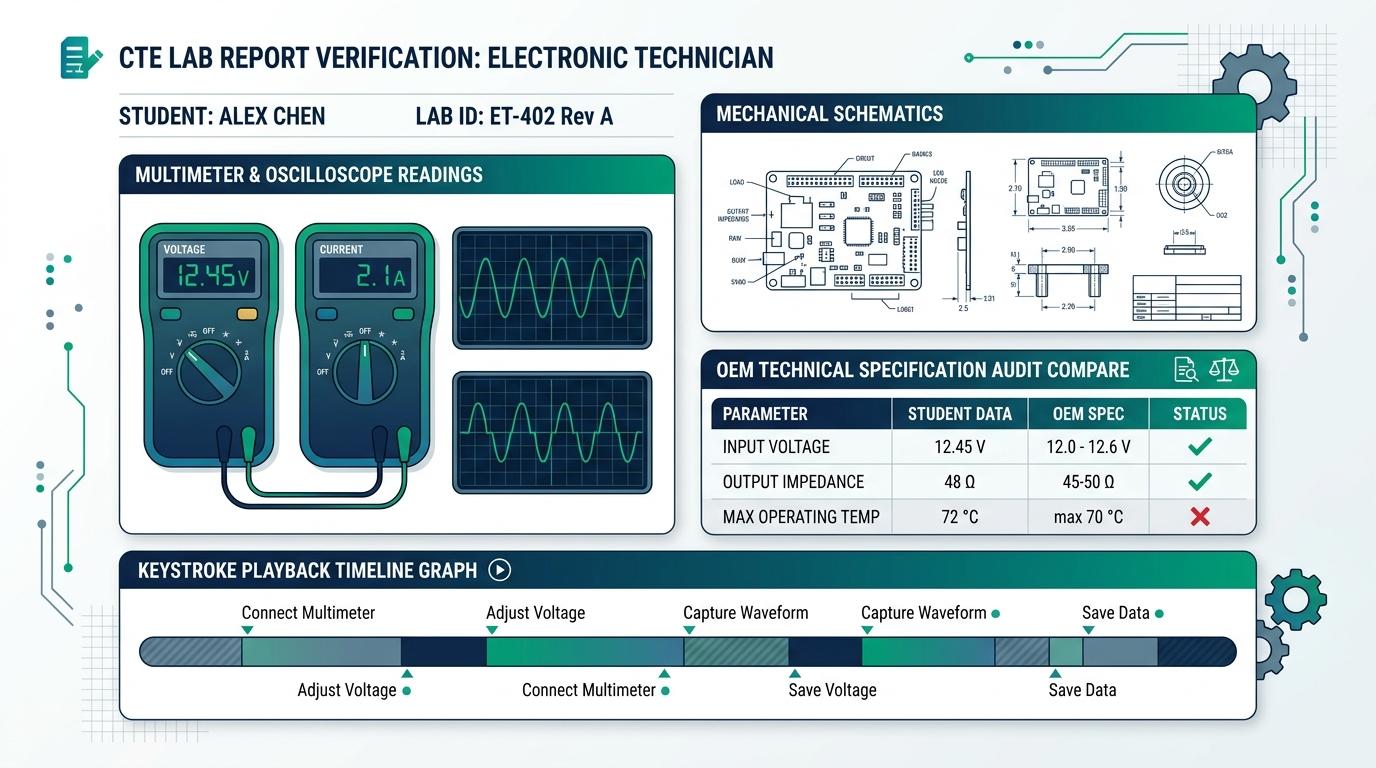
In modern Career and Technical Education (CTE), hands-on trade programs, and STEM capstone courses, student technical reports serve as the definitive record of physical benchwork, diagnostic trouble trees, and safety-critical equipment operations. However, vocational instructors and CTE department chairs face a compounding dual threat that undermines academic integrity, industry certifications, and workplace safety: uncited OEM equipment specifications (verbatim copy-pasting from proprietary service manuals, Caterpillar/Snap-on/Miller/Rockwell diagnostic tables, or manufacturer wiring schematics without technical attribution) and AI-hallucinated shop telemetry (synthesizing realistic multimeter voltage drops, invented refrigeration superheat/subcooling numbers, fake weld bead tensile test results, hallucinated CNC tool offset coordinates, and synthetic PLC ladder logic execution logs).
Generic AI detectors fail catastrophically on CTE technical reports because domain-specific acronyms, standard equipment specifications, and rigid step-by-step diagnostic workflows register as artificially low perplexity—generating catastrophic false positives against honest learners. Meanwhile, standalone legacy plagiarism checkers cannot detect synthetic, mathematically plausible lab numbers generated by Large Language Models (LLMs). Checkmark Plagiarism provides a non-punitive, multi-dimensional verification architecture specifically engineered for technical and vocational education: combining synchronized side-by-side OEM and web source matching, passage-level AI confidence sliders with honest short-text (<150w) guardrails, patent-pending Essay Playback™ (1x–8x scrubbable keystroke replay) to verify genuine procedural drafting versus massive external text pastes, and AST-driven rubric autograding with direct grade passback into Canvas LMS and Buzz LMS. By shifting from punitive guesswork to transparent, evidentiary audits, CTE programs protect Perkins V accountability, maintain industry certification standards (ASE, AWS, NIMS, EPA 608, NCCER), and instill real-world technical ethics.
Checkmark Plagiarism provides seamless enterprise interoperability for vocational and CTE programs through its comprehensive suite of AI rubric autograding, writing process replay, passage-level AI detection, side-by-side plagiarism checking, and native LMS integrations.
1. The Critical Role of Technical Documentation in Modern CTE
Career and Technical Education (CTE) has evolved far beyond traditional vocational shop classes. Across secondary career centers, polytechnic institutes, community colleges, and trade apprenticeship programs, CTE programs prepare students for high-skill, high-wage, and high-demand careers in precision manufacturing, automotive and diesel technology, HVAC/R systems, commercial electrical wiring, structural welding, industrial robotics, mechatronics, and allied health sciences.
Under federal frameworks such as the Strengthening Career and Technical Education for the 21st Century Act (Perkins V), school districts and technical colleges are evaluated directly on student attainment of recognized industry credentials and verifiable technical competencies. In every trade discipline, physical bench proficiency must be accompanied by rigorous, industry-aligned technical writing.
The Bridge Between Physical Benchwork and Industry Standards
In the workplace, a technician who conducts a diagnostic test or rebuilds a mechanical assembly does not merely complete the physical task; they must record accurate, legally defensible documentation on a work order, repair log, or engineering change report.
A student technical report serves as the primary artifact documenting:
- Procedural Methodology: The exact, sequential steps taken on the shop floor or laboratory bench, adhering to standard operating procedures (SOPs) and safety protocols.
- Raw Shop Floor Telemetry: Actual measurements recorded using precision instruments—including digital multimeters (DMM), dual-trace oscilloscopes, refrigerant manifold gauges, micrometer verniers, coordinate measuring machines (CMM), and torque transducers.
- Synthesis with OEM Specifications: Comparing observed shop measurements against manufacturer baseline specifications (e.g., comparing a measured brake rotor runout of 0.0035" against a maximum factory allowable limit of 0.0020").
- Root-Cause Analysis & Remediation: Drawing logical, data-backed conclusions to recommend specific repairs, component replacements, or calibration adjustments.
When the integrity of this technical reporting process is compromised, the educational validity of the entire CTE curriculum collapses—transforming genuine hands-on vocational mastery into an exercise in paper-based simulation.
2. The Dual Integrity Threat in CTE Technical Reporting
Instructors evaluating vocational lab reports and shop write-ups face two distinct yet frequently intertwined forms of academic and professional compromise: uncredited OEM specification hijacking and AI-hallucinated shop telemetry.
Threat 1: Uncredited OEM Specification Hijacking
Modern trades rely on extensive, copyrighted manufacturer literature: ALLDATA, Mitchell 1 ProDemand, Caterpillar SIS (Service Information System), Miller Electric Welding Calculators, Trane Service Manuals, and Rockwell Automation / Allen-Bradley Programming Manuals.
Students frequently copy entire multi-page diagnostic tables, wiring harness pinouts, component removal steps, or technical tolerance matrices directly from these proprietary databases into their lab reports without quotation marks, source attribution, or contextual synthesis.
- Why It Happens: Students often believe that because equipment manuals represent “standard industry data,” they do not require citation. Other times, students paste full pages of factory procedures to artificially inflate report length and create the illusion of comprehensive work.
- The Pedagogical Harm: When a student pastes an OEM diagnostic sequence verbatim, the instructor cannot determine whether the student genuinely understood how to trace the circuit or simply executed a digital copy-paste command. Furthermore, failing to cite technical manuals violates industry workplace compliance protocols, where referencing the exact technical bulletin revision number (TSB) is legally mandatory.
Threat 2: AI-Hallucinated Shop Telemetry and Lab Data
With the emergence of Large Language Models (LLMs) like ChatGPT, Claude, and specialized coding assistants, students who fell behind during a shop block, skipped laboratory measurements, or failed to record instrument readings can generate mathematically coherent, synthetic lab reports in seconds.
By providing a single prompt (e.g., “Write an automotive lab report for a 2021 Chevy Silverado with a P0171 lean condition, including realistic fuel trim percentages, MAF sensor voltage drops, and oxygen sensor waveforms”), an AI model can construct:
- Fabricated Multimeter & Oscilloscope Telemetry: Realistic sensor voltages (e.g., 0.85V to 0.12V oscillating fuel trim cycles, 4.2V MAF reference signals) that mimic real physical bench testing.
- Invented HVAC/R Thermodynamic Data: Chemically balanced evaporator superheat (12°F) and condenser subcooling (10°F) values calculated precisely for R-410A refrigerant at 75°F ambient temperature, complete with pressure-temperature (P-T) chart calculations.
- Synthetic Precision Machining Offsets: Perfectly computed G-code feeds, speeds, tool wear offsets (X +0.0012", Z -0.0008"), and Rockwell C hardness values that appear authentic on paper but were never measured on a physical lathe or milling machine.
- Fabricated Welding Tensile Test Results: Artificial yield strengths (72.4 ksi) and elongation percentages (24%) for an AWS D1.1 structural steel test coupon that was never placed into a hydraulic universal testing machine.
The Technical Jargon Dilemma: Why Generic Tools Fail
CTE technical reports present a unique challenge for automated integrity checkers:
- Generic Probabilistic AI Detectors Produce Rampant False Positives: LLM detectors rely on metrics like perplexity (unpredictability of word choice) and burstiness (variation in sentence structure). Technical reports inherently demand standardized, rigid vocabulary (e.g., “measured differential voltage across pins 6 and 14 on the J1962 Data Link Connector”). Generic AI detectors flag this disciplined, formulaic technical writing as “100% AI-Generated,” penalizing high-achieving, honest students.
- Traditional Plagiarism Checkers Miss Paraphrased & Synthetic Data: Standard web crawlers only match literal text strings. They cannot identify when numerical tables have been hallucinated by an AI, nor can they determine whether an uncited excerpt came from a proprietary shop intranet manual behind a corporate paywall.
| Report Dimension | Genuine Student Benchwork | Uncredited OEM Manual Paste | AI-Hallucinated Synthetic Report |
|---|---|---|---|
| Writing Velocity & Telemetry | Variable typing speed; bursts of narrative interspersed with long pauses while reading shop notes or calculators. | Massive instantaneous clipboard paste drops (hundreds of words in <3 seconds). | Instant paste drop of complete report, or mechanical steady typing (transcription) with zero backspacing. |
| Data Characteristics | Minor measurement anomalies, human recording variances, bench noise, shop temperature drift. | Textbook nominal values; perfect specification limits copied directly from factory tables. | Statistically perfect, idealized mathematical curves; lack of shop-specific environmental quirks. |
| Source Citation | Explicit references to manufacturer manuals, TSB bulletin numbers, and tool calibration dates. | Zero attribution; factory text presented as original student procedural prose. | Invented or generalized references (e.g., “per standard manufacturer guidelines” without part numbers). |
| Physical Artifact Link | Matches signed shop work order, physical grease marks on rough notes, serial numbers, bench photos. | Work order numbers or part codes may conflict with actual shop inventory or bench vehicle. | Work order details, vehicle VINs, or machine serial numbers do not correspond to physical shop assets. |
3. The Vocational, Safety, and Legal Dilemma
In academic humanities, a fabricated citation or uncredited paragraph results in a compromised academic grade. In Career and Technical Education, fabricated technical data and unverified competence represent catastrophic real-world safety risks, potential loss of institutional accreditation, and legal liability.
1. Life-Safety and OSHA Workplace Hazards
Vocational standards are rooted in strict compliance codes designed to prevent injury and death:
- Automotive & EV Technology (NFPA 70E / OSHA): An automotive student working on modern 400V–800V Electric Vehicles (EVs) must perform a High-Voltage Disconnect and Isolation Verification test using a CAT III 1000V multimeter. If a student fabricates the 0.0V de-energized isolation log using AI, they enter the dealership environment unaware of how to verify a dead bus—creating an imminent risk of fatal arc flash or electrocution.
- Structural Welding & Fabrication (AWS D1.1 / ASME Section IX): Welding inspection reports require documented pre-heat temperatures, interpass temperature logs, and bend test evaluations. A student who invents root-pass penetration dimensions rather than physically cutting and etching a weld specimen risks constructing critical infrastructure that fails under cyclic industrial stress.
- HVAC/R Commercial Systems (EPA Section 608 / ASHRAE 15): Falsifying refrigerant recovery logs, vacuum micron levels (<500 microns), or standing nitrogen pressure decay tests conceals leaks of ozone-depleting hydrofluorocarbons (HFCs) and risks explosive compressor failure from non-condensibles.
2. Institutional Accreditation and Perkins V Accountability
CTE programs operate under continuous audit by national credentialing bodies:
- ASE / NATEF (National Automotive Technicians Education Foundation)
- NCCER (National Center for Construction Education and Research)
- NIMS (National Institute for Metalworking Skills)
- AWS (American Welding Society) SENSE Accreditation
- HVAC Excellence / NATE Certification
During routine accreditation audits, site inspection teams review student portfolios and lab reporting records. If an audit reveals systemic, unverified AI-generated reports, fabricated machine logs, or widespread copyright infringement of OEM service literature, the institution faces immediate suspension of accreditation, revocation of testing center status, and forfeiture of Perkins V federal grant allocations.
4. The CTE Evidentiary Matrix: Legacy Tools vs. Checkmark Plagiarism
To effectively audit technical reports, vocational educators require an evidentiary suite that addresses the intersection of technical manuals, synthetic telemetry, and hands-on shop workflows.
| Audit Capability | Traditional Similarity Scanners | Generic Probabilistic AI Detectors | Unmonitored LMS Form Boxes | Checkmark Plagiarism Integrated Suite |
|---|---|---|---|---|
| OEM Technical Manual Source Matching | Flags all technical terms blindly; links to generic websites without side-by-side spec comparison. | Does not search external sources; cannot verify technical citations. | No source matching capability. | Synchronized Side-by-Side View: Links directly to live technical manuals, OEM portals, and patents with two-way clickable evidence cards. |
| Uncited Specification Differentiation | Treats uncredited shop specs identically to intentional malicious cheating. | Blind to citation formatting and technical source origin. | No citation analysis. | Dedicated Uncited Source Highlighting: Visual styling specifically flags missing manual attribution to facilitate citation coaching. |
| Handling Technical Trade Vocabulary | Generates high similarity scores on standard trade nomenclature. | High false-positive rate; flags low-perplexity technical terms as “AI generated.” | No detection. | Calibrated Domain Sliders: Multi-factor analysis adjusts for technical perplexity; short-text guardrails (<150w = N/A). |
| Shop Floor Telemetry & Log Verification | Completely blind to synthetic or hallucinated numbers. | Guesses based on text rhythm; cannot verify if data was measured or computed. | No telemetry or drafting context. | Patent-Pending Essay Playback™: 1x–8x scrubbable video replay reveals whether telemetry was typed from shop notes or pasted in bulk. |
| External Clipboard Tracking | None; only evaluates the static final submitted text. | None; evaluates final text snapshot only. | None; only records final timestamp. | External Paste Buffer Inspector: Captures exact timestamp and full original text of all pastes, even if later edited. |
| CTE Rubric Evaluation & LMS Sync | None; requires manual grade entry into gradebook. | None; separate standalone browser tool. | Basic manual LMS rubric scoring. | AST Rubric Autograding: Evaluates Perkins V / NATEF criteria; one-click direct sync to Canvas LMS and Buzz LMS. |
5. The Four-Phase CTE Instructor Technical Audit Protocol
Vocational educators and department chairs do not have hours to spend investigating suspicious submissions. The following four-phase protocol enables instructors to audit technical reports rapidly, objectively, and restoratively.
Phase 1: Physical Shop Floor Triangulation
Before opening digital integrity reports, the instructor verifies the baseline physical connection between the student's submission and the physical shop floor:
- Work Order & Asset Reconcilement: Does the vehicle VIN, engine serial number, CNC machine number, or HVAC trainer station listed in the digital report match the specific asset assigned to the student on the physical shop board?
- Rough Bench Notes Inspection: Does the student possess the physical, grease-smudged bench worksheet, handwritten multimeter readings, or timestamped oscilloscope camera capture taken during the lab period?
- Environmental Bench Noise Verification: Real-world measurements exhibit ambient shop noise (e.g., a line voltage fluctuating between 118.4V and 121.2V, or an ambient shop temperature of 68°F). If a report presents mathematically static, textbook-perfect numbers without normal physical noise, flag the report for writing telemetry review.
Phase 2: OEM Specification & Source Attribution Audit
Using Checkmark Plagiarism's side-by-side source viewer, the instructor examines all highlighted technical passages:
- Verbatim Manual Ingestion: Identify whether the student copied diagnostic sequences from Mitchell 1, ALLDATA, or Lincoln Electric manual PDFs.
- Two-Way Linked Evidence Evaluation: Click on the highlighted text in the student essay; Checkmark instantly jumps to the exact matched source excerpt in the sidebar, displaying the exact URL or technical manual document.
- Evaluating Attribution Intent: Determine if the student cited the source improperly (e.g., failed to list the manual publication year or page number) versus presenting the manufacturer's copyrighted troubleshooting flowchart as their own analytical reasoning.
Phase 3: Writing Telemetry and Keystroke Dynamics Analysis
The instructor opens Checkmark Essay Playback™ to inspect the chronological drafting timeline:
- Scrubbing the Keystroke Timeline (1x–8x Speed):
- Authentic Technical Drafting: The playback shows the student typing introductory remarks, pausing for 15–45 seconds to reference their physical shop notes or calculator, typing in the numerical telemetry table row by row, correcting typos, and drafting conclusions.
- External Clipboard Paste Drop: The entire 1,200-word report—or the entire data table and diagnostic analysis—appears on the canvas in a single 1.2-second paste event.
- Inspecting the External Paste Buffer:
- Clicking Checkmark's Paste Inspector opens a modal showing the exact text dropped into the document.
- If the student claims, “I exported this CSV directly from the Snap-on Zeus scanner,” the instructor can verify whether the pasted text contains raw scanner telemetry strings or full, beautifully formatted, prose paragraphs authored by an LLM.
- Detecting Second-Screen AI Transcription:
- If a student manually retyped text generated by an AI on their smartphone or second screen, Essay Playback reveals a distinctive mechanical typing cadence: steady, robotic character-by-character input without natural composing pauses, zero substantive structural rewrites, and no mathematical calculation pauses.
Phase 4: Restorative Technical Coaching and Defensible Conferences
When an audit confirms fabricated telemetry or uncredited OEM specifications, the instructor conducts an objective, non-punitive conference:
- Anchor the Conversation in Trade Professionalism: Open the dialogue by framing documentation accuracy not as an academic rule, but as an essential workplace safety, liability, and warranty standard.
- Present the Objective Telemetry: Open Checkmark Essay Playback™ and the side-by-side source viewer alongside the student. Show them the exact paste event or uncredited OEM manual match without making emotional accusations:
“Let's review the timeline together. Here at minute 0:45, we see this entire four-page diagnostic table and waveform analysis pasted in a single second. The report lists an oscilloscope capture on Channel B with a 2.5V square wave, but our shop bench was down for calibration during that block. Walk me through how you gathered these readings.”
- Prescribe Restorative Technical Remediation:
- Require the student to return to the shop bay during an open lab period to physically re-test the circuit or mechanical assembly under direct instructor observation.
- Mandate a proper technical citation rewrite, teaching the student how to format OEM service manual citations, TSB references, and instrument serial numbers.
6. Concrete Classroom Case Studies Across Trade Sectors
The following real-world case studies illustrate how Checkmark Plagiarism's multi-dimensional verification architecture operates across diverse CTE disciplines.
Context: High school seniors diagnosed a high-speed CAN communication fault on a 2020 Ford Escape using a PicoScope 4-channel oscilloscope.
The Submission: Flawless 1,500-word lab report describing how the student probed pins 6 & 14, found a short-to-ground on CAN-Low, and measured 60Ω terminating resistance.
Resolution: Student admitted panicking on oscilloscope setup. Instructor assigned a 30-minute supervised shop re-test, mastering time-base triggers.
Context: Community college HVAC apprentices calculated target superheat & subcooling on a 3-ton R-410A split system with a TXV valve.
The Submission: Included pressure readings (118 psig suction, 275 psig liquid) and concluded system was undercharged by 1.5 lbs, quoting factory charging curves.
Resolution: Instructor awarded full credit for bench calculations and coached the apprentice on OEM technical bulletin citation in service logs.
Context: Capstone students machined an aluminum aerospace mounting flange on a Haas 3-axis CNC vertical mill and documented CMM quality control tolerances.
The Submission: Inspection table showing true-position tolerances within ±0.0003" across 8 bolt holes with tool wear compensation analysis.
Resolution: Student admitted faking data to hide broken tool. Assigned to replace mill tooling, re-run G-code, and document real CMM inspection.
Context: A dual-enrollment student submitted a report detailing PLC ladder logic integration with a Fanuc 6-axis articulated robot arm.
The False Positive Risk: Generic black-box detector flagged the paper as “94% AI-Generated” due to formulaic ladder logic mnemonics (“XIC sensor_1 OTE start”).
Resolution: Checkmark keystroke telemetry conclusively proved student authorship, completely shielding an honest student from an unfair honor violation.
7. How Checkmark Plagiarism Solves CTE Technical Auditing at Scale
Checkmark Plagiarism provides an enterprise-grade, educator-first platform engineered specifically to meet the rigorous demands of career and technical programs, polytechnic colleges, and school districts.
N/A for samples under 150 words to prevent false accusations.1. Synchronized Technical Source Matching
Checkmark scans live web pages, open-access technical journals, and manufacturer documentation portals. When an uncredited specification or troubleshooting table is detected, Checkmark displays a side-by-side comparison highlighting exact matching phrases with clickable links, allowing instructors to verify whether a student copied a technical bulletin or drafted an independent analysis.
2. Patent-Pending Essay Playback™ (1x–8x Scrubbable Video Timeline)
Essay Playback™ reconstructs the entire composition session from start to finish. Instructors can scrub through typing sessions at 1x to 8x speed to observe:
- Authentic pauses where the student calculated formulas or checked physical notes.
- Real-time text deletions, structural revisions, and vocabulary adjustments.
- Exact paste events, preserving the complete original clipboard text even if the student later edited or disguised the pasted content.
3. Passage-Level AI Writing Detection with Domain Guardrails
Unlike generic tools that output an arbitrary whole-paper score (e.g., “78% AI”), Checkmark underlines specific sentences and paragraphs, pairing each with an individual evidence card and calibrated confidence slider. Checkmark applies strict short-text guardrails (<150 words = N/A) to prevent false-positive flags on brief technical responses or data summaries.
4. AST Rubric Autograding with Direct Canvas LMS & Buzz LMS Passback
Evaluating comprehensive technical lab reports against multi-criteria rubrics (e.g., Safety Compliance, Procedural Accuracy, Data Integrity, Diagnostic Reasoning, Technical Citation) is time-intensive. Checkmark’s AI Rubric Assistant generates:
- Criterion-by-criterion draft point recommendations.
- Quote-anchored justifications referencing specific lines in the student’s report.
- Formative feedback suggestions for student revision.
The instructor maintains 100% editorial authority to adjust scores before executing a one-click direct grade passback into the Canvas LMS or Buzz LMS gradebook.
5. Enterprise Privacy and Zero Data Retention
CTE programs often handle proprietary student projects, employer-sponsored apprenticeship logs, and sensitive capstone designs. Checkmark guarantees that student submissions are never used to train commercial AI models. Checkmark is fully FERPA and COPPA compliant, utilizing bank-grade encryption in transit and at rest.
8. Frequently Asked Questions (FAQs) for CTE Educators
1. How does Checkmark differentiate between an exported scanner CSV file and pasted AI text?
Modern automotive scan tools (e.g., Snap-on Zeus, Autel MaxiSYS) and data loggers allow students to export diagnostic telemetry as raw text or CSV strings. When a student pastes a raw data stream into their report, Checkmark's External Paste Inspector captures the exact raw clipboard payload. The instructor can view the pasted content and immediately verify whether it represents authentic machine output (raw timestamps, hexadecimal DTC codes, tab-delimited voltage columns) or an AI-generated natural language paragraph with synthetic explanations.
2. Why do generic AI detectors flag technical trade vocabulary as AI-generated?
Generic AI detectors measure perplexity (how unusual or creative a word sequence is). In vocational and technical writing, students are explicitly trained to use standardized, precise industry terminology (e.g., “NFPA 70E Category 2 PPE”, “R-410A saturation pressure”, “normally open momentary contact switch”). Because these technical phrases appear in rigid, predictable patterns, generic detectors mistake disciplined trade writing for AI-generated text. Checkmark eliminates this flaw through passage-level granularity, domain-calibrated confidence sliders, and writing process verification.
3. How should an instructor handle uncredited OEM manual excerpts in student reports?
Rather than applying punitive academic dishonesty penalties for every missing citation, Checkmark visually separates uncited source usage from malicious plagiarism. Instructors can use these highlights formatively during trade conferences, teaching students how to cite technical service bulletins, factory repair manuals, and wiring schematics using industry-standard documentation formats.
4. Does Essay Playback™ require students to install invasive surveillance software or webcams?
No. Checkmark firmly opposes invasive surveillance, webcam monitoring, and screen recording. Essay Playback™ captures non-invasive writing telemetry (keystroke timing, velocity, pauses, and paste events) directly within the native writing environment—including Google Docs, Microsoft Word, and LMS text editors (Canvas, Buzz). It records how the document was constructed without tracking student browsing history, cameras, or personal devices.
5. Can a student fake authentic writing telemetry by retyping AI text from a phone or second screen?
While a student can manually retype text from an external screen, they cannot replicate the natural cognitive rhythm of original technical composition. Checkmark’s keystroke telemetry identifies mechanical transcription patterns: perfectly uniform typing cadence without composing pauses, zero mathematical calculation stalls, and an absence of structural paragraph rewrites. When paired with physical shop floor triangulation, transcription is immediately apparent.
6. How does Checkmark integrate with CTE-focused learning management systems like Buzz LMS and Canvas?
Checkmark integrates seamlessly via 1-Click LTI 1.3 standards with Canvas LMS, Buzz LMS, and Google Classroom. Vocational instructors can launch Checkmark directly within their LMS speedgrader workflow, review integrity reports and Essay Playback™, review AI-suggested rubric scores, and push finalized grades and feedback directly back into the LMS gradebook with a single click.
7. What evidence should an instructor bring to a Perkins V or accreditation audit regarding report integrity?
During accreditation reviews (e.g., NATEF, AWS, NCCER) or Perkins V state audits, instructors can export Checkmark’s comprehensive Audit Dossier. This PDF report includes the side-by-side source comparison, passage-level AI confidence analysis, timestamped paste buffer history, and the finalized instructor-approved rubric evaluation—providing incontrovertible, defensible proof of authentic student competency documentation.
8. Are student submissions stored or used to train commercial AI models?
No. Checkmark adheres to a strict Zero-Model-Training guarantee. Student intellectual property, vocational lab reports, and technical capstone documentation are never indexed into public LLM training datasets, ensuring complete compliance with FERPA, COPPA, and district privacy requirements.
Conclusion: Fostering a Culture of Technical Trust and Workplace Ethics
In Career and Technical Education, the ultimate goal of academic integrity is not to catch students making mistakes, but to prepare them to enter the industrial workforce as skilled, ethical, and safety-conscious professionals. Falsified shop telemetry and uncredited technical specifications in the classroom directly translate to compromised safety, warranty fraud, and structural failures in the field.
By replacing opaque, adversarial AI percentages with Checkmark Plagiarism’s transparent, multidimensional verification suite—combining synchronized OEM source matching, patent-pending Essay Playback™ keystroke dynamics, and teacher-in-the-loop rubric autograding—CTE educators can uphold the highest standards of trade excellence.
“Stop guessing, start trusting.” Equip your vocational department with the defensible receipts needed to verify authentic hands-on competency, protect program accreditation, and empower the next generation of certified technicians.