
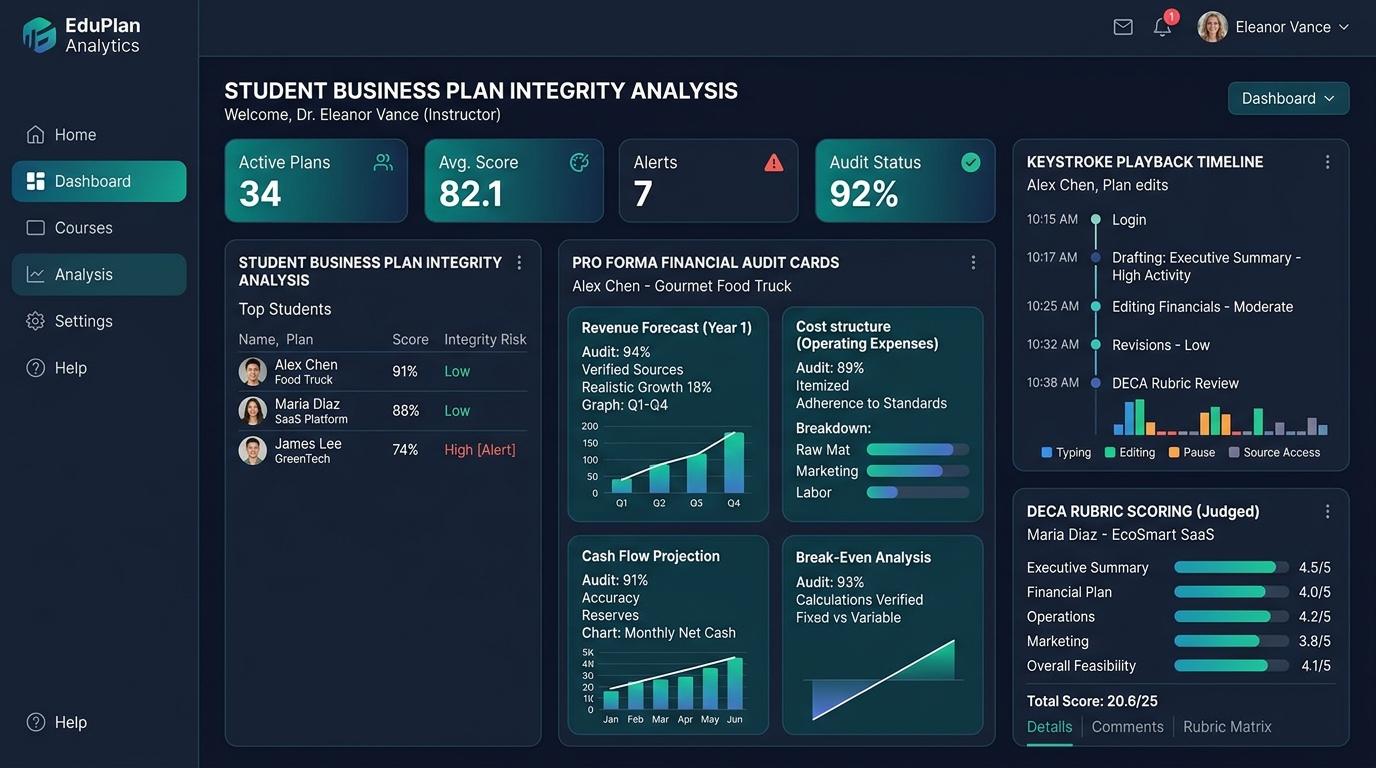
Executive Summary & CTE Business Integrity Mandate
High school Career and Technical Education (CTE) Business teachers, DECA chapter advisers, and FBLA mentors face an unprecedented integrity challenge: evaluating 10-page and 20-page Student Business Plans, Innovation Plans, and 3-Year Pro Forma Financial Projections in an era of generative AI. When high school students are confronted with complex market sizing, competitive matrices, and multi-table accounting statements, the temptation to prompt Large Language Models (LLMs) to generate slick, venture-capital-style investor decks is immense.
Generative AI creates polished corporate prose that conceals mathematically severed pro forma sheets, ungrounded TAM/SAM/SOM market sizes, and fabricated supplier quotes. Simultaneously, legacy whole-document AI text detectors fail business educators by triggering massive false-positive flags on standardized commercial terminology (e.g., ROI, SWOT, B2B, B2C, COGS, EBITDA) while completely overlooking prompt-injected fake financial models.
Checkmark Plagiarism resolves this structural dilemma through a multi-dimensional evidentiary approach: pairing passage-level calibrated confidence sliders and side-by-side plagiarism source verification with patent-pending Essay Playback™ (1x–8x keystroke replay) and a 100% external clipboard paste inspector. By inspecting the temporal drafting process, calculation pauses, and formula concordance, business educators can reliably distinguish authentic student financial inquiry from synthetic AI generation, protect honest students from false accusations, and conduct supportive, restorative pitch conferences.
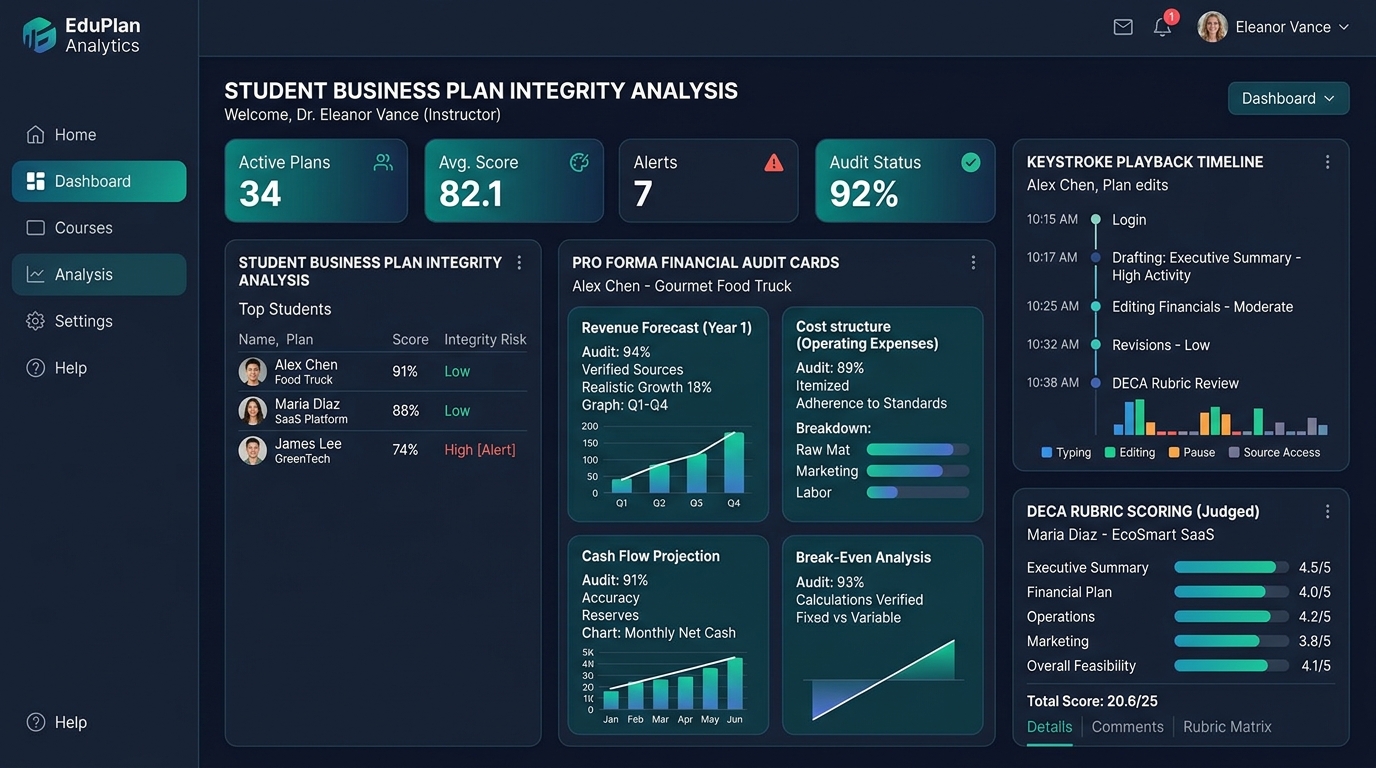
Checkmark Plagiarism empowers CTE departments and business educators with an integrated suite combining patent-pending Essay Playback™, passage-level AI detection, two-way source comparison, quote-anchored rubric autograding, and direct LMS integrations with Canvas LMS and Google Classroom.
1. The High School Entrepreneurship Landscape & The DECA Competitive Arena
Career and Technical Education (CTE) Business Management, Marketing, and Entrepreneurship pathways represent some of the most dynamic, career-connected learning environments in secondary education. Guided by frameworks from the National Business Education Association (NBEA), state CTE career clusters, and Career and Technical Student Organizations (CTSOs) such as DECA and FBLA (Future Business Leaders of America), high school students move beyond abstract textbook theory to build comprehensive, living venture blueprints.
Whether preparing for regional DECA competitions, state leadership conferences (SLC), the international stage at the DECA International Career Development Conference (ICDC), or completing a district-mandated CTE capstone portfolio, high school students are tasked with producing professional, multi-section written business plans.
The 10 & 20-Page Plan Anatomy (DECA/CTE)
- Executive Summary: Value proposition, capital ask, and ROI summary
- Problem & Solution: Market pain point, commercial feasibility
- Market Analysis: Local census demographics, TAM/SAM/SOM, competitors
- Marketing Mix (4 Ps): Product specs, pricing, distribution, promotions
- Operating & Legal: Staffing, supply chain, zoning, licensing
- 3-Year Pro Forma: COGS, Break-Even, P&L, Cash Flow, Balance Sheet
The Educator & Adviser Grading Burden
- Volume Crunch: 120–160 students drafting 10–20 pages = 1,200–3,200 pages
- Dual-Load Audit: Evaluating prose persuasiveness + spreadsheet mathematics
- High Stakes: Strict DECA Written Checklists; 5–15 penalty points per violation
- Time Deficit: 45+ minutes per business plan without automated integrity tools
Students prompt LLMs to generate instant 3,000-word plans with hallucinated $50B national TAM figures, severed pro forma sheets, phantom supplier quotes, and corporate jargon smokescreens.
Keystroke dynamics & 1x–8x Essay Playback™ visualizing authentic calculation pauses, 100% paste inspection, passage-level confidence sliders, and quote-anchored rubric autograding.
The Core Competitive Event Categories
In DECA and FBLA, written events demand rigorous synthesis of economic theory, primary market research, operational logistics, and accounting mathematics. The primary competitive categories include:
1. DECA Innovation Plan (EIP)
10 PagesA 10-page document detailing the feasibility, target customer persona, and commercial market viability of an original, innovative product or service concept.
2. DECA Start-Up Business Plan (ESB)
10 PagesA comprehensive 10-page operational blueprint for initiating and launching a new small venture from inception, including unit economics and working capital requirements.
3. DECA Independent (EIB) & Franchise (EFB)
20 PagesAn exhaustive 20-page strategic analysis modeling every facet of a new independent venture or purchasing and operating a recognized franchise territory (FDD disclosure review).
4. DECA Growth Plan (EBG) & FBLA Financials
15–20 PagesTactical expansion plans written for operating family businesses or comprehensive proposals requiring 3-year cash flow forecasts, capitalization schedules, and sensitivity tables.
The Classroom Assessment Reality
For the high school business educator managing five to six class periods—comprising Introduction to Business, Marketing I/II, AP Economics, and CTE Entrepreneurship Capstone—grading and mentoring these submissions presents a massive structural bottleneck:
- The Volume Crunch: 120 to 160 students drafting 10 to 20 pages each generate between 1,200 and 3,200 pages (over 500,000 to 1,000,000 words) of student writing alongside dozens of embedded Google Sheets and Excel financial workbooks.
- The Cognitive Dual-Load: Unlike scoring a standard literary analysis essay, a business educator cannot merely evaluate narrative flow, grammar, and thesis strength. The teacher must simultaneously perform an operational audit (checking supply chain logistics, municipal licensing, and labor laws) and a forensic mathematical audit (verifying whether the projected Gross Margin covers operating overhead, or whether the Break-Even Units calculation matches the underlying Cost of Goods Sold).
- The High-Stakes DECA Penalty Point Environment: DECA competitive rubrics enforce strict Written Event Checklists. Judges penalize submissions with 5 to 15 penalty points per infraction for exceeding page limits, omitting mandatory sections, or presenting unoriginal or uncredited concepts—forfeiting advancement. Plagiarism or unauthorized AI authorship results in immediate disqualification.
2. The LLM Temptation: Anatomy of a Synthetic Student Business Plan
When high school students are confronted with the intimidating complexity of a 20-page business plan—requiring demographic census analysis, competitive benchmarking, and multi-year pro forma balance sheets—the temptation to prompt Large Language Models (such as ChatGPT, Claude, or Google Gemini) is acute.
With a single prompt (“Write a 10-page DECA Start-Up Business Plan for an eco-friendly mobile sneaker cleaning business in Austin, Texas, including a 3-year financial projection”), an LLM generates a polished, 3,000-word document complete with executive headers, industry jargon, and neat tabular data in less than sixty seconds.
However, beneath the surface of this slick, corporate prose lies a web of severe pedagogical, mathematical, and empirical failures. Business educators and DECA advisers must recognize the five telltale pathologies of AI-synthesized student business plans:
The 5 Pathologies of an AI-Synthesized Student Business Plan
Silicon Valley Hallucination (TAM / SAM / SOM Sizing)
Macro national figures ($48B Global Footwear Market) substituted for local county reality. Complete absence of hyper-local census data, zip code demographics, or primary student surveys.
Mathematically Severed Pro Forma Statements
Net Income on the Income Statement does not flow into Cash Flow from Operations or Balance Sheet Retained Earnings. Break-even narrative claims directly contradict unit contribution margin formulas.
Phantom Suppliers & Ungrounded Overhead
Fabricated wholesale pricing ($0.15 custom boxes with zero Minimum Order Quantity). Omission of statutory employer payroll taxes (FICA 7.65%), merchant processing fees (2.9% + $0.30), and shipping freight.
Generic Digital Marketing Echo Chamber
Vague promises of “viral TikTok influencers and SEO optimization” with zero Customer Acquisition Cost (CAC) vs. Customer Lifetime Value (LTV) math, missing ad budgets, and zero local community activations.
Corporate Jargon Smokescreen
Overuse of enterprise buzzwords (“omnichannel synergy, turnkey monetization, agile paradigms”) serving as a linguistic facade to conceal the complete lack of customer discovery interviews or authentic student exploration.
Pathology 1: The Silicon Valley Hallucination (TAM/SAM/SOM Sizing)
Authentic high school entrepreneurship requires students to define their Total Addressable Market (TAM), Serviceable Addressable Market (SAM), and Serviceable Obtainable Market (SOM) using hyper-local data—such as local city chamber of commerce reports, U.S. Census Bureau QuickFacts for their high school’s county, or school-wide student surveys.
LLMs, trained on broad internet corpora and venture capital pitch decks, invariably hallucinate macroeconomic, enterprise-scale figures:
“The Total Addressable Market for our artisanal cookie cart in Naperville, Illinois is the $34.8 billion global baked goods market, with a Serviceable Obtainable Market of $4.2 million in Year 1.”
Flaw: Unrealistic venture-capital macro scale; completely disconnected from high school cart foot traffic.
“Naperville has a population of 149,540 with approximately 52,000 households. Targeting high school students and families within a 5-mile radius (approx. 8,200 households) with an average order of twice per semester at $15/box yields a Year 1 SOM of $24,600.”
Authenticity Marker: Grounded local municipal census data and feasible student operational capacity.
Pathology 2: The Mathematically Severed Pro Forma Statements
The most glaring signature of LLM-generated business plans is mathematical incoherence across financial tables. While LLMs excel at generating structured Markdown tables that look like accounting statements, they lack underlying relational spreadsheet logic.
In an authentic plan, Fixed Overhead ($3,000/mo) divided by Unit Contribution Margin ($15.00) yields precisely 200 units. LLM narratives frequently fabricate arbitrary milestones (e.g., claiming 450 units) that contradict their own unit cost tables.
When high school students prompt an LLM for financials, three structural flaws emerge:
- Broken Break-Even Mechanics: The LLM might state in the narrative that the product sells for $25.00 with a variable cost of $10.00 (Contribution Margin = $15.00) and monthly fixed costs of $3,000.00. The mathematically correct break-even point is
$3,000 / $15 = 200 unitsper month. Yet, the AI-synthesized text frequently claims: “The company will reach break-even upon selling 450 units in Month 3,” generating a direct contradiction between narrative prose and underlying unit economics. - Disconnected Three-Statement Modeling: In professional accounting, the Net Income calculated on the Income Statement (P&L) must flow directly into the Operating Activities section of the Cash Flow Statement and update Retained Earnings on the Balance Sheet. In an AI-generated draft, these three tables are generated independently, leading to balance sheets where
Assets ≠ Liabilities + Owner's Equity. - Static Linear Revenue Growth: LLMs frequently project revenues as perfectly linear progressions (e.g., exactly +10% every single month) without accounting for seasonality (e.g., summer lulls for school-based enterprises, holiday retail spikes in Q4) or working capital inventory constraints.
Pathology 3: The Phantom Supplier & Fictitious Overhead Quotes
Authentic business planning requires high schoolers to identify real commercial partners: querying domestic wholesalers for minimum order quantities (MOQs), researching local commercial lease rates per square foot on LoopNet, modeling 7.65% FICA/FUTA employer payroll taxes, and factoring in 2.9% + $0.30 credit card merchant processing fees (Stripe/Square). LLMs generate frictionless, phantom supply chains with no shipping freight, zero scrap rates, and nonexistent liability insurance.
Pathology 4: The Generic Digital Marketing Echo Chamber
LLMs inflate marketing sections with generic buzzwords (“leveraging viral TikTok marketing, nano-influencer outreach, and SEO optimization”) while providing zero Customer Acquisition Cost (CAC) vs. Customer Lifetime Value (LTV) calculations, zero allocated paid ad spend, and zero hyper-local community activations (e.g., sponsoring high school athletic booster clubs or setting up pop-up booths at local farmers’ markets).
Pathology 5: The Corporate Jargon Smokescreen
Overuse of enterprise buzzwords (“seamless omnichannel synergy, turnkey monetization, disruptive market positioning”) serves as a linguistic smokescreen concealing the complete absence of primary customer discovery interviews, pilot product testing, or authentic student voice.
Pro Forma Statement Concordance: Authentic Linked Model vs. AI Synthetic Dump
| Financial Dimension | Authentic Student Linked Model | AI-Generated Synthetic Table |
|---|---|---|
| Break-Even Concordance | Fixed Costs / Unit Contrib Margin strictly matches P&L line items | Narrative claims arbitrary units contradicting unit cost table |
| 3-Statement Integration | P&L Net Income dynamically flows to Cash Flow and Balance Sheet | Statements generated separately; Retained Earnings decoupled |
| Balance Sheet Equation | Assets = Liabilities + Equity balances perfectly each year | Mathematical imbalances masked by arbitrary plug numbers |
| Cost Structure Granularity | Line-item quotes: FICA (7.65%), Stripe (2.9%+$0.30), freight | Omission of merchant fees, insurance, and freight costs |
| Revenue Modeling | Grounded in local unit capacity, seasonality, & foot traffic | Smooth, artificial linear curve ($100k, $200k, $300k exact) |
3. The DECA Academic Integrity Guidelines & The Assessment Dilemma
Academic integrity in Career and Technical Education carries professional and ethical ramifications that go far beyond standard classroom grading. CTSOs are designed to prepare young people for the ethical responsibilities of business leadership.
The DECA Academic Honesty Policy & Written Event Penalties
Under the DECA Written Event General Rules:
- Originality of Work: All research, drafting, financial modeling, and graphic presentation must be the original creation of the student members listed on the title page.
- Attribution & Citations: All secondary research, industry data, demographic statistics, and external frameworks must be formally cited using standard bibliographic formats (APA or MLA).
- The Written Event Checklist & Penalty Points: Before a written business plan reaches competitive judges, event coordinators audit the document against a technical checklist. Penalty points (ranging from 5 to 15+ points per violation) are assessed for uncredited material, formatting non-compliance, or unauthorized assistance. In competitive DECA events where the difference between advancing to the ICDC stage and elimination is often 0.5 points, receiving a penalty point deduction is insurmountable.
- Disqualification: Plagiarism, fraud, or submitting unoriginal/AI-generated work results in immediate disqualification, forfeiture of awards, and potential suspension of the chapter’s competitive eligibility.
DECA Written Event Penalty Point Thresholds & Competitive Risks
100% original student research & keystroke-verified drafting. Verified local supplier quotes, formula-linked pro forma financials, and full formal citations for all census and industry data. Advances to DECA State and ICDC International Finals.
Page budget overage, minor formatting non-compliance, or missing bibliographic citations for external demographic data. Results in immediate loss of podium advancement due to narrow 0.5-point competitive victory margins.
Full or partial AI text synthesis, uncredited web plagiarism, fabricated financial statements, or non-original business models. Leads to public disqualification, chapter sanctions, and loss of CTE dual-enrollment college credit.
Why Generic Whole-Document AI Detectors Fail Business Educators
When high school business teachers attempt to police synthetic submissions using legacy, first-generation AI text detectors (which return a single 0–100% whole-document score), they encounter two devastating structural failures:
- The False-Positive Crisis on Standardized Commercial Terminology: Business writing is fundamentally structured, formal, concise, and reliant on standardized terminology and acronyms (ROI, SWOT, B2B, B2C, COGS, EBITDA, CAC, LTV, LLC, OSHA, 4 Ps, GAAP). Generic AI detectors measure linguistic perplexity (word choice unpredictability) and burstiness (sentence length variation). Because authentic business writing intentionally uses standardized, declarative sentences, generic tools flag honest, hardworking CTE students with alarming 70%–95% “Likely AI” red flags.
- The False-Negative Blindspot on Synthesized Financial Models: Generic text detectors evaluate prose syntax, not mathematical concordance. A student who prompts an LLM to generate an entire fabricated 3-year financial schedule and pastes it into a table receives a 0% AI flag while completely bypassing authentic mathematical inquiry.
Checkmark Plagiarism resolves this dilemma through passage-level calibrated confidence sliders, patent-pending Essay Playback™ writing telemetry, and 100% external clipboard paste inspection.
4. The High School Business Evidentiary Matrix
To evaluate student business plans fairly and defensibly, high school educators need a multi-dimensional assessment matrix that captures research origin, drafting time, calculation pauses, and formula integrity.
High School Business Plan Evidentiary Matrix
| Feature / Capability | Traditional Paper Binder | Generic Whole-Doc Detector | Google Docs Basic History | Checkmark Essay Playback™ Suite |
|---|---|---|---|---|
| Evaluation Granularity | Holistic paper scan | Single document-level 0–100% | 15-min periodic snapshots | Passage-level sliders & keystroke replay |
| Business Terms (SWOT/ROI/COGS) | Normal | High False Positives (Low perplexity) | Normal | Domain-calibrated (zero false alarms) |
| External Clipboard Paste Tracking | None | None | None (Cannot view source) | 100% text preservation & origin metadata |
| Financial Calculation Pause Audit | Manual only | None (evaluates prose only) | None (shows static numbers) | Visualizes genuine 30–90s calculation pauses |
| Side-by-Side Plagiarism Matching | Manual search | Highlighted text without live URLs | None | Two-way clickable quotes & live URLs |
| DECA/NBEA Rubric Autograding | Manual pen (45m/plan) | None | None | Quote-anchored AI autograding with LTI 1.3 |
| Student Privacy (FERPA/COPPA) | High (Physical) | Poor (retains student IP) | Medium (Google enterprise) | FERPA/COPPA Zero-retention guarantee |
5. Step-by-Step Business Educator Audit Protocol
High school CTE business teachers and DECA advisers can implement a bulletproof, four-phase audit protocol to verify writing authenticity and financial validity across 10-page and 20-page student plans.
Phase 1: Forensic Financial Audit
- Calculate Unit Contribution Margin: CM = Price - Var Cost
- Audit Break-Even Units vs. narrative milestone claims
- Trace 3-statement flow: P&L Net Income → Cash Flow → Equity
Phase 2: Local Market & Supplier Check
- Demand local county census data, not $50B macro metrics
- Audit supplier URLs, Minimum Order Quantities (MOQs), freight
- Confirm 7.65% FICA employer taxes & merchant fees
Phase 3: Essay Playback™ Telemetry
- Scrub 1x–8x timeline: verify organic revisions & typing cadence
- Inspect clipboard paste cards for external AI prompt dumps
- Detect transcription vs. 30–90s calculation pauses
Phase 4: Restorative Pitch Conference
- Review playback timeline collaboratively with the student
- Conduct “Explain Your Math” whiteboard defense
- Allow 48-hour restorative re-drafting with live keystroke logging
Phase 1: Forensic Financial & Pro Forma Concordance Audit
Before reading the executive narrative, jump straight to the financial tables:
- Calculate Unit Contribution Margin:
Contribution Margin = Selling Price - Direct Variable Cost per Unit
- Verify Break-Even Units:
Break-Even Units = Total Monthly Fixed Overhead / Unit Contribution MarginCompare this figure directly against the student’s break-even milestone in the narrative. If the narrative claims break-even at 300 units but the formula yields 850 units, the plan exhibits synthetic severance.
- Trace Three-Statement Linkages: Verify that Year 1 Net Profit on the Income Statement matches the Net Operating Income on the Cash Flow statement, and that Cash Ending Balance matches the Current Assets line on the Balance Sheet.
Phase 2: Local Market & Supplier Verification Check
- Demand Hyper-Local Sizing: Confirm that TAM/SAM/SOM are derived from specific geographic parameters (e.g., zip codes, municipal population figures, school enrollment numbers) rather than national macro-aggregates.
- Audit Commercial Suppliers: Ask students to provide direct links, invoice quotes, or vendor contact info for their primary suppliers and packaging partners.
- Check Statutory Overhead: Confirm that employee wages reflect current state minimum wage laws, include 7.65% statutory employer payroll taxes (FICA/Medicare), and account for 2.9% + $0.30 digital transaction fees.
Keystroke Dynamics: Authentic Financial Drafting vs. AI Transcription
Phase 3: Checkmark Essay Playback™ & Keystroke Dynamics Audit
- Scrub the Drafting Timeline: Use Checkmark’s patent-pending Essay Playback™ to review the entire drafting session at 1x to 8x speed. Look for authentic drafting markers: typing a sentence, pausing for 45 seconds to calculate unit costs, backspacing to correct a price, and formatting tabular columns.
- Inspect the Paste Buffer: Click on Checkmark’s External Paste Cards. Checkmark preserves 100% of pasted text. If a student pasted a 1,500-word market analysis section in a single 0.1-second event, the teacher can view the exact pasted content, timestamp, and source metadata.
- Detect Transcription vs. Organic Drafting: If the playback shows continuous, mechanical typing without pauses for mathematical thought or revision, the student was transcribing text off a second device.
Phase 4: The Restorative Pitch Conference & Coaching Protocol
- Collaborative Screen Review: Open Checkmark’s side-by-side playback view with the student. Frame the meeting around business coaching: “Let’s look at your drafting timeline and explore how you developed your financial projections.”
- The “Explain Your Math” Defense: Hand the student a whiteboard marker and ask them to calculate their Break-Even Units and Gross Margin live:
Gross Margin % = ((Revenue - COGS) / Revenue) * 100A student who authentically built the model will explain their logic effortlessly; a student who prompted an LLM will struggle to explain the numbers.
- Restorative Path to Mastery: If unauthorized AI generation is confirmed, allow the student a 48-hour revision window to conduct genuine primary interviews and rebuild their pro forma models in Google Sheets under live keystroke tracking.
6. How Checkmark Empowers High School Business Educators & DECA Advisers
Checkmark Plagiarism is engineered specifically for secondary CTE environments, combining forensic integrity telemetry with time-saving rubric autograding.
Calibrated confidence sliders eliminating false alarms on standard business terms like SWOT, ROI, COGS, EBITDA, and the 4 Ps.
1x to 8x keystroke video replay tracking 30–90s calculation pauses and detecting mechanical phone transcription.
Preserves the full string of every external paste even if subsequently edited, with 1-click jump to the exact timeline event.
Billions of web and academic pages crawled with direct two-way clickable quotes and live supplier/competitor source URLs.
Pre-configured DECA and NBEA rubrics validating formula concordance with 1-click grade passback to Canvas and Buzz.
Strict Zero-Data-Retention model ensuring student proprietary venture ideas and intellectual property are never fed to LLMs.
1. Passage-Level AI Detection with Calibrated Sliders
Checkmark eliminates opaque 0–100% whole-document scores. Instead, Checkmark evaluates essays at the sentence and passage level. Each highlighted section features an evidence card with a calibrated confidence slider distinguishing authentic formal business syntax from generic LLM output. Standard terms like “Strengths, Weaknesses, Opportunities, and Threats” or “Cost of Goods Sold” are recognized as domain conventions, eliminating false positives.
2. Patent-Pending Essay Playback™ (1x–8x Speed)
Checkmark captures high-resolution keystroke dynamics directly inside Google Docs on Chromebooks, Canvas LMS, Buzz LMS, and Microsoft Word. Educators can scrub through writing sessions at 1x, 2x, 4x, or 8x speed to watch students brainstorm, formulate financial tables, revise marketing strategies, and resolve calculation errors.
3. 100% External Clipboard Paste Inspector
When text is pasted from an external window (such as an LLM prompt interface, an essay mill, or another student’s document), Checkmark captures and permanently stores the complete pasted string. Even if the student subsequently rewrites or deletes the pasted text, the original external content remains accessible with a single click.
4. Quote-Anchored Rubric Autograder with LTI 1.3 Passback
Checkmark’s AI Autograder evaluates 10-page and 20-page business plans against standard DECA competitive rubrics and NBEA state frameworks. It generates granular, quote-anchored feedback cards for every criterion (e.g., Problem Feasibility, Marketing Mix, Operational Logistics, Financial Viability). High school business teachers maintain 100% final editorial control and can sync finalized scores directly into the Canvas, Buzz, or Google Classroom gradebooks with one click—saving 15 to 20 hours per major project.
5. FERPA & COPPA Enterprise Privacy Compliance
Checkmark enforces a strict Zero-Data-Retention Model. High school student submissions, financial models, and proprietary business ideas are never indexed into public LLM training datasets, protecting student intellectual property and complying fully with FERPA, COPPA, and district data privacy agreements.
7. Realistic High School CTE Classroom Case Scenarios
Case Scenario 1: The 11th-Grade DECA Innovation Plan (EIP)
External Paste Catch- The Setting: 11th-grade CTE Entrepreneurship student preparing a 10-page Innovation Plan for a mobile solar-powered bike repair station.
- The Flag: Checkmark flagged a 4-paragraph section under “Market Feasibility” displaying low burstiness, paired with an external paste event of 1,200 words.
- The Playback Investigation: The teacher scrubbed the Essay Playback timeline and discovered that at 11:42 PM on a Sunday, the student pasted a complete market analysis citing national German solar manufacturing data. No typing or drafting preceded the paste.
- The Conference & Resolution: In a supportive pitch conference, the teacher shared the paste card. The student admitted to prompting ChatGPT when overwhelmed by market research. The teacher guided the student to local city bicycle commuter data and allowed a 48-hour re-write under live keystroke logging. The revised plan scored 94/100 and advanced to DECA State Leadership Conference.
Case Scenario 2: The 12th-Grade Franchise Business Plan (EFB) Exoneration
False Positive Exoneration- The Setting: 12th-grade AP Economics / DECA student drafting a 20-page Franchise Business Plan for a Smoothie King territory.
- The Flag: A legacy detector flagged the plan as 84% AI-Generated due to heavy use of franchise disclosure terms (FDD, royalties, territory exclusivity, EBITDA).
- The Playback Investigation: The DECA adviser loaded Checkmark Essay Playback. The telemetry showed 4.5 hours of active, continuous writing across 6 sessions on a school Chromebook, with over 140 pauses exceeding 30 seconds where the student reviewed the Smoothie King FDD PDF in split-screen mode.
- The Resolution: The adviser verified authentic human authorship, completely exonerated the student, and prevented an unwarranted penalty point deduction at the regional DECA competition.
Case Scenario 3: The 10th-Grade Intro to Marketing Competitive Matrix
Plagiarism Coaching- The Setting: 10th-grade Intro to Marketing class completing a 5-page competitive matrix for a local boutique clothing store.
- The Flag: Checkmark’s plagiarism engine flagged an 18% direct similarity match to local business websites and Yelp customer reviews.
- The Playback Investigation: Checkmark’s two-way linked evidence cards showed the student had copied competitor product descriptions and customer complaints directly without quotation marks or attribution.
- The Resolution: The teacher utilized the side-by-side quote comparison in class to teach proper secondary source attribution and APA in-text citations, transforming a potential plagiarism infraction into a vital citation literacy lesson.
High School CTE Business Case Scenarios Summary
| Case Scenario | Identified Integrity Anomaly | Checkmark Resolution & Pedagogical Outcome |
|---|---|---|
| 11th-Grade EIP Innovation Plan | 1,200-word external paste of German solar data at 11:42 PM | Teacher used Paste Card in restorative meeting; student re-researched local commuter data. |
| 12th-Grade EFB Franchise Plan | 84% "Likely AI" on generic tool due to franchise legal terms | Checkmark Essay Playback proved 4.5 hours of organic drafting; student fully exonerated. |
| 10th-Grade Intro Marketing Plan | Uncited direct quotes from Yelp and competitor pricing menus | Plagiarism breakdown isolated 18% match; teacher coached APA citations; avoided penalty. |
8. Frequently Asked Questions (FAQ)
1. How does Checkmark differentiate between authentic business terminology and AI-generated text?
Standard AI detectors flag business terminology (e.g., ROI, SWOT, COGS, EBITDA, B2B) because these formal terms naturally exhibit low perplexity. Checkmark solves this by utilizing domain-calibrated linguistic models and passage-level sliders that recognize industry conventions. Checkmark pairs linguistic analysis with Essay Playback™ keystroke dynamics, verifying that the student organically drafted the text rather than pasting it from an LLM.
2. Can Checkmark detect when a student uses AI to generate pro forma financial spreadsheets?
Yes. Checkmark identifies financial fraud through two mechanisms: (1) External Paste Tracking, which records when a student copies a pre-generated tabular block from an external LLM interface into Google Docs or Canvas, and (2) Transcription Dynamics, which flags when complex multi-column financial tables are typed at continuous high speeds without natural calculation pauses, indicating the student is copying from a secondary screen.
3. How does Essay Playback™ protect students falsely accused of using AI by generic detectors?
If an administrator or competition judge flags an essay based on a generic percentage score, the student and teacher can load Checkmark Essay Playback. The tool provides a timestamped, keystroke-by-keystroke video replay of the student typing the essay, deleting mistakes, revising sentences, and consulting sources over several hours—providing irrefutable proof of authentic human authorship.
4. How does Checkmark integrate with DECA and FBLA written event checklists?
Checkmark’s Rubric Autograder can be pre-configured with official DECA and FBLA competitive rubrics (such as the 10-page EIP or 20-page EIB rubrics). The autograder audits submissions for required sections, bibliographic citations, and financial formula concordance, alerting teachers to potential penalty points before competitive submission.
5. Does Checkmark store or train AI models on student business ideas and financial plans?
No. Checkmark maintains full compliance with FERPA, COPPA, and district data privacy mandates. Student business plans, intellectual property, and proprietary venture ideas are never added to public training corpora or sold to third parties.
6. What happens if a student types on their phone or outside the LMS?
Checkmark captures writing telemetry seamlessly across Google Docs on Chromebooks, Canvas LMS, Buzz LMS, Schoology, and Microsoft Word. If a student writes on an unmonitored device and pastes the entire text into the submission window, Checkmark flags the bulk paste event and preserves the full pasted text for educator review.
7. How does Checkmark save CTE teachers grading time on large stacks of 20-page business plans?
Checkmark’s AI Rubric Autograder reads multi-page plans and generates first-draft scores, criterion-by-criterion justifications, and quote-anchored feedback cards in seconds. Teachers review and adjust the grades, then publish finalized scores and feedback directly to the Canvas, Buzz, or Google Classroom gradebooks with one click—reducing grading time from 45 minutes per plan to under 10 minutes.
Ready to Verify Authentic Authorship in Student Business Plans?
Equip your CTE business department and DECA chapter with the only academic integrity platform built for complex, multi-section student proposals. Combine keystroke dynamics, financial calculation audits, paste inspection, and rubric autograding.