
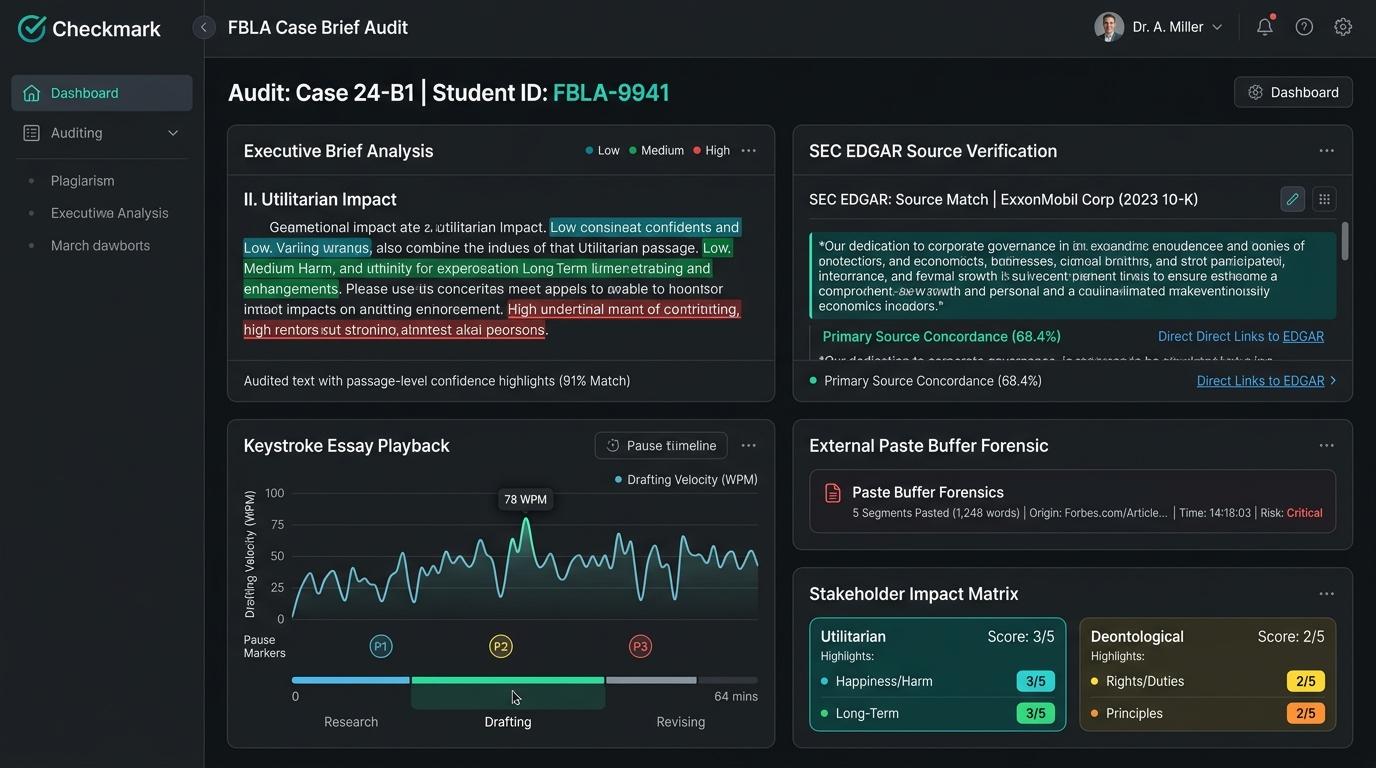
Executive Summary & FBLA Competitive Integrity Mandate
High school Career and Technical Education (CTE) Business teachers, Future Business Leaders of America (FBLA) chapter advisers, and competitive events judges face a critical challenge in evaluating competitive Business Ethics Case Briefs, Management Decision Making scenarios, and Ethical Leadership portfolios. Under the high-stakes pressure of regional, state, and national FBLA leadership conferences, student competitors increasingly turn to generative AI to synthesize the mandatory 1-page executive brief and oral presentation arguments.
While Large Language Models (LLMs) generate grammatically flawless corporate prose, they frequently hallucinate critical regulatory facts—inventing non-existent SEC 10-K filing dates, fabricating FTC consent decrees, conjuring phantom whistleblower testimonies, and generating shallow, buzzword-laden stakeholder analyses severed from balance-sheet realities. Simultaneously, legacy whole-document AI text detectors fail educators by generating catastrophic false-positive flags on standard business lexicon (ROI, fiduciary duty, whistleblowing, compliance, stakeholder, SEC, OSHA, utilitarianism) while completely missing prompt-engineered, ghostwritten corporate briefs.
Checkmark Plagiarism provides a defensible, multi-dimensional solution: combining passage-level calibrated confidence sliders and side-by-side regulatory source matching with patent-pending Essay Playback™ (1x–8x keystroke replay) and a 100% external clipboard paste inspector. By auditing SEC EDGAR permalinks, verifying normative ethical calculus, and inspecting the student's authentic temporal drafting process, FBLA advisers can eliminate synthetic hallucinations, uphold the FBLA Code of Ethics, protect honest competitors from false accusations, and conduct supportive, restorative boardroom debriefs.
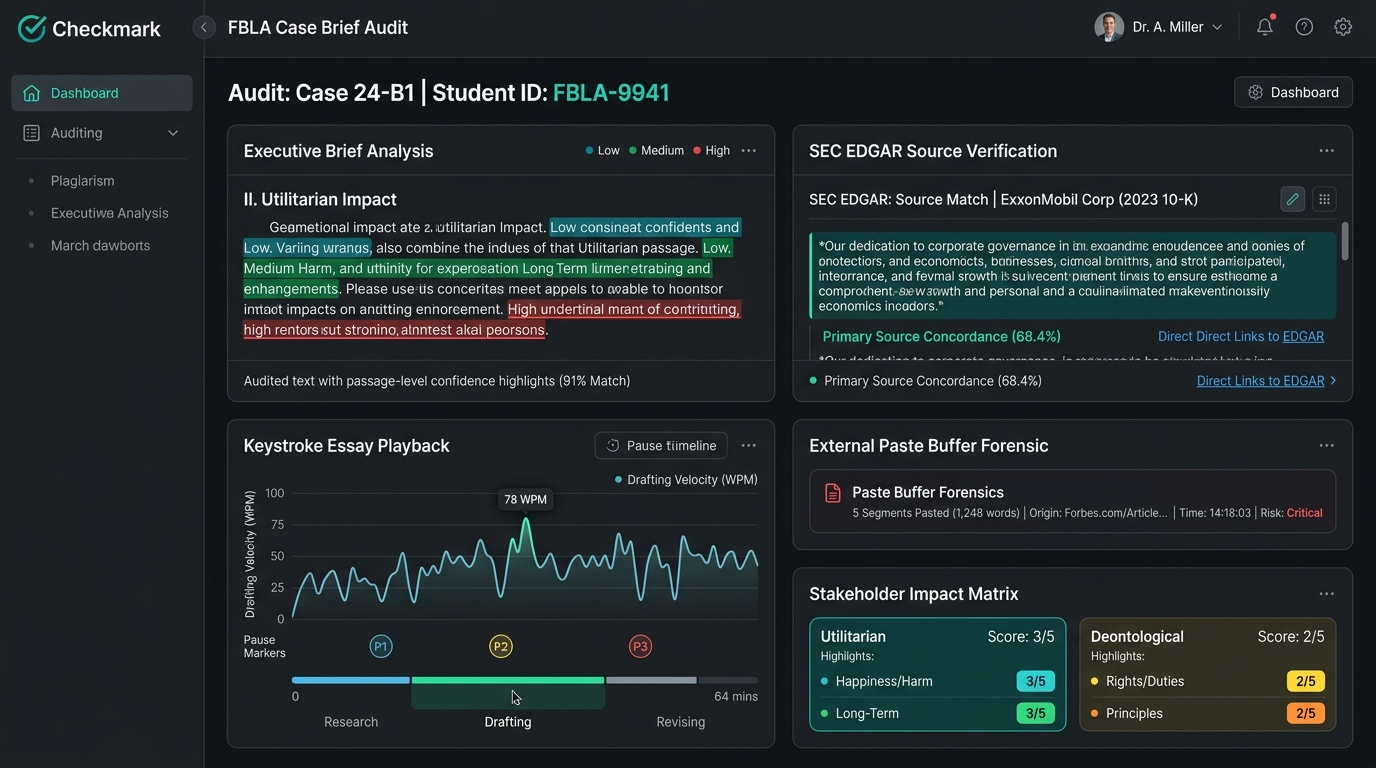
Checkmark Plagiarism empowers high school CTE departments, CTSO chapter advisers, and competitive judges with an integrated suite combining patent-pending Essay Playback™, passage-level AI detection, two-way regulatory source comparison, quote-anchored rubric autograding, and direct LMS integrations with Canvas LMS, Google Classroom, and Buzz LMS.
1. The High School Business Ethics Arena & The FBLA Competitive Architecture
High school Career and Technical Education (CTE) Business Management, Administration, and Marketing programs serve as the premier training ground for the next generation of corporate executives, entrepreneurs, and policy leaders. Guided by standards from the National Business Education Association (NBEA), state CTE career clusters, and Career and Technical Student Organizations (CTSOs) such as Future Business Leaders of America (FBLA) and DECA, secondary business students move beyond abstract textbook definitions to analyze complex, real-world corporate crises.
Within the national FBLA competitive events program, the Business Ethics event stands as one of the most intellectually demanding and prestigious competitions. High school competitors must investigate a complex, real-world corporate controversy—spanning data privacy breaches, algorithmic bias, offshore supply chain exploitation, environmental degradation, or executive accounting fraud—and deliver an exhaustive strategic adjudication.
The FBLA Business Ethics Event Anatomy
- 1-Page Executive Brief (Synopsis): 500-word written brief submitted prior to presentation
- 7-Minute Oral Presentation: Interactive pitch before corporate & legal judges
- 3-Minute Judge Q&A: High-pressure defense of regulatory evidence and moral calculus
- Required Case Scope: Real-world corporate controversy with multi-stakeholder impact
- Evaluative Criteria: Legal compliance vs. ethical duty, framework rigor, implementation feasibility
The High School CTE Adviser Reality
- Teaching Load: 120–160 students across 5–6 class periods on 1:1 Chromebooks
- Advising Load: 30–80 FBLA chapter competitors across 15+ written/oral events
- Competition Stakes: Strict National Event Guidelines; 5–20 penalty point deductions or disqualification
- Cognitive Dual-Load: Verifying primary corporate regulatory filings + normative moral logic
LLMs generate slick 1-page executive briefs packed with hallucinated SEC 10-K filing dates, phantom FTC fines, fabricated whistleblower depositions, and shallow ESG buzzword smokescreens.
SEC EDGAR concordance linking primary legal filings, keystroke dynamics via Essay Playback™ (1x–8x), 100% clipboard paste forensics, and passage-level confidence sliders.
1.1 The FBLA Business Ethics Event: Format, Constraints, & Scoring Structure
According to the National FBLA Competitive Events Guidelines, the Business Ethics event challenges a team of one to three high school students to analyze an authentic, contemporary ethical dilemma within the business landscape. The event comprises two tightly integrated components:
1. The 1-Page Executive Brief (Written Synopsis)
Pre-JudgedPrior to the competitive performance, teams must submit a concise, highly structured 1-page written synopsis (single-spaced, 10–12 point font, 1-inch margins) outlining their complete ethical adjudication.
- Corporate background & genesis of the controversy
- Statutory legal compliance vs. moral fiduciary duty
- Exhaustive 5-party stakeholder analysis
- Application of classical & modern ethical frameworks
- Actionable, financially feasible governance reforms
2. The 7-Minute Pitch & 3-Minute Judge Q&A
Live DefenseCompetitors deliver an interactive 7-minute presentation before corporate attorneys and executives, followed by an intensive 3-minute judicial cross-examination.
- Direct cross-examination on cited SEC/FTC filings
- Challenging Utilitarian calculus vs. Deontological maxims
- Testing pro forma financial feasibility of solutions
- Probing independent authorship and depth of research
- Assessing executive presence and rapid moral reasoning
1.2 Anatomical Structure of a Championship Business Ethics Case Brief
A championship-level high school business ethics brief does not merely summarize news headlines; it executes a rigorous, five-part analytical architecture grounded in business law, economic reality, and moral philosophy:
Identification of the Core Ethical Dilemma
Isolates root systemic organizational failures from surface PR symptoms. Distinguishes individual rogue actor malfeasance from institutional executive compensation structures and board-level pressures.
Legal vs. Ethical Boundary Analysis
Audits statutory compliance under federal mandates (SEC, FTC Act Section 5, OSHA, EPA, Sarbanes-Oxley, Dodd-Frank) while evaluating the pivotal threshold where corporate behavior is technically legal but ethically indefensible.
Primary Stakeholder Impact Matrix
Quantifies tangible harms and rights compromises across five distinct stakeholder groups: (1) Equity Shareholders & Creditors, (2) Frontline Workers & Labor Unions, (3) End Consumers & Data Subjects, (4) Tier-1/Tier-2 Supply Chain Vendors, and (5) Host Communities & Ecological Systems.
Normative Ethical Framework Application
Rigorous application of Classical Utilitarianism (hedonic calculus, aggregate harm distribution), Kantian Deontology (Categorical Imperative, Formula of Humanity), Aristotelian Virtue Ethics, Care Ethics, and Modern Stakeholder Capitalism (UN Global Compact, GRI Standards).
Feasible Strategic Recommendations & Governance Roadmap
Actionable crisis mitigation, victim restitution protocols, structural board governance reforms (independent compliance monitors, executive clawback provisions), and pro forma financial impact modeling ensuring solvency.
1.3 Primary Corporate Filings and Regulatory Documentation
Authentic high school business ethics briefs rely upon verifiable primary source legal records and regulatory filings rather than tertiary blog posts or sensationalized media summaries. Competitors must cite and cross-reference official filings housed in federal regulatory repositories:
- Form 10-K (Annual Report): Item 1A ("Risk Factors"), Item 3 ("Legal Proceedings"), and executive compensation disclosures
- Form 10-Q (Quarterly Report): Intra-year regulatory accruals, sudden litigation reserves, and earnings restatements
- Form 8-K (Current Report): Material unscheduled events, executive departures, and formal DOJ/SEC investigations
- FTC Enforcement Dockets: Consent decrees, Section 5 unfair trade practice complaints, and COPPA civil penalties
- OSHA Inspection Logs: Establishment safety citations, willful violation notices, and penalty assessments
- DOJ Settlement Dockets: Deferred Prosecution Agreements (DPAs), Non-Prosecution Agreements (NPAs), and monitorships
- EPA ECHO Database: Clean Air/Water Act administrative enforcement orders and Superfund remediation mandates
2. The LLM Temptation & Synthetic Hallucination in High School Business Briefs
As regional, state, and national competition submission deadlines loom, high school FBLA competitors experience intense time compression. Managing four to six academic courses, AP/IB examination preparation, extracurricular commitments, and chapter leadership responsibilities, student teams face the daunting task of condensing dozens of pages of dense federal filings and philosophical frameworks into a single, high-density 1-page executive brief.
In this high-pressure environment, the temptation to prompt commercial Large Language Models (such as ChatGPT, Claude, or Google Gemini) is overwhelming. A single prompt—"Write a 1-page FBLA Business Ethics executive brief on Company X's supply chain crisis using Utilitarianism, Kantian ethics, and SEC filings"—returns a polished, professional brief within thirty seconds.
However, LLMs operate through probabilistic token prediction rather than empirical verification. When tasked with synthesizing corporate legal histories and normative ethics, generative AI exhibits five severe, systematic pathologies that undermine competitive integrity and student learning:
Fabricated Filings & Phantom Fines
LLMs invent non-existent SEC 10-K filing dates, phantom FTC docket numbers, and fake civil penalties. They routinely conflate separate corporate entities or cite EU GDPR fines as U.S. federal consent orders.
Ghost Whistleblower Testimonies
Models generate dramatic, quote-marked statements from "unsealed internal audit memos" or "VP depositions" that never existed, manufacturing artificial corporate culpability out of thin air.
Ungrounded ESG Buzzword Smokescreen
Generates generic corporate platitudes ("circular stakeholder synergy") while completely omitting capital expenditure (CAPEX) modeling, balance-sheet constraints, and realistic ROI trade-offs.
Tokenized Ethical Lip Service
Superficially name-drops Kant's Categorical Imperative or Bentham's Utilitarianism in a single generic sentence without executing granular harm/benefit calculations across competing stakeholders.
Cross-Team Prompt and Brief Cloning
In high school chapters where multiple teams prepare in the same CTE computer lab, competitors share AI prompt chains. Chapter advisers receive briefs across different corporate subjects sharing identical syntactic skeletons, transition formulas ("In today's fast-paced corporate climate..."), and identical governance recommendations.
3. The National FBLA Ethics & Competition Integrity Dilemma
The national Future Business Leaders of America organization is anchored in the FBLA Creed and Code of Ethics, which demand that student members "conduct themselves with honesty, integrity, and ethical leadership at all times." At the regional, state, and national levels, competitive event integrity is governed by strict Written Event Guidelines and Performance Checklists.
The 3-Minute Judicial Q&A Exposure Risk
In FBLA competition, a single penalty deduction of 5 to 10 points on the written brief eliminates a team from advancing from Regionals to State, or from State to Nationals. When student teams present AI-hallucinated facts or unverified regulatory filings, experienced judges—often practicing corporate attorneys, CPAs, and executives—quickly pinpoint the fabrication:
"You cited a 2023 SEC 10-K filing indicating a $50M reserve for environmental litigation in Item 3. Can you walk us through the note in the financial statements explaining how that reserve was calculated?"
"Our research indicated it was a general litigation reserve, but we don't have the specific note breakdown here."
3.2 Why Legacy AI Text Detectors Fail High School Business Advisers
Confronted with the rise of LLMs, many high school business teachers and FBLA advisers have turned to legacy, whole-document AI detection software. However, generic statistical AI detectors create catastrophic failure modes in business education:
❌ The False Positive Crisis on Business Lexicon
Statistical detectors calculate perplexity and burstiness. Professional business writing is inherently disciplined, structured, and formal. When an honest student writes with domain terms (ROI, fiduciary duty, Sarbanes-Oxley, whistleblower, categorical imperative, SEC 10-K, CAPEX), legacy detectors return false 80%+ AI probability scores, demoralizing top students and triggering hostile parent conferences.
❌ The Humanizer Evasion Blindspot
When a student prompts an LLM and runs the output through a commercial paraphraser (QuillBot, Undetectable AI), the altered syntax drops the statistical score to "0% AI." Legacy detectors give a clean pass to a completely fabricated, ghostwritten brief containing hallucinated legal dockets.
4. The High School Business Education Evidentiary Matrix
To evaluate competitive business writing with fairness, rigor, and pedagogical integrity, high school CTE business educators require an objective, multi-dimensional evidentiary framework. The matrix below compares the four primary evaluation methods:
| Evaluation Dimension | Traditional Paper Binders | Generic Statistical AI Detectors | Standard Google Docs History | Checkmark Source & Essay Playback™ |
|---|---|---|---|---|
| Regulatory Primary Source Verification | Manual cross-referencing; time-prohibitive for 150+ students | None; evaluates surface text statistics only | None; tracks document edits without external source concordance | Automated side-by-side matching against live SEC EDGAR, FTC, and legal dockets with permalink verification |
| Keystroke Dynamics & Process Telemetry | Completely invisible; only finalized printed text is evaluated | None; blind to the temporal drafting and editing process | Coarse snapshot revisions every few minutes; misses external copying and rapid retyping | Patent-Pending Essay Playback™ (1x–8x replay) reconstructing every keystroke, deletion, revision burst, and pause |
| External Clipboard Paste Inspection | Impossible to detect | None; cannot inspect clipboard origins or payloads | Flags large chunk insertions but loses original text if student modifies words | 100% External Clipboard Paste Inspector preserving original raw pasted payload even after total sentence rewriting |
| Business Lexicon Sensitivity & False Positive Resilience | N/A (Manual human evaluation) | Severe Failure: Standard business terms trigger false AI flags | N/A (Does not score text) | Passage-level calibrated confidence sliders; eliminates false positives on technical business and ethical terminology |
| Stakeholder Analysis & Moral Calculus Auditability | Subjective teacher reading; difficult to check calculation depth | None; cannot evaluate analytical depth or normative frameworks | None; does not evaluate conceptual logic | Quote-anchored rubric autograding validating stakeholder trade-offs, financial feasibility, and moral framework rigor |
| Parent, CTSO, & Judicial Conference Defensibility | Low; based on subjective teacher intuition | Zero; black-box percentage scores collapse under appeal | Low; coarse revision jumps fail to prove independent authorship | Total Defensibility; objective keystroke replay video, timestamped paste logs, and primary source links |
5. Step-by-Step FBLA Adviser Audit Protocol
To ensure competitive business ethics briefs adhere to the highest standards of academic honesty and empirical rigor, high school FBLA advisers and CTE department chairs should implement this structured, five-step audit protocol before certifying submissions for competition:
Corporate Regulatory Filing & SEC EDGAR Permalink Audit
Advisers must verify that every corporate filing, financial figure, and regulatory enforcement action cited in the 1-page executive brief corresponds to an authentic public record:
- SEC EDGAR Verification: Search the target company's CIK or ticker symbol in the SEC EDGAR system.
- Accession Number Matching: Verify that cited 10-K or 10-Q reports match the exact fiscal year and filing date. Inspect Item 1A (Risk Factors) and Item 3 (Legal Proceedings) to confirm disclosures.
- FTC & OSHA Docket Confirmation: Cross-reference the FTC Legal Library or OSHA Establishment Search to verify case numbers and penalty amounts.
Ethical Framework & Stakeholder Calculus Sanity Checks
A rigorous business ethics brief requires genuine philosophical and economic synthesis. Advisers should review the brief against three core sanity checks:
- The Stakeholder Balance Test: Does the matrix address all five primary groups (Shareholders, Employees, Consumers, Supply Chain, Community/Environment)?
- The Normative Consistency Test: Is the chosen framework (Deontology vs. Utilitarianism) applied systematically to justify strategic actions rather than as a decorative buzzword?
- The Financial Feasibility Test: Do proposed ethical remediation strategies account for realistic operational costs, corporate capital structure, and free cash flow?
Keystroke Dynamics & Ethical Reasoning Analysis via Essay Playback™
Using Checkmark's patent-pending Essay Playback™, advisers scrub through the complete writing session at 1x to 8x speed to observe how the student constructed their moral arguments:
- Authentic Composing Pauses: Genuine student writing exhibits natural, non-linear drafting behaviors—pausing for 45–90 seconds to synthesize a legal point, typing a draft paragraph, backspacing to refine an ethical definition, and reorganizing stakeholder points.
- Detecting Mechanical Transcription: If the replay shows steady, unbroken typing at 75 words per minute with zero backspaces, zero organizational pauses, and zero conceptual revisions, the student is likely transcribing an AI-generated brief from a secondary monitor or smartphone.
External Paste Buffer Payload & Clipboard Forensic Inspection
Checkmark's 100% External Clipboard Paste Inspector captures and displays every character pasted into the document from external environments:
- Timestamped Capture: Review the exact timestamp, character count, and formatted text of every paste event.
- Payload Preservation: Even if a student pastes a 500-word AI-generated executive brief and subsequently edits every single sentence over two hours, Checkmark preserves the original raw pasted payload.
- Jump-to-Playback Integration: Click directly from the paste log into the Essay Playback™ timeline to watch how the pasted payload was integrated into the document structure.
The Restorative Boardroom Debrief & Executive Coaching Session
When audit anomalies emerge (such as hallucinated citations, external paste dumps, or transcription flatlines), the adviser conducts a restorative boardroom conference modeled after executive leadership debriefs:
- Present Objective Telemetry: Sit alongside the student team and review the Essay Playback™ replay and regulatory source comparison together: "In corporate management, presenting unverified filings creates massive liability. Let's look at how this brief was constructed."
- Examine the Source Disconnect: Show the discrepancy between the brief's cited figures and the live SEC EDGAR database.
- Establish a Restorative Revision Pathway: Grant a 48–72 hour revision window to replace synthetic content with authentic primary source research.
6. Real High School Classroom & FBLA Case Scenarios
These three realistic scenarios illustrate how high school CTE business educators and FBLA advisers apply multi-dimensional integrity audits in secondary classrooms:
Scenario A: 11th Grade FBLA Team – AI-Hallucinated FTC Fine & Phantom Whistleblower
Scenario B: 10th Grade Intro to Business – False AI Accusation Exonerated by Essay Playback™
Scenario C: Chapter-Wide Competitive Cohort – Peer Match Pinpoints Shared AI Templates
7. Checkmark’s Integrated Business Education Architecture
Checkmark Plagiarism provides high school CTE business educators, FBLA advisers, and school administrators with a comprehensive, educator-controlled platform designed specifically for the demands of secondary business writing and CTSO competitive auditing:
Passage-Level Calibrated Confidence Sliders
Rather than returning an arbitrary whole-document score (e.g., "68% AI"), Checkmark evaluates text at the sentence level. When students use formal business vocabulary (fiduciary duty, Sarbanes-Oxley, EBITDA), calibrated sliders recognize standard domain lexicon, preventing false-positive flags while highlighting suspicious passages with detailed linguistic evidence cards.
Patent-Pending Essay Playback™ (1x–8x Replay)
Reconstructs the entire writing session keystroke-by-keystroke. High school business teachers can scrub through the timeline at variable speeds to watch the brief evolve, observe research pauses, verify drafting velocity, and confirm that complex stakeholder matrices were constructed through deliberate intellectual effort.
100% External Clipboard Paste Inspector
Every external paste event is timestamped and captured in full. Checkmark preserves the complete raw pasted payload even if the student subsequently rewrites or modifies every word. The inspector includes a dedicated "Jump to Playback" button to observe exact paste integration.
Zero-Data-Retention & FERPA/COPPA Compliance
Student privacy is paramount. Checkmark adheres to strict FERPA and COPPA standards. Student business plans, competitive briefs, and school records are never used to train public or commercial AI models, and student data is protected with enterprise-grade cloud encryption at rest and in transit.
Quote-Anchored Rubric Autograding with Direct LMS Passback
Checkmark's AI Autograder accelerates the grading of heavy high school writing loads by evaluating student submissions against custom FBLA and NBEA rubrics. The system generates draft criterion scores accompanied by quote-anchored justifications tied directly to student prose. Teachers retain complete authority to review, adjust, and approve grades before executing a one-click passback to Canvas LMS, Google Classroom, Buzz LMS, or Schoology.
8. Frequently Asked Questions (FAQs)
1. How does Checkmark differentiate between standard business terminology and AI-generated prose?
Standard business terminology—such as fiduciary duty, utilitarianism, SEC Form 10-K, Sarbanes-Oxley, stakeholder impact, ROI, and whistleblower protection—naturally exhibits low linguistic perplexity, which causes generic whole-document AI detectors to trigger false positives. Checkmark resolves this by utilizing multi-factor linguistic pattern analysis combined with passage-level granularity and keystroke process telemetry. Rather than penalizing students for using precise professional vocabulary, Checkmark verifies whether the technical terminology is embedded within an authentic, organically drafted sentence structure supported by genuine revision history.
2. Can competitors bypass Checkmark by retyping AI text manually from a phone or second monitor?
No. When a student manually retypes text while reading off a secondary device, they produce a highly unnatural keystroke telemetry profile known as transcription flatlining. In Essay Playback™, this appears as rapid, steady typing (60–80+ WPM) sustained without organic composing pauses, without structural deletions, without word-choice hesitations, and without research-checking intervals. Checkmark's writing velocity and pause analysis highlights these mechanical transcription bursts, providing educators with objective evidence to discuss during conferences.
3. What happens if a student drafts their case brief offline in Microsoft Word or Google Docs before submitting?
Checkmark natively integrates with Google Docs, Microsoft Word, and LMS text editors (Canvas, Buzz, Schoology). When students draft in Google Docs on school-issued 1:1 Chromebooks or in Microsoft 365, Checkmark captures the granular revision timeline. If a student claims they drafted offline in a generic notes application and pasted the final text into the LMS at once, Checkmark flags the massive single-paste event while preserving the complete pasted payload. Advisers can then request earlier draft iterations or conduct an authentic oral debrief.
4. How can FBLA advisers use Checkmark to prepare teams for the 3-minute Judge Q&A?
Advisers can use Checkmark's Quote-Anchored Rubric Feedback and Source Concordance Viewer to simulate judicial cross-examination. By identifying weak links in primary source citations or vague assertions in the Stakeholder Impact Matrix before competition, advisers can target their mock Q&A drills on specific SEC filing details, regulatory penalty calculations, and ethical trade-offs, ensuring students can defend their briefs with complete factual command.
5. Does Checkmark store student business briefs in a public database or use them to train AI models?
No. Under Checkmark's strict Zero-Data-Retention architecture and FERPA/COPPA compliance policies, student submissions are never shared, sold, or utilized to train general AI or machine learning models. High school student intellectual property remains strictly private to the school district and chapter.
6. How does Checkmark support restorative integrity workflows instead of punitive measures?
Checkmark operates under the philosophy of "Stop guessing, start trusting." Rather than delivering an ambiguous, punitive AI percentage score that leads to adversarial confrontations, Checkmark provides transparent, objective receipts—including keystroke playback replays, raw paste payload comparisons, and primary source links. This transparent evidence allows advisers to facilitate supportive, growth-oriented boardroom debriefs that guide students toward authentic research mastery.
7. Can Checkmark autograde multi-page business plans and case briefs against custom FBLA/DECA rubrics?
Yes. Teachers and advisers can upload official FBLA, DECA, or custom district rubrics (via PDF, image, or text) or select from Checkmark's built-in business education rubric library. The AI Autograder generates comprehensive draft evaluations with criterion-level point allocations and quote-anchored justifications, which teachers can modify and sync directly back to their LMS gradebook.