
Executive Summary & Engineering Integrity Mandate
In Project Lead The Way (PLTW) secondary engineering courses—such as Introduction to Engineering Design (IED), Principles of Engineering (POE), and the capstone Engineering Design and Development (EDD)—the Engineering Design Notebook (EDN) is not merely a record-keeping binder; it is the definitive legal, academic, and professional artifact of a student’s cognitive problem-solving journey. Under PLTW, Next Generation Science Standards (NGSS HS-ETS1), and ABET-aligned secondary standards, students are assessed on their authentic progression through the 6-step Engineering Design Process (EDP): defining problems with rigorous design briefs, evaluating concepts via weighted decision matrices, modeling solutions in 3D CAD, physically fabricating prototypes in the shop, testing failure modes, and iterating based on empirical data.
However, high school engineering educators managing 120 to 160 students across multiple shop and lab sections face an escalating integrity crisis: when portfolio deadlines approach, students under intense time pressure increasingly prompt generative Large Language Models (LLMs) to backfill and fabricate their digital design notebooks. Generative AI models effortlessly manufacture idealized, retrofitted journal entries, hallucinate structural test metrics with 0.0% variance, confabulate physical material yield strengths disconnected from 3D-printed PLA infill densities or aluminum stock, and generate synthetic design matrix justifications that mask a lack of genuine shop experimentation.
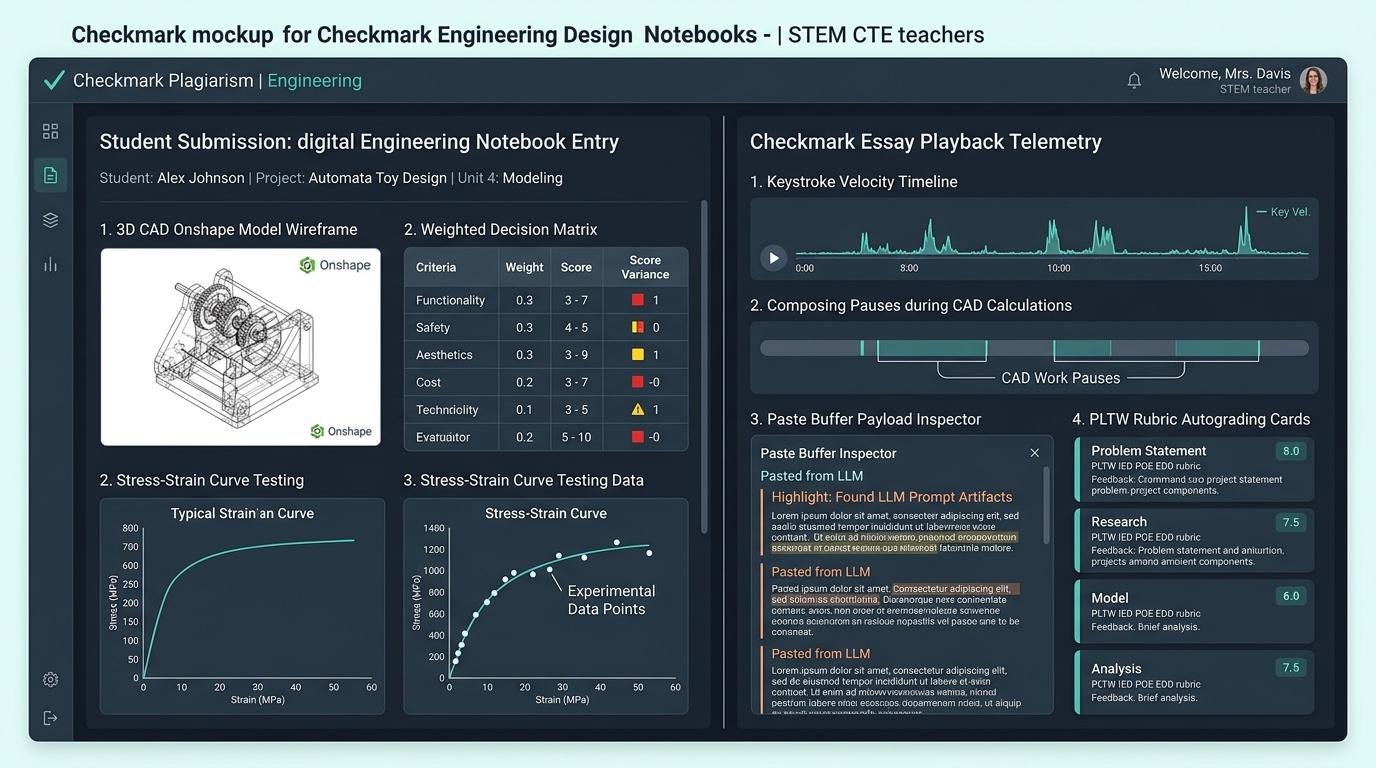
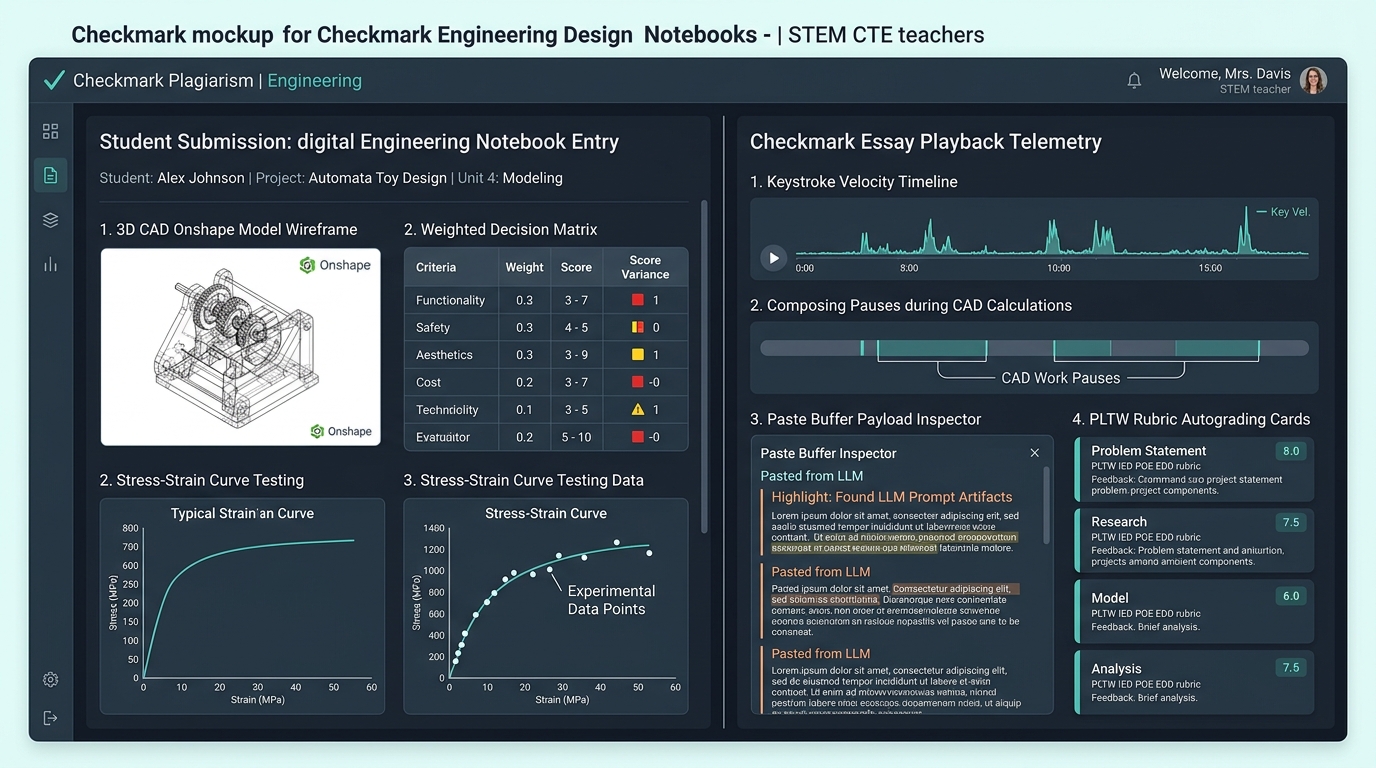
Compounding this challenge, generic commercial AI percentage detectors fail catastrophically in engineering classrooms—flagging standardized technical terminology (e.g., FEA, GD&T, factor of safety, shear stress, torque, orthographic projection) as “AI-generated” while completely missing fabricated empirical data and retrofitted logs. Checkmark Plagiarism resolves this crisis through a multi-dimensional evidentiary approach: combining passage-level AI confidence sliders, patent-pending Essay Playback™ writing telemetry (1x–8x replay), external paste buffer payload inspection, and quote-anchored rubric autograding synced directly with Canvas SpeedGrader, Agilix Buzz, and Google Classroom.
Pillar 1: Shop-to-Digital Concordance
- Physical prototype bench inspection & tool marks
- Onshape / Inventor CAD timeline & commit audits
- Bill of Materials (BOM) stock & fastener verification
- Empirical variance & physical sanity checks
Pillar 2: Keystroke Writing Telemetry
- Patent-pending Essay Playback™ (1x–8x replay)
- CAD measurement & derivation pauses (20–60s)
- External Paste Buffer Forensic Inspector
- Passage-level calibrated AI confidence sliders
Pillar 3: Restorative Shop Debriefs
- Lab bench whiteboarding & failure re-enactment
- Root-cause diagnostics over punitive zeroes
- Structured re-documentation of authentic iterations
- Formative growth aligned with ABET & NSPE ethics
1. The Disciplinary Anatomy of the PLTW Engineering Design Process (EDP) & Documentation Standards
In high school Career and Technical Education (CTE) engineering pathways, technical writing is fundamentally distinct from humanities composition. In English or social studies, writing is predominantly analytical or argumentative; in engineering, documentation is procedural, empirical, iterative, and legally binding.
The Engineering Design Notebook serves as an authentic industry-standard journal. In professional engineering practice (governed by patent law and intellectual property standards), an engineer’s notebook establishes chronological priority of invention, records empirical testing failures, and details trade-off decisions. PLTW secondary curricula operationalize these industry standards across four foundational high school courses:
- Introduction to Engineering Design (IED): Focuses on technical sketching, measurement systems, dimensioning standards (ANSI/ASME), 3D parametric CAD modeling (Autodesk Inventor, PTC Onshape, SolidWorks), reverse engineering, and systematic concept generation.
- Principles of Engineering (POE): Emphasizes mechanical advantage, simple machines, energy transfer, fluid power (hydraulics/pneumatics), statics and truss stress analysis, materials testing (tensile testing, stress-strain curves), and algorithmic machine control (microcontrollers, VEX robotics systems).
- Digital Electronics (DE) & Aerospace Engineering (AE): Explores combinational and sequential circuit design, Boolean logic, state machines, aerodynamic lift/drag calculations, propulsion systems, and orbital mechanics.
- Engineering Design and Development (EDD): The capstone course where student teams spend an entire academic year identifying an open-ended, real-world societal or technical problem, justifying the problem with market and patent research, engineering a fully functional physical prototype, testing it against rigorous performance metrics, and presenting their technical portfolio to a jury of practicing industry engineers.
The 6-Step PLTW Engineering Design Process (EDP) Cycle
PLTW Core Standard| EDP Phase | Core Disciplinary Deliverables & Notebook Documentation | Typical AI Fabrication Vulnerability |
|---|---|---|
| 1 Define the Problem | Formal Design Brief (Client, Target Consumer, Problem Statement, Design Statement, Project Scope), Quantitative Criteria & Constraints (Size, weight, budget, safety factor, thermal limits, ADA/OSHA compliance), Prior Art & Patent Search. | Overly broad textbook problem statements lacking local community constraints or shop tooling limits. |
| 2 Generate Concepts | Unconstrained Concept Brainstorming (Divergent thinking), Annotated Concept Thumbnail Sketches with isometric views, Weighted Decision Matrix (Scoring multiple concepts across weighted criteria: cost, manufacturability, safety, durability). | Retrofitted decision matrices with post-hoc justifications mathematically forcing pre-built designs to win. |
| 3 Develop a Solution | Detailed Technical Modeling (Parametric 3D CAD assemblies in Onshape/Inventor), Dimensioned Multi-View Orthographic Projections with GD&T, Bill of Materials (BOM) with COTS parts, Engineering Calculations (Statics, electrical load, tolerances). | Hallucinated bulk material strengths (e.g. isotropic PLA) ignoring 3D-printing layer shear or scrap bin stock. |
| 4 Construct & Test Prototype | Physical Shop Prototyping (3D printing, laser cutting, CNC machining, hand tools, microcontroller breadboarding), Standardized Test Protocol & Safety Matrix, Empirical Quantitative Data Collection (Repeated trials, sensor telemetry, variance). | Fabricated test tables with 0.0% variance, zero sensor drift, and impossible $R^2 = 1.00$ linear perfection. |
| 5 Evaluate the Solution | Data Analysis (Graphical trends, error analysis, % deviation), Design Evaluation against original Criteria & Constraints, Root-Cause Failure Diagnostics & Redesign Recommendations. | Scripted theatrical failure narratives describing non-existent shop tooling or materials never stocked in lab. |
| 6 Present the Solution | Formal Technical Design Review & Juried Presentation, Comprehensive Engineering Portfolio (Digital Design Notebook), Executive Summary & Production Transition Documentation. | Polished industrial rhetoric that collapses during live industry juror Q&A defense sessions. |
The Disciplinary Standards Governing High School Engineering Portfolios
Engineering notebooks in secondary schools are evaluated against standardized national rubrics and frameworks designed to mirror collegiate engineering accreditation (ABET):
PLTW Engineering Notebook Rubric
National MetricMeasures 7 core dimensions: Problem Definition, Concept Selection, Solution Development, Prototyping & Testing, Evaluation, Reflection/Self-Assessment, and Documentation Integrity (chronological entry, signatures, sketches, dates).
NGSS HS-ETS1 Engineering Design
State Science StandardEncompasses HS-ETS1-1 (analyze complex challenges), HS-ETS1-2 (break down systems), HS-ETS1-3 (evaluate solutions based on prioritized trade-offs), and HS-ETS1-4 (use computer simulations to model impacts).
ITEEA Standards (STEL)
Technological LiteracyFocuses on Standard 2 (Core Concepts of Technology and Engineering), Standard 8 (Attributes of Design), and Standard 9 (The Engineering Design Process as an iterative, non-linear human problem-solving enterprise).
ABET Feeder Competencies
Dual-Enrollment TransitionAligned with Criterion 3 (Student Outcomes 1, 2, and 6): Ability to identify, formulate, and solve complex engineering problems, develop and conduct appropriate experimentation, analyze empirical data, and apply engineering judgment.
When high school students maintain an authentic Engineering Design Notebook, their entries are messy, chronological, and filled with the cognitive friction of real-world fabrication. They record broken 3D printer nozzles, unexpected motor stall currents, stripped screw threads, dimensional clearance failures during subassembly mating, and mathematical recalibrations.
However, the migration from physical bound grid books to digital engineering notebooks (Google Docs, Canvas ePortfolios, Agilix Buzz digital journals, Microsoft OneNote Class Notebooks) on 1:1 student Chromebooks has opened a dangerous vulnerability: the emergence of AI-generated synthetic engineering documentation.
2. The Classroom Dilemma: LLM Fabrication and Retrofitted Engineering Logs
High school engineering teachers routinely manage 5 to 6 class periods per day, totaling 130 to 160 students across busy, high-noise environments: woodshops, metal fabrication areas, rapid prototyping lab spaces, electronics benches, and CAD computer clusters.
In this demanding environment, project milestones create intense bottleneck pressures. Students frequently spend weeks physically tinkering, cutting materials, and assembling parts in the shop while neglecting their daily documentation. When the quarter grading period or the PLTW Portfolio Review deadline hits, students find themselves holding a partially functional prototype but zero contemporaneous documentation for Steps 1 through 5 of the design process.
In previous decades, a student caught in this predicament had to manually backfill handwritten logs—an arduous task that usually produced sparse, fragmented entries. Today, generative AI tools (ChatGPT, Claude, Gemini) allow a student to paste a prompt such as:
“Write a 6-week daily engineering design notebook log for a high school PLTW EDD team designing an automated solar-powered greenhouse watering system. Include a design brief, a 5-option weighted decision matrix, detailed CAD modeling notes, physical prototyping logs with materials and tools, 5 testing trials with quantitative moisture sensor data, error analysis, and recommendations for redesign.”
Within 15 seconds, the LLM generates 10 pages of impeccably formatted, technical-sounding engineering documentation. The student copies this output directly into their digital notebook, pastes in a few Onshape screenshots, and submits the portfolio as authentic original work.
Authentic Engineering Drafting vs. Synthetic LLM Fabrication
Diagnostic Contrast Table| Notebook Dimension | Authentic High School Documentation | Synthetic LLM-Generated Documentation |
|---|---|---|
| Problem Definition & Design Brief | Reflects local community constraints, specific high school shop tooling, realistic budget caps ($50–$200), and actual user interviews. | Highly generalized, textbook language; broad societal scope lacking specific classroom vendor or machine limits. |
| Concept Generation & Decision Matrix | Uneven concept depth; rough hand sketches; idiosyncratic scoring rationales based on student tool familiarity and scrap stock. | Mechanically balanced ideas; perfectly normalized matrix weights; post-hoc rationales with flawless mathematical logic. |
| Prototyping & Shop Logs | Messy, non-linear shop logs; recounts tool jams, snapped drill bits, CAD export bugs, and thermal warping on 3D prints. | Clean, linear progression; generic industrial terminology without referencing specific classroom machines or setups. |
| Empirical Testing & Quantitative Data | Human measurement error; noisy sensor drift; outliers; physical apparatus failure; genuine student troubleshooting notes. | Zero measurement variance; idealized linear trends; $R^2 = 1.00$; synthetic data with 0.0% standard deviation. |
| Material Properties & Calculations | Grounded in actual stock on hand (e.g. 1/8" Baltic birch, 20% infill PLA, 6061 alu); rough empirical estimates. | Confabulates isotropic bulk specs (e.g. ASTM tensile strength for raw resin) ignoring 3D print layer shear. |
| Iteration & Trade-off Narratives | Organic pivots forced by physical breakage, motor burnout, or budget exhaustion at local hardware stores. | Synthetic, scripted dramas (“We identified a 12% stress concentration in FEA...”) disconnected from shop build. |
The Four Hallmarks of Fabricated Engineering Notebook Entries
High school engineering instructors must understand the specific structural artifacts and physical confabulations that characterize AI-generated engineering logs.
Synthetic Decision Matrices with Post-Hoc Justifications
In authentic engineering design, a Decision Matrix is a prospective tool: students establish evaluation criteria, assign percentage weights, and score competing concepts before committing capital and labor in the shop.
AI Synthesis Red Flags:
- Justifications use formal industrial rhetoric (“Concept C exhibits superior modularity and kinematic efficiency”) rather than shop constraints (“We already have the 1/2-inch aluminum rods in the scrap bin”).
- Uncanny scoring uniformity where all rejected concepts score 2s and 3s, while the chosen concept scores 4s and 5s across every metric with zero trade-off tension.
Confabulated Material Properties & Incompatibilities
LLMs generate text based on statistical token prediction across internet handbooks, lacking tactile awareness of high school shop realities:
Physical Disconnects:
- PLA Anisotropy Fallacy: Citing bulk tensile yield strength (65 MPa) for FDM 3D prints, ignoring layer delamination along the Z-axis.
- Laser Cutter Fantasies: Claiming to cut 6061-T6 aluminum sheet on a 40W CO2 makerspace laser (which only cuts acrylic/wood/cardboard).
- Hardware Mismatches: Specifying M3.5 x 18mm titanium screws instead of standard #8-32 or M3/M4 robotics kit hardware.
Fabricated Empirical Test Data with Zero Variance
When students perform genuine physical testing—such as timing automated sorters or testing bridge trusses on a Pasco tester—empirical data is inherently noisy.
Scripted Post-Hoc Iteration Dramas
Authentic engineering is recursive and frustrating. AI logs synthesize a sanitized, theatrical narrative of iteration disconnected from physical reality.
The Synthetic Drama Pattern:
“FEA indicated the cantilever experienced 1.42 mm deflection... we increased fillet radius from 2.0 to 4.5 mm and switched to carbon-fiber filament...”
Shop Reality: Bracket has no fillet radius, no carbon-fiber filament, and is held together with sheet-metal screws and hot glue.
3. The Engineering Ethics & PLTW / ABET Accreditation Dilemma
The integrity of the Engineering Design Notebook is foundational to the educational and ethical mission of secondary STEM programs. Unlike an English essay where creative interpretation is valued, an engineering notebook is a record of technical veracity.
The High School Engineering Integrity & Accreditation Stakes
PLTW End-of-Course Credit
EoC performance assessments and college credit qualification (RIT, Purdue, state universities) require verified documentation mastery. AI-fabricated portfolios undermine articulation agreements.
NSPE & IEEE Ethics
The National Society of Professional Engineers (NSPE) Code requires issuing public statements and lab data truthfully. Fabricating test metrics normalizes dangerous engineering malpractice.
EDD Industry Panels
In EDD, students defend portfolios before practicing engineers, patent attorneys, and professors. Students presenting AI-fabricated logs collapse under technical cross-examination.
Formative Growth
When students use AI to hide design failures, teachers cannot diagnose misconceptions (e.g. miscalculating gear ratios or moment arms), sabotaging foundational learning.
Why Generic Commercial AI Percentage Detectors Fail in High School Engineering
Faced with suspected AI generation in digital notebooks, many secondary teachers and administrators attempt to use generic commercial AI detection tools (such as Turnitin AI writing indicator, GPTZero, or CopyLeaks). These tools generate a single, whole-document “AI Probability Percentage” (e.g., “This document is 87% AI-Generated”).
In secondary engineering and technical writing, generic whole-document percentage detectors fail catastrophically for three fundamental reasons:
False Positive Trap: Technical Jargon
Engineering writing is inherently formal and structured. When an authentic student writes:
“The design brief specifies a maximum allowable deflection of 0.50 mm under a static load of 250 N, yielding a calculated Factor of Safety of 2.2 based on the yield tensile strength of 6061-T6 aluminum...”
The text exhibits low linguistic perplexity and uniform burstiness—the exact mathematical traits generic detectors flag as machine-generated. Honest students mastering technical precision are falsely accused.
False Negative Evasion & Black-Box Opacity
When students paste fabricated test logs or use basic paraphrasers, generic detectors dilute scores below detection thresholds, missing 100% fabricated data tables.
Furthermore, a single whole-document percentage score provides zero evidentiary “receipts.” Confronting a parent with “The AI score is 78%” creates immediate defensive denial, whereas writing playback provides undeniable visual proof.
4. The High School Engineering Evidentiary Matrix
To evaluate student documentation objectively, high school educators must compare the evidentiary capabilities of traditional and modern assessment methods:
High School Engineering Evidentiary Matrix
Comparative Analysis| Evidentiary Dimension | 1. Bound Paper Notebooks | 2. Generic AI Detectors | 3. Google Docs History | 4. Checkmark Essay Playback™ |
|---|---|---|---|---|
| CAD & Media Artifact Integration | Hand-signed pages, taped photos, pen-only entries. | None. Pure raw text strings. | Basic word diffs; no media telemetry. | Native integration with CAD timelines & image uploads. |
| Temporal Process Reconstruction | Low. Students backfill with backdated pens. | Zero. Static score with no timestamps. | Coarse, periodic 10-30 min snapshots. | Granular second-by-second keystroke replay (1x to 8x). |
| External Paste Forensic Capture | N/A. Hand-copied from phone screens. | Zero clipboard forensic tracking. | Shows large chunk; drops clipboard text. | Exact timestamp, char count, full preserved payload. |
| Technical Jargon Resilience | Evaluated directly by teacher. | High False Alarm on FEA/CAD terms. | N/A. No linguistic analysis. | Calibrated sliders prevent jargon false positives. |
| Empirical Data Verification | Manual instructor review of written values. | None. Misses fabricated tables completely. | None. No sanity check on units or variance. | Quote-anchored rubric analysis of empirical data. |
| Parent Conference Defensibility | Defensible, but huge friction for 150 students. | Highly adversarial; causes bitter disputes. | Weak; easily argued away by "drafting elsewhere". | Highly defensible, collaborative video playback proof. |
5. Step-by-Step Engineering Instructor Audit Protocol
When evaluating digital Engineering Design Notebooks in PLTW IED, POE, or EDD courses, secondary educators and department chairs should employ this 5-phase systematic audit protocol:
Phase 1: Physical Shop Build & Digital Documentation Concordance Audit
The most powerful advantage a secondary engineering instructor has over any software algorithm is the physical environment of the makerspace or workshop. Authentic engineering documentation is tethered to physical reality.
Compare the physical prototype directly against notebook claims. Check if claimed CNC aluminum mounts are actually 3D-printed PLA zip-tied to a VEX channel, or if drop-tested housings show zero impact marks.
In Onshape/Inventor, verify feature timestamps. If the notebook claims CAD was finished Oct 12 but the Onshape document history shows the first Part Studio created Nov 3 at 11:42 PM, the log is fabricated.
Phase 2: Decision Matrix & Quantitative Data Sanity Check
Audit the student’s Step 2 decision matrix and Step 4 empirical data tables for post-hoc retrofitting and statistical anomalies.
Check if criteria weights were artificially skewed (e.g. 45% weight to “Portability” when the Design Brief never mentioned it) to force a pre-built prototype to emerge as the winner.
Check for natural experimental scatter ($2% ext{ to }10%$ CV). If 10 consecutive trials of a high school crush test yield identical force readings of 142.5 N with 0.0% variance, the data is synthetic.
Phase 3: Writing Telemetry & CAD Reflection Audit (Essay Playback™)
Authentic technical writing contains frequent 15-to-60-second composing pauses where the student switches to Onshape, consults a digital caliper, or calculates a gear ratio.
[Type 14 words] ──► [Pause 42s: Inspect CAD/Calipers] ──► [Backspace 8 chars: Adjust Dimension] ──► [Type 22 words]
[Bulk Paste 1,850 chars at 00:00:01] ──► [Zero Revisions] ──► [Identical Timestamps Across 6 EDP Phases]
Phase 4: External Paste Buffer Payload Forensics
When high schoolers prompt ChatGPT, they generate entire sections in a browser tab and copy-paste them into their digital notebook. Checkmark captures and preserves the exact clipboard payload.
Forensic Finding: Conversational LLM prompt intro pasted directly into notebook. Preserved in Checkmark report even if student subsequently deletes introductory lines.
Phase 5: The Restorative Engineering Design Review Debrief
The ultimate objective of academic integrity in STEM is not punitive zeroes, but mentoring students into reflective, honest engineers.
Meet at the shop bench with prototype and Playback side-by-side.
Show telemetry calmly: "This section was pasted at 11:38 PM with zero variance."
Acknowledge deadline stress: "I know you spent 20 hours wiring that driver."
Ask student to demonstrate the test live on the bench.
Re-document real shop failures for partial credit; failure teaches engineering.
6. How Checkmark Empowers High School Engineering Instructors
Checkmark Plagiarism provides a dedicated suite of tools specifically engineered to support the unique workflow of secondary STEM and CTE educators:
Passage-Level Granularity vs. Opaque Scores
Rather than stamping a 20-page portfolio with a blanket “68% AI” badge, Checkmark evaluates text passage-by-passage. Standardized technical descriptions of ANSI thread tolerances or Ohm’s Law derivations remain clean and unflagged, while an AI-generated paragraph fabricating an unperformed drop test is highlighted with an individual evidence card.
Patent-Pending Essay Playback™ (1x–8x Speed)
Engineering teachers can watch a 2-hour documentation session unfold in 90 seconds. Instructors see the student pause to inspect an Onshape part drawing, type in caliper measurements, correct mathematical calculations, and compose authentic technical explanations.
Protection for Honest, Highly Technical Students
Neurodivergent students, high-achieving STEM students, and non-native English speakers who write in formal, concise, and structured engineering prose are protected against false accusations. When a generic detector flags an honest student’s statics report, Checkmark’s complete keystroke timeline serves as definitive proof of human authorship.
Quote-Anchored Rubric Autograding for High School Workloads
High school teachers grading 140 portfolios can leverage Checkmark’s teacher-in-the-loop rubric assistant. Pre-loaded with official PLTW and NGSS rubrics, the system provides quote-anchored justifications for each criterion. Teachers review, adjust, and push finalized grades directly into Canvas SpeedGrader, Agilix Buzz, or Google Classroom with one click.
7. High School Engineering Case Scenarios
To illustrate how these tools operate in practice, consider three authentic secondary engineering scenarios:
Maya K. submits a 6-page digital notebook. A generic detector flags it as "55% AI". Maya is in tears, insisting she built the toy and wrote her reflections herself.
Playback proves 4 hours of authentic drafting on design brief & CAD reflections. However, the Decision Matrix was pasted in 8 seconds from an LLM that scored Pear, Snail, and Eccentric cams after she built the Pear cam.
Teacher validates Maya's 4-hour authentic work, explains why backfilling undermines engineering, and has Maya spend 15 min recalculating her matrix from actual shop cam tests.
Jordan T. and Noah S. submit a Materials Testing Report featuring a pristine stress-strain curve with $R^2 = 1.0000$ and zero data scatter.
Checkmark flags high AI confidence on testing analysis. Playback shows a complete synthetic table paste at 1:14 AM. Instructor confirms the classroom tensile tester broke in Period 3 before the group ran trials.
Instead of an honor code penalty, Jordan and Noah repair the test fixture, run a real destructive test on aluminum, and document the genuine, noisy empirical data.
Alex R. submits a 35-page year-long capstone portfolio. Legacy LMS checker flags it with "88% AI Probability" due to PID tuning, PWM frequencies, and FEA stress formulas.
Checkmark sliders recognize domain terminology. Playback proves 42 hours of authentic drafting over 6 months; paste logs match Alex's own Arduino serial monitor dumps.
Alex is completely exonerated. The department chair uses Checkmark's telemetry dossier to defend Alex's portfolio before the university dual-credit review committee.
8. Frequently Asked Questions (FAQs) for High School Engineering Educators
Q1: Should high school engineering programs return to physical, bound paper notebooks?
While bound paper quadrille notebooks have historical value, modern engineering education must prepare students for industry workflows involving 3D CAD, digital simulation, code repositories, and collaborative cloud documentation. Returning exclusively to paper creates massive grading friction for teachers managing 150 students and does not eliminate cheating (students simply copy AI text from their smartphones by hand). A digital engineering notebook audited by writing process telemetry provides the best of both worlds: digital fluency with complete evidentiary transparency.
Q2: How does Checkmark handle multi-author group engineering capstone portfolios in EDD?
In year-long capstone courses like PLTW EDD, 2 to 4 students collaborate on a single portfolio. Checkmark tracks individual student contributions by author login, attributing keystrokes, composing time, revisions, and external pastes to specific team members. If one student pastes an AI-generated testing log while three others draft authentic CAD analyses, Checkmark isolates the exact contributor, protecting honest teammates from unfair group penalties.
Q3: Can Checkmark analyze technical drawings, CAD screenshots, and circuit schematics?
Yes. Checkmark's portfolio viewer integrates text telemetry with embedded visual artifacts. When a student inserts an Onshape render or a circuit schematic, Checkmark timestamps the image insertion relative to the surrounding text. If a student writes a 500-word technical description of a circuit 3 days before the circuit diagram was created or physically wired, the temporal disconnect is immediately visible.
Q4: How can teachers distinguish between authorized AI brainstorming and unauthorized fabrication in engineering?
Engineering departments should establish clear syllabus policies: using an LLM to generate initial brainstorming ideas or refine grammar in an executive summary is permissible assistance if cited; using an LLM to generate synthetic decision matrices, invent testing data, or write retrospective iteration narratives is authorship fraud. Checkmark's passage-level sliders and paste buffer inspector allow teachers to see exactly what text was imported and how it was revised.
Q5: What is the best way to handle parent conferences when a student denies using AI in their notebook?
Never rely on a single percentage score. In the conference, open Checkmark's Essay Playback™ and play the video replay of the writing session alongside the paste buffer log. Showing parents a 3-second bulk paste of 2,000 characters at 1:15 AM containing conversational LLM text transforms the meeting from an adversarial argument into a supportive, fact-based conversation about time management, shop safety, and academic integrity.
Q6: How does Checkmark protect student data privacy under FERPA, COPPA, and state student privacy laws?
Checkmark operates under a strict Zero-Training Architecture. Student engineering portfolios, CAD write-ups, and proprietary inventions are never used to train public or commercial AI models, never shared with third parties, and never indexed in public repositories. All data is encrypted in transit and at rest, maintaining 100% compliance with FERPA, COPPA, and state student data privacy agreements.
Q7: Can Checkmark's rubric autograding sync directly with Canvas SpeedGrader, Agilix Buzz, and Google Classroom?
Yes. Checkmark provides certified 1-click integrations via LTI 1.3. Engineering teachers can run rubric-based autograding directly inside Canvas SpeedGrader, Agilix Buzz, or Google Classroom. Teachers review quote-anchored criterion scores, edit feedback comments, and synchronize finalized grades directly into their LMS gradebook without manual data entry.
9. Conclusion: Restoring the Culture of Authentic Engineering Inquiry
The heart of high school engineering education is not the production of flawless, pristine technical prose—it is the messy, resilient, human process of turning ideas into functional physical solutions. When high school students encounter structural failures, short circuits, or dimensional misalignments in the shop, their first instinct should be to document the failure, analyze the root cause, and iterate, not to prompt an AI chatbot for an idealized cover-up.
By shifting from punitive black-box percentage scores to defensible writing telemetry, patent-pending Essay Playback™, and teacher-in-the-loop rubric autograding, Checkmark Plagiarism equips secondary PLTW educators, CTE department chairs, and robotics coaches to protect authentic student learning. High school teachers can stop guessing, start trusting, and guide the next generation of engineers toward genuine technical excellence and unwavering ethical integrity.
Equip Your PLTW Engineering & CTE Program with Checkmark
Ready to verify authentic design documentation, protect student intellectual honesty, and integrate quote-anchored rubric autograding with Canvas, Agilix Buzz, or Google Classroom?