
Career and Technical Education (CTE) Directors, Vocational Program Leads, Health Science Clinical Coordinators, Trade Apprenticeship Supervisors, and Perkins V Grant Administrators face an unprecedented accountability crisis: verifying the authenticity of student-authored clinical logs, daily workplace field journals, OSHA safety reflections, and capstone apprenticeship portfolios. With students placed across distributed off-campus job sites—from hospital intensive care units and automotive repair bays to commercial construction sites—instructors cannot physically observe every clinical encounter or diagnostic procedure. In response, an alarming number of learners have turned to Generative AI (LLMs like ChatGPT and Claude) to fabricate realistic, jargon-dense shift journals, inventing patient vital trends, CAN-bus oscilloscope waveforms, or 240V split-phase load calculations from the comfort of their homes—a phenomenon known as the “Ghost-Logged Shift.”
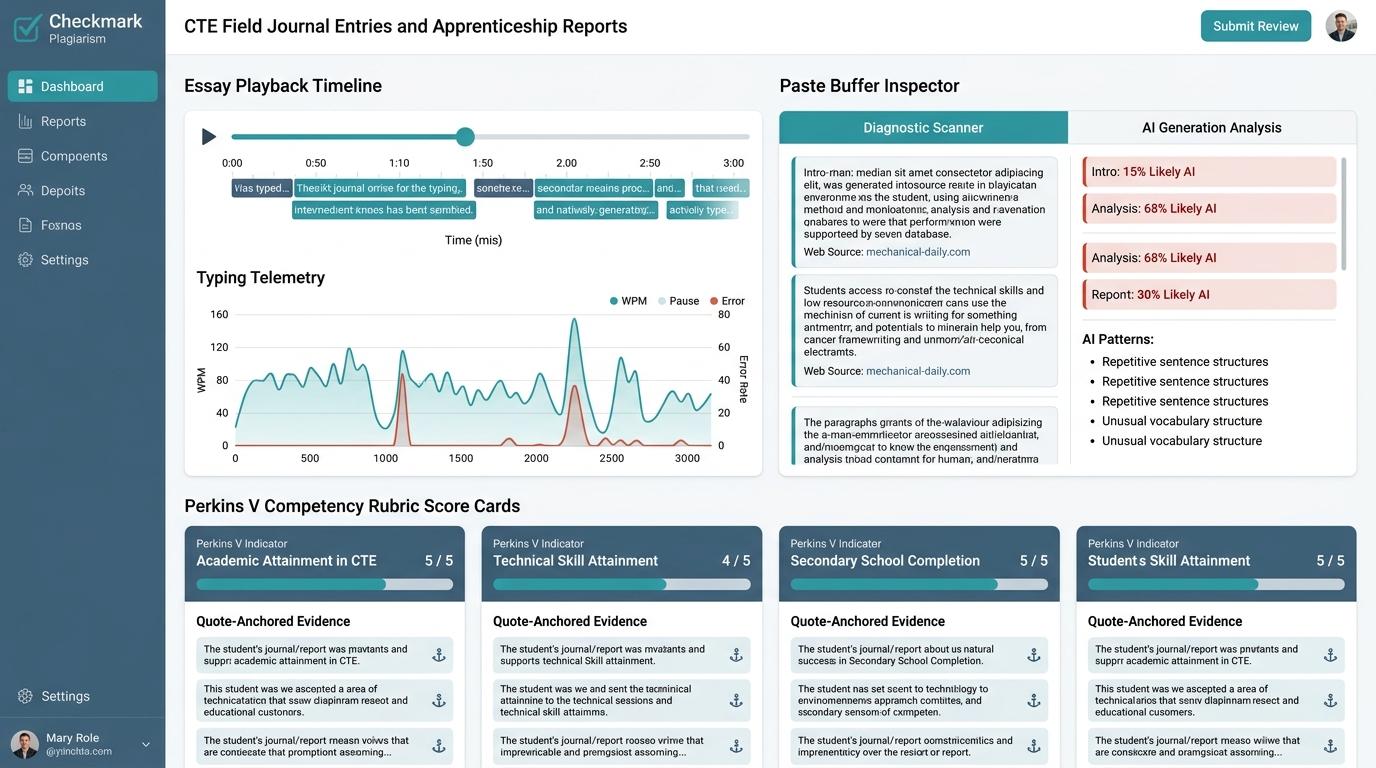
Traditional paper sign-off sheets are easily forged, static digital portals provide zero authorship context, and generic AI detectors generate devastating false positives on technical, acronym-heavy CTE terminology (e.g., subcutaneous heparin injection, CAN bus differential voltage, three-phase delta-wye transformer). Checkmark Plagiarism resolves this critical workplace-based learning (WBL) challenge through Non-Invasive Writing Telemetry and Teacher-in-the-Loop Rubric Autograding. By utilizing patent-pending Essay Playback™ (1x–8x scrubbable video replay of typing cadence, pause distributions, and procedural recall), a 100% External Paste Buffer Inspector (distinguishing permissible diagnostic machine readouts from illicit AI text drops), Passage-Level AI Confidence Sliders with Honest Short-Text (<150w) Guardrails, and AST-Powered Perkins V Competency Rubric Autograding, CTE programs can verify authentic on-the-job competency, satisfy stringent licensing board audits (NATEF, ACEN, NCCER, State Boards of Nursing), and uphold professional safety standards without invasive webcam surveillance or punitive guesswork.
Checkmark Plagiarism provides seamless enterprise interoperability for vocational and CTE programs through its comprehensive suite of AI rubric autograding, writing process replay, passage-level AI detection, side-by-side plagiarism checking, and native LMS integrations.
1. The Workplace-Based Learning (WBL) Integrity Dilemma in Modern CTE
Workplace-Based Learning (WBL), clinical practicums, co-op placements, and Registered Apprenticeships represent the crown jewel of modern Career and Technical Education. Reauthorized under the Strengthening Career and Technical Education for the 21st Century Act (Perkins V), federal and state accountability frameworks now tie hundreds of millions of dollars in career readiness funding directly to verifiable student attainment of recognized postsecondary credentials, workplace competencies, and documented on-the-job training (OJT) hours.
Whether preparing secondary high school seniors or postsecondary adult apprentices, CTE programs bridge the chasm between classroom theory and real-world mastery across vital industrial and healthcare sectors:
The Assessment Gap in Off-Site Learning
Unlike conventional academic subjects where instructors supervise students in centralized classrooms, CTE clinical coordinators and apprenticeship directors manage cohorts scattered across dozens of municipal facilities, hospitals, private contractors, and automotive dealerships. A single health science coordinator may oversee 45 nursing assistant students stationed across six regional nursing homes; an automotive department chair may supervise 30 apprentices across 15 franchise dealerships.
Because physical on-site faculty observation is limited to periodic spot-checks, the Reflective Field Journal and Clinical Logbook serves as the primary evidentiary bridge proving that:
- Active Participation: The student was physically present and actively performed the required procedural competencies.
- Cognitive Synthesis: The student accurately synthesized complex workplace observations (e.g., identifying abnormal cardiac telemetry rhythms, diagnosing parasitic electrical battery drains, calculating circuit ampacities under continuous load).
- Regulatory Internalization: The student internalized critical safety, ethical, and regulatory standards (OSHA, HIPAA, EPA Section 608, NFPA 70E National Electrical Code).
The High Stakes of Unverified Competency
In vocational education, a fabricated journal entry is not merely an academic honor code infraction—it is an existential safety, liability, and accreditation hazard:
A nursing student who fabricates clinical logs documenting geriatric feeding tube care or insulin administration without performing them enters the workforce as a licensed liability, directly endangering human lives.
An electrical apprentice who generates synthetic calculations for high-voltage panel grounding without physically understanding arc flash safety risks threatens their life, their coworkers, and municipal infrastructure.
Discovering widespread synthetic, AI-generated, or rubber-stamped logbooks during state licensing board audits results in immediate program suspension, loss of clinical contracts, and forfeiture of Perkins V federal funding.
2. The “Ghost-Logged Shift” & The Flaws of Legacy Verification Tools
The advent of accessible Large Language Models (LLMs) has fundamentally destabilized traditional vocational portfolio assessment, giving rise to the pervasive threat of the “Ghost-Logged Shift.”
1. Anatomy of the “Ghost-Logged Shift”
In a ghost-logged shift, a student who arrived late, slept in a breakroom, or completely missed an off-site practicum uses an AI model to construct a believable narrative of vocational competence. Within 15 seconds, an LLM can produce:
- Automotive Diagnostic Trees: A comprehensive step-by-step diagnostic log describing how the student used an oscilloscope to isolate a faulty camshaft position sensor on a 2022 Ford F-150, complete with realistic Freeze Frame P0340 OBD-II data and waveform duty cycles.
- Commercial Electrical Specs: A detailed commercial electrical log detailing the installation of a 200A subpanel, complete with accurate wire gauge sizing (3/0 copper), conduit fill percentages, and torque specifications per NEC Article 310.
- Culinary Arts & HACCP Controls: A culinary reflection describing the execution of a five-mother-sauces service, complete with exact emulsification temperatures, food cost variances, and HACCP critical control point logs.
Because LLMs excel at replicating domain-specific terminology, standard operating procedures, and professional reflective writing, these synthetic entries read like the work of an exemplary student.
2. The Total Breakdown of Paper Sign-Offs & Static Portfolios
For decades, vocational programs relied on physical logbooks signed by busy job-site supervisors (preceptors, journeymen, or service managers). However, workplace realities make paper records fundamentally indefensible:
- The “Friday Afternoon Signature Blitz”: Overworked shop foremen and head nurses routinely sign off on a month's worth of student log sheets in 30 seconds without reading the narrative entries or verifying procedural specifics.
- Zero Authorship Provenance: Static digital submissions (PDF uploads or standard LMS text fields) record only the final submission timestamp. They offer no proof of whether the entry was drafted over 45 minutes of thoughtful post-shift reflection or pasted from ChatGPT in 4 seconds.
- Accreditation Audit Vulnerability: When state licensing boards request proof of clinical hours during an accreditation review, paper signatures without verifiable drafting history provide no defense against institutional fraud investigations.
3. The “Jargon False Alarm” Dilemma: Why Probabilistic AI Detectors Fail in CTE
When CTE directors deploy generic whole-paper AI detection tools (which output a single probabilistic percentage like “78% AI-Generated”), they encounter massive failure rates specifically caused by the technical nature of vocational writing:
Technical specifications and standard diagnostic protocols follow rigid grammatical sequences. Statistical language models see correct technical jargon as identical to synthetic training data.
Vocational students are trained to write concise, standardized sentences. The absence of flowery prose mimics LLM structural predictability.
Checkmark ignores word probability guessing. Instead, it inspects keystroke dynamics and typing cadence, confirming that the student spent 28 minutes actively typing and calculating waveform data—proving 100% human authorship beyond doubt.
3. Traditional Logs vs. Generic AI Detectors vs. Non-Invasive Writing Telemetry
To establish defensible, audit-proof WBL verification, CTE programs must transition from static signatures and probabilistic guessing to objective, non-invasive writing process telemetry:
| Evaluation Dimension | Traditional Paper / PDF Logs | Generic Black-Box AI Detectors | Checkmark Writing Telemetry |
|---|---|---|---|
| Evidence Foundation | Physical ink signatures; easily forged or rubber-stamped. | Opaque mathematical probability score (e.g., “82% AI”). | Keystroke dynamics, real-time drafting playback, & clipboard capture. |
| Handling of Technical Jargon | High (human supervisor reads text directly). | Disastrous Failures: Flags correct acronyms as AI. | 100% Calibrated: Evaluates drafting behavior, not word probabilities. |
| Paste vs. Drafting Distinction | None; cannot determine if text was typed or pasted. | None; evaluates only static, surface-level text. | Granular: Preserves 100% of clipboard text with timestamped inspection. |
| Permissible Machine Telemetry | Unverified attachments or handwritten notes. | Often flagged as AI-generated boilerplate text. | Differentiates: Validates pasted diagnostic scan logs vs. AI generation. |
| Accreditation Audit Defense | Weak; relies on subjective signature verification. | Unusable in licensing appeals (unprovable black-box score). | Indisputable: Replays the student's actual procedural recall keystroke-by-keystroke. |
| Student Surveillance Impact | Low (paper-based). | Moderate (opaque algorithms scanning submissions). | Zero Surveillance: No webcams, screen capture, or keyloggers outside LMS. |
| LMS & Gradebook Workflow | Manual entry into spreadsheets; hours of overhead. | External portal; disconnected from vocational rubrics. | Native Integration: 1-Click LTI 1.3 sync to Canvas, Buzz, & Google Classroom. |
4. The Checkmark CTE & Apprenticeship Verification Suite
Checkmark Plagiarism delivers an enterprise-grade academic integrity and competency verification suite engineered specifically for the pedagogical, technical, and regulatory requirements of Career and Technical Education.
1. Patent-Pending Essay Playback™ (1x–8x Scrubbable Replay)
The cornerstone of Checkmark’s verification architecture is Essay Playback™, an unforgeable, patent-pending timeline visualizer that reconstructs the student's exact writing session.
When an apprentice or clinical student opens their LMS journal editor (in Canvas, Buzz LMS, Google Classroom, or Microsoft Word), Checkmark captures lightweight temporal telemetry:
- Cognitive Recall vs. Mechanical Dumping: A student reflecting on a real clinical shift exhibits natural, bursty typing patterns. They type a sentence describing patient positioning, pause for 12 seconds to recall the exact blood pressure reading or catheter insertion depth, backspace to correct a dosage unit from
mgtomcg, and continue drafting. - Scrubbable Replay Console: Vocational coordinators can scrub through the entire 30-minute writing session at 1x, 2x, 4x, or 8x speed. In 30 seconds, an instructor can visually confirm authentic drafting behavior or immediately identify a 2-second paste drop of 800 words.
2. External Paste Buffer Inspector (100% Clipboard Content Preservation)
In vocational disciplines, copying and pasting text into a journal is not inherently cheating. In fact, modern technicians and healthcare workers routinely paste legitimate digital machine telemetry into their logs:
- An automotive technician pastes an ASCII diagnostic trouble code scan log directly from an OBD-II scan tool.
- An HVAC technician pastes digital manifold pressure and superheat/subcooling calculations from a Bluetooth field probe.
- A medical assistant pastes a lab report format or standardized medication list.
Generic AI detectors and legacy plagiarism checkers treat all pasted text equally, generating false alarms on legitimate diagnostic data. Checkmark's External Paste Buffer Inspector captures and preserves the exact text copied from the clipboard at the millisecond it entered the document.
        === SNAP-ON ZEUS+ DIAGNOSTIC REPORT ===

        VIN: 1G1YY22U065109XXX | 2021 Silverado 1500 5.3L V8

        MODULE: Transmission Control Module (TCM)

        DTC P0751: 1-2 Shift Solenoid Valve Performance

        Line Pressure Duty Cycle: 48.2% @ 1850 RPM | Commanded: 72.0%

        Fluid Temp: 188°F | TCC Slip Speed: 145 RPM
Matches Snap-on serial data structure. Verified as approved shop telemetry. Surrounding 35 minutes of drafting proves authentic diagnostic trouble-tree synthesis.
3. Technical Jargon-Resistant Passage-Level AI Sliders with Honest Guardrails
Rather than generating a single opaque whole-document percentage that panics students and confuses employers, Checkmark uses Passage-Level AI Confidence Sliders:
- Passage-Specific Underlining: Only specific sentences displaying anomalous linguistic, syntactic, and structural patterns are highlighted directly within the essay.
- Calibrated Confidence Cards: Clicking an underlined sentence opens an evidence card displaying calibrated sliders that weigh human drafting variance against typical LLM syntactical markers, explaining why the passage was flagged.
- Honest Short-Text (<150 Words) Guardrails: In vocational education, many daily shift check-ins and quick incident notes are brief (50–120 words). Statistical linguistic models are mathematically unreliable on small text samples. While other tools guess wildly, Checkmark automatically displays
N/Afor submissions under 150 words, protecting students from uncalibrated false flags and prompting the instructor to rely on Essay Playback™ session history. - Private Educator Flags: AI flag statuses (Flagged, Resolved, Validated) remain strictly private to educators. This ensures that no student is automatically accused of misconduct without human review and verification.
4. Teacher-in-the-Loop CTE Rubric Autograding
Vocational instructors spend dozens of unpaid hours each week manually grading repetitive procedural field logs against complex industry standards. Checkmark streamlines this workload through AST-Powered Rubric Autograding:
- Perkins V & Industry Standard AST Parsing: Checkmark's grading engine parses multi-criterion analytic rubrics from NATEF, ACEN, NCCER, OSHA, and state CTE frameworks, converting them into structured Abstract Syntax Trees.
- Quote-Anchored Evidence Extraction: For every rubric performance indicator (e.g., “Diagnostic Logic”, “PPE & Safety Compliance”, “Reflective Synthesis”), Checkmark extracts verbatim quotes directly from the student's text to justify the suggested point score.
- Pre-Flight Teacher Review Console: The instructor retains 100% pedagogical authority. AI-suggested scores and feedback cards appear as editable drafts in a streamlined console. The teacher can adjust point allocations, edit comments, or override evaluations in seconds.
- 1-Click LMS Grade Passback via LTI 1.3: Once approved, finalized grades, per-criterion scores, and quote-anchored feedback push directly into Canvas SpeedGrader, Buzz LMS, or Google Classroom gradebooks with zero manual data entry.
Arrived at job site at 0700. Assisted Journeyman with 200A subpanel installation in commercial warehouse unit 4B.
Calculated total continuous load at 142A. Sized copper THHN feeder conductors at 3/0 AWG to maintain voltage drop below 2.5% over 120-foot run...
5. Real-World CTE Field Verification Case Studies
To illustrate how Checkmark’s integrated suite operates across diverse vocational environments, consider three real-world CTE placement scenarios:
| Scenario Feature | Case 1: Health Science (CNA/LPN) | Case 2: Automotive Service Tech | Case 3: Commercial Electrical |
|---|---|---|---|
| Setting | Long-term care clinical rotation | Dealership transmission repair bay | Commercial 3-phase job site |
| Incident Flag | Suspected Ghost Shift via Claude | Generic AI Detector flagged 88% | Suspiciously polished NEC summary |
| Essay Playback™ Finding | 4-second full paste event; 0 typing time | 34 active minutes drafting & calculating | 18 min math typed; reflection pasted |
| Paste Buffer Evidence | Prompt header: “Here is a realistic log...” | Raw Snap-on Zeus+ diagnostic scan log | Pasted 150-word AI textbook summary |
| Resolution & Outcome | Restorative makeup shift; zero patient risk | 100% Exonerated with full credit | Targeted trade writing coaching |
Case Study 1: Health Science Clinicals (CNA / LPN Rotation)
- The Setting: A secondary Health Science program placing 38 Certified Nursing Assistant (CNA) students in a 120-bed long-term care facility.
- The Incident: A student submitted an extraordinarily thorough 520-word clinical reflection detailing morning vital signs, assistance with activities of daily living (ADLs), and a complex observation of stage 2 sacral ulcer dressing change for “Room 214-B.”
- The Investigation via Checkmark:
- Generic Detector Scan: A legacy detector flagged the paper at 45% AI due to standard medical acronyms (
NPO,b.i.d.,systolic). - Essay Playback™ Audit: The clinical coordinator opened Checkmark's playback console. The timeline revealed that the entire 520-word entry appeared in a single 4-second paste event with 0 backspaces and 0 active typing time.
- Paste Buffer Inspection: Checkmark's External Paste Buffer Inspector captured the clipboard contents, revealing the prompt header: “Here is a realistic clinical journal entry for a CNA student caring for a resident with a pressure ulcer...”
- Clinical Cross-Check: The coordinator contacted the supervising floor nurse, who confirmed that Room 214 had been unoccupied for three days. The student had missed their morning clinical rotation due to oversleeping and generated the entry to avoid receiving an unexcused absence.
- Generic Detector Scan: A legacy detector flagged the paper at 45% AI due to standard medical acronyms (
- Resolution: Because the evidence was undeniable and non-adversarial, the coordinator held a restorative conference. The student completed an in-person remediation shift on patient charting ethics and rescheduled the mandatory clinical hours required for state licensing board certification.
Case Study 2: Automotive Service Technology (Diagnostic Field Log)
- The Setting: An ASE/NATEF-accredited postsecondary automotive apprenticeship program.
- The Incident: A student apprentice working at a local transmission repair shop submitted a technical diagnostic field report containing dense paragraphs of diagnostic scan data, DTC trouble trees, and oscilloscope voltage readings. A generic AI detector flagged the submission with an alarming 88% AI-Generated Probability, prompting the instructor to consider academic disciplinary action.
- The Investigation via Checkmark:
- Essay Playback™ Analysis: The instructor loaded Checkmark’s Essay Playback™. The session timeline showed that the student spent 34 active minutes drafting the report, pausing frequently for 15 to 45 seconds to perform mathematical calculations, correct component labels, and restructure their diagnostic reasoning.
- Paste Buffer Verification: The report contained a large 180-word block of hexadecimal diagnostic trouble code telemetry. Checkmark's Paste Buffer Inspector proved that this block was copied directly from an export file generated by a Snap-on Zeus+ Diagnostic Workstation at 2:15 PM, matching the shop's service order timestamp.
- Passage-Level Sliders: Checkmark's passage sliders confirmed that the student’s surrounding reflective prose (“The fluctuating waveform indicated a ground short in the harness rather than a faulty solenoid...”) exhibited authentic human drafting dynamics.
- Resolution: Checkmark completely exonerated the apprentice. Instead of facing a wrongful cheating allegation, the student received full competency credit for advanced diagnostic trouble-tree synthesis, and the instructor validated the shop's repair order.
Case Study 3: Electrical & HVAC Trade Apprenticeship (Load Calculations & Code Compliance)
- The Setting: An NCCER-aligned commercial electrical apprenticeship program.
- The Incident: An apprentice submitted a daily field journal on commercial conduit bending and 240V split-phase service load balancing. The submission contained a blend of handwritten formula transcriptions and a suspiciously polished summary of NEC Article 220 compliance.
- The Investigation via Checkmark:
- Hybrid Telemetry Breakdown: Checkmark’s Essay Playback™ revealed that the student actively typed their mathematical load calculations step-by-step over 18 minutes, displaying authentic typing velocity and backspace corrections.
- Targeted Passage Flagging: However, the concluding 150-word paragraph on NEC code theory was dropped into the document in a 2-second external paste. Checkmark’s Passage-Level Confidence Slider isolated only that specific paragraph as synthetic AI text, leaving the authentic mathematical calculations untouched.
- Resolution: In a supportive 5-minute review, the apprenticeship coordinator praised the student's authentic load calculations but walked through the pasted NEC code summary, asking the student to explain the code rationale in their own words. The student admitted using ChatGPT because they felt insecure about their formal writing skills. The instructor coached the student on concise trade documentation, allowing them to rewrite the reflection section authentically.
6. The 4-Phase CTE Field Verification Protocol
To implement an institutional framework that guarantees competency authenticity without imposing intrusive surveillance, CTE Directors should adopt Checkmark’s 4-Phase Field Verification Protocol:
Phase 1: Pre-Placement Calibration & Policy Alignment
Before students deploy to clinical sites or apprenticeship jobs, program leads must establish transparent boundaries:
- The “Telemetry vs. Generation” Rule: Clearly define that pasting machine logs (scanner readings, diagnostic waveforms, HVAC pressure tables) is fully permissible when accompanied by original, student-drafted analysis explaining the data.
- Prohibited AI Ghostwriting: Explicitly ban using generative LLMs to synthesize procedural accounts, patient interactions, or workplace reflections.
- Transparent Student Onboarding: Demonstrate Checkmark’s Essay Playback™ to students during orientation. Emphasize that Checkmark does not use webcams, track personal browsing, or install spyware—it simply records their authentic typing and revision in the LMS to protect their work from false accusations.
Phase 2: In-Shift and Immediate Post-Shift Journaling Workflow
- Timely Journaling Windows: Require journal entries to be submitted within 12 to 24 hours of shift completion while procedural details and cognitive recall are fresh.
- Direct LMS Composition: Instruct students to draft their reflections directly within the LMS text editor (or integrated Google Docs / Word via Checkmark LTI) rather than composing in external third-party scratchpads, ensuring full keystroke telemetry capture.
Phase 3: Automated Triaging & Telemetry Verification
When submissions arrive, the CTE Coordinator utilizes Checkmark's automated triage console:
- Green / Verified (85–90% of submissions): Submissions displaying natural typing velocity, organic pause distributions, and verified AST rubric alignment are queued for immediate 1-click teacher review and grade passback.
- Yellow / Review (8–12%): Submissions with large external paste events trigger an automated review. The instructor opens the Paste Buffer Inspector to confirm whether the pasted text is approved diagnostic equipment data.
- Red / Flagged (<3%): Submissions composed in under 30 seconds with 100% external paste volume and high AI confidence are flagged privately for instructor-led playback review.
Phase 4: Restorative Evidence-Based Coaching & Audit Filing
When anomalous drafting occurs, instructors avoid punitive accusations. Instead, they use Essay Playback™ as a coaching tool:
- The “Show Me Your Thinking” Conference: The instructor pulls up the playback recording alongside the student, opening the floor with: “Let's review the drafting session for Thursday's clinical log together. Walk me through the diagnostic steps you performed.”
- Accreditation-Ready Archiving: Checkmark automatically archives the verified drafting dossier, per-criterion rubric scores, and timestamped preceptor logs in a secure, FERPA/HIPAA-compliant vault, ready for unannounced state licensing board audits.
7. Turnkey WBL Journal Competency Rubric & Accreditation Audit Checklist
To assist CTE Directors in standardizing competency evaluation across all vocational pathways, Checkmark provides this turnkey, Perkins V-aligned analytic rubric:
| CRITERIA | LEVEL 4: EXEMPLARY (90–100%) | LEVEL 3: PROFICIENT (75–89%) | LEVEL 2: DEVELOPING (60–74%) | LEVEL 1: UNACCEPTABLE |
|---|---|---|---|---|
| 1. Procedural & Technical Accuracy | Precise, granular breakdown of equipment, tools, tolerances, and technical parameters. Verifiable machine telemetry. | Accurate procedural steps documented; minor omissions in secondary specifications. Technical terms used correctly. | Generic or high-level steps; missing key technical data, component IDs, or tolerances. Casual/vague language used. | Omitted procedures, incorrect terminology, or fabricated actions. |
| 2. Diagnostic & Problem-Solving | Flawless cause-and-effect troubleshooting logic. Explains why specific tests ruled out alternative failure modes. | Logical troubleshooting flow; explains why specific tests were chosen and interpreted. | Identifies the symptom but jumps to conclusions without systematic isolation steps. | No diagnostic logic; asserts fixes without investigative proof. |
| 3. Safety, OSHA, & Regulatory | Proactive identification of job hazards (JHA), PPE used, lock-out/tag-out, HIPAA, or NEC/EPA safety standards. | Clear documentation of PPE and standard safety protocols relevant to the shift's tasks. | Mentions basic PPE but fails to analyze environmental or situational workplace hazards. | Ignores safety risks; documents unsafe or non-compliant actions. |
| 4. Reflective Synthesis & Growth | Deep self-evaluation of speed, accuracy, and skill growth. Links shift experience to future career competency. | Identifies areas of personal improvement and connects shift tasks to classroom theory. | Superficial reflection (“Shift went well, learned a lot”); minimal self-critique. | Zero reflection; purely mechanical summary without growth connections. |
| 5. Authorship & Telemetry | 100% authentic drafting telemetry. Legitimate machine data properly cited and contexted. | Authentic drafting confirmed; minor external paste blocks verified as diagnostic logs. | Significant unverified pasted blocks without machine data attribution or explanation. | 100% synthetic paste; zero drafting history; ghost-logged shift. |
CTE Director Accreditation Audit Trail Checklist
Before submitting annual Perkins V or state licensing board compliance reports, vocational directors should verify the following institutional controls:
8. Restorative Coaching Protocols & Student Conference Scripts
When telemetry indicates anomalous writing behavior or suspected AI ghostwriting, CTE instructors should conduct conferences using a supportive, evidence-grounded restorative coaching framework:
• Avoid accusatory words like “cheating”, “caught”, or “fraud.”
• “Let's watch how this entry came together so you can walk me through the shift.”
• “Can you explain the difference between the 60-ohm terminating resistance and what you measured?”
• Assign a supervised shop/clinical practical remediation or journal redrafting opportunity.
Script A: Addressing a Suspected LLM-Fabricated Clinical Log
Instructor: “Thanks for meeting with me, Marcus. I was reviewing your clinical journal from your Thursday rotation at Meadowbrook Manor. You wrote about assisting with a sterile dressing change for a resident with a stage 3 pressure ulcer. Can you walk me through the infection control and sterile field precautions you took during that procedure?”
Student: (Hesitates) “Uh, well... we used gloves and cleaned the wound with saline.”
Instructor: (Opening Checkmark Playback Console) “Let's look at the drafting history in Checkmark together. When we look at the session timeline, we see that the entire 450-word journal entry was pasted into the LMS in four seconds from an external source, without any drafting or typing pauses. As your clinical coordinator, my primary job is to ensure you are 100% prepared to perform these procedures safely when you take your state board licensing exam. Did you participate in this dressing change on Thursday, or did you generate this narrative using an AI tool because you missed the rotation?”
Student: “I overslept on Thursday and missed the bus to the facility. I panicked because I couldn't afford an unexcused absence, so I asked ChatGPT to write what a CNA would do.”
Instructor: “I appreciate you being honest with me right now. Fabricating patient logs is a serious safety violation that can lead to permanent expulsion from the nursing program. Because you were honest today, we are going to treat this as a restorative learning experience. You will receive an incomplete for this clinical shift, complete a 2-hour module on clinical documentation ethics, and reschedule the required clinical makeup hours with our hospital partner next Saturday. Let's make sure our documentation always matches what our hands have actually done.”
Script B: Clarifying Legitimate Technical Data Pasting (Exonerating a Student)
Instructor: “Hey Jordan, I was looking over your transmission diagnostic log on the 2021 Silverado. Checkmark flagged a 200-word external paste event, so I wanted to check in and see how you put this report together.”
Student: (Anxious) “I didn't use ChatGPT! I swear I did the work!”
Instructor: (Reassuring) “Take a deep breath, Jordan—nobody is accusing you. Checkmark's Paste Buffer Inspector shows us the exact text you copied. Let's look at it together: it's the raw serial telemetry from the Snap-on scanner showing the solenoid pressure duty cycles. What I love seeing in your playback is that you spent 25 minutes afterwards typing out your interpretation of why that solenoid duty cycle caused the 2-3 shift flare. You did the exact right thing by importing machine data; next time, just add a quick heading like ‘[Pasted Snap-on Scan Data]’ so our system categorizes it instantly. Great diagnostic work on that transmission.”
9. Data Privacy, FERPA, HIPAA, and Enterprise Compliance
In vocational and workplace-based education, student journal entries frequently reference sensitive real-world environments, including hospital patient encounters, proprietary automotive shop repair orders, and commercial trade blueprints.
Deploying educational technology in these environments requires uncompromising data privacy:
10. Frequently Asked Questions (FAQs)
1. How does Checkmark verify field journals without invading student privacy or using webcam proctoring?
Checkmark operates entirely within the native LMS writing environment (Canvas, Buzz, Google Docs, or Word). It captures non-invasive, lightweight typing telemetry—such as keystroke intervals, backspaces, pause durations, and clipboard paste timestamps. It never accesses webcams, microphones, device screens, browsing history, or keystrokes outside the assigned assignment window.
2. Why do generic AI detectors fail so frequently on CTE and vocational writing?
Generic detectors evaluate text using statistical word probability (perplexity and burstiness). Because CTE students write about standardized procedures, rigid safety codes (OSHA, NEC), and technical terminology (“240V single-phase split-bus panel”, “subcutaneous heparin injection”), their natural vocabulary matches predictable textbook patterns, causing generic detectors to flag authentic student writing as AI. Checkmark avoids this by evaluating temporal drafting behavior and keystroke dynamics rather than penalizing industry jargon.
3. How does Checkmark distinguish between legitimate diagnostic tool logs and unauthorized AI generation?
Checkmark’s External Paste Buffer Inspector captures 100% of clipboard text when a paste event occurs. The instructor can open the inspector to view the exact raw text that was pasted. If the text is an ASCII fault log from an automotive OBD-II scan tool or digital manifold pressure readout, the instructor can instantly validate it. If it is an AI chatbot conversational response, the instructor has indisputable visual proof.
4. What happens if a student writes a very short daily shift log (under 150 words)?
Statistical AI text analysis is mathematically unreliable on short text blocks. While generic tools guess recklessly on brief submissions, Checkmark enforces an Honest Short-Text Guardrail, automatically displaying N/A for text under 150 words. Instructors instead rely on Checkmark’s Essay Playback™ session history to verify that the entry was typed authentically during the shift.
5. Can students type their field journals on mobile devices or tablets while at the job site?
Yes. Checkmark’s telemetry capture engine is fully responsive and optimized for mobile browsers, tablets (iPad/Android), and laptops used in automotive bays, clinical stations, and job trailers, capturing touch-screen typing cadence and paste events with millisecond precision.
6. How does Checkmark help CTE programs during State Licensing Board or Perkins V accreditation audits?
When state licensing boards (such as State Boards of Nursing, NATEF, or NCCER) audit student clinical portfolios, paper signatures often fail to prove hands-on procedural mastery. Checkmark provides a tamper-evident digital verification dossier for every student, complete with scrubbable Essay Playback™ sessions, timestamped diagnostic logs, and quote-anchored Perkins V rubric justifications.
7. Does Checkmark train AI models on student clinical notes or trade journal submissions?
No. Checkmark maintains a strict Zero Model Training Guarantee. Student field journals, clinical reflections, and technical portfolios are never stored in public LLM databases, never shared with third parties, and never used to train machine learning models, ensuring complete compliance with FERPA, HIPAA, and district data privacy agreements.
Conclusion: Elevating Vocational Excellence Through Defensible Integrity
Career and Technical Education prepares students for the essential trades and healthcare professions that sustain our communities. In these high-stakes environments, verified competence is not an abstract academic ideal—it is a matter of workplace safety, patient care, and professional pride.
By moving away from easily forged paper sign-offs and unreliable black-box AI detectors, CTE Directors can establish an objective, non-invasive standard of authenticity. Through Checkmark Plagiarism's Essay Playback™, External Paste Buffer Inspector, and Perkins V Rubric Autograding, vocational educators can eliminate assessment burnout, protect honest students, satisfy rigorous accreditation audits, and uphold the timeless dignity of authentic hands-on craftsmanship.