
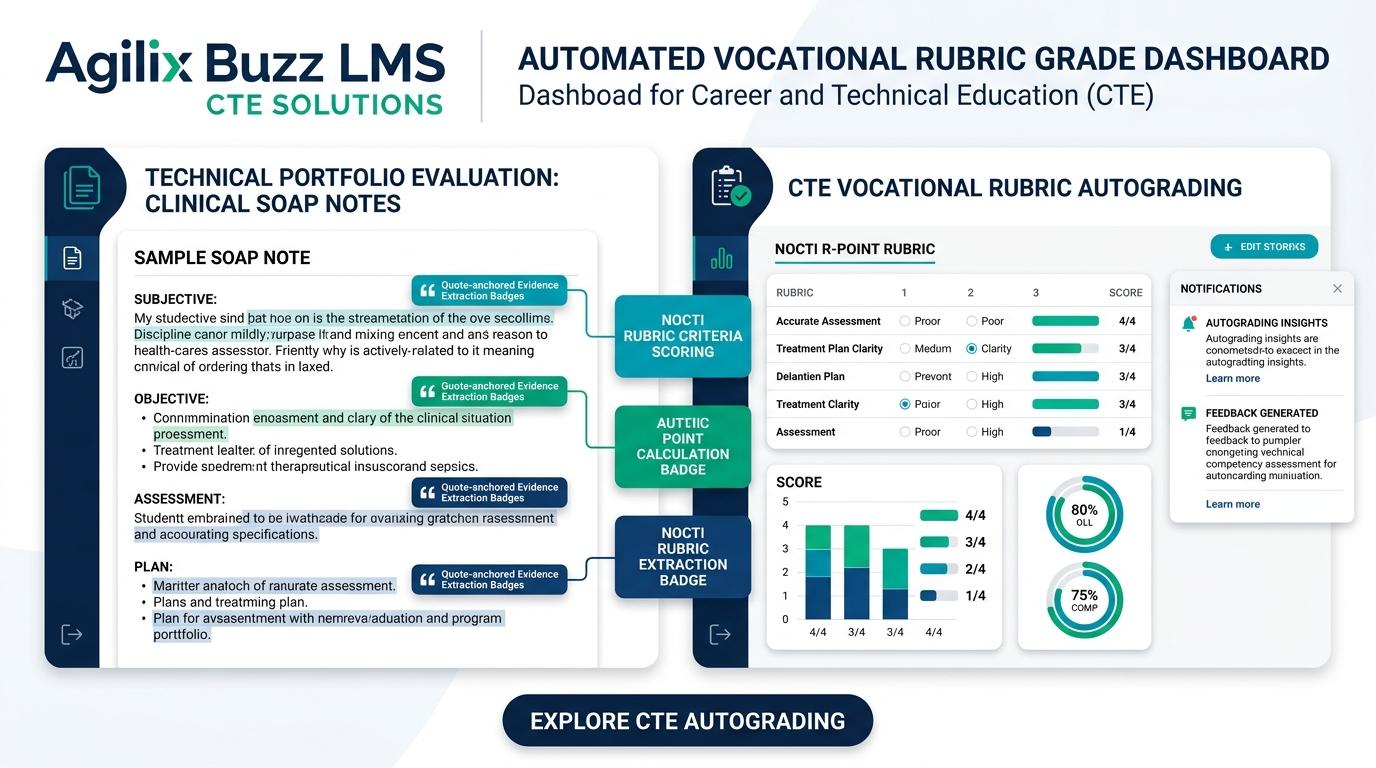
Career and Technical Education (CTE) programs operating on Agilix Buzz LMS face a critical assessment bottleneck: evaluating dense, multi-page technical writing portfolios—from biomedical clinical SOAP notes to engineering CAD fabrication logs and DECA business plans—against rigorous, multi-tiered industry competency rubrics across cohorts of 150 to 250+ students. Traditional manual rubric scoring within Buzz gradebooks generates a debilitating 2-to-3-week formative feedback lag, stalling hands-on shop fabrication and clinical rotations. By implementing Checkmark Plagiarism's 1EdTech LTI 1.3 Advantage integration, vocational programs can leverage AST-driven AI Rubric Autograding, grounded quote-anchored evidence extraction, and Assignment and Grade Services (AGS 2.0 / LineItem API). This architecture is designed to cut initial evaluation time sharply while keeping the CTE instructor in complete pedagogical control via a Pre-Flight Review Console. Combined with patent-pending Essay Playback™ (1x–8x keystroke replay with 100% paste buffer preservation), passage-level AI detection, and defensible plagiarism matching, CTE educators can deliver instantaneous, defensible, and standards-aligned formative evaluations directly into Buzz master-derivative course gradebooks.
Checkmark Plagiarism provides seamless enterprise interoperability for vocational and CTE programs through its comprehensive suite of AI rubric autograding, writing process replay, passage-level AI detection, side-by-side plagiarism checking, and native Agilix Buzz LMS integration.
1. The High-Volume Vocational Evaluation Crisis in Modern CTE
Career and Technical Education (CTE) has evolved far beyond traditional vocational training. Today's CTE pathways—spanning Health Science & Medical Technology, Engineering & Architecture, Business & Finance, Information Technology, and Advanced Manufacturing—require students to master rigorous, authentic technical writing. In high-performing CTE programs, writing is not an abstract academic exercise; it is the foundational medium of occupational competence.
The Assessment Bottleneck: Why CTE Instructors Are Drowning in Rubrics
Unlike general education English courses where instructors evaluate standard 5-paragraph literary essays, CTE educators evaluate complex, multi-page technical documentation. A single student submission often includes:
- Multi-Variable Technical Calculations: E.g., electrical load balancing, structural beam deflection calculations, or capital asset depreciation schedules.
- Domain-Specific Regulatory Citations: E.g., OSHA 1910 general industry standards, NFPA 70E electrical safety rules, or CDC clinical infection control protocols.
- Industry Credentialing Rubric Criteria: E.g., NOCTI technical competencies, SkillsUSA technical writing rubrics, and DECA/FBLA competitive event guidelines.
Consider the mathematical reality confronting a high school or postsecondary CTE instructor managing 180 students across four course sections in Agilix Buzz LMS:
Spending 60 hours grading a single milestone draft creates an unsustainable formative feedback lag of 14 to 21 days. In a vocational pathway, this delay has severe real-world consequences:
- Stalled Hands-On Execution: Students cannot safely proceed to physical CNC machining, 3D printing, or patient simulation rotations without verified first-draft safety specifications.
- Compounded Conceptual Errors: Without rapid formative feedback, students carry flawed market assumptions or incorrect clinical dosage formulas into subsequent project phases.
- Superficial Feedback Delivery: Overwhelmed instructors are forced to substitute detailed rubric annotations with rushed numeric scores, stripping students of the actionable guidance needed for industry certification.
2. Deconstructing the CTE Assessment Architecture in Agilix Buzz LMS
To solve the vocational evaluation crisis, educational technology leaders must understand how Agilix Buzz LMS structures competency-based learning, course propagation, and external tool interoperability.
• Master Rubric Criteria, Performance Bands & Point Weights
• Checkmark LTI 1.3 Deep-Linked Technical Writing Milestones
• Enrolled Students: 92
• Native Buzz Gradebook
• Enrolled Students: 88
• Native Buzz Gradebook
The Buzz Master-Derivative Course Blueprint Model
Agilix Buzz LMS is used by virtual schools, districts, and school networks, and its Master-Derivative architecture lets authors build a course once and deliver it to many derivative courses:
- Central Master Blueprint: District curriculum directors and CTE department chairs build standardized, standards-aligned course shells containing complete competency frameworks, industry rubrics, and project guidelines.
- Derivative Teacher Sections: Buzz automatically propagates the master course shell to dozens of individual teacher sections across multiple campuses.
- Inheritance & Version Control: When the master blueprint is updated (e.g., when updating an OSHA compliance rubric), changes cascade down to all derivative sections instantly without overwriting local teacher customizations.
The Gradebook Synchronization Gap in Buzz
While Buzz excels at distributing content, traditional manual grading in Buzz derivative sections creates severe administrative friction:
- Manual Matrix Clicking: Buzz's native gradebook requires instructors to open each student submission, click through 4 to 8 individual rubric criterion bands, type manual feedback strings into text boxes, and save.
- Disconnected Formative Revisions: When students submit multiple iterative drafts (e.g., Draft 1 Outline, Draft 2 Technical Specs, Final Capstone), teachers must manually recalculate sub-scores and re-enter data across multiple Buzz gradebook columns.
- Loss of Longitudinal Mastery Telemetry: If teachers bypass the native rubric tool due to time constraints and simply type an aggregate letter grade into Buzz, the district loses all granular telemetry regarding which specific industry competencies (e.g., “GD&T Precision” vs. “Material Safety Analysis”) students are failing to master.
1EdTech LTI 1.3 Advantage & Modern Interoperability in Buzz
Checkmark Plagiarism bridges the gap between external writing evaluation and native Buzz gradebooks using the full 1EdTech LTI 1.3 Advantage interoperability standard. This standard replaces brittle legacy plugins and CSV exports with robust, secure, API-driven communication.
• Automatic propagation to child sections
• Pushes point weights, sub-scores, & quote-anchored feedback
• Co-teachers, industry mentors, & evaluator role mapping
Industry & Competency Standards Alignment Matrix
CTE writing rubrics are strictly governed by Career and Technical Student Organizations (CTSOs) and national credentialing bodies. Checkmark Plagiarism natively parses and aligns with all major national CTE frameworks:
| Organization | Career Cluster / Pathway | Core Technical Writing Rubric Criteria |
|---|---|---|
| 🏛️ NOCTI | Manufacturing, Construction, STEM, IT | • Technical Accuracy & Math Modeling • OSHA Safety Compliance • Blueprint/Schema Fidelity |
| 🏥 HOSA | Health Science, Nursing, Medical Assisting | • Clinical SOAP Formatting • Pathophysiology Synthesis • Pharmacological Safety & Dosages |
| 💼 DECA & FBLA | Business Management, Finance, Marketing | • Executive Feasibility & SWOT • Financial Pro-Forma & ROI Logic • Competitive Market Strategy |
| ⚙️ SkillsUSA | Architectural Drafting, Precision Machining, Robotics | • Design Log Documentation • GD&T Tolerance Specifications • Fabrication Sequence Logic |
3. Checkmark Plagiarism’s AI Rubric Autograding & Teacher Moderation Suite for Buzz
Checkmark Plagiarism transforms how CTE programs evaluate writing by combining state-of-the-art Natural Language Processing (NLP) with an uncompromising teacher-in-the-loop governance philosophy.
AST Parsing of Complex CTE Competency Rubrics
Standard AI grading tools fail in vocational education because they assume simple, linear, generic 4-point scales. In contrast, CTE rubrics feature:
- Asymmetric Criterion Weights: E.g., “OSHA Safety Compliance” carries 40% of total points, while “Grammar & Mechanics” carries only 10%.
- Non-Linear Competency Bands: 5-tier scales ranging from 0 (Unacceptable / Safety Hazard) to 4 (Industry Apprentice Standard) and 5 (Master Technician Standard).
- Binary Disqualifiers: Immediate failure flags for critical safety violations (e.g., ungrounded high-voltage circuit design, HIPAA violation, fatal medication dosage calculation).
Checkmark uses an Abstract Syntax Tree (AST) Rubric Parser to deconstruct complex CTE rubrics into structured semantic constraints. The engine parses the exact conditional logic of each performance band, ensuring that AI evaluations adhere strictly to the instructor's domain rules.
Grounded Quote-Anchored Evidence Extraction
The core flaw of generic AI grading is hallucination and vague, generic praise (e.g., “Good job explaining the market strategy!”). Checkmark eliminates this by enforcing Grounded Quote-Anchored Evidence Extraction.
When evaluating a student's technical document, Checkmark:
- Scans the submission against the AST rubric parameters.
- Identifies and extracts the exact student sentences that satisfy—or fail to satisfy—each criterion.
- Generates Quote-Anchored Feedback Cards that visually highlight the student's prose and explain the exact score derivation.
“Patient was administered 500mg Metformin PO BID with meals. Concurrently, scheduled Lisinopril 10mg was held due to baseline morning blood pressure reading of 94/62 mmHg.”
- Strength: Correctly identified baseline hypotension contraindication for ACE inhibitor administration.
- Formative Deficit: Omitted re-assessment timeline protocol. The care plan rubric expects a documented re-assessment interval, such as a follow-up blood pressure check, after an antihypertensive is held.
“Insert specific vital sign monitoring interval and re-assessment timeline in Section 3B before clinical check-off.”
The Pre-Flight Teacher Review Console
In Checkmark’s philosophy, artificial intelligence evaluates first drafts, but educators hold final authority. All AI-generated evaluations remain in a strictly private draft state until reviewed and approved by the teacher.
The patient presents with acute stage 2 hypertension and type 2 diabetes mellitus. Baseline vitals at 0800: BP 158/96 mmHg, Heart Rate 82 bpm, SpO2 97% on room air.
Formulate a low-sodium dietary plan and maintain continuous telemetry monitoring...
Using the Pre-Flight Console, a CTE instructor can:
- Review an entire 15-page technical report in under 90 seconds.
- Click any score button to immediately bump points up or down.
- Accept, modify, or add personalized qualitative coaching comments.
- Click “Authorize & Sync to Buzz Gradebook” to transmit scores and feedback instantly via AGS 2.0.
The Multi-Factor Verification Triad
Authenticity is paramount in vocational education. If a student uses ChatGPT to generate a CAD specification or medical care plan, they bypass the cognitive learning process required for workplace safety. Checkmark equips CTE instructors with the industry’s most comprehensive integrity suite:
Patent-Pending Replay™
- 1x–8x keystroke replay scrubber
- 100% paste buffer preservation
- Transcription velocity detection
Passage-Level AI Sliders
- Sentence-level probability bars
- Sub-150-word honest guardrails (N/A)
- Perplexity & burstiness metrics
Side-by-Side Plagiarism
- Billions of live web & technical sources
- Cross-cohort student repository
- Uncited source differentiation
Distinguishing Legitimate Technical Pastes from AI Text Ingestion
CTE students frequently paste legitimate raw data into technical reports:
- Comma-separated telemetry from digital multimeters or automotive OBD-II scanners.
- Coordinate tables and geometric dimensions from AutoCAD or SolidWorks.
- Financial balance sheets exported from Microsoft Excel.
Generic AI detectors flag these data blocks as “unnatural” or “AI-generated.” Checkmark’s 100% External Paste Buffer Preservation solves this:
- Checkmark timestamps and stores the exact raw text of every paste event.
- Instructors can click a “Jump-to-Playback” button to see exactly when and where the paste occurred.
- If a student pastes raw CSV coordinates from a CNC lathe, the instructor can view the raw payload and immediately exonerate the student.
- If a student pastes 800 words of fully synthesized AI marketing copy, the instructor sees the entire raw prompt output, preserving indisputable forensic evidence.
4. Illustrative CTE Implementation Scenarios
To show how syncing Checkmark’s rubric autograding suite into Agilix Buzz LMS could work in practice, consider three illustrative CTE scenarios. The programs, cohorts, and figures below are hypothetical examples for planning purposes, not measured results from specific institutions:
| Performance Metric | Statewide HOSA Academy | Vocational DECA Cohort | Capstone CAD & Mfg |
|---|---|---|---|
| Student Cohort Size | 420 Students | 180 Students | 95 Students |
| Number of Instructors | 3 Lead Teachers | 2 Instructors | 1 Department Lead |
| Baseline Manual Grading Lag (Buzz Only) | 21 Days | 14 Days | 16 Days |
| Checkmark Moderated Turnaround | 3.5 Hours | 1.8 Hours | 55 Minutes |
| Feedback Velocity Improvement | ⬇️ 92% Lag Reduction | ⬇️ 91% Lag Reduction | ⬇️ 94% Lag Reduction |
| False AI Accusations Exonerated | 14 Students | 9 Students | 4 Students |
| Credential / Competition Pass Rate | 98.2% State Pass | +34% Score Gain | 100% Cert. Pass |
Scenario 1: Statewide Cyber Health Science Academy (HOSA Clinical Portfolio Sprint)
- Context: A statewide online public charter school offering Career Clusters in Therapeutic Services and Biomedical Science utilized Agilix Buzz LMS to deliver clinical coursework to 420 dispersed students.
- The Challenge: Students submitted 12-page geriatric care plans and HIPAA compliance analyses. Three lead instructors were buried under 140 hours of grading backlog, creating a 3-week delay that halted students from entering virtual hospital simulation labs.
- Checkmark Deployment:
- The district tech lead embedded Checkmark via LTI 1.3 into the Buzz Master Blueprint.
- The AST Rubric Parser ingested a HOSA-aligned clinical nursing care plan rubric with heavy weighting on “Pharmacological Safety” and “Pathophysiology Synthesis.”
- Instructors used the Pre-Flight Console to moderate autograded submissions. Checkmark’s Quote-Anchored Extraction identified missing dosage timeline checks in 62 student drafts.
- Essay Playback confirmed authentic student composing, while AGS 2.0 passed back criterion-level scores directly into Buzz.
- Illustrative Outcomes: Grading turnaround drops from 21 days to 3.5 hours per instructor, and 98.2% of students pass their subsequent state health science credentialing examinations.
Scenario 2: Comprehensive Vocational High School DECA Business Plan Cohort
- Context: An urban vocational high school enrolled 180 students in an advanced Entrepreneurship and Marketing pathway managed inside Agilix Buzz.
- The Challenge: Students were required to author 20-page comprehensive business plans. Teachers noticed widespread use of generative AI tools to generate boilerplate market analyses and generic financial projections, making it impossible to evaluate authentic student financial literacy.
- Checkmark Deployment:
- The business department mapped a DECA-style competitive event rubric into Checkmark.
- Checkmark’s Multi-Factor Triad analyzed student submissions. Passage-level AI detection highlighted unedited ChatGPT marketing text, while Paste Buffer Preservation verified authentic student-built Excel cash-flow model pastes.
- Teachers utilized the Pre-Flight Console to leave targeted formative comments.
- Illustrative Outcomes: Instructors conduct 5-minute data-driven student conferences using Checkmark’s quote anchors. Students revise their business plans with authentic local market data, yielding a 34% higher average score in regional DECA competitive presentations.
Scenario 3: Regional Career Center Engineering & CAD Capstone Cohort
- Context: A regional technical center enrolled 95 students in an automated manufacturing and mechanical design capstone course.
- The Challenge: Students submitted technical fabrication logs containing complex Geometric Dimensioning and Tolerancing (GD&T) specifications. Generic AI detection tools falsely accused four students of cheating due to the “unnatural” phrasing of standardized engineering terminology.
- Checkmark Deployment:
- The instructor opened Checkmark’s Patent-Pending Essay Playback™ and watched the 4x video replay of the accused students’ drafting sessions.
- Playback revealed continuous, authentic drafting of tolerance calculations over four hours, interspersed with legitimate pastes of AutoCAD coordinate tables.
- Checkmark’s defensible plagiarism engine verified that the technical definitions matched published ASME engineering standards rather than stolen peer logs.
- Illustrative Outcomes: The four students are fully exonerated with irrefutable keystroke evidence. The department completes all end-of-semester credentialing evaluations in 55 minutes, with a 100% NOCTI machining certification pass rate.
5. The 4-Phase CTE Buzz Calibration & Deployment Protocol
Educational technology directors and CTE department chairs can implement Checkmark Plagiarism and Agilix Buzz LMS using this 4-phase protocol:
• Parse NOCTI/HOSA/DECA rubrics via Checkmark AST Parser.
• Define asymmetric criterion point weights and binary disqualifier safety flags.
• Bind AGS 2.0 LineItem APIs to Buzz Gradebook mastery columns.
• Embed writing milestones via LTI Deep Linking 2.0 in Master Blueprint shell.
• Checkmark AI generates first-draft rubric scores, quote anchors, and integrity telemetry.
• Teachers review split-screen console, calibrate scores, and adjust comments in 90 seconds.
• AGS 2.0 transmits sub-criterion scores and feedback cards directly into Buzz gradebooks.
• Buzz Master-Derivative dashboards update longitudinal student competency analytics.
6. Step-by-Step Agilix Buzz Administrator LTI 1.3 Configuration Guide
Agilix Buzz administrators can deploy Checkmark Plagiarism across district or state domains in under 15 minutes using the standard 1EdTech LTI 1.3 Advantage specification.
Administrative Setup Steps in Agilix Buzz:
- Log into Agilix Buzz as a Domain Administrator.
- Open your domain's LTI or external tools settings (menu names may differ in your version of Buzz, so check the Agilix documentation).
- Add a new tool and input the Checkmark LTI 1.3 configuration parameters. The three bracketed endpoint values below are placeholders, so replace each with the exact value Checkmark provides for your deployment:
{
  "title": "Checkmark Plagiarism & AI Rubric Suite",
  "description": "LTI 1.3 Advantage integration for CTE rubric autograding, Essay Playback, and academic integrity.",
  "target_link_uri": "[launch URL provided by Checkmark]",
  "oidc_auth_url": "[OIDC login URL provided by Checkmark]",
  "public_jwks_url": "[public JWKS URL provided by Checkmark]",
  "scopes": [
    "https://purl.imsglobal.org/spec/lti-ags/scope/lineitem",
    "https://purl.imsglobal.org/spec/lti-ags/scope/result.readonly",
    "https://purl.imsglobal.org/spec/lti-ags/scope/score",
    "https://purl.imsglobal.org/spec/lti-nrps/scope/contextmembership.readonly"
  ],
  "custom_parameters": {
    "buzz_domain_id": "$ResourceLink.id",
    "course_master_id": "$Context.id",
    "user_role": "$Roles"
  }
}- Buzz will generate a Client ID and Deployment ID. Copy these values into your Checkmark District Admin Portal.
- Open your Master Blueprint Course in Buzz, navigate to Syllabus / Course Editor, select Add Activity → LTI Deep Link, and select the Checkmark Technical Writing Milestones and rubrics.
- Publish the Master Course. All derivative teacher sections will immediately inherit the autograded writing activities with native Buzz gradebook synchronization.
7. Enterprise Security, FERPA Compliance, & Student Data Sovereignty
In Career and Technical Education, student writing frequently contains sensitive intellectual property, such as:
- Proprietary engineering designs, patent-pending CAD schematics, and novel code repositories.
- Marketing feasibility studies containing non-disclosure-protected local business financials.
- Simulated or clinical-training electronic health records containing simulated protected health information (PHI).
Student technical portfolios, clinical charts, and code are NEVER ingested or used to train commercial AI models or neural networks.
Operates strictly within educational institutional authority; zero secondary monetization or third-party sharing of student writing telemetry.
All writing telemetry, keystroke logs, and rubric scores are encrypted in transit via TLS 1.3 and at rest via enterprise AES-256 protocols.
Strict data isolation ensures that student portfolios are only accessible by authorized local instructors and verified school administrators.
8. Frequently Asked Questions (FAQs)
1. How does Checkmark’s AGS 2.0 integration handle multi-draft revision cycles in Buzz?
Checkmark establishes a persistent AGS 2.0 LineItem container for each assigned milestone. When a student submits Draft 1, Checkmark generates an initial quote-anchored evaluation. After the instructor authorizes and syncs the first draft, the score and formative feedback cards appear in the Buzz gradebook. When the student submits a revised Draft 2, Checkmark updates the existing LineItem or creates a designated Draft 2 Revision sub-column (depending on the course configuration), giving teachers a side-by-side view of student growth without manual data entry.
2. Can CTE instructors edit or override AI-generated rubric scores before syncing to Buzz?
Yes, 100%. Checkmark operates on a strict teacher-in-the-loop governance framework. AI evaluations remain in a private draft state inside the Pre-Flight Review Console. Instructors can adjust individual criterion points with a single click, delete or add feedback cards, type personalized encouragement, or completely override the evaluation before pressing “Authorize & Sync to Buzz.”
3. How does Essay Playback™ distinguish legitimate CAD/multimeter pastes from AI cheating?
Checkmark’s patent-pending 100% External Paste Buffer Preservation timestamps and captures the exact raw content of every external paste event. When an engineering student copies numerical coordinates from SolidWorks or a biomedical student pastes lab telemetry from a spreadsheet, Checkmark logs the raw tabular data. Instructors can scrub through the Essay Playback™ timeline to verify the exact moment of the paste, confirming that the student pasted authentic technical data rather than synthesized AI prose.
4. Is Checkmark compliant with FERPA and HIPAA when evaluating student clinical health notes?
Checkmark complies with FERPA and COPPA. Clinical charting exercises in coursework should use simulated or de-identified patient information rather than real patient records. Submissions are processed in an ephemeral, encrypted cloud environment and are never used to train public or proprietary AI models. For allied health programs practicing clinical charting (SOAP notes), Checkmark provides a secure, private sandbox where student work is protected by AES-256 encryption and enterprise Role-Based Access Controls.
5. Can districts customize rubrics for regional or state-specific CTE frameworks?
Yes. Checkmark’s AST Rubric Parser can ingest any custom rubric format, including state-specific standards (such as California CTE Model Curriculum Standards, Texas TEKS for CTE, or Florida CAPE academies) and national frameworks (NOCTI, HOSA, DECA, SkillsUSA). Administrators can upload existing PDF/image rubrics, design them within Checkmark’s rubric builder, or sync them directly from Agilix Buzz master courses.
6. What happens when a Buzz Master Blueprint course is updated mid-semester?
Because Checkmark utilizes standard LTI 1.3 Deep Linking and AGS 2.0 LineItem bindings, any updates made to assignment instructions or rubric parameters in the Buzz Master Course automatically propagate to all derivative sections. Existing student submission histories and prior draft telemetry remain safely preserved and version-locked.
7. What do students see in their Agilix Buzz portal once an evaluation is synced?
Once an instructor clicks “Authorize & Sync” in the Pre-Flight Console, students see their finalized score in the native Buzz gradebook alongside clickable Quote-Anchored Feedback Cards. When students open the feedback view, they see their exact sentences highlighted with specific, actionable coaching guidance on how to refine their technical documentation for subsequent drafts.
9. Conclusion: Empowering Vocational Excellence with Defensible Technology
The goal of Career and Technical Education is to prepare students for high-skill, high-demand, and high-wage careers. In the modern workplace, professional excellence requires both technical skill and clear, authentic technical communication.
By eliminating the 60-hour grading bottleneck through Checkmark Plagiarism’s LTI 1.3 Advantage integration with Agilix Buzz LMS, CTE educators can move away from exhausting manual data entry and focus on what matters most: mentoring students, guiding clinical practice, and inspiring the next generation of technical leaders.
Stop Guessing, Start Trusting
Equip your vocational educators with quote-anchored rubric autograding, keystroke playback, and direct Agilix Buzz gradebook passback.
Schedule an Enterprise CTE Demonstration →