
In the Advanced Placement (AP) Capstone Diploma Program, AP Capstone Coordinators, AP Seminar and AP Research instructors, and High School Academic Deans face an unprecedented institutional verification mandate: verifying that multi-thousand-word academic research papers represent authentic, independent student scholarship under strict College Board limits on teacher involvement. Because College Board guidelines prohibit teachers from writing, revising, proofreading, or copyediting student work, educators cannot micromanage final submissions, yet teachers must affirm, to the best of their knowledge, in the College Board Digital Portfolio that the final submission is authentic student work.
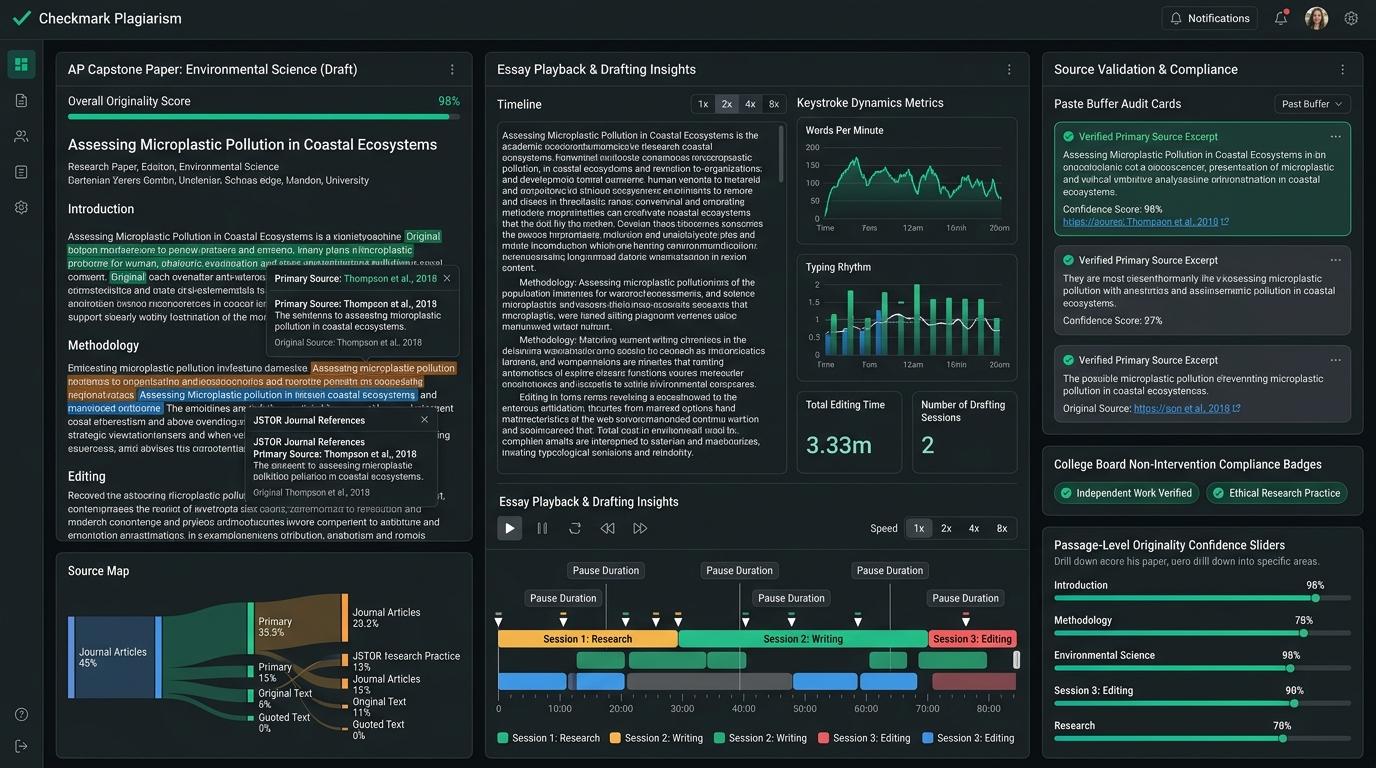
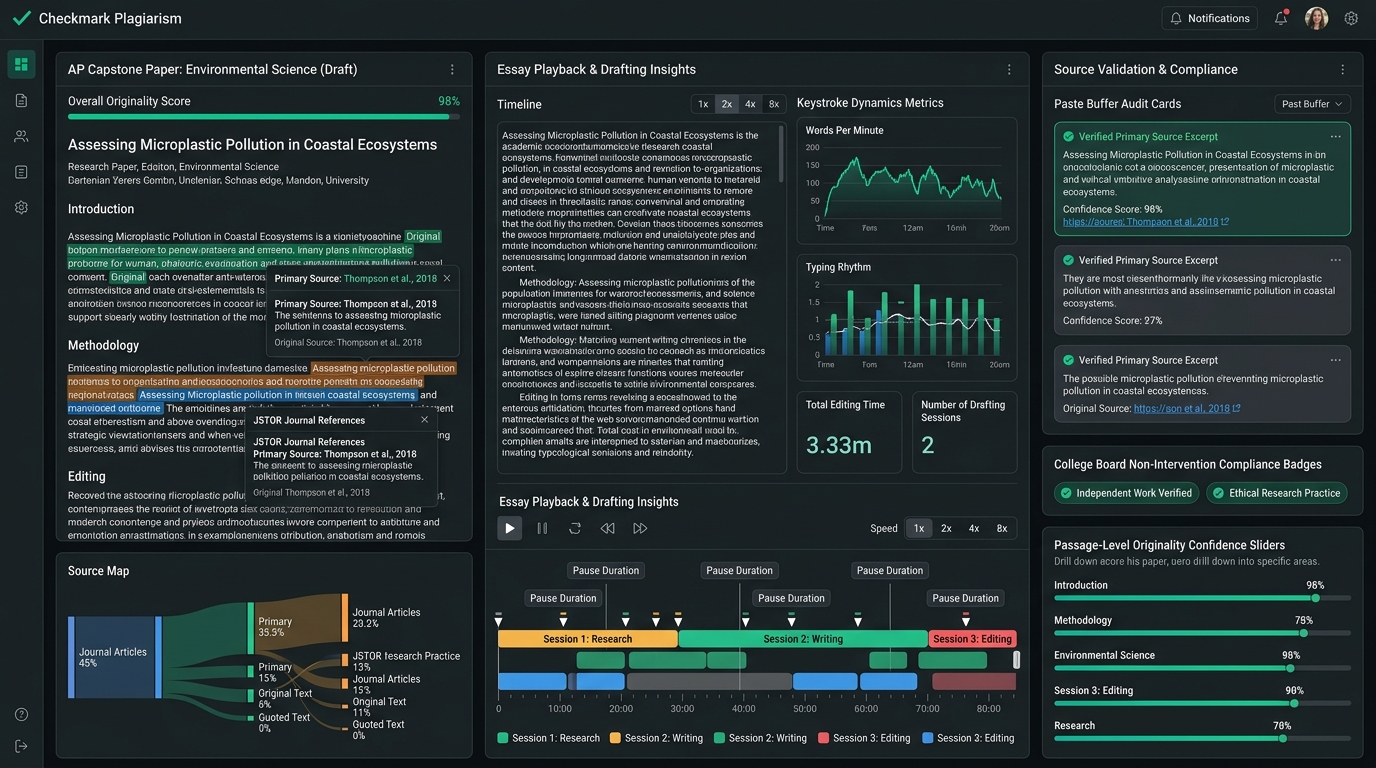
Relying on opaque, probabilistic AI detectors or basic similarity percentages fails catastrophically in academic research: static tools generate pervasive false positives on disciplinary jargon and legitimate scholarly quotations while missing heavily paraphrased or LLM-generated literature reviews. Checkmark Plagiarism solves this verification crisis through Writing Process Replay (patent-pending Essay Playback™). By combining scrubbable 1x–8x keystroke video replay, 100% immutable external paste buffer preservation, passage-level AI detection with calibrated confidence sliders, synchronized side-by-side plagiarism source matching, and quote-anchored rubric feedback aligned with AP rubrics, Checkmark provides defensible, longitudinal proof of genuine scholarly synthesis. This guide provides an exhaustive pedagogical and technical blueprint, real-world case studies, a 4-Phase Verification Protocol, and PREP-aligned check-in frameworks to ensure academic integrity without compromising student trust.
Checkmark Plagiarism equips AP Capstone Coordinators, AP Research advisors, Seminar teachers, and school leadership with forensic writing telemetry and enterprise LMS integrations across Canvas LMS, Agilix Buzz, and Google Classroom.
1. The AP Capstone Verification Dilemma: High Stakes, Academic Autonomy, and College Board Policy
The AP Capstone™ Diploma Program—comprising AP Seminar (Year 1) and AP Research (Year 2)—represents the pinnacle of secondary school academic inquiry. Unlike traditional AP courses that culminate in a standard multiple-choice and free-response exam, AP Capstone evaluates students on their capacity to conduct university-level, independent academic research, synthesize complex scholarly literature, formulate original research questions, execute empirical or qualitative methodologies, and defend their findings in extensive academic papers:
- AP Seminar: Requires an Individual Research Report (IRR) (1,200 words) and an Individual Written Argument (IWA) (2,000 words), demanding deep cross-curricular synthesis across multiple stakeholder perspectives and peer-reviewed sources.
- AP Research: Culminates in a 4,000-to-5,000-word Academic Paper and a Presentation and Oral Defense (POD), requiring students to design, execute, and document an original, year-long scholarly investigation across literature review, methodology, data analysis, and discussion sections.
- Individual Research Report (IRR - 1,200w)
- Individual Written Argument (IWA - 2,000w)
- Multi-perspective source synthesis & stimulus links
- Required teacher checkpoints (conversations about process and sources)
- Academic Research Paper (4,000 to 5,000w)
- Presentation & Oral Defense (POD)
- Year-long empirical, qualitative, or archival study
- Process and Reflection Portfolio (PREP)
Teachers may not write, revise, or correct work submitted for assessment, proofread or copyedit it for students, or give specific, directive feedback.
Teachers affirm, to the best of their knowledge, that the student's final submission is authentic student work.
- Score Cancellation (Score of 0 or Score Invalidation)
- AP Capstone Diploma™ disqualified
- High School district audit flag & disciplinary action
- University conditional admission rescinded
- False AI flag on STEM/ELL academic terminology
- Adversarial student-advisor disciplinary hearing
- Severe student emotional distress & trauma
- Permanent rupture of institutional trust
The Institutional Burden of the College Board Attestation
Students receive a score on an AP Research paper or AP Seminar performance task only if the teacher completes the required affirmations in the College Board Digital Portfolio, including an affirmation, to the best of the teacher's knowledge, that the final submission is authentic student work.
This creates a high-stakes pedagogical paradox:
- The Teacher-Role Limits: The College Board's Course and Exam Description (CED) lists as “do not” items writing, revising, amending, or correcting anything that contributes to the final work submitted for assessment, proofreading or copyediting student work, and giving specific, directive feedback. Instructors must act as facilitators and advisors, not co-authors or copyeditors.
- The Authenticity Affirmation: Despite being barred from micromanaging the drafting process, teachers must affirm, to the best of their knowledge, that the final submission is authentic student work.
If the College Board or an AP Reader flags a paper for uncredited source reproduction, fabricated empirical data, or unauthorized generative AI ghostwriting, the consequences reverberate across the institution:
- Score Cancellation & Diploma Revocation: Under the AP Capstone policies on plagiarism and on falsified or fabricated information, the student receives a score of 0 on the affected component of the performance task, which can put the AP Capstone Diploma™ or the AP Seminar and Research Certificate™ out of reach.
- College Admissions Jeopardy: Invalidation of AP Capstone scores can lead to rescinded university admissions offers, loss of academic scholarships, and disciplinary reporting to higher education institutions.
- School District Program Audits: High schools with recurring academic integrity flags risk administrative audits, loss of AP course authorization, and reputational damage across the district.
The Breakdown of the Process and Reflection Portfolio (PREP)
To ensure longitudinal authorship, the College Board's AP Research course uses the Process and Reflection Portfolio (PREP), in which students document their inquiry through regular journal entries, inquiry proposals, advisor check-in notes, annotated bibliographies, and reflection logs.
However, in the era of advanced large language models (LLMs), static reflection logs are no longer foolproof. A student who generates an entire literature review or methodology section using Claude or ChatGPT can easily construct a retroactively plausible PREP log in under thirty minutes.
To support the teacher's authenticity affirmation ethically and defensibly, AP Capstone Coordinators and teachers need objective writing process telemetry: verifiable evidence that proves the intellectual synthesis recorded in the PREP log actually occurred across physical drafting sessions.
2. Primary Source Synthesis vs. Generative Outsourcing: The Epistemic Gap
The intellectual core of AP Research and AP Seminar is scholarly synthesis—the ability to enter an ongoing academic conversation by identifying tensions, contradictions, consensus, and methodological gaps across dozens of peer-reviewed primary and secondary sources.
[JSTOR / PubMed PDF] → Extracts nuanced sample size limitation (n=42) → Identifies contradiction with 2024 longitudinal study (p < 0.01) → Formulates novel gap-filling research question: “How does microclimate X alter regional baseline Y?”
[Prompt: “Write an AP Research literature review on urban heat islands with 15 citations”] → Generates broad, homogenized summaries → Inserts real author names with fabricated/hallucinated contextual claims → Glosses over methodological disputes.
Deconstructing True Primary Source Synthesis
Authentic academic synthesis in AP Research is messy, non-linear, and cognitively demanding. When a student grapples with primary literature (such as scientific studies on JSTOR, clinical trials on PubMed, demographic datasets from the U.S. Census Bureau, or historical archives), their writing process exhibits distinct forensic hallmarks:
- Methodological Friction: The student actively wrestles with differences in sample sizes, geographic boundaries, regression models, or theoretical frameworks between Source A and Source B.
- Granular Textual Engagement: The student extracts exact statistics, quotes specific caveats from discussion sections, and integrates them into their own evolving Line of Reasoning.
- Iterative Paraphrasing: The student drafts a summary of a complex study, pauses to re-read the original PDF, deletes several sentences to correct a misinterpretation, and rewrites the passage in their own analytical voice.
The Mechanics of Generative AI Literature Reviews
In contrast, when a student prompts an LLM to generate an AP Research literature review, the resulting text exhibits superficial polish but lacks authentic academic depth:
- Homogenized Voice & Perplexity Flatlining: Sentences flow with uniform transition words (“Furthermore,” “Moreover,” “In addition”) and predictable syntactic structures, reflecting the statistical distribution of language model training data.
- Broad, Generalized Summaries: The LLM summarizes entire fields in sweeping generalizations (“Numerous researchers have explored the multifaceted impacts of urban density...”) without engaging with raw empirical data or methodological constraints.
- Citation Hallucination & Contextual Drift: Even when an LLM is fed real source PDFs, it frequently misattributes specific data points, quotes non-existent findings, or creates synthetically seamless transitions that gloss over genuine scholarly disputes.
Comparative Synthesis Matrix
| Evaluation Dimension | Authentic Student Synthesis | Generative AI Outsourcing | Checkmark Process Verification |
|---|---|---|---|
| Drafting Evolution | Multi-week, multi-session progression (20–60+ drafting sessions). | Single-session sudden appearance of full 1,000–2,000 word sections. | Essay Playback™ Timeline charts drafting velocity and session distribution over months. |
| Source Integration | Granular data extraction, selective quoting, and iterative paraphrasing. | Broad thematic summaries, generic claims, and synthetic transitions. | Paste Buffer Inspector tracks exact timestamps and origin of pasted source excerpts. |
| Cognitive Pauses | Extended pauses (45s–5min) before drafting complex synthesis paragraphs. | Rapid continuous typing bursts or instant clipboard insertion. | Keystroke Telemetry measures reflection pauses between reading and composing. |
| Revision Depth | Structural reorganization, paragraph reordering, heavy deletion/rewriting. | Minor surface tweaks, synonym swapping, or zero structural edits. | Keystroke Dynamics visualizes backspaces, rewrites, and structural shifts. |
| Citation Attribution | Explicit citation formatting tied to external PDF analysis. | Hallucinated DOIs, mismatched authors, or unanchored claims. | Side-by-Side Plagiarism Matching verifies live links to academic journals. |
3. The Structural Failure of Black-Box AI & Static Plagiarism Checkers in AP Research
When confronted with generative AI, many school districts turned to first-generation AI writing classifiers and legacy plagiarism checkers. In AP Capstone programs, however, these static tools fail catastrophically, creating false accusations, pedagogical friction, and investigative dead-ends.
Biochemical terminology (“oligonucleotide directed mutagenesis,” “homology-directed repair”) has low perplexity. Statistical detector falsely labels formal scientific syntax as AI prose.
5,000-word papers contain 40+ formal academic citations, block quotes, and standard headers. Generic scanners flag legitimate scholarly citations as unoriginal content.
Students who use AI humanizers (QuillBot, Undetectable AI) evade static classifiers through artificial synonym substitution. Superficial word-spinning fools detectors.
Static checkers cannot see whether 4,800 words took 6 months of active struggle or 2 minutes of pasting. Zero forensic process evidence to defend honest students.
Defect 1: The Domain-Specific Terminology & Syntax Penalty
AP Research papers require formal academic register, passive scientific voice, and precise disciplinary nomenclature (e.g., oligonucleotide hybridization, socio-economic stratification, quasi-experimental multivariate regression).
Because probabilistic AI detectors evaluate text based on perplexity (word choice predictability) and burstiness (sentence length variation), standard academic syntax is penalized:
- Scientific prose naturally favors predictable, standardized phrasing.
- When an AP Research student writes with rigorous academic precision, a black-box detector calculates low perplexity and outputs an alarming, false-positive score (e.g., “68% AI Detected”).
- This disproportionately harms high-achieving research students and English Language Learners (ELL) who rely on formal transition templates.
Defect 2: The Citation & Block Quote Distortion
A rigorous AP Research paper contains between 30 and 60 peer-reviewed references, formal block quotations, and detailed methodological descriptions. Legacy similarity detectors treat standard academic phrasing and cited quotes as unoriginal content, generating inflated similarity scores (35%–50%) that obscure whether the paper contains genuine intellectual theft or exemplary scholarly documentation.
Defect 3: The AI Humanizer & Paraphrasing Loophole
Students seeking to bypass AI detectors frequently run generated text through paraphrasing tools (e.g., QuillBot, Undetectable AI, HideMyAI). These tools introduce artificial syntactic noise and deliberate typos to artificially inflate perplexity, lowering the AI score to 0% on static detectors. However, the resulting text remains intellectually bankrupt—and static detectors cannot provide the evidence needed to challenge it.
Defect 4: The Complete Absence of Temporal Evidence
A static document checker analyzes only the final artifact. It cannot tell the difference between:
- A student who spent 120 hours across 45 sessions drafting, testing, deleting, and refining their methodology in Google Docs or Word.
- A student who generated their entire paper in ChatGPT at 3:00 AM on the submission deadline and pasted it into the document in five seconds.
Without writing process telemetry, coordinators and instructors are forced into an adversarial guessing game that erodes student trust and exposes the school to parental and legal disputes.
4. Checkmark’s Patent-Pending Essay Playback™ Suite: Forensic Telemetry for AP Capstone
Checkmark Plagiarism eliminates the guessing game by providing educators with transparent, defensible, and non-punitive writing process telemetry. Rather than relying on a single, opaque percentage, Checkmark integrates keystroke dynamics, paste buffer preservation, passage-level linguistic analysis, and quote-anchored rubric feedback into a unified forensic dashboard.
1x–8x scrubbable video replay of the complete drafting journey across all sessions. Color-coded timeline: Green (typing bursts), Orange (revisions), Blue (paste events). Visualizes authentic cognitive pauses (45s–5m) during complex primary source synthesis.
100% clipboard capture storing raw pasted source text prior to student revisions.
- Raw clipboard text stored
- “Jump to Replay” sync link
- Prompt injection capture
Granular passage-level confidence cards with honest <150w guardrails.
- Typical Human vs AI scale
- Strict <150w N/A guardrail
- Immune to AI humanizers
Dual-pane side-by-side quotes against live academic sources and journals.
- Live clickable DOIs/URLs
- Uncited vs quoted tags
- Peer match repository
Formative draft evaluations mapped directly to the College Board AP Research Academic Paper scoring criteria: focus of the inquiry, context in the scholarly literature, research method, conclusion and line of reasoning, communication, and citation.
Feature 1: Scrubbable 1x–8x Essay Playback™ Timeline
Checkmark's Essay Playback™ reconstructs the student's entire writing process keystroke-by-keystroke. Educators can scrub through months of drafting history like a video timeline at 1x, 2x, 4x, or 8x speed:
- Session Mapping: Displays the exact calendar dates, times, and duration of every writing session (e.g., Session 14: Oct 12, 1h 42m, 340 words added, 120 words deleted).
- Synthesis Contemplation Pauses: Highlights extended cognitive pauses (30 seconds to 5 minutes) where the student was reading an external journal article or analyzing data before formulating their next sentence.
- Structural Reorganizations: Shows where the student cut an entire section from the Literature Review, moved it to the Discussion section, and reworked the transitional phrasing.
Feature 2: External Paste Buffer Inspector with 100% Text Preservation
When a student pastes content into their document, Checkmark captures and stores 100% of the raw clipboard text along with an exact timestamp:
| Event ID | Session • Time | Pasted Chars / Words | Preserved Raw Clipboard Content | Integrity Status |
|---|---|---|---|---|
| #PST-04 | Session 6 • 16:24 | 412 chars / 58w | “Landsat-8 thermal infrared sensor data was calibrated using MODTRAN atmospheric correction...” | Verified Remote Sensing PDF |
| #PST-09 | Session 12 • 19:10 | 1,180 chars / 164w | “Table 3: Regression coefficients for albedo variance across urban microclimate zones...” | Verified Data Table Import |
| #PST-15 | Session 21 • 23:45 | 2,850 chars / 420w | “In analyzing the broader socioeconomic disparities in urban tree canopy distribution...” | Flagged for Advisor Check-In |
- Source Attribution Verification: When an AP Research student pastes a 150-word excerpt from a peer-reviewed study, the inspector allows the teacher to inspect the pasted text and verify that it matches an authentic source PDF from JSTOR or PubMed.
- Prompt Injection Detection: If a student pastes a block of text containing hidden LLM prompt artifacts (e.g., “Certainly! Here is a literature review section...”), Checkmark preserves the full raw paste even if the student instantly deletes or edits out the telltale introductory phrase.
- Jump-to-Playback Integration: Every paste event in the sidebar features a direct “Jump to Playback” button, instantly cueing the video timeline to the exact millisecond the paste occurred.

Feature 3: Mechanical Transcription Detection
Some students attempt to bypass paste detection by reading AI-generated text off a secondary monitor, tablet, or smartphone and manually typing it into their document.
Checkmark's Keystroke Dynamics Engine detects transcription through mathematical rhythm analysis:
- Monotonic Typing Velocity: Authentic human writing fluctuates naturally—fast bursts during familiar ideas, followed by pauses during synthesis. Manual transcription exhibits an unnaturally steady, mechanical cadence (e.g., an unvarying 65 words per minute for 45 minutes straight).
- Zero Backspace/Deletion Anomaly: A student composing a complex 5,000-word academic paper typically shows steady backspace and revision activity. Transcription exhibits a near-zero revision rate because the student is merely copying pre-formulated sentences.
Feature 4: Passage-Level AI Detection with Calibrated Confidence Sliders
Rather than assigning a single, misleading whole-paper percentage, Checkmark analyzes text at the passage level through our AI writing detection system:
- Granular Evidence Cards: Highlighting specific passages directly within the document, accompanied by sidebar cards with calibrated confidence sliders (typical human writing style vs. typical AI pattern).
- Honest Guardrails (<150 Words): Checkmark enforces an honest short-text guardrail: passages under ~150 words display
N/Arather than guessing on insufficient statistical sample sizes. - Immunity to AI Humanizers: While surface-level paraphrasers can alter perplexity to fool static scanners, they cannot falsify authentic temporal typing patterns, cognitive pauses, and revision history.
Feature 5: Quote-Anchored Rubric Autograding Aligned with AP Criteria
Checkmark includes an AI Rubric Autograder designed specifically for formative AP Capstone scoring:
- Aligned with AP Research Rubric: Evaluates drafts across the Academic Paper scoring criteria: focus of the inquiry, context in the scholarly literature, research method, conclusion and line of reasoning, communication, and citation.
- Quote-Anchored Justifications: Every criterion score is backed by specific quote cards citing exact sentences from the student's draft, giving teachers concrete evidence for formative conferences.
- Teacher-in-the-Loop Authority: AI rubric scores remain editable drafts until reviewed, modified, and approved by the AP instructor.

5. Comparative Evaluation Framework: Writing Telemetry vs. Legacy Tools
To help AP Capstone Coordinators and High School Deans select defensible verification technology, the following matrix compares Checkmark Plagiarism against legacy plagiarism checkers, generic AI detectors, and manual draft reviews:
| Evaluation Criteria | Checkmark Plagiarism (Essay Playback™) | Legacy Plagiarism Tools (e.g., Turnitin) | Black-Box AI Detectors (e.g., GPTZero) | Google Docs Version History |
|---|---|---|---|---|
| Keystroke Telemetry Resolution | Millisecond-level keystroke capture with 1x–8x scrubbable video playback. | None (Static final document snapshot only). | None (Static text classifier only). | Coarse snapshots (Saves every 15–30 mins; misses keystroke cadence). |
| External Paste Preservation | 100% raw clipboard capture preserved even after full rewrites. | Flags matching text only if found in external web index. | None (Evaluates text statistics, not clipboard events). | Shows inserted text blocks, but loses original clipboard metadata. |
| Transcription Detection | Automated detection of steady typing velocity and zero backspaces. | ❌ Incapable of detecting manual transcription. | ❌ Incapable of detecting manual transcription. | Manual inspection required; cannot compute typing rhythm metrics. |
| Primary Source Synthesis Proof | Visual proof of reading pauses, iterative paraphrasing, and quote formatting. | Static similarity percentage (Flags cited quotes as unoriginal). | Opaque percentage score (Penalizes academic STEM/ELL syntax). | Incomplete revision history without playback or paste analysis. |
| Fit with College Board Teacher-Role Guidelines | 100% Non-Punitive: Formative process verification without editing student prose. | Provides similarity scores that teachers often misinterpret punitively. | High false-positive rate creates adversarial student-teacher conflicts. | Compliant, but labor-intensive for multi-thousand-word papers. |
| Multilingual & STEM Fairness | Exonerates authentic writers via undeniable keystroke and session proof. | Inflates similarity on standard scientific methodology formulas. | Severe false positives on non-native English & technical syntax. | Neutral, but lacks automated linguistic confidence calibration. |
| LMS & Gradebook Integration | Direct LTI 1.3 sync with Canvas, Buzz LMS, and Google Classroom. | Standard LMS integration for similarity reports only. | Limited standalone integrations or browser extensions. | Native to Google ecosystem only; no external LMS passback. |
6. Illustrative AP Capstone Case Studies
The following case studies illustrate how AP Capstone educators can utilize Checkmark's writing telemetry to validate complex primary source synthesis, coach struggling researchers, and protect honest students from false accusations. They are illustrative composite scenarios; the students, sources, and figures are examples, not reports of real cases.
Topic: Urban Heat Islands (28 Empirical Papers)
Challenge: Synthesizing conflicting microclimate regression models without triggering suspicion of LLM generation.
Topic: Minimum Wage Policy Dynamics (2,000w)
Challenge: 41% similarity index triggered on generic scan due to dense BLS/CBO econometric tables.
Incident: District generic detector flagged 4,800-word CRISPR paper as “68% AI-Generated” due to dense biochemical terminology. Academic Dean scheduled a disciplinary hearing.
Resolution: Complete exoneration; teacher completed the College Board Digital Portfolio authenticity affirmation; student earned AP 5.
Case Study 1: AP Research — Environmental Science & Urban Planning
- Student & Context: Marcus T., a senior in AP Research, investigated the microclimate mitigation efficacy of green roof retrofits across 12 urban census tracts. His literature review required synthesizing 28 empirical studies with conflicting sensor calibration methodologies.
- The Verification Challenge: Marcus's literature review was extraordinarily sophisticated, featuring seamless cross-referencing between remote sensing studies (Landsat thermal imagery) and in-situ microclimate data. The AP Research teacher needed to confirm that Marcus independently synthesized these dense methodologies rather than outsourcing the literature review to Claude 3.5 Sonnet.
- The Telemetry Investigation:
- The teacher opened Marcus's submission in Checkmark's Essay Playback™.
- The session timeline documented 18 distinct drafting sessions over six weeks, totaling 24 hours of active writing.
- Scrubbing through Session 7 at 4x speed revealed Marcus drafting a 300-word paragraph comparing two conflicting regression equations: he typed two sentences, paused for 3 minutes and 12 seconds (contemplating the source differences), deleted the second sentence, rephrased the mathematical limitation, and cited both authors with accurate parenthetical citations.
- The External Paste Buffer Inspector confirmed that only raw numerical data tables were pasted from municipal open-data portals, with immediate citation formatting.
- Pedagogical Outcome: The teacher confidently verified Marcus's independent authorship, completed the College Board Digital Portfolio authenticity affirmation, and utilized his drafting process as an exemplary model for peer revision.
Case Study 2: AP Seminar — Individual Written Argument (IWA)
- Student & Context: Sophia R., a sophomore in AP Seminar, wrote her 2,000-word Individual Written Argument on the economic impact of state-level minimum wage increases on small business employment.
- The Verification Challenge: Sophia's paper contained extensive econometric data tables, congressional budget reports, and peer-reviewed economic studies. A generic similarity scan flagged the paper with a 41% similarity index due to the high density of statistical quotes and official policy names.
- The Telemetry Investigation:
- The AP Seminar instructor reviewed Sophia's draft using Checkmark's Two-Way Linked Evidence Cards.
- The report demonstrated that 100% of the highlighted similarity matches corresponded to correctly cited quotations from the Congressional Budget Office (CBO) and Bureau of Labor Statistics (BLS).
- Checkmark's Passage-Level AI Confidence Sliders confirmed that Sophia's original connective prose and argument transitions exhibited typical human writing styles.
- The Essay Playback™ player showed that Sophia drafted her counterargument section across three separate classroom drafting sessions, actively restructuring her Line of Reasoning to reconcile differing economic perspectives.
- Pedagogical Outcome: Rather than issuing an unwarranted plagiarism flag, the teacher used Checkmark's quote-anchored rubric feedback to help Sophia refine her transitional commentary, earning top marks on the IWA row for selecting and using evidence.
Case Study 3: Exonerating an AP Research Bioengineering Student
- Student & Context: Elena K., a high-achieving senior and non-native English speaker, submitted a 4,800-word AP Research paper on CRISPR-Cas9 off-target cleavage mitigation.
- The Verification Challenge: When scanned through the high school district's default black-box AI detector, Elena's paper received an alarming “68% AI Detected” score. The school's Academic Dean initially scheduled a disciplinary hearing to discuss withholding her AP Capstone submission.
- The Telemetry Investigation:
- The AP Capstone Coordinator intervened and requested a comprehensive Checkmark Verification Dossier.
- Checkmark's Essay Playback™ revealed that Elena had logged 42 hours and 15 minutes of drafting across 38 separate sessions over a four-month period.
- The keystroke analysis proved a robust 22.4% revision and backspace rate, with extensive sentence re-structuring during the explanation of guide-RNA design algorithms.
- Checkmark's Linguistic Pattern Analyzer explained the generic detector's error: the false-positive flag was triggered entirely by standard biochemical formulas and formal passive-voice sentence structures (“It was observed that oligonucleotide sequences...”), which naturally exhibit low perplexity.
- The timeline matched Elena's documented entries in her PREP portfolio with 100% chronological accuracy.
- Pedagogical Outcome: The Academic Dean completely dismissed the misconduct allegation. The teacher completed the Digital Portfolio authenticity affirmation, and Elena's research paper was submitted cleanly, ultimately earning an AP score of 5.
7. The 4-Phase AP Capstone Writing Process Verification Protocol
To institutionalize academic integrity across AP Seminar and AP Research cohorts, school districts should implement Checkmark's structured 4-Phase Writing Process Verification Protocol. This protocol is designed to stay within the College Board's teacher-role guidelines, transforming integrity verification from an adversarial audit into a continuous, developmental inquiry.
Student registers research question in LMS workspace. Baseline typing cadence established. Preliminary JSTOR/PubMed exploration logged.
Continuous telemetry tracking of drafting sessions. Paste Buffer Inspector audits raw source imports. Automated citation coaching flags uncredited quotes.
Telemetry monitors drafting of original empirical/qualitative methodology. Keystroke dynamics verify authentic struggle with statistical analysis and data tables.
AP Coordinator exports comprehensive Checkmark Verification Dossier. Non-punitive pre-POD conference conducted. The teacher completes the College Board Digital Portfolio authenticity affirmation.
Phase 1: Topic Inception & Exploratory Telemetry (Months 1–2)
- Goal: Establish baseline writing dynamics and verify authentic preliminary research inquiry.
- Protocol Steps:
- Students initialize their AP Research workspace via Canvas LMS, Buzz LMS, or Google Classroom with Checkmark tracking enabled.
- Students draft their initial research proposal, inquiry scope, and preliminary source list directly within the monitored editor.
- The AP instructor reviews early typing cadence metrics, establishing a baseline of natural typing speed, pause patterns, and vocabulary usage.
- Cross-reference initial drafting activity with the student's PREP Milestone 1 submission.
Phase 2: Literature Review Drafting & Source Synthesis (Months 3–4)
- Goal: Verify that literature review synthesis represents authentic engagement with scholarly sources.
- Protocol Steps:
- As students compose their 1,500-word Literature Review, Checkmark monitors session distribution and drafting cadence.
- Instructors periodically inspect the External Paste Buffer Inspector to confirm that pasted text consists of legitimate academic source quotes or raw data excerpts.
- If uncredited source material is detected, Checkmark's dedicated Uncited Source Flag alerts the teacher to conduct a targeted citation coaching conference before the draft advances.
- Ensure all drafting sessions reflect genuine contemplation pauses between source comparisons.
Phase 3: Methodology Execution & Data Synthesis (Months 5–6)
- Goal: Validate independent execution of empirical, qualitative, or historical methodologies.
- Protocol Steps:
- Students draft their Methodology, Results, and Discussion sections.
- Telemetry tracking verifies that data interpretation and statistical analysis were drafted iteratively rather than generated via automated LLM prompts.
- Instructors run Checkmark's Quote-Anchored Rubric Autograder to generate formative feedback on line of reasoning and on evidence and synthesis, staying within the College Board's teacher-role guidelines.
Phase 4: Final Dossier Defense & Digital Portfolio Attestation (Month 7)
- Goal: Generate a comprehensive, immutable verification dossier and complete the College Board Digital Portfolio authenticity affirmation.
- Protocol Steps:
- Prior to final submission, the AP Capstone Coordinator exports the Checkmark Verification Dossier, containing session summaries, total active writing time, paste logs, and passage-level AI confidence scores.
- During the student's pre-POD (Presentation and Oral Defense) check-in, the instructor conducts a brief, supportive dialogue reviewing key milestones from the playback timeline.
- With complete evidentiary proof of independent authorship, the Research Instructor completes the College Board Digital Portfolio authenticity affirmation, to the best of their knowledge, with the Coordinator's dossier on file.
8. Advisor Milestone Check-In Framework & PREP Integration
To stay within the College Board's teacher-role guidelines, AP teachers must avoid writing, revising, or correcting student prose and must avoid specific, directive feedback during check-in conferences. Checkmark's writing telemetry enables teachers to conduct formative, process-based inquiries that stay within those guidelines.
Educator Action: Open Checkmark Essay Playback™ at Session 8 (Source Comparison section).
Non-Intervention Prompt: “I noticed in your writing replay that you spent considerable time revising this transition between your first and second sources. Can you walk me through the methodological tension you identified between their two findings?”
Verification Signal: Student articulates the conceptual dispute fluidly in their own voice.
Educator Action: Review Paste Buffer Inspector entry #4 (180-word data excerpt).
Non-Intervention Prompt: “Let's look at this excerpt from the report you cited. How did you extract these specific statistics, and how do they support your overarching thesis?”
Verification Signal: Student explains their primary document extraction process immediately.
Educator Action: Examine 3-minute reflection pause before statistical analysis paragraph.
Non-Intervention Prompt: “In your playback timeline, you paused here for several minutes before modifying your quasi-experimental control group parameters. What analytical challenge did you encounter, and how did you resolve it?”
Verification Signal: Student recounts their cognitive troubleshooting with raw dataset anomalies.
Structuring Formative, Non-Directive Questions
By anchoring conferences in the student's own recorded writing telemetry, advisors can ask deep, illuminating questions without violating College Board guidelines:
- Focus on the Decision-Making Arc: Ask students why they chose to delete or restructure specific arguments rather than telling them how to write them.
- Validate Cognitive Struggle: Praise students for documented revision pauses and iterative drafts, reinforcing the idea that authentic academic writing requires wrestling with ideas.
- Eliminate Adversarial Accusations: If an anomaly appears in the telemetry (such as an unreferenced paste block), the teacher can frame the inquiry supportively: “Can you show me the original source document where this excerpt originated so we can ensure proper bibliographic formatting?”
9. Institutional Security, FERPA Zero-Training Compliance & LMS Integration
Secondary school districts and AP Capstone programs operate under strict federal and state student data privacy mandates. Deploying AI verification technology requires rock-solid legal and architectural protections.
Student research papers and intellectual property are NEVER used to train public or commercial Large Language Models (LLMs). Zero commercial data retention or third-party vector monetization.
- FERPA, COPPA, & CSPC Compliant
- AES-256 Encryption at Rest
- TLS 1.3 In-Transit Data Protection
- Canvas LMS LTI 1.3 Advantage Sync
- Agilix Buzz LMS Deep Integration
- Google Classroom API Integration
- Google & Microsoft SSO Federation
The Zero Model Training Policy
A primary concern for high school administrators and parents is the unauthorized ingestion of student intellectual property into commercial AI training datasets.
Checkmark Plagiarism enforces an absolute Zero Model Training Policy:
- Student papers submitted for verification are never used to train, fine-tune, or calibrate public or commercial LLMs.
- Submissions remain the exclusive intellectual property of the student and school district.
- Internal institutional repositories ensure peer-match plagiarism detection across school cohorts without exposing student text to external third parties.
Enterprise Compliance & Security Standards
- FERPA & COPPA Certified: Fully compliant with the Family Educational Rights and Privacy Act and Children's Online Privacy Protection Act.
- End-to-End Cryptographic Encryption: All writing telemetry, keystroke data, and submission files are encrypted using AES-256 at rest and TLS 1.3 in transit.
- Role-Based Access Control (RBAC): Writing playback dossiers, flag statuses, and telemetry reports are strictly restricted to authorized AP instructors, coordinators, and academic deans.
LTI 1.3 Advantage & Direct Grade Passback
Checkmark integrates natively into enterprise high school learning management systems:
- Canvas LMS & Buzz LMS: Complete LTI 1.3 Advantage certification enables single-sign-on (SSO), automated roster synchronization, embedded essay playback within SpeedGrader, and direct one-click grade passback.
- Google Classroom & Microsoft OneDrive: Native integration captures real-time keystroke dynamics and document revision history directly from Google Docs and Word 365 environments.
10. Frequently Asked Questions (FAQs)
No. It is designed to stay within them. The College Board's Course and Exam Description (CED) prohibits teachers from writing, revising, or correcting student work, proofreading or copyediting it, and giving specific, directive feedback. Checkmark's Essay Playback™ does not alter, edit, or generate text; it purely records and visualizes the student's independent writing process. This provides teachers and coordinators with passive, non-interventionist evidence about authorship, supporting the teacher's Digital Portfolio authenticity affirmation.
Checkmark's External Paste Buffer Inspector captures 100% of the raw clipboard text and timestamps the exact moment of insertion. When a student pastes an excerpt from a legitimate open-access journal or JSTOR PDF, the inspector stores the text, allowing the teacher to confirm that it matches an authentic, cited academic source. In contrast, if a student pastes an unformatted 800-word block from ChatGPT or an AI rewriter, the inspector captures the raw text (including any hidden prompt artifacts or telltale syntactic markers) even if the student subsequently edits the passage.
AP Research papers frequently trigger false positives on generic AI detectors due to formal academic tone, domain-specific scientific terminology (e.g., in biochemistry, physics, or econometrics), and passive-voice constructions, all of which naturally exhibit lower perplexity. Checkmark protects students by providing irrefutable physical drafting evidence: a student falsely flagged by a black-box detector can point to 40 hours of keystroke telemetry, active drafting sessions, structural deletions, backspaces, and reading pauses, conclusively proving authentic authorship.
Yes. Retyping text from a secondary screen (manual transcription) leaves distinct mathematical and behavioral anomalies in keystroke telemetry. Authentic human composition involves natural cognitive pauses (30 seconds to several minutes) before formulating ideas, accompanied by steady backspacing and revision. Manual transcription displays an unnaturally monotonic typing cadence (e.g., continuous 60 WPM without pause) and a near-zero revision rate. Checkmark's Mechanical Transcription Detection Engine flags these anomalies automatically.
Checkmark encourages students to compose directly within the LMS-integrated editor (Google Docs, Canvas, Buzz, or Microsoft Word via Checkmark plugins). However, if a student drafts a section offline and pastes it into their master document, Checkmark's Paste Buffer Inspector captures the entire pasted block. The student can then simply demonstrate their offline drafting notes, preliminary outlines, or research journals during their PREP check-in conference. The teacher can verify that the pasted text aligns with the student's documented PREP milestones.
Checkmark's session timeline maps directly to the AP Research PREP portfolio. While students manually record their reflections, search queries, and research hurdles in their PREP journals, Checkmark provides objective, timestamped telemetry that corroborates those entries. During milestone check-in conferences, advisors can review the playback timeline alongside the PREP journal, confirming that the intellectual breakthroughs documented in the reflection logs actually occurred during recorded drafting sessions.
Yes. Checkmark maintains an uncompromising Zero Model Training Policy. Student submissions, keystroke telemetry, and research drafts are never used to train, fine-tune, or calibrate public or commercial large language models. Checkmark is fully compliant with FERPA, COPPA, and CSPC, deploying enterprise-grade AES-256 encryption at rest and TLS 1.3 in transit. Student data remains the exclusive property of the student and school district.
11. Conclusion: Stop Guessing, Start Trusting in AP Capstone Verification
The Advanced Placement Capstone Diploma Program represents one of the highest achievements in secondary education, demanding that students master the rigorous art of independent scholarly synthesis. In an educational environment transformed by generative AI, relying on opaque similarity percentages or probabilistic AI detectors compromises the integrity of the program, harms honest students with false accusations, and leaves coordinators vulnerable to institutional liability.
By adopting Checkmark Plagiarism and patent-pending Essay Playback™, AP Capstone Coordinators, AP Research teachers, and High School Academic Deans transition from an adversarial guessing game to a transparent, defensible, and supportive verification framework. With keystroke-level video replay, 100% paste buffer preservation, passage-level linguistic confidence, and quote-anchored rubric feedback, educators gain defensible evidence to support the authenticity affirmations in College Board Digital Portfolios, protecting academic rigor while fostering genuine student trust.
Ready to Authenticate Your AP Capstone Cohort with Confidence?
Discover how Checkmark's patent-pending Essay Playback™, 100% paste buffer tracking, and quote-anchored AP rubric autograding provide defensible proof of authentic student synthesis across 4,000–5,000 word academic papers.