
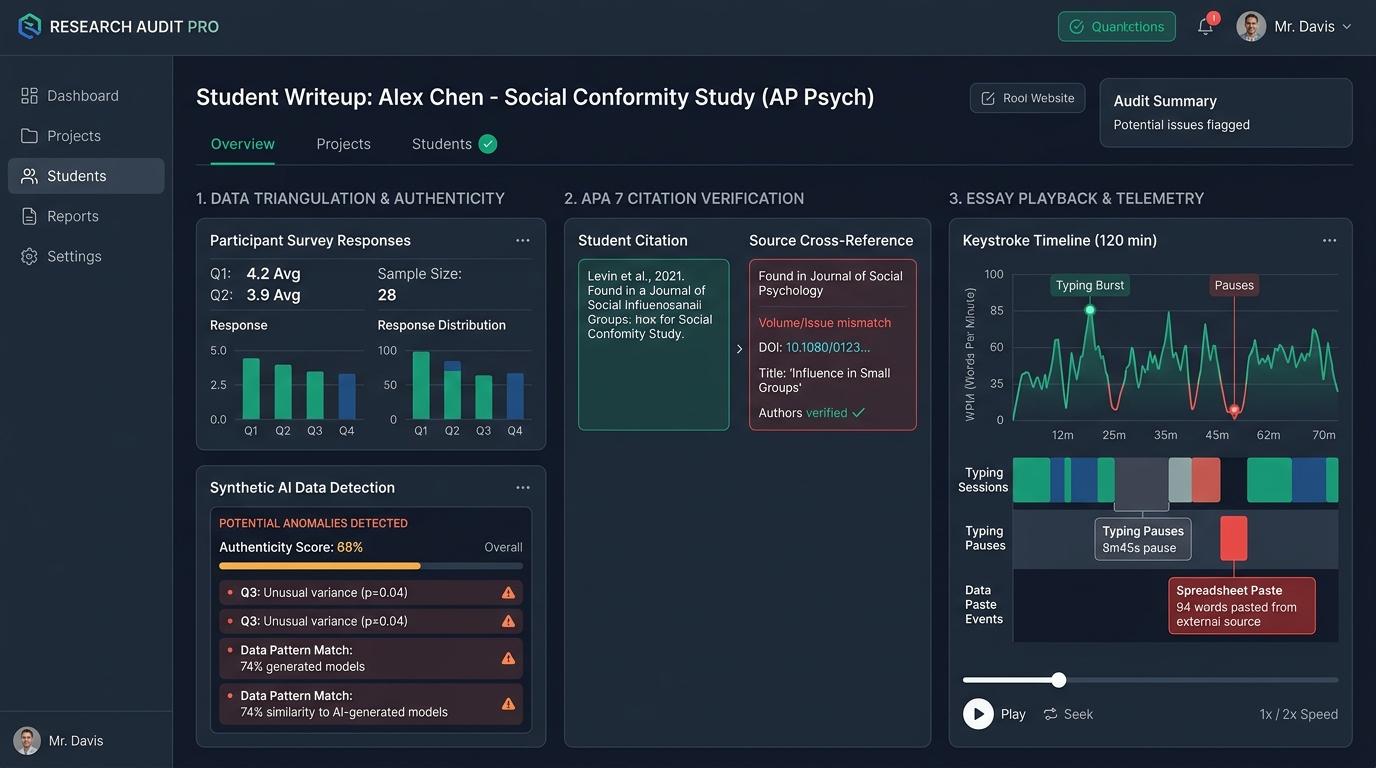
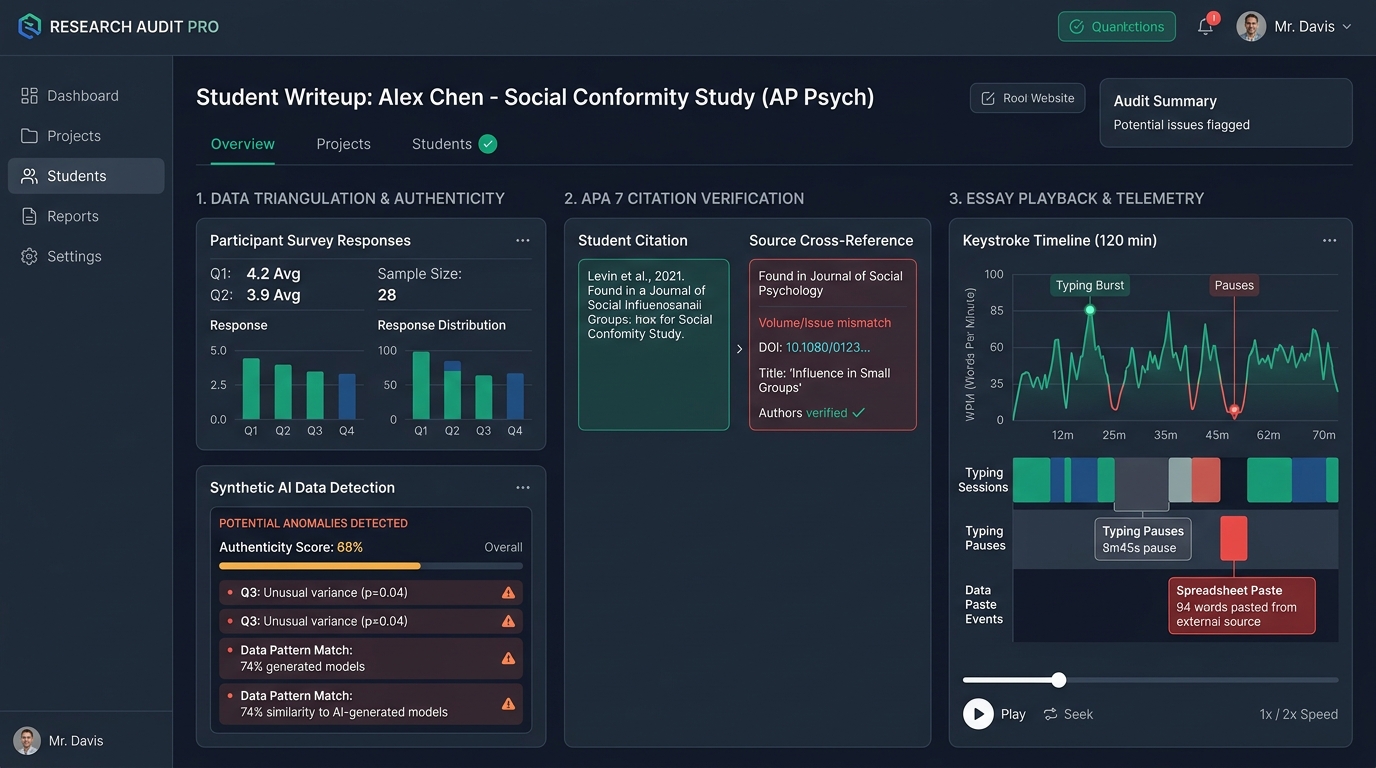
Advanced Placement (AP) Psychology teachers and behavioral science educators face a sophisticated integrity challenge: students using generative AI to fabricate entire empirical datasets, invent phantom participant surveys, hallucinate descriptive and inferential statistics, confabulate non-existent APA 7 citations, and synthesize qualitative participant interview quotes. Traditional plagiarism checkers completely miss these fabrications because the generated prose is syntactically unique, while generic, single-percentage AI detectors yield unhelpful black-box scores that risk falsely accusing diligent students.
Checkmark Plagiarism resolves this dilemma through a multi-dimensional evidentiary approach: pairing patent-pending Essay Playback™ keystroke telemetry (which visualizes the real-time cognitive struggle of data analysis, spreadsheet imports, and formula revisions) with synchronized side-by-side APA source matching, passage-level confidence sliders, and quote-anchored rubric autograding aligned to College Board Science Practices. This guide provides high school psychology faculty, department chairs, and integrity committees with an actionable, non-punitive protocol to audit empirical writeups, verify authentic scientific inquiry, and foster genuine empirical competence.
Checkmark Plagiarism provides behavioral science educators and high school departments with writing telemetry and academic verification integrated directly into Canvas LMS, Agilix Buzz, and Google Classroom.
1. The Empirical Integrity Crisis in Secondary Behavioral Sciences
In the Advanced Placement (AP) Psychology curriculum, the empirical research writeup represents the pinnacle of scientific skill acquisition. Grounded in the College Board's AP Psychology Science Practices (Concept Application, Research Methods and Design, Data Interpretation, and Argumentation), students are tasked with stepping into the shoes of psychological researchers. They formulate operational definitions, control for confounding variables, design surveys or observational protocols, collect raw participant data, calculate descriptive and inferential statistics, and contextualize their findings within established psychological literature following American Psychological Association (APA 7) guidelines.
However, the widespread accessibility of generative Large Language Models (LLMs) has introduced a subtle and pervasive threat to behavioral science education: the complete fabrication of empirical research pipelines.
Unlike basic essay assignments where AI misuse manifests as generic thematic summaries, empirical research fraud in AP Psychology strikes at the very heart of scientific epistemology:
- Messy, skewed human survey data & outlier responses
- Natural participant attrition and missing items
- Clunky student statistical calculations & manual formula friction
- Contextualized literature review with real study constraints
- Flawless, synthetic participant datasets with uniform variance
- Statistically impossible Pearson r and hallucinated p-values
- Confabulated APA 7 citations & dead 404 DOIs
- Synthetic qualitative quotes in clinical adult registers
Pristine, publication-style laboratory writeup unsupported by any physical data collection logs, Google Forms archive, or authentic human participant engagement.
Similarity checkers often find little or no match on novel generated syntax; black-box AI scores lack forensic proof for parent or student integrity meetings.
Scientific literacy decays, students bypass statistical reasoning, and research ethics are eroded prior to university transition.
The Four Manifestations of Empirical Fabrication in Student Psychology Writeups
Generative models allow students to produce polished, seemingly rigorous 8-page psychological lab reports in seconds. AP Psychology educators frequently encounter four distinct categories of empirical fabrication:
1. Fabricated Participant Surveys & Synthetic Sample Populations
Students required to administer a 10-item Likert-scale questionnaire on sleep deprivation and working memory to N = 50 peers simply prompt an LLM: “Generate a dataset of 50 high school students answering a 5-point Likert scale on sleep hours and stress.”
- The Artifact: The resulting data tables exhibit unnatural mathematical uniformity (e.g., perfectly symmetric Gaussian distributions that ignore adolescent behavioral skews, zero missing data points, and no participant response anomalies).
- The Forensic Void: When audited, there is no corresponding Google Forms timestamp log, no paper survey archive, and no digital record of participant recruitment.
2. AI-Hallucinated Descriptive & Inferential Statistics
LLMs operate on probabilistic next-token prediction, not mathematical calculation. When prompted to generate a results section, LLMs frequently confabulate statistical metrics that are mathematically impossible or internally contradictory:
- Reporting an extraordinary Pearson correlation coefficient of r = 0.94 with an impossible standard deviation of SD = 0.02 across a 5-point scale.
- Generating a significance value (p < .001) that directly contradicts the calculated degrees of freedom (df) and t-statistic.
- Hallucinating descriptive summary statistics where the stated mean and median violate the underlying raw score bounds.
3. Confabulated APA 7 Citations from Phantom Psychology Journals
To satisfy the literature review requirement, students ask AI for supporting psychological studies. LLMs frequently hallucinate convincing but entirely fictitious academic references:
- Confabulating nonexistent journal titles (e.g., the invented title Journal of Adolescent Neurocognitive Behavioral Dynamics).
- Attributing landmark cognitive or social psychology findings (such as Elizabeth Loftus's misinformation effect or Solomon Asch's conformity experiments) to fictitious contemporary researchers.
- Generating syntactically valid but dead DOI links (e.g., the fabricated DOI
https://doi.org/10.1037/0002-9432.58.4.492, which leads to an immediate 404 error page).
4. Synthetic Qualitative Quotations and Standardized Participant Voices
In observational or mixed-methods writeups, students often present open-ended participant quotes to support behavioral coding categories. AI-generated participant quotes invariably share a uniform, sophisticated lexical register:
- High school survey respondents speaking in complete, grammatically flawless compound-complex sentences with adult clinical vocabulary.
- Total absence of teenage colloquialisms, hesitation markers, transcription false starts, or varied vocabulary profiles.
2. The Pedagogical Dilemma: Scientific Rigor vs. High-Volume Grading Realities
AP Psychology is one of the most widely taken AP courses; it ranked sixth among all AP exams by volume in 2024 (College Board, AP Exam Volume Changes 2014-2024). A teacher with four to six sections can easily be responsible for 120 to 180 students. When each student submits an empirical research writeup containing a Literature Review, Operational Hypotheses, Methodology, Results (with charts), and Discussion, the educator is confronted with over 1,200 pages of technical student prose.
The Consequence: Teachers are forced to choose between superficial grading, vulnerable integrity policies, or unsustainable professional burnout.
Why Legacy Academic Integrity Checkers Fail in the Behavioral Sciences
When teachers attempt to streamline this audit using legacy educational technology, they hit an evidentiary wall:
- Legacy Plagiarism Checkers (e.g., Old Turnitin, CopyLeaks): Legacy similarity engines index published websites, academic databases, and student paper repositories. Because an LLM generates novel, syntactically original sentences, the similarity score can come back very low. The tool may flag few or no matches on a results section that was entirely fabricated by an AI model.
- Black-Box Whole-Paper AI Detectors: Generic AI checkers analyze text in isolation and return a single, opaque score (e.g., “78% Probability of AI”). In a scientific research writeup, these tools are catastrophic:
- High False Positive Rates on Scientific Language: Standardized psychological terminology (e.g., “statistically significant correlation,” “counterbalancing to eliminate order effects,” “informed consent and debriefing procedures”) is highly formulaic. Generic detectors frequently flag honest students who correctly use APA standard phrasing.
- Zero Defensible Evidence: A whole-paper percentage provides no actionable proof. When an educator meets with a student and their parents, an arbitrary 78% score cannot withstand scrutiny. It leads to defensive, adversarial confrontations that destroy teacher-student trust.
The Checkmark Philosophy: “Stop Guessing, Start Trusting”
To protect both academic standards and student-teacher relationships, academic integrity must shift from punitive probabilistic guessing to transparent process verification.
When educators possess objective, chronological evidence of how a student gathered data, drafted their hypotheses, calculated statistics, and integrated source material, integrity inquiries transform from contentious accusations into formative, supportive scientific coaching sessions.
3. The Empirical Evidentiary Matrix: Standalone Checkers vs. Checkmark Plagiarism
To establish a defensible audit standard for secondary and undergraduate psychology research, school districts and department chairs must evaluate tools across multidimensional evidentiary capabilities:
| Evidentiary Dimension | Legacy Similarity Checkers | Generic Black-Box AI Detectors | Checkmark Plagiarism Multi-Dimensional Suite |
|---|---|---|---|
| Detection Scope | Verbatim text matches against web & paper archives. | Whole-document probabilistic token distribution score. | Integrated: Plagiarism matching + Passage-Level AI + Keystroke Telemetry + Autograding. |
| Statistical & Data Verification | × Completely blind to fabricated numerical tables. | × Cannot evaluate data-prose alignment. | ✓ Telemetry tracks raw data spreadsheet pastes & subsequent manual formula revisions. |
| APA 7 Citation Verification | Flags cited quotes as unoriginal similarity matches. | × Cannot detect hallucinated studies. | ✓ Two-way linked evidence cards with clickable live source verification & uncited study flags. |
| Writing Process Telemetry | × None (only static final document analyzed). | × None (no behavioral or temporal history). | ✓ Patent-Pending Essay Playback™ with 1x–8x scrubbable keystroke video replay. |
| Clipboard History Forensics | × None. | × None. | ✓ Preserves 100% of original pasted clipboard payloads, even if subsequent prose is fully edited. |
| False-Positive Guardrails | × Penalizes standard APA terminology. | × High false positives on formulaic scientific phrasing. | ✓ Passage-level confidence sliders + Honest short-text (<150w) N/A guardrails. |
| Curriculum & Rubric Alignment | × None. | × None. | ✓ Quote-anchored rubric autograding aligned to College Board AP Psychology Science Practices. |
| LMS Workflow Integration | Basic similarity grade passback. | Standalone web portal. | ✓ Full LTI 1.3 sync with Canvas, Google Classroom, and Buzz LMS gradebooks. |
4. Step-by-Step AP Psychology Audit Protocol
To conduct rigorous, defensible, and restorative audits of empirical research papers without drowning in grading hours, AP Psychology teachers should implement a four-phase evaluation protocol:
- Raw Google Form check
- Participant timestamp log
- Variance & SD sanity check
- Live DOI resolution check
- Checkmark linked cards
- Uncited source review
- Essay Playback™ replay
- Paste payload inspection
- Cognitive pause dynamics
- Evidence-based conference
- Methodology inquiry
- Targeted resubmission plan
Phase 1: Raw Survey & Data Sheet Triangulation
Before reading the student's Discussion section, evaluate the empirical foundation of the study:
- Require Raw Data Artifact Submission: Require students to submit the raw, timestamped data collection sheet alongside their manuscript:
- For survey research: The linked Google Forms response sheet or original paper response slips.
- For experimental research: The observational tally sheets or computerized reaction-time trial logs.
- Statistical Plausibility & Variance Checks: Examine the reported descriptive statistics for mathematical anomalies:
- The Variance Sanity Check: Check if standard deviations are unnaturally uniform across completely different operational variables. Human psychometric data rarely yields identical standard deviations (e.g., SD = 1.25 across four unrelated survey scales).
- The Ceiling/Floor Effect Anomaly: Look for impossible means on bounded Likert scales (e.g., reporting a mean score of 4.92 out of 5.0 across 50 adolescent participants with zero variance).
- Sample Size & Degree of Freedom Consistency: Verify that degrees of freedom match sample size (df = N - 1 for single-sample t-tests; df = N - 2 for Pearson correlations). LLMs frequently hallucinate df values copied from unrelated online sample problems.
Phase 2: APA 7 Citation Verification & Literature Review Cross-Matching
Hallucinated academic sources are one of the clearest indicators of unmonitored generative AI usage.
“...according to a landmark study by Dr. Elena Vance (2023) in the Journal of Adolescent Social Cognitive Neuroscience, chronic smartphone notification alerts cause a 34% reduction in working memory capacity during dual-task laboratory paradigms...”

- Live DOI Resolution: Click through the DOIs provided in the References page. Checkmark Plagiarism provides direct clickable links for all external citations:
- A valid DOI will resolve immediately to Crossref, APA PsycNet, PubMed, or an established academic repository.
- A dead DOI or a DOI that redirects to an entirely unrelated paper indicates an AI-hallucinated citation.
- Uncited Source Differentiation: Checkmark's reporting engine visually differentiates between:
- Direct Web/Academic Matches (Plagiarism): Verbatim text borrowed from published papers without quotation marks.
- Uncited Sources: Passages that paraphrase real studies without proper APA in-text parenthetical citations (
[Uncited Source Flag]). - Confabulated Ghost Sources: Text referencing non-existent authors or journal titles, allowing teachers to address research integrity directly.
Phase 3: Writing Telemetry & Essay Playback™ Forensics
The cornerstone of the audit is inspecting the physical drafting timeline using Checkmark's patent-pending Essay Playback™.
Telemetry reveals authentic inter-key pauses (45s–90s) during source consultation, non-linear cursor movements, and progressive statistical reasoning.
Single massive paste containing Discussion, Hallucinated Results, and Ghost APA Citations with zero prior drafting friction.

- Scrubbing the Writing Timeline (1x to 8x Speed): Educators can scrub through the entire writing session like a video:
- Authentic Drafting Telemetry: Shows the student typing their Introduction, pausing for 45–90 seconds while checking a source, pasting a numerical data grid from Excel/Google Sheets, manually writing out formulas, making typographical errors, deleting sentences, and refining interpretations.
- Synthetic Generation Telemetry: Shows the document sitting blank for hours, followed by a massive, instantaneous paste of 1,500 words containing the entire Methods, Results, and Discussion sections.
- Immutable Clipboard Payload Inspection: When a student pastes content into the document, Checkmark logs the complete original clipboard text:
- Even if the student subsequently edits, paraphrases, or rearranges every sentence to bypass surface-level AI detectors, Checkmark maintains the exact original pasted string.
- Clicking the “Jump to Playback” button instantly navigates to the exact second in the timeline when the paste occurred, showing the student's cursor position and context.
- Detecting Mechanical Transcription (Second-Screen Retyping): If a student copies AI-generated text by retyping it manually from a smartphone or second monitor, generic detectors see only typed characters. Essay Playback™ identifies transcription signatures:
- Absence of Cognitive Pauses: Authentic empirical composition involves long pauses (15–60 seconds) preceding complex statistical claims. Transcription exhibits a rhythmic, unbroken stream of keystrokes.
- Zero Sentence Restructuring: A student transcribing text rarely deletes full clauses or reorganizes paragraphs; they type linearly from word 1 to word 1,000 with only minor mechanical backspacing.
Phase 4: Restorative Integrity & Scientific Ethics Conferences
When an audit reveals fabricated data or hallucinated studies, the educator's goal is not to execute a punitive ambush, but to conduct an empowering scientific ethics intervention.
“Let's look at your Essay Playback timeline together to see how your draft developed over time.”
Display the scrubbable keystroke replay and clipboard logs side-by-side to anchor the conversation in verifiable facts.“Walk me through the afternoon you collected these 60 survey responses. How did you calculate this standard deviation of 0.45 from your raw score sheet?”
Invites the student to explain their procedural thinking without feeling immediately cornered.“Checkmark's linked citation tool couldn't resolve this 2023 Vance study in APA PsycNet. Can you pull up the PDF in your research folder so we can review the original methodology?”
Gives the student an immediate opportunity to clarify genuine confusion vs. AI hallucination.“Our goal in AP Psychology is to master authentic empirical science. Let's set up a plan for you to collect real pilot data (N=10) with complete observational logs.”
Distinguishes between intentional misconduct and skill deficits, fostering authentic mastery.5. How Checkmark Plagiarism Powers AP Psychology Classrooms
Checkmark Plagiarism was engineered specifically to solve the high-volume, high-stakes verification challenges of secondary and higher education educators:
- 1x–8x video replay
- Clipboard capture
- Transcription flags
- Sentence highlights
- Calibrated sliders
- <150w honest guard
- Academic journal DBs
- Side-by-side quotes
- Uncited source flags
- AP Science Practices
- Quote justifications
- Canvas / Buzz passback
1. Passage-Level AI Confidence Sliders with Honest Short-Text Guardrails
- No Blanket Percentages: Checkmark underlines specific suspect sentences in the empirical writeup, attaching individual evidence cards with calibrated confidence sliders (typical human drafting style vs. typical AI syntactic patterns).
- Honest Guardrails (<150 Words): For brief hypothesis statements or abstract paragraphs under 150 words, Checkmark displays
N/Arather than guessing on statistically insufficient sample sizes. - Immunity to AI Humanizers: Paraphrasers like QuillBot or Undetectable AI modify surface syntax, but they cannot fake authentic drafting timelines, typing cadence, or raw data spreadsheet telemetry.
2. Side-by-Side APA 7 Source Matching & Dedicated Uncited Flags
- Side-by-Side Quote Comparison: Clicking any highlighted citation in the text scrolls directly to the corresponding card in the Plagiarism Breakdown sidebar, displaying the student's sentence alongside the live published source.
- Uncited Source Flagging: Separates intentional plagiarism from honest citation formatting mistakes, enabling teachers to deliver targeted citation coaching.
3. Quote-Anchored Rubric Autograding Aligned to AP Psychology Science Practices
Checkmark's AI Autograder evaluates student empirical writeups against customized rubrics tied directly to College Board AP Psychology standards:

Science Practice 1: Concept Application
Evaluates whether psychological theories (e.g., classical conditioning, dual-process theory) are accurately defined and applied to the empirical context.
Science Practice 2: Research Methods and Design
Assesses operational definitions, independent/dependent variable identification, confounding variable controls, and ethical participant safeguards.
Science Practice 3: Data Interpretation
Audits whether descriptive statistics, standard deviation interpretations, and scatterplot trends align with the reported raw data.
Science Practice 4: Argumentation
Checks whether the claims in the Discussion are defensible and supported by reasoning grounded in the writeup's own evidence.
Teacher Final Authority & Grade Passback: Every AI score remains a draft until approved or modified by the teacher. With a single click, scores and quote-anchored justification comments sync directly into Canvas LMS, Buzz LMS, or Google Classroom gradebooks.
4. Zero-Retention Student Privacy & FERPA/COPPA Compliance
- Zero Model Training: Student empirical papers, survey datasets, and writing telemetry are never used to train public or proprietary AI models.
- Enterprise Security: Full encryption at rest and in transit, ensuring complete compliance with federal and state student data privacy laws.
6. Illustrative AP Psychology Case Scenarios
The following hypothetical classroom scenarios illustrate how Checkmark's multi-dimensional evidence can resolve complex empirical research integrity challenges. They are examples, not reports from named schools, and the figures in them are illustrative:
Student Submission: An 8-page writeup investigating acoustic vs. semantic encoding on word recall. Reports N = 60 participants, an extraordinary Pearson r = 0.96, and p < .0001.
Legacy Checker: Turnitin reports 2% similarity. Generic AI detector reports 41% (inconclusive).
- Essay Playback reveals a total drafting time of 11 minutes.
- At 00:04, the student pasted a 3,200-character payload containing the entire Results & Discussion.
- Clipboard inspection shows the raw paste originated from an external browser window.
- Student submitted no raw participant response slips or Google Forms archive.
Outcome: In the conference, the teacher demonstrated the paste event. The student admitted to prompting an LLM after failing to collect survey responses before the deadline. The teacher assigned a restorative pilot study with N = 10 authentic participants and guided spreadsheet calculation.
Student Submission: A high-achieving student submits an empirical paper on circadian rhythms. A generic AI detector flags the Literature Review at 92% AI probability due to dense terminology.
- Checkmark's two-way linked source matching verified all 7 APA citations in live PubMed databases.
- Essay Playback revealed 4.5 hours of active drafting, over 180 backspace corrections, and continuous 30–60 second pauses while the student read research PDFs in another tab.
- Passage-level confidence sliders confirmed typical human drafting cadence across technical terms.
Outcome: The student was fully exonerated with zero adversarial friction. The teacher used the keystroke timeline to validate the student's deep engagement with primary literature.
Student Submission: A lab pair submits an observational study on bystander intervention in the school cafeteria. Student A claims equal contribution, but the writeup shows uneven style.
- Telemetry logs show Student B spent 3.2 hours drafting the Introduction, Methods, and Raw Tables.
- Student A logged in for 4 minutes and pasted an entire Discussion section generated by AI.
- Checkmark's passage-level sliders highlighted the Discussion as typical AI pattern, while the Introduction reflected authentic human keystrokes.
Outcome: The teacher awarded Student B full credit for authentic empirical analysis while placing Student A on a targeted restorative revision plan to write an original discussion based on the team's actual observational data.
7. Frequently Asked Questions (FAQ)
1. How does Checkmark detect fabricated participant survey data if no online record exists?
Checkmark audits empirical writeups by combining data-prose alignment analysis with Essay Playback™ telemetry. While a standalone text checker cannot see off-screen actions, Checkmark captures the exact moment a student drops a spreadsheet or data table into the document. If a writeup features complex descriptive statistics (N = 100, multi-variable standard deviations, ANOVA tables) with zero preceding data pastes, zero formula drafting friction, and a single instantaneous text paste, the writeup exhibits definitive forensic indicators of generative outsourcing. Furthermore, teachers can mandate the attachment of raw Google Forms/Sheets metadata to cross-verify timestamps against the playback log.
2. Why do generic AI detectors have such high false-positive rates on AP Psychology lab reports?
Scientific writing in AP Psychology relies heavily on standardized, formulaic nomenclature shaped by APA 7 guidelines (e.g., “statistically significant at the p < .05 level,” “operationalized as the number of correct responses,” “participants were debriefed regarding the deceptive confederate”). Large language models are trained on academic corpora that frequently use these exact phrases. Generic, black-box AI detectors flag these predictable n-grams as “machine-generated.” Checkmark avoids this flaw by combining passage-level granularity with keystroke dynamics, validating that the student actively composed these phrases through authentic human typing intervals.
3. How does Essay Playback™ distinguish between copying from an Excel spreadsheet vs. pasting AI text?
When a student pastes raw data from Excel, Google Sheets, or LoggerPro, Checkmark logs the clipboard payload as structured tabular/CSV text. The subsequent keystroke telemetry shows the student actively referencing that table—moving the cursor back and forth, pausing to calculate means, typing numbers, and revising sentences to interpret specific data points. In contrast, when a student pastes generative AI text, the payload consists of finished, syntactically polished prose with pre-calculated, often hallucinated conclusions, followed by zero analytical revisions.
4. What should an AP Psychology teacher do when Checkmark flags a hallucinated APA citation?
When Checkmark's linked evidence sidebar indicates that a cited journal article cannot be resolved in live academic databases (PsycINFO, PubMed, Crossref), the teacher should invite the student to a restorative conference. Rather than issuing an immediate zero, the teacher opens the draft in Checkmark and asks the student to provide the original PDF or source link. If the student prompted an LLM that confabulated the source, the visual evidence allows the teacher to address the critical difference between verified academic literature and synthetic hallucinations, assigning a targeted literature search assignment as a restorative correction.
5. How does Checkmark integrate with Canvas LMS, Buzz LMS, and Google Classroom?
Checkmark integrates seamlessly via LTI 1.3 standards. Assignments created in Canvas, Buzz, or Google Classroom automatically sync with Checkmark's evaluation suite. When students submit their empirical writeups, Checkmark runs plagiarism matching, passage-level AI detection, and keystroke playback reconstruction in the background. Teachers can review the dossier, utilize quote-anchored rubric autograding suggestions, adjust scores, and sync finalized grades and feedback directly back to the LMS gradebook with a single click.
6. Does Checkmark store student psychology research papers to train AI models?
No. Checkmark operates under a strict Zero Model Training guarantee. Student submissions, empirical datasets, and writing telemetry are never used to train public or proprietary AI models. Checkmark is fully compliant with FERPA, COPPA, and state-level student privacy statutes, utilizing enterprise-grade encryption at rest and in transit.
8. Summary: Restoring Trust and Scientific Rigor in AP Psychology
The ultimate goal of AP Psychology is not to produce publication-ready manuscripts, but to train students in the rigorous, ethical practices of empirical behavioral science. Generative AI makes it tempting for students to bypass the frustration of messy data, conflicting correlations, and complex APA citations in favor of synthetic perfection.
By replacing opaque, punitive black-box checkers with Checkmark Plagiarism’s multi-dimensional suite—combining patent-pending Essay Playback™, synchronized side-by-side source matching, passage-level confidence sliders, and teacher-controlled rubric autograding—educators gain the defensible receipts needed to uphold academic integrity, protect honest researchers, and guide students toward authentic scientific mastery.
Ready to bring transparent empirical research verification to your behavioral science department? Explore Checkmark Plagiarism and discover how writing process telemetry can transform your AP Psychology classroom.