
In alternative education, continuation high schools, and asynchronous credit recovery programs, vulnerable and at-risk students are routinely pushed toward course abandonment by opaque, punitive “black-box” AI detectors that generate arbitrary suspicion scores without actionable evidence. When a disengaged senior or English Language Learner receives a 75% AI flag on a graduation-critical essay, the result is often emotional shutdown, delayed graduation, or outright dropout.
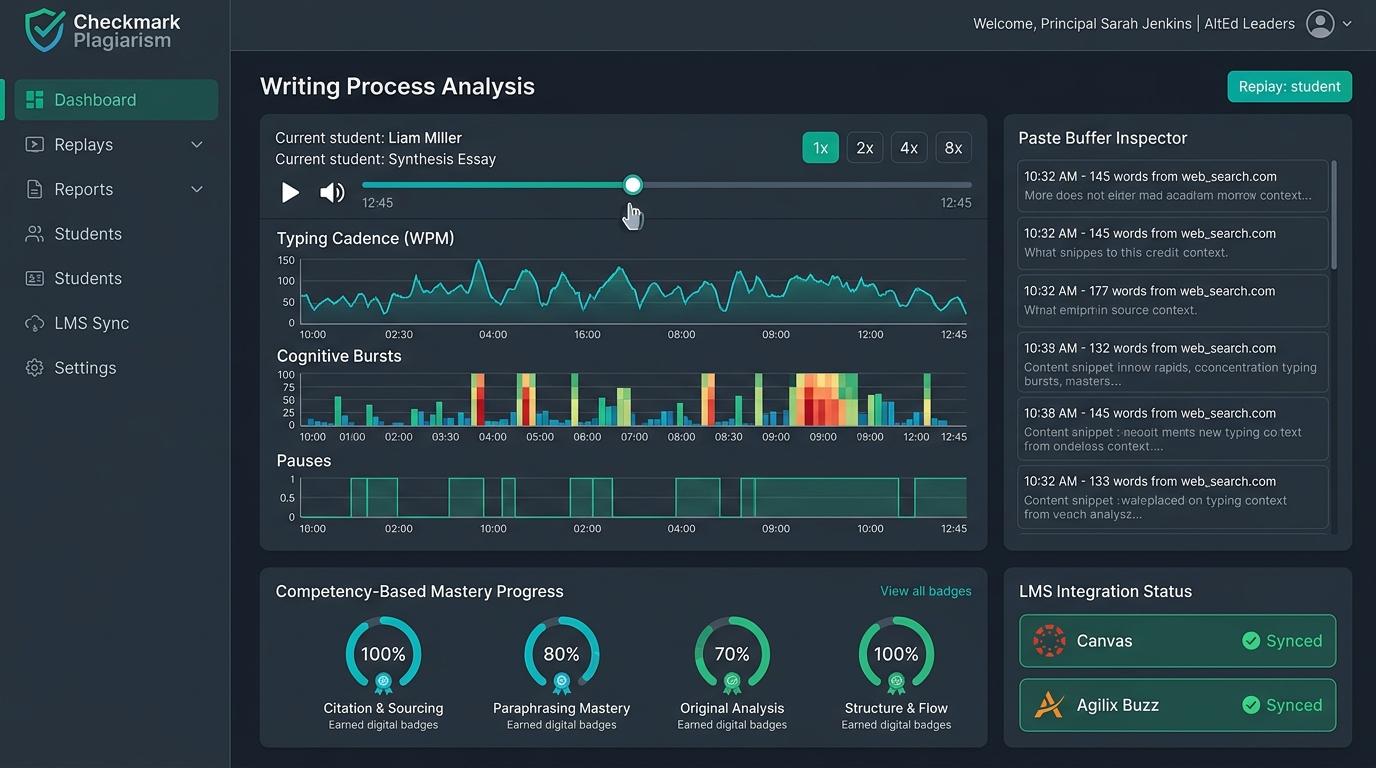
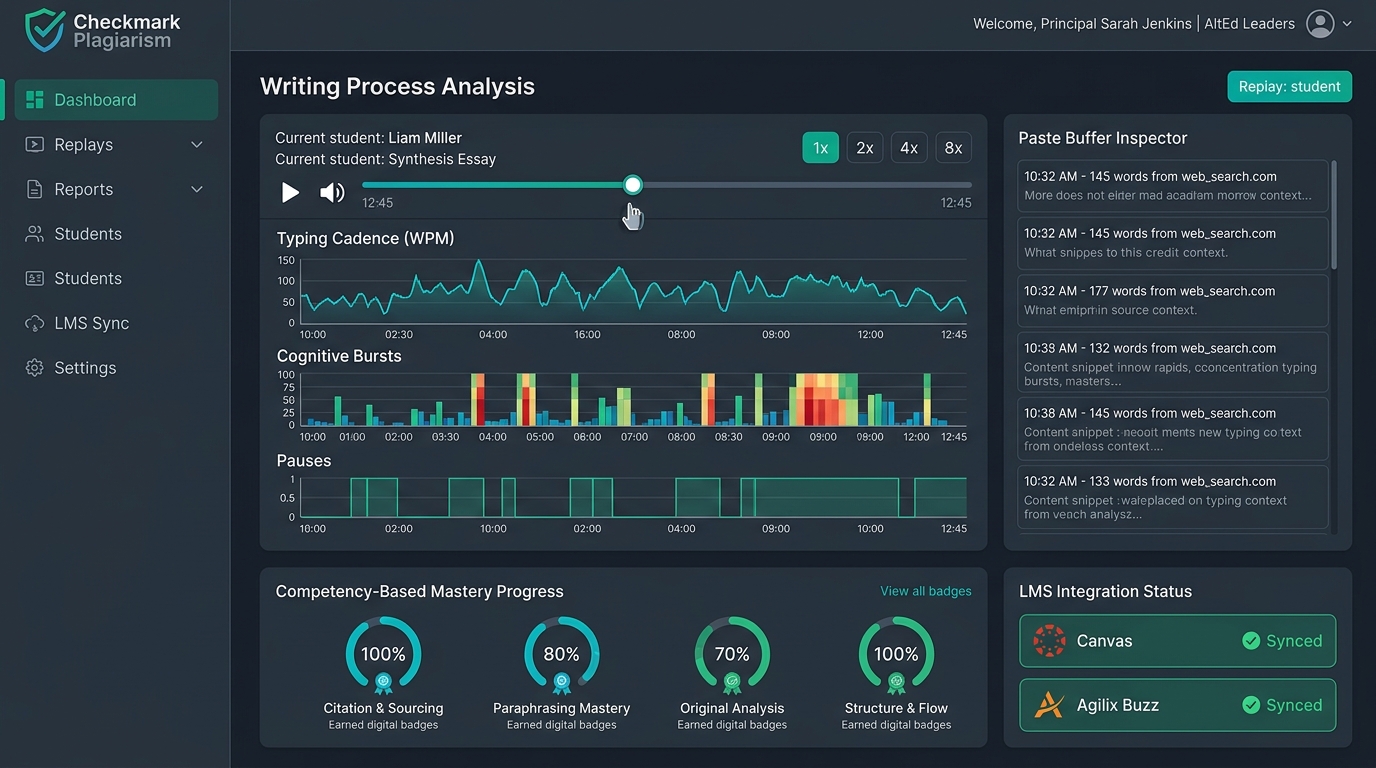
Checkmark Plagiarism enables Alternative Education Directors, Credit Recovery Coordinators, and At-Risk Youth Counselors to replace punitive surveillance with competency-based writing process telemetry and patent-pending Essay Playback™ (1x–8x scrubbable video replay). Guided by the core philosophy of “Stop guessing, start trusting,” educators can analyze continuous temporal drafting dynamics, inspect external clipboard preservation logs, diagnose authentic cognitive “stuckness” versus shortcut-taking, conduct supportive restorative conferences, and accelerate self-paced mastery with teacher-in-the-loop rubric autograding synced directly to Canvas LMS, Agilix Buzz, and Google Classroom.
Checkmark Plagiarism equips alternative education leaders, continuation high school principals, and credit recovery teachers with writing process replays, passage-level AI detection, side-by-side plagiarism verification, and AI-assisted rubric autograding.
1. The Credit Recovery Writing Dilemma: Why Black-Box AI Detectors Sabotage At-Risk Learners
Alternative high schools, district continuation academies, dropout-recovery charter networks, and asynchronous credit recovery centers serve students who navigate extraordinary academic, emotional, and structural obstacles. Students enrolled in modular credit recovery programs are often balancing:
- Substantial credit deficits: Severe delays in core English courses (English 9 through English 12) required for state graduation.
- Complex life responsibilities: Full-time employment, childcare, parenting obligations, or elder care.
- Adverse school histories: Chronic absenteeism, school-related anxiety, or histories of trauma.
- Specialized learning needs: Special education accommodations (IEPs / 504 plans) or English Language Learner (ELL / ML) designations.
- High-stakes graduation clocks: Impending graduation deadlines where a single failed half-credit prevents earning a high school diploma.
Asynchronous Modular Drafting
Credit-deficient senior drafting modular English essay late at night using dictation, non-linear notes, or translation aids.
Opaque Black-Box Scan
Probabilistic detector outputs a single number: “82% AI Detected” with zero behavioral evidence or explainability.
Presumption of Guilt
Automatic zero assigned; academic dishonesty flag on record; student enters defensive panic and feels unheard.
Emotional Shutdown → LMS Disengagement → Delayed Graduation → Permanent Institutional Dropout
In traditional seat-time models, writing instruction relies on synchronous observation—teachers circulating physical desks, observing handwritten outlines, and checking in during scheduled class periods. However, in modern self-paced, modular credit recovery environments—frequently delivered through digital LMS platforms like Agilix Buzz, Canvas LMS, Moodle, or Google Classroom—students work asynchronously across non-standard hours (e.g., late nights or weekends).
The Devastating Impact of Single-Number AI Scores on Vulnerable Writers
When credit recovery programs implement generic, whole-document AI detectors (which generate opaque percentage scores such as “78% AI Generated”), they inadvertently trigger a cascade of negative student outcomes:
- High False Positive Rates on Neurodivergent and ELL Writers: Students who use assistive tools (such as speech-to-text dictation, grammar correctors, or bilingual translation dictionaries) or who write with repetitive syntactic formulas frequently trigger high AI probability scores due to low linguistic burstiness and predictable vocabulary choices.
- The “Guilty Until Proven Innocent” Trap: A student accused of using AI based solely on an opaque detector percentage has no tangible way to prove their innocence. In traditional high schools, a well-resourced student might mobilize parent advocacy; in alternative education, at-risk students lack those support structures and frequently disengage completely.
- The Immediate Attrition Spiral: For a student who has already failed English 11 once, receiving an unverified accusation of academic dishonesty on their recovery draft confirms their worst fear: that the system is rigged against them. Instead of revising, they stop logging into the LMS, leading directly to institutional dropout.
- Administrative Paralysis for Alternative Ed Teachers: Credit recovery teachers often manage high student-to-teacher caseloads (often 100+ active modular enrollments). Instructors do not have the time to conduct forensic interrogations on dozens of ambiguous percentage flags, resulting in either arbitrary zeros or total capitulation where flags are simply ignored.
| Evaluation Dimension | Black-Box AI Detectors (Generic) | Writing Telemetry (Checkmark) |
|---|---|---|
| Core Evidence Provided | Single opaque probability score | Keystroke-by-keystroke 1x–8x playback replay |
| Cognitive Transparency | Zero insight into student effort | Shows drafting, pauses, deletions, and edits |
| Neurodivergent / ELL Fairness | High false-positive bias | Protects authentic voice and non-linear drafting |
| Pedagogical Actionability | Punitive (Zero grade / referral) | Restorative (Side-by-side co-viewing) |
| Impact on Course Completion | Increases student dropout & panic | Accelerates self-paced mastery retry cycles |
| Verification of Clipboard Text | None (Detects only static final text) | 100% paste buffer preserved with timestamps |
| LMS Workflow Integration | Disconnected external scan | Direct Canvas / Buzz / Classroom passback |
2. The Paradigm Shift: Seat-Time Compliance vs. Competency-Based Writing Process Telemetry
The historical foundation of alternative education accountability was rooted in seat-time compliance—tracking login minutes, time spent on slide decks, and minimum hourly thresholds. However, modern educational research and state graduation standards have decisively shifted toward Competency-Based Education (CBE) and Mastery Learning Models.
Student works at self-directed pace directly within connected LMS text editor.
Checkmark captures lightweight keystroke event stream, pauses, and revisions.
Teacher dashboard flags cognitive stalls (>30m pause) vs. unapproved shortcuts.
1-on-1 screen-share or in-person co-viewing of Essay Playback™ to validate growth.
Student applies quote-anchored rubric feedback to demonstrate mastery.
Teacher approves final score; 1-click LTI 1.3 passback syncs credit to gradebook.
In a competency-based model, credit is awarded when a student demonstrates mastery of specific writing standards (e.g., crafting a clear claim, integrating textual evidence, organizing transitional arguments, and executing purposeful revisions), regardless of whether that mastery took four hours or fourteen days.
Why Writing Process Telemetry is Essential for Competency Verification
Writing process telemetry provides the verifiable, non-invasive digital foundation that makes asynchronous mastery education possible:
- Proves Authentic Cognitive Effort: Rather than policing student presence via invasive webcams or screen-recording software, telemetry records the student's authentic intellectual struggle—the initial outline, the trial-and-error deletions, the search for appropriate vocabulary, and the structural rearrangements.
- Enables Low-Stakes, High-Frequency Revision: In credit recovery, failure is not terminal; it is diagnostic. Telemetry allows teachers to grade the evolution of a draft across multiple revision cycles, rewarding iterative improvement.
- Creates Defensible Audit Trails for State Funding: State education agencies (SEAs) and district compliance officers require verifiable evidence that students enrolled in remote or modular credit recovery actively produced their own coursework. Checkmark's visual replays provide an undeniable, timestamped evidentiary dossier that satisfies state attendance and competency auditing mandates without requiring high-stakes proctored exam rooms.
3. Diagnosing “Stuckness” vs. “Shortcut-Taking”: Cognitive Roadblock Telemetry
The most transformative application of writing process replays in alternative education is the ability to distinguish between cognitive struggle (“stuckness”) and deliberate evasion (“shortcut-taking”).
When an at-risk student disengages from a writing task, traditional LMS analytics only show an inactive user session or an incomplete assignment. Telemetry, however, reveals the exact moment and mechanism of cognitive stall.
Deconstructing the Telemetry Signals
To effectively intervene, alternative education teachers use three specific telemetry markers:
1. Temporal Pause Distribution (Cognitive Pauses vs. Idle Time)
- Micro-Pauses (200ms – 2s): Occur during normal sentence formation as the writer selects words and verifies syntax.
- Macro-Pauses (5s – 45s): Occur between paragraphs or complex clauses as the writer plans the next conceptual claim.
- Extended Cognitive Blocks (15m – 60m+): Indicate that the student encountered a major barrier (e.g., unable to locate a secondary source, confused about essay prompt requirements, or experiencing emotional frustration). Recognizing this allows the teacher to reach out with proactive scaffolding before the student gives up.
2. Burst Dynamics and Revision Ratios
Authentic human composition occurs in rhythmic bursts (averaging 4 to 12 words per burst) followed by short evaluation pauses. Furthermore, human drafting is characterized by high deletion and substitution rates (typically 12% to 30% of all keystrokes are backspaces, selections, or structural deletions). In contrast, artificial transcriptions exhibit an unnatural, flat typing cadence with near-zero backspacing.
3. Clipboard Payload Signatures
When text enters the document through a paste event, telemetry records the exact character count, timestamp, and source buffer text. This enables educators to immediately verify whether the pasted content is:
- Legitimate student prep work (e.g., student-authored brainstorming notes from an earlier modular assignment);
- A cited direct quote from an approved course reading;
- An unedited, full-scale essay payload generated by an external Large Language Model.
4. Checkmark Plagiarism's Accessible Writing Telemetry & Essay Playback™ Architecture
Checkmark Plagiarism delivers an integrated, educator-centric technology suite designed specifically to meet the needs of alternative high schools, virtual academies, and credit recovery consortia.
Patent-Pending Essay Playback™ (1x–8x Scrubbable Replay)
Visualizes the entire writing journey in a scrubbable video timeline. Reveals composing pauses, deletions, structural reorders, and typing velocity with zero webcam surveillance, preserving student dignity.
External Paste Buffer Inspector (100% Clipboard Preservation)
Captures and stores 100% of clipboard text pasted into the document at the exact millisecond of insertion, preserving raw content even if edited later. Features clickable “Jump to Playback” navigation.
Passage-Level AI & Multi-Source Plagiarism Engine
Underlines specific passages with calibrated confidence sliders instead of monolithic scores. Includes Honest Short-Text Guardrails (N/A for <150 words) and dedicated uncited source flagging.
Teacher-in-the-Loop Rubric Autograder & Direct LMS Passback
Evaluates drafts against modular rubrics with quote-anchored justifications. The educator retains 100% final authority to edit and approve before 1-click LTI 1.3 syncs grades directly to Buzz, Canvas, and Google Classroom.
Key Technical Capabilities Matrix
| Capability | Architectural Advantage in Alternative Education |
|---|---|
| 1x–8x Scrubbable Essay Playback™ | Allows teachers to audit an 8-hour writing project in 90 seconds. |
| Complete Clipboard History Storage | Proves if a paste was student's own notes vs. LLM output. |
| Mechanical Transcription Detection | Identifies retyping from second screens without false flags. |
| Passage-Level AI Confidence Sliders | Isolates unapproved AI paragraphs without condemning the whole paper. |
| Honest Short-Text Disclaimers | Prevents false alarms on 50-word modular reflection prompts. |
| Two-Way Linked Evidence Cards | Clicking essay highlight instantly jumps to matched source proof. |
| Native LMS Integrations | Seamless LTI 1.3 embed in Canvas, Agilix Buzz, Google Classroom. |
| Zero LLM Training Retention | Student trauma narratives & essays never enter commercial models. |
5. The 4-Phase Alternative Education Writing Process Protocol
To successfully operationalize writing process replays across credit recovery programs, Alternative Education Directors should establish a standardized, transparent 4-phase instructional protocol:
Modular Blueprint & Telemetry Onboarding
- Transparent Framing: Orient students during enrollment: Telemetry is framed as Student Protection Software—a personal defense receipt guaranteeing honest effort cannot be erased by AI flags.
- LMS Blueprint Setup: Embed Checkmark LTI 1.3 directly inside assignment shells across Buzz, Canvas, and Classroom.
- Mastery Contract: Co-sign the Competency Writing Contract setting transparent revision expectations.
Asynchronous Drafting & Cognitive Stall Triage
- Active In-Editor Composition: Students write directly in the connected editor across flexible asynchronous hours.
- Early Warning Stall Alerts: Dashboard notifies instructor when a student hits an extended pause (>30 mins) on a thesis or claim.
- Proactive Scaffolding: Teacher reaches out with supportive sentence starters before the student abandons the module.
Restorative Writing Conference & Co-Viewing
- Collaborative Replay: Teacher and student spend 3–5 minutes co-viewing the 1x–8x Essay Playback™ timeline.
- Validating Voice & Effort: Highlight moments of self-correction, vocabulary expansion, and structural edits.
- Non-Accusatory Paste Inquiries: Use the Paste Buffer Inspector to inspect clipboard sources and coach proper attribution.
Iterative Revision & Rubric Passback
- Quote-Anchored Justifications: Autograder drafts criterion feedback tied directly to student sentences.
- Formative Retry Cycles: Students scoring below mastery (e.g., 80%) complete targeted revisions in the same editor.
- Atomic Grade Sync: Educator approves finalized grade; 1-click LTI 1.3 passback syncs credit to LMS gradebook.
6. Restorative Coaching Dialogues & Credit Recovery Mastery Contracts
In alternative education, the language educators use during academic integrity inquiries determines whether a student stays enrolled or drops out. Below are two real-world coaching transcripts demonstrating how writing process replays transform high-stakes conversations into supportive learning opportunities.
Transcript 1: Coaching a Discouraged Student Past a Severe Cognitive Stall
Teacher: “Hi Marcus, thanks for hopping on this quick check-in. I was looking at your draft for Module 4, and instead of just looking at the final submission, I opened up your Essay Playback timeline. I noticed you spent almost an hour on this, but hit a major pause right after your opening sentence.”
Marcus: “Yeah... I don't know. I'm just bad at English. I sat there trying to figure out what to say about the character's motivation and my brain just blanked. I figured I'm probably going to fail this credit anyway.”
Teacher: “Marcus, look at the playback right here at minute 12. You wrote three different versions of your opening claim, deleted them, and kept trying. That tells me you care about getting it right and that you're thinking deeply about the text. You didn't just give up and walk away—you struggled through it. That's real effort.”
Marcus: (Relieved) “Yeah, I just couldn't find the right evidence from Chapter 3 to back it up.”
Teacher: “Let's look at Chapter 3 together right now. We'll find two strong quotes, drop them into your graphic organizer, and you can jump right back into the editor to finish your draft. You are only two paragraphs away from finishing this module and staying on track for graduation.”
Transcript 2: Addressing an Uncited Paste Restoratively Using the Clipboard Inspector
Teacher: “Hey Kayla, let's take a look at your Module 2 research draft together on screen. Checkmark gives us a complete visual replay of how the paper came together. Let's scrub to minute 4.”
Kayla: (Tense, looking down) “Is there a problem with it?”
Teacher: “Let's look together. Right here at 04:15, we see a paste event where these four paragraphs entered the document all at once. Checkmark's Paste Buffer Inspector shows us the exact text that came in from your clipboard. Can you walk me through where these notes came from?”
Kayla: “I was getting really stressed about the deadline, so I went to ChatGPT and asked it to write an explanation of the greenhouse effect, and I pasted it in. But I changed some of the words later!”
Teacher: “I appreciate your honesty, Kayla. In credit recovery, our goal is mastery of your own voice, not perfection under pressure. When an outside tool writes the paragraphs, you don't get the chance to build the argumentation skills you need for your diploma. Notice that I haven't entered a zero in Buzz. Here is what we're going to do: We are going to reset this draft. You'll keep the thesis statement you wrote yourself, and we'll use your course reading packet to pull real quotes. You have until Friday to resubmit, and your new playback timeline will show your complete original writing process.”
Kayla: “Wait, I don't get an automatic zero or a referral?”
Teacher: “No. In this program, we use mistakes as diagnostic checkpoints. Your job now is to show mastery on the revision.”
Alternative Education Competency Writing Mastery Contract
Alternative Education Competency Writing Mastery Contract
This agreement guarantees that writing submissions represent authentic student voice, iterative skill development, and demonstrable subject-matter mastery required for graduation credit.
• No unresolvable automatic zeros are assigned on initial diagnostic flags.
• Student and teacher co-view the Essay Playback™ timeline during a restorative check-in.
• A 48-to-72 hour revision window is granted to redraft in the integrated editor and demonstrate competency.
7. Real-World Alternative Education Case Studies
The following case studies illustrate how alternative education programs deployed Checkmark Plagiarism to eliminate punitive friction, protect student rights, and boost graduation rates.
Statewide Virtual Dropout Academy
Agilix Buzz LMS • 1,800 At-Risk Students
- Challenge: 38% false-positive dispute rate on generic AI detectors; course completion plummeted by 24% as students gave up on automated zeros.
- Solution: Deployed Checkmark LTI 1.3 in Agilix Buzz; trained teachers on 4-Phase Protocol and 1x–8x scrubbable replays.
- Outcome: Course completion surged to 94%; eliminated $42k/yr third-party webcam proctoring costs; 100% state audit compliance.
Urban Continuation Senior Sprint
Canvas LMS • 420 Credit-Deficient Seniors
- Challenge: 14 graduating seniors flagged >70% AI 3 weeks before commencement; diplomas at risk of being withheld.
- Solution: Checkmark telemetry revealed 12 students had 6–18 hours of authentic typing/revisions; 2 paste drops given 48-hr revision contracts.
- Outcome: 100% on-time graduation for cleared cohort; both revising students earned diplomas at summer commencement.
Trauma-Informed Learning Center
Google Classroom • 180 Court-Involved Youth
- Challenge: Trauma-impacted students shutting down or escalating during accusatory integrity interrogations.
- Solution: Adopted “Zero-Accusation Co-Viewing Policy” with Checkmark Essay Playback™ to celebrate writing growth.
- Outcome: 78% reduction in integrity behavioral referrals; writing stamina increased from 8 to 26 minutes per session.
8. District Governance, FERPA Compliance & Zero-Retention Security in Alternative Ed
Alternative education programs handle exceptionally sensitive student data. Essays written by at-risk students frequently contain deeply personal disclosures, including trauma narratives, foster care experiences, juvenile justice reflections, and mental health discussions.
School District Technology Directors, Alternative Ed Principals, and Procurement Officers must enforce rigorous legal and data privacy standards when selecting edtech writing tools:
| Compliance & Security Dimension | Commercial Consumer AI Tools | Checkmark Enterprise Suite |
|---|---|---|
| FERPA Zero-Model-Training Mandate | High Risk: Student text trains LLM | Zero Training: 100% private to district |
| COPPA (<13 Minor Privacy) | Non-compliant / data scraping | Fully COPPA Compliant |
| Fourth Amendment Search & Seizure | High Risk (Webcam room scans) | Zero Risk (No video, audio, or room scans) |
| State Data Privacy (SOPPA / CIPA) | Often third-party vendor leaks | Strict zero-retention cloud architecture |
| LTI 1.3 / 1-Roster LMS Integration | Manual copy-paste workflows | Secure, encrypted LMS grade passback |
| Audit Trail Defensibility for SEAs | Unverifiable black-box score | Timestamped playback JSON & PDF dossier |
Key Institutional Safeguards in Checkmark Plagiarism
- Zero LLM Model Training on Student Submissions: Checkmark guarantees under strict enterprise Service Level Agreements (SLAs) that student essays, telemetry logs, and rubric feedback are never used to train commercial generative AI models (such as OpenAI GPT or Anthropic Claude).
- Encrypted, Ephemeral Telemetry Architecture: All keystroke event streams, pause logs, and paste buffer snapshots are encrypted in transit (TLS 1.3) and at rest (AES-256). Data access is restricted exclusively to authorized educators within the district's authenticated LMS tenant.
- FERPA & COPPA Certified: Checkmark complies fully with the Family Educational Rights and Privacy Act (FERPA) and the Children's Online Privacy Protection Act (COPPA), ensuring student educational records remain under the sole custody of the local educational agency (LEA).
- Defensible Audit Logs for State Reporting: When state education departments audit alternative education programs for attendance compliance or competency verification, Checkmark generates exportable, timestamped PDF/JSON verification dossiers that prove authentic student coursework creation without violating student privacy.
9. Frequently Asked Questions (FAQs)
1. How does Essay Playback™ protect at-risk students from false AI accusations?
Generic AI detectors analyze static text for statistical predictability (perplexity and burstiness), which frequently leads to false positives on English Language Learners and neurodivergent students who use straightforward sentence structures. Essay Playback™ bypasses text-only guesswork by recording the authentic, temporal human writing process—including real-time typing bursts, pauses, deletions, and structural reorganizations. This provides irrefutable physical proof of authorship that instantly exonerates honest students.
2. Can students bypass writing process replay by manually retyping text from a second screen or phone?
No. Checkmark's engine features specialized Mechanical Transcription Detection. When a student retypes pre-generated text from a second screen, their keystroke dynamics display an unnatural, metronomic velocity (e.g., constant 65 WPM typing with zero backspaces, zero conceptual pauses, and zero structural deletions). Human composition is inherently erratic, bursting, and full of revision cycles. Checkmark flags mechanical transcriptions for educator review.
3. What happens if a student legitimately pastes their own rough outline from a different document?
Checkmark's External Paste Buffer Inspector captures and preserves 100% of all clipboard text. During a 1-on-1 conference, the educator can view the exact pasted text and verify that it matches the student's own rough notes or graphic organizer. Additionally, the student can show their previous modular assignment drafts to verify the provenance of their work.
4. How does writing telemetry replace the need for webcam proctoring in credit recovery?
Webcam proctoring records the student's physical environment, creating Fourth Amendment legal liabilities (Ogletree v. Cleveland State), high bandwidth failures, and privacy invasions. Checkmark records only the digital composition process inside the text editor. This proves authentic student creation in lightweight (<50 KB) telemetry data without capturing video, audio, or biometric data from the student's home.
5. How does Checkmark integrate with credit recovery platforms like Agilix Buzz, Canvas, and Google Classroom?
Checkmark integrates seamlessly via LTI 1.3 Advantage and Google Classroom API. Writing assignments open directly inside the LMS course shell. When an essay is submitted, Checkmark's AI Autograder generates draft rubric justifications, which the teacher can review, adjust, and approve. With one click, finalized grades and feedback sync directly back into the native LMS gradebook.
6. How does Checkmark handle short-text writing tasks under 150 words?
Many credit recovery modules include short-answer formative prompts (e.g., 50-word reading reflections). Black-box detectors frequently generate erratic false positives on short texts due to inadequate sample sizes. Checkmark incorporates Honest Short-Text Guardrails: any submission under ~150 words automatically displays an N/A flag for AI detection, preventing teachers from making disciplinary decisions on statistically invalid data.
7. Does Checkmark use student writing to train its AI models?
No. Checkmark maintains a strict zero-retention, zero-training architecture. Student essays, personal trauma reflections, and keystroke logs are never fed into commercial LLM training datasets. All data remains the exclusive property of the school district, fully compliant with FERPA, COPPA, and state student privacy regulations.
10. Conclusion: Transforming Credit Recovery from Suspicion to Self-Paced Mastery
The mission of alternative education is not to catch students doing something wrong; it is to create the conditions under which vulnerable learners can discover their potential, recover academic standing, and earn their high school diplomas.
By replacing punitive, black-box AI surveillance with Checkmark Plagiarism's writing process replays, keystroke telemetry, and educator-guided rubric autograding, Alternative Education Directors can:
- Eliminate the friction of false AI accusations that cause at-risk students to abandon courses;
- Diagnose cognitive writing stalls early, turning moments of frustration into supportive instructional interventions;
- Conduct empowering, restorative conferences that build student agency and self-efficacy;
- Streamline grading workflows across large caseloads through seamless Canvas LMS, Agilix Buzz, and Google Classroom passback;
- Safeguard student privacy with zero-training enterprise compliance.
In the era of ubiquitous generative AI, the path forward in alternative education is not more invasive surveillance—it is radical process transparency. “Stop guessing, start trusting.”
Stop guessing, start trusting.
Empower your credit recovery educators with transparent writing process telemetry today.