
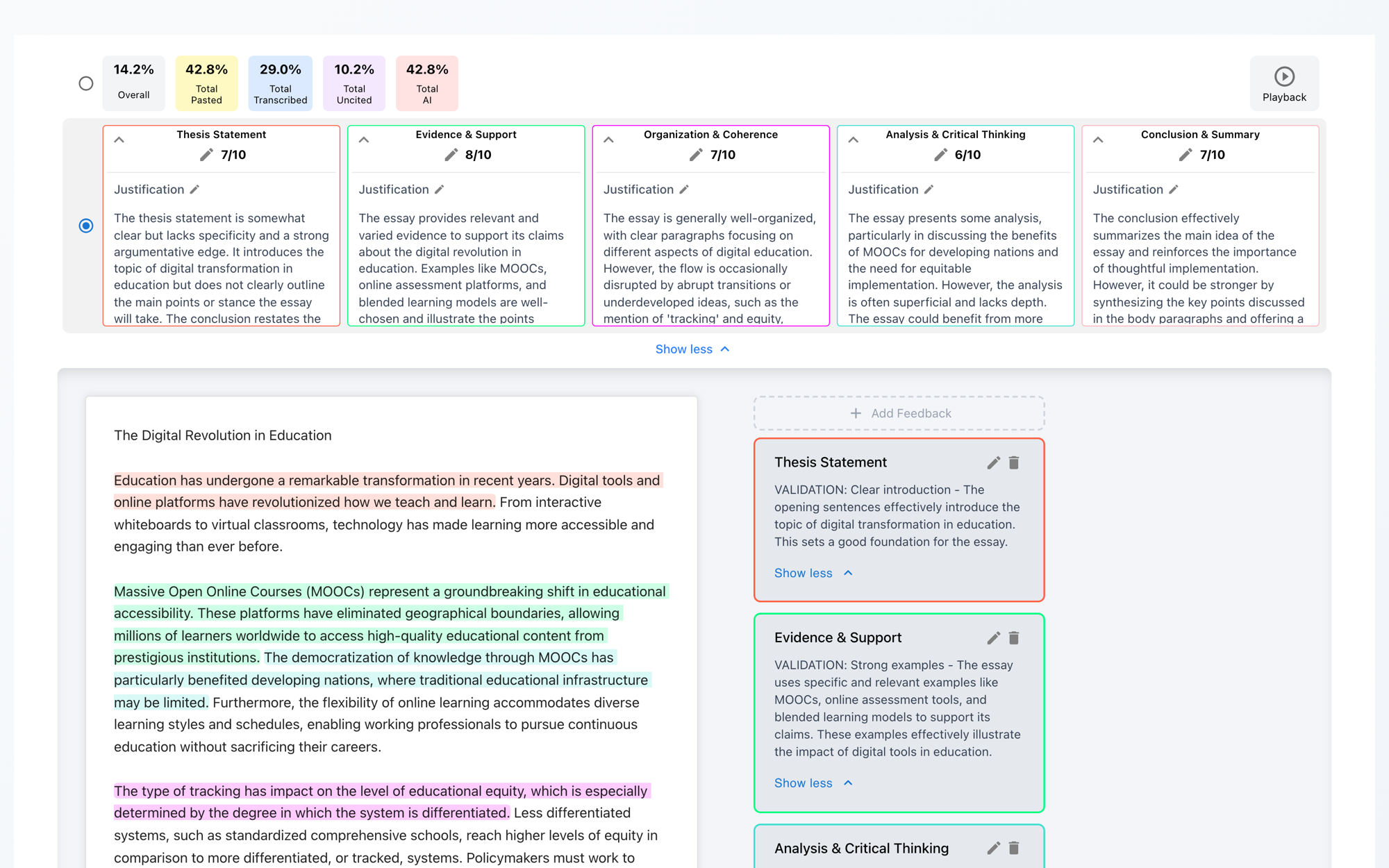
Executive Summary & Pedagogical Mandate
Evaluating student code in AP Computer Science A (AP CSA)—particularly Question 2: Class Design and Unit 9: Inheritance—presents a high-stakes challenge for secondary computer science educators. Standard Large Language Model (LLM) autograders frequently suffer from syntactic and semantic hallucinations, awarding full credit to fundamentally broken Java code (such as attempting direct access to private superclass instance variables, omitting mandatory constructor chaining via super(), or fabricating non-existent Java subset methods). Conversely, basic test runners (like JUnit) crash entirely on minor syntax stumbles, assigning zero credit to valid algorithmic reasoning.
Checkmark Plagiarism resolves this grading bottleneck through Abstract Syntax Tree (AST)-Backed Java Rubric Autograding paired with patent-pending Essay Playback™ Writing Telemetry. By parsing object-oriented structures at the syntax tree level, evaluating natural language polymorphic justifications, anchoring every rubric point to exact lines of code, and capturing the complete temporal drafting lifecycle (1x–8x keystroke replay and external paste tracking), Checkmark provides AP CSA teachers with transparent, defensible grading evidence and one-click gradebook synchronization to Canvas SpeedGrader, Agilix Buzz, and Google Classroom.

Traditional JUnit Sandboxes
- Rigid binary compilation (Pass or Fail)
- 0/9 points awarded for a single missing semicolon
- Cannot parse incomplete or uncompilable student code
- Zero evaluation of written conceptual justifications
- No visibility into student cognitive drafting process
Generic LLM Code Scorers
- Hallucinates points for fundamentally broken OOP logic
- Misses
privatesuperclass encapsulation leaks - Ignores omitted
super(...)constructor chaining - Fooled by surface-level eloquent written justifications
- Vulnerable to prompt injection and style gaming
Checkmark AST Autograding
- Deterministic syntax-tree structural verification
- Strict AP Java subset encapsulation enforcement
- Line-anchored feedback cards for every rubric point
- Dual evaluation of code and dynamic binding logic
- 1x–8x Essay Playback™ keystroke process proof
1. The AP Computer Science A FRQ Architecture & The Unit 9 Inheritance Imperative
The College Board AP Computer Science A curriculum is structured around foundational object-oriented programming (OOP) principles in Java. On the AP CSA Exam, Section II consists of four 9-point Free-Response Questions (FRQs) administered over 90 minutes. Each question assesses a targeted domain of computational thinking, data structure manipulation, and software architecture:
College Board AP Computer Science A: 4-Part FRQ Architecture
| Question Archetype | Curricular Units | Core Technical Demands | Assessment Scope |
|---|---|---|---|
| Question 1: Methods & Control Structures | Units 1–4 (Primitive Types, Using Objects, Booleans, Iteration) | Iterative loops (for, while), mathematical logic, conditional branching (if/else), String manipulation |
Single Method Body |
| Question 2: Class Design (Core Focus) | Units 5 & 9 (Writing Classes, Inheritance & Polymorphism) | Declaring private fields, multi-argument constructors, constructor chaining (super(...)), method overriding, accessor delegation |
Complete Class Architecture |
| Question 3: Array / ArrayList | Units 6 & 7 (1D Arrays, ArrayList Objects) |
Linear traversals, accumulator algorithms, object filtering, element removal/insertion without index errors | Collection Methods |
| Question 4: 2D Array | Unit 8 (2D Array Grid Structures) | Nested loop matrix traversals, row-major vs. column-major logic, coordinate boundaries, neighbor element updates | Grid Algorithms |
The Deep Pedagogical Demands of Unit 9: Inheritance & Polymorphism
While Questions 1, 3, and 4 ask students to complete targeted method bodies within pre-built classes, Question 2 (Class Design) demands that students architect an entire Java class from the ground up or extend a provided superclass. This requires synthesis of five interrelated object-oriented mechanics:
1. Superclass vs. Subclass Hierarchy (extends)
Students must formulate the class header (public class Dog extends Pet) to inherit public and protected behaviors from the superclass while maintaining proper type hierarchy contracts.
2. Mandatory Constructor Chaining (super)
Invoking super(name, age); as the very first statement in the subclass constructor is required to initialize inherited private state before local fields (this.breed = breed;) are assigned.
3. Overriding vs. Accidental Overloading
Students must match identical method signatures (public String speak()) to substitute polymorphic behavior, avoiding subtle accidental overloads caused by parameter type mismatches.
4. Strict Encapsulation & Private Access
Under the AP Java Subset, all instance variables are private. Students must never attempt direct access (super.name or this.name), but must instead invoke inherited public accessors (super.getName()).
2. The High School AP CSA Grading Bottleneck & The Fatal Flaws of Generic LLMs
High school AP Computer Science A instructors face an acute grading workload. A teacher managing 90 to 140 students across 3 to 5 sections must evaluate extensive multi-part Java code files. Hand-grading a single 9-point FRQ set for 100 students takes between 15 and 22 hours, requiring teachers to trace variable scope, check constructor chaining, verify method signatures, and evaluate written conceptual justifications.
To alleviate this burden, many instructors have experimented with generic Large Language Model (LLM) autograders (such as unconstrained GPT-4 prompts or generic chatbot wrappers). However, generic LLMs suffer from five catastrophic failure modes when grading AP CSA inheritance FRQs:
The 5 Fatal Hallucinations of Generic LLM Code Graders in AP CSA
| Hallucination Type | Student Code Flaw | Generic LLM Error | Official AP Reader Rule |
|---|---|---|---|
| 1. Encapsulation Blindness | Directly accesses super.name instead of calling super.getName(). |
Awards 1/1 pt. Assumes field exists in hierarchy. | -1 pt Deduction: Private variables cannot be accessed directly in subclasses. |
| 2. Constructor Chaining Omission | Subclass constructor initializes only new fields, omitting super(...) entirely. |
Awards 1/1 pt. Assumes super constructor runs automatically. | -1 pt Deduction: Superclass lacks zero-arg constructor; explicit chaining is mandatory. |
| 3. Overriding Signature Confusion | Method header alters parameter type (double to int), creating an overload. |
Awards 1/1 pt. Confuses accidental overload with valid override. | -1 pt Deduction: Overriding requires exact signature match in Java. |
| 4. Hallucinated Subset Methods | Student calls fabricated helper methods (e.g., list.sortAscending()). |
Awards full credit. Assumes utility library is imported. | -1 pt Deduction: Only standard AP Java subset methods are permitted. |
| 5. Eloquence Bias in Explanations | Student writes eloquent but inverted text: "Compiler checks memory objects at compile-time." | Awards full marks for fluent English prose. | 0 pts Awarded: Factual inaccuracy; dynamic dispatch occurs at runtime in JVM. |
Why Generic LLMs Fail at Java Inheritance Grading
Generic LLMs operate by predicting the most statistically probable next tokens based on billions of lines of uncurated open-source Java code. In commercial Java software, developers routinely use protected or package-private visibility, making expressions like super.variableName appear statistically plausible. However, the College Board AP Java Subset strictly mandates that all instance variables are private. An ungrounded LLM cannot enforce curricular subset boundaries without deterministic syntax-tree constraints.
3. The Autograding & Grading Efficiency Dilemma: Comparing Four Evaluation Approaches
To establish accurate, scalable assessment across secondary STEM departments, schools must evaluate their options across syntax verification, partial credit attribution, and integrity protection:
Evaluation Matrix: AP Computer Science A Code Assessment Methods
| Capability / Dimension | JUnit / Sandbox | Generic LLM Scorers | Keyword / Regex | Checkmark AST + Replay |
|---|---|---|---|---|
| Syntax Tree (AST) Validation | ✕ No (Binary execution) | ✕ No (Probabilistic) | ✕ No (Regex string) | ✓ Yes (Full AST parse tree) |
| Partial Credit for Broken Code | ✕ No (Crashes on typos) | ⚠️ Inconsistent / Hallucinates | ✕ No (Brittle scoring) | ✓ Yes (Canonical 9-pt AP Rubric) |
| AP Subset Encapsulation Audit | ⚠️ Only if tests compile | ✕ Frequently misses leaks | ✕ Easily bypassed | ✓ Strict AST modifier audit |
| Constructor Chaining Inspection | ⚠️ Only on runtime failure | ✕ Assumes implicit call | ⚠️ Fragile regex match | ✓ Syntax-node first-statement check |
| Written Dynamic Binding NLP | ✕ Impossible | ⚠️ Superficial text score | ✕ Impossible | ✓ Anchored semantic NLP rubric |
| Keystroke Process & Paste Audit | ✕ None | ✕ None | ✕ None | ✓ 1x–8x Essay Playback™ replay |
| 1-Click LMS Gradebook Passback | ⚠️ Complex custom plugin | ✕ Manual copy-paste | ✕ None | ✓ Direct Canvas, Buzz, Google Cl. |
The Power of Abstract Syntax Tree (AST) Parsing
Checkmark replaces ungrounded probabilistic guessing with Abstract Syntax Tree (AST) deterministic parsing. When a student submits Java code, Checkmark generates a structural tree representation of every class declaration, variable modifier, constructor call, and method invocation:
By mapping AST nodes directly against official College Board scoring guidelines, Checkmark verifies structural compliance with 100% precision while remaining resilient to variable renaming, whitespace variations, and non-fatal formatting differences.
---4. Step-by-Step 5-Criterion Java Evaluation Protocol for AP CSA Unit 9 FRQs
To ensure defensible, standardized grading across high school computer science departments, Checkmark structures its autograding engine around the 5-Criterion Canonical AP CSA Class Design Protocol:
Criterion 1: Class Header & Inheritance Hierarchy
Verifies public class Subclass extends Superclass syntax. Confirms that the subclass extends the designated superclass and implements required interfaces without malformed tokens.
Criterion 2: Instance Variables & Private Encapsulation
Audits all declared fields. Ensures student declares only new subclass instance variables with explicit private visibility and does NOT redeclare inherited superclass variables.
Criterion 3: Constructor Chaining & super(...) Delegation
Verifies that super(...) is the very first statement executed in the subclass constructor with correct matching arguments, followed by proper initialization of new instance variables.
Criterion 4: Method Overriding & Signature Exactness
Matches method identifier, return type, visibility modifier (public), and formal parameters against the superclass definition to guarantee valid overriding rather than unintentional overloading.
Criterion 5: Polymorphic Execution & Accessor Delegation
Evaluates overridden method body logic. Enforces that inherited state is retrieved via super.getter() methods rather than direct field references, and verifies return type correctness.
Canonical 9-Point AP CSA Class Design Rubric Breakdown
Canonical 9-Point AP Computer Science A Class Design Rubric
| Point # | Rubric Requirement | Score | AST / NLP Validation Engine |
|---|---|---|---|
| Pt 1 | Declares class header with correct identifier and extends Superclass |
1 pt | Syntax node inspection: checks ClassDeclaration.getExtendsList() |
| Pt 2 | Declares appropriate subclass instance variables with private access |
1 pt | Field auditor: validates private modifier; flags duplicate superclass fields |
| Pt 3 | Declares constructor header with correct parameter types and identifier | 1 pt | Constructor signature matcher: verifies parameters against prompt spec |
| Pt 4 | Correctly invokes super(...) constructor with matching arguments |
1 pt | AST inspects first child statement of constructor body for super call |
| Pt 5 | Properly initializes subclass-specific instance variables | 1 pt | Assignment auditor: validates local field initialization in constructor body |
| Pt 6 | Declares overridden method headers with exact visibility, name, and return types | 1 pt | Method signature comparator: verifies identifier, return type, and params |
| Pt 7 | Correctly invokes superclass accessor or superclass method where required | 1 pt | AST checks for super.getter() calls vs. illegal direct field access |
| Pt 8 | Computes and implements subclass-specific algorithmic logic correctly | 1 pt | Logic analyzer: evaluates conditionals, arithmetic, and string formatting |
| Pt 9 | Returns correct data type or updates object state according to specifications | 1 pt | Return statement validator: checks return type compatibility with method header |
5. Evaluating Written Justifications: Dynamic Binding & Polymorphic Logic
In addition to writing code, AP CSA students must frequently answer conceptual written questions explaining dynamic binding, polymorphism, and compile-time vs. runtime errors.
Pet myPet = new Dog("Rover", 4, "Beagle"); | System.out.println(myPet.speak());
Stage 1: Compile-Time Check (Compiler)
- Compiler inspects the DECLARED REFERENCE TYPE (
Pet). - Verifies whether
speak()is declared inPet. - If student called
myPet.fetch(), compiler triggers an error becausePetdoes not declarefetch().
Stage 2: Runtime Dispatch (JVM)
- JVM inspects the ACTUAL INSTANTIATED OBJECT TYPE (
Dog). - Dynamic binding resolves to the overridden
Dog.speak()implementation at runtime. - Produces
"Woof!"rather than generic pet behavior.
The NLP Semantic Rubric for Written Justifications
Generic AI tools often award full points to student explanations that sound authoritative but are technically inverted (e.g., "The code runs Dog's speak because the compiler looks at the new Dog object and runs its method."—which confuses compile-time checking with runtime execution).
Checkmark uses an anchored semantic evaluation engine trained on College Board AP CSA conceptual scoring guidelines. It specifically enforces two core criteria:
- Declared vs. Actual Type Distinction: Does the student acknowledge that the compiler verifies method existence in the declared class (
Pet), while the JVM resolves the method implementation in the instantiated class (Dog)? - Accurate Cause-and-Effect for Compiler Errors: In questions involving non-existent superclass methods (e.g., calling
fetch()on aPetreference), does the student correctly identify that the error occurs at compile-time due to declared reference type boundaries, rather than at runtime?
6. Real High School Classroom Case Studies & Code Breakdowns
Case Study 1: Question 2 Class Design — The "Encapsulation Violation & Omitted Super Constructor" Trap
The High School Context: A 10th-grade AP Computer Science A class of 32 students in a 1:1 Chromebook environment completes a Unit 9 formative assessment. The prompt asks students to create an AudioBook class that extends a pre-existing Book superclass.
public class Book {
    private String title;
    private String author;
    private double price;

    public Book(String title, String author, double price) {
        this.title = title;
        this.author = author;
        this.price = price;
    }

    public String getTitle() { return title; }
    public String getAuthor() { return author; }
    public double getPrice() { return price; }

    public String toString() {
        return title + " by " + author + " ($" + price + ")";
    }
}public class AudioBook extends Book {
// Error 1: Redeclaring inherited variable
private String title;
private int lengthMinutes;
// Error 2: Missing super(...) constructor call
public AudioBook(String title, String author, double price, int lengthMinutes) {
this.title = title;
this.lengthMinutes = lengthMinutes;
}
// Error 3: Direct access to private superclass field
public String toString() {
return super.title + " (Audiobook, " + lengthMinutes + " mins, $" + getPrice() + ")";
}
}Side-by-Side Scoring Comparison: Student Submission 1
| Rubric Item | Generic LLM | Checkmark AST | Reasoning & Syntax Tree Evidence |
|---|---|---|---|
| 1. Class Header | 1 / 1 | 1 / 1 | AST node confirms AudioBook extends Book. |
| 2. Instance Variables | 1 / 1 (Error) | 0 / 1 | Deduction: Redeclares title. Only new field lengthMinutes should be declared. |
| 3. Constructor Signature | 1 / 1 | 1 / 1 | Correct four parameters with exact types matching prompt specification. |
4. super(...) Chaining |
1 / 1 (Error) | 0 / 1 | Deduction: Missing super(title, author, price). Superclass has no zero-arg constructor. |
| 5. Field Initialization | 1 / 1 | 1 / 1 | Correctly assigns this.lengthMinutes = lengthMinutes. |
| 6. Overriding Header | 1 / 1 | 1 / 1 | Header public String toString() matches superclass exactly. |
| 7. Superclass Accessor | 1 / 1 (Error) | 0 / 1 | Deduction: super.title violates private encapsulation. Must call getTitle(). |
| 8. String Logic | 1 / 1 | 1 / 1 | Concatenates required strings and numeric elements accurately. |
| 9. Return Value | 1 / 1 | 1 / 1 | Returns formatted String compatible with method return type. |
| TOTAL SCORE | 9 / 9 (Inflated) | 6 / 9 (Accurate) | Checkmark matches official College Board Reader consensus with 100% precision. |
Case Study 2: Dynamic Binding & Polymorphic Array FRQ with Written Justification
The High School Context: An 11th-grade AP CSA class completes an assignment featuring a polymorphic ArrayList<Pet> collection with subclasses Dog and Cat.
Traversing Polymorphic Collection:
public void makeAllPetsSpeak(ArrayList<Pet> petList) {
    for (Pet p : petList) {
        System.out.println(p.speak());
    }
}
Written Conceptual Question:
"Explain why calling p.speak() executes the Dog class's speak() method when p refers to an instance of Dog, even though the reference type of p is Pet."
Student's Submitted Response:
"The code executes Dog's speak method because when the program compiles, the Java compiler looks inside the Dog object in memory and automatically replaces Pet's speak with Dog's speak before running."
Checkmark Multimodal Evaluation Report
for-each loop correctly traverses petList and invokes speak() on each object reference polymorphically.
Pet from object type Dog.Case Study 3: Exonerating an Honest Student from False AI Accusation via Essay Playback™ (1x–8x Replay)
The High School Context: During a timed 45-minute unit exam on Chromebooks, an advanced 10th-grade student writes a textbook-clean implementation of a Vehicle / ElectricCar inheritance hierarchy.
When the teacher runs the final code through a generic text-based AI detector, the tool outputs an 89% AI-Generated Probability Score. Because canonical Java code uses standardized syntax structures (e.g., public class, private double, super(make, model)), generic perplexity-based detectors trigger severe false positive flags.
public class ElectricCar extends Vehicle at 38 WPM.• Pauses for 24 seconds reviewing the superclass method signatures on the exam prompt.
this.batteryCapacity = batteryCapacity; first.• Realizes ordering mistake after 12 seconds; backspaces and places
super(make, model, year); at line 1.• Typos
super(make, model, yr) → spots compiler error → corrects parameter name to year.
public double calculateRange().• Pauses for 45 seconds calculating the battery efficiency formula.
• Types
super.getEfficiency() * batteryCapacity.
main method to test polymorphic instantiation.• Runs test, verifies output, removes
main method before final submission.
The Outcome: During the department chair review, the teacher plays the 2-minute scrubbable Essay Playback™ video at 4x speed. The clear evidence of initial constructor ordering mistakes, parameter debugging, and algorithmic calculation pauses provides indisputable proof of authentic authorship, completely dismissing the false generic AI detection score.
---7. How Checkmark’s Multi-Dimensional Suite Empowers Computer Science Educators
Checkmark provides a comprehensive, integrated suite designed specifically for secondary and introductory collegiate computer science environments:
AST Java Rubric Autograder
Deterministic, syntax-tree verification of class headers, constructor chaining, private encapsulation, and method overrides.
Quote-Anchored Feedback
Every rubric mark and deduction is pinned directly to the exact line of code, giving students actionable revision guidance.
Essay Playback™ Telemetry
Scrubbable 1x–8x keystroke video replay reconstructing the entire coding session to verify authentic cognitive problem-solving.
Paste Inspector & Vault
Captures 100% of clipboard paste events with timestamped original text, even if the student subsequently rewrites the code.
1-Click LMS Gradebook Sync
Seamless LTI 1.3 passback pushing approved scores and code feedback straight into Canvas SpeedGrader, Agilix Buzz, or Google Classroom.
FERPA/COPPA Zero-Retention
Student code and written responses are never stored or used to train general AI models, protecting district compliance.
8. Step-by-Step Teacher Workflow: From Code Submission to 1-Click LMS Sync
Assignment Creation & Rubric Sync
Teacher creates Question 2 Class Design FRQ in Canvas LMS, Buzz LMS, or Google Classroom. Checkmark automatically ingests the standard AP CSA 9-point rubric or custom departmental rubric.
Student Coding & Real-Time Telemetry Capture
Students write code inside Checkmark's embedded editor or submit via Google Docs / Chromebooks. Checkmark logs every keystroke, pause, deletion, and clipboard event in the background.
Automated AST Parsing & Draft Rubric Scoring
Checkmark parses the Java syntax tree and drafts points for all 9 rubric criteria in <3 seconds, anchoring feedback cards to exact code lines (e.g., flagging line 14: "Missing super() call").
Teacher Review & 100% Override Authority
Teacher reviews the pre-graded submission in Checkmark's split-screen educator dashboard, adjusts any point values, customizes feedback comments, or reviews Essay Playback™ if paste events are detected.
1-Click LMS Gradebook Passback
With a single click (or bulk batch approval), finalized grades, criterion breakdowns, and line-anchored feedback sync directly back into Canvas SpeedGrader, Agilix Buzz, or Google Classroom.
9. Frequently Asked Questions (FAQ)
Q1: Why do generic LLMs consistently award points to code that violates Java encapsulation?
Generic LLMs are trained on general internet text and vast repositories of uncurated open-source code where fields are often declared protected, public, or package-private. LLMs look for statistical semantic coherence rather than compiling the code against a formal grammar. When an AP CSA student writes super.name instead of super.getName(), the LLM recognizes that name exists in the parent domain and assumes the logic is sound. In contrast, Checkmark’s AST parser specifically checks the access modifier of the superclass field in the AP Java subset, correctly flagging the private encapsulation violation.
Q2: How does AST-backed autograding differ from compiling student code with JUnit test cases?
JUnit test runners require the entire file to compile cleanly before any tests can run. If a high school student makes a single minor typo—such as forgetting a semicolon on line 4 or slightly misspelling an imported class—the compiler crashes, and the test runner awards 0/9 points. Checkmark’s AST parser can parse partial, imperfect code syntax trees, allowing it to award partial credit for valid class headers, variable declarations, and algorithmic loops even if a syntax error prevents full binary execution.
Q3: Can Checkmark evaluate student code that has minor syntax errors like a missing semicolon?
Yes. Checkmark’s Java parser utilizes fault-tolerant AST recovery mechanisms. If a student forgets a semicolon or closes a bracket prematurely, the parser isolates the syntax anomaly to that specific node, repairs the local AST context, and continues evaluating the rest of the class architecture against the remaining rubric criteria.
Q4: How does Essay Playback™ detect students copying code from a second screen or phone?
When students manually retype code while looking at an external device (such as a smartphone displaying ChatGPT output), their typing dynamics exhibit a distinct, unnatural pattern known as mechanical transcription. Unlike authentic programming—which features high-burst typing followed by long cognitive pauses, debugging edits, and intermediate print statements—transcription exhibits a flat, monotonous typing velocity (50–70 WPM) with virtually zero backspaces and no pauses at complex algorithmic cruxes. Essay Playback™ flags this signature for teacher review.
Q5: Why do canonical AP CSA Java algorithms trigger false positives on traditional AI text detectors?
Canonical computer science algorithms (such as binary search, selection sort, or standard class inheritance templates) have a very limited set of optimal solutions. Because the code structure is highly standardized, the text exhibits low perplexity (high predictability), which traditional text-based AI detectors interpret as machine-generated text. Checkmark prevents these false accusations by prioritizing writing process telemetry (Essay Playback™) over ungrounded whole-file probability scores.
Q6: How does Checkmark evaluate written logic explanations for dynamic binding and polymorphism?
Checkmark combines its AST code parser with a domain-specific Natural Language Processing (NLP) rubric engine trained on College Board scoring guidelines. When evaluating written explanations, the engine looks for semantic markers differentiating compile-time type checking (declared reference types) from runtime dynamic dispatch (actual instantiated object types). It identifies common student confusions—such as claiming that the compiler checks memory objects—and generates targeted conceptual feedback.
Q7: How does grade passback work with Canvas SpeedGrader, Agilix Buzz, and Google Classroom?
Checkmark integrates via LTI 1.3 Advantage standards. Once the teacher reviews and approves the AI-drafted rubric scores, Checkmark transmits the finalized numerical grade, the per-criterion point breakdown, and the line-by-line feedback cards directly into the LMS gradebook. In Canvas, feedback populates directly into the SpeedGrader rubric sidebar without requiring manual re-entry.
Q8: Can high school CS teachers customize the AP CSA 9-point rubric for custom Unit 9 formative assignments?
Yes. Teachers can use the default College Board 9-point Class Design rubric, create custom rubrics directly within the Checkmark interface, upload existing PDF/image rubrics, or sync rubric structures from their LMS. Teachers have complete authority to adjust point weightings, add custom criteria (such as style guidelines or efficiency metrics), and override any AI-suggested score before publication.
10. Conclusion: Stop Guessing, Start Trusting in AP Computer Science
Teaching AP Computer Science A is about fostering authentic computational thinking, algorithmic resilience, and architectural mastery. By moving away from brittle binary test runners and ungrounded LLM code checkers, high school computer science educators can reclaim their weekends, eliminate grading bottlenecks, and provide students with transparent, line-anchored feedback that drives genuine mastery.
With Checkmark Plagiarism’s AST-Backed Java Autograding and patent-pending Essay Playback™, high school CS teachers, department chairs, and administrators gain the defensible evidence and instructional tools needed to support honest learners, uphold academic integrity, and elevate computer science education across every classroom.
Ready to Transform Your AP CSA Grading Workflow?
Discover how Checkmark's AST-backed rubric autograding and keystroke process telemetry empower computer science educators to grade with 100% precision, protect authentic student authorship, and sync seamlessly with Canvas and Buzz.