
In higher education institutions, secondary schools, and competitive academic programs, cumulative student writing portfolios, senior capstones, and multi-draft research dossiers represent the gold standard of authentic assessment. However, when academic integrity officers, honor council panels, and department chairs evaluate portfolios at major milestones—such as graduation clearances, program gateway defenses, or writing-across-the-curriculum (WAC) audits—they frequently confront a high-stakes forensic dilemma: automated similarity reports flagging extensive overlapping text across semesters, course sections, and scholarly databases.
Legacy plagiarism scanners collapse these submissions into a single punitive percentage, failing to distinguish between developmental patchwriting (the cognitive, transitional process of wrestling with unfamiliar disciplinary discourse) and deliberate source copying (intentional mosaic plagiarism, contract cheating, or automated paraphrasing). Grounded in the foundational research of David Bartholomae, Rebecca Moore Howard, and the multi-institutional Citation Project, this guide provides academic leaders with an evidence-based forensic framework. By integrating Checkmark Plagiarism’s multi-draft source verification workbench, discrete visual citation badges (Quoted & Cited, Cited but Unquoted, Uncited External Match, Peer Cohort Match), patent-pending Essay Playback™ keystroke dynamics, raw clipboard paste preservation, and passage-level AI detection, institutions can move from punitive guesswork to transparent, defensible adjudication that upholds academic standards while fostering student growth.
Checkmark Plagiarism empowers academic leadership and faculty with an integrated authorship verification ecosystem, combining side-by-side source verification with keystroke process playback, passage-level AI writing detection, quote-anchored rubric autograding, and direct LTI 1.3 integrations for Canvas LMS and Agilix Buzz LMS.
1. The High-Stakes Institutional Dilemma: Evaluating Portfolios at Scale
Writing portfolios occupy a vital position in modern educational assessment. Unlike single-assignment essays evaluated in isolation, portfolios aggregate reflective essays, preliminary outlines, annotated bibliographies, peer-reviewed drafts, and final capstone papers across an entire semester, academic year, or degree program. They are designed to demonstrate longitudinal intellectual development, disciplinary fluency, and critical synthesis.
Yet, when institutional integrity review committees evaluate these cumulative dossiers, they encounter unique forensic challenges that single-paper scanners were never engineered to handle:
How monolithic similarity scanners create forensic paralysis during cumulative milestone reviews
Submitted for Degree Clearance, Gateway Review, or Senior Honors
“47% Cumulative Textual Match Detected Across Corpus”
- Early draft self-matches across terms and LMS shells
- Standard disciplinary terminology & methodology formulas
- Developmental patchwriting in novice introductory course entries
- Missing quotation marks on cited source blocks
- Contract-cheated paper mill drop at final deadline
- Concealed multi-source mosaic patchwork
- AI-generated cloaked paraphrasing & humanizer spins
- Unindexed fraternity or peer test bank archives
Why Legacy Similarity Scores Fail Portfolio Audits
When an honor board reviews an aggregate portfolio similarity report, raw similarity percentages distort the truth in four fundamental ways:
When a student submits a final capstone that builds directly upon an annotated bibliography, a literature review from a prerequisite methods course, and three preliminary drafts, uncalibrated scanners flag the student's own earlier writing as unauthorized duplicate text.
Emerging researchers in specialized fields (e.g., organic chemistry, constitutional law, quantitative sociology) must adopt standardized phrasing, technical nomenclature, and established methodological descriptions. Legacy n-gram matchers interpret this necessary vocabulary as copied prose.
A portfolio is inherently temporal. An essay written in September during a student’s first semester should look cognitively and syntactically different from a capstone completed in May of their senior year. A static snapshot treats every page with equal weight, erasing the student’s progressive mastery of attribution.
Legacy tools treat all unquoted matching strings as intentional deception, ignoring the wide pedagogical gulf between a novice student struggling with synthesis and an upperclassman outsourcing a literature review to an essay mill.
2. Theoretical Foundations: Academic Apprenticeship & Cognitive Scaffolding
To adjudicate portfolio integrity fairly, academic integrity officers, deans, and department chairs must anchor institutional policy in established composition theory and empirical linguistics.
How student source integration evolves from novice mimicry to disciplinary mastery
- “Inventing the University” (Bartholomae)
- Heavy syntactic borrowing (Patchwriting)
- Cognitive overload in Zone of Proximal Development
- Thesaurus synonym substitution habits
- Blended student voice and source summary
- Intermittent quotation formatting errors
- Evolving citation mechanics & signal phrases
- Transitional reliance on authoritative phrasing
- Autonomous scholarly voice & critique
- Precise, selective block and inline quoting
- Fluid conceptual synthesis across multiple sources
- Robust attribution hygiene and complete citations
David Bartholomae: “Inventing the University”
In his seminal 1985 essay Inventing the University (first published in the Guilford Press volume When a Writer Can’t Write and reprinted in the Journal of Basic Writing in 1986), composition theorist David Bartholomae identified the central paradox facing novice academic writers:
“Every time a student sits down to write for us, he has to invent the university for the occasion ... He has to learn to speak our language, to speak as we do, to try on the peculiar ways of knowing, selecting, evaluating, reporting, concluding, and arguing that define the discourse of our community.” (Journal of Basic Writing 5.1, 1986, p. 4)
When students enter a new academic discipline, they do not yet possess the conceptual schemata required to rephrase complex scholarly arguments in their own words. To participate in academic dialogue, they must initially, in Bartholomae’s words, invent the university “by assembling and mimicking its language,” borrowing the syntax, cadence, and lexicon of authoritative sources. This linguistic mimicry is not fraud; it is the cognitive scaffolding through which academic literacy is acquired.
Rebecca Moore Howard & The Citation Project
In the early 1990s (“A Plagiarism Pentimento,” Journal of Teaching Writing) and again in 1995 (“Plagiarisms, Authorships, and the Academic Death Penalty,” College English), scholar Rebecca Moore Howard challenged the punitive orthodoxy of academic plagiarism by defining patchwriting:
Howard characterized patchwriting as part of the writing process, a developmental stage rather than an attempt to deceive or evidence of an ethical lapse (as summarized in Jamieson, 2018). In Vygotskian terms, this is work within the Zone of Proximal Development (ZPD): grappling with ideas that push the boundaries of the writer’s current cognitive comprehension.
The empirical findings of the Citation Project revealed how common this phenomenon is. A 2010 pilot study (Howard, Serviss, & Rodrigue, 2010) found patchwriting in all 18 of the first-year research papers it examined, and no summaries of sources. The later sixteen-school study (Jamieson & Howard, 2013), which analyzed 1,911 citations in 174 papers from 16 US colleges and universities, reported:
| Empirical Citation Project Finding | Institutional Prevalence | Pedagogical Implication for Honor Boards |
|---|---|---|
| Patchwriting | 16% of all source citations; present in 52% of papers | Patchwriting is common in first-year research writing, appearing at least once in roughly half of the papers studied. |
| Copying Cited but Not Marked as Quotation | 4% of all citations | Some students acknowledge the author with a citation while omitting the quotation marks. |
| Copying Cited and Marked as Quotation | 42% of all citations | Quotation was the most common way students used sources, so correctly marked quotations should not be treated as misconduct. |
| Summary | About 6% of all citations | Summary of three or more consecutive sentences of a source was rare; most citations were built from single sentences of the source. |
Sources: Jamieson, S., & Howard, R. M. (2013). “Sentence-Mining: Uncovering the Amount of Reading and Reading Comprehension in College Writers’ Researched Writing.” In R. McClure & J. P. Purdy (Eds.), The New Digital Scholar: Exploring and Enriching the Research and Writing Practices of NextGen Students (pp. 111-133). American Society for Information Science and Technology; see Tables 5.3 and 5.4. Jamieson, S. (2018). “Shouldn’t our expectations of students’ and academics’ intertextuality practices differ?” In D. Pecorari & P. Shaw (Eds.), Student Plagiarism in Higher Education: Reflections on Teaching Practice (pp. 105-122). Routledge.
The Syntactic Proximity Index (SPI)
To quantify the degree to which a student's text mirrors a source's underlying grammar versus their own natural writing baseline, one illustrative approach is a Syntactic Proximity Index (SPI). This is a heuristic sketched for this guide, not a standardized or published metric:
Where POS(T) represents the Part-of-Speech tag sequence (e.g., NOUN - VERB - ADJ - NOUN), measuring syntactic skeletal alignment independent of vocabulary; Leven denotes normalized Levenshtein edit distance between grammatical skeletons; J(N_k) is Jaccard similarity across overlapping k-token n-grams; and α, β are calibration weights.
In developmental patchwriting, POS alignment remains moderately high while lexical tokens are swapped with near-synonyms, accompanied by high backspace and pause telemetry in the writing history. In deliberate copying or contract cheating, POS alignment shifts abruptly across paragraphs, accompanied by zero-friction paste events.
3. Forensic Deconstruction: Developmental Patchwriting vs. Deliberate Source Copying
When an Academic Integrity Officer or Honor Board panel evaluates a contested portfolio entry, they must perform a multi-dimensional forensic analysis across six specific criteria:
| Forensic Criterion | Developmental Patchwriting | Deliberate Source Copying / Fraud |
|---|---|---|
| 1. Textual Architecture |
|
|
| 2. Stylistic Uniformity |
|
|
| 3. Drafting Telemetry |
|
|
| 4. Portfolio Trajectory |
|
|
| 5. Attribution Artifacts |
|
|
| 6. Student Oral Defense |
|
|
Telemetry: High variance in Inter-Key Interval (IKI), burst-pause-burst pacing, high edit distance, thesaurus window switches.
Telemetry: 0ms elapsed time, zero keystroke intervals, zero revision history, external clipboard buffer captured permanently.
Telemetry: Flat, robotic cadence (110ms ± 15ms), zero conceptual pauses at clause boundaries, near-zero structural deletions.
4. Checkmark Plagiarism’s Multi-Draft & Portfolio Integrity Suite
To enable academic integrity officers, honor councils, and writing program administrators to conduct rigorous, defensible, and restorative portfolio reviews, Checkmark Plagiarism delivers a unified technological ecosystem built around transparent evidence.
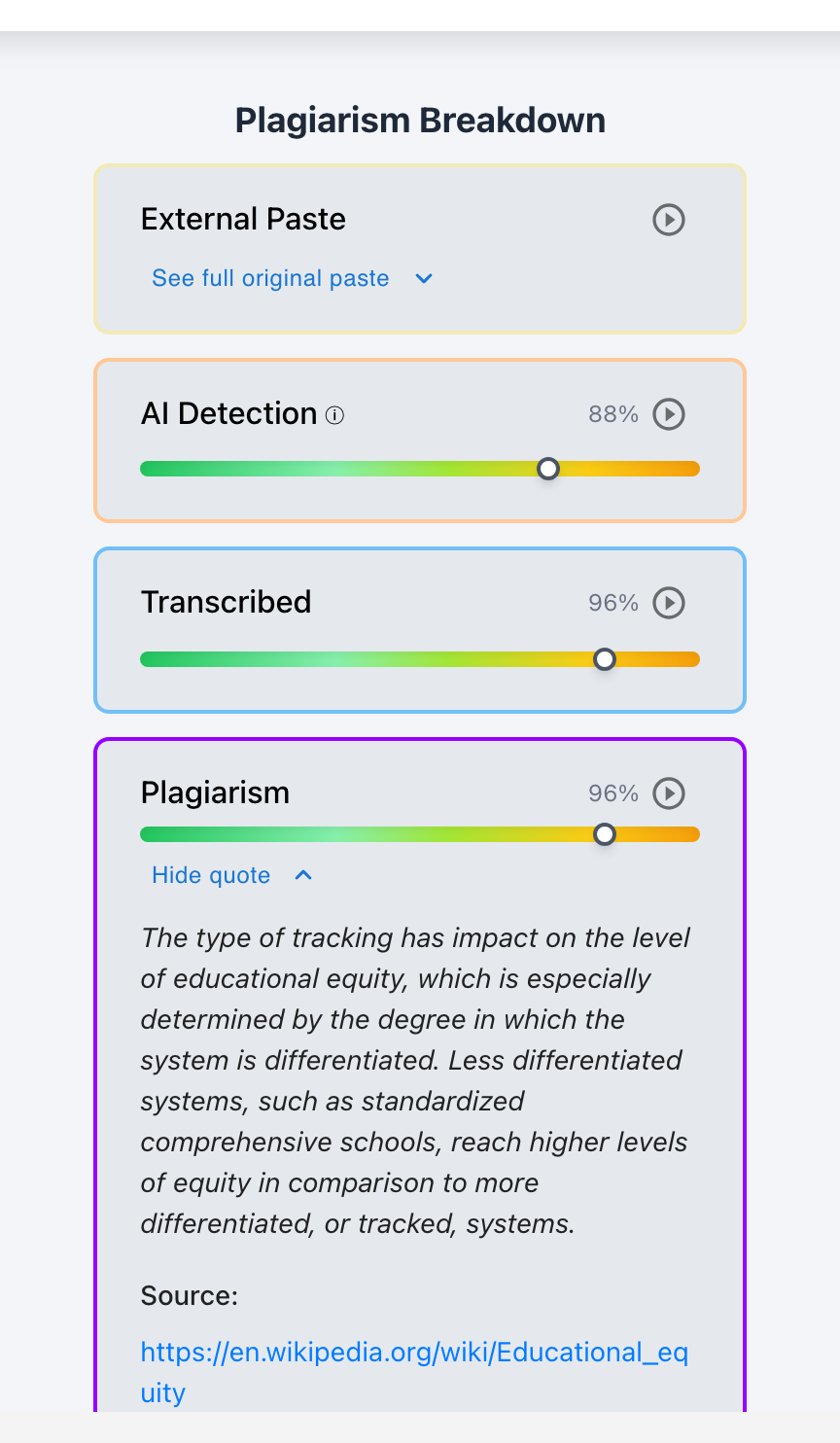
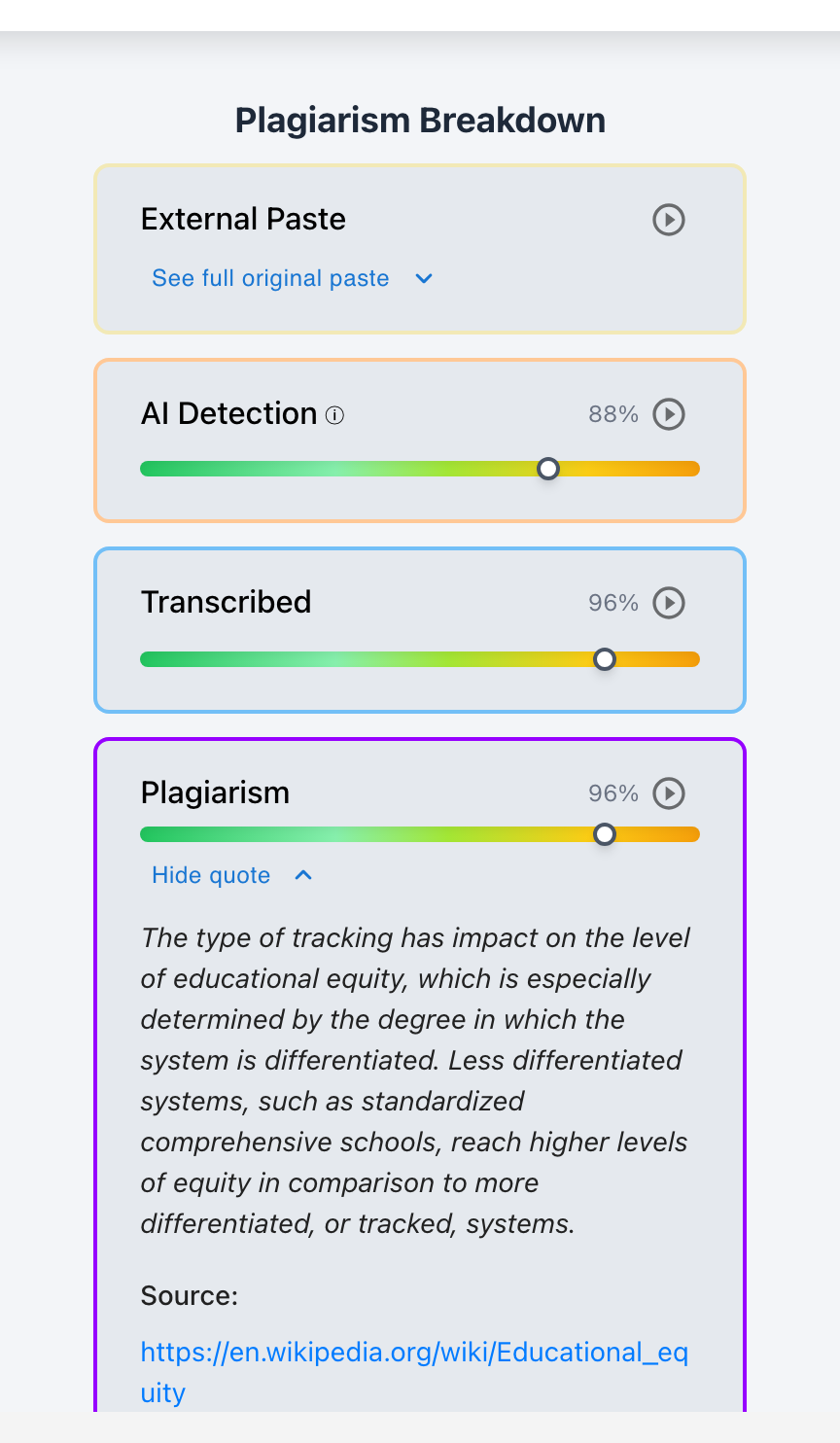
In describing how novices enter academic life, one scholar notes that every time a student sits down to write for a course, the student has to invent the university for the occasion and learn to speak as the instructors do (Bartholomae, 1985).
1. Synchronized Source Verification & 4-Badge Categorization
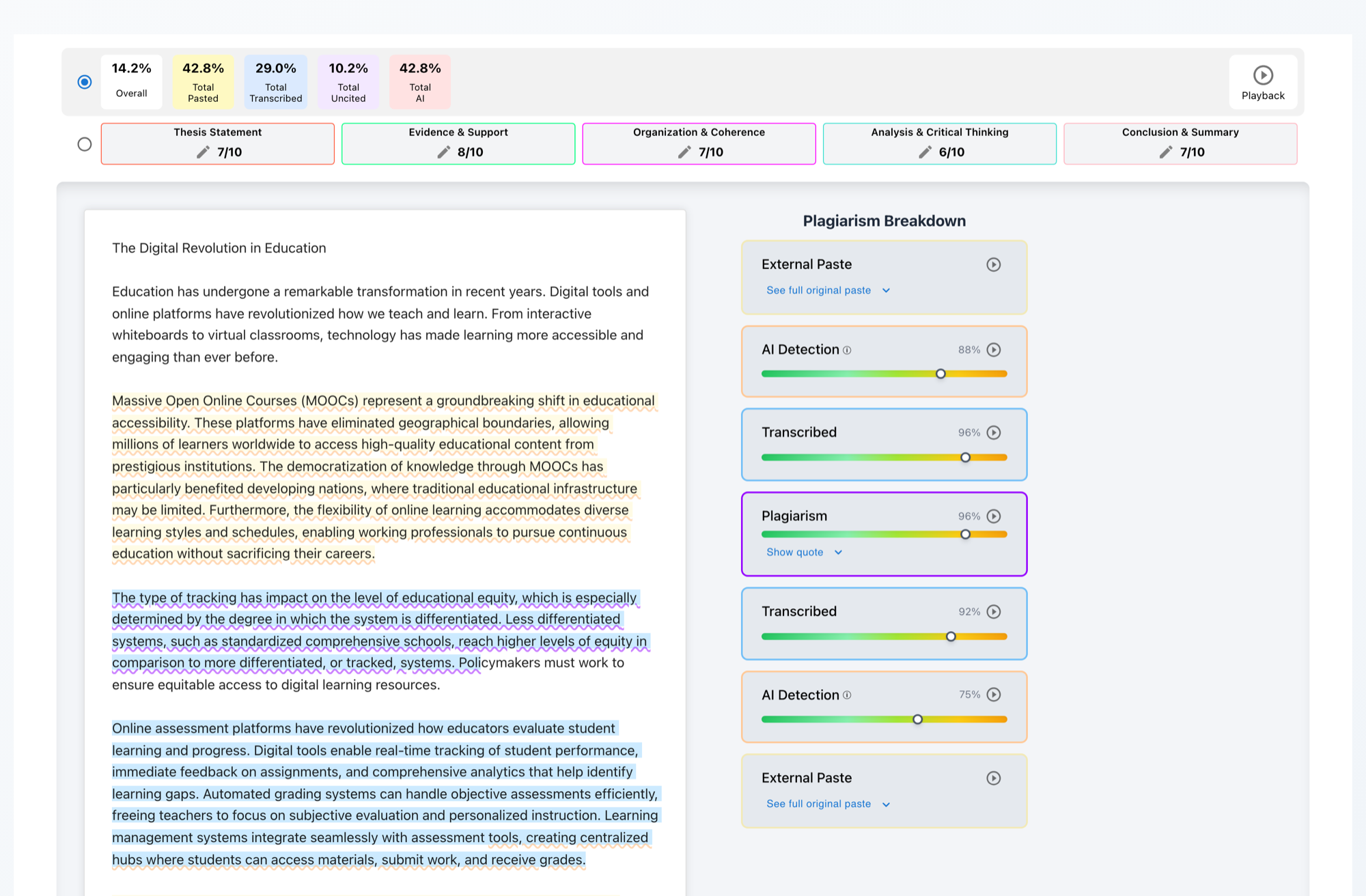
Checkmark eliminates the ambiguity of monolithic similarity scores by analyzing every matched phrase against its immediate syntactic and bibliographic context. In the Checkmark Integrity Report, matched passages are assigned one of four discrete visual status badges:
The passage is enclosed in valid quotation marks (or formatted as a block quotation) and possesses an adjacent parenthetical or footnoted citation. Excluded from risk calculations.
The passage exhibits near-verbatim or patchwritten alignment with an external source and includes an in-text author citation, but omits quotation marks. Routes to citation coaching.
The passage matches an external web page, journal article, or book without in-text attribution or quotation marks. Displays side-by-side text comparison with source URL and metadata.
The passage matches a submission from another student within the same school district, university department, or historical institutional repository without exposing student PII.
2. Essay Playback™ across Multi-Draft Portfolios
For portfolio evaluations, Checkmark’s patent-pending Essay Playback™ enables honor council committees to scrub through the entire writing history of every document in the portfolio timeline at 1x to 8x speed:
- Multi-Draft Session Linking: Reviewers can toggle between Draft 1 (Outline & Annotated Bib), Draft 2 (Rough Draft), and Draft 3 (Final Submission) to witness the evolution of specific paragraphs.
- Composing Pause Visualization: The timeline graphs writing velocity over time, highlighting where the student paused to formulate thoughts versus where writing flowed smoothly.
- Exoneration of Authentic Struggling Writers: If a student is accused of deliberate plagiarism because a literature review paragraph closely resembles a journal article, Essay Playback provides conclusive visual proof that the student spent 45 minutes typing, erasing, consulting notes, and re-crafting the sentence—proving developmental patchwriting rather than bad-faith cut-and-paste.
3. External Paste Buffer Tracking with 100% Raw Text Preservation
A critical challenge in modern plagiarism adjudication is the student who pastes a large block of text from an illicit source or AI generator, and then spends 20 minutes manually changing every fifth word using a thesaurus to evade similarity checkers.
Checkmark solves this through Complete Clipboard Telemetry:
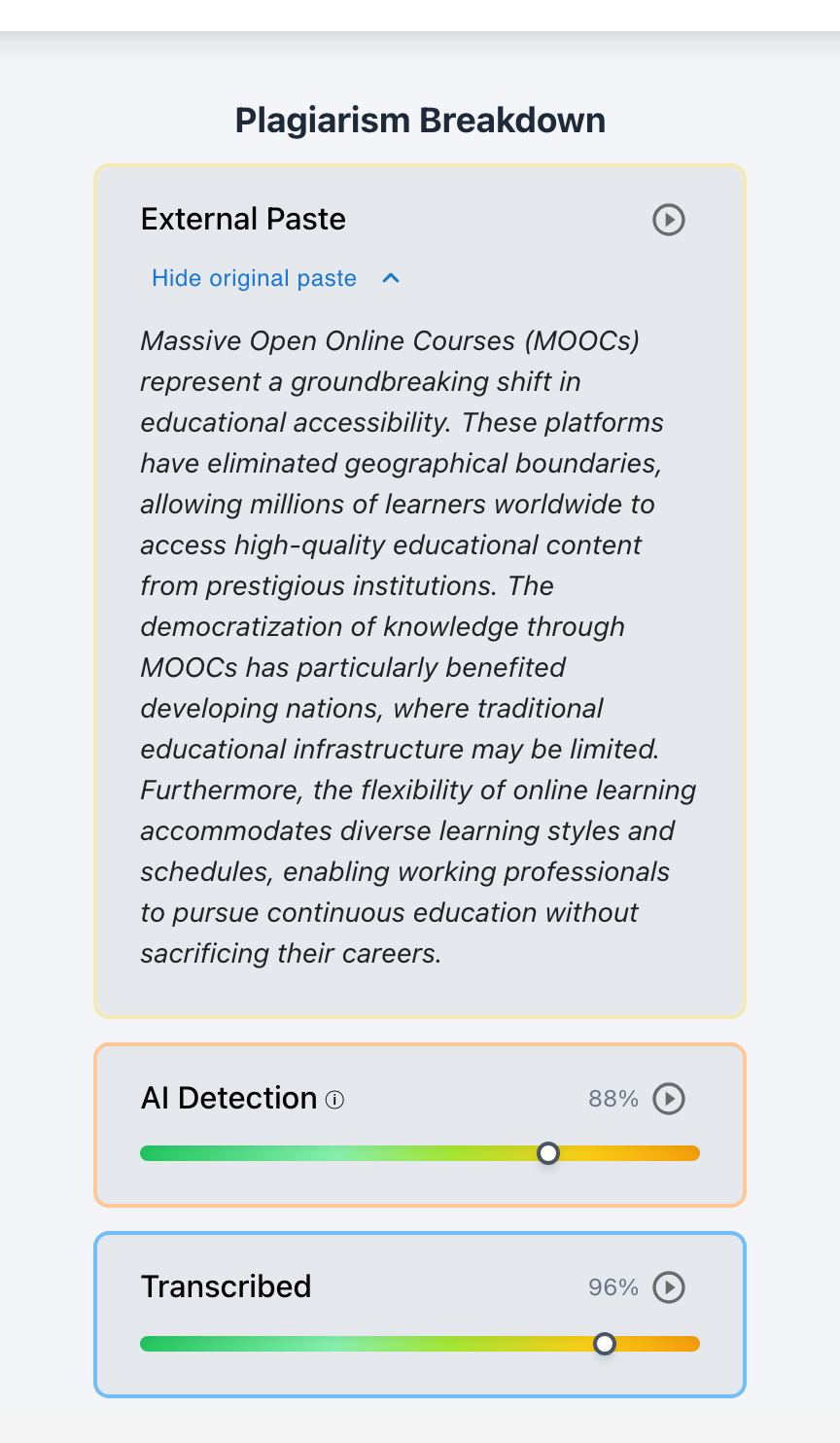
- The moment text is pasted into the document editor (in Google Docs, Microsoft Word, Canvas, or Buzz LMS), Checkmark captures the raw clipboard string, word count, timestamp, and source metadata.
- Even if the student subsequently edits, rewords, or deletes 100% of the pasted text, the original raw pasted text remains permanently preserved in the instructor’s evidence card.
- Clicking the “Jump to Playback” button transports the reviewer directly to the exact second in the timeline when the paste occurred, providing indisputable physical evidence during honor hearings.
4. Granular Passage-Level AI Detection with Honest Guardrails
Portfolio reviews often include non-standard writing genres—such as brief 100-word reflective self-assessments, artistic statements, or methodology abstracts. Generic AI detectors produce massive false-positive rates on short texts because statistical perplexity and burstiness metrics require sufficient sample sizes to achieve mathematical stability.
Checkmark protects students and institutions through rigorous safeguards:
- Honest Short-Text Guardrail (<150 words): Any portfolio section under 150 words displays
N/A (Sample Below Minimum Statistical Threshold)rather than generating an unreliable probability score. - Passage-Level Granularity: Rather than assigning an entire 20-page senior capstone a blanket “35% AI Score,” Checkmark highlights only the specific sentences that display non-human linguistic predictability, accompanied by individual evidence cards and calibrated confidence sliders.
- Immunity to AI “Humanizers”: While tools like QuillBot or Undetectable AI can alter surface vocabulary to trick static text classifiers, they cannot fabricate authentic keystroke dynamics, typing latencies, and revision histories in Essay Playback™.
5. Teacher-in-the-Loop Rubric Autograding & LMS Synchronization
Checkmark’s AI Rubric Autograder accelerates the evaluation of multi-genre portfolios while keeping faculty firmly in control:
- Evaluates portfolio artifacts against custom institutional rubrics (such as AAC&U Written Communication VALUE Rubrics).
- Generates quote-anchored justifications tied directly to specific lines of student prose, explaining exactly why a criterion received a given rating.
- All generated marks remain editable draft suggestions until explicitly approved by the instructor, who can publish finalized scores directly back to Canvas LMS SpeedGrader, Agilix Buzz, or Google Classroom with a single click.
5. Illustrative Case Studies in Institutional Adjudication
The following three illustrative scenarios (example cases, not drawn from named institutions) show how Academic Integrity Officers, Department Chairs, and Honor Boards apply Checkmark’s multi-vector evidence framework to resolve complex portfolio inquiries.
Undergraduate Pre-Nursing FYC Writing Portfolio
(Braveman et al., 2018) parenthetically 6 times and listed full citation in Works Cited, but failed to enclose patchwritten sentences in quotation marks.Hearing Analysis: During the hearing, the student was visibly distressed, fearing expulsion. When the Honor Board chair opened Checkmark’s Essay Playback™, the committee observed the student typing a sentence, pausing for 18 seconds, consulting Braveman's article, deleting three words, and typing synonyms. The amber Cited but Unquoted badges confirmed that the student had meticulously attributed the ideas to Braveman in every paragraph. Thanks to the keystroke receipts and citation badging, the committee avoided a wrongful suspension, transformed a terrifying disciplinary hearing into a restorative mentoring moment, and praised the student's longitudinal improvement.
Suspected Mosaic Plagiarism vs. Empirical Synthesis
Hearing Analysis: This case demonstrates why whole-document similarity percentages are dangerously misleading. Because the 40-page capstone contained 30 pages of original survey data and methodology, the legacy scanner reported a deceptively low 14% aggregate similarity score, which passed the department's automated filter. However, Checkmark's Paste Buffer Telemetry exposed the 2,850-word midnight clipboard drop. When confronted with the side-by-side synchronized view and the 0ms paste timestamp, the student admitted to purchasing the literature review section from an online tutoring service. The defensible evidence protected institutional accreditation and academic standards.
Authorized Collaborative Scaffolding vs. Peer Collusion
N/A (<150 words), preventing false AI flags on informal notes.Hearing Analysis: Without Checkmark's multi-draft portfolio tools, this AP student would have been disqualified from the AP Capstone program. The legacy LMS scanner simply reported a terrifying “42% Peer Plagiarism” alert because it could not recognize that the matching text was the student's own authorized prior team project. Checkmark's Peer Cohort Match Workbench immediately displayed both documents side-by-side, linking the student’s name to both submissions within the secure district repository. Combined with Essay Playback™, the AP coordinator verified in less than three minutes that all individual argument sections were 100% authentically composed.
6. The 4-Phase Restorative Portfolio Adjudication Protocol
Academic Integrity Officers, Deans, and Department Chairs should establish a standardized, transparent 4-phase protocol for evaluating contested portfolio submissions:
Filter out intra-portfolio self-matches (Draft 1 → Draft 2 → Final). Categorize matches using 4 Visual Badges (🟢, 🟡, 🔴, 🟣). Isolate disciplinary nomenclature and standard bibliographic strings.
Audit Essay Playback™ keystroke velocity, pauses, and backspaces. Inspect Paste Buffer Logs (0ms drops vs. incremental typing). Check Raw Clipboard Text Preservation for post-paste rewrites. Review Passage-Level AI Sliders with <150w Short-Text Guardrails.
Open Checkmark synchronized workbench alongside the student (“Stop guessing, start trusting”). Walk through Essay Playback™ collaboratively. Assess oral cognitive alignment (can student explain concepts?).
- Zero punitive transcript marks
- Writing Center coaching module
- Mandatory draft revision cycle for portfolio credit
- Formal Honor Board referral
- Course grade penalty / Assignment zero
- Documented academic integrity violation
Phase 1: Portfolio Triage & Multi-Draft Differential Analysis
Before notifying the student or convening a hearing, the integrity officer performs an initial evidentiary triage within Checkmark:
- Activate Multi-Draft Filter: Exclude previous assignment submissions by the same student within the portfolio container to eliminate self-matching false positives.
- Review Citation Badge Distribution: If 90%+ of flagged text consists of 🟢 Green (Quoted & Cited) or 🟡 Amber (Cited but Unquoted) badges, the issue is mechanical/developmental, not fraudulent.
- Check Disciplinary Jargon Density: Ensure that standard field methodologies and bibliographic references are excluded from similarity calculations.
Phase 2: Process Evidence & Writing Telemetry Audit
If substantive 🔴 Red (Uncited External) or 🟣 Purple (Peer Cohort) badges remain, the reviewer examines writing process telemetry:
- Audit Keystroke Dynamics in Essay Playback™: Observe whether the flagged passages were drafted with organic human pausing (Inter-Key Interval > 200ms, frequent backspaces) or injected instantly.
- Examine Paste Buffer Logs: Identify whether text was dropped via external clipboard (t < 10ms) and inspect the preserved raw clipboard text.
- Verify AI Confidence Sliders: Ensure no short-text sections (<150 words) are flagged and verify that flagged AI passages display consistent high-confidence linguistic markers.
Phase 3: The Restorative Evidence-Based Student Conference
The integrity conference is conducted under the guiding philosophy: “Stop guessing, start trusting.”
- Screen-Share the Evidence Workbench: Display the Checkmark report directly to the student, showing both the side-by-side text matches and the Essay Playback timeline.
- Conduct the Oral Explanation Probe: Ask the student to explain the core ideas of the flagged section without looking at the text.
- Invite the Student to Narrate Their Drafting: Replay the keystroke timeline at 2x speed and ask the student to describe what they were thinking and reading during the extended pauses.
Phase 4: Calibrated Outcome Determination
The committee categorizes the case into one of three outcome pathways:
- Path 1: Developmental Scaffolding (No Violation): Applied to patchwriting, missing quotation marks on cited sources, or early-stage discourse struggles. The student is referred to the Writing Center for a mandatory citation clinic and permitted to revise the portfolio entry for full or partial credit.
- Path 2: Negligent Misconduct (Formative Sanction): Applied when a student rushed, failed to track sources in research notes, and committed widespread uncredited patchwriting without deliberate intent. Requires portfolio re-submission with a grade cap and completion of an academic integrity module.
- Path 3: Deceptive Authorship Fraud (Disciplinary Sanction): Applied to contract cheating, wholesale paper mill pastes, deliberate mosaic cloaking, or unindexed peer theft confirmed by 0ms paste telemetry and failure of oral defense. Triggers standard institutional honor code penalties.
7. Institutional Governance: Honor Board Rubrics, Policies, & Guidelines
To ensure consistency across departments and academic terms, institutions should formalize portfolio review standards through objective deliberation rubrics and explicit syllabus policies.
Honor Council Portfolio Deliberation Rubric
Academic integrity boards should use the following standardized rubric during formal hearings to evaluate evidence objectively:
| Evaluation Criterion | 1: Clear Developmental Patchwriting (No Sanction) | 2: Negligent Source Integration (Educational Remedy) | 3: Deliberate Plagiarism / Fraud (Disciplinary Sanction) |
|---|---|---|---|
| Attribution Status | Author cited in-text & in bibliography; quotes omitted mechanically. | Source listed in bibliography but omitted from in-text sentences. | Source completely omitted from in-text citations and bibliography. |
| Writing Telemetry | Essay Playback proves organic drafting, pauses, and backspaces. | Mixed typing and pasting from student's own unstructured notes. | 0ms external clipboard drop or mechanical second-screen transcription. |
| Longitudinal Arc | Substantial reduction in borrowing between Draft 1 and Final. | Borrowing remains unchanged across drafts due to lack of revision. | Contested section inserted suddenly at final deadline with no prior draft. |
| Oral Articulation | Student thoroughly explains ideas and source concepts orally. | Student understands general idea but struggles with specific terms. | Student cannot define vocabulary or explain thesis arguments. |
| Recommended Action | Exoneration & Writing Center Referral | Draft Revision & Formative Ethics Module | Formal Course Failure & Disciplinary Record |
Model Syllabus Policy for Multi-Draft Portfolios
Writing Program Administrators and Department Chairs can adapt this model policy for inclusion in course syllabi and academic integrity handbooks:
Academic Integrity & Source Integration Policy for Multi-Draft Portfolios: In this course, writing is taught and evaluated as an iterative, developmental process. Your cumulative portfolio represents the evolution of your thinking, research, and disciplinary voice over time.
1. Developmental Drafting & Source Apprenticeship: As you engage with complex scholarship, learning to synthesize authoritative sources is a fundamental skill. If you struggle to put dense academic arguments into your own words, consult the instructor or Writing Center tutors during drafting stages. Close paraphrasing with proper citations (patchwriting) will be treated as a developmental coaching opportunity during preliminary drafts, not an honor code violation.
2. Attribution Requirements for Final Submissions: In your final portfolio submissions, all text derived from external sources must follow professional attribution standards:
- Direct phrasing (3+ consecutive words from a source) MUST be enclosed in quotation marks AND accompanied by a parenthetical citation.
- Paraphrased ideas MUST be entirely rewritten in your own sentence structure AND cited.
3. Writing Process Telemetry & Verification: This course uses Checkmark Plagiarism integrated within Canvas LMS. Checkmark captures authentic drafting history (Essay Playback™) to verify student authorship and protect honest students from false accusations. All assignments must be composed within the approved digital editor. Pasting pre-written text from outside documents in a single block without prior instructor approval may require an oral authorship conference.
8. Frequently Asked Questions (FAQs)
1. How does patchwriting differ legally and ethically from copyright infringement or deliberate fraud in academic settings?
In composition studies, patchwriting is recognized as a transitional cognitive strategy—a linguistic coping mechanism used by novice writers attempting to navigate unfamiliar academic vocabulary. Unlike copyright infringement (which involves commercial exploitation of proprietary intellectual property) or deliberate academic fraud (which involves intentionally misrepresenting outsourced or stolen work as one's own to gain unearned academic credentials), patchwriting typically includes author attribution and reflects active, albeit imperfect, student effort. Treating patchwriting as criminal fraud damages student self-efficacy and misallocates institutional disciplinary resources.
2. Why do legacy plagiarism tools frequently generate false alarms on multi-draft portfolio submissions?
Legacy plagiarism checkers evaluate documents as isolated, static strings of text. When applied to multi-draft portfolios, they trigger severe false positives because: (1) They flag a student’s final capstone against their own earlier draft submissions stored in LMS databases; (2) They cannot differentiate between properly cited paraphrases that lack quotation marks and uncredited copy-pastes; and (3) They treat standard disciplinary terminology, legal definitions, and scientific methodology protocols as copied text. Checkmark eliminates these errors through multi-draft cohort filtering, synchronized source badging, and keystroke playback.
3. Can a student fake authentic typing telemetry in Essay Playback™ by manually typing from a secondary screen?
No. Checkmark’s writing telemetry algorithms analyze fine-grained Keystroke Dynamics, including Inter-Key Intervals (IKI), cognitive pause latencies, and revision friction. When a student composes authentically, their typing displays high burstiness—rapid bursts of 5–15 characters followed by 2-to-10-second pauses at conceptual boundaries, interspersed with regular backspaces, word deletions, and cursor repositioning. When a student transcribes text from a secondary phone or monitor, their typing exhibits an unnaturally flat, isochronous rhythm (constant 100ms–130ms spacing) with zero conceptual pauses and near-zero structural revisions.
4. How should honor boards handle submissions that contain both developmental patchwriting and minor generative AI assistance?
Honor boards should use Checkmark’s Passage-Level AI Confidence Sliders and Essay Playback™ to evaluate the multi-modal drafting timeline: (1) Isolate the patchwritten sections to determine if the student was citing authentic human scholarship; (2) Examine the AI-flagged passages to determine whether AI was used legitimately as an editorial assistant (e.g., grammar refinement, brainstorming) or illegitimately as an automated ghostwriter; and (3) Checkmark’s granular evidence cards allow boards to evaluate each passage independently rather than rejecting the entire portfolio based on an ambiguous composite score.
5. What role does student intent play in determining portfolio academic integrity violations?
While institutional honor codes often state that lack of intent does not excuse plagiarism, establishing intent is essential for determining proportionality of sanctions. Distinguishing between developmental error (a student who cited the author but omitted quotation marks due to poor note-taking) and bad-faith deception (a student who used clipboard dumps and AI paraphrasers to conceal copied text) ensures that universities fulfill their educational mission. Checkmark provides the objective physical “receipts” (paste logs, keystroke playback, citation links) necessary to establish intent beyond subjective conjecture.
6. How does Checkmark Plagiarism comply with FERPA and COPPA during cross-semester cohort portfolio comparisons?
Unlike legacy vendors that store student essays in global, multi-tenant databases to train commercial AI models or monetize student intellectual property, Checkmark operates under a strict Zero-Retention, FERPA/COPPA-Compliant Architecture: Student writing is analyzed in real time using salted cryptographic hashes (MinHash LSH); Submissions are NEVER used to train machine learning models; and Cross-section and multi-semester comparisons occur strictly within the school district’s or university’s isolated, private institutional perimeter. Student personally identifiable information (PII) is never exposed across LMS shells or to external third parties.
7. How can writing center tutors and faculty collaborate using Checkmark's citation badges during portfolio revision cycles?
Checkmark’s two-way linked evidence workbench acts as a shared pedagogical diagnostic tool. Before a student submits their final graduation portfolio, writing center tutors and faculty can review the draft in Checkmark: Tutors filter the document by 🟡 Cited but Unquoted (Amber Badges) to conduct targeted, 15-minute workshops on quotation integration and signal phrases; Instructors use the AI Rubric Autograder to generate formative, sentence-level revision prompts anchored directly to student paragraphs; and this transforms academic integrity from a terrifying post-submission policing event into a continuous, supportive learning dialogue.
Elevate Portfolio Integrity with Defensible Process Evidence
Equip your academic integrity officers, honor council panels, and department chairs with Checkmark’s multi-draft source verification workbench, Essay Playback™ keystroke dynamics, and passage-level AI detection.