
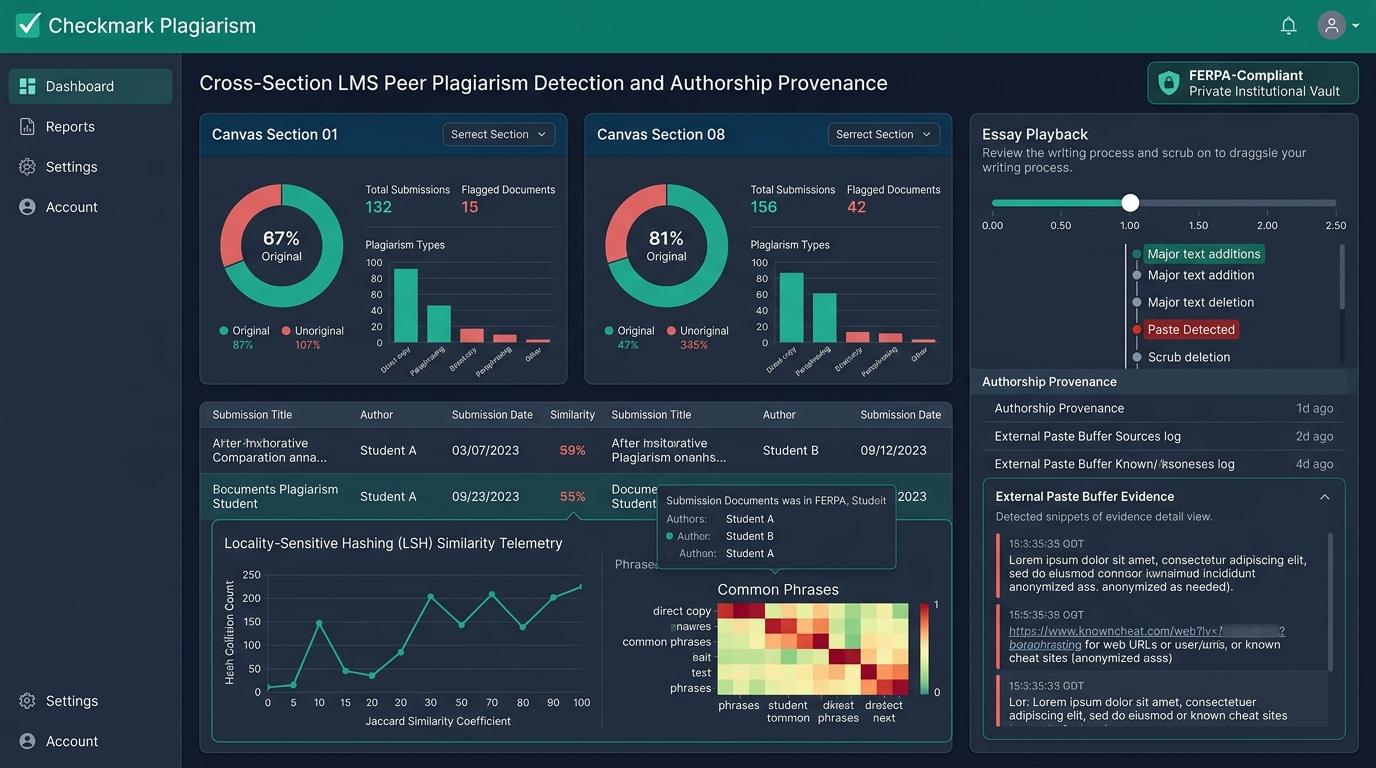
In secondary schools, unified school districts, and higher education institutions, unauthorized peer-to-peer assignment sharing across different class periods, distinct Learning Management System (LMS) course shells, and historical academic terms has become one of the most pervasive yet undetected vectors of academic dishonesty. When students share lab reports between morning and afternoon periods, exchange essays across parallel Canvas LMS sections taught by different instructors, or access multi-semester student organization test banks, traditional web-only plagiarism scanners fail entirely because the text does not exist on the public internet. Furthermore, legacy commercial plagiarism tools create severe FERPA vulnerabilities by permanently storing student writing in global, multi-tenant databases.
To resolve this crisis without compromising student privacy or pedagogical trust, academic integrity officers, department chairs, and instructional technology directors must deploy a Cross-Cohort Multi-Vector Integrity Architecture. By combining privacy-preserving cryptographic hashing (salted MinHash / Locality-Sensitive Hashing) across isolated LMS shells with patent-pending Essay Playback™ keystroke dynamics, side-by-side comparative source alignment, passage-level AI writing detection, and quote-anchored rubric autograding, Checkmark Plagiarism provides educational leaders with the transparent, defensible evidence needed to definitively establish authorship provenance, protect honest students, and foster restorative learning conversations.
Checkmark Plagiarism empowers academic integrity officers, deans, and department chairs to safeguard multi-section curricula by connecting cross-cohort plagiarism scanning with writing process replay, passage-level AI detection, and enterprise integrations for Canvas LMS, Agilix Buzz, and Google Classroom.
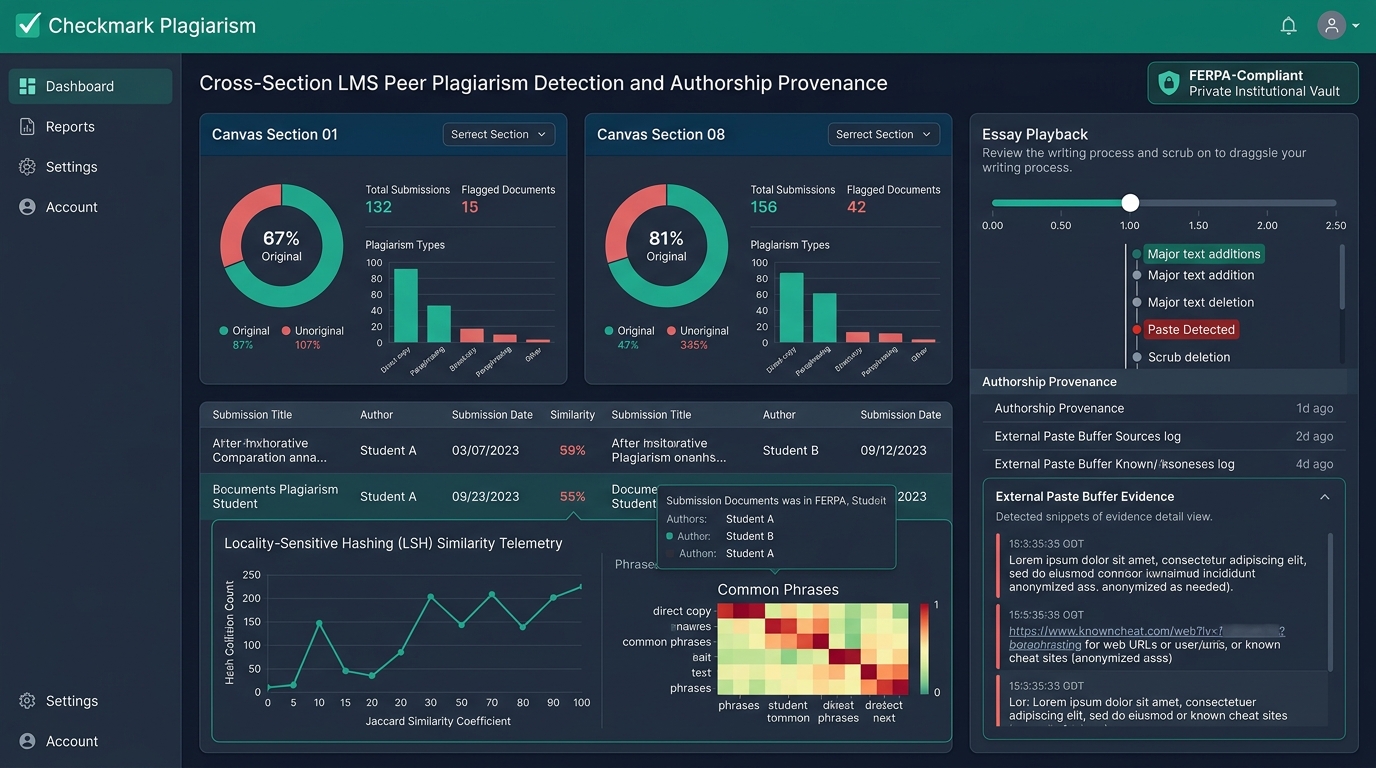
1. The Anatomy of Modern Peer-to-Peer Assignment Sharing
In modern digital learning environments, academic collaboration and peer interaction are encouraged as foundational pedagogical practices. However, the boundary between legitimate peer collaboration and unauthorized assignment sharing has become increasingly blurred by ubiquitous cloud productivity suites, group messaging platforms, and institutional LMS architectures.
Same instructor, identical lab prompt or DBQ, submitted 5 hours apart. Afternoon students receive completed calculations, analysis paragraphs, and conclusions.
Same university course, 1,000+ enrolled students, 12 separate TAs grading in SpeedGrader silos with zero cross-section communication.
Persistent cloud archives maintained by student organizations or sports teams. Incoming students retrieve previous A-grade assignments and modify headers.
Student B passes Student A's authentic draft through an AI paraphraser or types from a second screen, depressing traditional similarity percentages to single digits.
The Institutional Blind Spots of LMS Silos
Learning Management Systems such as Canvas LMS, Agilix Buzz, Google Classroom, and Moodle are architecturally designed around isolated administrative containers:
- Canvas LMS: Organizes instruction into unique
course_identities, isolatedsub_account_idstructures, and distinct section enrollments. A teaching assistant grading Section 04 typically possesses zero visibility into submissions uploaded to Section 12. - Agilix Buzz: Structures curricula through master course templates deployed across distributed school domain shells and independent teacher gradebooks.
- Google Classroom: Segregates coursework into distinct class stream folders within Google Drive, preventing native cross-cohort comparison.
When students exploit these architectural partitions, conventional grading workflows break down. An instructor grading 150 submissions across three sections cannot mentally cross-reference a 2,000-word essay submitted on Monday morning against an essay submitted on Tuesday afternoon by a student in a completely different section.
2. Technical Mechanics: Cross-Section Cohort Scanning vs. External Web Matching
Detecting peer-to-peer assignment sharing requires fundamentally different computational architectures than standard web plagiarism scanning. Conventional search engines crawl open HTML pages on the public web, but student submissions inside LMS portals are private, password-protected, and strictly firewalled.
| Architectural Vector | Legacy Web-Only Plagiarism Scanners | Checkmark Private Cross-Cohort Vaults |
|---|---|---|
| Target Corpus | Public HTML pages, open web, blogs, Wikipedia | Cross-section LMS submissions & live web |
| Multi-Section Indexing | ❌ None (completely blind to internal LMS shells) | ✅ Real-time cross-section & cross-term synchronization |
| Student Privacy & FERPA | ⚠️ Varies; student work frequently stored in global multi-tenant pools | ✅ 100% FERPA/COPPA zero-retention institutional vault |
| Secondary AI Training | ❌ Student text harvested to train commercial AI models | ✅ Zero AI model training on student writing (strict zero-training SLA) |
| Provenance Determination | ❌ Impossible (text-only match without temporal data) | ✅ Definite (patent-pending Essay Playback™ keystroke replay) |
The Mathematics of Privacy-Preserving Cohort Matching
To scan across multiple LMS sections without exposing raw student writing to external third parties or violating student intellectual property, Checkmark Plagiarism employs an advanced Cryptographic Locality-Sensitive Hashing (LSH) and MinHash pipeline.
Student essay is normalized (lowercased, stripped of non-semantic formatting) and segmented into overlapping k-shingles (e.g., k = 8 tokens).
Shingles are transformed through h independent hash functions using district-specific cryptographic salts: h_i(s) = (a_i × s + b_i) mod p.
MinHash signature vectors are partitioned into b bands of r rows. Documents with high Jaccard similarity collide in identical hash buckets without transmitting or storing readable student prose.
Real-time matching across Canvas Course IDs, Agilix Buzz Domains, and Google Classroom cohorts strictly within the secure institutional perimeter.
1. Tokenization and $k$-Shingling
When an essay is submitted via an LMS integration, the system extracts the textual payload and decomposes it into a continuous sequence of overlapping token clusters known as $k$-shingles. For a document $D$, the set of $k$-shingles $S(D, k)$ represents all contiguous word sequences of length $k$:
By selecting $k = 7$ to $k = 9$, the algorithm captures distinct syntactical constructions while remaining robust against minor punctuation changes or trivial stop-word substitutions.
2. MinHash Signature Generation
Directly comparing raw shingle sets across tens of thousands of district submissions requires prohibitive computational memory ($O(N^2)$). Instead, Checkmark computes a compact MinHash signature vector. For a set of $h$ randomized, pairwise-independent hash functions ${h_1, h_2, dots, h_m}$, the $i$-th component of the MinHash signature for document $D$ is defined as the minimum hash value across all shingles:
The fundamental theorem of MinHashing guarantees that the probability of two documents having identical MinHash values under a random hash function is mathematically equivalent to their Jaccard similarity coefficient:
3. Locality-Sensitive Hashing (LSH) Banding
To enable sub-second candidate pair matching across millions of historical district assignments, MinHash signatures are divided into $b$ bands, each containing $r$ rows ($m = b cdot r$). Two documents are flagged as potential peer-sharing candidates if their sub-vectors match exactly in at least one band:
By tuning $b$ and $r$, academic integrity administrators establish an exact, calibrated threshold (e.g., $J ge 0.65$) that reliably flags substantive peer sharing while ignoring coincidental overlap in standardized assignment instructions.
3. FERPA, COPPA, and the Zero-Retention Imperative
When establishing cross-section peer detection systems, school districts and universities face a strict legal boundary: student data privacy.
[ District A Student ] → [ Central Vendor Cloud ] → [ Derivative AI Training & Global Public Index ]
Violation: Secondary use of student records without parental consent (34 CFR § 99.33). Student intellectual property is monetized and retained indefinitely in third-party databases.
The Federal Regulatory Framework
Under the Family Educational Rights and Privacy Act (FERPA, 34 CFR Part 99), student essays, research reports, and writing submissions are legally classified as Education Records. When an educational institution uses a third-party technology platform, the vendor must operate strictly as an authorized “School Official” under 34 CFR § 99.31(a)(1)(i)(B):
- Strict Purpose Limitation (34 CFR § 99.33(a)): The vendor may access and process student data only for the explicit educational service contracted by the institution.
- Prohibition on Secondary Data Exploitation: A vendor cannot legally ingest student essays into external commercial databases, pool submissions into global unencrypted indexes accessible to other institutions, or use student writing to train proprietary artificial intelligence models.
Checkmark’s Zero-Retention & Private Institutional Vault Architecture
Checkmark Plagiarism eliminates federal compliance exposure through an enterprise Zero-Retention Architecture:
- Institutional Multi-Tenant Isolation: Cross-section scanning occurs strictly within the verified boundaries of your district or university account. Submissions from District A are never accessible, readable, or searchable by District B.
- Cryptographic Hash Vaulting: Submissions stored for cross-term integrity matching are maintained as non-reversible mathematical signatures rather than plain-text documents.
- Zero Machine Learning Training: Student essays are never ingested, vectorized, or processed to train general AI models, NLP classifiers, or third-party neural networks.
- Granular Data Lifecycle Controls: District administrators maintain complete sovereignty to define document retention schedules—enabling automatic cryptographic purging upon student graduation or term conclusion.
4. The Provenance Dilemma: Who Wrote It, and Who Copied It?
When an academic integrity report flags an 84% Peer Overlap between two essays submitted in different Canvas sections, academic integrity officers face the fundamental Provenance Dilemma:
“If Student A and Student B submit nearly identical papers, which student spent three days conducting research and drafting the prose, and which student received the completed file five minutes before the deadline?”
Static text similarity report flags 88% Peer Overlap. Because text-only tools lack timestamps of the drafting process, instructors cannot distinguish between the author and the recipient.
Essay Playback™ replays the exact composition history. Student A displays 4.5 hours of drafting with natural typing bursts, revisions, and pauses. Student B displays a 0.2-second clipboard paste.
Why Text-Only Similarity Checkers Fail
Traditional plagiarism detection platforms operate exclusively on static, post-hoc textual comparisons. They analyze the finished string of characters submitted to the LMS. Because static text contains zero temporal information, text-only scanners cannot determine:
- The chronological order of drafting (as opposed to submission timestamps, which can be easily manipulated).
- Whether a student typed the words character-by-character or pasted the entire manuscript in a single action.
- Whether one student acted as an unconsenting victim whose shared Google Doc or physical notebook was copied without permission.
5. Checkmark Plagiarism’s Multi-Vector Integrity Suite
Checkmark resolves the provenance crisis through an integrated suite of forensic writing analytics:
Cross-Section Peer Alignment
Salted MinHash / LSH vaults index cross-cohort submissions across Canvas, Buzz, and Google Classroom. Side-by-side synchronized comparison highlights matched spans and paraphrased clauses.
Patent-Pending Essay Playback™
Keystroke-by-keystroke video timeline with 1x to 8x scrubbable controls, composing pause analytics, and raw paste buffer preservation proving authentic author provenance.
Passage-Level AI Writing Detection
Sentence-level confidence sliders, perplexity and burstiness metrics, short-text guardrails (<150 words N/A), and private educator flag workflows immune to synonym humanizers.
AI Rubric Autograder & Passback
Quote-anchored rubric justifications, educator final scoring authority, and 1-click grade sync back to Canvas SpeedGrader, Agilix Buzz, and Google Classroom.
Pillar 1: Side-by-Side Comparative Peer Alignment
Checkmark displays flagged cross-section matches within a synchronized, split-screen comparison interface:
“The enzymatic activity of catalase decreases precipitously as thermal energy exceeds 45°C, causing irreversible denaturation of the protein’s tertiary active site.”
“The enzymatic activity of catalase decreases rapidly as thermal energy exceeds 45°C, causing irreversible denaturation of the enzyme’s tertiary structure.”
- Two-Way Linked Evidence Cards: Clicking any highlighted sentence in either essay automatically jumps to and highlights the corresponding text in the comparison panel.
- Paraphrase & Synonym Tracking: Highlights structural syntax alignment even when a student has swapped individual words using a thesaurus or paraphrasing extension.
- Private Institutional Repository: Direct clickable links allow authorized department chairs to review the matching peer submission within their institutional portal.
Pillar 2: Patent-Pending Essay Playback™ & Keystroke Dynamics
Essay Playback™ captures the entire temporal drafting process, transforming static submissions into a rich, scrubbable video timeline:
Keystroke Metrics that Prove Authorship Provenance
| Telemetry Dimension | Authentic Student Author | Unauthorized Peer Recipient |
|---|---|---|
| Total Active Time | 2 to 6+ hours across multiple sessions | < 5 minutes (bulk paste or rapid mechanical re-type) |
| Deletion / Revision Ratio | 15% – 30% backspaces, deletions, and structural re-writes | < 2% deletions (linear character feed or single paste) |
| Composing Pauses | Frequent 4–15s cognitive pauses before complex clauses | Continuous mechanical typing (>85 WPM) with zero composing pauses |
| External Paste Buffer | Isolated direct quotes and citations with source references | Large multi-paragraph text insertion from unverified clipboard |
1. The External Paste Buffer with 100% Original Text Retention
When a student pastes external text into the document editor, Checkmark captures the exact timestamp, logs the character count, and permanently archives the full raw clipboard content in an isolated paste buffer.
“The enzymatic activity of catalase decreases precipitously as thermal energy exceeds 45°C...”
Even if the student subsequently spends an hour rewriting every sentence, deleting paragraphs, or substituting synonyms to evade detection, the original pasted text remains preserved in the evidence dossier. A single click on the “Jump to Paste Event” button takes the educator directly to that exact millisecond in the playback timeline.
2. Transcription Telemetry Analysis
If a student avoids pasting by manually typing out a peer’s essay from a second monitor, tablet, or smartphone, Essay Playback’s Transcription Detection Engine identifies the unnatural mechanical signature:
- Typing speed remains uniform (e.g., 75–90 WPM) without the natural velocity variations associated with cognitive composition.
- Zero large structural reorganizations, paragraph deletions, or outline restructuring.
- Lack of typical lexical search pauses (pausing before complex vocabulary or syntactical transitions).
Pillar 3: Passage-Level AI Writing Detection
When peer assignment sharing is combined with generative AI rewrites or paraphrasing tools, Checkmark’s AI writing detection analyzes the prose at sentence-level granularity:
- Passage-by-Passage Calibration: Each sentence is evaluated independently, displaying an evidence card with a calibrated confidence slider:
Typical Human Writing Style ←——————————→ Typical AI Pattern
- Linguistic Architecture Metrics: Evaluates perplexity (statistical unexpectedness of token sequences) and burstiness (variation in sentence structure and length).
- Short-Text Guardrails: Passages or submissions under ~150 words display
N/Ato prevent false positive flags on insufficient sample sizes. - Educator-Only Flag Privacy: Flag statuses (Flagged, Resolved, Not Flagged) remain private to instructors, preventing unverified automated flags from causing undue student anxiety.
Pillar 4: AI Autograder & Quote-Anchored Rubric Feedback
To assist instructors managing hundreds of cross-section submissions, Checkmark integrates an AI Rubric Autograder:
- Quote-Anchored Justifications: Every criterion score is backed by direct quotations pulled from the student’s text, explaining exactly why the essay met or missed specific rubric expectations.
- Teacher-in-the-Loop Final Authority: All automated scores and comments remain in draft status until reviewed, adjusted, and approved by the classroom teacher.
- Seamless LMS Gradebook Passback: Finalized grades, rubric matrices, and feedback comments push directly into Canvas LMS SpeedGrader, Agilix Buzz, or Google Classroom with one click.
6. Comprehensive System Comparison Matrix
| Feature / Capability | Legacy Plagiarism Scanners | Standalone AI Detectors | Checkmark Plagiarism Suite |
|---|---|---|---|
| Multi-Section LMS Scanning | Partial (Global Cloud Pool) | ❌ None | ✅ Private Institutional LSH Vaults |
| Provenance Determination | ❌ Impossible (No timeline) | ❌ Impossible | ✅ Patent-Pending Essay Playback™ |
| Keystroke & Pause Dynamics | ❌ Not captured | ❌ Not captured | ✅ 1x–8x scrubbable video timeline |
| Raw Paste Buffer Archive | ❌ Discarded | ❌ Discarded | ✅ 100% original text clipboard cache |
| FERPA Zero-Retention Policy | ❌ Submissions permanently retained | ⚠️ Varies / multi-tenant pool | ✅ 100% Zero-Model Training & Ephemeral |
| Granularity of AI Analysis | Single opaque percentage | Whole-document score | ✅ Passage-level calibrated confidence |
| Rubric Feedback & Passback | ❌ Manual grading only | ❌ None | ✅ Quote-anchored rubric autograding |
7. Real-World Case Studies & Empirical Forensic Walkthroughs
Case Study 1: The High School AP Biology Lab (Period 1 vs. Period 6 Handoff)
Drafts 1,200-word cellular respiration report. Active writing time: 2 hr 45 min with 320 typographic corrections and 48 cognitive pauses.
Submits report at 11:30 PM. Active writing time: 8 minutes. Single paste event inserted 1,180 words into blank document.
Case Study 2: University Multi-Section Introductory Psychology (3,000 Students, 12 Canvas Sections)
4.2 hours of authentic drafting, variable burstiness, multiple outline reorganizations, and citation insertions.
0 paste events, but mechanical typing rate of 88 WPM for 22 continuous minutes with 0 backspaces and 0 pauses >2s.
Case Study 3: The Inter-Term Fraternity Test Bank Archive (Spring 2024 to Fall 2026)
Literary analysis on The Great Gatsby archived as a cryptographic MinHash signature in institutional vault.
Submits same paper in Agilix Buzz. System flags 84% structural match. Paste buffer logged 1,450 words in 0.4 seconds.
8. Step-by-Step Investigation Protocol for Academic Integrity Officers
To ensure consistency, procedural fairness, and compliance with institutional honor codes, integrity officers and department chairs should follow a structured five-phase protocol:
Phase 1: Automated Triage & Cross-Section Flag Review
Open the Checkmark Academic Integrity Dashboard. Filter out common assignment prompts, boilerplates, and properly formatted direct quotations. Focus attention on cross-section peer overlap exceeding calibrated institutional thresholds (>35% non-quoted overlap).
Phase 2: Split-Screen Structural & Textual Alignment
Launch the Side-by-Side Comparison Interface. Inspect flagged submissions concurrently for shared idiosyncratic errors (identical typos or erroneous calculations), matching bibliographies, and structural syntactical alignment across body paragraphs.
Phase 3: Temporal Forensics via Essay Playback™
Review the 1x–8x scrubbable video timeline, total active composing time, composing pause distributions, and raw clipboard paste buffer logs. Determine conclusively which student is the original author and which received the completed text.
Phase 4: The Supportive Restorative Student Conference
Invite the student to a collaborative writing review using Checkmark's Student Conference Mode. Use open-ended metacognitive prompts: “Walk me through your drafting process. Let's look at your Essay Playback timeline together.”
Phase 5: Defensible Documentation & Adjudication
Export a timestamped Checkmark Integrity Dossier containing side-by-side textual alignment, keystroke telemetry graphs, paste buffer logs, and rubric feedback. Archive within student records to guarantee defensibility during honor council hearings or grade appeals.
9. Institutional Policy Frameworks: Collaboration vs. Collusion
To prevent peer sharing before it occurs, academic institutions must establish explicit policy distinctions between Authorized Collaboration and Unauthorized Collusion:
- Discussing assignment prompts, rubric criteria, and brainstorming general research themes.
- Jointly conducting laboratory experiments and collecting raw observational data in authorized lab groups.
- Peer-reviewing a printed or read-only draft to provide verbal feedback and constructive critique.
- Utilizing campus writing centers, peer tutoring programs, or approved instructional scaffolds.
- Transmitting written drafts, digital files, slide decks, or completed code to peers across class periods.
- Copying analytical narratives, hypotheses, interpretation of results, or conclusions from a lab partner.
- Providing full edit access to a live Google Doc or emailing completed assignment files.
- Accessing fraternity, sorority, club test banks, or persistent inter-term assignment repositories.
Sample Syllabus Policy Clause for Multi-Section Courses
“In this course, intellectual growth is rooted in authentic personal effort. While students are encouraged to form study groups and verbally discuss overarching course themes, all written assignments, laboratory reports, essays, and computer code must represent your independent, original composition.
Transmitting, sharing, AirDropping, emailing, or posting your written drafts to other students—regardless of whether they are enrolled in your specific class period, a different section, or a future academic term—is strictly prohibited and constitutes academic collusion. If you share your file with a peer who subsequently submits your prose, both submissions will be subject to formal academic integrity review.
Our department utilizes Checkmark Plagiarism with patent-pending Essay Playback™ to verify authentic writing processes, cross-section submissions, and keystroke dynamics. Students should compose their work within authorized LMS/Google Docs environments and maintain their revision history. Protect your intellectual work: never share editable digital files with peers.”
10. Frequently Asked Questions (FAQs)
How does Checkmark detect peer assignment sharing if two students are enrolled in completely different Canvas LMS course shells?
Checkmark connects at the root institutional account or sub-account level within Canvas LMS, Agilix Buzz, or Google Classroom. When an essay is submitted in Canvas Course ID #10401, its cryptographic Locality-Sensitive Hash (LSH) signature is indexed within your private institutional vault. When another student submits an essay in Canvas Course ID #10408, the system cross-references the hash signatures across all active and historical sections in real time, instantly alerting the instructor to overlapping text without requiring manual cross-course search.
What if a student claims their friend stole their file without their knowledge or permission?
This is where Checkmark’s patent-pending Essay Playback™ is vital. By reviewing the keystroke-by-keystroke playback, the academic integrity officer can inspect the complete drafting history of both students. The original author will show an organic drafting timeline spanning hours, characterized by natural typing bursts, composing pauses, and extensive revisions. The recipient will show a rapid external paste event or mechanical second-screen transcription. Playback telemetry provides the objective proof needed to exonerate the student whose work was taken.
Does cross-section cohort scanning violate FERPA or COPPA regulations?
No. Checkmark operates under a strict Zero-Retention & Zero-Training Data Architecture. Submissions scanned for peer matching are housed in an isolated, multi-tenant institutional container dedicated solely to your school district or university campus. Student writing is never pooled into global third-party databases, never made searchable to other institutions, and never used to train commercial AI models. All data processing satisfies FERPA’s “School Official” requirements (34 CFR § 99.31) and COPPA data minimization mandates.
How does Checkmark handle students who use “AI Humanizers” or synonym spinners on a peer’s essay?
While AI humanizers and synonym spinners alter surface vocabulary to evade primitive character-matching algorithms, they cannot disguise structural syntactical alignment or generate an authentic temporal writing history. Checkmark’s Passage-Level AI Detection identifies unnatural linguistic predictability, while Essay Playback™ exposes the underlying fraud: the student’s document will show either a bulk paste of the AI-spun text or a complete absence of organic research and drafting pauses.
Can Essay Playback™ distinguish between typing an original thought and retyping from a phone or second monitor?
Yes. Authentic cognitive composition follows a distinct physiological rhythm: writers generate text in bursts of 5 to 15 words, followed by 3- to 10-second pauses while formulating the next clause, accompanied by frequent backspaces (typically 15% to 30% of total keystrokes) and structural revisions. In contrast, manual transcription from a secondary screen exhibits continuous, steady typing speeds (often 75–90+ WPM), near-zero composing pauses, and less than 2% backspaces. Checkmark’s transcription analytics flag this mechanical pattern automatically.
What happens if two lab partners legitimately share the same raw experimental data?
Checkmark allows instructors to define assignment-specific parameters and exclude specific tabular sections, data blocks, or shared mathematical calculations from the overall similarity index. Furthermore, side-by-side evidence cards clearly separate shared numerical data from analytical narrative prose, allowing teachers to verify that while the data points match, the hypothesis, interpretation, and synthesis represent each student’s independent voice.
How does quote-anchored rubric autograding help prevent grading inconsistencies across different TAs and adjuncts?
In large multi-section courses, different TAs often grade with varying standards of severity. Checkmark’s AI Rubric Autograder evaluates submissions against a unified institutional rubric, generating draft point breakdowns and written justifications tied directly to specific quotes in the student’s text. Because the lead professor and department chair can review rubric scorings across all sections simultaneously, grading standards remain standardized and equitable across every section.
11. Conclusion: Fostering a Culture of Trust and Authentic Authorship
Addressing peer-to-peer assignment sharing across different LMS sections does not require transforming educators into punitive surveillance officers. The philosophy of Checkmark Plagiarism is simple: “Stop guessing, start trusting.”
By moving away from opaque, one-dimensional percentage scores and adopting a Multidimensional Integrity Architecture—anchored by private cryptographic hashing, side-by-side source verification, passage-level AI detection, and patent-pending Essay Playback™—academic integrity officers and department chairs can protect the integrity of their curricula, defend honest student effort, and guide emerging writers with objective, transparent evidence.
Ready to Safeguard Multi-Section Integrity at Your Institution?
Discover how Checkmark Plagiarism provides cross-section peer detection, patent-pending Essay Playback™, and FERPA-compliant zero-retention architecture for Canvas LMS, Agilix Buzz, and Google Classroom.
Explore Checkmark Plagiarism Solutions →