
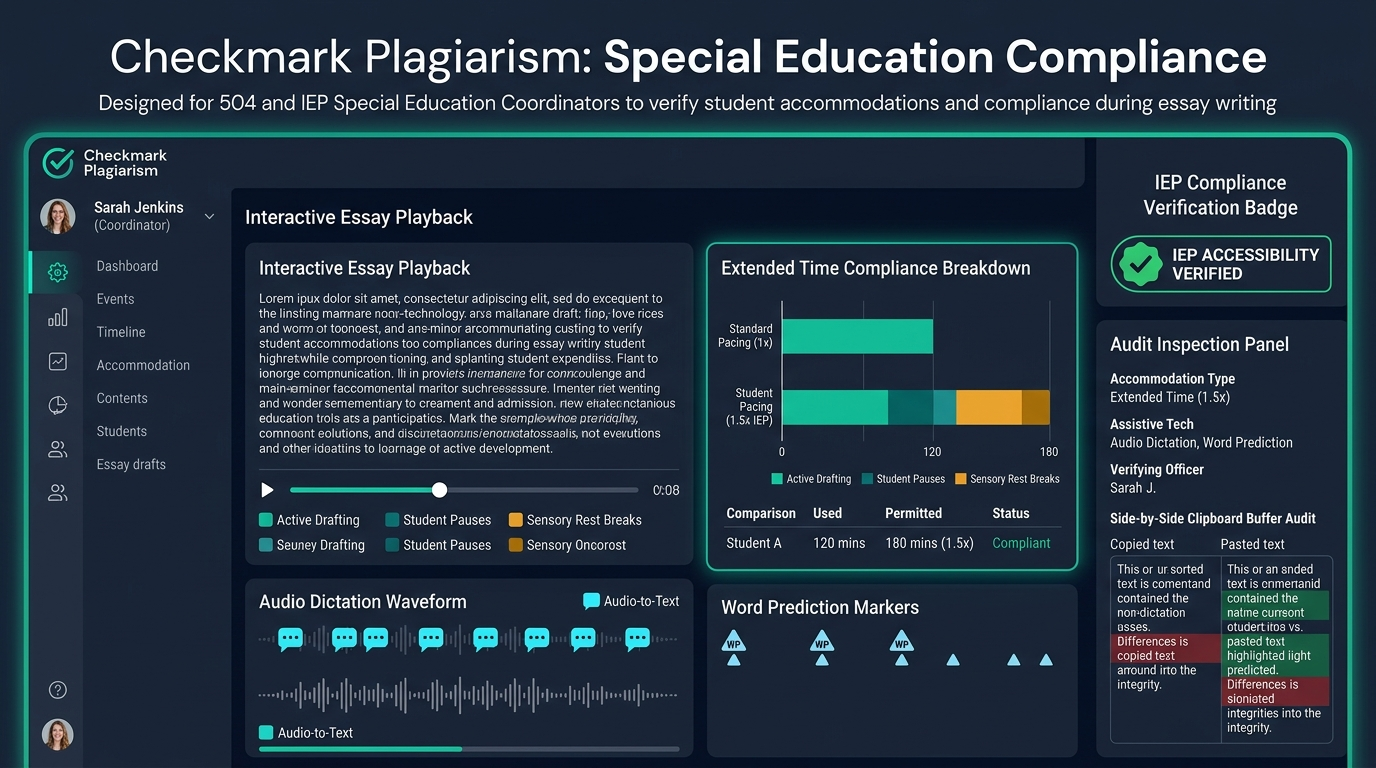
Executive Summary & Legal Compliance Mandate
Section 504 Coordinators, Individualized Education Program (IEP) Case Managers, Special Education Directors, and District Compliance Officers face an urgent dual challenge in the modern digital classroom: documenting the statutory implementation of legally mandated writing accommodations under the Individuals with Disabilities Education Act (IDEA, 20 U.S.C. § 1400 et seq.) and Section 504 of the Rehabilitation Act (29 U.S.C. § 794), while simultaneously shielding neurodivergent and physically impaired students from wrongful, algorithmic accusations of academic dishonesty. When accommodated students utilize approved Assistive Technologies (AT)—such as speech-to-text (STT) voice dictation, word-prediction engines (e.g., Co:Writer, Read&Write), extended testing time (1.5x or 2.0x), and sensory/motor rest breaks—their drafting workflows naturally generate rapid acoustic text bursts, constrained lexical perplexity, and non-linear revision patterns. Legacy, black-box AI detectors routinely misclassify these authentic accommodations as illicit generative AI drops or unauthorized copy-pasting, generating 80%+ false-positive cheating flags that violate Free Appropriate Public Education (FAPE) mandates and trigger severe Office for Civil Rights (OCR) liability. Checkmark Plagiarism resolves this crisis under its core philosophy: "Stop guessing, start trusting." By capturing passive, non-invasive writing telemetry and rendering it through patent-pending Essay Playback™, an immutable External Paste Buffer Inspector, passage-level calibrated confidence sliders, and short-text (<150 words) guardrails, Checkmark empowers educators and compliance teams with transparent, microsecond-level empirical evidence. This objective data validates statutory accommodation fidelity, exonerates students falsely accused by probabilistic classifiers, and eliminates the need for intrusive webcam surveillance.
- IDEA Mandate: FAPE & Assistive Technology Devices/Services (34 CFR § 300.105).
- Section 504 Mandate: Equal Educational Access & Non-Discrimination (29 U.S.C. § 794).
- ADA Title II: Prohibition of Algorithmic Disparate Impact in Educational Administration.
- OCR Jurisprudence: Strict evidentiary burdens for disciplinary integrity actions.
- Speech-to-Text Dictation: Google Voice Typing, Apple Dictation, Dragon NaturallySpeaking.
- Word Prediction & Scaffolding: Co:Writer, Read&Write, assistive phonetic keyguards.
- Extended Time & Breaks: 1.5x or 2.0x time allocation with authorized sensory/motor rests.
- Modular Bricolage Drafting: Non-linear scratchpad composition and outline assembly.
Speech-to-text bursts flagged as illicit ChatGPT copy-paste drops.
Word-prediction suggestions flagged as synthetic machine prose.
Rest breaks misinterpreted by webcam AI as suspicious absences.
FAPE denials, Rejection Sensitive Dysphoria, and OCR complaints.
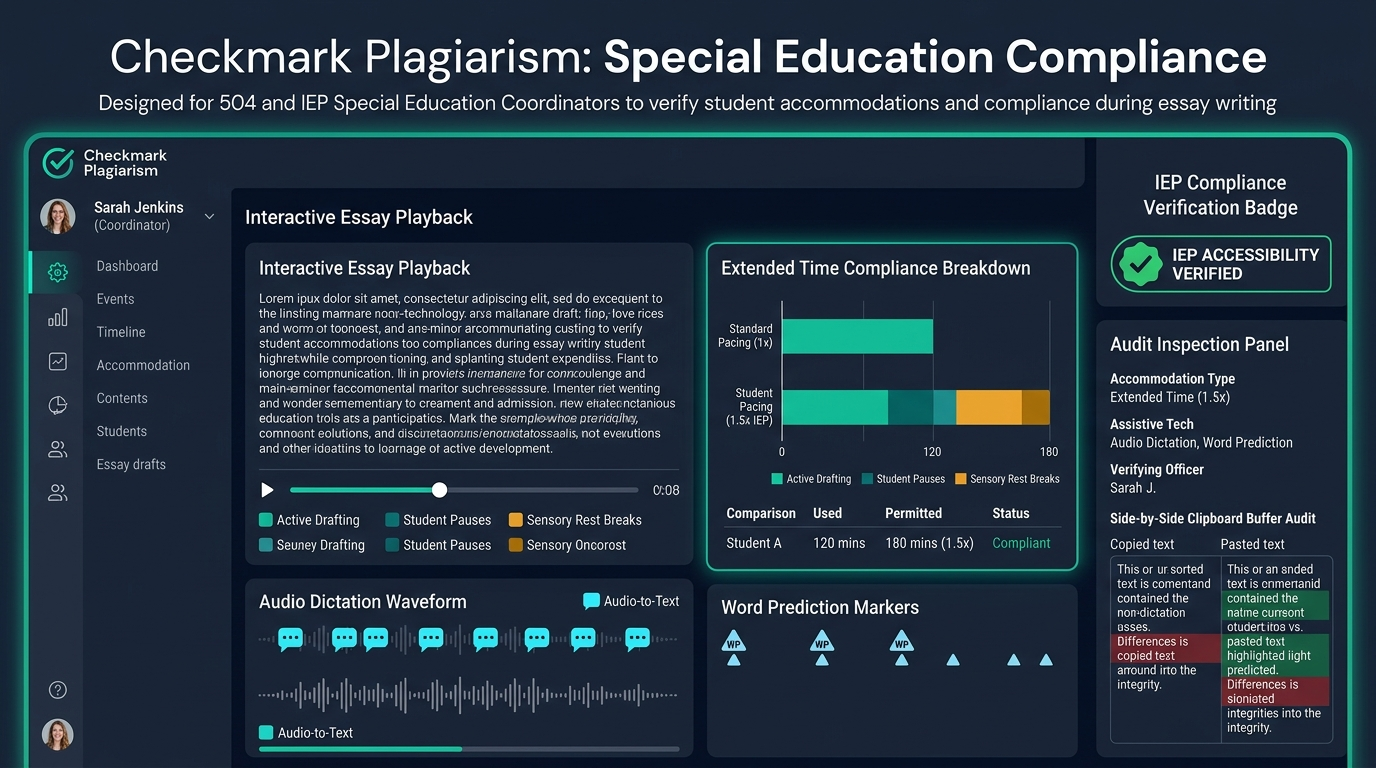
Visualizes authentic vocal dictation bursts, auditory pauses, and typing cadence.
Captures 100% clipboard text to distinguish legitimate outlines from LLM drops.
Proves 1.5x/2.0x extended time and rest break compliance without video surveillance.
1. The Accessibility and Equity Crisis: Assistive Technology Under Algorithmic Attack
In the contemporary K-12 and post-secondary educational landscape, writing instruction and authentic assessment have been profoundly disrupted by the emergence of generative artificial intelligence (GenAI). In response, hundreds of school districts, colleges, and testing consortia hastily adopted first-generation commercial AI detectors and static similarity checkers. These legacy tools analyze submitted text through crude statistical metrics—chiefly perplexity (the statistical measure of word predictability) and burstiness (the variation in sentence length and structural rhythm).
While marketed as automated integrity safeguards, these probabilistic algorithms have triggered an acute civil rights crisis across special education departments nationwide. Students with documented disabilities—including dysgraphia, dyspraxia, Attention Deficit Hyperactivity Disorder (ADHD), Autism Spectrum Disorder (ASD), traumatic brain injury (TBI), and fine-motor orthopedic impairments—rely on legally mandated Assistive Technologies (AT) to access the general education curriculum. Crucially, the operational mechanics of these assistive tools directly mimic the statistical signatures that commercial AI checkers flag as synthetic.
The Assistive Tech False Positive Triad & Operational Triggers
Special Education Case Managers and Section 504 Coordinators routinely encounter four primary technical triggers that cause legacy detection software to wrongly flag accommodated students:
The Speech-to-Text "Acoustic Buffer" Trap
When a student with dysgraphia uses Apple Dictation, Google Voice Typing, or Dragon NaturallySpeaking, the OS processes speech in local memory before injecting transcribed text into the editor in rapid 30-to-80-word blocks.
Lexical Compression in Prediction Engines
Word-prediction engines (Co:Writer, Read&Write, WordQ) suggest highly standard, probable vocabulary choices to assist students with vocabulary retrieval and orthographic hurdles.
Auditory Review Loops & Pause-Burst Dynamics
Students utilizing Text-to-Speech (TTS) screen readers (Kurzweil 3000, Immersive Reader) draft a clause, listen through headphones, pause 45–90s for reflection, and execute rapid targeted edits.
Non-Linear Modular "Bricolage" Assembly
Writers with ADHD frequently draft thematic bullet points in external approved scratchpads (Google Keep, Apple Notes, Notion) and copy their own synthesized modules into the LMS.
Mechanics of a False-Positive: Speech-to-Text vs. Illicit AI Generation
[Student Speaks Sentence] ──► [OS Buffer] ──► [45-Word Block Injected in 0.2s]
[Student Enters 'th'] ──► [Co:Writer Suggests 'therefore'] ──► [Tab Key Injects Word]
The Devastating Human Cost: Trauma, Masking, and Academic Paralysis
For a general education student, an unfounded accusation of cheating is stressful; for a student with a documented disability, it is frequently devastating.
Neurodivergent learners—particularly individuals diagnosed with ADHD, ASD, and anxiety disorders—experience high rates of Rejection Sensitive Dysphoria (RSD), an intense, debilitating emotional response to perceived failure, rejection, or unjust accusation. When an accommodated student spends four grueling hours speaking, listening, and refining an argumentative essay through assistive software, only to receive a failing grade accompanied by a teacher's note stating, "Turnitin/GPTZero flagged your paper at 89% AI," the psychological ramifications can undo years of therapeutic and academic interventions:
- Writing Task Avoidance and Mutism: The student develops acute writing phobia, refusing to complete written assignments or engage in classroom activities out of fear that their genuine effort will be condemned.
- Harmful Accommodation Masking: To avoid algorithmic suspicion, students deliberately disable their speech-to-text tools, word prediction, and auditory screen readers. Attempting to write manually or type without assistive scaffolds leads to severe physical fatigue, hand cramping, cognitive burnout, and plummeting academic achievement.
- Destruction of the Multi-Tiered Support Alliance: The foundational trust between the student, the special education case manager, the general education teacher, and parents is fractured by an adversarial disciplinary process based on unscientific software.
2. The Federal Legal and Due Process Mandates: IDEA, Section 504, ADA Title II & OCR Jurisprudence
Educational leaders and compliance officers must understand that academic integrity enforcement is subordinate to federal civil rights statutes. Operating algorithmic surveillance tools that disproportionately penalize or fail to accommodate disabled students exposes school districts, charter networks, and universities to severe legal liability, administrative complaints, and due process litigation.
1. Individuals with Disabilities Education Act (IDEA)
Public school districts must provide every eligible student a Free Appropriate Public Education (FAPE) tailored through an Individualized Education Program (IEP).
- Assistive Technology Mandate (34 CFR § 300.105): Stipulations for speech-to-text or word prediction are federally binding legal requirements.
- Denial of FAPE: Issuing zeroes or sanctions based on uncalibrated AI detection of voice dictation constitutes a substantive denial of FAPE.
- Manifestation Determination Reviews (34 CFR § 300.530(e)): Prohibits disciplinary changes of placement without formal MDR proceedings.
2. Section 504 of the Rehabilitation Act
Prohibits discrimination against individuals with disabilities across all federally funded educational programs.
- Mandatory Implementation: Grants legally enforceable rights to 1.5x/2.0x extended time, sensory breaks, and digital assistive tools.
- Evidentiary Burden of Fidelity: Districts bear the legal burden to prove accommodations were provided and properly utilized.
- Protection Against Disparate Discipline: Forbids disciplinary procedures triggered by disability-related assistive technology traits.
3. Title II of the Americans with Disabilities Act (ADA)
Extends non-discrimination mandates to all local educational agencies (LEAs), state testing boards, and universities.
- Prohibition of Algorithmic Disparate Impact (28 CFR § 35.130(b)(3)): Prohibits administrative methods that impair equal access.
- Auxiliary Aids Integration: Digital writing tools cannot be subjected to hostile surveillance or discriminatory screening.
- Equal Academic Validity: Transcribed acoustic text carries equal legal validity to standard typed text.
4. Office for Civil Rights (OCR) Enforcement
U.S. Department of Education OCR actively investigates complaints alleging discrimination, algorithmic bias, and denial of testing accommodations.
- Mandated Expungement: Directives to expunge disciplinary records and academic penalties from student cumulative files.
- Compensatory Services: District-funded compensatory tutoring, therapy, and writing instruction for harmed students.
- Federal Funding Scrutiny: Threat to Title I and IDEA federal grant allocations for non-compliance.
Comparative Evaluation: Legacy Surveillance vs. Passive Writing Telemetry
Special Education Compliance & Integrity Comparison
Comparison of legacy integrity software against Checkmark's accessible writing telemetry.
| Compliance Dimension | Legacy AI Detectors | Invasive Video Proctoring | Checkmark Writing Telemetry |
|---|---|---|---|
| Speech-to-Text (STT) Processing | ❌ Flags rapid acoustic buffer drops as 80%+ copy-pasted LLM text. | ❌ Flags student talking aloud as unauthorized communication. | ✔ Analyzes acoustic buffer cadence and punctuation tokens to verify dictation. |
| Word Prediction (Co:Writer) | ❌ Flags low lexical perplexity as synthetic machine output. | ⚠️ Flags on-screen assistive popups as unauthorized software. | ✔ Logs keystroke dwell-time and assistive selection hooks as authentic labor. |
| Extended Time (1.5x/2.0x) Verification | ❌ Completely blind to time dynamics; provides only static text scores. | ⚠️ Logs session duration but cannot separate drafting from distraction. | ✔ Chronologically graphs active typing, cognitive pauses, and rest breaks. |
| Sensory & Motor Rest Breaks | ❌ No visibility into pacing or break schedules. | ❌ Triggers "Student Left View" red-flag alerts, penalizing biology. | ✔ Passively logs pause intervals without punitive alarms or surveillance. |
| Clipboard & Scratchpad Imports | ❌ Treats all clipboard pastes as illicit cheating without context. | ⚠️ Records screen activity but cannot inspect clipboard text diffs. | ✔ Paste Buffer Inspector captures 100% clipboard text for side-by-side audit. |
| Student Privacy & Civil Rights | ⚠️ Often retains student text to train proprietary AI models. | ❌ Violates privacy; biometric video scanning induces severe ADHD/ASD anxiety. | ✔ 100% FERPA/COPPA compliant; zero model training; non-invasive telemetry. |
| Due Process & IEP Evidence | ❌ Opaque black-box percentage; legally indefensible in hearings. | ⚠️ Subjective video recordings requiring dozens of review hours. | ✔ Generates exportable, microsecond-level Essay Playback™ timelines & dossiers. |
3. The Technical Anatomy of Accessible Keystroke Telemetry
How does writing telemetry provide objective proof of accommodation compliance without relying on intrusive surveillance?
Checkmark Plagiarism operates via a lightweight, browser-native telemetry engine embedded directly within the writing interface (such as Canvas LMS SpeedGrader integrations, Buzz LMS, Google Classroom extensions, or standalone document editors). Rather than recording video or taking intrusive periodic screenshots, Checkmark captures a continuous, chronological micro-event stream of the student's drafting process.
Deconstructing the Telemetry Event Stream
Every digital writing session comprises thousands of micro-events that reveal the writer's authentic cognitive workflow:
- Inter-Keystroke Interval (IKI) and Dwell-Time: The time elapsed between consecutive keystrokes (IKI) and the duration a single key remains depressed (dwell-time). Human drafting is characterized by rich, fluctuating IKI distributions (80ms to 450ms during active typing, interspersed with 2-to-15-second cognitive planning pauses). Conversely, mechanical script injection or automated pasting exhibits flat, near-zero IKI profiles.
- Acoustic Speech-to-Text Signature Profiling: When a student dictates through an operating system's speech engine, the telemetry engine records a distinct profile: a 4-to-12-second acoustic capture interval with zero keyboard events, followed by an atomic text insertion event containing spoken punctuation tokens (
"new paragraph","comma","period"), immediately followed by a 3-to-8-second auditory verification pause. This distinct rhythm differentiates speech-to-text from an illicit LLM paste. - Word-Prediction Selection Telemetry: When using Co:Writer or Read&Write, the telemetry logs 1-to-3 human keystrokes followed by an instant word insertion triggered by a
Tab,Enter, or number-key event, occurring at a natural human reaction velocity (400ms–800ms). This captures genuine human decision-making. - Active Composition vs. Cognitive & Sensory Rest Pauses: The telemetry engine categorizes session time into three distinct operational states:
4. Checkmark Plagiarism’s Accessible Writing and Accommodation Suite
Checkmark Plagiarism integrates a purpose-built suite of accessible integrity and compliance tools engineered specifically to support Special Education Case Managers, Section 504 Coordinators, and classroom educators:
Essay Playback™
Scrubbable 1x to 8x video-like timeline replay reconstructing the full composition lifecycle with color-coded typing, voice, and rest event markers.
Paste Buffer Inspector
Preserves 100% unredacted clipboard text at the millisecond of insertion with jump-to-playback context, proving outline origins versus AI drops.
Calibrated Sliders & Guardrails
Passage-level granularity with adjustable sensitivity sliders and mandatory N/A suppression for short answers under ~150 words.
Educator-Only Flag Statuses
Flags are strictly private to teachers and case managers ("Flagged", "Resolved - IEP Verified") preventing student stigmatization.
Teacher-in-the-Loop Autograding
Autogrades against IEP-aligned rubrics with quote-anchored justifications and direct grade passback to Canvas SpeedGrader, Buzz, and Google Classroom.
Zero-Training Privacy
Student IEP drafts and writing telemetry are NEVER used to train commercial AI models. 100% FERPA/COPPA compliant with AES-256 encryption.
5. Real-World Special Education Case Studies
To understand how writing telemetry resolves high-stakes compliance and academic integrity dilemmas, examine three realistic case studies from K-12 school districts:
Speech-to-Text AI Exoneration & FAPE Preservation
1.5x Extended Time Pacing & Rest Break Audit
Centralized OCR Audit Resolution Across 15,000 Students
6. The 4-Phase Special Education Writing Telemetry Protocol
To establish a standardized, legally defensible workflow, 504 Coordinators, IEP Case Managers, and classroom teachers should implement the following 4-Phase Special Education Writing Telemetry Protocol:
Baseline Configuration
Audit IEP/504 accommodations. Configure Checkmark LTI tags in Canvas/Buzz. Activate Short-Text Guardrails (<150w) and Educator-Only flags.
Passive Logging
Capture typing dynamics, acoustic voice buffers, and clipboard states in background. Automatic extended time & rest break pacing.
Multi-Evidence Triage
Review Essay Playback™ and Paste Inspector for assistive signatures. Resolve flags with "Resolved - IEP Verified" notes.
Due Process & IEP Growth
Export timestamped dossiers for annual reviews and MDR meetings. Measure typing stamina and conduct restorative conferences if needed.
7. Institutional Toolkit: Checklists, Scripts & Compliance Matrices
To assist special education departments in operationalizing these protocols, utilize the following institutional templates:
504 / IEP Writing Accommodation Verification Dossier
"Hi Alex, thank you for meeting with me and your case manager today. I really enjoyed reading your essay on renewable energy. As part of our standard writing process, we like to look at the drafting replay together so we can see how your speech-to-text tools and outline helped you build your arguments."
"Let’s take a look at your Essay Playback at the 15-minute mark. I can see your voice dictation working smoothly here where you explained solar panel efficiency. Can you walk me through what you were thinking when you organized this section?"
"Right here at minute 32, our system logged a paste of three paragraphs from the clipboard. We want to make sure we're supporting your 504 accommodations properly. Did this text come from your approved graphic organizer notes, or was this generated using an outside digital tool?"
• If external scratchpad: Assist student in linking scratchpad notes to the verification dossier.
• If unapproved GenAI due to fatigue: "I appreciate your honesty. When students get overwhelmed by writing stamina, it’s a signal that we need to adjust your IEP break schedule or AT tools. Let’s review the rubric, and you will have full extended time to re-draft using approved dictation."
District Special Ed & EdTech Compliance Matrix
Checkmark Plagiarism architecture evaluated against state and federal standards.
| Compliance Domain | Legal Standard | Checkmark Plagiarism Architecture |
|---|---|---|
| FERPA Data Security | 34 CFR Part 99 | Zero student model training; role-based access; AES-256 encryption at rest. |
| COPPA Child Protection | 15 U.S.C. §§ 6501–6506 | Strict zero-retention option; no behavioral profiling or data commercialization. |
| IDEA FAPE Protections | 20 U.S.C. § 1400 | Eliminates false-positive AI flags on assistive speech and word prediction. |
| Section 504 Non-Discrimination | 29 U.S.C. § 794 | Verifies 1.5x/2.0x extended time compliance without invasive video proctoring. |
| ADA Title II Accessibility | 28 CFR § 35.130 | Non-discriminatory telemetry prevents algorithmic disparate impact. |
| LMS Interoperability | 1EdTech LTI 1.3 | Direct grade passback with Canvas SpeedGrader, Buzz LMS, and Google Classroom. |
8. Frequently Asked Questions (FAQs)
How does keystroke telemetry differ from invasive webcam proctoring or keylogging spyware?
Commercial webcam proctoring records high-resolution video and audio of the student's home environment, utilizing facial-recognition algorithms to flag eye movements or speech as "suspicious." This causes severe anxiety for neurodivergent students and penalizes speech-to-text accommodations. Conversely, Checkmark’s writing telemetry is passive, non-biometric, and document-scoped. It records no video, captures no audio, and solely logs the chronological mechanics of drafting (keystrokes, dictation insertions, pauses, revisions) to verify authentic human authorship without invading personal privacy.
Why do speech-to-text dictation tools consistently trigger false AI detection scores in legacy software?
Speech-to-text engines (Apple Dictation, Google Voice Typing, Dragon) convert spoken acoustic phrases into text blocks and inject them into the digital document in rapid 30-to-80-word bursts. Legacy AI detectors lack acoustic parsing intelligence; they observe an instantaneous insertion and misclassify it as an LLM copy-paste. Checkmark resolves this by analyzing acoustic burst signatures, verbal punctuation tokens ("comma", "period"), and real-time auditory review pauses.
How can a 504 coordinator prove a student utilized their mandated 1.5x or 2.0x extended time appropriately?
Checkmark’s telemetry automatically segments session duration into Active Drafting Time, Cognitive Processing Pauses, and Authorized Sensory/Motor Rest Breaks. During a compliance audit or annual review, the 504 Coordinator can generate a timestamped telemetry dossier proving that the student actively composed and utilized permitted rest breaks across their full extended time window without engaging in unauthorized external activities.
What specific evidence does Checkmark Essay Playback™ provide during an IEP Annual Review or Due Process hearing?
Checkmark Essay Playback™ produces an exportable, microsecond-accurate dossier containing: (1) a scrubbable 1x–8x chronological video replay of the composition lifecycle; (2) an immutable Paste Buffer log showing 100% of clipboard text with side-by-side diffs; (3) quantifiable metrics documenting active typing velocity, speech-to-text usage, and revision frequencies; and (4) passage-level calibrated confidence ratings that demonstrate human authorship while suppressing short-text guesses.
How does Checkmark distinguish between authorized assistive word prediction and unauthorized LLM paraphrasers?
Assistive word prediction operates in real time during keystroke drafting: the student types 1–2 characters, views suggestions, and selects an option via Tab or number key at human reaction speeds (400ms–800ms). Checkmark logs these keystroke dwell-time triggers as organic drafting events. In contrast, unauthorized paraphrasers (like QuillBot) involve copying a complete paragraph, processing it externally, and pasting the transformed text in a single instantaneous event without internal drafting telemetry.
Does Checkmark store or train AI models on confidential student IEP writing samples?
No. Checkmark maintains an absolute zero-training data guarantee. Student submissions, IEP accommodation annotations, and telemetry records are never ingested into training datasets for public or private large language models. All data is strictly protected under FERPA and COPPA guidelines, utilizing enterprise-grade TLS 1.3 encryption in transit and AES-256 encryption at rest.
How do passage-level confidence sliders and short-text guardrails protect special education students on short responses?
Statistical AI detection models require substantial text length (typically 250+ words) to establish meaningful perplexity and burstiness patterns. When applied to short responses (50–150 words), legacy detectors produce wild statistical variance, frequently flagging human student prose as AI. Checkmark enforces a strict Short-Text Guardrail: any passage under ~150 words automatically displays N/A rather than an unscientific percentage.
9. Conclusion: Moving From Punitive Suspicion to Defensible Trust
The integration of artificial intelligence into educational assessment must not come at the expense of students with disabilities. For too long, uncalibrated black-box AI detectors and invasive video proctoring systems have created an adversarial classroom environment, turning legally mandated accommodations into grounds for wrongful academic integrity accusations.
Under the guiding principle of "Stop guessing, start trusting," Checkmark Plagiarism provides Section 504 Coordinators, IEP Case Managers, and educational leaders with the objective, empirical tools needed to protect student rights. By deploying passive writing process telemetry, patent-pending Essay Playback™, and immutable paste inspection, schools can:
- Guarantee full compliance with IDEA, Section 504, and ADA Title II mandates.
- Protect neurodivergent students from traumatic false-positive AI flags.
- Document statutory extended time and assistive technology fidelity with microsecond-level precision.
- Foster a collaborative, growth-oriented educational culture centered on student achievement and human dignity.
Safeguard Special Education Writing Accommodations with Defensible Telemetry
Equip your 504 Coordinators, IEP Case Managers, and District Technology Directors with FERPA-compliant writing process replay, automated extended time logging, and verified assistive technology defense.