
No. Manually retyping a ChatGPT response keystroke-by-keystroke does not make it undetectable—it remains immediately detectable through both linguistic AI analysis and behavioral keystroke process tracking.
A growing trend among students trying to bypass AI detectors and "paste detection" is opening ChatGPT on a phone or split-screen and manually typing every word into Google Docs or Canvas. Students assume that because they physically pressed the keys, the document will appear as authentic human writing. In reality, this technique fails on two distinct forensic levels: the textual layer still contains synthetic AI language markers, while the process layer records an unnatural transcription rhythm.
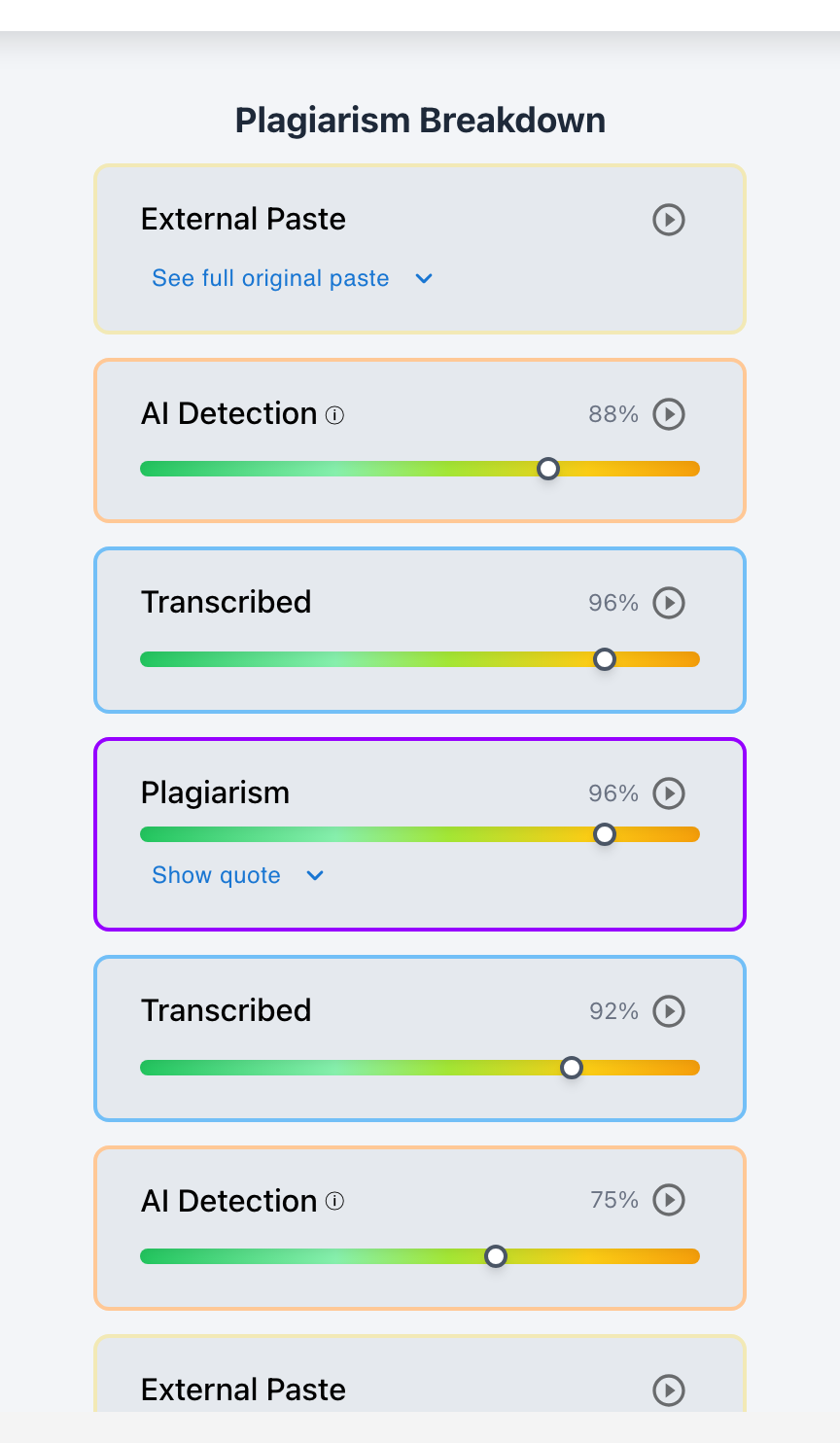
Through Checkmark Plagiarism's Dual AI + Process Analysis, retyped AI text is identified through overlapping linguistic and behavioral signals.
Checkmark Plagiarism powers dual verification by pairing essay writing playback with AI detection, plagiarism detection, autograding, and integrations with Canvas and Google Classroom.
The Dual Traps of Retyping ChatGPT Output
Trap 1: The Linguistic AI Profile
Typing words by hand does not change their statistical probability. The text still exhibits flat perplexity, low burstiness, signature AI cliches ("delve," "tapestry"), and hallucinated citations.
Trap 2: The Transcription Keystroke Rhythm
Manual transcription generates an unnatural gaze-shift typing cadence (bursts of 5 words separated by 2-second reading pauses) with near-zero backspacing and zero structural revisions.
How Checkmark AI + Process Analysis Uncovers Retyped AI
When an instructor reviews a submission in Checkmark Plagiarism, the system combines two independent detection engines:
- Static AI Neural Engine: Evaluates word transition probabilities across the essay, identifying synthetic language structures with 99%+ accuracy regardless of keyboard input method.
- Essay Playback Keystroke Analytics: Proves that the student typed in an unbroken, linear fashion from introduction to conclusion without ever pausing to formulate a thesis or restructuring a paragraph.
- Citation Database Auditing: Instantly cross-checks cited sources in JSTOR and Google Scholar, exposing phantom DOIs and hallucinated authors generated by ChatGPT.
Read more in how Checkmark writing process analysis works.
Comparison: Authentic Composition vs. Retyping ChatGPT vs. Pasting ChatGPT
Authentic Composition
- 0% AI probability score.
- Natural thinking pauses (10–60s).
- 20%+ backspace/revision rate.
- Verified, real academic citations.
Retyping ChatGPT
- 95%+ AI probability score.
- Gaze-shift pause cadence.
- <2% backspace/revision rate.
- Hallucinated AI citations.
Pasting ChatGPT
- 99%+ AI probability score.
- Instant 1-second paste flag.
- 0 minutes active typing.
- Hallucinated AI citations.
A 5-Step Educator Protocol for Investigating Retyped AI
Educator Retyped AI Investigation Checklist:
- 1. Check the Checkmark AI Detection score: high probability flags synthetic syntax.
- 2. Review the Essay Playback video replay: check for linear transcription cadences.
- 3. Note the absence of backspacing, clause deletions, and structural reorganization.
- 4. Audit 2–3 cited bibliography sources in Google Scholar for hallucinations.
- 5. Hold a 2-minute conference asking the student to explain and defend their thesis orally.
How Checkmark Plagiarism Powers AI + Process Analysis
Checkmark Plagiarism combines **AI detection, essay writing playback, static AI detection, plagiarism detection, autograding, and Canvas/Google Classroom integrations** to ensure that retyping ChatGPT text is caught through multiple corroborating forensic signals.
Frequently Asked Questions
Does retyping ChatGPT's output bypass AI detectors?
No. AI detectors evaluate the vocabulary and sentence structures on the page. Retyping does not change the mathematical predictability or cliches of AI text.
Can teachers tell if I typed ChatGPT text by hand?
Yes. The AI detector flags the language patterns, while writing playback shows unnatural linear typing with near-zero backspacing or revisions.
What if I retype ChatGPT and change a few words?
Checkmark's AI engine detects statistical perplexity across whole paragraphs, and playback logs still show linear transcription with minimal localized edits.
Why do students retype ChatGPT text?
Students mistakenly believe detectors only look for paste events, not realizing that text analysis and keystroke cadence analysis operate simultaneously.
What is a normal student backspace rate?
Authentic student writing typically exhibits a 15% to 30% backspace/edit rate as thoughts are refined. Retyping AI text results in backspace rates below 2%.
How does writing playback prove an essay was copied from ChatGPT?
Playback shows continuous linear typing from start to finish without brainstorming pauses, deleted sentences, or structural reorganization.
What should a teacher do if a student retyped ChatGPT text?
Share the high AI score, hallucinated citations, and linear playback timeline during an objective academic integrity conference.
How does Checkmark Plagiarism integrate with Canvas LMS?
Checkmark Plagiarism displays visual writing playback timelines, cadence metrics, and AI probability heatmaps directly inside Canvas SpeedGrader.
Does transcription detection protect honest students?
Yes. Honest students show authentic drafting rhythms with natural pauses and revisions, protecting them from false accusations.
Why is retyping ChatGPT worse than writing the essay?
It takes hours of tedious typing without learning the material, while still resulting in immediate detection and academic penalties.
Authentic Effort Outshines Algorithmic Shortcuts
Manually typing machine-generated words cannot replace human intellect. By combining AI neural detection with keystroke process analytics, Checkmark Plagiarism provides educators with the multi-signal evidence needed to uphold academic rigor with total confidence.
Checkmark Plagiarism supports this comprehensive approach with AI detection, essay writing playback, static AI detection, plagiarism detection, autograding, and integrations with Canvas and Google Classroom.
See how Checkmark pairs essay writing playback with multi-signal detection to catch retyped ChatGPT responses inside your LMS. View a sample report or request a demonstration.