
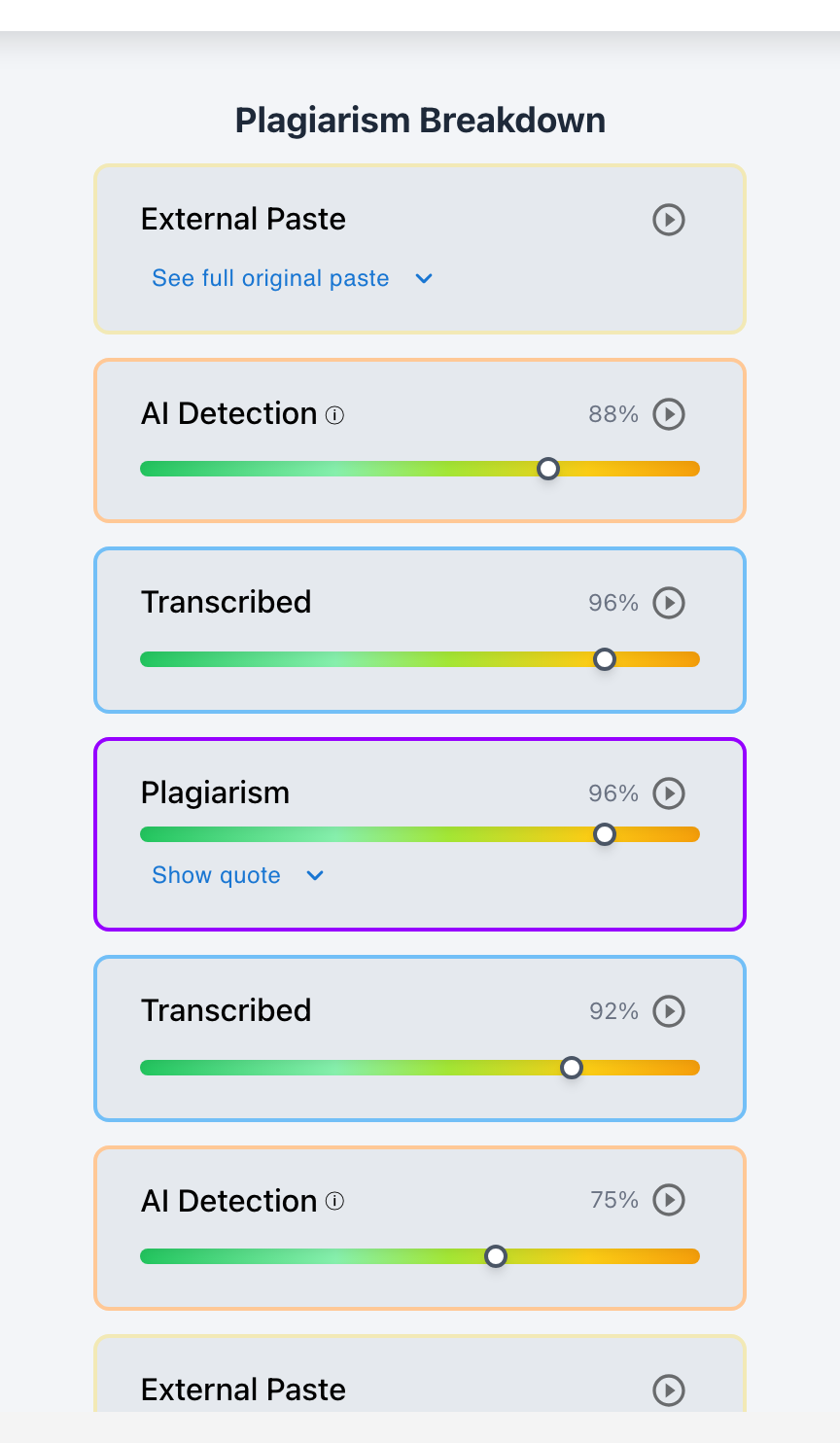
No. Manually typing ChatGPT's output does NOT make AI detection impossible. Retyping only evades simple clipboard paste tracking—it has zero effect on linguistic AI classifiers (which evaluate the statistical perplexity of the words themselves) and simultaneously creates a glaring robotic transcription signature in keystroke history.
On social media platforms like TikTok and Reddit, a widespread student myth claims: "AI detectors only look for copy-paste events; if you type ChatGPT word-for-word, it's 100% undetectable." This advice is fundamentally flawed. Static AI detectors analyze the mathematical probabilities of vocabulary arrangements on the submitted document—regardless of whether they were typed, pasted, or dictated. Furthermore, manually typing someone else's text produces an unmistakable transcription keystroke pattern that Checkmark Plagiarism flags instantly.
Below is a detailed analysis debunking the manual typing myth and explaining how modern integrity platforms catch transcribed AI.
Checkmark Plagiarism busts AI evasion myths by pairing AI detection with essay writing playback, plagiarism detection, autograding, and integrations with Canvas and Google Classroom.
The 4 Flaws in the "Manual Typing" Evasion Strategy
1. Linguistic Perplexity Remains Low
AI detectors evaluate word relationships. Typing ChatGPT's exact phrases produces the same low perplexity and synthetic syntax scores as a direct paste.
2. Creates a Transcription Keystroke Trap
Typing text from a phone screen produces a continuous, flat 70+ WPM typing speed with <2% backspaces and zero cognitive pauses—a dead giveaway of copying.
3. The Vocabulary-to-Time Disparity
Composing 1,500 words of complex rhetorical prose in 20 minutes with zero edits contradicts the biological limits of human cognitive composition.
4. Total Failure in Oral Conferences
Students who transcribe AI text focus on striking keys rather than understanding content—collapsing when asked to define words or explain their thesis orally.
Why Static Detectors Don't Care How Text Was Entered
Understanding the difference between input method and textual analysis:
- Input-Agnostic Classification: AI classifiers examine the finished string of characters submitted to Canvas. The software does not check whether "multifaceted tapestry" was pasted or typed; it evaluates the mathematical likelihood of that phrase appearing in that context.
- Syntactic Burstiness: Human writers naturally vary sentence lengths (mixing 4-word punches with 30-word compound structures). AI generates uniform sentence rhythms that remain identical when retyped.
- Multi-Signal Synergy: When Checkmark combines a 90% AI linguistic score with a 20-minute unedited typing history, the case for academic misconduct is 100% conclusive.
Read more in how Checkmark writing process analysis works.
Comparison: The Student Myth vs. Technical Reality
The Student Myth (TikTok/Reddit Advice)
- "AI detectors only flag clipboard copy-paste."
- "If you type it out, it looks 100% human."
- "Typing slowly beats the software."
- "Teachers can never prove anything if you typed it."
Technical Reality (Checkmark Multi-Signal)
- AI classifiers analyze words, not clipboard history.
- Retyping leaves an unnatural transcription footprint.
- Zero backspaces and uniform pauses expose the shortcut.
- 2-minute oral check-in confirms lack of authorship.
A 5-Step Educator Protocol for Debunking Retyped AI
Retyped AI Investigation Checklist:
- 1. Open the student's submission in Checkmark Playback inside Canvas SpeedGrader.
- 2. Review the AI Probability Score: verify if neural classifiers flag synthetic vocabulary.
- 3. Inspect the Deletion Rate metric: note whether backspaces are below 3%.
- 4. Check the Total Active Typing Time: verify if 1,200+ words were typed in under 25 minutes.
- 5. Hold a 2-minute oral defense: ask the student to explain the thesis and define complex terms.
How Checkmark Plagiarism Powers Evasion-Proof Integrity
Checkmark Plagiarism combines **AI detection, essay writing playback, static AI detection, plagiarism detection, autograding, and Canvas/Google Classroom integrations** to render manual AI transcription completely transparent.
Frequently Asked Questions
Why do students think retyping ChatGPT makes it undetectable?
Because early AI discussions focused on copy-paste detection, leading students to believe that physical keyboard typing was an unbreakable loophole.
Can an AI detector tell the difference between typed text and pasted text?
Static detectors evaluate text alone, but Checkmark combines AI detection with keystroke playback to analyze both text structure and typing behavior.
What is a transcription cadence in typing history?
It is a flat, robotic typing speed (65–85 WPM) with zero thinking pauses between complex sentences and a sub-2% backspace rate.
How does Checkmark detect typed AI writing?
Checkmark correlates high linguistic AI probability scores with transcription speed anomalies and zero revision depth in Essay Playback.
Can a student beat detection by typing AI text slowly?
Even if typed slowly, the text retains its low perplexity AI patterns, while the lack of character deletions and natural pauses still exposes transcription.
How does Checkmark Plagiarism integrate with Canvas LMS?
Checkmark provides certified LTI 1.3 integration, SpeedGrader sidebar embeds, two-way grade passback, and single sign-on (SSO).
What should a teacher do if a student denies using AI?
Review the combined AI probability heatmap and 15-second typing playback replay together in a non-adversarial conference.
Why do authentic student writers have high backspace rates?
Because authentic thinking involves trial, error, and self-editing—producing an average of 15% to 30% character deletions during composition.
Does transcription detection work on Google Docs?
Yes. Checkmark extracts revision history metadata and keystroke timelines seamlessly from Google Docs and Canvas submissions.
Why is multi-signal proof essential for academic integrity?
Because combining linguistic AI scores with keystroke writing process forensics creates an airtight, defensible case for student due process.
No Loopholes in Authentic Learning
Academic integrity is about genuine intellectual effort, not clever evasion tricks. By pairing linguistic AI detection with keystroke process analytics in Checkmark Plagiarism, educators ensure that student writing is evaluated with absolute fairness, accuracy, and truth.
Checkmark Plagiarism supports this comprehensive approach with AI detection, essay writing playback, static AI detection, plagiarism detection, autograding, and integrations with Canvas and Google Classroom.
See how Checkmark pairs linguistic AI detection with keystroke telemetry to catch manually typed AI text. View a sample report or request a demonstration.